REVIEW 3 major objections 3 minor 31 references
The Shape of Information: Global Information Geometric Limits in Multi-task Quantum Systems
T0 review · 3 major / 3 minor · reviewed 2026-08-03 · deepseek-v4-flash
Pith's one-line read One matrix sets the ceiling on multi-task quantum capacity.
desk verdict New g-QFIM bound for multi-task quantum systems is clean but rests on an unproved one-dimensional lemma; needs referee scrutiny. read the letter →
The pith
A machine-rendered reading of the paper's core claim, the machinery that carries it, and where it could break.
The reading
What carries the argument
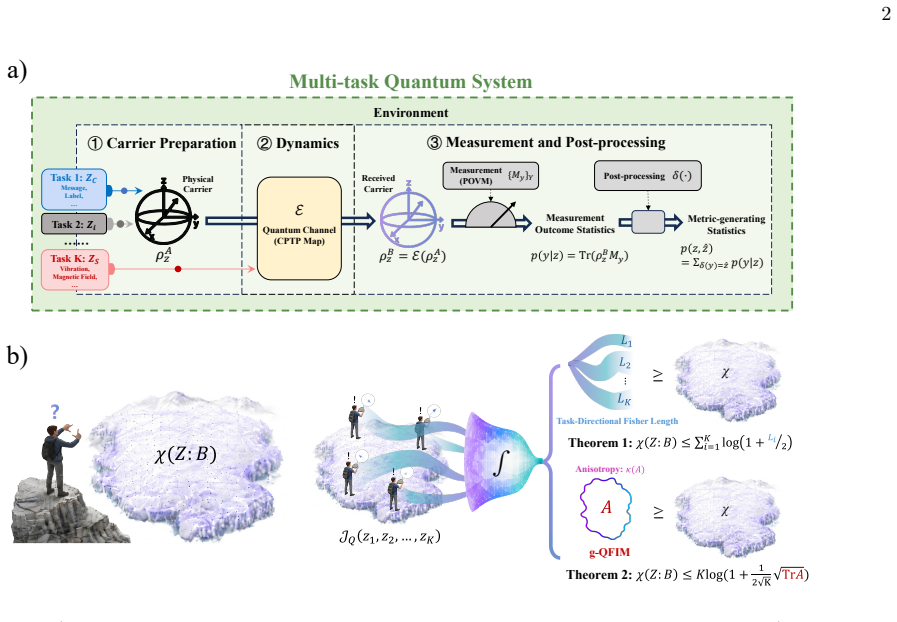
The global quantum Fisher information matrix (g-QFIM), A = ∫ R(φ) J̃_Q(φ) R(φ) dφ over the normalized task-variable cube, where R is a diagonal matrix of prior weights. It aggregates the local quantum Fisher information of the received state family into a single positive-semidefinite matrix whose trace bounds total capacity and whose spectrum determines how information is distributed: det(A) measures the independent information volume and κ(A) measures anisotropy between task directions. The proof machinery also uses one-dimensional directional Fisher lengths L_i, Jensen inequalities, and a classical-register extension to reduce the multi-task Holevo information to single-parameter bounds.
What would settle it
Compute the exact Holevo information for the two-mode phase-encoding ensemble of Eq. (11) at resource values around N = 2/3 by optimizing over POVMs, and compare with the trace bound: any violation of χ ≤ 2 log(1 + (1/(2√2))√TrA) would refute Theorem 2. Similarly, testing Lemma 1 on a one-parameter state family with a discontinuous prior (for instance uniform on [0, 2π]) would settle whether the unproved one-dimensional bound actually holds.
Extended reading notes
Core claim
The central result is Theorem 2: for K independent tasks encoded in a quantum state, the joint Holevo information satisfies χ(Z1,...,ZK:B) ≤ K log(1 + (1/(2√K))√TrA), where A is the prior-weighted integral of the quantum Fisher information matrix over the task-variable space. Theorem 1 gives a sharper, separable bound in terms of task-directional Fisher lengths L_i. The same object A is then interpreted through det(A) as the system's independent multi-task capability and through κ(A) as its allocability; when extra resources make det(A) decrease while κ(A) grows, the information geometry becomes anisotropic and information concentrates into fewer collective modes. The paper demonstrates this
Load-bearing premise
The main proofs reduce to a one-dimensional finite-support Holevo–QFI inequality stated without proof in Appendix B (Lemma 1); if that lemma fails for Holevo information or for the non-smooth finite-support priors the paper allows, both core bounds collapse, and the phase-transition claim is demonstrated only for a specific two-mode model with a uniform 2π prior.
Editorial extensions
If this is right
- Multi-task capacity is not additive: sharing one carrier across K tasks tightens the ceiling because the bound scales as K log(1 + (1/(2√K))√TrA).
- There is an optimal resource point where det(A) is maximal; beyond it, extra physical resources stop increasing independent task capacity and instead flow into a collective mode (the paper identifies N = 2/3 for its photonic model).
- Different noise mechanisms leave distinct fingerprints: attenuation primarily shrinks total capacity, phase diffusion shrinks capacity while leaving allocability relatively intact, and mode crosstalk mainly destroys allocability by making the information geometry anisotropic.
- The framework gives a measurement-independent criterion for designing integrated sensing-and-communication systems, including the possibility of deliberately hiding certain parameter directions for privacy or selective visibility.
Reading between the lines
- A testable extension: for Gaussian or coherent-state ensembles the same trace bound should be comparable with exact Holevo capacities, and one could search for the extremal state family that saturates the inequality.
- The 'structural phase transition' is exhibited in a two-mode toy model; whether it sharpens into a genuine critical phenomenon as the number of modes and the resource budget grow is a question the paper leaves open.
- The bound suggests a design rule the paper does not state explicitly: allocate physical resources so that the g-QFIM spectrum is as isotropic as possible, because anisotropy κ(A) is what wastes independent task capacity.
- The same geometry likely extends to classical multi-antenna or classical ISAC systems, where an analogous Fisher-information matrix would play the role of A, connecting the quantum result to a broader capacity-region picture.
Editorial analysis
A structured set of objections, weighed in public.
Referee Report
Summary. The manuscript introduces a 'global quantum Fisher information matrix' (g-QFIM) and uses it to bound the Holevo information of a multi-task quantum ensemble. For K independent scalar tasks with product priors, it derives a separable capacity bound (Theorem 1) and a trace-based capacity bound (Theorem 2), with extensions to correlated priors and arbitrary K in the appendices. The authors illustrate the framework with a two-mode vacuum-single-photon phase-encoding model, claiming a structural phase transition at N=2/3, and they simulate attenuation, phase diffusion, and mode crosstalk to show how noise reshapes the geometry. The main theoretical results are presented as non-asymptotic, measurement-independent upper bounds on the Holevo information.
Significance. If the main theorems are correct, the manuscript provides compact, calculation-friendly, measurement-independent ceilings for multi-task quantum information and an interpretable geometric diagnostic (det A and κ(A)) for information allocation. The appendices give transparent chain-rule and Jensen-based derivations with no fitted parameters, which is a strength. However, the entire proof rests on the unproved one-dimensional Lemma 1, and the phase-transition claim goes beyond what the theorems establish. The numerical 'confirmation' also currently compares only QFIM-derived quantities, not the actual Holevo information under noise. With a proof or precise citation for Lemma 1, the framework could be a useful contribution to quantum ISAC and multi-task quantum networks.
major comments (3)
- [Appendix B, Lemma 1] Lemma 1 is the load-bearing foundation for Theorems 1, 2, 5, and 6, but it is stated without proof and without a precise theorem number or statement from [29]. The hypothesis 'prior support contained in a finite interval' is too weak as written: for a prior with atoms, the integral ∫√F dθ does not see the point masses, and the bound needs explicit regularity conditions. More importantly, the standard data-processing route controls only the accessible information sup_M I(Θ;Y), not the Holevo information χ of the ensemble. Since Lemma 1 is applied directly to χ in Eqs. (27), (32), (58), and (95), the authors must either supply a self-contained proof or cite the exact theorem from [29] and state explicitly that it applies to Holevo information, not merely to accessible information. If the lemma holds only for the accessible information, the main theorems collapse.
- [Results and 'General systems' criterion] The claimed 'structural phase transition' is not a consequence of Theorems 1–2. The criterion ∂det A/∂N=0, ∂²det A/∂N²<0, ∂κ(A)/∂N>0 is introduced ad hoc, and the specific value N=2/3 is an exact property of the symmetric toy model (η=1/2, W=2π), as can be seen from χ_true=H(1−N,N/2,N/2). The theorems only give upper bounds; they do not imply that det(A) or κ(A) determines the true capacity. The abstract's language 'reveal a structural phase transition' overstates the generality. Please either derive the criterion from the bounds or explicitly present it as a model-based observation with clear limitations.
- [Non-ideal effect models and Figures 3–5] The numerical 'confirmation' under noise does not directly validate the theorems. The figures plot the task-budget curves (L1,L2) and the QFIM diagnostics det(A) and κ(A), but they do not compute or compare the actual Holevo information χ for the noisy channels. No error bars, confidence intervals, or Monte Carlo averaging are reported, and the 'realistic noise channels' are simple state-level ansätze. The statement that simulations 'confirm these predictions' is therefore not supported. Please either provide a direct comparison of the bound to χ under noise, or rephrase the claim as an illustrative demonstration.
minor comments (3)
- [Figure captions] Figure 4 and Figure 5 are both captioned 'Tradeoff curve family under attenuation,' but the text describes phase diffusion and crosstalk, respectively. The captions should be corrected.
- [Theorem 1 statement] The main-text Theorem 1 states K=2, while the general-K result is relegated to Appendix E. Please clarify in the main text that the general case is in the appendix, and unify the notation for K=2 and K>2.
- [Figures and axis labels] Several axis labels and quantities in Figures 2–5 are garbled or missing units (e.g., 'Information (nats)'), and the extracted figure text contains encoding artifacts. Please provide clean, legible figures.
Circularity Check
No significant circularity: the claimed bounds follow from an external one-dimensional Fisher-information lemma via Jensen/Cauchy–Schwarz, and the g-QFIM is defined from the QFIM, not from the Holevo quantity; the phase transition is checked against an independently computed exact Holevo entropy.
full rationale
The derivation chain is self-contained modulo an external lemma. Theorem 1 (Eq. 4) follows from the Holevo chain rule (Eq. 24), Lemma 1 (Eq. 26), QFI monotonicity under CPTP maps (Eq. 29), and the block-diagonal classical–quantum QFI identity (Eq. 30); these are stated inputs, not reformulations of the conclusion. Lemma 1 is attributed to ref. [29] (Górecki et al.), whose authors do not overlap with this paper, so no self-citation chain is load-bearing. Theorem 2 (Eq. 7) is obtained from Theorem 1 by Jensen and Cauchy–Schwarz in Appendix C, with A defined in Eq. (8) directly from J_Q and prior weights; A's diagonal entries equal ∫F_i dφ_i by construction, but that is a definition of an intermediate quantity, not a fit to χ. The correlated-prior and K-task extensions in Appendices D and E use the same one-dimensional bound plus Jensen, and are not circular. The numerical 'phase transition' is also not circular: χtrue is computed exactly as S(ρ̄)=H(1−N,nH,nV) in Eq. (13), while det(A) and κ(A) are computed from the QFIM in Eq. (12), so the comparison is an independent check. No fitted parameters appear anywhere in the derivation. Flagged per the reviewing rule: Appendix B's Lemma 1 is stated without proof and is load-bearing for both theorems; this is an omitted-proof/correctness risk (e.g., whether the cited inequality controls Holevo χ rather than accessible information, and the atomic-prior caveat), but it is not a circularity because the bound reduces to an external published inequality, not to the claimed conclusion. The paper's own conclusion also admits that tightness and achievability need further discussion, which is consistent with a non-circular but conditional derivation.
Assumptions & free parameters
assumptions (5)
- domain assumption Lemma 1: one-dimensional finite-support Holevo–QFI bound χ ≤ log(1 + (1/2)∫√F dθ)
- domain assumption State family is differentiable and QFIM J_Q exists via SLD for all parameters in the prior support
- domain assumption Product prior for independent tasks (main theorems); extended to correlated priors in Appendix D with finite mutual information
- ad hoc to paper The optimal resource point is identified by ∂det A/∂N=0, ∂²det A/∂N²<0, ∂κ/∂N>0
- ad hoc to paper The two-mode vacuum-single-photon model and uniform 2π phase prior faithfully represent multi-task quantum systems
Cite this review
Pith. "Pith review of The Shape of Information: Global Information Geometric Limits in Multi-task Quantum Systems." pith.science (2026). https://pith.science/paper/GT3UA75N
@misc{pith2026260728961,
  author       = {Pith},
  title        = {Pith review of: The Shape of Information: Global Information Geometric Limits in Multi-task Quantum Systems},
  year         = {2026},
  howpublished = {\url{https://pith.science/paper/GT3UA75N}},
  note         = {Machine review of arXiv:2607.28961}
}
read the original abstract
Future quantum networks are expected to perform multiple tasks simultaneously within a single system, such as integrated sensing and communication (ISAC) architectures. Despite various metrics, we find that the evaluation of multiple tasks can be unified by their information capacity, and the total task capacity is not determined simply by addition, but is fundamentally constrained by an information geometry which we call the global quantum Fisher information matrix (g-QFIM). With this insight, we derive a non-asymptotic, measurement-independent upper bound on the Holevo information for multi-task systems, which takes a Shannon-capacity-like form. It not only quantifies the capacity limit, but also the allocability. Our results reveal a structural phase transition in multi-task performance under resource variation, where additional physical resources no longer increase independent task capacity but instead concentrate more information into a new mono-task mode. Numerical simulations based on photonic phase encoding and realistic noise channels confirm these predictions. This work establishes a unified information-geometric principle for quantum multi-task systems, with implications for the design of future quantum networks and ISAC architectures.
Figures


Figures from the paper (1 more)

Reference graph
Works this paper leans on
-
[29]
Górecki, X
W. Górecki, X. Lu, C. Macchiavello, and L. Maccone, Mutual information bounded by fisher information, Phys. Rev. Res. 7, L022013 (2025)
2025
-
[1]
Azuma, S
K. Azuma, S. E. Economou, D. Elkouss, P. Hilaire, L. Jiang, H.-K. Lo, and I. Tzitrin, Quantum repeaters: From quantum networks to the quantum internet, Rev. Mod. Phys. 95, 045006 (2023)
2023
-
[2]
Simon, Towards a global quantum network, Nat
C. Simon, Towards a global quantum network, Nat. Photonics. 11, 678 (2017)
2017
-
[3]
H. J. Kimble, The quantum internet, Nature 453, 1023 (2008)
2008
-
[4]
Liu, Y.-B
Y.-C. Liu, Y.-B. Cheng, X.-B. Pan, Z.-Z. Sun, D. Pan, and G.-L. Long, Quantum integrated sensing and commu- nication via entanglement, Phys. Rev. Appl. 22, 034051 (2024)
2024
-
[5]
S. Liu, Y. Tian, Y. Zhang, Z. Lu, X. Wang, and Y. Li, Integrated quantum communication network and vibration sensing in optical fibers, Optica 11, 1762 (2024)
2024
-
[6]
S. Lu, F. Liu, Y. Li, K. Zhang, H. Huang, J. Zou, X. Li, Y. Dong, F. Dong, J. Zhu, et al. , Integrated sensing and communications: Recent advances and ten open challenges, IEEE Internet Things J. 11, 19094 (2024)
2024
-
[7]
F. Liu, Y. Cui, C. Masouros, J. Xu, T. X. Han, Y. C. Eldar, and S. Buzzi, Integrated sensing and communications: Toward dual-functional wireless networks for 6g and beyond, IEEE J. Sel. Areas Commun. 40, 1728 (2022)
2022
Show all 31 references
-
[8]
J.-P. Chen, C. Zhang, Y. Liu, C. Jiang, D.-F. Zhao, W.-J. Zhang, F.-X. Chen, H. Li, L.-X. You, Z. Wang, et al. , Quantum key distribution over 658 km fiber with distributed vibration sensing, Phys. Rev. Lett. 128, 180502 (2022)
2022
-
[9]
Marra, C
G. Marra, C. Clivati, R. Luckett, A. Tampellini, J. Kronjäger, L. Wright, A. Mura, F. Levi, S. Robinson, A. Xuereb, et al. , Ultrastable laser interferometry for earthquake detection with terrestrial and submarine cables, Science 361, 486 (2018)
2018
-
[10]
S.-H. Wei, B. Jing, X.-Y. Zhang, J.-Y. Liao, C.-Z. Yuan, B.-Y. Fan, C. Lyu, D.-L. Zhou, Y. Wang, G.-W. Deng, et al. , Towards real-world quantum networks: a review, Laser Photonics Rev. 16, 2100219 (2022)
2022
-
[11]
Awschalom, K
D. Awschalom, K. K. Berggren, H. Bernien, S. Bhave, L. D. Carr, P. Davids, S. E. Economou, D. Englund, A. Faraon, M. Fejer, et al. , Development of quantum interconnects (quics) for next-generation information technologies, PRX Quantum 2, 017002 (2021)
2021
-
[12]
Wehner, D
S. Wehner, D. Elkouss, and R. Hanson, Quantum internet: A vision for the road ahead, Science 362, eaam9288 (2018)
2018
-
[13]
Gisin and R
N. Gisin and R. Thew, Quantum communication, Nat. Photonics. 1, 165 (2007)
2007
-
[14]
C. L. Degen, F. Reinhard, and P. Cappellaro, Quantum sensing, Rev. Mod. Phys. 89, 035002 (2017)
2017
-
[15]
T. D. Ladd, F. Jelezko, R. Laflamme, Y. Nakamura, C. Monroe, and J. L. O’Brien, Quantum computers, Nature 464, 45 (2010)
2010
-
[16]
X. Zhou, A. Shen, S. Hu, W. Ni, X. Wang, and E. Hossain, Towards quantum-native communication systems: State-of-the-art, trends, and challenges, IEEE Commun. Surv. Tutor. 28, 1436 (2025)
2025
-
[17]
Giani, M
A. Giani, M. Z. Win, and A. Conti, Quantum sensing and communication via non-gaussian states, IEEE J. Sel. Areas Inf. Theory 6, 18 (2024)
2024
-
[18]
M. A. Nielsen and I. L. Chuang, Quantum computation and quantum information (Cambridge university press, 2010)
2010
-
[19]
C. E. Shannon, A mathematical theory of communication, Bell Syst. Tech. J. 27, 379 (1948)
1948
-
[20]
A. S. Holevo, Bounds for the quantity of information transmitted by a quantum communication channel, Problemy Peredachi Informatsii 9, 3 (1973) . 17
1973
-
[21]
Gyongyosi, S
L. Gyongyosi, S. Imre, and H. V. Nguyen, A survey on quantum channel capacities, IEEE Commun. Surv. Tutor. 20, 1149 (2018)
2018
-
[22]
A. S. Holevo and V. Giovannetti, Quantum channels and their entropic characteristics, Rep. Prog. Phys. 75, 046001 (2012)
2012
-
[23]
W. Roga, M. Fannes, and K. Życzkowski, Universal bounds for the holevo quantity, coherent information, and the jensen-shannon divergence, Phys. Rev. Lett. 105, 040505 (2010)
2010
- [24]
-
[25]
D. Guo, S. Shamai, and S. Verdú, Mutual information and minimum mean-square error in gaussian channels, IEEE Trans. Inf. Theory 51, 1261 (2005)
2005
-
[26]
S. Y. Efroimovich, Information contained in a sequence of observations, Probl. Inf. Transm. 15, 24 (1980)
1980
-
[27]
H. L. Van Trees, Detection, estimation, and modulation theory, part I: detection, estimation, and linear modulation theory (John Wiley & Sons, 2004)
2004
-
[28]
R. D. Gill and B. Y. Levit, Applications of the van Trees inequality: a Bayesian Cramér-Rao bound, Bernoulli 1, 59 (1995)
1995
-
[30]
Brezis and H
H. Brezis and H. Brézis, Functional analysis, Sobolev spaces and partial differential equations , Vol. 2 (Springer, 2011)
2011
-
[31]
C. E. Shannon, Communication in the presence of noise, Proc. IEEE 86, 447 (1998)
1998
Reviewed August 3, 2026 · model on record in the stance chip above.
Discussion (0). Sign in to comment.