REVIEW 4 major objections 4 minor 8 references
Critical Flicker Fusion Frequency As A Falsifiable Boundary Between Plastic And Non-Plastic Neural Systems
T0 review · 4 major / 4 minor · reviewed 2026-08-03 · deepseek-v4-flash
Pith's one-line read This review argues that critical flicker fusion frequency marks a fixed boundary in neural plasticity: temporal resolution is stable, while spatial vision stays trainable.
desk verdict A genuinely useful conceptual review that overstates CFFF's fixedness; the frame is right, but the persistence criterion carries more weight than the data allow. read the letter →
The pith
A machine-rendered reading of the paper's core claim, the machinery that carries it, and where it could break.
The reading
What carries the argument
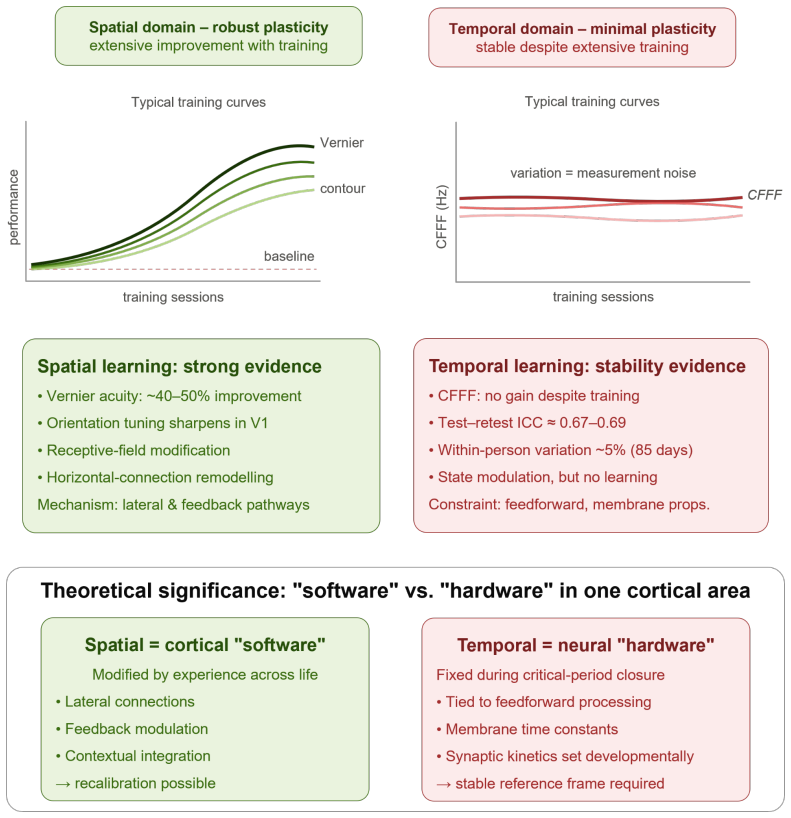
The argument is carried by CFFF as an index of a 'perceptual clock', operationalized through three jointly necessary boundary criteria: high within-individual stability, resistance to non-specific training, and a mechanistic link to feedforward circuitry fixed during critical periods. The load-bearing anatomical contrast is between critical-period-stabilized thalamocortical feedforward connections ('hardware') and lifelong-plastic horizontal and feedback connections ('software') within primary visual cortex; all stability and training data are read through that contrast.
What would settle it
A well-powered controlled study showing that a non-temporal cognitive training regimen (for example, number-puzzle practice) raises CFFF by more than 10% of baseline, or that within-individual CFFF variation under controlled conditions exceeds 10%, would refute the paper's boundary claim.
Extended reading notes
Core claim
The central claim is that CFFF marks the divide between non-plastic and plastic neural systems, with the empirical centrepiece being the dissociation inside primary visual cortex: spatial properties such as orientation, contrast, and contour integration are readily trained, while temporal resolution stays fixed. The paper marshals stability data — roughly 4–5% within-individual variation, test-retest reliability up to about r=0.95, and about eight times more variance between people than within — alongside training data in which only paradigms engaging the magnocellular-dorsal visual stream move CFFF, while an active cognitive control task does not. It attributes this stability to feedforward
Load-bearing premise
The load-bearing premise is that CFFF's stability is caused by developmentally fixed feedforward brain circuitry; the review's evidence for that link is indirect, so if the stability actually comes from the eye's photoreceptors or from measurement conditions, the boundary claim loses one of its defining conditions.
Editorial extensions
If this is right
- Any cognitive training that does not engage the temporal (magnocellular-dorsal) stream should leave CFFF below a 10% improvement; an active puzzle-based control task is the direct test.
- CFFF can serve as a practice-resistant trait marker for individual differences in temporal processing, including a confound-free measure of age-related decline.
- Working-memory load should depress CFFF, and lower CFFF should predict wider uncertainty, worse metacognitive calibration, smaller effective capacity, and stronger temporal crowding.
- Pharmacological and attentional interventions should modulate how efficiently the temporal ceiling is used, but should never raise the ceiling itself.
- Computational theories of perception that assume learning can tune every parameter will need a fixed temporal resolution as a built-in constraint, not a learnable one.
Reading between the lines
- A testable extension not reported in the paper: if CFFF is a true ceiling, training-induced gains in healthy adults should be inversely related to baseline CFFF, so individual ranking is preserved across training.
- The same logic implies that CFFF should predict who benefits most from temporal perceptual-learning training and who benefits least from spatial training — a differential-transfer prediction that would directly probe the boundary.
- If the perceptual-clock reading is right, children whose CFFF reaches adult-like values early should show earlier stabilization of temporal binding windows, connecting the boundary claim to developmental trajectories.
- Clinically, because CFFF is a stable trait, an individual's deviation from their own baseline may detect cortical slowing earlier than comparison with population norms; the paper floats this idea but does not commit to it.
Editorial analysis
A structured set of objections, weighed in public.
Referee Report
Summary. This review proposes that critical flicker fusion frequency (CFFF) marks a boundary between non-plastic and plastic neural systems. The boundary is operationalized by three jointly necessary conditions: high within-individual stability, resistance to non-specific training, and a mechanistic link to critical-period-stabilized thalamocortical feedforward circuitry. The paper argues CFFF satisfies these conditions, presents a two-step inference for a 'perceptual clock' requiring a stable temporal reference, and derives testable predictions for working memory, metacognition, and capacity. It is framed as a falsifiable review, with explicit quantitative criteria and a proposed decisive retention study.
Significance. If the framework holds, CFFF would be a trait-like marker of a structural temporal ceiling, with implications for perceptual learning, cognitive aging, and clinical monitoring. The paper's main strengths are its explicit falsification criteria, its honest acknowledgment of underconstrained components (especially the persistence criterion), and its two-step logical structure that separates the functional argument for a stable clock from the empirical evaluation of CFFF. However, the central claim is currently stronger than the evidence: two of the three defining conditions rest on extrapolation or untested persistence, and the operational thresholds are calibrated to existing data. The proposed experiments in Section 6.3 are well-targeted and could resolve the main uncertainties.
major comments (4)
- [Section 6.3 / Criterion 3 (persistence)] The paper's central claim that CFFF satisfies all three boundary conditions is undermined by its own admission that the persistence criterion is 'currently the least constrained by data.' Section 1.2 states that 'current data support all four' criteria, but none of the training studies cited (Seitz et al., 2005, 2006; Zhou et al., 2016; Eisen-Enosh et al., 2023) includes a retention follow-up. A durable 30% gain (Seitz) persisting beyond one week would constitute consolidated perceptual learning and contradict the non-plastic boundary. The current classification of such gains as stream-specific or state-dependent is therefore post hoc. This is load-bearing because criterion 3 is jointly necessary.
- [Section 2.3 / Condition 3 (mechanistic link)] The mechanistic condition is not met by direct evidence. The text states that the critical-period-stabilized thalamocortical architecture 'plausibly underlies CFFF stability,' and that evidence from somatosensory cortex 'plausibly generalises to the visual system.' These are inferences, not demonstrations. No direct study links CFFF to parvalbumin-interneuron maturation, perineuronal nets, or SynCAM 1 in the visual thalamocortical pathway. The boundary claim therefore lacks one of its three defining supports, even if CFFF stability and training resistance were fully established.
- [Section 1.2 / Operational thresholds] The quantitative criteria (10% CV, 10% training gain, 1-week persistence, 8:1 variance ratio) are introduced as 'pre-specified,' but they are evidently calibrated to the reviewed data: the 10% thresholds sit above the 4–5% stability and the ~3% familiarization effect, while the 1-week persistence duration has no independent justification. More problematically, the non-specific-training criterion is operationalized so that any positive training effect can be reclassified as stream-specific (if it engages the magnocellular–dorsal stream) or state-dependent (if it does not), without pre-specified markers for either category. This weakens the falsifiability that the paper claims as its main contribution.
- [Supplementary Table S1 / Training evidence] The evidence for stream-specific CFFF plasticity rests on very small samples: Seitz et al. used n=5 per group, Zhou et al. n=10 per arm, and Eisen-Enosh et al. n=6. The classification of yoga training (Vani et al., 1997) as 'state/arousal' rather than perceptual learning is asserted without direct evidence. Given that criterion 2 (non-specific training resistance) is load-bearing, the small samples and post-hoc classification make the conclusion that only magnocellular–dorsal training modifies CFFF more tentative than the text suggests.
minor comments (4)
- [Section 4.1] The claim that CFFF 'eliminates a persistent confound in cognitive-ageing research' is too strong; the cited age-related decline data rely on cross-sectional comparisons with different psychophysical methods, and the conversion of dB/decade to Hz-equivalent in Table S2 is described in a footnote but could be clearer in the main text.
- [Section 3.1.3] The 'thermometer' analogy and the two-step inference structure are helpful, but the text could more explicitly state that the stability prediction is tested against CFFF data for the first time in this review, since the cited studies were not designed to test the perceptual-clock hypothesis.
- [Supplementary Table S1] The row for Lambourne & Tomporowski (2010) says the values are 'described here on the authors' authority rather than as original data'; this phrasing is awkward and should be reworded for a formal supplementary table.
- [Abstract / Section 7] The abstract and conclusion state that CFFF 'satisfies' all three boundary conditions, while Section 6.3 concedes the persistence criterion is untested. The conclusions should be tempered to reflect that the framework is currently a hypothesis with partial support, not an established classification.
Circularity Check
No significant circularity: the review's inferential structure is unidirectional and the boundary criteria are not defined in terms of CFFF; only minor non-load-bearing self-citations and post-hoc calibration concerns appear.
full rationale
The paper claims CFFF marks a plasticity boundary and attempts to preempt circularity via a two-step structure: an independent functional argument (internal clock theory, alpha oscillations, multisensory binding, tACS/cTBS, clinical populations) generates the prediction that temporal-resolution markers should be stable within and variable between individuals (Section 3.1.1), and CFFF is then evaluated as a candidate marker against that prediction (Section 3.1.2). This is a legitimate hypothetico-deductive structure rather than a reduction of the conclusion to the input. The boundary definition in Section 1.1 is a general operationalization (stability, resistance to non-specific training, mechanistic link to feedforward circuitry), not a definition in terms of CFFF; showing CFFF satisfies it is an empirical claim. The mechanistic condition is admittedly provisional ('plausibly underlies', Section 2.3) and the persistence criterion is 'currently the least constrained by data' (Section 6.3), but these are limitations in evidence, not circularity. The paper cites the authors' prior work (Mankowska et al. 2021, 2022, 2025, 2026) but these citations are for definitions, stimulus parameters, and supplementary data, and the central stability/training evidence comes from independent groups (Haarlem, Muth, Seitz, Zhou, Eisen-Enosh). Thus no load-bearing self-citation or definitional equivalence can be exhibited. Score 2 reflects only the presence of minor self-citations and the post-hoc calibration of the quantitative thresholds (10%, one week) to the observed data, which weakens falsifiability but does not constitute circularity.
Assumptions & free parameters
free parameters (4)
- Spontaneous instability criterion threshold =
10% intra-individual CV
- Non-specific training criterion threshold =
10% improvement from baseline
- Persistence criterion duration =
1 week
- Proportion-of-variance criterion ratio =
8:1 between-/within-individual variance
assumptions (5)
- domain assumption CFFF is a valid construct across measurement methods
- domain assumption Thalamocortical feedforward connections are stabilised during critical periods and resist adult plasticity
- ad hoc to paper Evidence from somatosensory cortex generalises to visual cortex
- domain assumption Metabolic cost of faster temporal processing is prohibitive
- domain assumption A perceptual clock requires a stable reference frequency
Cite this review
Pith. "Pith review of Critical Flicker Fusion Frequency As A Falsifiable Boundary Between Plastic And Non-Plastic Neural Systems." pith.science (2026). https://pith.science/paper/MQYMDYMN
@misc{pith2026260729068,
  author       = {Pith},
  title        = {Pith review of: Critical Flicker Fusion Frequency As A Falsifiable Boundary Between Plastic And Non-Plastic Neural Systems},
  year         = {2026},
  howpublished = {\url{https://pith.science/paper/MQYMDYMN}},
  note         = {Machine review of arXiv:2607.29068}
}
read the original abstract
Experience-dependent neural plasticity is fundamental to adaptive behaviour, yet certain perceptual abilities resist modification despite extensive training. Critical flicker fusion frequency (CFFF), the threshold at which flickering light appears continuous, is a foundational constraint in visual temporal processing that shows exceptional within-individual stability in adults, contrasting sharply with the highly plastic spatial abilities processed through the same cortical pathways. This review proposes a hierarchical framework in which CFFF marks a boundary between plastic and non-plastic neural systems, operationalised via explicit falsification criteria. We examine whether CFFF stability reflects peripheral constraints, thalamocortical dynamics, cortical temporal filtering, or an integrated multi-level architecture, concluding it emerges from convergent constraints across processing levels. Within primary visual cortex, spatial properties show robust perceptual learning while temporal processing remains constrained, with temporal critical periods closing earlier than spatial ones. Critically, CFFF is unresponsive to non-specific cognitive training yet modifiable by perceptual-learning paradigms engaging the magnocellular-dorsal stream, a pattern defining rather than contradicting the plasticity boundary. Three principles reinforce this stability: a perceptual clock requires a stable reference frame for temporal binding; metabolic constraints render faster processing energetically prohibitive; and speed-accuracy trade-offs suggest selection optimised integration windows. We argue CFFF may serve as a trait marker whose links to working memory precision, metacognitive accuracy, and capacity limits remain testable hypotheses, not established findings. Understanding CFFF as a plasticity boundary illuminates how flexible cognitive systems operate within rigid sensory constraints.
Figures


Figures from the paper (1 more)

Reference graph
Works this paper leans on
-
[4]
CFFF as an Individual-Difference Variable: Implications for Cognition 4.1 Stable Trait Architecture The combination of high within-individual stability and substantial between-individual variation (SD ~5 Hz around a mean of ~40 Hz; ~80:10 variance partition; Section 1.2) positions CFFF as a strong candidate trait marker of neural temporal architecture (Ha...
2024
-
[5]
Instead, for each we draw out a single, focused implication of treating temporal resolution as a fixed parameter
Implications for Theoretical Frameworks in Cognitive Neuroscience A full integration of CFFF with each major theoretical framework is beyond the scope of this review. Instead, for each we draw out a single, focused implication of treating temporal resolution as a fixed parameter. 5.1 Predictive Coding and the Free-Energy Principle Predictive coding assume...
2009
-
[6]
Future Research Directions 6.1 CFFF and Working-Memory Uncertainty A priority is to test directly whether CFFF predicts the precision of working- memory representations. Using neural decoding (Li et al., 2021), distribution width during maintenance could be related to individual CFFF – if CFFF reflects fundamental temporal-resolution constraints, lower CF...
2021
-
[7]
Conclusion Critical flicker fusion frequency marks a boundary in neural plasticity between processing levels that retain lifelong plasticity and those fixed during development. The central contribution of this review is to render that claim falsifiable: a plasticity boundary is defined by high within-individual stability, resistance to non-specific traini...
arXiv 2022
-
[8]
https://doi.org/10.3389/fnhum.2010.00215 111 Ferguson, M. A., Henshaw, H., Clark, D. P. A., & Moore, D. R. (2014). Benefits of Phoneme Discrimination 112 Training in a Randomized Controlled Trial of 50- to 74-Year-Olds With Mild Hearing Loss. Ear and 113 Hearing, 35(4), e110–e121. https://doi.org/10.1097/AUD.0000000000000020 114 Fornaciai, M., & Park, J. ...
arXiv 2010
-
[60]
https://doi.org/10.1002/hup.661 399 Seitz, A. R., Sr, J. E. N., Holloway, S. R., & Watanabe, T. (2006). Perceptual Learning of Motion Leads to 400 Faster Flicker Perception. PLOS ONE, 1(1), e28. https://doi.org/10.1371/journal.pone.0000028 401 Semedo, J. D., Jasper, A. I., Zandvakili, A., Krishna, A., Aschner, A., Machens, C. K., Kohn, A., & Yu, B. M. 402...
arXiv 2006
-
[610]
https://doi.org/10.1093/ARCLIN/ACV054 315 Miederer, I., Buchholz, H.-G., Rademacher, L., Eckart, C., Kraft, D., Piel, M., Fiebach, C. J., & 316 Schreckenberger, M. (2025). Dopaminergic Mechanisms of Cognitive Flexibility: An [18F] Fallypride 317 PET Study. Journal of Nuclear Medicine: Official Publication, Society of Nuclear Medicine, 66(3), 318 405–409. ...
arXiv 2025
-
[2013]
These likely reflect optimised attentional allocation rather than changed fundamental resolution, supporting the hierarchical model
and benefits extending to amblyopia (Li et al., 2011) and dyslexia under parietal neuromodulation (Bertoni et al., 2024). These likely reflect optimised attentional allocation rather than changed fundamental resolution, supporting the hierarchical model. Pharmacologically, temporal processing is modulated by several neurotransmitter systems, all in a stat...
2011
Reviewed August 3, 2026 · model on record in the stance chip above.
Discussion (0). Continue with ORCID to comment.