REVIEW 3 major objections 5 minor 26 references
Numerical Optimization of Two-Qubit Gates in Silicon Flip-Flop Qubit Arrays under Electrical Control
T0 review · 3 major / 5 minor · reviewed 2026-08-03 · deepseek-v4-flash
Pith's one-line read The paper claims that high-fidelity entangling gates in silicon flip-flop qubit arrays require co-optimizing control pulses, local phase corrections, and device geometry rather than tuning the interaction in isolation.
desk verdict Solid, self-contained numerical study of flip-flop qubit gates; the co-design conclusion is plausible, but the multi-qubit fidelity numbers need an explicit statement of whether spectator leakage is included. read the letter →
The pith
A machine-rendered reading of the paper's core claim, the machinery that carries it, and where it could break.
The reading
What carries the argument
The argument is carried by three interlocking tools: FlipFlopQSim, a simulator that propagates the coupled electron-nuclear spin-orbital Hamiltonian under realistic time-dependent electric fields; Makhlin invariants, which classify the two-qubit entangling content up to local operations and identify hold-time windows where the dipole-dipole interaction is locally equivalent to sqrt(iSWAP) or iSWAP; and the electrically driven Rz rotation calibrated at the clock-transition bias point, whose hold time maps linearly onto rotation angle with a tunable fine structure. The Makhlin invariants do the work of separating the nonlocal gate from local phases, while the calibrated Rz dataset supplies the
What would settle it
Recompute the optimized sqrt(iSWAP) and iSWAP pulse sequences in the full 8^N basis, or experimentally measure population in parallel-spin states at the optimal operating points. If the resulting infidelity exceeds 1e-3, or if observed leakage is non-negligible, the quantitative support for the central co-design claim fails.
Extended reading notes
Core claim
The central claim is that isolated two-qubit optimization is insufficient: residual dipolar couplings from spectator qubits alter both the nonlocal entangling evolution and the local phases, so the correction angle calibrated for an isolated pair is no longer optimal in larger arrays. The paper demonstrates this by simulating the full spin-orbital dynamics, classifying the entangling landscape with Makhlin invariants, calibrating electrically driven Rz rotations over a full 2π phase range, and reconstructing complete pulse sequences. The resulting sqrt(iSWAP) and iSWAP gate infidelities, 4.72e-4 and 6.14e-4, fall below the 1e-3 threshold, and symmetric active-idle configurations in linear, s
Load-bearing premise
The quoted fidelities assume a reduced four-dimensional-per-qubit subspace that discards parallel electron-nuclear spin configurations; if those discarded states participate in the driven dynamics at the optimized operating points, the infidelity numbers are optimistic.
Editorial extensions
If this is right
- Two-qubit gate calibration must be performed in the actual array environment, not inferred from isolated-pair simulations.
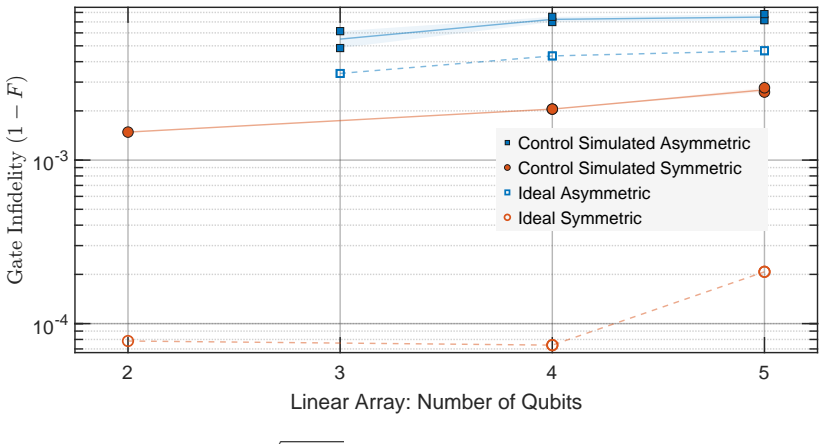
- Symmetric qubit layouts are preferable; they reduce spectator-induced distortion and can outperform asymmetric layouts even when the latter assume ideal local corrections.
- Electrically driven Rz rotations calibrated over a full 2π range are sufficient to implement the necessary local corrections at the required accuracy.
- iSWAP gates are far more sensitive to geometry and system size than sqrt(iSWAP), making sqrt(iSWAP) the more practical target for early multi-qubit demonstrations.
- The absence of any CNOT-equivalent region confirms that the XY-type dipole-dipole interaction cannot produce CNOT in a single entangling step, guiding gate set selection.
Reading between the lines
- The reduced 4^N subspace used throughout could be checked against the full 8^N basis at the optimized operating points; if leakage into parallel-spin states is non-negligible, the quoted infidelities would rise and possibly cross the threshold.
- The strong sensitivity of the correction angle (deviations of 1e-4 rad degrade fidelity) suggests that closed-loop experimental calibration will be needed, not just open-loop simulations.
- The co-design principle likely transfers to other dipolarly coupled spin-orbital qubit platforms, where spectator-induced phase shifts are similarly layout-dependent.
- Dynamically tunable metallic couplers, mentioned as future work, would make the geometry dependence controllable and could turn asymmetric layouts from liabilities into assets.
Editorial analysis
A structured set of objections, weighed in public.
Referee Report
Summary. This paper presents a numerical study of two-qubit entangling gates in silicon flip-flop qubit arrays. Using a MATLAB framework (FlipFlopQSim), the authors simulate coherent spin-orbital dynamics under electrical control, classify two-qubit operations via Makhlin invariants, and identify hold-time windows locally equivalent to sqrt(iSWAP) and iSWAP. They then design electrically driven Rz rotations to compensate local phases, reporting full physical infidelities of 4.72e-4 for sqrt(iSWAP) and 6.14e-4 for iSWAP. The multi-qubit section analyzes linear, square, and star arrays and concludes that spectator couplings shift the entangling landscape, so gate optimization must co-optimize pulses, local phases, and geometry; symmetric layouts are consistently better than asymmetric ones. All simulations use the reduced 4^N anti-parallel spin basis.
Significance. The paper's contribution is a concrete computational pipeline and a qualitative design principle: isolated two-qubit optimization is insufficient in multi-qubit flip-flop arrays, and symmetric qubit environments mitigate spectator-induced distortions. Strengths include the openly available code, the use of Makhlin invariants to separate local from nonlocal content, and the comparison of ideal versus physically simulated Rz corrections, which goes beyond bare optimization. If the spectator-excitation and basis-truncation concerns are resolved, the framework will be useful for device design. The spin-conservation structure of the Hamiltonian suggests the 4^N reduction may be exact, but this is not demonstrated in the manuscript; and the multi-qubit fidelity numbers are not yet shown to be unconditional.
major comments (3)
- [Sec. 6, Figs. 5-6] The analysis projects idle spectators onto |0> to define a reduced two-qubit operator and notes that this 'implicitly restricts our analysis to conditional trajectories where the spectator qubits remain unexcited.' The manuscript never states whether the reported infidelities are computed from the full N-qubit propagator or from this projected operator. If the latter, spectator excitations are discarded by construction, and the quoted values are conditional success probabilities rather than unconditional gate fidelities. Please report spectator excitation probabilities or full-register infidelity for the optimal operating points.
- [Appendix A; Sec. 5] All quantitative results, including the headline values 4.72e-4 and 6.14e-4, are obtained in the reduced 4^N basis with no 8^N cross-check. The excluded parallel-spin configurations are asserted to be 'energetically detuned and weakly coupled,' but no truncation error is quantified. Given the spin-projection conservation of the Hamiltonian in Eqs. (5)-(12), the reduction may be exactly decoupled; this should be stated and ideally verified numerically at the two-qubit level. Without this, the sub-threshold claims are not fully justified.
- [Sec. 5, Eq. (14)] The reported infidelities are minima obtained by optimizing correction angle and hold time with the same fidelity metric used to evaluate performance. This does not invalidate the optimization, but reporting only the minimum is fragile; the paper itself notes strong sensitivity to theta. To support the fault-tolerance claim, the authors should report the infidelity over a finite operating range (e.g., a small neighborhood of the optimal theta and thold) or provide an out-of-sample check for the optimized parameters.
minor comments (5)
- [Sec. 2, Eq. (5)] The expression 'ˆI+' appears garbled; please clarify the identity and formatting throughout the Hamiltonian definitions.
- [Eq. (16)] The relative threshold 0.1 is arbitrary; please state how the classification changes with the threshold or justify the choice.
- [Fig. 4] The left panel's axis label 'piSWAP' should be '√iSWAP'; also consider using consistent notation for the square-root gate in the text and figures.
- [Sec. 6] The statement that the two local-correction forms give a 'negligible difference' should be quantified (e.g., maximum infidelity difference) rather than left qualitative.
- [Appendix A] 'Energetically detuned and weakly coupled' is imprecise; if the excluded states are decoupled by spin conservation, say so explicitly.
Circularity Check
No load-bearing circularity found; the reported fidelities are explicitly optimized quantities and the stated approximations are limitations, not circular reductions.
full rationale
Walking the derivation chain: Sec. 2 defines the physical Hamiltonian explicitly (Eqs. 5-13); Sec. 4 classifies gates with Makhlin invariants from [22]; Sec. 5 optimizes Rz correction pulses and reports the infidelity at the optimized operating point; Sec. 6 extends the same procedure to multi-qubit arrays, noting that spectator projection restricts results to conditional trajectories. No step reduces an output to an input by construction: the reported infidelities (4.72e-4, 6.14e-4) are minima of an explicit cost function, not out-of-sample predictions, and the paper is transparent that they are optimized quantities. The Makhlin invariants and the XY-interaction limitation on CNOT are independent external results [22,26]. Self-citations [21,23,24] supply the simulation code and prior geometry studies, but the central co-design claim is supported by the new full-physics simulations reported here, not by an appeal to those citations. The stated limitations are genuine but non-circular: the 4^N subspace truncation (Appendix A) and the spectator-ground projection (Sec. 6, 'implicitly restricts our analysis to conditional trajectories') are unquantified approximation choices, and a full-register unconditional infidelity is not reported; these are correctness-risk items, not circular reasoning. No fitted parameter is renamed as a prediction; no uniqueness theorem from the authors' prior work is invoked to force a choice.
Assumptions & free parameters
free parameters (4)
- Hyperfine profile steepness c =
5.174e-4 m V^-1
- Baseline device parameters (B0, Δγ, d, Vt) =
0.4 T, -0.002, 15 nm, 11.29 GHz
- Control and layout parameters =
ΔE_idle=1e4 V/m, ΔE_int=1300 V/m, τ1=2 ns, τ2=20 ns, r=360 nm, ΔE_ct=290 V/m
- Makhlin equivalence threshold =
0.1 ||g_ideal||
assumptions (6)
- domain assumption Parallel electron-nuclear spin configurations are energetically detuned and can be neglected, so the reduced 4^N flip-flop subspace is sufficient.
- standard math Makhlin invariants uniquely classify two-qubit gates up to local unitary equivalence.
- standard math The dipole-dipole Hamiltonian reduces to an XY-type interaction in the orbital eigenbasis, so CNOT cannot be reached in a single entangling step.
- domain assumption Spectator qubits can be projected onto their |0> ground states, yielding a unitary reduced description for conditional trajectories.
- domain assumption Time evolution is noiseless and computed by piecewise-constant matrix exponentiation.
- domain assumption The hyperfine coupling profile A(ΔEz)=A0/(1+exp(c·ΔEz)) and the adopted device parameters from Ref. [15] describe the physical system.
Cite this review
Pith. "Pith review of Numerical Optimization of Two-Qubit Gates in Silicon Flip-Flop Qubit Arrays under Electrical Control." pith.science (2026). https://pith.science/paper/P647KTS3
@misc{pith2026260729123,
  author       = {Pith},
  title        = {Pith review of: Numerical Optimization of Two-Qubit Gates in Silicon Flip-Flop Qubit Arrays under Electrical Control},
  year         = {2026},
  howpublished = {\url{https://pith.science/paper/P647KTS3}},
  note         = {Machine review of arXiv:2607.29123}
}
abstract
Silicon-based donor flip-flop qubits offer a promising path toward scalable, fault-tolerant quantum computing by combining the long coherence times of nuclear spins with fast, fully electrical control and long-range dipole-dipole coupling between qubits. However, realizing high-fidelity entangling operations in this platform remains challenging. The entangling interaction is intrinsically coupled to electron orbital dynamics, which can lead to leakage into non-computational states and unwanted phase accumulation. Furthermore, in multi-qubit architectures, residual dipolar couplings from spectator qubits distort the effective interaction landscape. In this work, we employ a numerical simulation framework, FlipFlopQSim, that models the spin-orbital dynamics of interacting flip-flop qubits to extract effective logical operations from realistic electrical control pulses. Using Makhlin invariants, we map the entangling landscape generated by electrically controlled dipole-dipole interactions and identify operating regions locally equivalent to canonical two-qubit gates, such as $\sqrt{iSWAP}$ and $iSWAP$. We then optimize the control parameters of physically realizable, electrically driven $R_z$ rotations to implement the necessary local corrections and maximize composite gate fidelity. Finally, we scale our analysis to multi-qubit registers with various geometries and connectivity patterns to evaluate spectator-induced distortions. Our results demonstrate that high-fidelity entangling operations cannot be optimized in isolation; rather, they require a co-design approach that simultaneously optimizes pulse control, local phase compensation, and physical device geometry. This work provides a robust numerical framework for assessing the scalability of electrically controlled silicon quantum processors and outlines key design principles for robust multi-qubit gate implementation.
Figures


Figures from the paper (3 more)


Reference graph
Works this paper leans on
-
[1]
Guido Burkard et al. “Semiconductor Spin Qubits”. In:Rev. Mod. Phys.95 (2023), p. 025003.doi: 10.1103/RevModPhys.95.025003
-
[2]
Silicon Spin Qubits from Laboratory to Industry
M. De Michielis et al. “Silicon Spin Qubits from Laboratory to Industry”. In:Journal of Physics D: Applied Physics56 (2023), p. 363001.doi:10.1088/1361-6463/acd8c7
-
[3]
Donor-based qubits for quantum computing in silicon
J. C. McCallum, B. C. Johnson, and T. Botzem. “Donor-based qubits for quantum computing in silicon”. In:Applied Physics Reviews8 (2021), p. 031314.doi:10.1063/5.0060957
-
[4]
A silicon-based nuclear spin quantum computer
B. E. Kane. “A silicon-based nuclear spin quantum computer”. In:Nature393 (1998), pp. 133–137. doi:10.1038/30156
doi:10.1038/30156 1998
-
[5]
Interfacing spin qubits in quantum dots and donors—hot, dense, and coherent
L. M. K. Vandersypen et al. “Interfacing spin qubits in quantum dots and donors—hot, dense, and coherent”. In:Npj Quantum Information3 (2017), p. 34.doi:10.1038/s41534-017-0038-y
-
[6]
Donor spins in silicon for quantum technologies
A. Morello et al. “Donor spins in silicon for quantum technologies”. In:Advanced Quantum Tech- nologies3 (2020), p. 2000005.doi:10.1002/qute.202000005
-
[7]
A single-atom electron spin qubit in silicon
J. J. Pla et al. “A single-atom electron spin qubit in silicon”. In:Nature489.7417 (2012), pp. 541– 545.doi:10.1038/nature11449
-
[8]
High-fidelity readout and control of a nuclear spin qubit in silicon
Jarryd J. Pla et al. “High-fidelity readout and control of a nuclear spin qubit in silicon”. In:Nature 496.7445 (2013), pp. 334–338.doi:10.1038/nature12011
Show all 26 references
-
[9]
Coherent Manipulation of Coupled Electron Spins in Semiconductor Quantum Dots
J. R. Petta et al. “Coherent Manipulation of Coupled Electron Spins in Semiconductor Quantum Dots”. In:Science309.5744 (2005), pp. 2180–2184.doi:10.1126/science.1116955
2005 doi
-
[10]
Electrically controlling single-spin qubits in a continuous microwave field
Arne Laucht et al. “Electrically controlling single-spin qubits in a continuous microwave field”. In: Science Advances1 (2015), e1500022.doi:10.1126/sciadv.1500022
2015 doi
-
[11]
Storing quantum information for 30 seconds in a nanoelectronic device
Juha T. Muhonen et al. “Storing quantum information for 30 seconds in a nanoelectronic device”. In:Nature Nanotechnology9 (2014), pp. 986–991.doi:10.1038/nnano.2014.211
2014 doi
-
[12]
Quantum Information Storage for over 180 s Using Donor Spins in a 28Si
M. Steger et al. “Quantum Information Storage for over 180 s Using Donor Spins in a 28Si ”Semicon- ductor Vacuum””. In:Science336.6086 (2012), pp. 1280–1283.doi:10.1126/science.1217635
2012 doi
-
[13]
Electron spin relaxation of single phosphorus donors in metal-oxide- semiconductor nanoscale devices
Stefanie B. Tenberg et al. “Electron spin relaxation of single phosphorus donors in metal-oxide- semiconductor nanoscale devices”. In:Physical Review B99 (2019), p. 205306.doi:10 . 1103 / PhysRevB.99.205306
2019
-
[14]
Electron spin coherence exceeding seconds in high-purity silicon
Alexei M. Tyryshkin et al. “Electron spin coherence exceeding seconds in high-purity silicon”. In: Nature Materials11 (2012), pp. 143–147.doi:10.1038/nmat3182
2012 doi
-
[15]
Silicon quantum processor with robust long-distance qubit couplings
Guilherme Tosi et al. “Silicon quantum processor with robust long-distance qubit couplings”. In: Nature Communications8 (2017), p. 450.doi:10.1038/s41467-017-00378-x
2017 doi
-
[16]
Robust electric dipole transition at microwave frequencies for nuclear spin qubits in silicon
Guilherme Tosi et al. “Robust electric dipole transition at microwave frequencies for nuclear spin qubits in silicon”. In:Physical Review B98 (2018), p. 075313.doi:10.1103/PhysRevB.98.075313
2018 doi
-
[17]
An electrically driven single-atom flip-flop qubit
Rostyslav Savytskyy et al. “An electrically driven single-atom flip-flop qubit”. In:Science Advances 9.6 (2023), eadd9408.doi:10.1126/sciadv.add9408
2023 doi
-
[18]
Fast high-fidelity single-qubit gates for flip-flop qubits in silicon
F. A. Calderon-Vargas, Edwin Barnes, and Sophia E. Economou. “Fast high-fidelity single-qubit gates for flip-flop qubits in silicon”. In:Phys. Rev. B106 (2022), p. 165302.doi:10 . 1103 / PhysRevB.106.165302. 12
2022
-
[19]
Universal set of quantum gates for the flip-flop qubit with 1/f noise
E. Ferraro et al. “Universal set of quantum gates for the flip-flop qubit with 1/f noise”. In:EPJ Quantum Technology9.2 (2022).doi:10.1140/epjqt/s40507-022-00120-7
2022 doi
-
[20]
Fast noise-resistant control of donor nuclear spin qubits in silicon
James Simon et al. “Fast noise-resistant control of donor nuclear spin qubits in silicon”. In:Phys. Rev. B101 (20 May 2020), p. 205307.doi:10.1103/PhysRevB.101.205307
2020 doi
-
[21]
Version 1.0.0
Lorenzo D’Onofrio, Elena Ferraro, and Marco De Michielis.FlipFlopQSim. Version 1.0.0. 2026. doi:10.5281/zenodo.21669875
2026 doi
-
[22]
Nonlocal Properties of Two-Qubit Gates and Mixed States, and the Optimization of Quantum Computations
Yuriy Makhlin. “Nonlocal Properties of Two-Qubit Gates and Mixed States, and the Optimization of Quantum Computations”. In:Quantum Information Processing1.4 (2002), pp. 243–252.doi: 10.1023/A:1022144002391
2002 doi
-
[23]
Parallel Gate Fidelity of Flip-Flop Qubits in Small 1D- and 2D-Arrays in a Noisy Environment
M. De Michielis, D. Rei, and E. Ferraro. “Parallel Gate Fidelity of Flip-Flop Qubits in Small 1D- and 2D-Arrays in a Noisy Environment”. In:Advanced Quantum Technologies7 (2024), p. 2300455. doi:10.1002/qute.202300455
2024 doi
-
[24]
Impact of Parallel Gating on Gate Fidelities in Linear, Square, and Star Arrays of Noisy Flip-Flop Qubits
M. De Michielis and E. Ferraro. “Impact of Parallel Gating on Gate Fidelities in Linear, Square, and Star Arrays of Noisy Flip-Flop Qubits”. In:Advanced Quantum Technologies8.1 (2025), p. 2400341. doi:10.1002/qute.202400341
2025 doi
-
[25]
Fidelity of quantum operations
Line Hjortshøj Pedersen, Niels Martin Møller, and Klaus Mølmer. “Fidelity of quantum operations”. In:Physics Letters A367.1–2 (2007), pp. 47–51.doi:10.1016/j.physleta.2007.02.069
2007 doi
-
[26]
Natural two-qubit gate for quantum computation using the XY interaction
Norbert Schuch and Jens Siewert. “Natural two-qubit gate for quantum computation using the XY interaction”. In:Physical Review A67 (2003), p. 032301.doi:10.1103/PhysRevA.67.032301. 13
2003 doi
Reviewed August 3, 2026 · model on record in the stance chip above.
Discussion (0). Continue with ORCID to comment.