REVIEW 4 major objections 4 minor 49 references
Scheduled inpainting blends a source animation into every denoising step, letting pretrained motion diffusion models edit existing clips interactively for the first time.
Reviewed by Pith at T0; open to challenge. T0 means a machine referee read the full paper against a public rubric. the ladder, T0–T4 →
T0 review · deepseek-v4-flash
2026-08-03 13:02 UTC pith:YCJ3J5X5
load-bearing objection A straightforward inference-time method for editing existing motion clips with pretrained diffusion models; the core idea is real and practically useful, but the quantitative evaluation is thinner and the universality claim softer than the prose suggests. the 4 major comments →
Interactive Generative Motion Editing via Scheduled Inpainting
The pith
A machine-rendered reading of the paper's core claim, the machinery that carries it, and where it could break.
Core claim
The paper's central claim is that scheduling the amount of inpainting over the diffusion process — rather than using a fixed or binary mask — unlocks interactive generative motion editing. At high noise levels the base motion is copied wholesale into the generation, at low noise levels the model is left alone, and in between a linear interpolation controlled by two user parameters σ_s and σ_e blends the two. The same formula, with a spatiotemporal mask α_mask, decides which joints and frames are preserved. The enabling insight is that this blend must be computed in a custom alignment space — origin at the first frame, facing along the x-axis, zero mean and unit variance, differential root co
What carries the argument
The load-bearing object is the scheduled blend identity M0_gen = α_t M_base + (1−α_t) M0_gen, evaluated at every denoising step, where α_t = α_time^t · α_mask. The timestep schedule α_time^t is a linear ramp between user-set noise levels σ_s and σ_e (full overwrite above σ_s, no inpainting below σ_e), giving direct control over preservation versus generation. The spatiotemporal mask α_mask, built from Gaussian kernels around user constraints, localizes editing to chosen joints and frames. All blending happens in a hand-designed inpainting space that aligns both sequences to a common origin and orientation, normalizes scale, and represents the root via differential coordinates — this normaliz
Load-bearing premise
The method assumes that, after normalizing scale, orientation, and root drift, linearly interpolating a source clip into the model's generated estimate at every denoising step stays on the manifold of motions the pretrained model can still denoise naturally.
What would settle it
Stitch a crouching clip with a long-stride clip of the same character via scheduled inpainting and inspect the blended poses at high-noise denoising steps: if foot sliding, self-penetration, or limb spasm appears despite the alignment and normalization, the linear-blend assumption fails. A direct quantitative check is to compare root-relative reconstruction error with and without the paper's normalization on a scale-mismatched pair — the paper predicts normalization removes most of the error.
If this is right
- Any pretrained interactive motion diffusion model can be turned into an editing tool with no retraining and no added inference cost beyond the standard generation pass.
- Artists can chain and combine editing operations — extending a clip, stitching two clips, compositing upper and lower body, retiming, and dragging points — inside one real-time session while the base motion stays intact.
- Because the source clip is inpainted rather than passed as a hard constraint, the edited result itself remains editable, enabling iterative refinement.
- The preservation/generation trade-off is explicitly user-controllable through two scalars, and reconstruction error improves monotonically as inpainting strength increases.
- Scheduled inpainting succeeds in cases where noise-inversion and noise-optimization approaches fail or run too slowly for interactive use (the paper reports roughly 0.19 seconds per batch versus 4.5–10.3 seconds for inversion baselines).
Where Pith is reading between the lines
- The same schedule-and-blend recipe should transfer to other generative modalities — audio, video, shape — wherever a pretrained diffusion prior exists and the task is 'edit an existing exemplar without retraining.'
- The shrinking Gaussian kernel for sparse constraints suggests a general principle worth extracting: constraint influence should be annealed with noise level so that high noise steers global structure and low noise enforces local detail.
- The paper's own convex-hull observation implies a practical ceiling: edits are confined to the model's learned distribution, so a feasibility visualizer (which the authors mention as future work) may become a necessary companion in production use.
- A testable extension: apply the same normalization and scheduled blend to stylized or non-human characters; the claimed model-agnosticism predicts it should work with any diffusion backbone that accepts joint-and-frame conditioning.
Editorial analysis
A structured set of objections, weighed in public.
Referee Report
Summary. The paper introduces scheduled inpainting, an inference-time method for editing existing motion clips with pretrained interactive motion diffusion models. The core idea is to blend the base motion M_base into the denoised generation at every diffusion step via Eq. (1), with a user-controllable schedule α_time and a spatiotemporal preservation mask α_mask. A dedicated inpainting space (Section 3.3) aligns and normalizes both sequences before blending. The method is demonstrated on direct manipulation, extension, stitching, compositing, and retiming, using IBMM and SF-control as backbone models. The evaluation comprises qualitative comparisons against MotionLab, CondEditor, DNO, and noise-inversion, quantitative reconstruction metrics in Tables 1 and 2, ablations of the schedule, mask, normalization, and kernel shape, and a usability test with two professional artists.
Significance. If the results hold, the paper makes a useful practical contribution: a training-free, inference-only technique that upgrades pretrained generative motion models into interactive editing tools, potentially reducing manual effort in animation production. The method is simple, conceptually clear, and the authors are honest about limitations, including the 'convex hull problem' in Appendix C. The strengths are the compatibility with multiple backbone models, the unified treatment of several editing tasks, and the inclusion of ablations. However, the quantitative evaluation is thin and partly circular: the main reconstruction metrics measure distance to the base motion that Eq. (1) explicitly injects, and the user study has only two participants. These weaknesses currently make the broad claims of 'extensive validation' and a 'single interactive framework' stronger than the evidence supports.
major comments (4)
- [§5.3.1, Table 2, Eq. (1)] The L2P/L2R reconstruction metrics measure distance to M_base, which Eq. (1) directly injects at high noise through α_t. The ablation across σ_s and σ_e is therefore partly tautological: stronger inpainting schedules mechanically lower the error to the base motion. The statement that σ_s=500/σ_e=50 'best balances' preservation and natural edits is not supported by these numbers alone; it relies on qualitative inspection. Please add evaluation metrics that separate preservation from edit quality (e.g., constraint satisfaction, physical plausibility, user preference) and report variances across random seeds and motion clips.
- [§5.4] The usability test involves only two professional artists and is entirely qualitative. This is too thin to support the abstract's 'extensively validate our approach' or the broad claim of enabling a production-ready workflow. A larger user study with statistical analysis, or at minimum a clearly labeled pilot study with softened conclusions, is needed. As it stands, the evidence from the usability test is anecdotal.
- [Appendix C, §6] Appendix C shows that for exaggerated or periodic motions, the plain scheduled inpainting of Eq. (1) loses the base motion's dynamics; the authors must automatically detect and add extrema points as additional constraints. This directly demonstrates that the inpainting space of Section 3.3 does not in general keep the blended sequence on the model's motion manifold. The paper should either integrate this constraint-addition into the method description and evaluate it as part of the framework, or explicitly scope the method's applicability and characterize failure modes. Otherwise the claim of a 'single interactive framework' for arbitrary input clips is overbroad.
- [§5.2.2–5.2.3] The comparisons with MotionLab, CondEditor, DNO, and noise-inversion are mostly qualitative or based on a single clip without error bars. Since the central novelty is a general inference-time framework, the absence of a quantitative comparison over a diverse set of clips, with distributions over seeds and clips, limits the support for the claimed advantage over these baselines. Please provide quantitative results with variance for at least the interactive baselines, or temper the comparative claims accordingly.
minor comments (4)
- [Eq. (4)–(5)] Notation inconsistency: G(j,t;c_i) is defined in Eq. (4) but the expression depends only on t and c_i, and Eq. (5) uses G(t;c_i). Align the notation to avoid confusion.
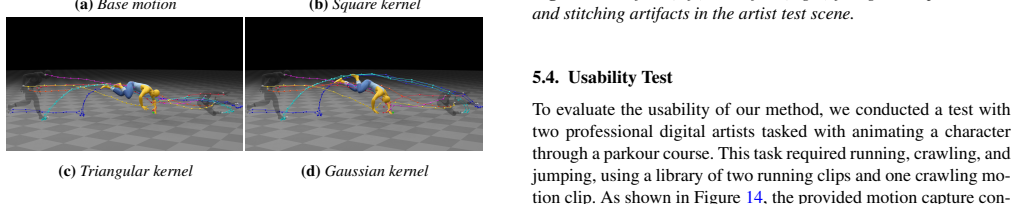
- [§5.3.4, Figure 13] The text refers to a 'piecewise linear' kernel while Figure 13 labels the same kernel as 'Triangular kernel'. Use one consistent name.
- [Table 3] The 'Ours' row lists σ_s=500 and σ_e=50, but the recommended schedule is discussed in Table 2. Ensure the reader can easily map the schedule notation between tables.
- [Abstract and §5] The abstract states 'extensively validate our approach', but the quantitative evaluation lacks error bars and the user study has two participants. Consider softening the wording to match the evidence presented.
Circularity Check
Reconstruction validation is tautological: L2P/L2R measure distance to M_base, which Eq. (1) injects directly; otherwise the pipeline is self-contained.
specific steps
-
self definitional
[Section 5.3.1, Table 2 (and Table 1; Eq. 1, Section 3)]
"To evaluate the results, we measure foot-sliding and root-relative reconstruction error of non-root joints, reported as L2 position error (L2P) and L2 rotation error (L2R), to quantify the motion naturalness and similarity to base motion. ... For stronger inpainting schedules, the reconstruction error improves linearly with the strongest schedule of σs=300 and σe=50 achieving the best metrics."
Eq. (1) defines the inpainted motion as a convex combination α_t×M_base+(1−α_t)×M0_gen. L2P/L2R are exactly the distance to M_base. Therefore increasing α (stronger inpainting schedule) mechanically decreases L2P/L2R; the monotone improvement reported in Table 2 is the injected fraction, not an emergent property of the generative prior or the representation space. The same metric supports the 'significantly improving base motion preservation' statement in Table 1. The ablation is thus a measure of the user-controlled injection knob, not independent evidence that the method reconstructs or preserves motion. DNO/noise-inversion comparisons on this metric are similarly tilted, because scheduled inpainting is allowed to copy M_base into the output by construction.
full rationale
Scheduled inpainting itself is mostly self-contained: Eqs. (1)-(5) define an inference-time blend and spatiotemporal mask; Section 3.3's alignment/normalization is explicitly designed and ablated (Figs. 11, 16); and the comparisons to DNO, noise-inversion, MotionLab, and CondEditor, the foot-sliding metric, and the artist usability test provide independent evidence for the interactive-editing claim. The self-citations to [ABB*24] (SKEL-Betweener) and [VAG*25] (IBMM) are used as a prior rig/model and to construct a baseline, not to prove the central mechanism, so they are not load-bearing circularity. Appendix C is an honest limitation: highly exaggerated/periodic motions fall outside the model's distribution and require automatic extrema constraints, which weakens the universal-interactive-editing claim but is not a circular step. The one genuine circularity is the quantitative reconstruction validation: because the output is a weighted copy of M_base, L2P/L2R vs M_base are controlled by the schedule, making the Table 2 ablation and part of Table 1 tautological. This does not invalidate the whole system—the qualitative, foot-sliding, and user-study evidence stands—but the headline preservation metrics reduce by construction. Score 5.0.
Axiom & Free-Parameter Ledger
free parameters (3)
- σ_s (schedule start) =
500 (recommended)
- σ_e (schedule end) =
50 (recommended)
- µ_ci (influence radius) =
5–40 (user-controlled)
axioms (3)
- domain assumption Pretrained models IBMM [VAG*25] and SF-control [HBLK25] exist, run at interactive rates, and expose the model's predicted clean motion M0_gen at each diffusion timestep.
- domain assumption Linear interpolation in the paper's normalized inpainting space yields inputs that the diffusion model can still denoise plausibly.
- domain assumption The 'convex hull problem' described in Appendix C is a real limitation of the underlying generative models.
read the original abstract
Motion editing is central to VFX and game development, where it is used extensively to modify and augment existing movements to conform to new environments or changes in artistic direction. While traditional motion editing can do small modifications, it cannot accommodate larger structural edits, resulting in visual warping artifacts that require authoring new motion. Conversely, recent advances in large-scale generative modeling have unlocked newfound capabilities for authoring entire movements by directly manipulating sparse spatial constraints. While impressive at creating new movements, these methods lack the capability to preserve and edit existing motion interactively. In this work, we introduce scheduled inpainting, a method that enables interactive generative motion editing, a novel paradigm unifying motion synthesis and editing by leveraging generative models. Scheduled inpainting is a simple yet powerful inference-based technique that enables fine-grained spatiotemporal control over the balance between preserving the original motion and generating new content. By building atop generative models that support direct manipulation, our system allows artists to interactively refine existing animations while ensuring results remain natural and consistent with the learned motion distribution. Scheduled inpainting is versatile and supports many editing applications, such as extending, stitching, and compositing different clips. Finally, we extensively validate our approach by comparing with four baselines, conducting ablations of our design, and reporting user feedback.
Figures




Reference graph
Works this paper leans on
-
[1]
W., Guay M
Agrawal D., Buhmann J., Borer D., Sumner R. W., Guay M. : SKEL-Betweener : A neural motion rig for interactive motion authoring. ACM Transactions on Graphics (TOG) 43, 6 (2024), 1--11
2024
-
[2]
J., Varol G
Athanasiou N., Cseke A., Diomataris M., Black M. J., Varol G. : MotionFix : Text-driven 3D human motion editing. In SIGGRAPH Asia 2024 Conference Papers (2024), pp. 1--11
2024
-
[3]
: Autodesk motionbuilder, 2025
Autodesk Inc. : Autodesk motionbuilder, 2025. Version 2025, Autodesk, Inc., San Rafael, CA. URL: https://www.autodesk.com/products/motionbuilder/
2025
-
[4]
M., Kapadia M
Bae J., Hwang I., Lee Y.-Y., Guo Z., Liu J., Ben-Shabat Y., Kim Y. M., Kapadia M. : Less is more: Improving motion diffusion models with sparse keyframes. In Proceedings of the IEEE/CVF International Conference on Computer Vision (2025), pp. 11069--11078
2025
-
[5]
Chai J., Hodgins J. K. : Constraint-based motion optimization using a statistical dynamic model. In ACM SIGGRAPH 2007 papers. ACM, 2007
2007
-
[6]
: Text-driven human motion generation with motion masked diffusion model
Chen X. : Text-driven human motion generation with motion masked diffusion model. arXiv preprint arXiv:2409.19686 (2024)
Pith/arXiv arXiv 2024
-
[7]
Chen L.-H., Lu S., Dai W., Dou Z., Ju X., Wang J., Komura T., Zhang L. : Pay attention and move better: Harnessing attention for interactive motion generation and training-free editing. arXiv preprint arXiv:2410.18977 (2024)
Pith/arXiv arXiv 2024
-
[8]
B., van de Panne M
Cohan S., Tevet G., Reda D., Peng X. B., van de Panne M. : Flexible motion in-betweening with diffusion models. In ACM SIGGRAPH 2024 Conference Papers (2024), pp. 1--9
2024
-
[9]
W., Zhao N
Guo Z., Hu Z., Soh D. W., Zhao N. : MotionLab : Unified human motion generation and rditing via the motion-condition-motion paradigm. In Proceedings of the IEEE/CVF International Conference on Computer Vision (2025), pp. 13869--13879
2025
-
[10]
: Motion editing with spacetime constraints
Gleicher M. : Motion editing with spacetime constraints. In Proceedings of the 1997 symposium on Interactive 3D graphics (1997), pp. 139--ff
1997
-
[11]
: Control operators for interactive character animation
Gou R., van de Panne M., Holden D. : Control operators for interactive character animation. ACM Transactions on Graphics (TOG) 44, 6 (2025), 1--20
2025
-
[12]
K., Fatahalian K
Goel P., Zhang H., Liu C. K., Fatahalian K. : Generative motion infilling from imprecisely timed keyframes. In Computer Graphics Forum (2025), Wiley Online Library, p. e70060
2025
-
[13]
Hwang I., Bae J., Lim D., Kim Y. M. : Motion synthesis with sparse and flexible keyjoint control. In Proceedings of the IEEE/CVF International Conference on Computer Vision (ICCV) (2025)
2025
-
[14]
URL: https://www.sidefx.com/docs/houdini/character/kinefx/index.html
Houdini : Kinefx, 2025. URL: https://www.sidefx.com/docs/houdini/character/kinefx/index.html
2025
-
[15]
: Classifier-free diffusion guidance
Ho J., Salimans T. : Classifier-free diffusion guidance. arXiv preprint arXiv:2207.12598 (2022)
Pith/arXiv arXiv 2022
-
[16]
: COMO : Controllable motion generation through language guided pose code editing
Huang Y., Wan W., Yang Y., Callison-Burch C., Yatskar M., Liu L. : COMO : Controllable motion generation through language guided pose code editing. In European Conference on Computer Vision (2024), Springer, pp. 180--196
2024
-
[17]
G., Yurick M., Nowrouzezahrai D., Pal C
Harvey F. G., Yurick M., Nowrouzezahrai D., Pal C. : Robust motion in-betweening. ACM Transactions on Graphics (TOG) 39, 4 (2020), 60--1
2020
-
[18]
: Dynamic motion blending for versatile motion editing
Jiang N., Li H., Yuan Z., He Z., Chen Y., Liu T., Zhu Y., Huang S. : Dynamic motion blending for versatile motion editing. In Proceedings of the Computer Vision and Pattern Recognition Conference (2025), pp. 22735--22745
2025
-
[19]
: Optimizing diffusion noise can serve as universal motion priors
Karunratanakul K., Preechakul K., Aksan E., Beeler T., Suwajanakorn S., Tang S. : Optimizing diffusion noise can serve as universal motion priors. In Proceedings of the IEEE/CVF Conference on Computer Vision and Pattern Recognition (2024), pp. 1334--1345
2024
-
[20]
: SimMotionEdit : Text-based human motion editing with motion similarity prediction
Li Z., Cheng K., Ghosh A., Bhattacharya U., Gui L., Bera A. : SimMotionEdit : Text-based human motion editing with motion similarity prediction. In Proceedings of the Computer Vision and Pattern Recognition Conference (2025), pp. 27827--27837
2025
-
[21]
: GENMO : A generalist model for human motion
Li J., Cao J., Zhang H., Rempe D., Kautz J., Iqbal U., Yuan Y. : GENMO : A generalist model for human motion. In Proceedings of the IEEE/CVF International Conference on Computer Vision (2025), pp. 11766--11776
2025
-
[22]
: A motion is worth a hybrid sentence: Taming language model for unified motion generation by fine-grained planning
Li R., Han L., Shu S., Liu Y., Lin Y., Ma Y., Guo J., Liu Z., Li X. : A motion is worth a hybrid sentence: Taming language model for unified motion generation by fine-grained planning. In Proceedings of the 33rd ACM International Conference on Multimedia (2025), pp. 1404--1413
2025
-
[23]
Lee J., Shin S. Y. : A hierarchical approach to interactive motion editing for human-like figures. In Proceedings of the 26th annual conference on Computer graphics and interactive techniques (1999), pp. 39--48
1999
-
[24]
: Drag your noise: Interactive point-based editing via diffusion semantic propagation
Liu H., Xu C., Yang Y., Zeng L., He S. : Drag your noise: Interactive point-based editing via diffusion semantic propagation. In Proceedings of the IEEE/CVF conference on computer vision and pattern recognition (2024), pp. 6743--6752
2024
-
[25]
: Interactive generation of human animation with deformable motion models
Min J., Chen Y.-L., Chai J. : Interactive generation of human animation with deformable motion models. ACM Transactions on Graphics (TOG) 29, 1 (2009), 1--12
2009
-
[26]
: Contact-aware human motion generation from textual descriptions
Ma S., Cao Q., Zhang J., Tao D. : Contact-aware human motion generation from textual descriptions. arXiv preprint arXiv:2403.15709 (2024)
Pith/arXiv arXiv 2024
-
[27]
F., Pons-Moll G., Black M
Mahmood N., Ghorbani N., Troje N. F., Pons-Moll G., Black M. J. : AMASS : Archive of motion capture as surface shapes. In International Conference on Computer Vision (Oct. 2019), pp. 5442--5451
2019
-
[28]
N., Bocquelet F., Harvey F
Oreshkin B. N., Bocquelet F., Harvey F. G., Raitt B., Laflamme D. : ProtoRes : Proto-residual network for pose authoring via learned inverse kinematics. In International Conference on Learning Representations (2022)
2022
-
[29]
U., Karunratanakul K., Wang P., Xue H., Chen C., Guo C., Cao J., Ren J., Tulyakov S
Pinyoanuntapong E., Saleem M. U., Karunratanakul K., Wang P., Xue H., Chen C., Guo C., Cao J., Ren J., Tulyakov S. : MaskControl : Spatio-temporal control for masked motion synthesis. In Proceedings of the IEEE/CVF International Conference on Computer Vision (ICCV) (2025)
2025
-
[30]
: High-resolution image synthesis with latent diffusion models
Rombach R., Blattmann A., Lorenz D., Esser P., Ommer B. : High-resolution image synthesis with latent diffusion models. In Proceedings of the IEEE/CVF Conference on Computer Vision and Pattern Recognition (2022), pp. 10684--10695
2022
-
[31]
: MixerMDM : Learnable composition of human motion diffusion models
Ruiz-Ponce P., Barquero G., Palmero C., Escalera S., Garc \' a-Rodr \' guez J. : MixerMDM : Learnable composition of human motion diffusion models. In Proceedings of the Computer Vision and Pattern Recognition Conference (2025), pp. 12380--12390
2025
-
[32]
W., Guay M., Buhmann J
Studer J., Agrawal D., Borer D., Sadat S., Sumner R. W., Guay M., Buhmann J. : Factorized motion diffusion for precise and character-agnostic motion inbetweening. In Proceedings of the 17th ACM SIGGRAPH Conference on Motion, Interaction, and Games (2024), pp. 1--10
2024
-
[33]
Sadat S., Hilliges O., Weber R. M. : Eliminating oversaturation and artifacts of high guidance scales in diffusion models. In The Thirteenth International Conference on Learning Representations (2024)
2024
-
[34]
: Denoising diffusion implicit models
Song J., Meng C., Ermon S. : Denoising diffusion implicit models. In International Conference on Learning Representations (2022)
2022
-
[35]
: Human motion diffusion as a generative prior
Shafir Y., Tevet G., Kapon R., Bermano A. : Human motion diffusion as a generative prior. In International Conference on Learning Representations (2024), vol. 2024, pp. 8717--8733
2024
-
[36]
Shi Y., Wang J., Jiang X., Lin B., Dai B., Peng X. B. : Interactive character control with auto-regressive motion diffusion models. ACM Transactions on Graphics (TOG) 43, 4 (2024), 1--14
2024
-
[37]
H., Pan J., Yan H., Zhang W., Tan V
Shi Y., Xue C., Liew J. H., Pan J., Yan H., Zhang W., Tan V. Y., Bai S. : DragDiffusion : Harnessing diffusion models for interactive point-based image editing. In Proceedings of the IEEE/CVF Conference on Computer Vision and Pattern Recognition (2024), pp. 8839--8849
2024
-
[38]
: EDGE : Editable dance generation from music
Tseng J., Castellon R., Liu K. : EDGE : Editable dance generation from music. In Proceedings of the IEEE/CVF Conference on Computer Vision and Pattern Recognition (2023), pp. 448--458
2023
-
[39]
Tessler C., Guo Y., Nabati O., Chechik G., Peng X. B. : MaskedMimic : Unified physics-based character control through masked motion inpainting. ACM Transactions on Graphics (TOG) 43, 6 (2024), 1--21
2024
-
[40]
Tevet G., Raab S., Gordon B., Shafir Y., Cohen-or D., Bermano A. H. : Human motion diffusion model. In The Eleventh International Conference on Learning Representations (2023)
2023
-
[41]
W., Buhmann J
V \"o geli L., Agrawal D., Guay M., Borer D., Sumner R. W., Buhmann J. : Implicit B \'e zier motion model for precise spatial and temporal control. In Proceedings of the 2025 18th ACM SIGGRAPH Conference on Motion, Interaction, and Games (2025), pp. 1--10
2025
-
[42]
F., Picard D., Kalogeiton V
Wang X., Dufour N., Andreou N., Cani M.-P., Abrevaya V. F., Picard D., Kalogeiton V. : Analysis of classifier-free guidance weight schedulers. Transactions on Machine Learning Research (2024). URL: https://openreview.net/forum?id=SUMtDJqicd
2024
-
[43]
: Leader is guided: Interactive motion generation via lead-follow paradigm and trajectory guidance
Wang R., Ma C., Zhao J., Xu H., Sun D., Chen H., Xiong L., Wang Z., Li X. : Leader is guided: Interactive motion generation via lead-follow paradigm and trajectory guidance. In Proceedings of the 33rd ACM International Conference on Multimedia (2025), pp. 1802--1811
2025
-
[44]
: Motion warping
Witkin A., Popovic Z. : Motion warping. In Proceedings of the 22nd annual conference on Computer graphics and interactive techniques (1995), pp. 105--108
1995
-
[45]
Wu B., Xie J., Ding M., Kong Z., Ren J., Bai R., Qu R., Shen L. : FineMotion : A dataset and benchmark with both spatial and temporal annotation for fine-grained motion generation and editing. arXiv preprint arXiv:2507.19850 (2025)
Pith/arXiv arXiv 2025
-
[46]
Xu W., Fan S., Henderson P., Ho E. S. : Multi-person interaction generation from two-person motion priors. In Proceedings of the Special Interest Group on Computer Graphics and Interactive Techniques Conference Conference Papers (2025), pp. 1--11
2025
-
[47]
: Sketch2Anim : Towards transferring sketch storyboards into 3D animation
Zhong L., Guo C., Xie Y., Wang J., Li C. : Sketch2Anim : Towards transferring sketch storyboards into 3D animation. ACM Transactions on Graphics (TOG) 44, 4 (2025), 1--15
2025
-
[48]
: FineMoGen : Fine-grained spatio-temporal motion generation and editing
Zhang M., Li H., Cai Z., Ren J., Yang L., Liu Z. : FineMoGen : Fine-grained spatio-temporal motion generation and editing. Advances in Neural Information Processing Systems 36 (2023), 13981--13992
2023
-
[49]
: Motion anything: Any to motion generation
Zhang Z., Wang Y., Mao W., Li D., Zhao R., Wu B., Song Z., Zhuang B., Reid I., Hartley R. : Motion anything: Any to motion generation. arXiv preprint arXiv:2503.06955 (2025)
Pith/arXiv arXiv 2025
discussion (0)
Sign in with ORCID, Apple, or X to comment. Anyone can read and Pith papers without signing in.