REVIEW 3 major objections 5 minor 55 references
Entanglement in bipartite systems with symmetry: coupled chaotic kicked Bose-Hubbard systems
T0 review · 3 major / 5 minor · reviewed 2026-08-03 · deepseek-v4-flash
Pith's one-line read For a bipartite system in which two chaotic subsystems each conserve a local quantity and the coupling leaves only the sum conserved, the average eigenstate entanglement is claimed to follow a universal transition governed by one parameter,
desk verdict A genuinely new RMT ensemble and a clean Λ_N derivation for kicked Bose-Hubbard, but the full-transition interpolation is untested in unequal sector dimensions—worth a serious referee. read the letter →
The pith
A machine-rendered reading of the paper's core claim, the machinery that carries it, and where it could break.
The reading
What carries the argument
The key object is the conserved-quantity transition ensemble (CQTE): a statistical model in which the time-evolution operator has the form U = E e^{iV}, with E a diagonal random unitary carrying the uncoupled COE/CUE spectra and V a Gaussian coupling that only connects adjacent sectors of the local conserved charge. The ensemble is designed so that, after a large-dimension scaling, all statistical inputs (level spacings, coupling fluctuations) combine into a sector-dependent parameter Λ_{qA}, whose dimension-weighted average √Λ_q controls the transition. The analytical work combines two tools: standard perturbation theory for the Schmidt values, regularized by assuming immediate avoided cros
What would settle it
Compute the mean largest Schmidt value and the mean linear entropy as functions of the rescaled coupling for two independent dimension choices of the CQTE and for the kicked Bose-Hubbard model: the paper predicts the specific slope λ₁ ≈ 1 − (4/√(2π))√Λ_q for COE in the small-coupling limit and the universal collapse of S₂/S∞₂ onto Eq. (73); a different slope or a failure of the curves to collapse would refute the central claim.
Extended reading notes
Core claim
The central claim is that the average linear entanglement entropy S2 of eigenstates in such a symmetry-breaking bipartite system is a universal function of a single transition parameter √Λ_q, defined as the dimension-weighted average of sector transition parameters. In leading order for the time-reversal-invariant (COE) case, the largest Schmidt value obeys λ₁ = 1 − (4/√(2π))√Λ_q, and the extrapolated full transition is given by S₂ = S∞₂ (1 − (1/K) Σ_{qA} k_{qA} ν_{qA}(Λ_{qA})). The same parameter also organizes the number entropy, which dominates the total entropy for weak coupling and exhibits a slow, power-law approach to the random-matrix limit. For the kicked Bose-Hubbard model the tran
Load-bearing premise
The derivation of the full transition curve hinges on the assumption that resonant level crossings immediately turn into avoided crossings once the coupling is switched on, together with the sector-averaging approximations (equal sector dimensions and variances, equal probability for ±1 sector coupling, and statistical independence of matrix elements and Schmidt values) used in the extrapolation.
Editorial extensions
If this is right
- Any weakly chaotic bipartite system with two local conservation laws merging into one should show the same rescaled entanglement transition, independent of its microscopic realization.
- For weak coupling, total entanglement is essentially the number entropy, so measuring particle-number fluctuations in one subsystem approximates the entanglement entropy.
- The explicit Λ_N for the kicked Bose-Hubbard model turns the universal curve into a quantitative prediction that can be checked in current cold-atom or optical-lattice setups.
- The recursive extrapolation yields a closed-form description of the entire transition, not just the small-coupling limit, allowing predictions in the region where the largest Schmidt value is no longer near unity.
Reading between the lines
- The same single-parameter description likely extends to the growth of entanglement after a sudden quench, since the eigenstate results and the local Fock-space coupling structure are closely tied; the paper does not treat dynamics, but the machinery appears transferable.
- Because the number entropy is measurable through number fluctuations, the predicted Λ_N could act as a probe of the onset of quantum chaos in interacting bosonic systems without needing full state tomography.
- The banded-structure localization resembles Fock-space Anderson localization; testing whether the slow power-law approach to the random-matrix limit persists at larger particle numbers would sharpen that analogy and could connect to many-body localization studies.
- A natural extension is to non-Abelian conserved charges (for example spin), where the sector decomposition and the nearest-sector coupling assumption would need revision; the paper lists this as a future direction.
Editorial analysis
A structured set of objections, weighed in public.
Referee Report
Summary. The paper studies average eigenstate entanglement in bipartite Floquet systems where two local conserved quantities are broken by a coupling into one global conserved quantity. It introduces the 'conserved quantity transition ensemble' (CQTE), built from random matrices in each symmetry sector plus a nearest-sector Gaussian coupling, and derives a single transition parameter Λ. Using regularized perturbation theory, the authors obtain a leading-order law for the largest Schmidt value, λ₁ = 1 − C√Λ, and a non-perturbative interpolation, Eq. (73), for the average linear entanglement entropy S₂ as a weighted sum over sectors. The paper then applies this to a kicked Bose-Hubbard model with L=4 sites, deriving Λ_N analytically from the Hamiltonian. Numerical comparisons against the equal-dimension CQTE and the kicked Bose-Hubbard model are presented.
Significance. If the central claim holds, this is a significant step: it provides a universal, single-parameter description of eigenstate entanglement across the breaking of two U(1) conservation laws into one, and it cleanly separates the number entropy from the configurational entropy. The paper's strengths include an explicit random-matrix ensemble, an analytic derivation of Λ_N (Eq. (86)) directly from the kicked Bose-Hubbard Hamiltonian rather than by fitting, and explicit numerical data in Figs. 8–11 supporting the perturbative law and the universal collapse. The main caveats are that the full-transition formula Eq. (73) is derived under equal-sector assumptions in Appendix A and that its application to the Bose-Hubbard model relies on an unverified sector-resolved dominance argument. These gaps affect the strength of the claimed universality of the full transition, not the perturbative small-Λ result.
major comments (3)
- [Appendix A / Eq. (73); Sec. IV] The full-transition formula (73) is derived under the explicit assumptions stated in Appendix A: all sector dimensions and variances are equal, the probabilities for coupling q_A→q_A+1 and q_A→q_A−1 are each 1/2, and the Schmidt values are independent of the matrix elements. The paper itself notes these are 'not exact' for Bose-Hubbard-type dimension structures. Nevertheless Eq. (73) is applied to the kicked Bose-Hubbard model via Eq. (86), where k_{N_A}=(N_A+1)(N−N_A+1) varies strongly across sectors. The only validation of Eq. (73) in a non-equal-dimension setting is against the physical Bose-Hubbard model (Fig. 11), which introduces additional uncontrolled approximations. There is no numerical test of Eq. (73) against the CQTE with Bose-Hubbard dimensions. Such a test is necessary to establish that the full transition curve, not just the transition parameter, is universal in √Λ_q alon
- [Sec. IV, final paragraph] The justification for applying the COE-based CQTE to the kicked Bose-Hubbard model is the assertion that 'the dominant contributions to the entanglement entropy come from subspaces with sufficiently large effective κ̃=UN_A/N'. No sector-resolved analysis is given. The authors also state that the fraction of small-κ̃ operators does not diminish as N increases, so this is not a standard large-N suppression. A quantitative check, e.g., comparing the contribution of each N_A sector to S₂ against Λ_{N_A}, or replacing the small-κ̃ U_{N_A} operators by integrable (Poisson) evolution while keeping the large-κ̃ sectors COE, is needed to support the agreement in Fig. 11.
- [Sec. IIIB7 / Eq. (73)] The interpolation step leading to Eq. (73) uses the exponent 1/S∞₂ without a derivation from the recursive equation (67)–(69). The exponent is chosen so that the formula approaches the RMT asymptotic value, and the numerical agreement for equal-dimension CQTE in Figs. 9–10 is good. However, because the same interpolation is then exported to the Bose-Hubbard model, the paper should state more clearly that the functional form of the full transition is partly a heuristic interpolation, not a consequence of the perturbation theory. This does not invalidate the small-Λ result, but it bears on the strength of the claim that Eq. (73) is a universal analytic description of the full transition.
minor comments (5)
- [Eqs. (58)–(59), (61)–(63)] The typography for the COE coefficients is ambiguous: '4√(2π)' appears where the perturbative coefficient should be 4/√(2π). Please check all COE coefficients in Eqs. (58), (59), (61), and (63) and ensure the division by √(2π) is printed unambiguously.
- [Sec. IIB / Eqs. (44)–(46)] The notation for the large-M limit is confusing: Eq. (44) writes k̃_{q_A}=k_{q_A}/√M, while Eq. (46) writes D_{q_A±1}=2π/(M k̃_{q_A±1}). Clarify whether M is the total Hilbert-space dimension or the number of blocks, and how k relates to M. This will help readers verify the M-independence of Λ.
- [Eq. (71) / App. A] The expression '(2π)^{1/4} 3√{2+2}' is poorly typeset; it should presumably be the cube root of (2+2), i.e., (2π)^{1/4}∛(4). Please reformat all such coefficients in Eq. (71) and Eq. (A21)–(A22) so that the derivation can be checked.
- [Sec. IV / Fig. 11] Figure 11 shows only two system sizes (N=20,24) and 10 disorder realizations, with no error bars. Given that the central claim is quantitative agreement, an estimate of the statistical uncertainty (e.g., with error bars or shaded band) would be helpful.
- [App. A] There is a typo in the sentence 'Them, the normalized distribution of the matrix elements...'; it should read 'Then'. Also, the assumptions of statistical independence used in Eq. (A11) should be stated explicitly at the point where they are first used.
Circularity Check
No significant circularity: Λ is derived from coupling variances and sector dimensions, and the analytic λ1 and full-transition curves are tested against CQTE and Bose-Hubbard numerics with no fitted parameter.
full rationale
The transition parameter is not defined from the quantity being predicted. Equations (50)-(51) define √Λ_qA from the coupling variance σ²_qA and mean level spacings D_qA±1, i.e., from Hamiltonian/model data, not from entanglement entropies or Schmidt values. The variance scaling in Eq. (14) is a modeling choice that ensures a finite large-M limit; the nontrivial content is the derived functional law λ_{qA,1} = 1 − C√Λ_qA (Eq. (58)), which is checked against CQTE numerics in Fig. 8 without fitting. The regularization of resonances, Eq. (57), is indeed an assumption inherited from the authors' prior work [17,18], and it is load-bearing in making the perturbative integral converge. However, it is explicitly stated as an assumption ('We assume in the presence of interactions...'), given a physical rationale (degenerate perturbation theory), and its consequences are tested numerically in this paper; it is not an unverified self-citation chain. The full-transition formula Eq. (73) is an interpolation between the perturbative result and the random-matrix asymptotic value, with the exponent ν_qA=(μ_qA)^{1/S∞_2} chosen to match both limits; the coefficients in s(Λ_qA) (App. A) are computed from integrals, not fitted. The application to the kicked Bose-Hubbard model uses the analytically computed Λ_N of Eq. (86) and is compared to data in Fig. 11 with no fitted parameter. The acknowledged limitations—Appendix A's equal-dimension/equal-variance assumptions and the final-paragraph assertion that large-κ̃ sectors dominate—are validity gaps or approximations, not cases of a prediction being equivalent to its input by construction. There is no fitted parameter renamed as a prediction, and no central result reduces to a self-citation alone.
Assumptions & free parameters
free parameters (4)
- ε (coupling strength) =
control parameter, scanned across the transition (Fig. 5)
- σ̃²_{qA} (block-specific variance weights) =
1 for all blocks in CQTE numerics; k_{N_A} k_{N_A-1}/2 for Bose-Hubbard
- Coefficients in s(Λ), Eq. (71) =
√(2π), (2π)^{1/4}·3√(2+2)/3, 3/2 (COE)
- Interpolation exponent 1/S∞₂ in Eq. (73) =
1/S∞₂
assumptions (5)
- domain assumption Resonant level crossings immediately repel and are regularized by Eq. (57)
- standard math Eigenphases of tensor products of COE/CUE matrices follow Poissonian statistics R₂(s)=1 in the large-M limit
- domain assumption Statistical independence of eigenphase and eigenstate-vector statistics in the ensemble average, R(s,w) = R₂(s)ϱ(w)
- ad hoc to paper Appendix-A approximations: equal sector dimensions and variances; probabilities 1/2 for q_A,b = q'_{A,b} ± 1; independence of matrix elements and Schmidt values
- domain assumption Kicked Bose-Hubbard subsystems with κ=48, J=π/4, μ∈[−1/2,1/2] are quantum chaotic and described by the COE
Cite this review
Pith. "Pith review of Entanglement in bipartite systems with symmetry: coupled chaotic kicked Bose-Hubbard systems." pith.science (2026). https://pith.science/paper/WG7AYP52
@misc{pith2026260729165,
  author       = {Pith},
  title        = {Pith review of: Entanglement in bipartite systems with symmetry: coupled chaotic kicked Bose-Hubbard systems},
  year         = {2026},
  howpublished = {\url{https://pith.science/paper/WG7AYP52}},
  note         = {Machine review of arXiv:2607.29165}
}
read the original abstract
We investigate the average eigenstate entanglement in a bipartite many-body system which exhibits a breaking of two local conservation laws into a global conserved quantity. Such a setting is realized by the particle number conservation in Bose-Hubbard systems. We devise a corresponding random matrix model which captures the universal features of this symmetry breaking and allows for applying powerful random matrix methods. By combining the concept of symmetry resolved entanglement with perturbation theory for quantum chaotic systems we obtain a universal entanglement transition depending on a single fundamental parameter. Furthermore, the symmetry resolved entanglement allows for separating the genuine entanglement from the part which originates from the conserved quantity. This latter contribution is quantified by the number entropy. For this it is shown that the symmetry breaking generates a localization of the eigenstates due to a banded structure of the time-evolution operator. By extrapolating the results beyond the perturbative regime we obtain an analytic description of the full transition.
Figures

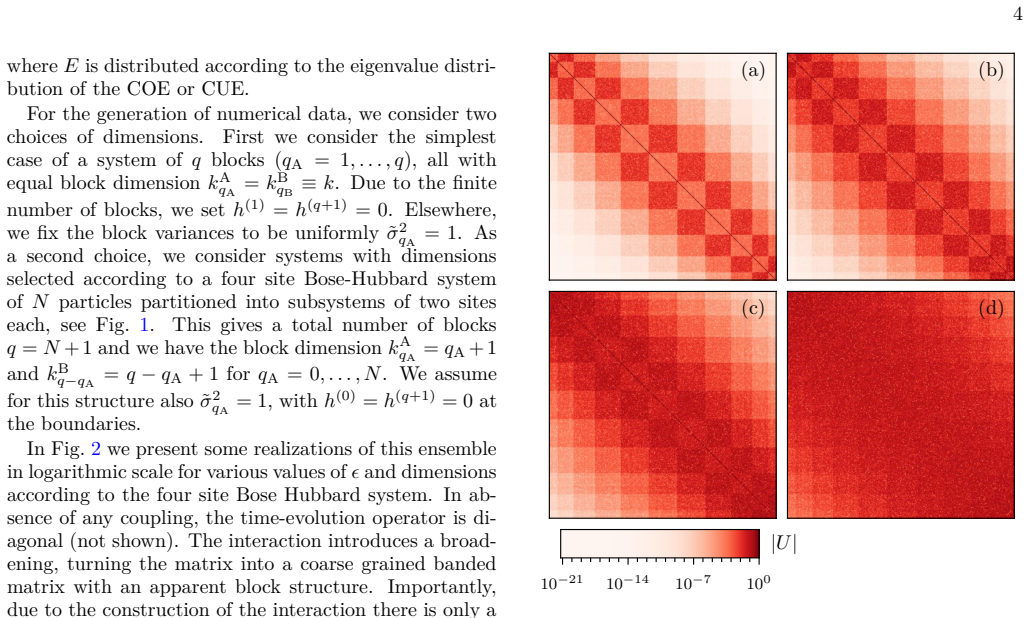

Figures from the paper (8 more)


Reference graph
Works this paper leans on
-
[1]
Perturbation theory By implementing the notion of conserved quantities explicitly into the framework of perturbation theory for unitarysystems[17], weobtainforaneigenstate|Ψ jk;q A⟩ 10−6 10−3 100 (a) pqA (b) 0 20 40 0.01 0.1 (c) qA pqA 0 20 40 (d) qA FIG. 7. The block amplitudes for typical eigenstates of the CQTE withq= 50andk= 5and COE statistics averag...
-
[2]
back exchange processes
We distinguish an overall coupling strengthϵ, which is assigned to all blocks and hence allows to establish UAB(0) = 1. Furthermore, we weight the variance by the dimension of the matrix to eliminate intrinsic block-size effects. Note that this scaling can be effectively reverted or enhanced by choosing the block-specific variances˜σ2 qA accordingly. This...
-
[3]
Instead, the treatment relies on exploiting the statistical properties of the uncoupled eigenproblem
Statistical properties In contrast to typical use-cases of perturbation theory, the unperturbed eigenproblem is not analytically known. Instead, the treatment relies on exploiting the statistical properties of the uncoupled eigenproblem. By construc- tion of the model, the subblock dynamics are given as the tensor product of two independent random matrice...
-
[4]
Transition parameter The large matrix limit has an important consequence on the formulation of perturbation theory. As the mean level spacing decreases for increasingly large matrices (due to the increased number of eigenphases on the finite unit circle) the phase differences tend to become reso- nant, i.e.,D→0. More precisely and tailored for our scenari...
-
[5]
We have numerically observed in Fig
Reduced density matrix and Schmidt values We can now turn towards the characterization of the Schmidt values of the reduced density matrix. We have numerically observed in Fig. 3(a-b) that for small cou- plings, the reduced density matrix remains essentially di- agonal. Hence the Schmidt values can be approximately identified as the leading diagonal entri...
-
[6]
Regularization of resonances We assume in the presence of interactions, that these level crossings immediately start to repel in the form of avoided level crossings. This behavior can be imple- mented in form of a regularization [17, 18], giving rise to the replacement |hqA j′k′,jk|2 (θj′k′,q′ A −θjk,q A)2→ 1 2 [ 1− ( 1 + 4 |hqA j′k′,jk|2 (θj′k′,q′ A −θjk...
-
[7]
[17, 23]
Moments of the Schmidt values The remainder of the perturbative approach, i.e., the derivation of the linear entropy from the perturbative expression follows without significant modification the derivation of Refs. [17, 23]. We therefore state the main results directly without repeating the detailed derivation. We obtain for the sum over the square of all...
-
[8]
For the entanglement entropy restricted to states with valueq A, combining Eq
Therefore, allλj forj≥3only contribute in higher order ofΛq, which will be crucial when later giving a description of the complete transition. For the entanglement entropy restricted to states with valueq A, combining Eq. (61) and Eq. (62) we obtain an average value of S2,qA = 1− ∑ j λ2 j = √ ΛqA { π 3 2/2CUE√ 2πCOE, (63) for smallΛqA. The average linear ...
Show all 55 references
-
[9]
In contrast, the numerical investigations, see Fig
Recursive extrapolation In the previous section we have obtained a perturba- tive description of the entanglement transition suited for small values of the transition parameter. In contrast, the numerical investigations, see Fig. 6, demonstrate that the universality withΛq rem...
-
[10]
Amico, R
L. Amico, R. Fazio, A. Osterloh, and V. Vedral,Entan- glement in many-body systems, Rev. Mod. Phys.80, 517 (2008)
2008
-
[11]
Nandkishore and D
R. Nandkishore and D. A. Huse,Many-body localiza- tion and thermalization in quantum statistical mechanics, Annu. Rev. Condens. Matter Phys.6, 15 (2015)
2015
-
[12]
D. A. Abanin and Z. Papić,Recent progress in many-body localization, Ann. Phys. (Berlin)529, 1700169 (2017)
2017
-
[13]
D. A. Abanin, E. Altman, I. Bloch, and M. Serbyn,Col- loquium: Many-body localization, thermalization, and en- tanglement, Rev. Mod. Phys.91, 021001 (2019)
2019
-
[14]
Goldstein and E
M. Goldstein and E. Sela,Symmetry-resolved entan- glement in many-body systems, Phys. Rev. Lett.120, 200602 (2018)
2018
-
[15]
Feldman and M
N. Feldman and M. Goldstein,Dynamics of charge- resolved entanglement after a local quench, Phys. Rev. B 100, 235146 (2019)
2019
-
[16]
Bonsignori, P
R. Bonsignori, P. Ruggiero, and P. Calabrese,Sym- metry resolved entanglement in free Fermionic systems, J. Phys. A52, 475302 (2019)
2019
-
[17]
Capizzi, P
L. Capizzi, P. Ruggiero, and P. Calabrese,Symmetry re- solved entanglement entropy of excited states in a CFT, J. Stat. Mech.2020, 073101 (2020)
2020
-
[18]
Murciano, J
S. Murciano, J. Dubail, and P. Calabrese,More on sym- metry resolved operator entanglement, J. Phys. A57, 145002 (2024)
2024
-
[19]
Kiefer-Emmanouilidis, R
M. Kiefer-Emmanouilidis, R. Unanyan, M. Fleischhauer, and J. Sirker,Evidence for unbounded growth of the number entropy in many-body localized phases, Phys. Rev. Lett.124, 243601 (2020)
2020
-
[20]
Kiefer-Emmanouilidis, R
M. Kiefer-Emmanouilidis, R. Unanyan, M. Fleischhauer, and J. Sirker,Slow delocalization of particles in many- body localized phases, Phys. Rev. B103, 024203 (2021)
2021
-
[21]
Kiefer-Emmanouilidis, R
M. Kiefer-Emmanouilidis, R. Unanyan, J. Sirker, and M. Fleischhauer,Bounds on the entanglement entropy by the number entropy in non-interacting Fermionic sys- tems, SciPost Phys.8, 083 (2020)
2020
-
[22]
Lukin, M
A. Lukin, M. Rispoli, R. Schittko, M. E. Tai, A. M. Kauf- man, S. Choi, V. Khemani, J. Léonard, and M. Greiner, Probing entanglement in a many-body – localized system, Science364, 256 (2019)
2019
-
[23]
Neven, J
A. Neven, J. Carrasco, V. Vitale, C. Kokail, A. El- ben, M. Dalmonte, P. Calabrese, P. Zoller, B. Vermer- sch, R. Kueng, and B. Kraus,Symmetry-resolved entan- glement detection using partial transpose moments, npj Quantum Information7, 152 (2021)
2021
-
[24]
Vitale, A
V. Vitale, A. Elben, R. Kueng, A. Neven, J. Carrasco, B. Kraus, P. Zoller, P. Calabrese, B. Vermersch, and M. Dalmonte,Symmetry-resolved dynamical purification in synthetic quantum matter, SciPost Phys.12, 106 (2022)
2022
-
[25]
S. C. L. Srivastava, S. Tomsovic, A. Lakshminarayan, R. Ketzmerick, and A. Bäcker,Universal scaling of spec- tral fluctuation transitions for interacting chaotic sys- tems, Phys. Rev. Lett.116, 054101 (2016)
2016
-
[26]
Tomsovic, A
S. Tomsovic, A. Lakshminarayan, S. C. L. Srivastava, and A. Bäcker,Eigenstate entanglement between quan- tum chaotic subsystems: Universal transitions and power laws in the entanglement spectrum, Phys. Rev. E98, 032209 (2018)
2018
-
[27]
Lakshminarayan, S
A. Lakshminarayan, S. C. L. Srivastava, R. Ketzmerick, A. Bäcker, and S. Tomsovic,Entanglement and localiza- tion transitions in eigenstates of interacting chaotic sys- tems, Phys. Rev. E94, 010205(R) (2016). 17
2016
-
[28]
M. V. Berry, N. L. Balazs, M. Tabor, and A. Voros, Quantum maps, Ann. Phys. (N.Y.)122, 26 (1979)
1979
-
[29]
A. Chan, A. De Luca, and J. T. Chalker,Spectral statis- tics in spatially extended chaotic quantum many-body sys- tems, Phys. Rev. Lett.121, 060601 (2018)
2018
-
[30]
Prosen,Exact time-correlation functions of quan- tum Ising chain in a kicking transversal magnetic field, Prog
T. Prosen,Exact time-correlation functions of quan- tum Ising chain in a kicking transversal magnetic field, Prog. Theor. Phys. Suppl.139, 191 (2000)
2000
-
[31]
J. J. Pulikkottil, A. Lakshminarayan, S. C. L. Srivastava, A. Bäcker, and S. Tomsovic,Entanglement production by interaction quenches of quantum chaotic subsystems, Phys. Rev. E101, 032212 (2020)
2020
-
[32]
Herrmann, M
T. Herrmann, M. F. I. Kieler, F. Fritzsch, and A. Bäcker, Entanglement in coupled kicked tops with chaotic dynam- ics, Phys. Rev. E101, 022221 (2020)
2020
-
[33]
J. J. Pulikkottil, A. Lakshminarayan, S. C. L. Srivastava, M. F. I. Kieler, A. Bäcker, and S. Tomsovic,Quantum co- herence controls the nature of equilibration and thermal- ization in coupled chaotic systems, Phys. Rev. E107, 024124 (2023)
2023
-
[34]
Fritzsch and M
F. Fritzsch and M. F. I. Kieler,Universal spectral corre- lations in interacting chaotic few-body quantum systems, Phys. Rev. E109, 014202 (2024)
2024
-
[35]
Yoshimura, S
T. Yoshimura, S. J. Garratt, and J. T. Chalker,Operator dynamics in Floquet many-body systems, Phys. Rev. B 111, 094316 (2025)
2025
-
[36]
Altland, J
A. Altland, J. Telles de Miranda, and T. Micklitz,Ten- sor product random matrix theory, Phys. Rev. Res.6, L042029 (2024)
2024
-
[37]
Altland, K
A. Altland, K. W. Kim, and T. Micklitz,Path integral approach to quantum thermalization, arXiv:2509.06028 [cond-mat.mes-hall] (2025)
2025 arXiv
-
[38]
M. F. I. Kieler, F. Fritzsch, and A. Bäcker,Semiclassical foundation of universality in chaotic quantum circuits, arXiv:2605.27052 [quant-ph] (2026)
2026 arXiv
-
[39]
Repulsion of energy levels
N. Rosenzweig and C. E. Porter,"Repulsion of energy levels" in complex atomic spectra, Phys. Rev.120, 1698 (1960)
1960
-
[40]
V. E. Kravtsov, I. M. Khaymovich, E. Cuevas, and M. Amini,A random matrix model with localization and ergodic transitions, New J. Phys.17, 122002 (2015)
2015
-
[41]
Buijsman and Y
W. Buijsman and Y. Bar Lev,Circular Rosenzweig- Porter random matrix ensemble, SciPost Phys.12, 082 (2022)
2022
-
[42]
Efetov,Supersymmetry and theory of disordered met- als, Adv
K. Efetov,Supersymmetry and theory of disordered met- als, Adv. Phys.32, 53 (1983)
1983
-
[43]
Y. V. Fyodorov and A. D. Mirlin,Statistical properties of eigenfunctions of random quasi 1d one-particle Hamilto- nians, Int. J. Mod. Phys. B08, 3795 (1994)
1994
-
[44]
Altland and M
A. Altland and M. R. Zirnbauer,Field theory of the quan- tum kicked rotor, Phys. Rev. Lett.77, 4536 (1996)
1996
-
[45]
Barghathi, C
H. Barghathi, C. M. Herdman, and A. Del Maestro, Rényi generalization of the accessible entanglement en- tropy, Phys. Rev. Lett.121, 150501 (2018)
2018
-
[46]
Barghathi, E
H. Barghathi, E. Casiano-Diaz, and A. Del Maestro,Op- erationally accessible entanglement of one-dimensional spinless Fermions, Phys. Rev. A100, 022324 (2019)
2019
-
[47]
Murciano, P
S. Murciano, P. Calabrese, and L. Piroli,Symmetry- resolved page curves, Phys. Rev. D106, 046015 (2022)
2022
-
[48]
Bianchi and P
E. Bianchi and P. Donà,Typical entanglement entropy in the presence of a center: Page curve and its variance, Phys. Rev. D100, 105010 (2019)
2019
-
[49]
Tkocz, M
T. Tkocz, M. Smaczyński, M. Kuś, O. Zeitouni, and K.Życzkowski,Tensor products of random unitary matri- ces, Random Matrices: Theory Appl.1, 1250009 (2012)
2012
-
[50]
M. P. Strzys, E. M. Graefe, and H. J. Korsch,Kicked Bose–Hubbard systems and kicked tops — destruction and stimulation of tunneling, New J. Phys.10, 013024 (2008)
2008
-
[51]
M. Fava, R. Fazio, and A. Russomanno,Many-body dy- namical localization in the kicked Bose-Hubbard chain, Phys. Rev. B101, 064302 (2020)
2020
-
[52]
A. R. Kolovsky,Bose–Hubbard Hamiltonian: Quantum chaos approach, Int. J. Mod. Phys. B30, 1630009 (2016)
2016
-
[53]
Dubertrand and S
R. Dubertrand and S. Müller,Spectral statistics of chaotic many-body systems, New J. Phys.18, 033009 (2016)
2016
-
[54]
Richter, J
K. Richter, J. D. Urbina, and S. Tomsovic,Semiclas- sical roots of universality in many-body quantum chaos, J. Phys. A55, 453001 (2022)
2022
-
[55]
Bianchi, P
E. Bianchi, P. Dona, and R. Kumar,Non-Abelian symmetry-resolved entanglement entropy, SciPost Phys. 17, 127 (2024)
2024
Reviewed August 3, 2026 · model on record in the stance chip above.
Discussion (0). Continue with ORCID to comment.