REVIEW 3 major objections 4 minor 24 references
For a two-correction Hermite predictor, all 48 seventh-order nonlinear error terms collapse to one scalar coefficient, and rational nodes plus an algebraic parameter cancel it.
Reviewed by Pith at T0; open to challenge. T0 means a machine referee read the full paper against a public rubric. the ladder, T0–T4 →
T0 review · deepseek-v4-flash
2026-08-03 11:27 UTC pith:JPZ6TAWI
load-bearing objection A genuinely new rank-one defect theorem for two-correction Hermite deferred correction, with an exact order-seven certificate; the load-bearing transport step needs independent coefficient-level checking before I'd trust it fully. the 3 major comments →
Certified Seventh-Order Two-Derivative Hermite Deferred Correction via Node-Sweep Co-Design
The pith
A machine-rendered reading of the paper's core claim, the machinery that carries it, and where it could break.
Core claim
The central discovery is a rank-one collapse of the complete order-seven B-series defect. Starting from the H4 predictor, whose order-five defect is shown to lie in the single direction of the exact-flow coefficients on the five trees, each correction's leading action is a tree-independent scalar stage recurrence plus unary grafting: the first correction maps the order-five defect to U(aex|T5), the second to U^2(aex|T5). Hence all 48 order-seven coefficients satisfy Eτ=0 for τ outside U^2(T5) and EU2(θ)=120 aex(θ)C7; the symmetry-weighted norm is sqrt(886)|C7|, and C7=0 is equivalent to all 48 nonlinear seventh-order conditions. The author constructs Certified-E7 with nodes (0, 7/20, 37/50,
What carries the argument
The load-bearing machinery is B-series analysis on rooted trees, specifically the unary-grafting operator U(τ)=[τ] (adding one root above a tree, realized by multiplication by f'(u)). Two structural lemmas carry the argument: Lemma 4.5 shows the H4 predictor's order-five defect is a scalar multiple of the exact-flow coefficient vector on T5, because each H4 substep's quadrature error is a scalar moment times h^5 u^(5); Proposition 4.6 shows that at the first new order only the h f'(u) terms contribute, the second-derivative and quadratic terms starting one order later, so each correction is a tree-independent scalar recurrence T(c,β) followed by unary grafting. Iterating gives the one-dimens
Load-bearing premise
The collapse hinges on the transport lemma: a defect carried through a later exact or fourth-order substep has its order-five homogeneous part unchanged, with all modifications beginning at order six, and on the claim that only the h f'(u) term contributes at the first new order; if transport mixed the five order-five tree directions, the 48 defects would not be rank one and cancelling C7 would no longer certify seventh order.
What would settle it
Compute, by exact B-series arithmetic, all 48 order-seven defect coefficients for the Certified-E7 nodes and βE (or for any nodes and β) and verify that the 39 coefficients outside U^2(T5) vanish and the nine inside satisfy EU2(θ)=120 aex(θ)C7. Any nonzero outside coefficient, or any violation of the proportionality, refutes the rank-one theorem. Numerically, run a 60-digit nonlinear test whose exact solution is not on an invariant manifold and measure the convergence rate over small Δt; a rate below seven for Certified-E7 would indicate the certificate is incomplete.
If this is right
- Certified-E7 reaches classical global order exactly seven with the same stage count and only two corrections, so seventh order costs no extra stages or sweeps.
- Because one scalar C7 controls all 48 nonlinear order conditions, checking or optimizing seventh order reduces to a one-dimensional algebraic problem for this architecture.
- Accuracy-P40, with the same architecture, cuts the complete symmetry-weighted principal-error norm to 9.8% of the LGL–L3 value while keeping the strong-stiff factor below 0.40; Allen–Cahn and Cahn–Hilliard tests show fewer corrections and GMRES iterations.
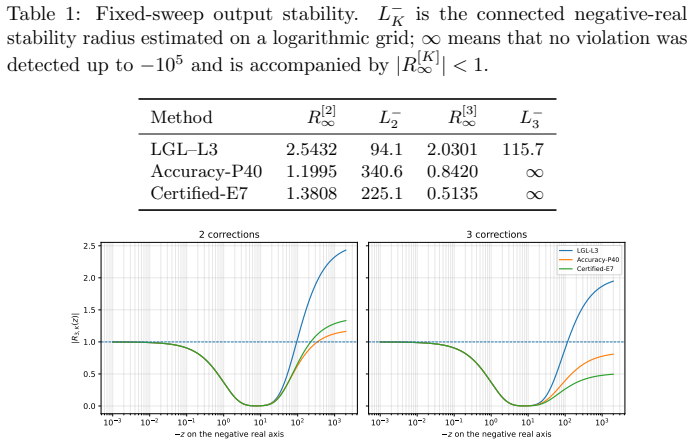
- The finite-sweep stability function after exactly two corrections has finite negative-real stability intervals even when the iteration spectral radius is below one; a third correction restores far-stiff output damping for the new designs.
- For generic parameters the architecture is only sixth order; the seventh-order member is an exceptional algebraic set, so a user must use the certified βE and complete both corrections to gain the order.
Where Pith is reading between the lines
- By symmetry of the argument, a similar rank-one collapse may hold for other predictors whose principal defect is one-directional and whose corrections act by grafting; testing H2 or H6 predictors under the same two-correction budget would show whether the phenomenon is broader.
- The co-design principle suggests that node–sweep optimization should be applied jointly to other multiderivative deferred-correction architectures; the scalar certificate makes such searches cheap, since only C7 or its analogues need vanish.
- The sharp distinction between iteration convergence and fixed-sweep output damping implies that any practical high-order code should expose a minimum-correction count and a far-stiff safeguard, as the paper does; this is testable by measuring R[K]_∞ on stiff linear and nonlinear problems.
- The exact algebraic cancellation might be extendable to higher order: rational nodes with small denominators plus coprimality checks against the next chain polynomial could yield certified order eight, provided the corresponding defect is still one-dimensional.
Editorial analysis
A structured set of objections, weighed in public.
Referee Report
Summary. The manuscript considers two-derivative Hermite deferred correction with s=3 subintervals, an H4 predictor, and exactly two correction sweeps. It claims that for this architecture the complete order-seven B-series defect is rank one: all 48 rooted-tree coefficients lie in the image of two unary graftings applied to the order-five predictor defect, and each nonzero coefficient equals 120 aex(θ) C7. Hence C7 = 0 is equivalent to all 48 seventh-order conditions. Using rational nodes (0, 7/20, 37/50, 1) and the algebraic root βE of p7 in (3/5, 5/8), the paper constructs Certified-E7 and uses coprimality with p8 to prove exact order seven. A second configuration, Accuracy-P40, minimizes the full principal-error norm subject to J_stiff < 0.40. The paper also proves a stopped-stability lower bound, distinguishes correction-iteration convergence from fixed-sweep output stability, and reports 60-digit nonlinear order tests plus Allen–Cahn and Cahn–Hilliard experiments.
Significance. The claimed rank-one collapse is a significant structural insight. It reduces a 48-dimensional nonlinear order-certification problem to one scalar coefficient for this specific predictor–correction architecture, and the algebraic certification machinery (rational nodes, primitive quadratic, root isolation, modular gcd) is elegant and, if correct, a strong contribution. The separation of fixed-sweep output stability from asymptotic correction convergence is also practically useful. The numerical experiments are appropriate: they use branched elementary differentials, which a scalar test cannot activate, and the phase-field tests connect the stiff design objective to work counts. The exact algebraic quantities in Appendix A are a useful audit trail, although the code itself is not shipped. The main weakness is that the two structural lemmas underpinning rank one are asserted rather than demonstrated at the coefficient level; this is fixable but must be addressed before the central claim is fully established.
major comments (3)
- [Section 4.4, Lemma 4.5] The transport assertion in the proof of Lemma 4.5 is load-bearing and is not proved. The text states that when a defect created on an earlier subinterval is transported through a subsequent exact or fourth-order substep, the derivative of the transport map is I + O(h), so the order-five homogeneous part is unchanged and all modifications begin at order six. This is not immediate: the H4 substep is not the exact flow, and the order-five defect is a B-series vector, not a scalar. A one-line O(h) argument does not show that the transported vector remains proportional to aex|T5 at order five. I recommend supplying a complete B-series induction for the composite predictor defect, or a supplementary exact table of the stage defects through order five. Without this, Theorem 4.7 does not follow from the written proof.
- [Section 4.4, Proposition 4.6] The tree-independence of recurrence (35) is the second load-bearing step. The proof asserts that h^2 g terms contribute only at order r+2 and that only the h f'(u) linearization contributes at r+1, but the coefficient-level derivation of (35) is not shown; Appendix A only states that applying (29)–(31) gives this recurrence. This is precisely the step where a tree-dependent coefficient would destroy rank one. Please expand the proof to show, by explicit B-series composition, that the order-(r+1) equation is scalar and independent of the tree structure of e_r, and include the nine order-seven multipliers instead of merely stating their squared sums 90 and 886.
- [Appendix A] The appendix says the accompanying code implements these recurrences and that its certificate file records the primitive polynomials, sign evaluations, Euclidean calculation, and all 48 order-seven checks, but no code or certificate file is included in the manuscript. Since the exactness claim rests on very large integer arithmetic and the 48-tree audit is not tabulated, the audit cannot be reproduced from the text alone. I request that the code/certificate be made available as supplementary material, or that a complete coefficient table be added to the appendix.
minor comments (4)
- [Section 4.4, Eq. (38)] Please state explicitly that the √90 and √886 values correspond to the unweighted and symmetry-weighted norms, respectively. The text says the nine supported multipliers have squared sums 90 and, after symmetry weighting, 886, but equation (38) places both identities together without marking which is which.
- [Section 6.2] A reader may wonder whether Certified-E7's exact order guarantee survives finite row tolerances; Proposition 3.3 addresses this, but the statement in Section 6.2 would benefit from a forward reference to (21).
- [Figure 2 / Table 3] The convergence rates for Certified-E7 at the finest intervals (6.982 and 6.945) are slightly below 7; the text attributes this to asymptotic order, but a comment on the magnitude of the order-seven error constant or the tolerance floor would help the reader interpret the rates.
- [Section 7.4] The reported wall times are not monotone in n; the text acknowledges this, but Figure 3 and Table 4 could be clearer if the medians were shown with quartiles instead of only in the text.
Circularity Check
No significant circularity: the rank-one order-seven defect theorem is derived from B-series arguments, and Certified-E7's parameter is solved from an exact recurrence then tested independently.
full rationale
The paper's central claim is that for the H4 predictor, s=3, and two corrections, the complete order-seven B-series defect is rank one, so that the scalar coefficient C7 controls all 48 rooted-tree conditions. This is not assumed but derived: Lemma 4.5 argues that each H4 substep's order-five defect is a scalar multiple of aex|T5 and that transport through later substeps leaves the order-five homogeneous part unchanged; Proposition 4.6 then derives, from an explicit Fréchet expansion, that the first new order is produced only by unary grafting with a tree-independent scalar stage recurrence (35). These are parameter-independent B-series arguments, and the theorem 4.7 proportionality to C7 is a consequence, not an input. The algebraic certificate solves C7(beta)=0 via an exact rational recurrence and proves exact order seven by coprimality of p7 and p8; the numerical tests are independent checks of that derivation. The only notable self-referential element is Accuracy-P40's reported 9.8% principal-error reduction, which is the value of the objective being minimized in equation (11); however, the paper does not present this as a prediction or as evidence for the rank-one theorem, so it is not load-bearing circularity. There are no author self-citations, no imported uniqueness theorems, and no ansatz smuggled in via citation. The unexpanded O(h) transport step in Lemma 4.5 is a proof-completeness point that an all-tree audit could test, but it does not reduce the conclusion to its own input.
Axiom & Free-Parameter Ledger
free parameters (3)
- betaE (Certified-E7 correction parameter) =
root of p7 in (3/5,5/8), approximately 0.61647415
- Certified-E7 nodes c1,c2 =
7/20, 37/50
- Accuracy-P40 nodes c1,c2 and beta =
0.303155, 0.721876, 0.572261
axioms (5)
- standard math B-series composition formulas (29)-(31) and rooted-tree enumeration through order eight.
- standard math Hermite interpolation remainder F-H = F^{(2s+2)}/(2s+2)! omega(tau) and the implicit-function theorem for stage solvability.
- domain assumption Dense Hermite collocation Jacobian is nonsingular for sufficiently small Delta t on each fixed finite-dimensional problem.
- ad hoc to paper Transport of an order-five defect through a later exact or fourth-order substep changes its homogeneous direction only at order six (Lemma 4.5 proof).
- ad hoc to paper Second-derivative (h^2 g) terms in the correction equation contribute only at order r+2, so the first new defect order is generated solely by unary grafting (Proposition 4.6).
read the original abstract
Two-derivative Hermite deferred correction combines high collocation order with sequential single-state solves, but the stopped method depends jointly on the nodes and the correction sweep. We co-design these ingredients for diffusion-dominated semilinear problems. For three subintervals, an H4 predictor, and two corrections, the complete order-seven B-series defect has rank one in the 48-dimensional rooted-tree space: two corrections apply two unary graftings to the one-directional order-five predictor defect. Hence one scalar chain coefficient controls every nonlinear principal-error condition. Rational nodes and an isolated algebraic correction parameter cancel this coefficient; coprimality with the order-eight chain polynomial proves classical order exactly seven. A complementary design, Accuracy-P40, retains generic sixth order but reduces the complete principal-error norm to $9.8\%$ of the LGL--L3 value while satisfying $J_{\mathrm{stiff}}<0.40$. We also distinguish convergence of repeated corrections from absolute stability after a fixed number of sweeps: two corrections have finite negative-real stability intervals, whereas a third correction restores far-stiff output damping for the new designs. High-precision nonlinear order tests verify sixth versus seventh order, and Allen--Cahn and Cahn--Hilliard calculations show that Accuracy-P40 reduces correction and Krylov work.
Figures


Reference graph
Works this paper leans on
-
[1]
On Explicit Two-Derivative Runge–Kutta Methods
R. P. K. Chan and A. Y. J. Tsai. “On Explicit Two-Derivative Runge–Kutta Methods”. In:Numerical Algorithms53 (2010), pp. 171–194
2010
-
[2]
A Two-Stage Fourth Order Time-Accurate Discretization for Lax– Wendroff Type Flow Solvers. I. Hyperbolic Conservation Laws
J. Li and Z. Du. “A Two-Stage Fourth Order Time-Accurate Discretization for Lax– Wendroff Type Flow Solvers. I. Hyperbolic Conservation Laws”. In:SIAM Journal on Scientific Computing38.5 (2016), A3046–A3069. 27
2016
-
[3]
Explicit Strong Stability Pre- serving Multistage Two-Derivative Time-Stepping Schemes
A. J. Christlieb, S. Gottlieb, Z. Grant, and D. C. Seal. “Explicit Strong Stability Pre- serving Multistage Two-Derivative Time-Stepping Schemes”. In:Journal of Scientific Computing68 (2016), pp. 914–942
2016
-
[4]
A Strong Stability Preserving Analysis for Explicit Multistage Two-Derivative Time-Stepping Schemes Based on Taylor Series Conditions
Z. Grant, S. Gottlieb, and D. C. Seal. “A Strong Stability Preserving Analysis for Explicit Multistage Two-Derivative Time-Stepping Schemes Based on Taylor Series Conditions”. In:Communications on Applied Mathematics and Computation1 (2019), pp. 21–59
2019
-
[5]
Implicit Multistage Two-Derivative Discontinuous Galerkin Schemes for Viscous Conservation Laws
A. Jaust, J. Schuetz, and D. C. Seal. “Implicit Multistage Two-Derivative Discontinuous Galerkin Schemes for Viscous Conservation Laws”. In:Journal of Scientific Computing 69 (2016), pp. 866–891
2016
-
[6]
High-Order Multiderivative IMEX Schemes
A. J. Dittmann. “High-Order Multiderivative IMEX Schemes”. In:Journal of Compu- tational Physics436 (2021), p. 110155
2021
-
[7]
Spectral Deferred Correction Methods for Ordinary Differential Equations
A. Dutt, L. Greengard, and V. Rokhlin. “Spectral Deferred Correction Methods for Ordinary Differential Equations”. In:BIT Numerical Mathematics40 (2000), pp. 241– 266
2000
-
[8]
Semi-Implicit Spectral Deferred Correction Methods for Ordinary Differential Equations
M. L. Minion. “Semi-Implicit Spectral Deferred Correction Methods for Ordinary Differential Equations”. In:Communications in Mathematical Sciences1.3 (2003), pp. 471–500
2003
-
[9]
Integral Deferred Correction Meth- ods Constructed with High Order Runge–Kutta Integrators
A. J. Christlieb, B. W. Ong, and J. -M. Qiu. “Integral Deferred Correction Meth- ods Constructed with High Order Runge–Kutta Integrators”. In:Mathematics of Computation79 (2010), pp. 761–783
2010
-
[10]
Parallel High-Order Integrators
A. J. Christlieb, C. B. Macdonald, and B. W. Ong. “Parallel High-Order Integrators”. In:SIAM Journal on Scientific Computing32.2 (2010), pp. 818–835
2010
-
[11]
A Multi-Level Spectral Deferred Correction Method
R. Speck, D. Ruprecht, M. Emmett, M. L. Minion, M. Bolten, and R. Krause. “A Multi-Level Spectral Deferred Correction Method”. In:BIT Numerical Mathematics 55 (2015), pp. 843–867
2015
-
[12]
Faster SDC Convergence on Non-Equidistant Grids by DIRK Sweeps
M. Weiser. “Faster SDC Convergence on Non-Equidistant Grids by DIRK Sweeps”. In: BIT Numerical Mathematics55 (2015), pp. 1219–1241
2015
-
[13]
On the Convergence of Spectral Deferred Correction Methods
M. F. Causley and D. C. Seal. “On the Convergence of Spectral Deferred Correction Methods”. In:Communications in Applied Mathematics and Computational Science 14 (2019), pp. 33–64
2019
-
[14]
Improving Efficiency of Parallel Across the Method Spectral Deferred Corrections
G. ˇCaklovi´ c, T. Lunet, S. G¨ otschel, and D. Ruprecht. “Improving Efficiency of Parallel Across the Method Spectral Deferred Corrections”. In:SIAM Journal on Scientific Computing47.1 (2025), A430–A453
2025
-
[15]
On the Analysis of Spectral Deferred Corrections for Differential–Algebraic Equations of Index One
M. Bolten and L. Wimmer. “On the Analysis of Spectral Deferred Corrections for Differential–Algebraic Equations of Index One”. In:Journal of Scientific Computing 108 (2026), p. 67
2026
-
[16]
Parallel-in-Time High-Order Multiderivative IMEX Solvers
J. Schuetz, D. C. Seal, and J. Zeifang. “Parallel-in-Time High-Order Multiderivative IMEX Solvers”. In:Journal of Scientific Computing90.1 (2022), p. 54
2022
-
[17]
Implicit Two-Derivative Deferred Correction Time Dis- cretization for the Discontinuous Galerkin Method
J. Zeifang and J. Schuetz. “Implicit Two-Derivative Deferred Correction Time Dis- cretization for the Discontinuous Galerkin Method”. In:Journal of Computational Physics464 (2022), p. 111353
2022
-
[18]
Stability of Implicit Multiderivative Deferred Correction Methods
J. Zeifang, J. Schuetz, and D. C. Seal. “Stability of Implicit Multiderivative Deferred Correction Methods”. In:BIT Numerical Mathematics62 (2022), pp. 1487–1503
2022
-
[19]
J. C. Butcher.B-Series: Algebraic Analysis of Numerical Methods. Springer, 2021
2021
-
[20]
On the Stability and Accuracy of One-Step Methods for Solving Stiff Systems of Ordinary Differential Equations
A. Prothero and A. Robinson. “On the Stability and Accuracy of One-Step Methods for Solving Stiff Systems of Ordinary Differential Equations”. In:Mathematics of Computation28 (1974), pp. 145–162
1974
-
[21]
Hairer and G
E. Hairer and G. Wanner.Solving Ordinary Differential Equations II: Stiff and Differential-Algebraic Problems. 2nd ed. Springer, 1996
1996
-
[22]
A Microscopic Theory for Antiphase Boundary Motion and Its Application to Antiphase Domain Coarsening
S. M. Allen and J. W. Cahn. “A Microscopic Theory for Antiphase Boundary Motion and Its Application to Antiphase Domain Coarsening”. In:Acta Metallurgica27.6 (1979), pp. 1085–1095
1979
-
[23]
Free Energy of a Nonuniform System. I. Interfacial Free Energy
J. W. Cahn and J. E. Hilliard. “Free Energy of a Nonuniform System. I. Interfacial Free Energy”. In:The Journal of Chemical Physics28.2 (1958), pp. 258–267
1958
-
[24]
L-Stable Spectral Deferred Correction Methods and Applications to Phase Field Models
L. Yao, Y. Xia, and Y. Xu. “L-Stable Spectral Deferred Correction Methods and Applications to Phase Field Models”. In:Applied Numerical Mathematics197 (2024), pp. 288–306. 28
2024
discussion (0)
Sign in with ORCID, Apple, or X to comment. Anyone can read and Pith papers without signing in.