REVIEW 6 major objections 5 minor 56 references
A single Fourier Neural Operator closure, trained online inside a differentiable fluid solver, reproduces both linear and nonlinear electrostatic Landau damping and generalises across initial perturbation amplitudes.
Reviewed by Pith at T0; open to challenge. T0 means a machine referee read the full paper against a public rubric. the ladder, T0–T4 →
An online-trained Fourier Neural Operator with a memory window reproduces linear and nonlinear Landau damping in a 1D electrostatic fluid model and interpolates across initial amplitudes.
T0 review reviewed 2026-08-03 challenge →
load-bearing objection Honest, well-scoped demonstration of online-trained non-Markovian FNO closure for 1D Landau damping; the core result holds for the single-mode setup, but the abstract oversells generalization and the closure is explicitly solver-coupled. the 6 major comments →
A Neural Operator Closure for Landau Damping in Electrostatic Plasma
The pith
A machine-rendered reading of the paper's core claim, the machinery that carries it, and where it could break.
The reading
Core claim
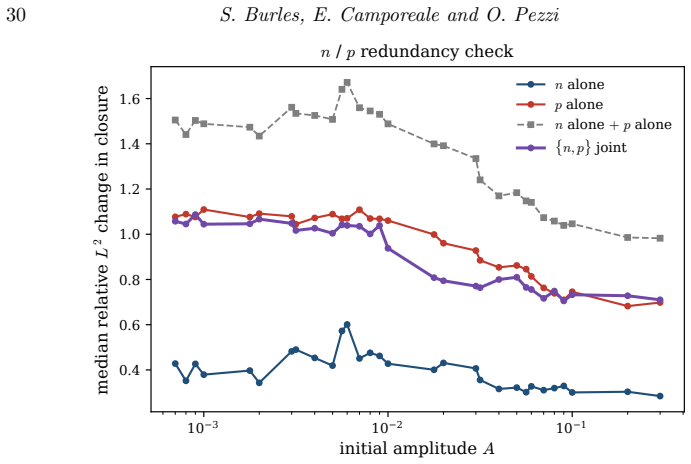
The paper's central claim is that a single Fourier Neural Operator, trained a posteriori by backpropagating through a differentiable fluid solver, supplies the heat-flux-gradient closure that the one-dimensional electrostatic moment hierarchy needs to reproduce Landau damping. Deployed in the same fluid solver, the FNO recovers the linear damping rate to within about 0.2 percent in the training window and reproduces the nonlinear saturation and bounce oscillations of the trapped state over hundreds of plasma periods. One FNO, trained on amplitudes from 10^-3 to 10^-1 and conditioned on a log-amplitude channel, tracks the damping rate through the linear-to-nonlinear transition and interpolate
What carries the argument
The load-bearing object is the Fourier Neural Operator closure for the heat-flux gradient, ∂xq, entering the pressure equation of a 1D electrostatic fluid model. The FNO has eight Fourier layers with 32 retained modes and 64 hidden channels; its 251 input channels consist of five resolved fields {n, u, p, E, ∂xq} over a trailing window of K=50 timesteps (a non-Markovian memory horizon of 5 omega_p^-1), plus a spatially constant log-amplitude conditioning channel that lets one model modulate between linear and nonlinear regimes. Inputs are normalised by the RMS density perturbation amplitude and passed through an inverse-hyperbolic-sine transform to compress dynamic range. Online training is
Load-bearing premise
The learned closure is defined only through its effect on one specific discretised fluid solver—SSPRK3 time stepping, second-order central differences, a 128-point grid, and fixed wavenumber k=0.35—so if the effective heat flux does not transfer to other solvers, grids, or wavenumbers, the claim of a broadly applicable learned plasma closure collapses.
What would settle it
Deploy the trained FNO in the same physical setup but with a different time integrator or grid (e.g., classical RK4 or 256 spatial points) and compare the closed-fluid trajectory to the Vlasov ground truth; if it becomes unstable or drifts beyond the error level reported in the paper, the portability claim is falsified. A sharper test: train at k=0.35 and run at k=0.5 with the same amplitudes; failure there would show the closure has learned the specific mode, not the damping mechanism.
If this is right
- A learned fluid closure can replace analytic linear-theory closures like Hammett-Perkins for problems where both linear and nonlinear regimes matter, using a single model rather than a regime switch.
- Online-trained closures are stable in deployment by construction; the paper's matched comparison suggests that a-priori-optimal closures can be stable or accurate in pointwise flux but still fail to reproduce resolved-moment trajectories.
- The heat flux in a truncated fluid model should be judged by its effect on the resolved moments, not by pointwise agreement with the kinetic flux; the learned effective flux is a legitimate closure even where it diverges from the kinetic one.
- The amplitude-conditioning channel and input normalisation allow one model to span several decades of perturbation amplitude, so training sets need not cover every amplitude, only the regimes.
- Memory-window dependence is physically structured (peak sensitivity at lags separated by the oscillation period), suggesting that finite-memory neural closures can encode genuine kinetic memory rather than being arbitrary fits.
Where Pith is reading between the lines
- Editorial extension: the fixed wavenumber k=0.35 is the true test boundary; the same recipe should be tried across wavenumbers, since the closure's memory of phase mixing is likely k-dependent, and the paper does not claim transfer across k.
- Editorial extension: the sensitivity diagnostics suggest a testable refinement—if the memory window were shortened below the bounce period in the nonlinear regime, accuracy should degrade; scanning K would map the memory requirement quantitatively.
- Editorial extension: because the effective flux is scheme-dependent, portability between fluid codes may require either retraining per discretisation or a parametrisation that conditions on discretisation metadata—an open problem the paper flags as future work.
- Editorial extension: the same online-training-with-memory recipe may apply to other unresolved kinetic effects (e.g., pressure anisotropy in 2D/3D or electromagnetic fluctuations), where the Mori-Zwanzig memory integral is similarly non-trivial; the 1D electrostatic case is a proof-of-concept.
Editorial analysis
A structured set of objections, weighed in public.
Referee Report
Summary. The paper proposes a data-driven closure for the one-dimensional electrostatic fluid equations, replacing the heat-flux-gradient term in the pressure equation with a Fourier Neural Operator (FNO) trained online: the loss is computed on trajectories of a differentiable SSPRK3 solver closed by the FNO, rather than on pointwise fits to kinetic heat-flux data. The closure is non-Markovian, acting on a trailing K=50-step memory window of the resolved moments, with an amplitude-conditioning channel logA_scale. The authors train single-amplitude closures for linear (A=1e-3) and nonlinear (A=1e-1) Landau damping, and a multi-amplitude closure trained on A=1e-3 to 1e-1 at four points per decade. They report that the online-trained closures reproduce the kinetic electric-field energy evolution in both regimes, that the multi-amplitude closure interpolates across held-out amplitudes and extrapolates to amplitudes below the training range, and that the learned flux should be interpreted as an effective, scheme-dependent closure rather than the true kinetic heat flux. Comparison is made against an offline-trained FNO (which fails in the matched configuration) and against a calibrated Hammett-Perkins closure (which fails in the nonlinear regime). A sensitivity/ablation analysis is used to argue that the closure computes a genuine moment-to-flux relation with physically structured memory use.
Significance. If the central claims hold, the paper would be a useful demonstration that an online-trained, non-Markovian neural closure can reproduce both linear and nonlinear Landau damping with a single model, and that a posteriori training yields stable deployment in the same solver. The memory-window design, the amplitude-conditioning channel, and the explicit ablation/HSIC analysis are valuable contributions, and the authors are appropriately candid about the scheme dependence of the learned object. However, the paper's headline claims currently outrun the evidence: the generalization claim is only true below the training envelope, all reported errors come from single runs without seed variability, and the closure is only tested in the exact solver/grid/wavenumber used for training. The Hammett-Perkins benchmark is calibrated to the kinetic damping rate, so its linear-rate agreement is by construction. These issues are load-bearing for the abstract's wording about generalization and broad applicability, though the underlying method remains plausible and worthy of revision.
major comments (6)
- [§4.3, Fig. 5(a), Fig. 6] The abstract states the closure 'generalises to initial perturbation amplitudes outside the training set,' but the evidence shows this is only true for extrapolation below the training minimum. At A=0.2 and A=0.3, which lie above A_max=0.1, the damping rate departs sharply from the kinetic value and the WE(t) envelope is over-predicted (Fig. 5a and the last two panels of Fig. 6). The paper itself describes this as a 'failure to extrapolate above the training envelope.' The claim in the abstract and Section 1 should be qualified to specify interpolation and downward extrapolation, and the failure mode should be acknowledged in the abstract.
- [§3.2 and §4.4] The closure outputs ∂xq directly with no zero-mean constraint, so it can inject a spatially uniform source/sink into the pressure equation. On a periodic domain, no true heat-flux gradient can have a nonzero spatial mean, since ∫∂xq dx=0. The authors justify this as allowing net heating from Landau damping, but it means the learned object is not a physical closure in the standard sense; it is a solver-embedded effective term. This is consistent with the paper's own admission that the flux is 'not a unique or scheme-independent object' (§4.4) and that the FNO is 'tightly coupled to this particular numerical method' (§3.2). This combination undercuts the 'broadly applicable learned plasma closure' framing. The authors should either impose the zero-mean constraint and assess the consequences, or explicitly reframe the contribution as a solver-specific correction and provide a portability te
- [§4.1, Table 4, Table 6] The linear-regime claim of reproducing Landau damping is stated without the important test-window caveat. The fitted damping rate in the test window (t>75) has relative error 1.82e-1 (18%), and the electric-field error crosses 10% only 1.4 ω_p^{-1} after leaving the training window, reaching 50% at 45 ω_p^{-1} and 100% at 55 ω_p^{-1}. The paper does acknowledge this drift as 'expected,' but the abstract's unqualified 'reproduces both linear and nonlinear Landau damping' masks a substantial generalization gap in the linear case. The authors should either report the test-window degradation in the abstract/claims or define the reproduction claim only over the trained window and the nonlinear long-time behavior, where the performance is genuinely better.
- [§3.6, Table 4] The Hammett-Perkins benchmark coefficient is calibrated by matching the kinetic linear damping rate (χ=√(4.8/π)≈1.24, 22% below the canonical √(8/π)). Therefore, the statement that 'the calibrated closure reproduces the damping rate' (Table 4 caption) is true by construction and cannot serve as independent validation. The meaningful comparison is the oscillation frequency, where HP is shown to have a ~5% error. The paper should clearly label the HP linear-rate agreement as a calibration check, not a predictive success, and should avoid implying that HP validation strengthens the case for the FNO.
- [§4.1, §4.2, §4.3; Tables 4-6] All quantitative results are based on a single trained model for each configuration, with no repeated training seeds, no error bars, and no measure of training variability. Since the FNO training is stochastic (AdamW, random initialization, data sampling), the reported accuracy could be seed-dependent. The authors should either train multiple seeds and report mean/standard deviation for the key metrics (damping rates, errors, t_div), or at least state that all results are single-run and cannot be used to infer statistical robustness. This is particularly important for the claimed visual agreement in Figs. 1 and 3, which may not be representative.
- [§3.2, §5] The portability limitation is acknowledged in §3.2, but the paper still frames the contribution as a step toward closures 'suitable for large-scale fluid simulation.' All online tests use the same SSPRK3 integrator, second-order central differences, 128-point grid, and fixed k=0.35; no test is performed with a different spatial resolution, timestep, integrator, or wavenumber. As the reader's report notes, the learned effective flux is only defined through its action on this specific discretized dynamics. A minimal transfer test (e.g., varying Nx or Δt) would materially strengthen the portability claim. Without it, the conclusions should be restricted to the exact numerical configuration used.
minor comments (5)
- [Figure 3(b) caption] The panel title reads 'Linear (A=10^-1) (Offline Training)' but the case is the nonlinear amplitude A=10^-1. This is a typographical inconsistency with the surrounding text and should be corrected to 'Nonlinear'.
- [Figure 5(a) legend] The legend entry 'Landau' is ambiguous; it likely denotes the theoretical linear Landau rate. Please label it explicitly, e.g., 'linear Landau rate γ_Landau = ...'.
- [§3.2, Eq. (3.7)] The notation M_t is used for the window of K slots, and later M^(1), M^(2) for substage windows. The distinction between the accepted-state buffer and the provisional overwritten slot is described in prose but would be clearer if the buffer update rule were written as an explicit algorithm or pseudocode.
- [§4.5, Figure 10] The HSIC lag analysis is carefully caveated regarding autocorrelation, but the same caveat applies to Figure 12's correlation analysis where inputs are asinh-normalized; please state the normalization explicitly in the text or caption to avoid confusion.
- [§3.4, Table 3] The statement that 'the batch size is selected dynamically to make use of available GPU memory' and that 'the value of 50 corresponds to the 40GB A100' is helpful, but it would be useful to report the total number of training iterations per epoch (or total snapshot count) for reproducibility.
Circularity Check
Minor by-construction agreement in the calibrated Hammett-Perkins baseline; the FNO closure itself is an honest supervised-learning claim with genuine held-out-amplitude tests.
specific steps
-
fitted input called prediction
[§3.6 (Hammett-Perkins closure benchmark) and §4.1 / Table 4]
"At our k = 0.35 the canonical coefficient sqrt(8/pi) ≈ 1.60 over-damps the mode; we therefore calibrate the coefficient to match the kinetic linear damping rate, obtaining chi = sqrt(4.8/pi) ≈ 1.24, 22% below the canonical value. ... With the calibrated coefficient the Hammett-Perkins fluid WE(t) tracks the kinetic decay envelope and rate across the full run, with a fitted damping rate gamma_HP = -3.52e-2 (Table 4), matching the kinetic rate by construction."
The HP baseline's single free coefficient χ is fitted to exactly the quantity that Table 4 then reports as agreement: the kinetic linear damping rate at k = 0.35. The matching rate is therefore tautological, as the paper itself states ('matching the kinetic rate by construction'). This is a benchmark calibration, not a prediction, and it does not bear on the FNO's central claim; the FNO's in-sample agreement is likewise a fit, while the paper's independent content lies in the held-out amplitude tests (§4.3), which are genuine out-of-sample evaluations.
full rationale
The central claim is a machine-learning closure trained online against kinetic moment trajectories and tested against the same kind of ground truth; that is supervised learning, not circular derivation. The FNO is not constructed to output the kinetic heat flux or to match any fitted damping rate; it is optimized on trajectory loss and then evaluated on held-out data, including amplitudes below the training minimum (where it succeeds) and above it (where it fails). The paper's own limitations sections are explicit that the learned flux is solver-dependent and not unique, which is an honest scope restriction rather than a circular step. Self-citations (the Burles & Camporeale review, Pezzi et al. solver papers) are used for context and numerical method, not to justify a conclusion. The only by-construction agreement in the paper is the Hammett-Perkins baseline coefficient, which is calibrated to the kinetic damping rate and then reported as matching it 'by construction'; this is a minor, admitted artifact of a benchmark and does not affect the FNO result. Overall circularity is therefore low: score 2.
Axiom & Free-Parameter Ledger
free parameters (3)
- FNO network weights =
~millions of parameters (8 Fourier layers, 64 hidden channels)
- Hammett-Perkins coefficient χ =
sqrt(4.8/π) ≈ 1.24
- Memory window length K =
50 steps (5 ω_p^{-1})
axioms (6)
- domain assumption Vlasov-Poisson kinetic simulation provides a faithful ground truth for collisionless Landau damping.
- domain assumption The moment hierarchy can be truncated at pressure if a suitable effective heat flux is learned (Mori-Zwanzig projection).
- domain assumption The FNO architecture (8 Fourier layers, 32 modes, 64 channels) is expressive enough for the closure.
- domain assumption The specific fluid discretization (SSPRK3, 2nd-order central differences) is representative for the closure's deployment.
- domain assumption Kinetic simulations are collisionless and noise-free; no collisional operators are used.
- domain assumption The single-wavenumber perturbation (k=0.35) is representative of the linear-to-nonlinear transition.
Cite this review
Pith. "Pith review of A Neural Operator Closure for Landau Damping in Electrostatic Plasma." pith.science (2026). https://pith.science/paper/CO2ZVXJT
@misc{pith2026260729364,
  author       = {Pith},
  title        = {Pith review of: A Neural Operator Closure for Landau Damping in Electrostatic Plasma},
  year         = {2026},
  howpublished = {\url{https://pith.science/paper/CO2ZVXJT}},
  note         = {Machine review of arXiv:2607.29364}
}
read the original abstract
We present a data-driven plasma fluid closure for both linear and nonlinear electrostatic Landau damping in one dimension. A Fourier Neural Operator (FNO) is trained online within a differentiable fluid solver, with the loss computed on trajectories produced by the closed fluid simulation rather than on individual kinetic snapshots. The closure is non-Markovian, acting on a trailing window of the resolved moment history so as to represent the memory of the unresolved dynamics. We demonstrate that a single FNO trained in this way reproduces both linear and nonlinear Landau damping, generalises to initial perturbation amplitudes outside the training set, and remains numerically stable when deployed in independent fluid simulations. In the nonlinear regime the learned heat flux reproduces the resolved-moment dynamics without matching the kinetic heat flux pointwise, behaving as an effective closure that compensates for the truncated higher moments, though the learned specific flux is expected to depend on the numerical scheme and training data. A sensitivity analysis of the trained model shows that it computes a genuine moment-to-flux relation whose reliance on the memory window is physically structured.
Figures


Reference graph
Works this paper leans on
-
[1]
Physics of Plasmas , keywords =
Eulerian simulations of collisional effects on electrostatic plasma waves. Physics of Plasmas , keywords =. doi:10.1063/1.4821613 , archivePrefix =. 1307.0683 , primaryClass =
-
[2]
Physics of Plasmas , keywords =
Phase space dynamics of unmagnetized plasmas: Collisionless and collisional regimes. Physics of Plasmas , keywords =. doi:10.1063/5.0160549 , archivePrefix =. 2306.03567 , primaryClass =
-
[3]
Journal of Plasma Physics , keywords =
ViDA: a Vlasov-DArwin solver for plasma physics at electron scales. Journal of Plasma Physics , keywords =. doi:10.1017/S0022377819000631 , archivePrefix =. 1905.02953 , primaryClass =
Pith/arXiv arXiv 1905
-
[4]
Francis Filbet and Lorenzo Pareschi , abstract =. A Numerical Method for the Accurate Solution of the Fokker–Planck–Landau Equation in the Nonhomogeneous Case , journal =. 2002 , issn =. doi:https://doi.org/10.1006/jcph.2002.7010 , url =
arXiv 2002
-
[5]
The integration of the vlasov equation in configuration space , journal =
C.Z Cheng and Georg Knorr , abstract =. The integration of the vlasov equation in configuration space , journal =. 1976 , issn =. doi:https://doi.org/10.1016/0021-9991(76)90053-X , url =
-
[6]
A. Mangeney and F. Califano and C. Cavazzoni and P. Travnicek , abstract =. A Numerical Scheme for the Integration of the Vlasov–Maxwell System of Equations , journal =. 2002 , issn =. doi:https://doi.org/10.1006/jcph.2002.7071 , url =
arXiv 2002
-
[7]
Proceedings of the Royal Society of London
The. Proceedings of the Royal Society of London. A. Mathematical and Physical Sciences , author =. 1956 , pages =. doi:10.1098/rspa.1956.0116 , abstract =
arXiv 1956
-
[8]
Physical Review Letters , author =
Fluid moment models for. Physical Review Letters , author =. 1990 , pages =. doi:10.1103/PhysRevLett.64.3019 , language =
-
[9]
Journal of Geophysical Research: Space Physics , author =
Do. Journal of Geophysical Research: Space Physics , author =. 2022 , note =. doi:10.1029/2021JA030241 , abstract =
-
[10]
Lautenbach, Simon and Grauer, Rainer , month = oct, year =. Multiphysics. Frontiers in Physics , publisher =. doi:10.3389/fphy.2018.00113 , abstract =
arXiv 2018
-
[11]
Burles, Samuel and Camporeale, Enrico , month = apr, year =. The. doi:10.48550/arXiv.2511.22486 , abstract =
work page internal anchor Pith review Pith/arXiv arXiv doi:10.48550/arxiv.2511.22486
-
[12]
Hybrid simulations of magnetic reconnection with kinetic ions and fluid electron pressure anisotropy , volume =. Physics of Plasmas , author =. 2016 , pages =. doi:10.1063/1.4943893 , abstract =
-
[13]
Physical Review Letters , author =
Equations of. Physical Review Letters , author =. 2009 , pages =. doi:10.1103/PhysRevLett.102.085001 , language =
-
[14]
Ohia, O. and Egedal, J. and Lukin, V. S. and Daughton, W. and Le, A. , month = sep, year =. Demonstration of. Physical Review Letters , publisher =. doi:10.1103/PhysRevLett.109.115004 , abstract =
-
[15]
Landau fluid models of collisionless magnetohydrodynamics , volume =. Physics of Plasmas , author =. 1997 , pages =. doi:10.1063/1.872517 , abstract =
-
[16]
An improved ten-moment closure for reconnection and instabilities , volume =. Physics of Plasmas , author =. 2020 , pages =. doi:10.1063/5.0012067 , abstract =
-
[17]
Comparison of multi-fluid moment models with particle-in-cell simulations of collisionless magnetic reconnection , volume =. Physics of Plasmas , author =. 2015 , pages =. doi:10.1063/1.4906063 , abstract =
-
[18]
A. Physics of Plasmas , author =. 2005 , pages =. doi:10.1063/1.2096582 , abstract =
-
[19]
Journal of Geophysical Research: Space Physics , author =
A fluid model with finite. Journal of Geophysical Research: Space Physics , author =. 2006 , note =. doi:10.1029/2005JA011425 , abstract =
-
[20]
Journal of Plasma Physics , author =
Landau fluid closures with nonlinear large-scale finite. Journal of Plasma Physics , author =. 2015 , pages =. doi:10.1017/S0022377814000671 , abstract =
-
[21]
Machine learning surrogate models for. Physics of Plasmas , author =. 2020 , pages =. doi:10.1063/1.5129158 , abstract =
-
[22]
Neural network representability of fully ionized plasma fluid model closures , volume =. Physics of Plasmas , author =. 2020 , pages =. doi:10.1063/5.0006457 , abstract =
-
[23]
Identification of high order closure terms from fully kinetic simulations using machine learning , url =
Laperre, Brecht and Amaya, Jorge and Jamal, Sara and Lapenta, Giovanni , month = mar, year =. Identification of high order closure terms from fully kinetic simulations using machine learning , url =
-
[24]
Electron neural closure for turbulent magnetosheath simulations: energy channels , shorttitle =
Miloshevich, George and Vranckx, Luka and Lopes, Felipe Nathan de Oliveira and Dazzi, Pietro and Arrò, Giuseppe and Lapenta, Giovanni , month = sep, year =. Electron neural closure for turbulent magnetosheath simulations: energy channels , shorttitle =. doi:10.48550/arXiv.2510.00282 , abstract =
-
[25]
Proceedings of the National Academy of Sciences , author =
Machine-learning heat flux closure for multi-moment fluid modeling of nonlinear. Proceedings of the National Academy of Sciences , author =. 2025 , note =. doi:10.1073/pnas.2419073122 , abstract =
-
[26]
Qin, Yilan and Ma, Jiayu and Jiang, Mingle and Dong, Chuanfei and Fu, Haiyang and Wang, Liang and Cheng, Wenjie and Jin, Yaqiu , month = aug, year =. Data-driven modeling of. Physical Review Research , publisher =. doi:10.1103/PhysRevResearch.5.033079 , abstract =
-
[27]
Liu, Kexin and Cheng, Wenjie and Fu, Haiyang and Jiang, Mingle and Ma, Jiayu and Qin, Yilan , month = dec, year =. Data-driven. 2022. doi:10.1109/ACES-China56081.2022.10065169 , abstract =
arXiv 2022
-
[28]
Machine Learning: Science and Technology , author =
Machine learning of hidden variables in multiscale fluid simulation , volume =. Machine Learning: Science and Technology , author =. 2023 , pages =. doi:10.1088/2632-2153/acf81a , abstract =
-
[29]
Physical Review Research , author =
Embedding physical symmetries into machine-learned reduced plasma physics models via data augmentation , volume =. Physical Review Research , author =. 2026 , note =. doi:10.1103/9fq1-vpqz , abstract =
-
[30]
Generalized neural closure models with interpretability , volume =. Scientific Reports , author =. 2023 , pmid =. doi:10.1038/s41598-023-35319-w , abstract =
-
[31]
Li, T. and Biferale, L. and Bonaccorso, F. and Scarpolini, M. A. and Buzzicotti, M. , month = apr, year =. Synthetic. Nature Machine Intelligence , publisher =. doi:10.1038/s42256-024-00810-0 , abstract =
-
[32]
Brunton, Steven L. and Noack, Bernd R. and Koumoutsakos, Petros , month = jan, year =. Machine. Annual Review of Fluid Mechanics , publisher =. doi:10.1146/annurev-fluid-010719-060214 , abstract =
-
[33]
Plasma Physics and Controlled Fusion , author =
Plasma. Plasma Physics and Controlled Fusion , author =. 2003 , pages =. doi:10.1088/0741-3335/45/6/701 , abstract =
-
[34]
Collisional effects on the numerical recurrence in. Physics of Plasmas , author =. 2016 , pages =. doi:10.1063/1.4940963 , abstract =
-
[35]
Wei, Shichen and Liu, Yuhong and Fu, Haiyang and Dong, Chuanfei and Wang, Liang , month = aug, year =. Data-. 2023. doi:10.23919/ACES-China60289.2023.10249492 , abstract =
arXiv 2023
-
[36]
Li, Zongyi and Kovachki, Nikola and Azizzadenesheli, Kamyar and Liu, Burigede and Bhattacharya, Kaushik and Stuart, Andrew and Anandkumar, Anima , month = may, year =. Fourier. doi:10.48550/arXiv.2010.08895 , abstract =
-
[37]
The Physics of Fluids , author =
Collisionless. The Physics of Fluids , author =. 1965 , pages =. doi:10.1063/1.1761193 , abstract =
-
[38]
and Trivelpiece, Alvin W
Krall, Nicholas A. and Trivelpiece, Alvin W. , year =. Principles of
-
[39]
Journal of Advances in Modeling Earth Systems , author =
A Posteriori Learning for Quasi-Geostrophic Turbulence Parametrization , volume =. Journal of Advances in Modeling Earth Systems , author =. 2022 , pages =. doi:10.1029/2022MS003124 , number =
-
[40]
Physical Review Fluids , author =
Embedded training of neural-network subgrid-scale turbulence models , volume =. Physical Review Fluids , author =. 2021 , pages =. doi:10.1103/PhysRevFluids.6.050502 , number =
-
[41]
Shankar, Varun and Chakraborty, Dibyajyoti and Viswanathan, Venkatasubramanian and Maulik, Romit , year =. Differentiable Turbulence: Closure as a partial differential equation constrained optimization , url =. doi:10.48550/arXiv.2307.03683 , publisher =
-
[42]
Foundations of Data Science , author =
Scientific machine learning for closure models in multiscale problems: a review , volume =. Foundations of Data Science , author =. 2024 , pages =. doi:10.3934/fods.2024043 , number =
-
[43]
Proceedings of the Royal Society A , author =
A priori estimation of memory effects in reduced-order models of nonlinear systems using the. Proceedings of the Royal Society A , author =. 2017 , pages =. doi:10.1098/rspa.2017.0385 , number =
arXiv 2017
-
[44]
Physical Review Fluids , author =
Non-. Physical Review Fluids , author =. 2017 , pages =. doi:10.1103/PhysRevFluids.2.014604 , number =
-
[45]
Recurrent neural network closure of parametric
Wang, Qian and Ripamonti, Nicol\`. Recurrent neural network closure of parametric. 2020 , pages =. doi:10.1016/j.jcp.2020.109402 , journal =
arXiv 2020
-
[46]
Nature Machine Intelligence , author =
Learning nonlinear operators via. Nature Machine Intelligence , author =. 2021 , pages =. doi:10.1038/s42256-021-00302-5 , number =
-
[47]
Measuring Statistical Dependence with
Gretton, Arthur and Bousquet, Olivier and Smola, Alex and Sch\". Measuring Statistical Dependence with. 2005 , pages =. doi:10.1007/11564089_7 , booktitle =
-
[48]
SIAM/ASA Journal on Uncertainty Quantification , author =
Shapley Effects for Global Sensitivity Analysis: Theory and Computation , volume =. SIAM/ASA Journal on Uncertainty Quantification , author =. 2016 , pages =. doi:10.1137/15M1048070 , number =
-
[49]
and Lee, Su-In , year =
Lundberg, Scott M. and Lee, Su-In , year =. A Unified Approach to Interpreting Model Predictions , booktitle =
-
[50]
SIAM/ASA Journal on Uncertainty Quantification , author =
On Shapley Value for Measuring Importance of Dependent Inputs , volume =. SIAM/ASA Journal on Uncertainty Quantification , author =. 2017 , pages =. doi:10.1137/16M1097717 , number =
-
[51]
Journal of Plasma Physics , author =
A learned closure method applied to phase mixing in a turbulent gradient-driven gyrokinetic system in simple geometry , volume =. Journal of Plasma Physics , author =. 2022 , keywords =. doi:10.1017/S0022377822000095 , abstract =
-
[52]
Advances in Neural Information Processing Systems , volume =
Paszke, Adam and Gross, Sam and Massa, Francisco and Lerer, Adam and Bradbury, James and Chanan, Gregory and Killeen, Trevor and Lin, Zeming and Gimelshein, Natalia and Antiga, Luca and Desmaison, Alban and K. Advances in Neural Information Processing Systems , volume =
-
[53]
arXiv preprint arXiv:2412.10354 , year =
A Library for Learning Neural Operators , author =. arXiv preprint arXiv:2412.10354 , year =
-
[54]
Journal of Plasma Physics , author =
An introductory guide to fluid models with anisotropic temperatures. Journal of Plasma Physics , author =. 2019 , keywords =. doi:10.1017/S0022377819000801 , abstract =
-
[55]
Hunana, P. and Zank, G.P. and Laurenza, M. and Tenerani, A. and Webb, G.M. and Goldstein, M.L. and Velli, M. and Adhikari, L. , month = sep, year =. New. Physical Review Letters , publisher =. doi:10.1103/PhysRevLett.121.135101 , abstract =
-
[56]
Journal of Plasma Physics , author =
An introductory guide to fluid models with anisotropic temperatures. Journal of Plasma Physics , author =. 2019 , keywords =. doi:10.1017/S0022377819000850 , abstract =
This paper was first reviewed by deepseek-v4-flash on August 3, 2026.
discussion (0)
Sign in with ORCID, Apple, or X to comment. Anyone can read and Pith papers without signing in.