REVIEW 2 major objections 4 minor 25 references
Gas Phase Ion Species Released During Grain Collisions: Implications For Protoplanetary Disks
T0 review · 2 major / 4 minor · reviewed 2026-08-03 · deepseek-v4-flash
Pith's one-line read Colliding dust grains release adsorbed water into the surrounding gas even at very low pressure, giving protoplanetary disks a potential in situ source of water molecules and ions.
desk verdict A first species-level measurement of what grain collisions release into gas, with a plausible water signal but a title that overpromises on 'ion species'. read the letter →
The pith
A machine-rendered reading of the paper's core claim, the machinery that carries it, and where it could break.
The reading
What carries the argument
The instrument is a quadrupole mass spectrometer that ionizes incoming molecules and measures them by mass-to-charge ratio, with a range of 1–200 u. Collisions are generated in two complementary devices inside the same ultrahigh-vacuum chamber: a rotating mesh cylinder containing about 200 glass beads of mixed sizes, and a lever arm that slides a few beads over a bed of fixed beads. The decisive comparison is differential—the signal recorded without particles, which folds in feedthrough motion and residual-gas background, is subtracted from the with-particle signal. A second analytical step compares the water-related mass ratios to a known water cracking pattern to test whether the observed
What would settle it
Run the rotating mesh cylinder through the same pressure range and rotation speeds with no grains inside; if the water-related signal rises with rotation exactly as it does with grains, then the excess is not caused by grain collisions. A second, complementary check: use freshly baked grains that have been degassed in vacuum; if the collision signal for water disappears, the source is adsorbed surface water; if it remains, the water is produced by the collision itself.
Extended reading notes
Core claim
The central claim, stated on the paper's own terms, is that mutual collisions between untreated glass beads under high vacuum release adsorbed water into the gas phase. The evidence is a mass-spectrometric excess: for water-related masses, the signal with particles clearly exceeds the pressure-matched calibration signal without particles, and the excess disappears when the grains stop moving. Comparing the relative abundances of H3O, OH, H, H2, and H2O with a known 75 eV water cracking pattern shows that every measured ratio lies inside the uncertainty interval expected from cracking, so the experiment cannot yet say whether water enters the spectrometer as intact ions, radicals, or neutral
Load-bearing premise
The central claim relies on the assumption that the no-particle calibration fully removes every background source—especially water from the rotating feedthrough and residual gas—so that the excess signal is genuinely caused by grain collisions.
Editorial extensions
If this is right
- Grain collisions are a demonstrated source of water release from surfaces even at 10^-7 to 10^-5 mbar, so dust-dust impacts can contribute water molecules to protoplanetary disk gas.
- If adsorbed water leaves grains on collision, the same mechanism can seed gas-phase water ions in the disk midplane, a region otherwise shielded from stellar and cosmic ionizing radiation.
- Triboionization models of disk chemistry and magnetohydrodynamic turbulence gain a concrete molecular pathway: mechanical grain contacts, not radiation alone, can ionize the gas.
- Since several organic species also show collision-linked signals, water is likely not the only adsorbate released; the molecular inventory of the gas may be altered by collisions more broadly.
Reading between the lines
- If the released water comes from adsorbed monolayers rather than from the bulk, then the release efficiency should scale with surface coverage; controlled experiments that dose grains with known water layers and measure the collision signal would turn this qualitative finding into a rate law disk models can use.
- The current setup cannot separate ions from neutrals because the spectrometer ionizes everything it samples. A non-ionizing detector or threshold-ionization scheme could settle whether collisions directly emit ions, which is the key open question for triboionization.
- The same differential mass-spectrometry approach could be applied to other volatile adsorbates—CO, CO2, methanol, or simple organics—to map which molecules are collisionally released at the freeze-out temperatures of different disk regions.
- A stronger test of the central claim would be to repeat the experiment with baked, surface-cleaned grains; if the water signal vanishes, it confirms the reservoir is surface adsorbates; if it persists, the water may be produced by tribochemical reactions at the contact.
Signed reviews
Editorial analysis
A structured set of objections, weighed in public.
Referee Report
Summary. The paper reports mass-spectrometric measurements of gas-phase species released when glass bead grains collide in a rotating mesh cylinder (setup A) and in a pendulum-style sliding contact (setup B), at pressures of 10^-7 to 10^-5 mbar. Subtraction of a no-particle control yields an excess signal during collisions, with water-related molecules (H2O, OH, H3O, H, H2) showing the largest enhancement. The authors compare the relative abundances of these species to a standard 75 eV water cracking pattern, finding consistency, and conclude as a major finding that water is released upon grain collisions. They frame this as evidence that collisional molecular release from adsorbate-covered grains can contribute to gas-phase chemistry and triboionization in protoplanetary disks, while carefully noting the experiment cannot distinguish between ions directly emitted from the grains and neutrals ionized inside the spectrometer.
Significance. If the central claim is established, this would be a valuable first direct laboratory demonstration that grain-grain collisions release adsorbed water molecules at low ambient pressure, a process with potential implications for the ionization state and volatile budget of protoplanetary disk midplanes. The paper has clear strengths: it uses untreated 'dirty' particles appropriate for simulating natural adsorbate layers; it acknowledges the ion-vs-neutral ambiguity and the cracking-pattern caveat; and it includes an explicit limitations section discussing differences between the experiment and protoplanetary disks. The comparison to a known water cracking pattern is a useful consistency check, and the yes/no detection inventory (Fig. 5) provides a broad survey. However, the adequacy of the no-particle control is the load-bearing point for the central claim, and the current manuscript does not establish that the excess water signal originates specifically from the grain surfaces rather than from apparatus effects induced by the mechanical load of the particles.
major comments (2)
- [§2, Fig. 3] The no-particle control is meant to quantify molecules released by feedthrough motion, but it does not replicate the mechanical state of the rotating cylinder loaded with ~200 glass beads. Adding particles changes the torque, vibration, friction, and introduces bead-on-mesh micro-sliding, any of which can desorb water from the metal mesh or feedthrough surfaces independently of grain-grain collisions. Because the control is measured without particles, the excess water-related signal in Fig. 3 could in principle be an apparatus artifact of the loaded rotation rather than release from grain surfaces. The manuscript does not provide raw data, calibration fit parameters, or an error budget for this subtraction. A control with an equivalent mechanical load (e.g., a non-adsorbing mass, or a mesh with glued beads preventing relative motion) or a direct surface-state measurement would be needed
- [§3, after Table 1] The text states: 'Therefore, we cannot currently say whether significant amounts of these molecules and ions are originally generated by the colliding grains. However, as a major finding, we can firmly say that water is released upon collisions.' These two sentences are in tension: if the measurement cannot attribute the molecules/ions to the grains, the firm claim that water is released (and by implication released from the grains) is not supported. The cracking-pattern comparison in Table 1 only demonstrates that the relative abundances of the detected water-related species are consistent with cracking of water vapor; it does not establish the source of the water. The authors should either qualify the major finding to say that water-related species are released from the experimental system during collisions, or provide additional evidence that the source is the grain surfaces. This dis
minor comments (4)
- [Table 1] The exponents in the table are garbled (e.g., '2.40·10 ¹' and similar), making the numerical values and uncertainties hard to read. Please reformat the table with proper superscripts and consistent significant figures.
- [Fig. 2] The time axis is labeled in seconds but the tick labels show '0 40 80 120' with no explicit units; clarify the axis label and ensure the '40 s of pre- and post-exposure' statement is visually consistent.
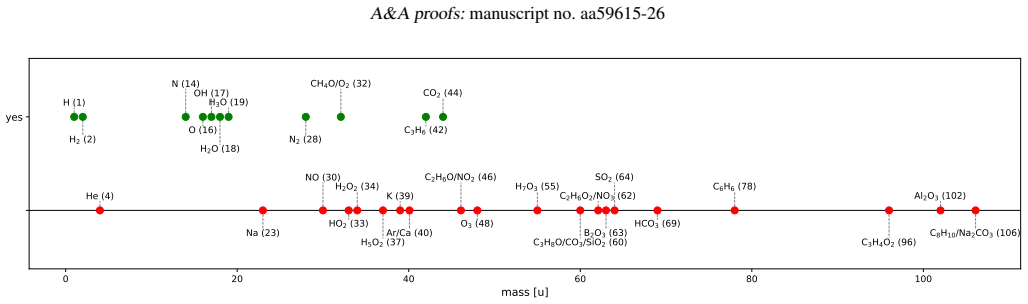
- [Fig. 5] Several mass assignments are ambiguous (e.g., m/z 32 as 'CH4O/O2', m/z 60 as 'C3H8O/CO3/SiO2'). In a yes/no plot, this ambiguity is acceptable, but a note that isobaric species cannot be separated would help the reader interpret the results.
- [§4] The caveats section is appropriately cautious, but it would benefit from a quantitative estimate of how the terrestrial residual-gas history (e.g., water monolayers on the chamber walls) might compare to the expected adsorbate coverage on disk grains. This would frame the extrapolation more clearly.
Circularity Check
No significant circularity: the central claim is an internally controlled differential measurement, not a derivation from fitted inputs or self-cited theory.
full rationale
The paper's central claim is that collisions of glass beads release water-related molecules. The measured quantity is the excess ion current in the rotating-cylinder setup with particles over a no-particle calibration (Sec. 2, Figs. 2-3); it is an operational differential measurement. No equation reduces the conclusion to an input, and no fitted parameter is renamed as a prediction. The calibration is empirical and is explicitly described as isolating feedthrough motion; whether it perfectly isolates grain-surface release is an experimental validity question, not a circularity. The cracking-pattern comparison (Table 1) is used only to bound interpretation, and the paper explicitly states that it cannot distinguish original ions from fragment ions and does not claim proof of water-ion triboionization. Self-citations (Hock et al. 2025; Jungmann et al. 2021; Penner et al. 2024; Wurm et al. 2022) are contextual and are explicitly hedged as 'plausible' rather than load-bearing. The disk inference is flagged as a first analog experiment with substantial caveats in Sec. 4. Therefore no circular step is exhibited.
Assumptions & free parameters
free parameters (1)
- Control power-law calibration =
not reported
assumptions (4)
- domain assumption Glass beads with residual Earth-like adsorbates are a meaningful analog for silicate grains in protoplanetary disks.
- domain assumption Grain surfaces in cool to moderately tempered disk regions carry at least monolayers of water and organics that can be released.
- domain assumption The excess water-related signal measured during rotation originates from grain surfaces rather than from chamber walls, residual gas, or feedthrough motion.
- domain assumption The reference H2O cracking pattern for a 75 eV ion source is applicable to the QMG 250 conditions.
Cite this review
Pith. "Pith review of Gas Phase Ion Species Released During Grain Collisions: Implications For Protoplanetary Disks." pith.science (2026). https://pith.science/paper/ZBZ65DC3
@misc{pith2026260729376,
  author       = {Pith},
  title        = {Pith review of: Gas Phase Ion Species Released During Grain Collisions: Implications For Protoplanetary Disks},
  year         = {2026},
  howpublished = {\url{https://pith.science/paper/ZBZ65DC3}},
  note         = {Machine review of arXiv:2607.29376}
}
read the original abstract
Grain charging and gas ionization are important processes in protoplanetary disks. Both occur in mutual collisions between grains, as charge is exchanged between grain surfaces but also released into the surrounding gas as ions. The charge carrier for tribocharging, the origin of the gaseous ions, and their composition are currently unknown. However, it is important to know to validate the significance of these processes under disk conditions. In this work, we approach these questions by detecting molecules ejected during grain collisions by mass spectrometry. As tribocharging works well under normal atmospheric conditions, we use untreated "dirty" particles here. Without collisions, our measurements show a background mix of molecules. Among these are organics, but especially water-related molecules. During collisions, the abundances of not all but quite a few molecules change. Water-related molecules account for one of the largest changing fractions. These results suggest that particle collisions release adsorbates even at very low pressure, which is relevant for protoplanetary disks. As monolayers of water and organics are present on all surfaces in cool to moderately tempered parts of protoplanetary disks, this supports the importance of triboionization in disks.
Figures


Figures from the paper (1 more)
Reference graph
Works this paper leans on
-
[1]
Balbus, S. A., & Hawley, J. F. 1991, ApJ, 376, 214, doi: 10.1086/170270
doi:10.1086/170270 1991
-
[3]
Bergin, E. A., Aikawa, Y ., Blake, G. A., & van Dishoeck, E. F. 2007, in Protostars and Planets V , ed. B. Reipurth, D. Jewitt, & K. Keil, 751.https://arxiv. org/abs/astro-ph/0603358
arXiv 2007
-
[4]
A., Galembeck, F., & Pollack, G
Burgo, T. A., Galembeck, F., & Pollack, G. H. 2016, Journal of Electrostatics, 80, 30, doi: 10.1016/j.elstat.2016.01.002
-
[5]
2026, Nature, 651, 626, doi: 10.1038/s41586-025-10088-w Grünebeck, C., Onyeagusi, F
Grosjean, G., Ostermann, M., Sauer, M., et al. 2026, Nature, 651, 626, doi: 10.1038/s41586-025-10088-w Grünebeck, C., Onyeagusi, F. C., Teiser, J., & Wurm, G. 2024, Soft Matter, 20, 9572, doi: 10.1039/D4SM01013B
-
[6]
2024, PASP, 136, 054302, doi: 10.1088/1538-3873/ad3455
Henning, T., Kamp, I., Samland, M., et al. 2024, PASP, 136, 054302, doi: 10.1088/1538-3873/ad3455
-
[7]
2025, PSJ, 6, 99, doi: 10.3847/PSJ/adc579
Hock, P., Teiser, J., & Wurm, G. 2025, PSJ, 6, 99, doi: 10.3847/PSJ/adc579
-
[8]
Jungmann, F., Onyeagusi, F. C., Teiser, J., & Wurm, G. 2022, Journal of Electro- statics, 117, 103705, doi: 10.1016/j.elstat.2022.103705
arXiv 2022
-
[9]
2021, PhRvE, 104, L022601, doi: 10.1103/PhysRevE.104.L022601
Jungmann, F., van Unen, H., Teiser, J., & Wurm, G. 2021, PhRvE, 104, L022601, doi: 10.1103/PhysRevE.104.L022601
Show all 25 references
-
[10]
2015, ApJ, 812, 67, doi: 10.1088/0004-637X/812/1/67
Kimura, H., Wada, K., Senshu, H., & Kobayashi, H. 2015, ApJ, 812, 67, doi: 10.1088/0004-637X/812/1/67
2015 doi
-
[11]
J., & Shinbrot, T
Lacks, D. J., & Shinbrot, T. 2019, Nature Reviews Chemistry, 3, 465, doi: 10.1038/s41570-019-0115-1
2019 doi
-
[12]
M., Waitukaitis, S
Lee, V ., James, N. M., Waitukaitis, S. R., & Jaeger, H. M. 2018, Physical Review Materials, 2, 035602, doi: 10.1103/PhysRevMaterials.2.035602
2018 doi
-
[13]
G., Padovani, M., & Gaches, B
Luo, G., Bisbas, T. G., Padovani, M., & Gaches, B. A. L. 2024, A&A, 690, A293, doi: 10.1051/0004-6361/202450285
2024 doi
-
[14]
M., et al
Patapis, P., Morales-Calderón, M., Arabhavi, A. M., et al. 2025, A&A, 704, A5, doi: 10.1051/0004-6361/202556296
2025 doi
-
[16]
2021, A&A, 652, A106, doi: 10.1051/0004-6361/202140601
Pillich, C., Bogdan, T., Landers, J., Wurm, G., & Wende, H. 2021, A&A, 652, A106, doi: 10.1051/0004-6361/202140601
2021 doi
-
[17]
Rocha, W. R. M., van Dishoeck, E. F., Ressler, M. E., et al. 2024, A&A, 683, A124, doi: 10.1051/0004-6361/202348427
2024 doi
-
[18]
2020, Nature Physics, 16, 225, doi: 10.1038/s41567-019-0728-9
Steinpilz, T., Joeris, K., Jungmann, F., et al. 2020, Nature Physics, 16, 225, doi: 10.1038/s41567-019-0728-9
2020 doi
-
[19]
2019, ApJ, 874, 60, doi: 10.3847/1538- 4357/ab07bb
Steinpilz, T., Teiser, J., & Wurm, G. 2019, ApJ, 874, 60, doi: 10.3847/1538- 4357/ab07bb
2019 doi
-
[20]
2019, Journal of The American Society for Mass Spectrometry, 30, 1503, doi: 10.1007/s13361-019-02220-8
Sugimura, N., Watabe, Y ., & Shibue, T. 2019, Journal of The American Society for Mass Spectrometry, 30, 1503, doi: 10.1007/s13361-019-02220-8
2019 doi
-
[21]
F., & Black, J
Tabone, B., van Dishoeck, E. F., & Black, J. H. 2024, A&A, 691, A11, doi: 10.1051/0004-6361/202348487
2024 doi
-
[22]
2025, Nature Astronomy, doi: 10.1038/s41550-024-02470-x
Teiser, J., Penner, J., Joeris, K., et al. 2025, Nature Astronomy, doi: 10.1038/s41550-024-02470-x
2025 doi
-
[23]
D., Gasman, D., et al
Temmink, M., Sellek, A. D., Gasman, D., et al. 2025, A&A, 699, A134, doi: 10.1051/0004-6361/202554213
2025 doi
-
[24]
2016, Grundlagen der Vakuumtech- nik, stand 2016 edn
Umrath, W., Bahnen, R., Dreifert, T., et al. 2016, Grundlagen der Vakuumtech- nik, stand 2016 edn. (Köln: Leybold GmbH). https://www.leybold.com
2016
-
[25]
R., Lee, V ., Pierson, J
Waitukaitis, S. R., Lee, V ., Pierson, J. M., Forman, S. L., & Jaeger, H. M. 2014, PhRvL, 112, 218001, doi: 10.1103/PhysRevLett.112.218001
2014 doi
-
[26]
W., Mori, S., & Bai, X.-N
Wang, Y ., Ormel, C. W., Mori, S., & Bai, X.-N. 2025, A&A, 696, A38, doi: 10.1051/0004-6361/202453036
2025 doi
-
[27]
2022, MNRAS, 517, L65, doi: 10.1093/mn- rasl/slac077 Article number, page 4
Wurm, G., Jungmann, F., & Teiser, J. 2022, MNRAS, 517, L65, doi: 10.1093/mn- rasl/slac077 Article number, page 4
2022 doi
Reviewed August 3, 2026 · model on record in the stance chip above.
Discussion (0). Continue with ORCID to comment.