REVIEW 2 major objections 6 minor 35 references
When does admission control reduce congestion? A stochastic ordering approach
T0 review · 2 major / 6 minor · reviewed 2026-08-03 · deepseek-v4-flash
Pith's one-line read The paper shows admission control can increase congestion in state-dependent queues, and proves that independence between customer types and service requirements restores stochastic dominance of the uncontrolled over the controlled workload
desk verdict A solid counterexample-plus-positive-result paper: the negative examples are real, Theorem 3's coupling works, but Theorem 2's proof needs a small repair. read the letter →
The pith
A machine-rendered reading of the paper's core claim, the machinery that carries it, and where it could break.
The reading
What carries the argument
The proof of Theorem 3 uses a coupling between the controlled and uncontrolled workload processes. At an arrival where the controlled workload is lower, the controlled customer is assigned the service requirement of the next customer who joined the uncontrolled system — a quantity already contained in the uncontrolled workload but not in the controlled one. Because service requirements are independent of types and history, this swap does not alter the marginal law of the controlled process, and it guarantees that the controlled workload never jumps above the uncontrolled one, yielding pathwise dominance and hence stochastic ordering.
What would settle it
Simulate the paper's own two-type model but with service times equal to a constant for both types, so that (P2) holds. Use the same suppression policy (no arrivals on [0,1)) and the same initial workload 2. If for any arrival rate and type probability the controlled expected squared workload at time 2 exceeds the uncontrolled one, Theorem 3 is false. The paper's own Theorem 3 predicts the inequality always goes the other way; the search need only scan the two parameters λ_h and q.
Extended reading notes
Core claim
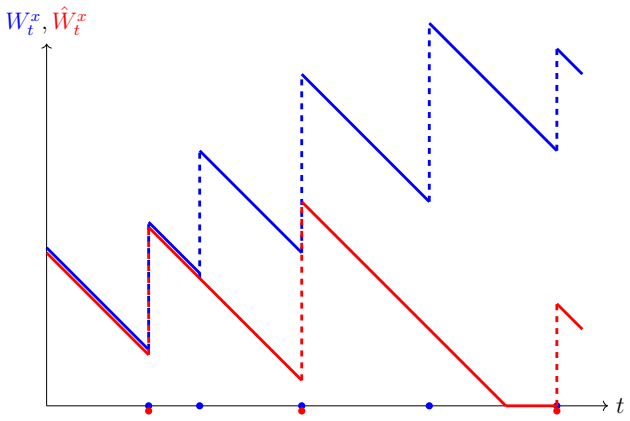
The central claim is that admission control is not automatically beneficial when joining decisions depend on the workload. The paper constructs two counterexamples in an M_t/G(Ψ)/1 + H(Ψ) queue where suppressing arrivals on an early interval makes the controlled workload exceed the uncontrolled one at a later fixed time — once by admitting a customer whose large service requirement would have been blocked by high congestion, and once by letting several modest customers accumulate. The positive result (Theorem 3) states that when the service requirement of each customer is independent of their type (and of the workload history), every contingent admission-control policy is initially busy-peri
Load-bearing premise
The key premise is that a customer's service requirement is independent of their type and of the workload history — if service needs can be predicted from the state a customer observes or from the fact of being admitted, the coupling that sustains the dominance result collapses.
Editorial extensions
If this is right
- If the paper is right, designers cannot assume admission control reduces congestion in systems where customers observe the workload and adapt; they must model the feedback loop.
- The independence condition (types independent of service requirements) provides a concrete, checkable sufficient condition under which any state-based admission policy is safe up to the first idle period.
- The stability application gives a finite-mean busy-period criterion for state-dependent M/G/1+H queues: stable whenever the corresponding state-invariant system with the peak arrival rate is stable, provided service and patience times are independent.
- The two counterexamples give explicit templates for when control backfires: when more impatient customers need longer service, or when small arrivals accumulate after a period of suppression.
Reading between the lines
- The pathwise coupling suggests a stronger, algorithmically useful fact: under independence, even randomized or history-dependent admission policies that admit based on any pre-arrival information cannot make the workload stochastically worse before idleness; one might extend this to controlled release of a queue (e.g., parking arrivals) rather than outright rejection, though the paper does not do
- Real systems with correlated type–service pairs are likely to exhibit the failure; an empirical test would measure the correlation between observed patience and service duration and check whether the intuitive dominance holds when the correlation is near zero.
- The busy-period-only result does not address long-run stationary workload; a natural open direction is whether independence also yields stochastic ordering beyond the first busy period when the system is stable — the current coupling argument does not automatically extend past absorption.
Signed reviews
Editorial analysis
A structured set of objections, weighed in public.
Referee Report
Summary. The paper studies whether admission control reduces congestion in a single-server queue where customers' joining decisions depend on the observed workload. It formalizes "effectiveness" via stochastic dominance of workload processes (Definition 1) and introduces the weaker notion of initial busy-period effectiveness (Definition 3). The main negative results are two explicit counterexamples (Theorems 1 and 2) in which a policy that suppresses arrivals on [0,1) makes the expected workload at time 2 larger than in the uncontrolled system. The main positive result (Theorem 3) states that if customer type and service requirement are independent (condition (P2)), then every contingent admission control policy is initially busy-period effective; the proof is based on a coupling that transfers to the controlled system the service requirements of customers who joined only the uncontrolled system. An application to stability of state-dependent M/G/1+H queues is sketched in Section 5.3.
Significance. If the results are correct, the paper identifies a genuine behavioral-feedback mechanism through which admission control can backfire, and a clean structural condition (independence of type and service requirement) under which this cannot happen. The counterexamples are simple, explicit, and separate two different mechanisms: a single large service requirement versus the cumulative effect of several small arrivals. Theorem 3 is the main contribution: its coupling proof is self-contained and establishes pathwise dominance, which is substantially stronger than a comparison of means. The stability application shows potential use beyond the immediate setting. The main caveats are that the proof of Theorem 2 contains a false event claim (though the theorem appears salvageable), and the coupling in Theorem 3 is not fully specified at a boundary case, so the central proof needs repair before the results can be accepted as written.
major comments (2)
- [§4.4 Step 2] The proof of Theorem 2 claims that on the event that the first arrival in (1,1.1) and the first arrival in (1.9,2) are both Type-1, "at least two Type-1 customers join" and that \hat W_2^2 ≥ 1.8 is in fact an equality. This is false. If a Type-2 arrival occurs in (1.1,1.9), that customer joins (the workload just before that time is 2.9−t_m > 1) and raises the workload at time 1.9 to 2.0, so the Type-1 in (1.9,2) balks. In that path the final workload at time 2 is 1.9, coming from one Type-1 and one Type-2, so the lower bound 1.8 still holds, but the stated event-based reasoning is incorrect. The proof should be repaired by a case analysis that partitions on whether a Type-2 arrival occurs in (1.1,1.9), or by an equivalent argument. This is a load-bearing gap in the second counterexample.
- [§6.1-6.2] The coupling construction for Theorem 3 is not fully specified and appears internally inconsistent. In Step 3, when \hat V^x_{T_n-}<V^x_{T_n-}, the text assigns \hat S_n ≡ S_{n_k} unconditionally. But if the number of uncontrolled joiners before T_n equals k−1 (i.e., M(T_n-)=k−1), then the k-th uncontrolled joiner has not yet occurred, so S_{n_k} is not defined at time T_n and may be a future service requirement. Equation (8) in Section 6.2 handles this boundary case by setting \hat S_n = S_n when M(T_n-)=k−1, which is causally available, but Step 3 does not mention this case. The proof can be repaired by stating and proving the invariant that \hat V^x<V^x implies M(T_n-)>k−1, so S_{n_k} has already been added to V^x and is available. As written, the central coupling of Theorem 3 is not well-defined, and the pathwise dominance argument requires this missing justification.
minor comments (6)
- [§4.4] The parameter choice is stated as "q=λ_h^2" in the final sentence, but Step 3 defines q(λ_h)=λ_h^{-2}. The displayed formula later should be q=λ_h^{-2}.
- [§3.3] The text says "as illustrated in Figure 2" when referring to the controlled workload overtaking the uncontrolled one; the correct reference is Figure 3, whose caption is "Failure of pathwise dominance".
- [§6.2] Typo: "ˆZ_n is is uniformly distributed" should read "ˆZ_n is uniformly distributed".
- [Notation] The notation W_2^2 (and \hat W_2^2) in the counterexamples is easy to misread as a square of W_2 rather than the workload at time 2 with initial workload x=2. Consider adding a brief notational reminder, e.g., writing W^2_2(t) or defining the superscript explicitly in the proof.
- [§5.3] The stability application is only sketched; the proof that condition (5) implies finite expected busy period is deferred to an argument in [7]. Since this is advertised as a contribution, the authors should either provide the details or label the subsection as a sketch.
- [References] Reference [12] is listed as an unpublished manuscript. If it is not publicly available, the citation should be marked accordingly or replaced by a published source.
Circularity Check
No circular derivation; central Theorem 3 is proved by a self-contained coupling with marginal-law verification, and the only self-citation is peripheral.
full rationale
I walked the derivation chain. The counterexamples (Theorems 1 and 2) are constructed on the natural coupling with explicit Poisson thinning and existential parameter choices; no fitted constant is renamed as a prediction. Theorem 3 is not derived from the paper's own conclusion: the coupling in Section 6.1 builds \hat V from the baseline primitives, assigns \hat S_n = S_{n_k} when the controlled workload lags, and Section 6.2 verifies the marginal assumptions (\hat A1), (\hat A3), and (\hat A4) under P2. This is the standard 'same marginal law plus a.s. ordering' proof of stochastic dominance, not a definitional identity. The one self-citation (Bodas & Jacobovic [7]) appears only in the auxiliary stability application in Section 5.3, where the paper says 'one may apply the same arguments... To keep the manuscript concise, we omit the details.' That is an omitted proof and peripheral reliance, but it is not load-bearing for the central theorem and does not reduce the main claim to a self-citation. A separate non-circularity concern is the event claim in Theorem 2 Step 2 (a Type-2 arrival in (1.1,1.9) can balk a later Type-1); that is a proof gap, not a circularity step. Overall, no circular step was found.
Assumptions & free parameters
assumptions (5)
- domain assumption Reflected workload dynamics W_t = L_t - inf_{0≤s<t} L_s^- with unit service rate and strictly positive service requirements (Section 2.1).
- domain assumption Assumptions (A1)-(A3) and (\hat A1)-(\hat A5): IID types, deterministic threshold balking Φ(Y_n, W_{T_n-}), service distribution depending only on type, independent dispatcher randomizations.
- standard math A nonhomogeneous Poisson arrival process can be represented by thinning a homogeneous Poisson process (Lewis and Shedler [21]).
- domain assumption Condition (5) from Baccelli, Boyer and H\'ebuterne [3] is a sufficient condition for finite expected busy period of the state-invariant M/G/1+H queue.
- domain assumption Regenerative-cycle argument from Bodas and Jacobovic [7] used for the time-varying periodic extension in Section 5.3.
Cite this review
Pith. "Pith review of When does admission control reduce congestion? A stochastic ordering approach." pith.science (2026). https://pith.science/paper/FYJKNPAB
@misc{pith2026260729439,
  author       = {Pith},
  title        = {Pith review of: When does admission control reduce congestion? A stochastic ordering approach},
  year         = {2026},
  howpublished = {\url{https://pith.science/paper/FYJKNPAB}},
  note         = {Machine review of arXiv:2607.29439}
}
read the original abstract
Admission control is a widely used mechanism for regulating congestion in stochastic service systems, where restricting arrivals is expected to reduce workload and improve performance. In many settings, however, customers make decisions based on the observed system state, creating a feedback loop between control actions and future arrivals. This raises a fundamental question: does admission control necessarily reduce congestion under state-dependent behavior? We address this question using stochastic ordering of workload processes. We show that admission control may fail to reduce congestion due to endogenous feedback effects, and construct explicit counterexamples illustrating this phenomenon. We then identify a general condition under which admission control is effective over the initial busy period. In particular, independence between customers' types and service requirements eliminates the adverse feedback mechanism and restores stochastic dominance. These results highlight fundamental limitations of admission control and the importance of accounting for behavioral responses in the design of stochastic service systems.
Figures


Figures from the paper (2 more)


Reference graph
Works this paper leans on
-
[7]
Bodas, S. A., & Jacobovic, R. (2024). Useful stochastic bounds in time-varying queues with service and patience times having general joint distribution.arXiv preprint arXiv:2406.12745
arXiv 2024
-
[1]
Adan, I., & Van der Wal, J. (1989). Monotonicity of the throughput of a closed queueing network in the number of jobs.Operations Research,37, 953-957
1989
-
[2]
Ata, B., & Shneorson, S. (2006). Dynamic control of an M/M/1 service system with adjustable arrival and service rates.Management Science,52, 1778-1791
2006
-
[3]
Baccelli, F., Boyer, P., & H´ ebuterne, G. (1984). Single-server queues with impa- tient customers.Advances in Applied Probability,16, 887-905
1984
-
[4]
Boxma, O., Perry, D., Stadje, W., & Zacks, S. (2010). The busy period of an M/G/1 queue with customer impatience.Journal of Applied Probability,47, 130- 145
2010
-
[5]
Boxma, O., Perry, D., & Stadje, W. (2011). The M/G/1+ G queue revisited. Queueing Systems,67, 207-220
2011
-
[6]
P., & Ephremides, A
Bhattacharya, P. P., & Ephremides, A. (1991). Stochastic monotonicity proper- ties of multiserver queues with impatient customers.Journal of Applied Proba- bility,28, 673-682
1991
-
[8]
Carr, S., & Duenyas, I. (2000). Optimal admission control and sequencing in a make-to-stock/make-to-order production system.Operations research,48, 709- 720
2000
Show all 35 references
-
[9]
Cohen, A., Subramanian, V., & Zhang, Y. (2024). Learning-based optimal ad- mission control in a single-server queuing system.Stochastic systems,14, 69-107. 38
2024
-
[10]
Debo, L., & Li, C. (2021). Design and pricing of discretionary service lines. Management Science,67, 2251-2271
2021
-
[11]
Feldman, P., & Segev, E. (2022). The important role of time limits when con- sumers choose their time in service.Management Science,68, 6666-6686
2022
-
[12]
Gat, Y., & Jacobovic, R. (2026). Priority queues with discretionary services. Unpublished manuscript
2026
-
[13]
(2016).Rational queueing
Hassin, R. (2016).Rational queueing. CRC press
2016
-
[14]
(2003).To queue or not to queue: Equilibrium behavior in queueing systems (Vol
Hassin, R., & Haviv, M. (2003).To queue or not to queue: Equilibrium behavior in queueing systems (Vol. 59). Springer Science & Business Media
2003
-
[15]
Haviv, M., & Puterman, M. L. (1998). Bias optimality in controlled queueing systems.Journal of Applied Probability,35, 136-150
1998
-
[16]
Heyman, D. P. (1982). On Ross’s conjectures about queues with non-stationary Poisson arrivals.Journal of Applied Probability,19, 245-249
1982
-
[17]
Jacobovic, R. (2022). Internalization of externalities in queues with discretionary services.Queueing Systems,100, 453-455
2022
-
[18]
Jacobovic, R. (2022). Regulation of a single-server queue with customers who dynamically choose their service durations.Queueing Systems,101, 245-290
2022
-
[19]
Jouini, O., & Dallery, Y. (2007). Monotonicity properties for multiserver queues with reneging and finite waiting lines.Probability in the Engineering and Infor- mational Sciences,21, 335-360
2007
-
[20]
Knudsen, N. C. (1972). Individual and social optimization in a multiserver queue with a general cost-benefit structure.Econometrica: Journal of the Econometric Society, 515-528
1972
-
[21]
W., & Shedler, G
Lewis, P. W., & Shedler, G. S. (1979). Simulation of nonhomogeneous Poisson processes by thinning.Naval research logistics quarterly,26, 403-413. 39
1979
-
[22]
Maglaras, C., & Zeevi, A. (2005). Pricing and design of differentiated services: Approximate analysis and structural insights.Operations Research,53, 242-262
2005
-
[23]
Moyal, P., & Perry, O. (2022). Many-server limits for service systems with de- pendent service and patience times.Queueing Systems,100, 337-339
2022
-
[24]
Naor, P. (1969). The regulation of queue size by levying tolls.Econometrica: journal of the Econometric Society, 15-24
1969
-
[25]
Rolski, T. (1981). Queues with non-stationary input stream: Ross’s conjecture. Advances in Applied Probability,13, 603-618
1981
-
[26]
Rolski, T. (1986). Upper bounds for single server queues with doubly stochastic Poisson arrivals.Mathematics of Operations Research,11, 442-450
1986
-
[27]
Ross, S. M. (1978). Average delay in queues with non-stationary Poisson arrivals. Journal of Applied Probability, 15, 602-609
1978
-
[28]
G., & Yao, D
Shanthikumar, J. G., & Yao, D. D. (1986). The effect of increasing service rates in a closed queuing network.Journal of Applied Probability,23, 474-483
1986
-
[29]
G., & Yao, D
Shanthikumar, J. G., & Yao, D. D. (1987). Stochastic monotonicity of the queue lengths in closed queueing networks.Operations Research,35, 583-588
1987
-
[30]
G., & Yao, D
Shanthikumar, J. G., & Yao, D. D. (1989). Stochastic monotonicity in general queueing networks.Journal of Applied Probability,26, 413-417
1989
-
[31]
M., & van der Wal, J
Van Dijk, N. M., & van der Wal, J. (1989). Simple bounds and monotonicity results for finite multi-server exponential tandem queues.Queueing Systems,4, 1-15
1989
-
[32]
Van Nunen, J. A. E. E., & Puterman, M. L. (1983). Computing optimal control limits for GI/M/s queuing systems with controlled arrivals.Management Science, 29, 725-734. 40
1983
-
[33]
R., & Kumar, S
Ward, A. R., & Kumar, S. (2008). Asymptotically optimal admission control of a queue with impatient customers.Mathematics of Operations Research,33, 167-202
2008
-
[34]
Wu, C., Bassamboo, A., & Perry, O. (2019). Service system with dependent service and patience times.Management Science,65, 1151-1172
2019
-
[35]
Yu, L., & Perry, O. (2023). Many-server heavy-traffic limits for queueing systems with perfectly correlated service and patience times.Mathematics of Operations Research,48, 1119-1157. 41
2023
Reviewed August 3, 2026 · model on record in the stance chip above.
Discussion (0). Continue with ORCID to comment.