REVIEW 1 major objections 4 minor 39 references
Hidden chiral signatures in ferroaxial K2Zr(PO4)2
T0 review · 1 major / 4 minor · reviewed 2026-08-03 · deepseek-v4-flash
Pith's one-line read An electric field can switch hidden chirality in ferroaxial K2Zr(PO4)2, creating a tunable nonlinear Hall response.
desk verdict Solid computational paper with concrete, falsifiable predictions for field-induced chirality in a ferroaxial insulator; the real-space 'chirality' label leans on a literature measure, but the momentum-space BCD results stand on their own. read the letter →
The pith
A machine-rendered reading of the paper's core claim, the machinery that carries it, and where it could break.
The reading
What carries the argument
The central object is the atomic-site electric toroidal monopole, G0,i = Gi · pi, the dot product of the electric toroidal dipole moment Gi and the electric dipole moment pi at each atomic site; it is a pseudoscalar that serves as a real-space measure of electronic chirality. The companion machinery is the Berry curvature dipole tensor Dab, which quantifies the momentum-space response and transforms as D = det(S) S D S^T under point-group operations. The paper computes both from DFT-plus-Wannier calculations and shows that the field-induced ferri-chiral state produces a Berry curvature dipole of C3-symmetric form, whose sign pattern across domains and fields encodes the chirality switching.
What would settle it
Measure the electric-field-induced nonlinear Hall voltage in doped K2Zr(PO4)2 as a function of field direction and strength. If the sign of the second-harmonic voltage does not reverse when the applied field is reversed for a fixed ferroaxial domain, or if the diagonal Berry curvature dipole components do not switch sign between opposite ferroaxial domains, the central claim fails. A complementary test is single-domain circular dichroism or optical rotation, which should reverse with field reversal.
Extended reading notes
Core claim
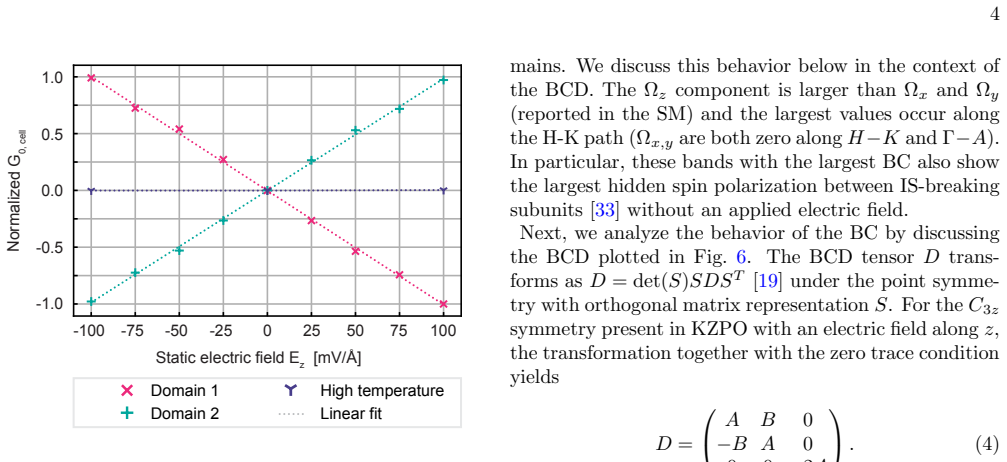
The ferroaxial phase of KZPO is antiferro-chiral in real space: local electric toroidal monopole moments G0,i on oxygen and phosphorus atoms cancel between inversion-related subunits. Applying a static electric field along the ferroaxial z-axis breaks inversion while preserving the mirror relation between ferroaxial domains, turning the antiferro-chiral pattern into a ferri-chiral one with a net G0,cell that is linear in field strength, opposite for opposite domains, and reversible within a domain. In momentum space, the same distortions induce Berry curvature, whose dipole tensor acquires the C3-symmetric form with diagonal components A that switch sign between opposite domains and off-diag
Load-bearing premise
The load-bearing premise is that the atomic-site electric toroidal monopole G0,i = Gi·pi faithfully represents electronic chirality; if that identification is wrong, the real-space chirality claims reduce to statements about a multipole product, not about handedness.
Editorial extensions
If this is right
- In any pure ferroaxial material, an electric field along the ferroaxial axis should induce a net electronic chirality that is opposite for opposite ferroaxial domains.
- The induced chirality is linearly tunable by field strength, and reversing the field flips the net chirality within each domain.
- Doped or gated ferroaxial insulators should exhibit a nonlinear Hall current whose sign switches with applied field direction and with ferroaxial domain orientation.
- The sign pattern of the Berry curvature dipole distinguishes the ferroaxial domains, offering an all-electrical readout of ferroaxial order.
- The vanishing of Berry curvature in the zero-field ferroaxial phase is consistent with the antiferro-chiral cancellation, linking real-space and momentum-space chirality measures.
Reading between the lines
- If the electric toroidal monopole is a faithful chirality measure, then local structural chirality exists even in an inversion-symmetric crystal, which could be probed by local circular dichroism or chiral-phonon spectroscopy on a single domain.
- The off-diagonal Berry curvature dipole components, which do not flip between domains, could be used to disentangle the ferroaxial domain contribution from other second-order transport sources in a multidomain sample.
- A direct testable extension: measure the second-harmonic Hall response in charge-doped KZPO; if the sign does not follow the predicted field/domain pattern, the monopole-based chirality measure is not capturing the relevant electronic handedness.
- Applying strain or a magnetic field alongside the electric field might reveal additional multipole couplings, since the electric toroidal monopole is only one of several time-reversal-even multipoles contributing to the chiral response.
Signed reviews
Editorial analysis
A structured set of objections, weighed in public.
Referee Report
Summary. The paper reports first-principles DFT and multipole analyses of the ferroaxial material K2Zr(PO4)2. It claims that the ferroaxial phase is antiferro-chiral in real space, with inversion-related structural subunits carrying opposite atomic-site electric toroidal monopole moments. Applying an electric field along the ferroaxial axis is shown to induce a ferri-chiral state with a net electric toroidal monopole that is opposite for opposite ferroaxial domains and tunable with field strength. In momentum space, the same field induces a Berry curvature dipole with symmetry-determined sign changes between domains and field orientations; the authors estimate a measurable nonlinear Hall voltage. The momentum-space results are computed with Wannier interpolation and checked against two different Wannier models.
Significance. If correct, the paper establishes an electric-field-switchable chirality in a ferroaxial material, connecting real-space multipole order to a concrete momentum-space observable. The BCD prediction is a falsifiable, quantitative result, supported by symmetry analysis and two independent Wannier models. The real-space chirality interpretation, however, rests entirely on the atomic-site electric toroidal monopole measure adopted from earlier literature, which is not independently validated in this material. The nonlinear Hall voltage estimate provides a clear experimental target.
major comments (1)
- [Antiferro-chirality in real space; Eq. (1)] The central real-space claims—antiferro-chirality at zero field and field-induced ferri-chirality—are derived entirely from the atomic-site ET monopole G0,i = Gi·pi of Eq. (1). This pseudoscalar changes sign under inversion, but the paper does not establish that it faithfully measures the geometric chirality of the electron density in KZPO, as opposed to being a generic bilinear product of the ET dipole and the induced electric dipole. A concrete test would be to compute an independent chirality descriptor for the same DFT densities (e.g., the chirality density of Ref. [28] or a continuous chirality index) and compare its sign and field dependence with G0,cell. Without such a comparison, the interpretation of the zero-field phase as antiferro-chiral and the field-induced phase as ferri-chiral is only as strong as the adopted literature measure; the BCD results are not affected.
minor comments (4)
- [Abstract/Introduction] The term 'paraxial phase' is used to describe the high-temperature phase but is not defined on first use. Please define or use a more explicit term such as 'non-ferroaxial phase'.
- [Fig. 4] The electric field axis is labeled in mV/Å while the text uses V/Å. Use consistent units for readability.
- [Methods, Eq. (2)] The Berry curvature formula is written with an implicit sum over bands; specify that the sum is over occupied states in Eq. (3) or clarify the notation.
- [SM, Table S-I] The note that the cubic groups T and O have identically zero BCD despite being chiral is useful; consider adding a comment in the main text when discussing Eq. (4).
Circularity Check
Real-space 'induced chirality' reduces to the defining G·p measure; the BCD prediction is independent.
-
self definitional
[Eq. (1), Computational Methods; Section 'Induced ferri-chirality in real space', Fig. 4]
"As chirality measure, we consider the atomic-site ET monopole moment G0,i = G i · p i = w(l, l′)0,111_i · w(l, l′)0,101_i ,(1) ... Next, we demonstrate that the electric field strength can be used to tune the size of the net electronic chirality, by evaluating the sum over all atoms in the unit cell G0,cell = P_i G0,i ... As shown in Fig. 4, the net moment ... is linearly susceptible to the electric field that imposes structural chirality."
Eq. (1) defines the paper's real-space chirality measure as the product G·p. The electric field acts by inducing the electric dipoles p_i while the ET dipoles G_i are fixed by the ferroaxial order, so a nonzero net G0,cell under E_z is a direct consequence of the definition rather than an independent first-principles prediction. The zero-field antiferro pattern likewise follows from the inversion-odd character of p in Eq. (1), so inversion-related sites necessarily have opposite G0. The computed magnitudes, linearity, and domain sign structure add content, and the Berry-curvature-dipole calculation is not built from G0, so the circularity is partial rather than total.
full rationale
The momentum-space part of the paper is genuinely self-contained: the Berry curvature and BCD are computed from Wannier-interpolated DFT (Eqs. 2-3) with no reference to the real-space G0 measure, and the C3 form of the BCD tensor is verified numerically rather than imposed. This part is a falsifiable, externally comparable prediction. The real-space chirality claim, however, is not independent of its input: Eq. (1) defines G0_i = G_i·p_i as the ET-monopole 'chirality measure,' so the antiferro pattern at zero field and the field-induced net chirality are, to a significant degree, restatements of that definition evaluated with computed p_i(E). The magnitudes and sign structure are nontrivial and the measure is supported by external Refs. 11 and 12, not solely by self-citation, but the paper does not independently validate G0 as a faithful measure of handedness in KZPO. Overall this is one partial definitional reduction, not a fully circular derivation.
Assumptions & free parameters
assumptions (4)
- domain assumption DFT within LDA (with SOC) accurately describes the electronic structure and multipole moments of K2Zr(PO4)2.
- domain assumption The atomic-site electric toroidal monopole G0 = G·p is a valid measure of electronic chirality.
- domain assumption The linear ionic response to an applied electric field computed from Born effective charges and force constants (Iñiguez method) captures the actual field-induced structural distortion.
- standard math The tight-binding Wannier interpolation and WannierBerri evaluation correctly compute the Berry curvature and Berry curvature dipole.
Cite this review
Pith. "Pith review of Hidden chiral signatures in ferroaxial K2Zr(PO4)2." pith.science (2026). https://pith.science/paper/S5YDK5T4
@misc{pith2026260729573,
  author       = {Pith},
  title        = {Pith review of: Hidden chiral signatures in ferroaxial K2Zr(PO4)2},
  year         = {2026},
  howpublished = {\url{https://pith.science/paper/S5YDK5T4}},
  note         = {Machine review of arXiv:2607.29573}
}
read the original abstract
We use first-principles calculations and multipole analyses to demonstrate the relationship between ferroaxiality and chirality in the prototypical ferroaxial material K2Zr(PO4)2. Using the atomic-site electric toroidal monopole as a measure of electronic chirality in real space, we show that, while the paraxial phase of K2Zr(PO4)2 is non-chiral, the ferroaxial phase is antiferro-chiral. By applying an electric field, we induce a ferri-chiral state with net electronic chirality which is opposite for opposite underlying ferroaxial domains and can be tuned by the direction and strength of the electric field. Associated with the real-space induced chirality, we find a distinct response in momentum space, with induced non-zero components in the Berry curvature dipole tensor that switch sign between opposite ferri-chiral domains. Our findings therefore reveal hidden chirality in ferroaxial materials in both real and momentum space.
Figures


Figures from the paper (3 more)


Reference graph
Works this paper leans on
-
[28]
Hoshino, M.-T
S. Hoshino, M.-T. Suzuki, and H. Ikeda, Spin-derived electric polarization and chirality density inherent in lo- calized electron orbitals, Phys. Rev. Lett.130, 256801 (2023)
2023
-
[1]
He and G
Z. He and G. Khalsa, Optical control of ferroaxial order, Phys. Rev. Res.6, 043220 (2024)
2024
-
[2]
Z. Zeng, M. F ¨orst, M. Fechner, D. Prabhakaran, P. G. Radaelli, and A. Cavalleri, Photo-induced nonvolatile rewritable ferroaxial switching, Science390, 195 (2025)
2025
-
[3]
W. Jin, E. Drueke, S. Li, A. Admasu, R. Owen, M. Day, K. Sun, S.-W. Cheong, and L. Zhao, Observation of a ferro-rotational order coupled with second-order nonlin- ear optical fields, Nat. Phys.16, 42 (2020)
2020
-
[4]
Hayashida, Y
T. Hayashida, Y. Uemura, K. Kimura, S. Matsuoka, M. Hagihala, S. Hirose, H. Morioka, T. Hasegawa, and T. Kimura, Phase transition and domain formation in ferroaxial crystals, Phys. Rev. Mater.5, 124409 (2021)
2021
-
[5]
Nagai and T
T. Nagai and T. Kimura, Chemical switching of ferroax- ial and nonferroaxial structures based on second-order Jahn–Teller activity in (Na,K)2Hf(BO3)2, Chem. Mater. 35, 4109 (2023)
2023
-
[6]
Hlinka, J
J. Hlinka, J. Privratska, P. Ondrejkovic, and V. Janovec, Symmetry guide to ferroaxial transitions, Phys. Rev. Lett.116, 177602 (2016)
2016
-
[7]
Yamagishi, T
S. Yamagishi, T. Hayashida, R. Misawa, K. Kimura, M. Hagihala, T. Murata, S. Hirose, and T. Kimura, Ferroaxial transitions in glaserite-type compounds: Database screening, phonon calculations, and experimen- tal verification, Chem. Mater.35, 747 (2023)
2023
Show all 39 references
-
[8]
V. M. Dubovik, L. A. Tosunyan, and V. V. Tugushev, Ax- ial toroidal moments in electrodynamics and solid-state physics, JETP63, 344 (1986)
1986
-
[9]
Hayami, R
S. Hayami, R. Oiwa, and H. Kusunose, Electric ferro- axial moment as nanometric rotator and source of longi- tudinal spin current, J. Phys. Soc. Jpn.91, 113702 (2022)
2022
-
[10]
Bhowal and N
S. Bhowal and N. A. Spaldin, Electric toroidal dipole order and hidden spin polarization in ferroaxial materials, Phys. Rev. Res.6, 043141 (2024)
2024
-
[11]
Oiwa and H
R. Oiwa and H. Kusunose, Rotation, electric-field re- sponses, and absolute enantioselection in chiral crystals, Phys. Rev. Lett.129, 116401 (2022)
2022
-
[12]
A. Inda, R. Oiwa, S. Hayami, H. M. Yamamoto, and H. Kusunose, Quantification of chirality based on electric toroidal monopole, J. Chem. Phys.160, 184117 (2024)
2024
-
[13]
N. A. Spaldin, Towards a modern theory of chiralization, arXiv:2601.16042 (2026)
2026
-
[14]
Hayashida, Y
T. Hayashida, Y. Uemura, K. Kimura, S. Matsuoka, D. Morikawa, S. Hirose, K. Tsuda, T. Hasegawa, and T. Kimura, Visualization of ferroaxial domains in an order-disorder type ferroaxial crystal, Nat. Commun.11, 4582 (2020)
2020
-
[15]
Hayami, R
S. Hayami, R. Oiwa, and A. Inda, Chirality/axiality- induced axiality/chirality via surface polarization, J. Phys. Soc. Jpn.94, 123702 (2025)
2025
-
[16]
M. Fava, A. H. Romero, and E. Bousquet, Handedness selection and hysteresis of chiral orders in crystals, Phys. Rev. Lett.135, 146102 (2025)
2025
-
[17]
Xiao, M.-C
D. Xiao, M.-C. Chang, and Q. Niu, Berry phase effects on electronic properties, Rev. Mod. Phys.82, 1959 (2010)
1959
-
[18]
Vanderbilt,Berry phases in electronic structure the- ory: electric polarization, orbital magnetization and topo- logical insulators(Cambridge University Press, 2018)
D. Vanderbilt,Berry phases in electronic structure the- ory: electric polarization, orbital magnetization and topo- logical insulators(Cambridge University Press, 2018)
2018
-
[19]
Sodemann and L
I. Sodemann and L. Fu, Quantum nonlinear Hall effect induced by Berry curvature dipole in time-reversal invari- ant materials, Phys. Rev. Lett.115, 216806 (2015)
2015
-
[20]
N. B. M. Schr ¨oter, D. Pei, M. G. Vergniory, Y. Sun, K. Manna, F. de Juan, J. A. Krieger, V. S ¨uss, M. Schmidt, P. Dudin, B. Bradlyn, T. K. Kim, T. Schmitt, C. Cacho, C. Felser, V. N. Strocov, and Y. Chen, Chiral topological semimetal with multifold band crossings and long f...
2019
-
[21]
Q. Yang, J. Xiao, I. Robredo, M. G. Vergniory, B. Yan, and C. Felser, Monopole-like orbital-momentum lock- ing and the induced orbital transport in topological chiral semimetals, Proc. Natl. Acad. Sci. U.S.A.120, e2305541120 (2023)
2023
-
[22]
Kresse and J
G. Kresse and J. Furthm ¨uller, Efficient iterative schemes for ab initio total-energy calculations using a plane-wave basis set, Phys. Rev. B54, 11169 (1996)
1996
-
[23]
Kresse and D
G. Kresse and D. Joubert, From ultrasoft pseudopoten- tials to the projector augmented-wave method, Phys. Rev. B59, 1758 (1999)
1999
-
[24]
´I˜ niguez, First-principles approach to lattice-mediated magnetoelectric effects, Phys
J. ´I˜ niguez, First-principles approach to lattice-mediated magnetoelectric effects, Phys. Rev. Lett.101, 117201 (2008)
2008
-
[25]
Cricchio, F
F. Cricchio, F. Bultmark, O. Gr ˚ an¨as, and L. Nordstr ¨om, Itinerant magnetic multipole moments of rank five as the hidden order in URu 2Si2, Phys. Rev. Lett.103, 107202 (2009)
2009
-
[26]
Bultmark, F
F. Bultmark, F. Cricchio, O. Gr ˚ an¨as, and L. Nordstr ¨om, Multipole decomposition of LDA+U energy and its ap- plication to actinide compounds, Phys. Rev. B80, 035121 (2009)
2009
-
[27]
V. A. M ¨uller, N. Taufertsh ¨ofer, and N. A. Spaldin, On multipoles, their decomposition by time-reversal symme- try, and the electric toroidal monopole, arXiv:2607.13053 (2026)
2026 arXiv
-
[29]
Pizzi, V
G. Pizzi, V. Vitale, R. Arita, S. Bl ¨ugel, F. Freimuth, G. G´ eranton, M. Gibertini, D. Gresch, C. Johnson, T. Koretsune, J. Iba˜ nez-Azpiroz, H. Lee, J.-M. Lihm, D. Marchand, A. Marrazzo, Y. Mokrousov, J. I. Mustafa, Y. Nohara, Y. Nomura, L. Paulatto, S. Ponc´ e, T. Pon- wei...
2020
-
[30]
S. S. Tsirkin, High performance Wannier interpolation of Berry curvature and related quantities with Wannier- Berri code, Npj Comput. Mater.7, 33 (2021)
2021
-
[31]
Momma and F
K. Momma and F. Izumi, VESTA: a three-dimensional visualization system for electronic and structural analy- sis, J. Appl. Cryst.41, 653 (2008)
2008
-
[32]
Y. Xie, R. Oiwa, and S. Hayami, Spinless electric toroidal multipoles in ferroaxial K 2Zr(PO4)2 revealed by 7 symmetry-adapted closest wannier analysis, Phys. Rev. B113, 205133 (2026)
2026
-
[33]
Zhang, Q
X. Zhang, Q. Liu, J.-W. Luo, A. J. Freeman, and A. Zunger, Hidden spin polarization in inversion- symmetric bulk crystals, Nat. Phys.10, 387 (2014)
2014
-
[34]
N. B. Joseph, A. Bandyopadhyay, and A. Narayan, Chirality-tunable nonlinear Hall effect, Chem. Mater.36, 8602 (2024)
2024
-
[35]
K. Ueno, S. Nakamura, H. Shimotani, A. Ohtomo, N. Kimura, T. Nojima, H. Aoki, Y. Iwasa, and M. Kawasaki, Electric-field-induced superconductivity in an insulator, Nat. Mater.7, 855 (2008)
2008
-
[36]
K. Ueno, S. Nakamura, H. Shimotani, H. T. Yuan, N. Kimura, T. Nojima, H. Aoki, Y. Iwasa, and M. Kawasaki, Discovery of superconductivity in KTaO 3 by electrostatic carrier doping, Nat. Nanotechnol.6, 408 (2011)
2011
-
[37]
Hayami, R
S. Hayami, R. Oiwa, and H. Kusunose, Unconventional Hall effect and magnetoresistance induced by metallic fer- roaxial ordering, Phys. Rev. B108, 085124 (2023)
2023
-
[38]
Jo and P
D. Jo and P. M. Oppeneer, Unconventional orbital cur- rents and torques due to ferro-rotational orbital textures, Npj Spintronics4, 22 (2026)
2026
-
[39]
V. Wang, N. Xu, J.-C. Liu, G. Tang, and W.-T. Geng, V ASPKIT: A user-friendly interface facilitating high- throughput computing and analysis using V ASP code, Comput. Phys. Commun.267, 108033 (2021). Supplemental Material: Hidden chiral signatures in ferroaxial K2Zr(PO4)2 Nora...
2021
Reviewed August 3, 2026 · model on record in the stance chip above.
Discussion (0). Continue with ORCID to comment.