REVIEW 5 minor 43 references
Telecom-compatible polarization-to-time-bin conversion of atom-photon entanglement for heterogeneous quantum networks
T0 review · 0 major / 5 minor · reviewed 2026-08-03 · deepseek-v4-flash
Pith's one-line read Telecom time-bin conversion preserves ion-photon entanglement at 96.3%
desk verdict A careful, first-of-its-kind experimental demonstration of polarization-to-time-bin conversion for atom-photon entanglement at telecom wavelengths; the central claim holds despite a few reporting soft spots. read the letter →
The pith
A machine-rendered reading of the paper's core claim, the machinery that carries it, and where it could break.
The reading
What carries the argument
A passive fiber-based polarization-to-time-bin encoder: a fiber polarization beam splitter sends horizontal polarization down a short path and vertical down a roughly 90 ns longer path, after which a diagonal polarizer erases which-way information, so the photon's polarization amplitudes become early/late time-bin amplitudes. A second, Michelson-type analyzer interferometer with Faraday mirrors and active phase stabilization projects the time-bin state onto the equator of the Bloch sphere for tomography. Supporting machinery includes two quantum frequency converters (854 nm to 1550 nm and back), automated polarization drift compensation, and temperature stabilization that keeps the encoder p
What would settle it
Run the two tomographies interleaved in short alternating blocks (e.g., 10-minute periods) with the same ion, same fibers, and same settings, and recompute the fidelity ratio. If the interleaved ratio deviates from 96.3(4.2)% by more than the quoted uncertainty, or the corrected time-bin fidelity falls below about 91%, the stated preservation is contaminated by drift or background misestimation.
Extended reading notes
Core claim
The paper demonstrates that polarization-entangled photons from a single 40Ca+ ion, after quantum frequency conversion to 1550 nm, can be routed through a fiber-based unbalanced Mach-Zehnder encoder whose two paths and a diagonal polarizer erase which-way information, mapping horizontal polarization to an early time bin and vertical to a late time bin. Analysis with a Michelson-type interferometer and full quantum state tomography yields a background-corrected fidelity of 91.3(4.1)% for the time-bin-encoded entangled state, and the ratio of time-bin fidelity to polarization-reference fidelity, FTB/Fpol = 96.3(4.2)%, matches the independently measured 97.3(1.1)% process fidelity of the encode
Load-bearing premise
The 96.3(4.2)% fidelity-preservation figure comes from dividing fidelities obtained in two separate, hours-long tomography runs (4.5 h polarization reference, 10 h time-bin run); if the ion state preparation, fiber polarization, or detection efficiency drifted between those campaigns, the ratio would attribute to the conversion errors that actually came from drift. A second fragile premise is that the background-correction procedure removes only uncorrelated noise, since the
Editorial extensions
If this is right
- A trapped-ion quantum memory can now emit telecom-compatible time-bin qubits, making it interoperable with solid-state nodes that naturally produce time-bin photons.
- Time-bin encoding removes the need for active polarization stabilization on deployed fiber links, simplifying metropolitan quantum network infrastructure.
- The temporal separation of the time bins is set externally by interferometer path length rather than by emitter dynamics, decoupling the qubit format from the memory's timescale.
- The background-correction and fidelity-estimation protocol demonstrated here carries over to entanglement distribution over urban fiber, where signal-to-background ratios are low.
Reading between the lines
- If the conversion is truly passive and phase-stable, the same interface should work with any single-photon source whose emission time is not controlled, since it requires no synchronization—unlike active switching approaches.
- The fidelity ratio's dependence on two separately acquired runs suggests a straightforward protocol test: interleave polarization-reference and time-bin measurements in short alternating blocks; if the ratio remains stable, the conversion loss is quantified cleanly.
- The demonstrated chain of ion, quantum frequency conversion, and encoder could be extended to a full repeater segment by interfering time-bin photons from two such nodes at a Bell-state measurement, the natural next step toward heterogeneous networks.
Editorial analysis
A structured set of objections, weighed in public.
Referee Report
Summary. This paper reports an experimental interface that converts atom-photon entanglement generated by a single trapped 40Ca+ ion from polarization encoding at 854 nm to time-bin encoding at 1550 nm in the telecom C-band. The photonic qubit is converted to 1550 nm by quantum frequency conversion, then passed through a fiber-based Mach-Zehnder-like encoder that maps polarization to early/late time bins; the resulting time-bin state is analyzed with a Michelson interferometer and detected after a second frequency-conversion stage. Full quantum state tomography yields a polarization reference fidelity of Fpol = 94.8(0.8)% and a time-bin fidelity of FTB = 91.3(4.1)% (raw 83.3(4.8)% without background correction), while the independently measured TBE+analyzer process fidelity is FP = 97.3(1.1)%. The paper claims, together with the parallel work of Ferrari et al., the first demonstration of polarization-to-time-bin conversion of photons entangled with a single atomic quantum memory.
Significance. If the result holds, it is a valuable advance for heterogeneous quantum networks: it demonstrates that a trapped-ion atomic memory can emit telecom-compatible time-bin qubits while retaining entanglement with the memory, and it explicitly targets fiber-robust encoding. The central claim is supported by several independent pieces of evidence: the raw, background-uncorrected time-bin fidelity of 83.3(4.8)% already exceeds the 50% entanglement threshold by more than 6 standard deviations; the background-corrected fidelity is 91.3(4.1)%; and the independently measured process fidelity of the conversion chain, 97.3(1.1)%, corroborates the relative preservation figure. The manuscript also provides careful auxiliary characterizations of temperature stability, active phase stabilization, and loss budgets in the appendices, which is a strength. The main weakness is presentational rather than technical: the headline '96.3(4.2)% fidelity' is a ratio of two separately acquired fidelities, not the absolute fidelity of the converted state, and this should be clarified.
minor comments (5)
- [Abstract and Section III] The abstract and Section III report 'preserves entanglement with 96.3(4.2)% fidelity.' As written, this is the ratio FTB/Fpol, not the fidelity of the time-bin state to the ideal entangled state, which is FTB = 91.3(4.1)% (raw 83.3(4.8)%). Please rephrase to state explicitly that 96.3(4.2)% is the relative fidelity compared with the polarization reference, and that the absolute fidelity of the converted state is 91.3(4.1)%.
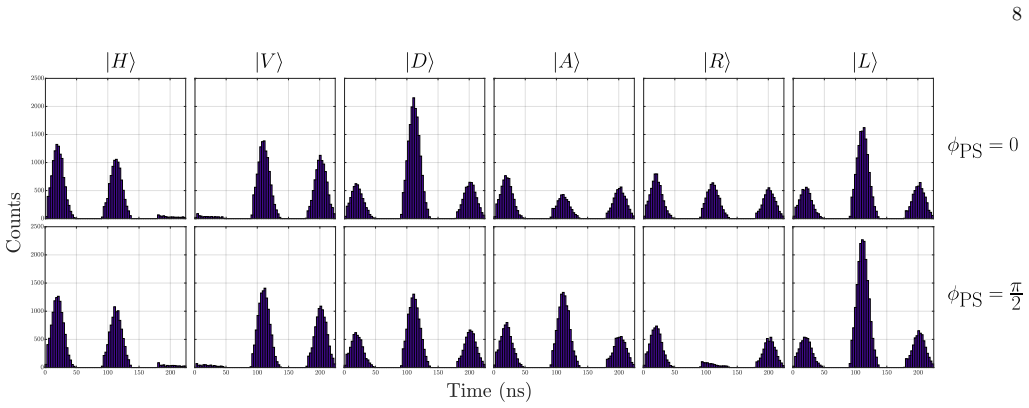
- [Section III, Fig. 2] The ratio FTB/Fpol is formed from two tomography runs acquired in separate campaigns (4.5 h polarization reference and 10 h time-bin run, Fig. 2). The manuscript does not state whether the polarization reference was interleaved with the time-bin runs or repeated before/after. Please state the acquisition order and discuss the possible influence of slow drifts on this ratio. The central entanglement claim is not affected, because the raw FTB already exceeds the entanglement threshold, but the precise quantitative preservation figure should be qualified.
- [Appendix E] The process fidelity is given as FP = (1/4)(1+Tr(M)), but the matrix M is not defined in the text. Please specify that M is the process/Pauli transfer matrix obtained from the maximum-likelihood reconstruction, and clarify how the six input polarizations and two phase settings enter the Stokes-vector decomposition.
- [Appendix D / Section III] The background-correction procedure of Ref. [8] is applied to a data set with average SBR of only 3.5, whereas the polarization reference has SBR 54.7. Please provide a brief justification that the correction removes only uncorrelated background at this SBR, or explicitly state that the raw FTB = 83.3(4.8)% is the conservative entanglement certification.
- [Section II.C, Fig. 2] In Fig. 2b, the three arrival-time peaks are not labeled; adding 'early', 'central', and 'late' would improve readability. Also, the mathematical notation in Eq. (1) and the abstract renders the phase factor inconsistently; ensure e^{iω_L t} appears uniformly.
Circularity Check
No significant circularity: the time-bin entanglement claim rests on direct tomography and an independently measured process fidelity.
full rationale
The paper's central claim is an experimental demonstration, not a derivation fitted to its own conclusion. The time-bin atom-photon entanglement is established by direct quantum state tomography, with a raw fidelity of 83.3(4.8)% that already exceeds the 50% entanglement threshold. Thus the result does not depend on the background-correction procedure inherited from ref. [8]. The process fidelity FP = 97.3(1.1)% is independently characterized with attenuated laser pulses through the encoder and analyzer, and the reported 96.3(4.2)% preservation ratio is a measured comparison between two tomography runs, not a fitted parameter used as a prediction. Self-citations to prior work by the same group concern apparatus (QFC, APC), the entanglement generation protocol, and background correction; they are procedural and none of them is used to define the target quantity or to forbid alternatives. There is no uniqueness theorem, no ansatz smuggled in via citation, and no renaming of a known result. The only quantitative subtlety is that the abstract's '96.3% fidelity' refers to a ratio of fidelities rather than the final-state fidelity of 91.3(4.1)%, but this is a presentation ambiguity, not a circular step.
Assumptions & free parameters
assumptions (5)
- domain assumption The 40Ca+ ion-photon entanglement generation protocol of refs. [8,32,34,35] produces the state of Eq. 1.
- domain assumption Quantum frequency conversion at 854→1550→854 nm preserves photonic polarization and atom-photon entanglement, as characterized in refs. [27,33,34].
- standard math For a maximally entangled input, the channel process fidelity equals the output entanglement fidelity (Schumacher [37]; Vardoyan et al. [38]).
- domain assumption The background-correction procedure introduced in ref. [8] removes only uncorrelated noise and does not remove entangled signal.
- domain assumption The diagonal polarizer in the encoder fully erases which-way information.
Cite this review
Pith. "Pith review of Telecom-compatible polarization-to-time-bin conversion of atom-photon entanglement for heterogeneous quantum networks." pith.science (2026). https://pith.science/paper/5GO3JBPB
@misc{pith2026260729609,
  author       = {Pith},
  title        = {Pith review of: Telecom-compatible polarization-to-time-bin conversion of atom-photon entanglement for heterogeneous quantum networks},
  year         = {2026},
  howpublished = {\url{https://pith.science/paper/5GO3JBPB}},
  note         = {Machine review of arXiv:2607.29609}
}
abstract
A key enabling feature of future quantum networks is interoperability between platforms that operate at different wavelengths and with different qubit encodings. We demonstrate an interface that converts atom-photon entanglement from polarization encoding at an atomic wavelength to time-bin encoding in the telecom C-band. Atom-entangled photons at 854 nm are generated from a single $^{40}$Ca$^+$ ion. After quantum frequency conversion to 1550 nm, the photonic polarization qubit is converted into a time-bin qubit using a fiber-based Mach--Zehnder-like encoder. Full quantum tomography of the final state verifies that the process preserves entanglement with 96.3(4.2)% fidelity. Together with the independent work of Ferrari et al. [arXiv:2607.07805 (2026)], this is the first demonstration of polarization-to-time-bin conversion of photons entangled with a single atomic quantum memory. The telecom-compatible interface enables robust qubit transmission over optical fibers and provides a key building block for heterogeneous quantum networking architectures.
Figures


Figures from the paper (3 more)


Reference graph
Works this paper leans on
-
[8]
M. Bock, P. Eich, S. Kucera, M. Kreis, A. Lenhard, C. Becher, and J. Eschner, High-fidelity entanglement be- tween a trapped ion and a telecom photon via quantum frequency conversion, Nature Communications9(2018)
2018
-
[1]
H. J. Kimble, The quantum internet, Nature453, 1023 (2008)
2008
-
[2]
D. P. DiVincenzo, The physical implementation of quan- 9 tum computation, Fortschritte der Physik48, 771 (2000)
2000
-
[3]
Nigmatullin, C
R. Nigmatullin, C. J. Ballance, N. d. Beaudrap, and S. C. Benjamin, Minimally complex ion traps as modules for quantum communication and computing, New Journal of Physics18, 103028 (2016)
2016
-
[4]
Jiang, J
L. Jiang, J. M. Taylor, A. S. Sørensen, and M. D. Lukin, Distributed quantum computation based on small quan- tum registers, Phys. Rev. A76, 062323 (2007)
2007
-
[5]
J. I. Cirac, A. K. Ekert, S. F. Huelga, and C. Mac- chiavello, Distributed quantum computation over noisy channels, Phys. Rev. A59, 4249 (1999)
1999
-
[6]
van Loock, W
P. van Loock, W. Alt, C. Becher, O. Benson, H. Boche, C. Deppe, J. Eschner, S. H¨ ofling, D. Meschede, P. Mich- ler, F. Schmidt, and H. Weinfurter, Extending Quantum Links: Modules for Fiber- and Memory-Based Quantum Repeaters, Advanced Quantum Technologies3, 1900141 (2020)
2020
-
[7]
S.-H. Wei, B. Jing, X.-Y. Zhang, J.-Y. Liao, C.-Z. Yuan, B.-Y. Fan, C. Lyu, D.-L. Zhou, Y. Wang, G.-W. Deng, H.-Z. Song, D. Oblak, G.-C. Guo, and Q. Zhou, Towards real-world quantum networks: A review, Laser & Pho- tonics Reviews16, 2100219 (2022)
2022
Show all 43 references
-
[9]
van Leent, M
T. van Leent, M. Bock, F. Fertig, R. Garthoff, S. Eppelt, Y. Zhou, P. Malik, M. Seubert, T. Bauer, W. Rosenfeld, W. Zhang, C. Becher, and H. Weinfurter, Entangling sin- gle atoms over 33km telecom fibre, Nature607, 69–73 (2022)
2022
-
[10]
Jayakumar, A
H. Jayakumar, A. Predojevi´ c, T. Kauten, T. Huber, G. S. Solomon, and G. Weihs, Time-bin entangled pho- tons from a quantum dot, Nature Communications5, 4251 (2014)
2014
-
[11]
Tchebotareva, S
A. Tchebotareva, S. L. N. Hermans, P. C. Humphreys, D. Voigt, P. J. Harmsma, L. K. Cheng, A. L. Verlaan, N. Dijkhuizen, W. de Jong, A. Dr´ eau, and R. Hanson, Entanglement between a diamond spin qubit and a pho- tonic time-bin qubit at telecom wavelength, Phys. Rev. Lett.123, ...
2019
-
[12]
C. M. Knaut, A. Suleymanzade, Y.-C. Wei, D. R. As- sumpcao, P.-J. Stas, Y. Q. Huan, B. Machielse, E. N. Knall, M. Sutula, G. Baranes, and et al., Entanglement of nanophotonic quantum memory nodes in a telecom network, Nature629, 573–578 (2024)
2024
-
[13]
Briegel, W
H.-J. Briegel, W. D¨ ur, J. I. Cirac, and P. Zoller, Quan- tum Repeaters: The Role of Imperfect Local Operations in Quantum Communication, Phys. Rev. Lett.81, 5932 (1998)
1998
-
[14]
Ulrich and A
R. Ulrich and A. Simon, Polarization optics of twisted single-mode fibers, Appl. Opt.18, 2241 (1979)
1979
-
[15]
Y.-Y. Ding, H. Chen, S. Wang, D.-Y. He, Z.-Q. Yin, W. Chen, Z. Zhou, G.-C. Guo, and Z.-F. Han, Polar- ization variations in installed fibers and their influence on quantum key distribution systems, Opt. Express25, 27923 (2017)
2017
-
[16]
Kucera, C
S. Kucera, C. Haen, E. Arensk¨ otter, T. Bauer, J. Meiers, M. Sch¨ afer, R. Boland, M. Yahyapour, M. Lessing, R. Holzwarth, C. Becher, and J. Eschner, Demonstra- tion of quantum network protocols over a 14-km urban fiber link, npj Quantum Information10, 10.1038/s41534- 024-008...
2024 doi
-
[17]
Ward and M
T. Ward and M. Keller, Generation of time-bin-encoded photons in an ion-cavity system, New Journal of Physics 24(2022)
2022
-
[18]
S. Saha, M. Shalaev, J. O’Reilly, I. Goetting, G. Toh, A. Kalakuntla, Y. Yu, and C. Monroe, High- fidelity remote entanglement of trapped atoms medi- ated by time-bin photons, Nature Communications16, 10.1038/s41467-025-57557-4 (2025)
2025 doi
-
[19]
Kupchak, P
C. Kupchak, P. J. Bustard, K. Heshami, J. Ersk- ine, M. Spanner, D. G. England, and B. J. Sussman, Time-bin-to-polarization conversion of ultrafast photonic qubits, Phys. Rev. A96, 053812 (2017)
2017
-
[20]
Sanaka, K
K. Sanaka, K. Kawahara, and T. Kuga, Experimen- tal probabilistic manipulation of down-converted photon pairs using unbalanced interferometers, Phys. Rev. A66, 040301 (2002)
2002
-
[21]
Scalcon, C
D. Scalcon, C. Agnesi, M. Avesani, L. Calderaro, G. Fo- letto, A. Stanco, G. Vallone, and P. Villoresi, Cross- encoded quantum key distribution exploiting time-bin and polarization states with qubit-based synchronization, Advanced Quantum Technologies5, 2200051 (2022)
2022
-
[22]
Martin, F
A. Martin, F. Kaiser, A. Vernier, A. Beveratos, V. Scarani, and S. Tanzilli, Cross time-bin photonic en- tanglement for quantum key distribution, Phys. Rev. A 87, 020301 (2013)
2013
-
[23]
L. Yu, C. M. Natarajan, T. Horikiri, C. Langrock, J. S. Pelc, M. G. Tanner, E. Abe, S. Maier, C. Schneider, S. H¨ ofling, M. Kamp, R. H. Hadfield, M. M. Fejer, and Y. Yamamoto, Two-photon interference at telecom wavelengths for time-bin-encoded single photons from quantum-dot ...
2015
-
[24]
Takesue, K
H. Takesue, K. Inoue, O. Tadanaga, Y. Nishida, and M. Asobe, Generation of pulsed polarization-entangled photon pairs in a 1.55-µm band with a periodically poled lithium niobate waveguide and an orthogonal polariza- tion delay circuit, Opt. Lett.30, 293 (2005)
2005
-
[25]
Bussi` eres, J
F. Bussi` eres, J. A. Slater, J. Jin, N. Godbout, and W. Tittel, Testing nonlocality over 12.4 km of under- ground fiber with universal time-bin qubit analyzers, Phys. Rev. A81, 052106 (2010)
2010
-
[26]
Vasconcelos, S
R. Vasconcelos, S. Reisenbauer, C. Salter, G. Wachter, D. Wirtitsch, J. Schmiedmayer, P. Walther, and M. Trupke, Scalable spin–photon entanglement by time- to-polarization conversion, npj Quantum Information6, 10.1038/s41534-019-0236-x (2020)
2020 doi
-
[27]
Arensk¨ otter, T
E. Arensk¨ otter, T. Bauer, and S. K. et al., Telecom quan- tum photonic interface for a 40Ca+ single-ion quantum memory, npj Quantum Inf9, 34 (2023)
2023
-
[28]
A. L. Ferrari, D. Wu, M. A. Zalewski, and N. M. Linke, Robust ion-photon entanglement via polarization- to-time-bin conversion (2026), arXiv:2607.07805 [quant- ph]
2026 arXiv
-
[29]
Sch¨ afer, B
M. Sch¨ afer, B. Kambs, D. Herrmann, T. Bauer, and C. Becher, Two-stage, low noise quantum frequency con- version of single photons from silicon-vacancy centers in diamond to the telecom c-band, Advanced Quantum Technologies8, 2300228 (2025)
2025
-
[30]
Herrmann, R
D. Herrmann, R. Morsch-Golsong, T. Bauer, M. Sch¨ afer, D. Lindler, L. Ehre, P. van Loock, M. Markham, N. Palmer, S. Mandal, O. Williams, and C. Becher, Highly indistinguishable photons from a tin-vacancy spin qubit in diamond (2026), arXiv:2607.22439 [quant-ph]
2026 arXiv
-
[31]
Baumgart, M
P. Baumgart, M. Bergerhoff, J. Meiers, S. Kucera, and J. Eschner, Indistinguishability of photonic qubits emit- 10 ted from trapped 40Ca+ ions via pulsed excitation (2026), arXiv:2605.29825 [quant-ph]
2026 arXiv
-
[32]
Bergerhoff, O
M. Bergerhoff, O. Elshehy, S. Kucera, M. Kreis, and J. Eschner, Quantum repeater node with free-space cou- pled trapped ions, Phys. Rev. A110, 032603 (2024)
2024
-
[33]
Bauer and C
T. Bauer and C. Becher, Polarization-preserving quan- tum frequency conversion for entanglement distribution in trapped-atom based urban area quantum networks, in Optica Quantum 2.0 Conference and Exhibition(Optica Publishing Group, 2023) p. QW4A.4
2023
-
[34]
M. Bock, P. Sekatski, J.-D. Bancal, S. Kucera, T. Bauer, N. Sangouard, C. Becher, and J. Eschner, Calibration- independent bound on the unitarity of a quantum chan- nel with application to a frequency converter, npj Quan- tum Information10, 10.1038/s41534-024-00859-0 (2024)
2024 doi
-
[35]
6 AUTHOR CONTRIBUTIONS C.H
with color centers in diamond [12, 29, 30, 40, 41] and demonstrates the feasibility of its deployment on the Saarbr¨ ucken urban fiber network [16]. 6 AUTHOR CONTRIBUTIONS C.H. and J.G.-F. designed, built and characterized the time-bin conversion setup. M.B., C.H. and P.B. pre...
-
[36]
Bergerhoff, P
M. Bergerhoff, P. Baumgart, C. Haen, J. Meiers, T. Bauer, J. Haferkamp, C. Becher, and J. Eschner, Quantum repeater segment with free-space coupled co- trapped ions using telecom photon interference (2026), arXiv:2606.12313 [quant-ph]
2026 arXiv
-
[37]
plug and play
A. Muller, T. Herzog, B. Huttner, W. Tittel, H. Zbinden, and N. Gisin, “plug and play” systems for quantum cryp- tography, Applied Physics Letters70, 793 (1997)
1997
-
[38]
Schumacher, Sending quantum entanglement through noisy channels (1996), arXiv:quant-ph/9604023 [quant- ph]
B. Schumacher, Sending quantum entanglement through noisy channels (1996), arXiv:quant-ph/9604023 [quant- ph]
1996 arXiv
-
[39]
Vardoyan, M
G. Vardoyan, M. Skrzypczyk, and S. Wehner, On the quantum performance evaluation of two distributed quantum architectures, Performance Evaluation153, 102242 (2022)
2022
-
[40]
D. F. V. James, P. G. Kwiat, W. J. Munro, and A. G. White, Measurement of qubits, Phys. Rev. A64, 052312 (2001)
2001
-
[41]
A. J. Stolk, K. L. van der Enden, M.-C. Slater, I. te Raa- Derckx, P. Botma, J. van Rantwijk, J. J. B. Biemond, R. A. J. Hagen, R. W. Herfst, W. D. Koek, A. J. H. Meskers, R. Vollmer, E. J. van Zwet, M. Markham, A. M. Edmonds, J. F. Geus, F. Elsen, B. Jungbluth, C. Haefner, C....
2024
-
[42]
J. M. Brevoord, J. F. Geus, T. Turan, M. G. Romero, D. B. Rodr ´ ıguez, N. Codreanu, A. M. Stramma, R. Han- son, F. Elsen, and B. Jungbluth, Quantum frequency conversion of single photons from a tin-vacancy center in diamond, Optica Quantum3, 583 (2025)
2025
-
[43]
Slav ´ ık, G
R. Slav ´ ık, G. Marra, E. Fokoua,et al., Ultralow thermal sensitivity of phase and propagation delay in hollow core optical fibres, Scientific Reports5, 15447 (2015)
2015
Reviewed August 3, 2026 · model on record in the stance chip above.
Discussion (0). Continue with ORCID to comment.