REVIEW 2 major objections 4 minor 70 references
A pair of polar molecules in two distinct rovibrational states experiences a long-range repulsion that shields them from collisional loss, enabling tunable two-component quantum gas mixtures without external fields.
Reviewed by Pith at T0; open to challenge. T0 means a machine referee read the full paper against a public rubric. the ladder, T0–T4 →
T0 review · deepseek-v4-flash
2026-08-03 03:33 UTC pith:IHSTIUYO
load-bearing objection Vibrational shielding is a solid proposal; the stress-test fear about inter-vibrational exchange is quantitatively negligible, and the two-microwave tuning scheme is the genuinely new part. the 2 major comments →
Tunable two-component ultracold molecular gases with vibrational shielding
The pith
A machine-rendered reading of the paper's core claim, the machinery that carries it, and where it could break.
Core claim
The paper finds that the vibrational dependence of the molecular rotational constant can be turned into a collisional shield. For a pair consisting of one molecule in (v=0, n=1) and another in (v', n=0), the dipole-dipole interaction couples this upper pair state to the lower-lying (0,0)+(v',1) state, whose energy lies below by ΔEv = 2(b0 - bv'). This second-order coupling gives a repulsive potential V_eff = C6/R^6 with C6 = 2 μ0^2 μv'^2/[9(4πϵ0)^2 ΔEv], which is large because ΔEv is only a few percent of b0. Coupled-channel scattering calculations for NaCs, CaF, and Na40K show elastic rates that follow the universal C6 threshold law and loss rates suppressed by many orders of magnitude at c
What carries the argument
Vibrational shielding: the repulsive C6/R^6 interaction that arises when two molecules in different vibrational levels (0,1) and (v',0) are coupled in second order by the dipole-dipole operator to the lower pair level (0,0)+(v',1). The energy gap ΔEv = 2(b0 - bv') is the control parameter; because b decreases with v, ΔEv>0 and the upper pair level feels repulsion. This barrier suppresses inelastic loss. Tuning knobs: static electric fields mix rotational states and change the effective dipole; microwave fields dress the n=0→1 transition, generating effective dipoles and additional repulsive barriers. The two-microwave scheme uses two σ+ fields with frequency separation much larger than their
Load-bearing premise
The whole scheme hinges on the assumption that the dipole-dipole coupling between the two chosen pair levels is the only significant one; if the transition dipoles between different vibrational levels are not extremely small, the repulsive barrier and the loss suppression it provides would be altered.
What would settle it
Measure the two-body loss rate for a trapped gas of molecules in (0,1)+(1,0) at collision energies below E6; if the loss rate is comparable to the universal one for a purely attractive C6 potential rather than suppressed by orders of magnitude, vibrational shielding is not efficient. A cheaper check is an ab initio calculation of the inter-vibrational transition dipole matrix elements ⟨v=0|μ(R)|v'⟩ for NaCs or CaF; if they are not much smaller than the permanent dipole moments μ0 and μv', the C6 formula must be revised.
If this is right
- A collisionally stable bulk mixture of polar molecules in two rovibrational states can be created with no external shielding field, with elastic-to-loss ratios high enough for evaporative cooling in fermionic mixtures.
- Static electric fields tune the intercomponent scattering length from large positive through zero to large negative values, enabling studies of miscibility, phase separation, and droplets, without destroying the shielding.
- A single red-detuned microwave field satisfying Δ<0 and |Δ|≲ΔEv simultaneously shields intra- and intercomponent collisions, stabilizing a 3D mixture of bosonic molecules.
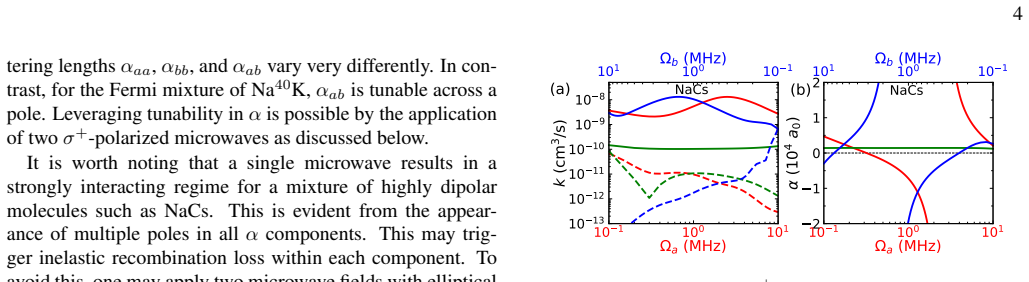
- Two microwave fields at frequencies separated by much more than their detunings let the two components' interactions be tuned independently, so the ratio γ=α_ab/√(α_aa α_bb) can be set to essentially any value.
- For fermionic Na40K, the intercomponent scattering length can be tuned through a pole, providing a route to the BCS-BEC crossover in a molecular superfluid mixture.
Where Pith is reading between the lines
- The same mechanism should work for any polar molecule with a sufficiently strong vibrational dependence of the rotational constant; the paper's table lists five (including SrF), but the universality of C6 in reduced units suggests a broad class.
- Because the two-microwave scheme decouples the components, a loaded optical lattice with independently tunable on-site interactions U_aa, U_bb, and U_ab becomes feasible, which the paper mentions but does not develop.
- The neglect of inter-vibrational transition dipole moments is untested; if they contribute, the effective C6 and hence barrier height would change, and the predicted loss suppression could be compromised.
- The use of excited vibrational states (v' up to 10 in the two-microwave scheme) raises the question of radiative or blackbody-induced decay; measuring or computing these lifetimes would be a natural next step.
Editorial analysis
A structured set of objections, weighed in public.
Referee Report
Summary. The manuscript proposes 'vibrational shielding' as a mechanism to stabilize ultracold polar molecules in two different rovibrational states. The idea is that the pair state (0,1)+(v',0) couples via the dipole-dipole interaction to the energetically nearby state (0,0)+(v',1), producing a repulsive C6/R^6 interaction because the rotational constant depends on the vibrational level (ΔEv = 2(b0−bv')). The authors derive the C6 coefficient in End Matter Eq. (E2), compute adiabats, and perform coupled-channel scattering calculations for NaCs, CaF, and Na40K, including hyperfine channels, reporting loss suppression by orders of magnitude. They then propose tuning of the interactions with static electric fields and with one or two microwave fields, including a two-microwave scheme for independent control of intra- and intercomponent interactions in a two-component mixture. The paper contains explicit basis-set details and claims 1% convergence.
Significance. If the central mechanism holds, this is an important proposal: it offers a route to tunable two-component molecular quantum gases without magnetic Feshbach resonances, with potential applications in tweezers, bulk mixtures, and impurity physics. The analytic C6 expression is parameter-free, and the scattering calculations are substantial and molecule-specific, covering three species of current experimental interest. The proposal is falsifiable and directly tied to experimental observables such as loss-rate coefficients and scattering lengths. However, the central field-free shielding claim depends on a single unquantified assertion about inter-vibrational transition dipoles, which is load-bearing and not addressed by the numerical calculations as presented.
major comments (2)
- [Vibrational shielding / End Matter Eq. (E3)] The central claim of field-free shielding rests on the sentence 'Note that we do not consider interactions arising from transition dipoles between inter-vibrational levels, as they are very small.' No quantitative bound is given. The rigid-rotor Hamiltonian in Eq. (E3) fixes the vibrational quantum numbers, so the exactly degenerate exchange channel |(0,1);(v',0)> ↔ |(v',0);(0,1)> is absent by construction. For a nonzero inter-vibrational transition dipole d_{0,v'}, this channel is coupled at first order by H_dd, producing a long-range C3/R^3 interaction (and, via L=2 coupling, an attractive C4/R^4 tail) that can dominate the proposed C6/R^6 repulsion at large R. For NaCs, d_{0,1} is plausibly ~0.1 D, making the exchange contribution at R~R6 comparable to E6 and to the 10 nK energies of Figs. 3–4. The authors should compute or bound d_{0,v'} for NaCs, Na40K, and CaF, include the exchange
- [Effect of two σ+-microwaves] The two-microwave scheme uses v'=10 as the second component, with the stated rationale that ΔE_v∼0.1 b0 is much larger than the individual detunings. The manuscript does not assess the lifetime of a molecule in v'=10 or the rate of vibration-changing collisions. If v'=10 relaxes on a timescale comparable to or shorter than the experimental sequence, the proposed independent tuning of aa and bb interactions cannot be realized. Please provide an estimate of the spontaneous-emission lifetime for the relevant v'=10 level of NaCs (and any other molecule used in this scheme) and discuss possible inelastic channels.
minor comments (4)
- [Abstract / Introduction] The phrase 'without requiring any external field' is stronger than what is shown: the scattering results in Fig. 2(b) are calculated at B=200 G, which is used to decouple hyperfine channels. The shielding mechanism itself is field-free, but the practical loss suppression relies on a magnetic field; please qualify the wording.
- [Fig. 2(b)] The colored elastic-scattering curves are hidden beneath the black universal curve, so the reader cannot see the claimed agreement. Consider plotting with markers or a small offset.
- [Table I] The numerical columns (especially ΔEv, C6, R6, E6/kB) appear misaligned in the preprint; exponents may be attached to the wrong quantities. Please check the typesetting and units.
- [End Matter, coupled-channel method] The justification for omitting rotational pair functions beyond (n=0,1) says they are 'energetically far off'; please give the energy gap in units of ΔEv for the largest omitted channel and state the convergence test for that truncation.
Circularity Check
No significant circularity: the C6 shielding interaction is derived from a parameter-free second-order perturbation expression, and the predicted scattering rates come from independent coupled-channel calculations.
full rationale
The central claim—that the pair state (0,1)+(v',0) experiences a repulsive long-range interaction—is derived analytically as C6 = 2 μ0^2 μv'^2/[9(4πε0)^2 ΔEv] from the dipole-dipole matrix element in Eqs. (E1)–(E2), with ΔEv = 2(b0−bv'). The inputs b_v and μ_v come from ab initio potential and dipole-moment data, not from the scattering results being predicted. The coupled-channel calculations solve the full Hamiltonian (E3) including hyperfine and Zeeman terms, with an absorbing boundary at short range, and the resulting elastic and loss rates are then compared with universal C6 R^-6 threshold formulas. The loss suppression shown in Fig. 2 is therefore a nontrivial output of the scattering dynamics, not an input constructed to match it. The paper's self-citations (Refs. [20,23,29,33,39,47]) are used mainly for numerical methodology, hyperfine Hamiltonians, and context; none is invoked to establish the shielding result itself. One limitation is explicitly stated: 'Note that we do not consider interactions arising from transition dipoles between inter-vibrational levels, as they are very small' — this is a physical assumption with no quantitative bound, and the 'field-free' section nevertheless uses B=200 G to decouple hyperfine channels. These are correctness/overclaim concerns, but they are not circular reductions: the derivation does not assume the conclusion it claims to predict.
Axiom & Free-Parameter Ledger
free parameters (3)
- Single-microwave detuning-to-Rabi ratio delta=Delta/Omega =
-0.65 (NaCs), -0.15 (Na40K)
- Two-microwave parameter ratios delta_a=-1, delta_b=1, Omega_b=1/Omega_a =
set in Fig. 4
- Vibrational quantum number v'=10 for second component in two-microwave scheme =
10
axioms (6)
- standard math Second-order perturbation theory applies to the dipole-dipole coupling between the pair levels (0,1)+(v',0) and (0,0)+(v',1), yielding a repulsive C6 R^-6 interaction.
- domain assumption Inter-vibrational transition dipole moments are negligible for the shielding interaction.
- domain assumption Molecules are described as rigid rotors with vibrationally averaged b_v and mu_v; vibrational dynamics beyond the level labels is ignored.
- domain assumption Short-range collisions are fully absorbed (unit probability of loss) via absorbing boundary conditions; no back-coupling from chemical reaction products.
- ad hoc to paper For the two-microwave scheme, excited vibrational state v'=10 is long-lived enough for experiments.
- standard math Universal threshold rates for a C6 R^-6 potential from Idziaszek and Julienne apply to the Wigner regime.
read the original abstract
We propose a method to realize stable, tunable two-component quantum mixtures of ultracold polar molecules. First, we show that a pair of polar molecules in two distinct rovibrational states exhibits a repulsive interaction, thereby leading to collisional shielding without requiring any external field. We refer to this as "vibrational shielding". This intercomponent interaction is tunable by an external static electric or a microwave field, with the latter stabilizing both inter- and intracomponent interactions in a two-component bulk mixture. Additionally, we show that two microwave fields can independently tune the interactions of the individual components. Our findings thus open the door to the experimental realization of tunable quantum mixtures using polar molecules, analogous to tunable magnetic Feshbach resonances in two-component atomic quantum gases.
Figures




Reference graph
Works this paper leans on
-
[1]
Enrico Fermi
G. Lamporesi, Two-component spin mixtures, inQuantum Mix- tures with Ultra-cold Atoms, International School of Physics “Enrico Fermi”, V ol. 211, edited by R. Grimm, M. Inguscio, G. Lamporesi, and S. Stringari (IOS Press, NL, 2025) p. 1–28
2025
-
[2]
Timmermans, Phase separation of Bose-Einstein conden- sates, Phys
E. Timmermans, Phase separation of Bose-Einstein conden- sates, Phys. Rev. Lett.81, 5718 (1998)
1998
-
[3]
Schirotzek, C.-H
A. Schirotzek, C.-H. Wu, A. Sommer, and M. W. Zwierlein, Observation of Fermi polarons in a tunable Fermi liquid of ul- tracold atoms, Phys. Rev. Lett.102, 230402 (2009)
2009
-
[4]
Baroni, G
C. Baroni, G. Lamporesi, and M. Zaccanti, Quantum mixtures of ultracold gases of neutral atoms, Nat. Rev. Phys.6, 736 (2024)
2024
-
[5]
C. Chin, R. Grimm, P. S. Julienne, and E. Tiesinga, Feshbach resonances in ultracold gases, Rev. Mod. Phys.82, 1225 (2010)
2010
-
[6]
L. D. Carr, D. DeMille, R. V . Krems, and J. Ye, Cold and ultra- cold molecules: science, technology and applications, New J. Phys.11, 055049 (2009)
2009
-
[7]
M. A. Baranov, M. Dalmonte, G. Pupillo, and P. Zoller, Con- densed matter theory of dipolar quantum gases, Chem. Rev. 112, 5012 (2012)
2012
-
[8]
S. L. Cornish, M. R. Tarbutt, and K. R. A. Hazzard, Quantum computation and quantum simulation with ultracold molecules, Nat. Phys.20, 730 (2024)
2024
-
[9]
Schindewolf, J
A. Schindewolf, J. Hertkorn, I. Stevenson, M. Ciardi, P. Groß, D. Wang, T. Karman, G. Qu ´em´ener, S. Will, T. Pohl, and T. Langen, Colloquium: Strongly dipolar molecular Bose- Einstein condensates: From few- to many-body physics, Rev. Mod. Phys. (2026)
2026
-
[10]
Micheli, G
A. Micheli, G. K. Brennen, and P. Zoller, A toolbox for lattice- spin models with polar molecules, Nat. Phys.2, 341 (2006)
2006
-
[11]
A. V . Gorshkov, S. R. Manmana, G. Chen, J. Ye, E. Demler, M. D. Lukin, and A. M. Rey, Tunable superfluidity and quantum magnetism with ultracold polar molecules, Phys. Rev. Lett.107, 115301 (2011)
2011
-
[12]
Schmidt, L
M. Schmidt, L. Lassabli `ere, G. Qu ´em´ener, and T. Langen, Self-bound dipolar droplets and supersolids in molecular Bose- Einstein condensates, Phys. Rev. Res.4, 013235 (2022)
2022
-
[13]
Langen, J
T. Langen, J. Boronat, J. S ´anchez-Baena, R. Bomb ´ın, T. Kar- man, and F. Mazzanti, Dipolar droplets of strongly interacting molecules, Phys. Rev. Lett.134, 053001 (2025)
2025
-
[14]
W.-J. Jin, F. Deng, S. Yi, and T. Shi, Bose-Einstein condensates of microwave-shielded polar molecules, Phys. Rev. Lett.134, 233003 (2025)
2025
-
[15]
Ciardi, K
M. Ciardi, K. R. Pedersen, T. Langen, and T. Pohl, Self-bound superfluid membranes and monolayer crystals of ultracold polar molecules, Phys. Rev. Lett.135, 153401 (2025)
2025
-
[16]
A. V . Avdeenkov, M. Kajita, and J. L. Bohn, Suppression of in- elastic collisions of polar 1Σstate molecules in an electrostatic field, Phys. Rev. A73, 022707 (2006)
2006
-
[17]
Wang and G
G. Wang and G. Qu ´em´ener, Tuning ultracold collisions of ex- cited rotational dipolar molecules, New J. Phys.17, 035015 (2015)
2015
-
[18]
Karman and J
T. Karman and J. M. Hutson, Microwave shielding of ultracold polar molecules, Phys. Rev. Lett.121, 163401 (2018)
2018
-
[19]
Lassabli `ere and G
L. Lassabli `ere and G. Qu ´em´ener, Controlling the scattering length of ultracold dipolar molecules, Phys. Rev. Lett.121, 163402 (2018)
2018
-
[20]
Mukherjee, M
B. Mukherjee, M. D. Frye, C. R. Le Sueur, M. R. Tarbutt, and J. M. Hutson, Shielding collisions of ultracold CaF molecules with static electric fields, Phys. Rev. Res.5, 033097 (2023)
2023
-
[21]
Matsuda, L
K. Matsuda, L. D. Marco, J.-R. Li, W. G. Tobias, G. Valtolina, G. Qu´em´ener, and J. Ye, Resonant collisional shielding of reac- tive molecules using electric fields, Science370, 1324 (2020)
2020
-
[22]
Anderegg, S
L. Anderegg, S. Burchesky, Y . Bao, S. S. Yu, T. Karman, E. Chae, K.-K. Ni, W. Ketterle, and J. M. Doyle, Observation of microwave shielding of ultracold molecules, Science373, 779 (2021)
2021
-
[23]
Karman, N
T. Karman, N. Bigagli, W. Yuan, S. Zhang, I. Stevenson, and S. Will, Double microwave shielding, PRX Quantum6, 020358 (2025)
2025
-
[24]
Schindewolf, R
A. Schindewolf, R. Bause, X.-Y . Chen, M. Duda, T. Kar- man, I. Bloch, and X.-Y . Luo, Evaporation of microwave- shielded polar molecules to quantum degeneracy, Nature607, 677 (2022)
2022
-
[25]
Bigagli, W
N. Bigagli, W. Yuan, S. Zhang, B. Bulatovic, T. Karman, I. Stevenson, and S. Will, Observation of Bose-Einstein con- densation of dipolar molecules, Nature631, 289 (2024)
2024
-
[26]
Z. Shi, Z. Huang, F. Deng, W.-J. Jin, S. Yi, T. Shi, and D. Wang, Bose-Einstein condensate of ultracold sodium- 6 rubidium molecules with tunable dipolar interactions, Nat. Phys. (2026)
2026
-
[27]
Zhang, W
S. Zhang, W. Yuan, N. Bigagli, H. Kwak, T. Karman, I. Steven- son, and S. Will, Observation of self-bound droplets of ultracold dipolar molecules, Nature651, 601 (2026)
2026
-
[28]
Mukherjee, J
B. Mukherjee, J. M. Hutson, and K. R. A. Hazzard, SU(N) magnetism with ultracold molecules, New J. Phys.27, 013013 (2025)
2025
-
[29]
Mukherjee and J
B. Mukherjee and J. M. Hutson, SU(N) symmetry with ultra- cold alkali dimers: weak dependence of scattering properties on hyperfine state, Phys. Rev. Res.7, 013099 (2025)
2025
-
[30]
J.-L. Li, G. M. Koutentakis, M. Hrast, M. Lemeshko, A. Schin- dewolf, and R. Alhyder, Tunable field-linked s-wave interac- tions in dipolar fermi mixtures, Communications Physics9, 10.1038/s42005-026-02578-8 (2026)
-
[31]
E. F. Walraven and T. Karman, Rotational-state dependence of interactions between polar molecules, Phys. Rev. A109, 043310 (2024)
2024
-
[32]
E. F. Walraven and T. Karman, Hyperfine van der Waals re- pulsion between open-shell polar molecules, Phys. Rev. A112, 032810 (2025)
2025
-
[33]
Mukherjee and M
B. Mukherjee and M. Tomza, Optical excitation and stabiliza- tion of ultracold field-linked tetratomic molecules, Phys. Rev. Lett.136, 013401 (2026)
2026
-
[34]
Docenko, M
O. Docenko, M. Tamanis, R. Ferber, A. Pashov, H. Kn ¨ockel, and E. Tiemann, Spectroscopic studies of NaCs for the ground state asymptote of Na plus Cs pairs, Eur. Phys. J. D31, 205 (2004)
2004
-
[35]
Russier-Antoine, A
I. Russier-Antoine, A. J. Ross, M. Aubert-Fr ´econ, F. Martin, and P. Crozet, An improved potential energy curve for the ground state of NaK, J. Phys. B - At. Mol. Opt.33, 2753 (2000)
2000
-
[36]
The dipole moment functions for the alkali-metal diatoms are taken from Ref. [62]. For CaF and SrF, we use the CCSD(T) method [63] using MOLPRO [64] to calculate their ground electronic potentials and dipole moment functions with atomic basis sets and bond functions similar to Ref. [62]
-
[37]
Idziaszek and P
Z. Idziaszek and P. S. Julienne, Universal rate constants for re- active collisions of ultracold molecules, Phys. Rev. Lett.104, 113202 (2010)
2010
-
[38]
M. L. Gonz ´alez-Mart´ınez, J. L. Bohn, and G. Qu ´em´ener, Adi- mensional theory of shielding in ultracold collisions of dipolar rotors, Phys. Rev. A96, 032718 (2017)
2017
-
[39]
Mukherjee and J
B. Mukherjee and J. M. Hutson, Controlling collisional loss and scattering lengths of ultracold dipolar molecules with static electric fields, Phys. Rev. Res.6, 013145 (2024)
2024
-
[40]
E. F. Walraven, M. R. Tarbutt, and T. Karman, Scheme for deter- ministic loading of laser-cooled molecules into optical tweez- ers, Phys. Rev. Lett.132, 183401 (2024)
2024
- [41]
-
[42]
Y . Bao, S. S. Yu, L. Anderegg, E. Chae, W. Ketterle, K.-K. Ni, and J. M. Doyle, Dipolar spin-exchange and entanglement between molecules in an optical tweezer array, Science382, 1138 (2023)
2023
-
[43]
C. M. Holland, Y . Lu, and L. W. Cheuk, On-demand entan- glement of molecules in a reconfigurable optical tweezer array, Science382, 1143 (2023)
2023
-
[44]
Bigagli, C
N. Bigagli, C. Warner, W. Yuan, S. Zhang, I. Stevenson, T. Kar- man, and S. Will, Collisionally stable gas of bosonic dipolar ground-state molecules, Nat. Phys.19, 1579 (2023)
2023
-
[45]
J. Lin, G. Chen, M. Jin, Z. Shi, F. Deng, W. Zhang, G. Qu´em´ener, T. Shi, S. Yi, and D. Wang, Microwave shielding of bosonic NaRb molecules, Phys. Rev. X13, 031032 (2023)
2023
-
[46]
J. Dutta and J. M. Hutson, Microwave shielding of ultracold polar molecules on the transitionn= 1→2(2026), arXiv:2607.02470 [physics.atom-ph]
Pith/arXiv arXiv 2026
-
[47]
Dutta, B
J. Dutta, B. Mukherjee, and J. M. Hutson, Universality in the microwave shielding of ultracold polar molecules, Phys. Rev. Res.7, 023164 (2025)
2025
-
[48]
D. S. Hall, M. R. Matthews, J. R. Ensher, C. E. Wieman, and E. A. Cornell, Dynamics of component separation in a binary mixture of bose-einstein condensates, Phys. Rev. Lett.81, 1539 (1998)
1998
-
[49]
C. R. Cabrera, L. Tanzi, J. Sanz, B. Naylor, P. Thomas, P. Cheiney, and L. Tarruell, Quantum liquid droplets in a mix- ture of Bose-Einstein condensates, Science359, 301 (2018)
2018
-
[50]
D. S. Petrov, Quantum mechanical stabilization of a collapsing Bose-Bose mixture, Phys. Rev. Lett.115, 155302 (2015)
2015
-
[51]
Zwerger, ed.,The BCS–BEC Crossover and the Unitary Fermi Gas, Lecture Notes in Physics, V ol
W. Zwerger, ed.,The BCS–BEC Crossover and the Unitary Fermi Gas, Lecture Notes in Physics, V ol. 836 (Springer, 2012)
2012
-
[52]
D. S. Petrov, Elastic multibody interactions on a lattice, Phys. Rev. A90, 021601(R) (2014)
2014
-
[53]
Cardarelli, S
L. Cardarelli, S. Greschner, and L. Santos, Engineering inter- actions and anyon statistics by multicolor lattice-depth modula- tions, Phys. Rev. A94, 023615 (2016)
2016
-
[54]
G. M. Nixon, F. N. ¨Unal, and U. Schneider, Individually tun- able tunnelling coefficients in optical lattices using local peri- odic driving, Quantum Sci. and Technol.9, 045030 (2024)
2024
-
[55]
Bergmann, H
K. Bergmann, H. Theuer, and B. W. Shore, Coherent population transfer among quantum states of atoms and molecules, Rev. Mod. Phys.70, 1003 (1998)
1998
-
[56]
E. S. Shuman, J. F. Barry, and D. DeMille, Laser cooling of a diatomic molecule, Nature467, 820 (2010)
2010
-
[57]
Polovy, E
G. Polovy, E. Frieling, D. Uhland, J. Schmidt, and K. W. Madison, Quantum-state-dependent chemistry of ultracold6Li2 dimers, Phys. Rev. A102, 013310 (2020)
2020
-
[58]
Schmidt and M
R. Schmidt and M. Lemeshko, Rotation of quantum impurities in the presence of a many-body environment, Phys. Rev. Lett. 114, 203001 (2015)
2015
-
[59]
K. Feng, H. Yang, H. J. J´o´zwiak, and T. Karman, Ro-vibrational van der waals interaction between ultracold polar molecules (2026), arXiv:2607.25774 [cond-mat.quant-gas]
Pith/arXiv arXiv 2026
-
[60]
H. J. J ´o´zwiak, H. Yang, E. Dizer, A. Christianen, and T. Kar- man, Tunable state-dependent interactions in collisionally sta- ble mixtures of polar molecules (2026), arXiv:2607.25777 [cond-mat.quant-gas]
Pith/arXiv arXiv 2026
-
[61]
E. F. Walraven, K. Feng, J. Rodewald, M. R. Tarbutt, and T. Karman, Deterministic loading of molecular arrays by microwave-assisted collisions (2026), arXiv:2607.25783 [physics.atom-ph]
Pith/arXiv arXiv 2026
-
[62]
Ladjimi and M
H. Ladjimi and M. Tomza, Diatomic molecules of alkali- metal and alkaline-earth-metal atoms: Interaction potentials, dipole moments, and polarizabilities, Phys. Rev. A109, 052814 (2024)
2024
-
[63]
R. J. Bartlett and M. Musiał, Coupled-cluster theory in quantum chemistry, Rev. Mod. Phys.79, 291 (2007)
2007
-
[64]
Werner, P
H.-J. Werner, P. J. Knowles,et al., Molpro, version 2019.2, a package ofab initioprograms, see https://www.molpro.net
2019
-
[65]
W. J. Childs, G. L. Goodman, and L. S. Goodman, Precise de- termination of thevandNdependence of the spin-rotation and hyperfine interactions in the CaF ground state, J. Mol. Spec- trosc.86, 365 (1981)
1981
-
[66]
S. A. Will, J. W. Park, Z. Z. Yan, H. Loh, and M. W. Zwierlein, Coherent microwave control of ultracold 23Na40Kmolecules, Phys. Rev. Lett.116, 225306 (2016)
2016
-
[67]
Aldegunde and J
J. Aldegunde and J. M. Hutson, Hyperfine structure of alkali- metal diatomic molecules, Phys. Rev. A96, 042506 (2017). 7
2017
-
[68]
J. M. Hutson and C. R. Le Sueur,MOLSCAT: a program for non- reactive quantum scattering calculations on atomic and molec- ular collisions, Comp. Phys. Comm.241, 9 (2019)
2019
-
[69]
D. C. Clary and J. P. Henshaw, Chemical reactions dominated by long-range intermolecular forces, Faraday Discuss. Chem. Soc.84, 333 (1987)
1987
-
[70]
class 1” and “class 2
L. M. C. Janssen,Cold collision dynamics of NH radicals, Ph.D. thesis, Radboud University, Nijmegen (2012). END MA TTER Value ofC 6 for vibrational shielding–The effective inter- action in vibrational shielding gives rise to a repulsive long- rangeC 6R−6 potential. To derive the value ofC 6, we con- sider a coupled basis set|((n A, nB)NABL)J M⟩for molecul...
2012
discussion (0)
Sign in with ORCID, Apple, or X to comment. Anyone can read and Pith papers without signing in.