REVIEW 4 major objections 5 minor 126 references
This monograph argues that modern discrepancy theory can be unified through Banaszczyk's theorem and its algorithmic conversions, and provides a self-contained proof of that theorem.
Reviewed by Pith at T0; open to challenge. T0 means a machine referee read the full paper against a public rubric. the ladder, T0–T4 →
T0 review · deepseek-v4-flash
2026-08-04 01:10 UTC pith:K7CNOXC6
load-bearing objection A useful, well-attributed monograph of known discrepancy results; the new proof in Chapter 6 has a repairable gap in exposition and the ChatGPT claim in §1.8 should go. the 4 major comments →
Discrepancy Theory: An Algorithmic and Geometric Perspective
The pith
A machine-rendered reading of the paper's core claim, the machinery that carries it, and where it could break.
Core claim
The central claim is that Banaszczyk's theorem is the right organizing principle for discrepancy theory. On the book's own terms: for any closed convex set K in R^m with Gaussian measure at least 1/2 and any vectors of Euclidean length at most 1/5, there exist signs whose signed sum lies in K. From this theorem the book derives the O(√log m) Komlós bound, the γ2-norm discrepancy bound disc(M) ≤ γ2(M)√log(2m), the best known upper bound for axis-parallel boxes, and prefix/Steinitz consequences; it then shows that algorithmic variants—Lovett-Meka's Brownian walk, Rothvoss's projection, the Gram-Schmidt Walk, and SDP vector discrepancy—convert the nonconstructive geometry into polynomial-time c
What carries the argument
Banaszczyk's theorem (Theorem 5.1) is the load-bearing object: a Gaussian-measure condition on a convex body guarantees a low-discrepancy signed sum. The proof's engine is the construction, for each direction u with ||u||≤1/5, of a convex body K*u contained in (K−u)∪(K+u) whose Gaussian measure is at least that of K; the body is built via Ehrhard symmetrization and a pairing argument that reduces the higher-dimensional comparison to Gaussian measures of one-dimensional intervals. The algorithmic chapters supply the mechanism that turns this existence theorem into computation: a Gaussian walk in a shrinking subspace, projection onto K∩[−1,1]^n, the Gram-Schmidt Walk for sub-Gaussian discrepan
Load-bearing premise
The load-bearing premise is that the self-contained proof of Banaszczyk's theorem—through the Ehrhard-Borell inequality and the one-dimensional interval comparison—is correct; if that chain breaks, the book's advertised unified treatment collapses, and the peripheral Section 1.8 claim that a ChatGPT-discovered algorithm resolves open problems is not proven in the text.
What would settle it
Recompute the key numeric and monotonic checks in Section 6.4: the ratio f(d) = (Φ(d)−Φ(d+r))/Φ(p+d) must be non-decreasing in d, with f(p) ≥ 1 for p ≥ 1 and r ≤ 1/5. A counterexample at p=1, r=0.2, d=0 would falsify the book's proof of Theorem 6.1.
If this is right
- Banaszczyk's theorem yields the best known O(√log m) bound for the Komlós vector-balancing problem, improving on the O(log n) given by partial coloring alone.
- The same theorem gives disc(M) ≤ γ2(M)√log(2m), which yields polylogarithmic approximations of hereditary discrepancy and the best known upper bound for the discrepancy of axis-parallel boxes.
- The proof framework implies prefix-discrepancy and Steinitz bounds, including a √log n prefix Komlós bound and near-Euclidean Steinitz estimates.
- The algorithmic chapters claim polynomial-time colorings matching several nonconstructive bounds, including Spencer-type O(√n) results via Lovett-Meka and Rothvoss algorithms.
- The Gram-Schmidt Walk provides an efficient way to sample a near-sub-Gaussian discrepancy distribution, making the Komlós bound constructive; the Self-Balancing Walk extends near-optimal bounds to the online setting.
Where Pith is reading between the lines
- The book leaves implicit that the 1/5 length bound and the 1/2 Gaussian threshold are the true bottlenecks: improving either constant in Theorem 5.1 would immediately improve every application it feeds, so the constants are a natural focus for future work.
- Because the proof rests on Ehrhard-Borell, a sharper one-dimensional comparison could plausibly remove the additive √log n term in prefix discrepancy and settle the Euclidean Steinitz conjecture; this is an inference, not a result in the book.
- A testable extension of the book's approach would be to run the Gram-Schmidt Walk on the prefix problem (Theorem 5.15); the book states that no efficient algorithm is known, so a concrete open route is to adapt the sub-Gaussian sampling to the prefix setting.
- The Section 1.8 claim that a ChatGPT-discovered algorithm resolves open problems is an unverified aside, separate from the core derivation; it should be treated as a pointer to external work rather than part of the book's contribution.
Editorial analysis
A structured set of objections, weighed in public.
Referee Report
Summary. This is an expository monograph on combinatorial discrepancy theory, aiming to present modern algorithmic and convex-geometric techniques through a unified set of ideas. The visible portion covers Chapters 1-6: classical linear-algebraic methods (Beck-Fiala, permutations, boxes, vector balancing), partial-coloring methods and Spencer's theorem, the Lovett-Meka and Rothvoss algorithms, and a substantial presentation of Banaszczyk's theorem with Chapter 6 devoted to the geometric proof of the key measure-increase lemma. The table of contents advertises further chapters on hereditary discrepancy, algorithmic Banaszczyk bounds, the Gram-Schmidt walk, and online discrepancy, but those chapters are not present in the submitted text. The visible proofs of Beck-Fiala and Spencer follow standard arguments, and the general structure of the Banaszczyk proof is recognizable, but the submitted manuscript is incomplete and the central proof contains local gaps that need repair.
Significance. If completed, the monograph would be a useful modern reference: it explains several important techniques in one place, including Giannopoulos's geometric partial-coloring lemma, Royen's correlation inequality, the Lovett-Meka edge walk, and Rothvoss's convex-programming algorithm. The visible mathematical content is broadly coherent and accurately attributed to the existing literature. However, the submitted version cannot be accepted as a finished work: its advertised scope is not present, and the proof of Banaszczyk's theorem — the main geometric contribution of the book — has steps that are not written correctly. The manuscript does not contain machine-checked proofs or reproducible code, so the assessment rests entirely on the written arguments. The central claims are standard and likely correct, but the presentation is not yet refereable in its current form.
major comments (4)
- [Overall submission, Chapters 7-10] The table of contents lists Chapters 7-10, including hereditary discrepancy, algorithmic Banaszczyk bounds, the Gram-Schmidt walk, and online discrepancy, but these chapters are absent from the submitted text. Consequently, several advertised contributions — for example the algorithmic proof of Banaszczyk's bound, the self-balancing walk, and the claimed constant vector-discrepancy proof in Chapter 10 — cannot be checked. This is an incomplete submission and blocks acceptance.
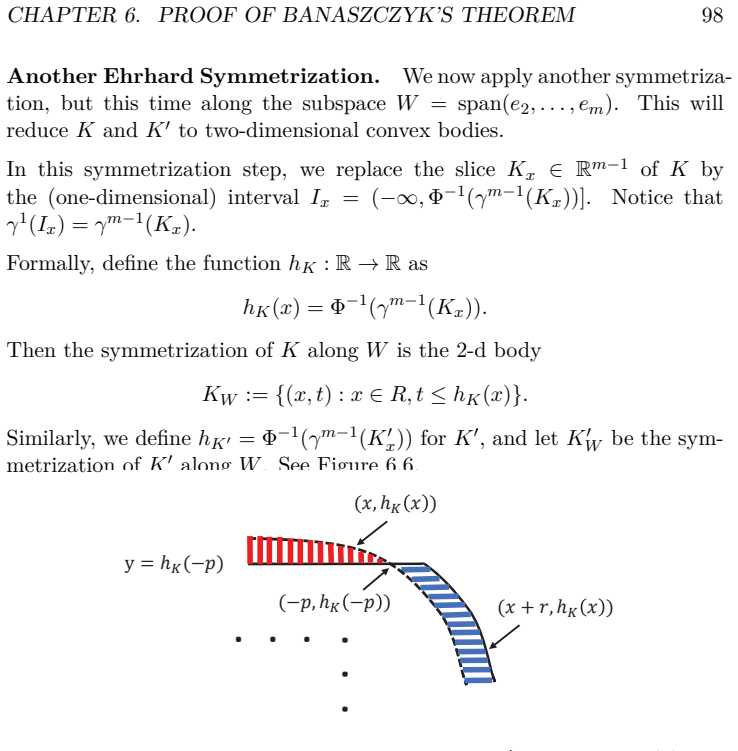
- [Section 6.4, Lemma 6.5] The chord-replacement argument is written incorrectly. For a concave decreasing h_K, the chord L through P=(-p,h_K(-p)) and Q=(-r/2,h_K(-r/2)) lies below h_K on [-p,-r/2] and above h_K outside this interval, including on (-∞,-p] and [-r/2,∞). The displayed statement 'L(x)≤h_K(x) for x≤−p−d' is undefined and generally false. More importantly, the blue-region case analysis treats x∈[-p,-r/2) and then 'x > r/2', omitting the whole range [-r/2,r/2]. The conclusion is salvageable by changing the second condition to x≥−r/2, because γ1([a,a+r]) decreases under a right shift for a≥−r/2, but as written the proof of γ2(C)≤γ2(D) is incomplete. Since Theorem 6.6 and Theorem 6.1 depend on this step, this must be fixed.
- [Section 6.5, Proposition 6.4] Proposition 6.4 asserts that the Ehrhard symmetrization used to reduce to two dimensions preserves convexity of K and K'. The section states the Ehrhard-Borell inequality but the proof of log-concavity of the slice functions h_K and h_{K'} and the resulting convexity is not included in the submitted text; more generally, Section 6.5 ends before the argument is completed. This is a load-bearing step in the reduction to two dimensions, and it needs a full proof or a precise, self-contained reference.
- [Section 1.8 and later cross-references] Section 1.8 states that a ChatGPT-discovered algorithm 'gives a new constructive proof of Theorem 5.15, and resolves several open problems in this book.' This is inconsistent with later statements: for example, Section 5.6 still describes an efficient version of Theorem 5.15 as open, and several open problems in earlier chapters are not updated. No bibliography entries or verification details are supplied. This is not load-bearing for the core mathematics, but the unsupported and internally inconsistent claim should be removed or substantiated, and all open-problem statements cross-referenced consistently.
minor comments (5)
- [Lemma 3.14] In the displayed consequence of Sidak's lemma, the product should run over i=1,...,m, not i=1,...,n, and the factors should be γ1([-t_i,t_i]), not γ_n(S_i). The current indexing is confusing.
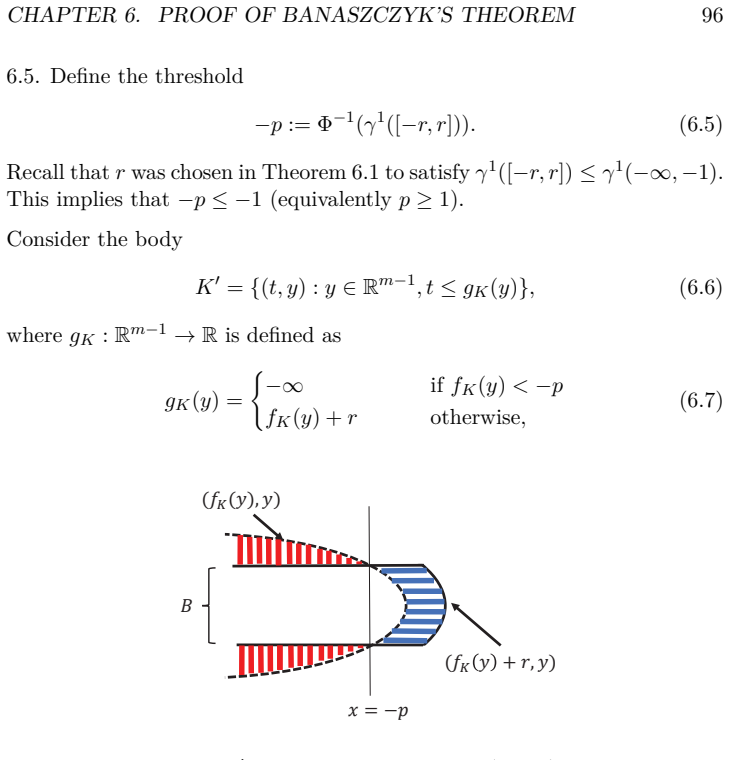
- [Section 6.4.1] The numerical values γ1([-1/5,1/5])≈0.1585 and γ1((-∞,-1])≈0.1586 are correct, but the surrounding comparison of these values is written loosely; the condition should be stated as γ1([-r,r])≤γ1((-∞,-1]) for r≤1/5.
- [Theorem 2.8] The proof concludes with a bound of O(k log n) for the discrepancy, while the theorem statement promises O(k log^2 n). The dependence on n should be stated consistently.
- [Section 5.3] The convexity of K*u is asserted in one sentence. A short verification using the affine variation of the endpoints of the slices would improve readability.
- [Bibliography] The text cites references such as [2], [5], [17], and [44] but no reference list appears in the submitted version. A complete bibliography is required for any publication.
Circularity Check
No significant circularity: the book's central derivation (proof of Banaszczyk's Theorem 5.1) proceeds from external theorems and contains no fitted parameters; self-citations are ordinary attributions.
full rationale
I walked the derivation chain of the central claim, Theorem 5.1 (Banaszczyk). The theorem is not defined in terms of its own conclusion: the body K*u in (6.1) is constructed from K and u, and Theorem 5.8's inequality γ_m(K*u) ≥ γ_m(K) is argued via symmetrization, reduction to two dimensions, the chord replacement in Lemma 6.5, and the 1-D interval comparisons of §6.4, all resting on external ingredients (Gaussian isoperimetric/Ehrhard–Borell inequality, cited [47,36]; Sidak's Lemma 3.14; Royen's correlation inequality Theorem 3.19; Talagrand's comparison Theorem 5.12). There are no fitted parameters, no predictions from data, and no quantity is set up so that the claimed conclusion holds by construction. The abundant self-citations (e.g., Nikolov [98], Matoušek–Nikolov–Talwar [91], Dadush–Nikolov–Talwar–Tomczak-Jaegermann [45], Bansal–Jiang [17]) attribute independently published, externally falsifiable results; none is invoked as an unverified uniqueness theorem or as a load-bearing ansatz. The skeptic-flagged issue in Lemma 6.5 (the case analysis over a∈[−r/2,r/2] in the chord-replacement argument) and the omitted proofs of Ehrhard–Borell and Royen are correctness/completeness concerns, not definitional circularity, and per the operating rules proof gaps do not by themselves raise the circularity score. The unusual §1.8 passage claiming that an external ChatGPT-discovered algorithm 'resolves several open problems' is flagged as a reliability/citation concern, but it plays no role in the core derivation of Chapters 5–6, so it is not load-bearing. Verdict: the monograph is self-contained against external benchmarks; no circularity.
Axiom & Free-Parameter Ledger
axioms (8)
- standard math Prekopa-Leindler inequality (Lemma 3.16).
- standard math Sidak's lemma (Lemma 3.14).
- standard math Royen's Gaussian correlation inequality (Theorem 3.19).
- standard math Gaussian isoperimetric inequality (Sudakov-Tsirelson / Borell, Theorem 4.8).
- standard math Ehrhard-Borell inequality (Theorem 6.13).
- standard math Talagrand's comparison theorem (Theorem 5.12).
- standard math Small-ball inequality for Brownian motion (Eq. 3.17).
- domain assumption Membership oracle and polynomial-time SDP solvability for Rothvoss' algorithm.
read the original abstract
Combinatorial discrepancy theory is a subject with roots in combinatorics, geometry, and number theory, and with numerous applications to mathematics and computer science. At its core, discrepancy theory is about dividing a collection of objects into two parts that are as balanced as possible. For example, given a collection of subsets of a finite universe, we may wish to color the elements with two colors so that each set is approximately evenly split. Other problems in discrepancy are more geometric in flavor, and ask for example, to assign signs to a collection of vectors, so that the sum of the signed vectors is as small as possible. Classical results, such as the Beck-Fiala theorem and Spencer's "six deviations" result, show that it is often possible to attain remarkably small discrepancy, often far smaller than what naive random colorings achieve. In recent years, discrepancy theory has undergone a transformation, driven by new algorithmic techniques and a rich interplay between probability, optimization, and convex geometry. These developments have led not only to new constructive proofs of foundational theorems, but also to several new results and research directions. This monograph aims to provide an accessible and unified introduction to these modern developments, with a focus on the core algorithmic and convex geometric ideas that have driven them. For several results, we provide new simpler analyses, while highlighting the intuition behind the proofs.
Figures




Reference graph
Works this paper leans on
-
[2]
Optimal online discrepancy minimization in linear time, 2026
Ishaq Aden-Ali. Optimal online discrepancy minimization in linear time, 2026
2026
-
[3]
Schulman, and Orli Waarts
Miklós Ajtai, James Aspnes, Moni Naor, Yuval Rabani, Leonard J. Schulman, and Orli Waarts. Fairness in scheduling.J. Algorithms, 29(2):306–357, 1998
1998
-
[4]
Alon and J.H
N. Alon and J.H. Spencer.The probabilistic method. Wiley- Interscience series in discrete mathematics and optimization. Wiley, 2000
2000
-
[5]
Altschuler and Konstantin Tikhomirov
Dylan J. Altschuler and Konstantin Tikhomirov. Online beck–fiala down to logarithmic sparsity, 2026
2026
-
[6]
Liu, and Mehtaab Sawhney
Ryan Alweiss, Yang P. Liu, and Mehtaab Sawhney. Discrepancy min- imization via a self-balancing walk. InSymposium on Theory of Com- puting, STOC, pages 14–20, 2021
2021
-
[7]
Comput., 46(5):1554–1573, 2017
Per Austrin, Venkatesan Guruswami, and Johan Håstad.(2 +ε)-Sat is NP-hard.SIAM J. Comput., 46(5):1554–1573, 2017
2017
-
[8]
An elementary introduction to modern convex geometry
Keith Ball. An elementary introduction to modern convex geometry. InFlavors of geometry, pages 1–58. Cambridge Univ. Press, 1997
1997
-
[9]
Balancing vectors and convex bodies.Studia Math., 106(1):93–100, 1993
Wojciech Banaszczyk. Balancing vectors and convex bodies.Studia Math., 106(1):93–100, 1993
1993
-
[10]
Balancing vectors and Gaussian measures of n-dimensional convex bodies.Random Structures and Algorithms, 12(4):351–360, 1998
Wojciech Banaszczyk. Balancing vectors and Gaussian measures of n-dimensional convex bodies.Random Structures and Algorithms, 12(4):351–360, 1998. 165 BIBLIOGRAPHY166
1998
-
[11]
On series of signed vectors and their rearrange- ments.Random Structures & Algorithms, 40(3):301–316, 2012
Wojciech Banaszczyk. On series of signed vectors and their rearrange- ments.Random Structures & Algorithms, 40(3):301–316, 2012
2012
-
[12]
Constructive algorithms for discrepancy minimization
Nikhil Bansal. Constructive algorithms for discrepancy minimization. InSymposium on Foundations of Computer Science, FOCS, pages 3– 10, 2010
2010
-
[13]
On a generalization of iterated and randomized round- ing
Nikhil Bansal. On a generalization of iterated and randomized round- ing. InSymposium on Theory of Computing, STOC, pages 1125–1135. ACM, 2019
2019
-
[14]
An algorithm for Komlós conjecture matching Banaszczyk’s bound
Nikhil Bansal, Daniel Dadush, and Shashwat Garg. An algorithm for Komlós conjecture matching Banaszczyk’s bound. InSymposium on Foundations of Computer Science, FOCS, pages 788–799, 2016
2016
-
[15]
The Gram-Schmidt walk: A cure for the Banaszczyk blues.Theory Comput., 15:1–27, 2019
Nikhil Bansal, Daniel Dadush, Shashwat Garg, and Shachar Lovett. The Gram-Schmidt walk: A cure for the Banaszczyk blues.Theory Comput., 15:1–27, 2019
2019
-
[16]
Algorithmic discrepancy beyond partial coloring
Nikhil Bansal and Shashwat Garg. Algorithmic discrepancy beyond partial coloring. InSymposium on Theory of Computing, STOC, pages 914–926. ACM, 2017
2017
-
[17]
Decoupling via affine spectral- independence: Beck-Fiala and Komlós bounds beyond banaszczyk, 2025
Nikhil Bansal and Haotian Jiang. Decoupling via affine spectral- independence: Beck-Fiala and Komlós bounds beyond banaszczyk, 2025
2025
-
[18]
Nikhil Bansal, Aditi Laddha, and Santosh S. Vempala. A unified ap- proach to discrepancy minimization. InAPPROX/RANDOM, volume 245 ofLIPIcs, pages 1:1–1:22, 2022
2022
-
[19]
Flow time schedul- ing and prefix Beck-Fiala
Nikhil Bansal, Lars Rohwedder, and Ola Svensson. Flow time schedul- ing and prefix Beck-Fiala. InSymposium on Theory of Computing, STOC, pages 331–342. ACM, 2022
2022
-
[20]
Nikhil Bansal and Joel H. Spencer. On-line balancing of random in- puts.Random Struct. Algorithms, 57(4):879–891, 2020
2020
-
[21]
Bárány and VS Grinberg
I. Bárány and VS Grinberg. On some combinatorial questions in finite- dimensional spaces.Linear Algebra and its Applications, 41:1–9, 1981
1981
-
[22]
On a class of balancing games.J
Imre Bárány. On a class of balancing games.J. Comb. Theory, Ser. A, 26(2):115–126, 1979
1979
-
[23]
On the power of linear dependencies
Imre Bárány. On the power of linear dependencies. InBuilding bridges, pages 31–45. Springer, 2008. BIBLIOGRAPHY167
2008
-
[24]
The Brunn-Minkowski theorem and related geometric and functional inequalities
Franck Barthe. The Brunn-Minkowski theorem and related geometric and functional inequalities. InInternational Congress of Mathemati- cians. Vol. II, pages 1529–1546. Eur. Math. Soc., Zürich, 2006
2006
-
[25]
A convexity condition in Banach spaces and the strong law of large numbers.Proc
Anatole Beck. A convexity condition in Banach spaces and the strong law of large numbers.Proc. Amer. Math. Soc., 13:329–334, 1962
1962
-
[26]
Beck and W
J. Beck and W. W. L. Chen. Note on irregularities of distribution. II. Proc. London Math. Soc. (3), 61(2):251–272, 1990
1990
-
[27]
Balanced two-colorings of finite sets in the square i
József Beck. Balanced two-colorings of finite sets in the square i. Combinatorica, 1(4):327–335, 1981
1981
-
[28]
Roth’s estimate of the discrepancy of integer sequences is nearly sharp.Combinatorica, 1(4):319–325, 1981
József Beck. Roth’s estimate of the discrepancy of integer sequences is nearly sharp.Combinatorica, 1(4):319–325, 1981
1981
-
[29]
Irregularities of distribution
József Beck. Irregularities of distribution. II.Proc. London Math. Soc. (3), 56(1):1–50, 1988
1988
-
[30]
József Beck and William W. L. Chen.Irregularities of distribution, volume 89 ofCambridge Tracts in Mathematics. Cambridge University Press, Cambridge, 1987
1987
-
[31]
Integer-making theorems.Discrete Ap- plied Mathematics, 3(1):1–8, 1981
József Beck and Tibor Fiala. Integer-making theorems.Discrete Ap- plied Mathematics, 3(1):1–8, 1981
1981
-
[32]
A note on the Beck-Fiala theo- rem.Combinatorica, 17(1):147–149, 1997
Debe Bednarchak and Martin Helm. A note on the Beck-Fiala theo- rem.Combinatorica, 17(1):147–149, 1997
1997
-
[33]
Lacey, and Armen Vagharshakyan
Dmitriy Bilyk, Michael T. Lacey, and Armen Vagharshakyan. On the small ball inequality in all dimensions.J. Funct. Anal., 254(9):2470– 2502, 2008
2008
-
[34]
On the discrepancy of3permutations.Random Struc- tures Algorithms, 1(2):215–220, 1990
Géza Bohus. On the discrepancy of3permutations.Random Struc- tures Algorithms, 1(2):215–220, 1990
1990
-
[35]
The Brunn-Minkowski inequality in Gauss space.In- ventiones Mathematicae, 30:207, 1975
Christer Borell. The Brunn-Minkowski inequality in Gauss space.In- ventiones Mathematicae, 30:207, 1975
1975
-
[36]
The Ehrhard inequality.Acad
Christer Borell. The Ehrhard inequality.Acad. Sci. Paris, 337(10):663–666, 2003
2003
-
[37]
An improvement of the Beck-Fiala theorem.Combin
Boris Bukh. An improvement of the Beck-Fiala theorem.Combin. Probab. Comput., 25(3):380–398, 2016
2016
-
[38]
Tight hardness results for minimizing discrepancy
Moses Charikar, Alantha Newman, and Aleksandar Nikolov. Tight hardness results for minimizing discrepancy. InACM-SIAM Sympo- sium on Discrete Algorithms, SODA, pages 1607–1614, 2011. BIBLIOGRAPHY168
2011
-
[39]
Chazelle.The discrepancy method: randomness and complexity
B. Chazelle.The discrepancy method: randomness and complexity. Cambridge University Press, 2001
2001
-
[40]
Gaussian discrepancy: A probabilistic relaxation of vector balancing
Sinho Chewi, Patrik Gerber, Philippe Rigollet, and Paxton Turner. Gaussian discrepancy: A probabilistic relaxation of vector balancing. Discret. Appl. Math., 322:123–141, 2022
2022
-
[41]
Convergence a.s
Sergej Chobanyan. Convergence a.s. of rearranged random series in Banach space and associated inequalities. InProbability in Banach spaces, pages 3–29. Birkhäuser Boston, MA, 1994
1994
-
[42]
Combettes and Sebastian Pokutta
Cyrille W. Combettes and Sebastian Pokutta. Revisiting the approx- imate Carathéodory problem via the Frank-Wolfe algorithm.Math. Program., 197(1):191–214, 2023
2023
-
[43]
Towards a constructive version of Banaszczyk’s vector bal- ancing theorem
Daniel Dadush, Shashwat Garg, Shachar Lovett, and Aleksandar Nikolov. Towards a constructive version of Banaszczyk’s vector bal- ancing theorem. InAPPROX/RANDOM, volume 60, 2016
2016
-
[44]
Towards a constructive version of Banaszczyk’s vector bal- ancing theorem.Theory Comput., 15:Paper No
Daniel Dadush, Shashwat Garg, Shachar Lovett, and Aleksandar Nikolov. Towards a constructive version of Banaszczyk’s vector bal- ancing theorem.Theory Comput., 15:Paper No. 15, 58, 2019
2019
-
[45]
Balancing vectors in any norm
Daniel Dadush, Aleksandar Nikolov, Kunal Talwar, and Nicole Tomczak-Jaegermann. Balancing vectors in any norm. InSymposium on Foundations of Computer Science, FOCS, pages 1–10. 2018
2018
-
[46]
Tichy.Sequences, discrepancies and applications, volume 1651 ofLecture Notes in Mathematics
Michael Drmota and Robert F. Tichy.Sequences, discrepancies and applications, volume 1651 ofLecture Notes in Mathematics. Springer- Verlag, Berlin, 1997
1997
-
[47]
Symétrisation dans l’espace de Gauss.Mathematica Scandinavica, 53:281–301, 1983
Antoine Ehrhard. Symétrisation dans l’espace de Gauss.Mathematica Scandinavica, 53:281–301, 1983
1983
-
[48]
Proximity results and faster algorithms for integer programming using the Steinitz lemma
Friedrich Eisenbrand and Robert Weismantel. Proximity results and faster algorithms for integer programming using the Steinitz lemma. ACM Trans. Algorithms, 16(1):5:1–5:14, 2020
2020
-
[49]
Efficient algorithms for discrepancy minimization in convex sets.Random Struct
Ronen Eldan and Mohit Singh. Efficient algorithms for discrepancy minimization in convex sets.Random Struct. Algorithms, 53(2):289– 307, 2018
2018
-
[50]
A simplified disproof of Beck’s three permutations con- jecture and an application to root-mean-squared discrepancy.Combin
Cole Franks. A simplified disproof of Beck’s three permutations con- jecture and an application to root-mean-squared discrepancy.Combin. Probab. Comput., 30(3):398–411, 2021. BIBLIOGRAPHY169
2021
-
[51]
On some vector balancing problems.Studia Mathematica, 122(3):225–234, 1997
Apostolos Giannopoulos. On some vector balancing problems.Studia Mathematica, 122(3):225–234, 1997
1997
-
[52]
E. D. Gluskin. Extremal properties of orthogonal parallelepipeds and their applications to the geometry of Banach spaces.Mat. Sb. (N.S.), 136(178)(1):85–96, 1988
1988
-
[53]
V. S. Grinberg and S. V. Sevastjanov. Value of the Steinitz constant. Funktsional. Anal. i Prilozhen., 14(2):56–57, 1980
1980
-
[54]
Grothendieck
A. Grothendieck. Résumé de la théorie métrique des produits ten- soriels topologiques.Bol. Soc. Mat. São Paulo, 8:1–79, 1953
1953
-
[55]
Inapproximability results for set splitting and satisfiability problems with no mixed clauses.Algorithmica, 38(3):451– 469, 2004
Venkatesan Guruswami. Inapproximability results for set splitting and satisfiability problems with no mixed clauses.Algorithmica, 38(3):451– 469, 2004
2004
-
[56]
Es- sential coding theory, 2012
Venkatesan Guruswami, Atri Rudra, and Madhu Sudan. Es- sential coding theory, 2012. Draft available athttps: //cse.buffalo.edu/faculty/atri/courses/coding-theory/ book/web-coding-book.pdf
2012
-
[57]
Spielman, and Peng Zhang
Christopher Harshaw, Fredrik Sävje, Daniel A. Spielman, and Peng Zhang. Balancing covariates in randomized experiments with the Gram–Schmidt walk design.Journal of the American Statistical As- sociation, 119(548):2934–2946, 2024
2024
-
[58]
Nicholas J. A. Harvey, Roy Schwartz, and Mohit Singh. Discrepancy without partial colorings. InAPPROX/RANDOM, volume 28, pages 258–273, 2014
2014
-
[59]
Near-optimal herding
Nick Harvey and Samira Samadi. Near-optimal herding. InConference on Learning Theory, COLT, pages 1165–1182, 2014
2014
-
[60]
A Fourier-analytic approach for the discrepancy of random set systems
Rebecca Hoberg and Thomas Rothvoss. A Fourier-analytic approach for the discrepancy of random set systems. InACM-SIAM Symposium on Discrete Algorithms, SODA, pages 2547–2556, 2019
2019
-
[61]
Spencer’s theorem in nearly input-sparsity time
Vishesh Jain, Ashwin Sah, and Mehtaab Sawhney. Spencer’s theorem in nearly input-sparsity time. InACM-SIAM Symposium on Discrete Algorithms, SODA, pages 3946–3958, 2023
2023
-
[62]
Linear-sized sparsi- fiers via near-linear time discrepancy theory
Arun Jambulapati, Victor Reis, and Kevin Tian. Linear-sized sparsi- fiers via near-linear time discrepancy theory. InACM-SIAM Sympo- sium on Discrete Algorithms, SODA, pages 5169–5208, 2024. BIBLIOGRAPHY170
2024
-
[63]
A tighter relation between hereditary discrepancy and determinant lower bound
Haotian Jiang and Victor Reis. A tighter relation between hereditary discrepancy and determinant lower bound. InSymposium on Simplic- ity in Algorithms (SOSA), pages 308–313. 2022
2022
-
[64]
M. I. Kadec. On a property of broken lines inn-dimensional space. Uspehi Matem. Nauk (N.S.), 8(1(53)):139–143, 1953
1953
-
[65]
Practical and private (deep) learning without sampling or shuffling
Peter Kairouz, Brendan McMahan, Shuang Song, Om Thakkar, Abhradeep Thakurta, and Zheng Xu. Practical and private (deep) learning without sampling or shuffling. InInternational Conference on Machine Learning, ICML, pages 5213–5225, 2021
2021
-
[66]
Narendra Karmarkar and Richard M. Karp. An efficient approxima- tion scheme for the one-dimensional bin-packing problem. InSympo- sium on Foundations of Computer Science, pages 312–320, 1982
1982
-
[67]
Optimal online discrepancy minimization
Janardhan Kulkarni, Victor Reis, and Thomas Rothvoss. Optimal online discrepancy minimization. InSymposium on Theory of Com- puting, STOC, pages 1832–1840. ACM, 2024
2024
-
[68]
On operators factorizable throughLp space
Stanislaw Kwapień. On operators factorizable throughLp space. In Actes du Colloque d’Analyse Fonctionnelle, volume 100 ofSupplément au Bull. Soc. Math. France, pages 215–225. 1972
1972
-
[69]
On range searching in the group model and combinatorial discrepancy.SIAM J
Kasper Green Larsen. On range searching in the group model and combinatorial discrepancy.SIAM J. Comput., 43(2):673–686, 2014
2014
-
[70]
Royen’s proof of the Gaussian corre- lation inequality
RafałLatał a and Dariusz Matlak. Royen’s proof of the Gaussian corre- lation inequality. InGeometric aspects of functional analysis, volume 2169 ofLecture Notes in Math., pages 265–275. Springer, 2017
2017
-
[71]
R. Latala. On some inequalities for Gaussian measures.Proc. ICM, 2:813–822, 2002
2002
-
[72]
Ravi, and Mohit Singh.Iterative methods in combi- natorial optimization
Lap Chi Lau, R. Ravi, and Mohit Singh.Iterative methods in combi- natorial optimization. Cambridge University Press, New York, 2011
2011
-
[73]
Proofs of the Gaussian isoperimetric inequal- ity.https://perso.math.univ-toulouse.fr/ledoux/files/2024/ 01/Gaussian-isoperimetry.pdf
Michel Ledoux. Proofs of the Gaussian isoperimetric inequal- ity.https://perso.math.univ-toulouse.fr/ledoux/files/2024/ 01/Gaussian-isoperimetry.pdf
2024
-
[74]
Isoperimetry and Gaussian analysis
Michel Ledoux. Isoperimetry and Gaussian analysis. InLectures on probability theory and statistics (Saint-Flour, 1994), volume 1648 of Lecture Notes in Math., pages 165–294. Springer, Berlin, 1996
1994
-
[75]
Springer-Verlag, Berlin, 1991
Michel Ledoux and Michel Talagrand.Probability in Banach spaces, volume 23. Springer-Verlag, Berlin, 1991. BIBLIOGRAPHY171
1991
-
[76]
Lower bounds in communication com- plexity.Found
Troy Lee and Adi Shraibman. Lower bounds in communication com- plexity.Found. Trends Theor. Comput. Sci., 3(4):263–398, 2009
2009
-
[77]
A direct product the- orem for discrepancy
Troy Lee, Adi Shraibman, and Robert Špalek. A direct product the- orem for discrepancy. InConference on Computational Complexity, CCC, pages 71–80, 2008
2008
-
[78]
Determin- istic discrepancy minimization via the multiplicative weight update method
Avi Levy, Harishchandra Ramadas, and Thomas Rothvoss. Determin- istic discrepancy minimization via the multiplicative weight update method. InInteger Programming and Combinatorial Optimization, IPCO, pages 380–391, 2017
2017
-
[79]
On the gap between hereditary dis- crepancy and the determinant lower bound.SIAM J
Lily Li and Aleksandar Nikolov. On the gap between hereditary dis- crepancy and the determinant lower bound.SIAM J. Discrete Math., 38(2):1222–1238, 2024
2024
-
[80]
Complexity measures of sign matrices.Combinatorica, 27(4):439–463, 2007
Nati Linial, Shahar Mendelson, Gideon Schechtman, and Adi Shraib- man. Complexity measures of sign matrices.Combinatorica, 27(4):439–463, 2007
2007
-
[81]
Liu, Ashwin Sah, and Mehtaab Sawhney
Yang P. Liu, Ashwin Sah, and Mehtaab Sawhney. A Gaussian fixed point random walk. InInnovations in Theoretical Computer Science Conference, ITCS, pages 101:1–101:10, 2022
2022
discussion (0)
Sign in with ORCID, Apple, or X to comment. Anyone can read and Pith papers without signing in.