REVIEW 5 major objections 5 minor 26 references
Adaptive Hybrid Modeling of Collisionless Plasma Shocks and Ion Acceleration
T0 review · 5 major / 5 minor · reviewed 2026-08-04 · deepseek-v4-flash
Pith's one-line read A feedback-controlled outflow boundary holds simulated collisionless plasma shocks stationary in the simulation frame, allowing hybrid runs that match observations at roughly one-thousandth of the usual domain length.
desk verdict AFORA is a clever and potentially important shock-frame method, but until its reflective outflow boundary is benchmarked against a moving-shock run, the claimed spectra should be treated as provisional. read the letter →
The pith
A machine-rendered reading of the paper's core claim, the machinery that carries it, and where it could break.
The reading
What carries the argument
The central mechanism is the AFORA feedback loop, built around a semi-transparent downstream boundary. Outgoing ions are reflected specularly if the local plasma density at their cell is below a threshold n_d, and absorbed otherwise. The threshold is initialized from the mass continuity equation, n_d = n_u(M_A + 1), and then every control interval Delta_t_sh it is updated by n_new = n_old exp(alpha Delta_x_sh), where Delta_x_sh is the measured displacement of the shock front from its target position. This converts the boundary into an adaptive open reservoir that cancels front drift by automatically changing the proportion of reflected vs. absorbed ions. The front position itself is tracked
What would settle it
Run a controlled benchmark for the same physical parameters (M_A = 3, beta_i = 0.383, beta_e = 0.5, one magnetic inclination angle) in a conventional moving-shock domain long enough to reach a quasi-steady spectrum, then compare the downstream magnetic compression, wave spectra, and time-averaged ion energy distribution against the AFORA stationary-frame run. A systematic deviation beyond statistical scatter would mean the boundary controller is producing the reported spectra rather than the shock physics.
Extended reading notes
Core claim
The paper's central claim is that a kinetic simulation of a collisionless shock can be run in the shock frame, with the shock front held artificially stationary, without losing the physical fidelity of a much larger moving-shock simulation. The AFORA algorithm first creates a back-propagating shock by reflecting the incoming plasma off a wall; after the shock speed is measured, the system is Galilean-transformed into the shock frame and the wall is switched to a controlled outflow. The controller reflects or absorbs outgoing ions depending on whether the local density is below or above an adaptive threshold n_d, seeded from the mass continuity equation and updated as n_new = n_old exp(alpha
Load-bearing premise
The method's physical faithfulness rests on the assumption that the semi-transparent outflow boundary — reflecting or absorbing ions based on an adaptively adjusted density threshold — behaves like a genuine open downstream reservoir for a supercritical shock, so that forcing the front to stand still does not distort the downstream turbulence, compression ratios, or the return of energetic ions to the shock front.
Editorial extensions
If this is right
- Simulation domains and run times for converged shock dynamics can be reduced by nearly three orders of magnitude, making multi-dimensional parameter scans in Mach number, magnetic inclination, and beta computationally feasible.
- Time-averaged, quasi-stationary ion spectra can be computed with a few-percent scatter, so acceleration efficiencies can be quantified reliably rather than inferred from transients.
- Downstream spectra in the solar wind frame provide ready seed-ion inputs for Fokker-Planck transport models of solar energetic particles.
- Resolved upstream wave packets, sharp ramps, overshoots, and downstream oscillations in the simulated magnetic profiles match observed interplanetary shock profiles for oblique and quasi-perpendicular geometries.
Reading between the lines
- A direct benchmark against a long, large-domain moving-shock run for identical physical parameters would isolate whether the boundary controller, rather than the shock physics, is responsible for the reported spectra.
- The same density-feedback controller could in principle be adapted to full electromagnetic (full-PIC) models, potentially extending the domain reduction to electron-scale shock physics.
- If the efficiency ranking holds in 3D, it makes a testable SEP prediction: quasi-parallel CME shocks should dominate the near-injection-energy seed population, while oblique shocks should contribute disproportionately to the highest-energy seed ions.
- The exponential update rule behaves like a proportional controller on the downstream density; replacing it with a more physics-informed boundary that also controls momentum flux could improve robustness for very high Mach numbers or strong reflected-ion pressures.
Editorial analysis
A structured set of objections, weighed in public.
Referee Report
Summary. The paper introduces AFORA, an adaptive-frame algorithm for hybrid (kinetic-ion/fluid-electron) simulations of collisionless shocks. A shock is first generated in the downstream frame, then the simulation is Lorentz/ Galilean transformed to the shock frame, and a semi-transparent downstream boundary with a density threshold n_d is continually adjusted via Eq. (4) to keep the shock front stationary. The authors demonstrate 2D runs at five magnetic inclination angles using the event-driven HYPERS code, report quasi-steady shock structures and downstream ion spectra, argue that the results agree with IP shock observations, and conclude that the method reduces the domain size by roughly three orders of magnitude, making multi-dimensional and eventually 3D shock simulations practical.
Significance. If the central claim is valid, this is a potentially important methodological contribution: holding the shock in the simulation frame would remove a serious bottleneck in kinetic shock modeling and could enable 3D hybrid simulations and self-consistent seed-spectra inputs for SEP/Fokker-Planck codes. The paper also has concrete positive features: it tests five shock geometries, reports run diagnostics, makes reduced data and processing scripts available on Zenodo, and relies on an asynchronous, event-driven solver with published predecessors. However, the central claim is not yet established because the adaptive boundary condition may itself control the physics it is supposed to simulate, and the supporting comparisons are partly qualitative or post hoc.
major comments (5)
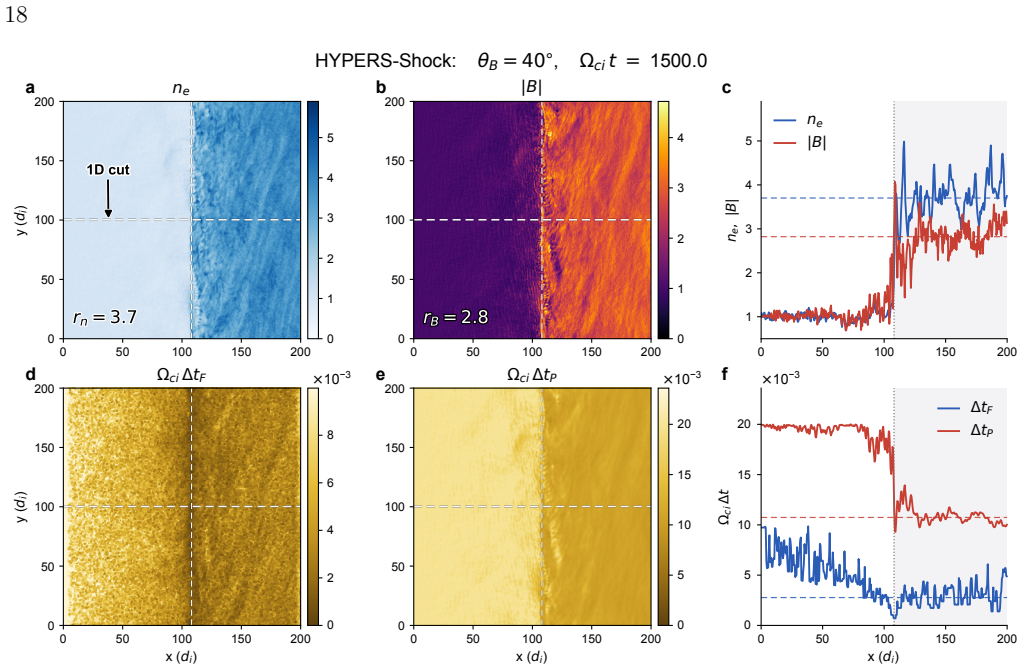
- [Sec. 3, Eqs. (3)-(4)] The central load-bearing concern is the physical equivalence of the adaptive outflow boundary to an open downstream reservoir. When the local cell density is below n_d, outgoing particles are reflected specularly; when above, they are absorbed. In a physical downstream region, a high-energy particle crossing the outflow plane downstream of the shock does not return. Here, a right-going downstream ion can be reflected, re-enter the downstream region, and possibly recross the shock, artificially contributing to the DSA/SDA cycle. Because Eq. (4) deliberately adjusts n_d to cancel shock-front displacements, the stationarity shown in Fig. 1 and the spectral convergence shown in Fig. 2 cannot by themselves distinguish this artifact from true shock physics. The claim that AFORA yields converged spectra and acceleration efficiencies requires a same-parameter comparison with a moving-shock simul
- [Sec. 5.2 and Figs. 4-6] The paper states "excellent agreement" with IP shock observations, but no observed profile is plotted, overlaid, or scored. The comparison is purely qualitative and based on visual similarity of wave packets, ramps, and downstream oscillations. Given that reproducing observed IP shock profiles is one of the paper's validation pillars, this comparison needs to be quantitative: overlay representative observed and simulated profiles, define an error metric (e.g., amplitude, wavelength, and decay of downstream oscillations), and state the physical parameters of the events used.
- [Sec. 5, Fig. 2 and Table 1] The cutoff time Omega_ci t = 750 is chosen post hoc, after the shock front has supposedly settled. Figure 2(c) shows that the energy-averaged scatter depends on the start time of the averaging window, but the paper does not test whether the acceleration efficiencies in Table 1 or the spectral ordering in Fig. 3 are robust to moving the cutoff earlier or later. Since the discarded transient contains the largest front excursions (Fig. 1), and since the controller is active throughout, the claim of quasi-stationarity should be supported by a sensitivity scan over the cutoff time rather than a single fixed value.
- [Sec. 3 and Sec. 4] The empirical factor K(theta_B) is used to modify the shock-frame transformation, with values 1.3, 1.2, 1.1, 1.0, 1.0 for theta_B = 0-80 degrees, and the controller gain alpha in Eq. (4) is stated only as "selected to guarantee alpha|Delta x_sh| << 1". No sensitivity study is presented for either parameter. More importantly, since V_sh = K V_sh0 enters Eq. (3), the effective Mach number in the continuity estimate changes with K, while Section 4 still defines M_A = V_u/V_A = 3. The manuscript should clarify how K affects the physical shock parameters (compression ratio, upstream flow speed) and demonstrate that the reported spectra are not sensitive to reasonable variations of K and alpha.
- [Sec. 4, simulation setup] The convergence claim is based on runs with 25 macro-particles per cell and a 400x400 grid. No particle-number or resolution convergence test is reported. The high-energy tail in Fig. 3 is sampled by at most 44 out of 111 shots at the curve endpoints, which is marginal for a claim of converged spectra. A short convergence study (e.g., 50 or 100 particles per cell, or a finer mesh) would substantially strengthen the paper.
minor comments (5)
- [Sec. 3, paragraph after Eq. (2)] Typo: "shock fame" should be "shock frame".
- [Eq. (3) and Sec. 4] The symbol M_A is used both for the nominal Mach number M_A = V_u/V_A and for M_A = V_u/|V_sh| in Eq. (3). These definitions differ when V_sh is modified by K(theta_B). Please standardize notation.
- [Sec. 5.3 and Fig. 3] The fitted power-law slopes (-4.8, -5.9, -6.9) are quoted in the text but the fits are not shown in Fig. 3. State the fitting interval and the uncertainty of each slope.
- [Sec. 5.3] The sentence "These spectra were found not to be sensitive to the length of their recording box in the x-direction, up to 0.3 times the length of the simulation domain" is not accompanied by any figure or table. Either show the test or move this claim to a supplemental section.
- [Sec. 2.2 and Sec. 6] The comparison with Caprioli & Spitkovsky (2014) uses L = 10^5 d_i, but the physical parameters of that reference differ from those used here. The factor-of-1000 domain reduction should be stated with the caveat that the comparison is across different runs/parameters.
Circularity Check
Partial circularity: AFORA's quasi-steady shock position and downstream density/compression are enforced by the adaptive boundary controller, while the energetic-ion spectra retain independent content.
-
self definitional
[Sec. 3, Eq. (4); Sec. 5.1, Fig. 1]
"The algorithm periodically, at time intervals, ∆t_sh, modifies n_d to ensure the shock front continues to be positioned near the middle of the computational domain. past this time, x_sh settles onto an asymptotic value for every angle, confirming that the adaptive outflow boundary holds the shock front stationary in the simulation box, rather than letting it drift toward either simulation boundary."
The regulated variable in Eq. (4) is the shock-front displacement: n_new_d = n_old_d exp(alpha Delta_x_sh), with n_d raised when Delta_x_sh > 0 and lowered when Delta_x_sh < 0. Thus x_sh about constant is the controller's setpoint, not an emergent property. The abstract's claim that 'shock evolution remains quasi-steady' and Figure 1's 'stationarity' diagnostic therefore report the action of the feedback law as if it were a physical result; the quasi-steady frame is enforced by construction.
-
other
[Sec. 3, Eq. (3) and the reflection rule; Table 1 caption]
"an outgoing particle is reflected back specularly at the outflow boundary, if the plasma density at its cell is found to be below a certain 'time-steady' threshold value, n_d; otherwise, the particle is absorbed. Using the mass continuity equation, which assumes the downstream plasma velocity, V_d = 0, we estimate the initial value of n_d: n_u(V_u − V_sh) = n_d((V_d = 0)−V_sh) =⇒ n_d = n_u(MA + 1) r_B and r_n are the plateau-averaged downstream to upstream compression ratios, computed with respect to the absolute value of magnetic field, |B| and plasma density, n_e, respectively."
Because the boundary reflects particles when local density is below n_d and absorbs them above n_d, the outflow condition actively regulates the downstream density to the threshold n_d. Eq. (3) sets that threshold from the imposed M_A and the assumed V_d = 0, i.e., n_d/n_u = M_A + 1. The r_n values reported in Table 1 as shock compression ratios are therefore constrained by the same boundary input that the paper presents as a diagnostic output; they are not an independent test of the Rankine-Hugoniot jump. This is a boundary-set input reported as a measured shock property.
full rationale
The central AFORA mechanism is a feedback controller: Eq. (4) changes the downstream density threshold to drive the shock-front displacement to zero, and Eq. (3) seeds that threshold from the imposed Mach number and assumed zero downstream velocity. Consequently, Figure 1's demonstration that x_sh becomes stationary is the controller's setpoint, not an independent physical validation, and Table 1's compression ratios are partly determined by the same threshold that the boundary enforces. This is partial circularity: the stationarity and density-compression 'results' reduce by construction to the algorithm's own control inputs. The energetic-ion spectra, turbulence morphology, and the theta_B ordering of acceleration efficiency are not directly prescribed by Eqs. (3)-(4) and emerge from the simulation, so the paper retains independent content. The self-citations to HYPERS/EMAPS are implementation credentials rather than a uniqueness argument, and the absence of a same-parameter moving-shock comparison is a validation gap, not itself a circular step. The overall score is 6: some reported predictions are forced by construction, but the core spectral/physical content is not fully equivalent to the inputs.
Assumptions & free parameters
free parameters (4)
- K(theta_B) =
1.3, 1.2, 1.1, 1.0, 1.0 for theta_B=0,20,40,60,80 deg
- alpha =
not specified (alpha>0, alpha*|Delta_x_sh| << 1)
- n_d threshold =
initial n_u*(M_A+1); continuously updated
- spectra cutoff time =
Omega_ci t = 750
assumptions (6)
- domain assumption Hybrid model approximations: kinetic ions, quasi-neutral inertia-free fluid electrons in the Darwin approximation.
- domain assumption Galilean/Lorentz transformation of ion and electron velocities without transforming the magnetic field is adequate for non-relativistic shocks.
- standard math The Rankine-Hugoniot-like continuity equation n_u(V_u - V_sh) = n_d(-V_sh) gives a valid initial downstream density threshold.
- domain assumption A reflecting-wall setup produces a supercritical shock whose structure can be compared with observed IP shocks.
- domain assumption 2D periodic-in-y simulations capture the ion-acceleration physics relevant for the reported efficiency rankings.
- ad hoc to paper 25 macro-particles per cell is sufficient for converged ion spectra and shock structure.
Cite this review
Pith. "Pith review of Adaptive Hybrid Modeling of Collisionless Plasma Shocks and Ion Acceleration." pith.science (2026). https://pith.science/paper/EV4O7MQO
@misc{pith2026260800253,
  author       = {Pith},
  title        = {Pith review of: Adaptive Hybrid Modeling of Collisionless Plasma Shocks and Ion Acceleration},
  year         = {2026},
  howpublished = {\url{https://pith.science/paper/EV4O7MQO}},
  note         = {Machine review of arXiv:2608.00253}
}
read the original abstract
We present a novel efficient technique for hybrid (kinetic ions, quasi-neutral fluid electrons) simulations of non-relativistic magnetized collisionless plasma shocks, frequently observed near the Sun, in the solar system, and beyond. This Adaptive Frame-Of-Reference Algorithm (AFORA) enables multi-dimensional simulations of plasma shocks along with concomitant ion acceleration in the shock frame, where shock evolution remains quasi-steady. Compared to moving shocks, this technique allows us to reduce the simulation time and domain size to a minimum while achieving converged shock dynamics and spectra of energetic ions. Using an event-driven (asynchronous) hybrid code, HYPERS, we demonstrate this approach in two spatial dimensions for different orientations of the background magnetic field with respect to the shock normal. Our results show excellent agreement of simulation shocks with observations of interplanetary (IP) shocks. We verify that different shock configurations (quasi-parallel, oblique, and quasi-perpendicular) convert bulk plasma flow energy into ion acceleration with varying degrees of efficiency. These findings underscore the importance of efficient and robust numerical algorithms for future high-resolution modeling of plasma shocks and ion acceleration in three dimensions. In addition to enabling efficient computational studies of collisionless shocks in general, this work paves the way for accurate prediction of seed populations of Solar Energetic Particles (SEPs), generated by coronal mass ejection (CME) shocks. The characteristics of seed ions can be used as inputs to Fokker-Planck models that simulate long-term transport and acceleration of ions along magnetic field lines through their interactions with background solar wind turbulence.
Figures


Figures from the paper (6 more)



Reference graph
Works this paper leans on
-
[1]
Balogh, A., & Treumann, R. A. 2013, ISSI Scientific Report Series, Vol. 12, Physics of Collisionless Shocks: Space Plasma Shock Waves (New York: Springer), doi: 10.1007/978-1-4614-6099-2
-
[2]
Bennett, L., & Ellison, D. C. 1995, Journal of Geophysical Research, 100, 3439, doi: 10.1029/94JA02197
-
[3]
Caprioli, D., Orusa, L., Cernetic, M., Haggerty, C. C., & Ostler, B. 2025, The Astrophysical Journal Letters, 993, L1, doi: 10.3847/2041-8213/ae109b
-
[4]
Caprioli, D., & Spitkovsky, A. 2014, The Astrophysical Journal, 783, 91, doi: 10.1088/0004-637X/783/2/91 Gargat´ e, L., & Spitkovsky, A. 2012, The Astrophysical Journal, 744, 67, doi: 10.1088/0004-637X/744/1/67
-
[5]
Dimmock, A. P. 2022, Frontiers in Physics, 10, 852720, doi: 10.3389/fphy.2022.852720
arXiv 2022
-
[6]
Gedalin, M., Roytershteyn, V., & Pogorelov, N. V. 2023, The Astrophysical Journal, 945, 50, doi: 10.3847/1538-4357/acb13a
-
[7]
Gedalin, M., Zhou, X., Russell, C. T., Drozdov, A. Y., & Liu, T. Z. 2018, Journal of Geophysical Research: Space Physics, 123, 8913, doi: 10.1029/2018JA025945
-
[8]
2005, The Astrophysical Journal, 624, 765, doi: 10.1086/429265
Giacalone, J. 2005, The Astrophysical Journal, 624, 765, doi: 10.1086/429265
doi:10.1086/429265 2005
Show all 26 references
-
[9]
Ellison, D. C. 1992, Geophysical Research Letters, 19, 433, doi: 10.1029/92GL00379
1992 doi
-
[10]
C., & Bennett, L
Ellison, D. C., & Bennett, L. 1997, Journal of Geophysical Research, 102, 19789, doi: 10.1029/97JA01529
1997 doi
-
[11]
2020, ApJS, 246, 29, doi: 10.3847/1538-4365/ab5221
Giacalone, J., Mitchell, D., Allen, R., et al. 2020, ApJS, 246, 29, doi: 10.3847/1538-4365/ab5221
2020 doi
-
[12]
Hanson, E. L. M., Agapitov, O. V., Vasko, I. Y., et al. 2020, The Astrophysical Journal Letters, 891, L26, doi: 10.3847/2041-8213/ab7761
2020 doi
-
[13]
M., Goodrich, C
Leroy, M. M., Goodrich, C. C., Winske, D., Wu, C. S., & Papadopoulos, K. 1981, Geophysical Research Letters, 8, 1269, doi: 10.1029/GL008i012p01269
1981 doi
-
[14]
2006a, Journal of Computational Physics, 216, 179 , doi: http://dx.doi.org/10.1016/j.jcp.2005.12.008 —
Omelchenko, Y., & Karimabadi, H. 2006a, Journal of Computational Physics, 216, 179 , doi: http://dx.doi.org/10.1016/j.jcp.2005.12.008 —. 2006b, Journal of Computational Physics, 216, 153 , doi: http://dx.doi.org/10.1016/j.jcp.2005.11.029 —. 2012, Journal of Computational Physi...
2005 doi
-
[15]
A., Chen, L.-J., & Ng, J
Omelchenko, Y. A., Chen, L.-J., & Ng, J. 2021, J. Geophys. Res. Space Physics, 126, e2020JA029035, doi: 10.1029/2020JA029035
2021 doi
-
[16]
A., & Karimabadi, H
Omelchenko, Y. A., & Karimabadi, H. 2023, in Space and Astrophysical Plasma Simulation, ed. J. B¨ uchner (Springer), 393–423. https://doi.org/10.1007/978-3-031-11870-8 13
2023 doi
-
[17]
A., Sokolov, I., Zhao, L., & Zhu, K
Omelchenko, Y. A., Sokolov, I., Zhao, L., & Zhu, K. 2026, Movies for ”Adaptive Hybrid Modeling of Collisionless Plasma Shocks and Ion Acceleration”, Zenodo, doi: 10.5281/zenodo.21422353
2026 doi
-
[18]
2023, Physical Review Letters, 131, 095201, doi: 10.1103/PhysRevLett.131.095201
Orusa, L., & Caprioli, D. 2023, Physical Review Letters, 131, 095201, doi: 10.1103/PhysRevLett.131.095201
2023 doi
-
[19]
2025, Physics of Plasmas, 32, 052901, doi: 10.1063/5.0269035
Orusa, L., & Valenzuela-Villaseca, V. 2025, Physics of Plasmas, 32, 052901, doi: 10.1063/5.0269035
2025 doi
-
[20]
2020, Journal of Geophysical Research: Space Physics, 125, e2019JA027442, doi: 10.1029/2019JA027442
Preisser, L., Blanco-Cano, X., Trotta, D., Burgess, D., & Kajdiˇ c, P. 2020, Journal of Geophysical Research: Space Physics, 125, e2019JA027442, doi: 10.1029/2019JA027442
2020 doi
-
[21]
2026, The Astrophysical Journal, 997, 144, doi: 10.3847/1538-4357/ae2611
Reville, B. 2026, The Astrophysical Journal, 997, 144, doi: 10.3847/1538-4357/ae2611
2026 doi
-
[22]
V., Roussev, I., Gombosi, T., et al
Sokolov, I. V., Roussev, I., Gombosi, T., et al. 2004, ApJ, 616, L171, doi: 10.1086/426812
2004 doi
-
[23]
2023, Monthly Notices of the Royal Astronomical Society, 525, 1856, doi: 10.1093/mnras/stad2384
Trotta, D., Pezzi, O., Burgess, D., et al. 2023, Monthly Notices of the Royal Astronomical Society, 525, 1856, doi: 10.1093/mnras/stad2384
2023 doi
-
[24]
2011, Planetary and Space Science, 59, 449, doi: 10.1016/j.pss.2010.01.007
Umeda, T., Yamao, M., & Yamazaki, R. 2011, Planetary and Space Science, 59, 449, doi: 10.1016/j.pss.2010.01.007
2011 doi
-
[25]
Winske, D., & Quest, K. B. 1988, Journal of Geophysical Research, 93, 9681 24
1988
-
[26]
2003, in Lecture Notes in Physics, Vol
Winske, D., Yin, L., Omidi, N., Karimabadi, H., & Quest, K. 2003, in Lecture Notes in Physics, Vol. 615, Space Plasma Simulation, ed. J. B¨ uchner, M. Scholer, & C. T. Dum (Berlin, Heidelberg: Springer Berlin Heidelberg), 136–165, doi: 10.1007/3-540-36530-3 8
2003 doi
Reviewed August 4, 2026 · model on record in the stance chip above.
Discussion (0). Continue with ORCID to comment.