REVIEW 2 major objections 4 minor 34 references
A segmented calorimeter suppresses sub-crystal shower structure without destroying it, and physics-constrained generative inference recovers most of the lost information.
Reviewed by Pith at T0; open to challenge. T0 means a machine referee read the full paper against a public rubric. the ladder, T0–T4 →
2026-08-04 00:38 UTC pith:M7WICEFI
load-bearing objection Worth refereeing; the independent angle/vertex test is the real evidence, while the headline moment gains are training objectives and the pre-response target conflates segmentation recovery with detector-response correction. the 2 major comments →
Physics-Constrained Generative Inference of Sub-Crystal Electromagnetic Shower Structure in a Segmented Calorimeter
The pith
A machine-rendered reading of the paper's core claim, the machinery that carries it, and where it could break.
Core claim
The central claim is that finite segmentation suppresses sub-crystal shower information without erasing it: because the Molière radius of pure CsI (≈3.53 cm) exceeds the central crystal pitch (2.5 cm), the sharing of energy among neighboring crystals still encodes the fine transverse structure. The paper casts the reconstruction of that structure as an ill-posed inverse problem and solves it with a physics-constrained generative model, adding penalty terms on the zeroth-through-third spatial moments of the shower (total energy, center of energy, lateral width, and profile skewness) to the standard reconstruction and adversarial losses. The result is a map from coarse crystal images to sub-cr
What carries the argument
The load-bearing object is the set of low-order spatial moments of the shower energy distribution—M0 total energy, M1 centroid, M2 lateral width, M3 normalized skewness—used as differentiable physics constraints in the training loss. These moments correspond to the physical observables that calorimeter analyses actually use, and constraining them selects, among the many sub-crystal distributions consistent with a coarse readout, those that are physically plausible showers. The generator is a ConvNeXt encoder-decoder with PixelShuffle upsampling, trained adversarially with a Wasserstein-GP critic, and the moment terms counter the tendency of unconstrained adversarial training to produce spuri
Load-bearing premise
The high-resolution truth reference is defined by Geant4 energy depositions taken before light attenuation and electronics response are applied, while the low-resolution input contains those detector effects; the paper acknowledges that the reported performance therefore conflates recovery of segmentation-suppressed morphology with partial correction of detector response, and the two are not separated.
What would settle it
Train the identical model with high-resolution targets computed after including light attenuation and electronics response in the fine-grained deposits (i.e., at the same response level as the input). If the reductions in moment residuals and the downstream angular/vertex improvements largely disappear, the reported gains are mostly a detector-response correction rather than a recovery of segmentation-suppressed sub-crystal information.
If this is right
- The effective granularity of an existing calorimeter can be improved computationally, without reducing crystal size or changing readout.
- Downstream observables not used in training—such as photon incident angle and π0 decay vertex—improve because the recovered morphology restores the asymmetry and width that the segmentation had smeared.
- The gain is smallest for integral quantities (total energy) and largest for shape-sensitive ones (width, skewness), so the method is best deployed where position resolution dominates vertex or direction reconstruction.
- At higher beam momenta, such as the proposed KOTO II configuration, the π0 spectrum shifts to higher energy where position resolution matters most, so the benefit of the method grows with beam momentum.
- A naive adversarial super-resolution without moment constraints can degrade physics observables (e.g., skewness) below the raw-readout level, demonstrating that physical constraints, not image fidelity, are what protect downstream reconstruction.
Where Pith is reading between the lines
- A natural next test is to separate the two conflated effects: train with high-resolution targets defined after light attenuation and electronics response, so the reconstruction can only recover segmentation-suppressed morphology, not correct detector response. If the moment gains persist, the method is genuinely recovering sub-crystal structure; if they vanish, the reported improvements owe more t
- The ratio between the Molière radius and the transverse cell size likely controls the recoverable fraction; an experiment with different crystal sizes (the KOTO calorimeter already has 2.5 cm and 5.0 cm crystals) could test whether the gain scales with that ratio, predicting where the method is most useful.
- The moment-constrained generative recipe could be transferred to other inverse problems in physics, such as unblurring finely segmented images from coarser sensors or imposing known conservation laws as constraints in surrogate models; the fourth-order-moment counterexample suggests that constraints on higher, less physically stable moments may not be as effective.
Editorial analysis
A structured set of objections, weighed in public.
Referee Report
Summary. The paper proposes a physics-constrained generative super-resolution framework for the KOTO CsI calorimeter. A GAN-based generator upsamples coarse 21×21 crystal-energy images to a finer virtual grid (k=2–5) and is trained with pixel, adversarial, and four spatial-moment losses (total energy, centroid, width, skewness). The authors report 40–62% reductions in moment residuals in a 1 GeV bin, ablation results showing each moment constraint improves its corresponding observable, and out-of-distribution downstream improvements on photon incident-angle reconstruction and π0 decay-vertex resolution on a KL→π0ννbar MC sample. The central claim is that finite segmentation suppresses but does not eliminate sub-crystal shower information, and that a substantial fraction can be recovered.
Significance. If the central claim holds, the work is significant: it offers a purely computational route to improve effective calorimeter granularity and downstream physics observables without hardware changes, with a concrete reference system (KOTO) and a realistic KL→π0ννbar application. The strongest aspects are the controlled ablations, the use of an independent angle regressor not present in the training objective, and the out-of-distribution MC evaluation. The paper is clearly written, reproducible in its hyperparameter reporting, and transparent about its own limitations. However, the headline moment improvements are partly circular because the loss functions are the same as the validation metrics, and the target definition conflates segmentation recovery with detector-response deconvolution.
major comments (2)
- [Section II / Section IV E] The HR reference is defined from Geant4 energy depositions 'prior to the application of light attenuation and electronics effects,' while the LR input includes those effects. The paper acknowledges in Section IV E that the reported performance consequently 'reflects both the recovery of segmentation-suppressed shower morphology and a partial correction of detector-response effects' and that the two are 'not separated in the present work.' This is a load-bearing issue for the central claim: the moment improvements in Table III and the downstream angle/vertex gains could be driven largely by deconvolving the detector response rather than by recovering information suppressed by segmentation. A control experiment that removes detector response from the LR input (or includes it in the HR target) is needed to separate the two contributions and support the abstract's conclusion that 'finite det
- [Section III D 2 / Section III E 1 / Section IV A] The zeroth- through third-moment losses defined in Section III D 2 are the same quantities used as validation metrics in Section IV A, and model selection uses the validation loss of Eq. (12), which contains those exact terms. The reported 40–62% reductions on these moments are therefore in-sample by construction; the model is explicitly trained to minimize these residuals. The ablation in Section IV B is informative but does not remove the circularity, since the 6-loss configuration is selected using the same objective. The credible independent evidence is the angle regressor of Section IV C, which uses a quantity never fed to the SR loss, and the vertex study of Section IV D. The paper should clearly separate 'metrics used in training/selection' from 'out-of-sample validation,' or report hold-out observables not present in the loss.
minor comments (4)
- [Abstract / Conclusion] The abstract states 'reduces the per-event residual of these moments ... by roughly 40–62%,' but Table III shows the zeroth-moment (total energy) improvement is only about 4% (1.63%→1.56%). The 40–62% range refers to the first, second, and third moments. The conclusion is explicit, but the abstract should be rephrased to avoid implying all low-order moments improve by that amount.
- [Section I] Reference [17] (Arjovsky et al., WGAN) is cited together with [16] as 'adversarial super-resolution of photon images.' The WGAN paper is a general adversarial method, not an application to photon images. The sentence should cite only [16] or include an additional dedicated super-resolution reference.
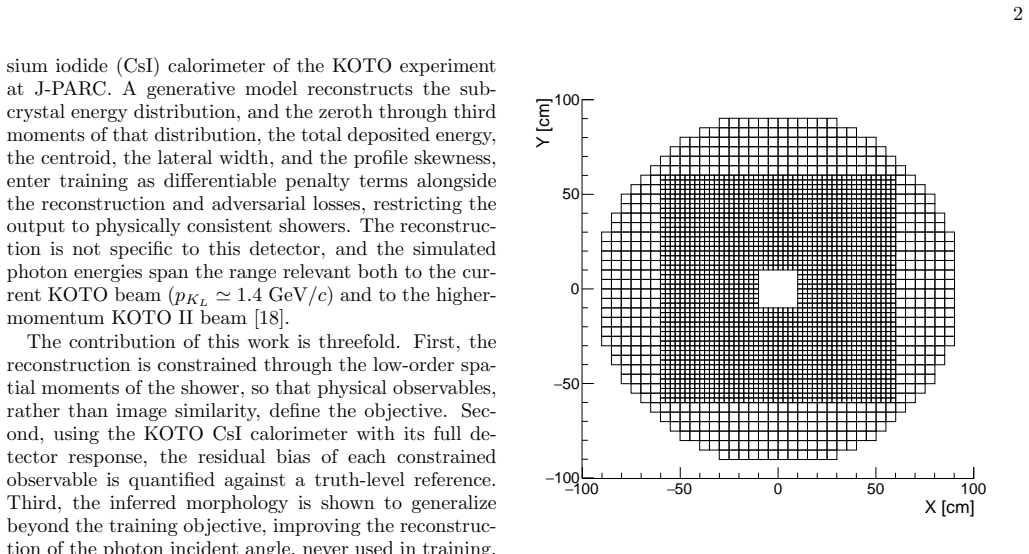
- [Figure 1] The axis labels in Fig. 1 appear garbled in the compiled text ('100 −50 −0 50 100'); also '−0' appears to be a typographical artifact. The figure should be regenerated or the axes reformatted.
- [Section III E 1] The statement 'The generator is first pre-trained for 10 epochs ... for the remaining training, about 150 epochs in total' is ambiguous: does the total include the 10 pre-training epochs or not? Please clarify the total training length and the early-stopping criterion.
Circularity Check
The headline 40-62% moment improvements are the training objective (Eq. 11) and model-selection metric (Eq. 12), so they are not independent evidence; the angle/vertex studies supply the only non-circular support.
specific steps
-
fitted input called prediction
[Sec. III D 2 (Eqs. 4-11); Sec. III E 1 (Eq. 12); Sec. IV A (Table III)]
"The same moment definitions are used for the validation in Section IV A. ... we compute the moments of order 0 through 3, defined in Section III D 2, for each shower image and evaluate the residual between the reconstructed SR image and the finest-grid HR(k=5) reference."
The four reported moment residuals (Table III, Fig. 4; abstract 40-62%) are exactly the LM0-LM3 penalties in the composite training loss (Eq. 11), and the selected model is chosen using Lval (Eq. 12), which contains the same moment terms. The generator is therefore explicitly optimized and early-stopped to minimize the very quantities later reported as evidence of recovered sub-crystal information. Even with a held-out test split, this makes the headline improvement a direct measure of the optimization objective, not an independent validation of the claim that segmentation-suppressed information is recovered. The downstream angle and vertex results remain non-circular because those observables were absent from the loss.
full rationale
The central circular step is the moment-residual validation: the metrics used as evidence (0th-3rd moment residuals) coincide with the loss terms being minimized and with the validation loss used for model selection. This does not make the whole paper circular, because the paper also validates on a separately trained angle regressor and a K_L->pi0 nu nubar vertex sample, neither of which enters the SR objective. No load-bearing self-citation or imported uniqueness theorem is present; the KOTO references are experimental context. The pre-response HR target is a genuine confound (the reported gain conflates segmentation recovery with detector-response deconvolution, as the paper admits in Sec. IV E), but that is a validity/correctness concern rather than a circular reduction, so it does not raise the circularity score above 6. Score 6 reflects that one quantitative headline claim reduces by construction to its training objective while independent downstream validation remains.
Axiom & Free-Parameter Ledger
free parameters (2)
- Loss weights λ_gen, λ_adv, λ_M0–λ_M3 =
Varies per upsampling factor k; see Table II
- Early-stopping patience, learning-rate schedule, batch size, gradient-penalty coefficient =
patience 15, initial LR 1e-4 decayed by 0.55 per 30 epochs, batch 128, λ_GP=10
axioms (5)
- domain assumption Geant4 simulation of electromagnetic showers in undoped CsI is a reliable proxy for true detector response and for truth-level energy depositions.
- domain assumption The Molière radius of pure CsI (R_M ≈ 3.53 cm) exceeds the 2.5 cm central crystal size, so inter-crystal energy sharing encodes sub-crystal localization.
- domain assumption Low-order spatial moments (0 through 3) are sufficient physical observables for calorimeter reconstruction, and higher moments can be neglected.
- domain assumption The virtual sub-crystal HR image computed from Geant4 energy depositions before light attenuation and electronics effects is a valid truth-level reference.
- domain assumption An XGBoost regressor trained on zeroth-through-third moments is an adequate probe of the information content in LR, SR, and HR images for angle reconstruction.
invented entities (1)
-
Virtual sub-crystal segmentation (k×k subdivisions within each physical crystal)
no independent evidence
read the original abstract
The finite transverse granularity of a segmented electromagnetic calorimeter fundamentally limits the precision with which the observables of a shower can be reconstructed, among them its position, its lateral profile, and the direction of the incident particle. We show that a substantial fraction of the information suppressed by the segmentation can be inferred under physical constraints, and that it propagates to downstream physics quantities. The reconstruction is cast as an inverse problem and solved with a generative model constrained by the low-order spatial moments of the shower, driving the solution toward physically consistent energy distributions rather than image similarity alone. Using the undoped CsI calorimeter of the KOTO experiment as a reference system, the reconstruction reduces the per-event residual of these moments with respect to the truth-level reference by roughly 40-62% in a representative 1 GeV bin. The inferred morphology also generalizes beyond the training objective: on a $K_{L}\to\pi^{0}\nu\bar\nu$ Monte Carlo sample it improves the reconstruction of the photon incident angle, a quantity never used during training, and of the $\pi^{0}$ decay vertex. These results indicate that finite segmentation is better viewed as a limit on what a calorimeter measures directly than as an absolute limit on the physics information it retains, with the recoverable fraction depending on the observable and growing with the shower energy.
Figures


Reference graph
Works this paper leans on
-
[1]
Data-Driven Objectives Generic Reconstruction Loss (Lgen):The mean absolute error (L 1 loss) is employed as the primary re- construction constraint. Compared to the mean squared error (L2 loss), theL 1 loss is less sensitive to outliers and produces less spatial blurring, giving more stable guid- ance for the overall energy distribution of the shower: Lge...
-
[2]
Moment-Based Physical Constraints The four constraints below are the physical content of the method. Each corresponds to a property of the 5 shower that is directly used in calorimeter reconstruc- tion, and together the low-order moments constitute a physically motivated prior: they encode conserved and measurable quantities of an electromagnetic cascade,...
-
[3]
Composite Loss and Validation The generator is trained to minimize the weighted sum of all six loss terms: Ltotal =λ genLgen +λ advLadv +λ M0LM0 +λ M1LM1 +λ M2LM2 +λ M3LM3. (11) Balancing these constraints is a non-trivial optimization problem, as differences in numerical scale and gradient magnitudes can cause the data-driven terms to dominate the physic...
-
[4]
The generator is first pre-trained for 10 epochs on the reconstruction loss alone, so that it learns the global shower morphology before adversarial supervision begins
Training Schedule and Loss Balancing Training proceeds in two stages. The generator is first pre-trained for 10 epochs on the reconstruction loss alone, so that it learns the global shower morphology before adversarial supervision begins. The full composite loss of Eq. (11) is then activated for the remaining training, about 150 epochs in total. The balan...
-
[5]
Awes, F.E
T.C. Awes, F.E. Obenshain, F. Plasil, S. Saini, S.P. Sorensen, G.R. Young, Nucl. Instrum. Methods A311, 130 (1992)
1992
-
[6]
Without additional constraints, genera- tive models may produce spurious low-energy deposits in inactive detector regions
Output Constraints and Background Regularization Electromagnetic shower images are highly sparse, with only a small fraction of pixels containing non-zero en- ergy deposits. Without additional constraints, genera- tive models may produce spurious low-energy deposits in inactive detector regions. A binary activity mask is constructed from the LR input imag...
2000
-
[7]
Yamanaka (KOTO Collaboration), Prog
T. Yamanaka (KOTO Collaboration), Prog. Theor. Exp. Phys.2012, 02B006 (2012)
2012
-
[8]
Ahn et al
J.K. Ahn et al. (KOTO Collaboration), Phys. Rev. Lett. 134, 081802 (2025)
2025
-
[9]
Fabjan, F
C.W. Fabjan, F. Gianotti, Rev. Mod. Phys.75, 1243 (2003)
2003
-
[10]
Watanabe et al., Nucl
H. Watanabe et al., Nucl. Instrum. Methods A545, 542 (2005)
2005
-
[11]
Mikuni, B
V. Mikuni, B. Nachman, Phys. Rev. D106, 092009 (2022)
2022
-
[12]
Paganini, L
M. Paganini, L. de Oliveira, B. Nachman, Phys. Rev. D 97, 014021 (2018)
2018
-
[13]
Belayneh et al., Eur
D. Belayneh et al., Eur. Phys. J. C80, 688 (2020)
2020
-
[14]
Radovic et al., Nature560, 41 (2018)
A. Radovic et al., Nature560, 41 (2018)
2018
-
[15]
These values are reported for re- producibility, and the results are not sensitive to their precise choice
in the final stage. These values are reported for re- producibility, and the results are not sensitive to their precise choice
-
[16]
Khattak, S
G.R. Khattak, S. Vallecorsa, F. Carminati, G.M. Khan, Eur. Phys. J. C82, 386 (2022)
2022
-
[17]
Krause, D
C. Krause, D. Shih, Phys. Rev. D107, 113003 (2023)
2023
-
[18]
Dong, C.C
C. Dong, C.C. Loy, K. He, X. Tang, IEEE Trans. Pattern Anal. Mach. Intell.38, 295 (2016)
2016
-
[19]
Goodfellow et al., Adv
I. Goodfellow et al., Adv. Neural Inf. Process. Syst.27, 2672 (2014)
2014
-
[20]
Ledig et al., inProc
C. Ledig et al., inProc. IEEE/CVF Conf. on Computer Vision and Pattern Recognition (CVPR)(IEEE, 2017), p. 4681
2017
-
[21]
Pang, J.A
I. Pang, J.A. Raine, D. Shih, Phys. Rev. D109, 092009 (2024)
2024
-
[22]
Erdmann, A
J. Erdmann, A. van der Graaf, F. Mausolf, O. Nacken- horst, Eur. Phys. J. C83, 1001 (2023)
2023
-
[23]
Arjovsky, S
M. Arjovsky, S. Chintala, L. Bottou, inProc. 34th Int. Conf. on Machine Learning (ICML), PMLR70, 214 (2017)
2017
-
[24]
KOTO II Collaboration,Proposal for the KOTO II Ex- periment at J-PARC, arXiv:2501.14827 [hep-ex] (2024)
Pith/arXiv arXiv 2024
-
[25]
Sato, J.W
K. Sato, J.W. Lee et al. (KOTO Collaboration), Nucl. Instrum. Methods A982, 164527 (2020)
2020
-
[26]
Agostinelli et al
S. Agostinelli et al. (GEANT4 Collaboration), Nucl. In- strum. Methods A506, 250 (2003)
2003
-
[27]
Allison et al., IEEE Trans
J. Allison et al., IEEE Trans. Nucl. Sci.53, 270 (2006)
2006
-
[28]
Allison et al., Nucl
J. Allison et al., Nucl. Instrum. Methods A835, 186 (2016)
2016
-
[29]
Z. Liu, H. Mao, C.-Y. Wu, C. Feichtenhofer, T. Darrell, S. Xie, inProc. IEEE/CVF Conf. on Computer Vision and Pattern Recognition (CVPR)(IEEE, 2022), p. 11966
2022
-
[30]
Shi et al., inProc
W. Shi et al., inProc. IEEE/CVF Conf. on Computer Vision and Pattern Recognition (CVPR)(IEEE, 2016), p. 1874
2016
-
[31]
Gulrajani, F
I. Gulrajani, F. Ahmed, M. Arjovsky, V. Dumoulin, A.C. Courville, Adv. Neural Inf. Process. Syst.30, 5767 (2017)
2017
-
[32]
Paszke et al., Adv
A. Paszke et al., Adv. Neural Inf. Process. Syst.32, 8026 (2019)
2019
-
[33]
D.P. Kingma, J. Ba, inProc. 3rd Int. Conf. on Learning Representations (ICLR)(2015), arXiv:1412.6980 [cs.LG]
Pith/arXiv arXiv 2015
-
[34]
T. Chen, C. Guestrin, inProc. 22nd ACM SIGKDD Int. Conf. on Knowledge Discovery and Data Mining(ACM, New York, 2016), p. 785
2016
This paper was first reviewed by deepseek-v4-flash on August 4, 2026.
discussion (0)
Sign in with ORCID, Apple, or X to comment. Anyone can read and Pith papers without signing in.