REVIEW 2 major objections 4 minor 40 references
Hamiltonian Thresholds for Objective Records
T0 review · 2 major / 4 minor · reviewed 2026-08-04 · deepseek-v4-flash
Pith's one-line read In exact QND product monitoring, strong quantum Darwinism requires two simultaneous Hamiltonian thresholds — a record-discrimination edge for the observed fragment and a surplus-dephasing edge for its complement — so objective records exist
desk verdict Real sufficient-side results and a good resource argument; the claimed matching converse is not backed by the stated assumptions. read the letter →
The pith
A machine-rendered reading of the paper's core claim, the machinery that carries it, and where it could break.
The reading
What carries the argument
The central object is the strong-QD deficit Δ_SQD(S:F) = [H_Π − χ_Π(S:F)]₊ + D_Π(S:F), split into a record-accessibility term and a pointer-discord term. The record term is controlled by the multiple quantum Chernoff exponent C_rec(F), which measures how well a fragment can distinguish pointer values; the discord term is controlled by the residual coherence R_dec(F̄) left by the unobserved complement, via a trace-norm continuity bound and, under nondegeneracy, a quadratic BKM expansion. For phase monitors the resource is local asymmetry A_G(σ), the relative entropy of asymmetry for the Abelian generator family, which upper-bounds χ_Π(S:F) for every fragment.
What would settle it
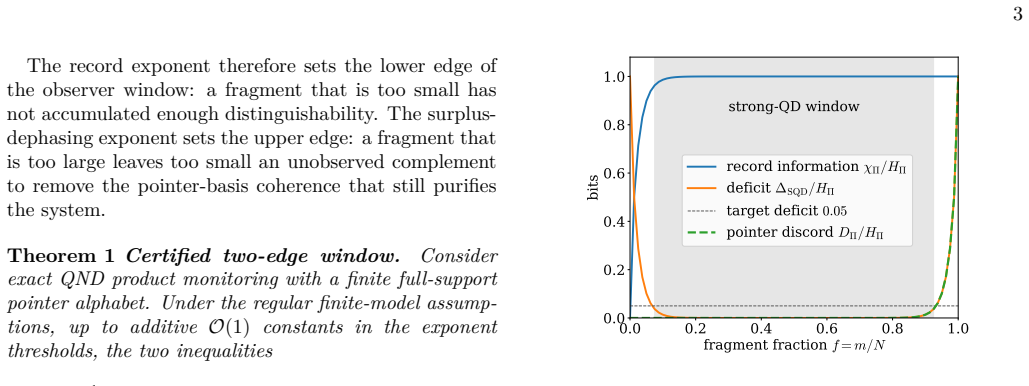
For a binary pointer with equal priors and N pure probes with single-probe overlap s, compute the strong-QD deficit Δ_SQD(m) = 1 − h₂((1+sᵐ)/2) + h₂((1+sᴺ)/2) − h₂((1+sᴺ⁻ᵐ)/2) for each fragment size m. If, at fixed accuracy ε, the set of m with Δ_SQD(m) < ε does not form a two-edge window of the form given by Eq. (15)—for example, if it extends monotonically to m = N—the window claim fails. Alternatively, any product ensemble exhibiting vanishing Holevo deficit while the minimum discrimination error stays bounded away from zero would violate record-regularity and break the logarithmic converse
Extended reading notes
Core claim
The central discovery is a pair of Hamiltonian exponents that control strong quantum Darwinism in product monitoring: C_rec(F), the multiple quantum Chernoff exponent of the observed fragment, and C_dec(F̄), the surplus-dephasing exponent of its complement. Theorem 1 certifies that if C_rec(F) ≥ log(1/ε) + loglog(1/ε) + O(1) and C_dec(F̄) ≥ log(1/ε) + O(1), then the strong-QD deficit Δ_SQD(S:F) is O(ε); under the supplement's regularity assumptions the same edges give matching converse bounds at logarithmic accuracy. Theorem 2 proves for Abelian phase monitors that the pointer Holevo information of any fragment is bounded by its local asymmetry budget A_G(F), so the number of disjoint δ-accu
Load-bearing premise
The matching converse bounds—that fragments just below the record edge or just above the dephasing edge fail to be objective witnesses at the same logarithmic accuracy—rest on the supplement's regularity assumptions (vanishing Holevo deficit equivalent to vanishing discrimination error, and a nondegenerate quadratic expansion of discord), which are plausible but not proven to hold for every possible product monitor.
Editorial extensions
If this is right
- Strong quantum Darwinism is not monotone in fragment size: objective records are certified only inside a finite two-edge window, refining the usual mutual-information-plateau picture.
- A bath can decohere a system efficiently while providing no locally readable records, and a fragment can carry substantial mutual information that is still not an objective record because of residual discord.
- For Abelian phase monitors, no fragment can contain more pointer information than its local asymmetry budget, bounding the maximum number of redundant witnesses.
- In homogeneous i.i.d. streams the asymptotic redundancy density equals 1/m_rec(δ) up to integer rounding, with an explicit asymmetry-saturation ceiling.
- In the spin-phase bath, raising temperature suppresses the record exponent and the witness capacity as T⁻² while leaving the dephasing exponent finite, so hot probes can decohere but lose the ability to witness.
Reading between the lines
- If the two-edge window holds generally, it implies a resource trade-off: increasing per-carrier record information by stronger coupling also reduces the residual dephasing complement, so for a fixed total environment there is an optimal fragment fraction that maximizes objective redundancy.
- The asymmetry bound suggests an engineering route to stronger witnesses: prepare environment carriers with large local coherence (e.g., squeezed or pure transverse states) to raise the redundancy density without increasing temperature.
- The block-capacity law invites a coding interpretation: each minimal witness block is like a codeword in a broadcast model, so error-correcting codes over blocks could in principle exceed the simple 1/m_rec density—a testable extension.
- The converse bounds rely on regularity assumptions that could be checked numerically: if some product ensembles show vanishing Holevo deficit while discrimination error stays high, the logarithmic converse fails and thresholds could become polynomial rather than logarithmic.
Editorial analysis
A structured set of objections, weighed in public.
Referee Report
Summary. The paper studies when environmental fragments are objective witnesses, not merely decoherers, in repeated QND product-monitoring models. Its central claim (Theorem 1) is a two-edge finite-size certificate: a fragment F is certified as an ε-accurate strong quantum-Darwinism witness when its record-discrimination exponent C_rec(F) is at least log(1/ε)+loglog(1/ε)+O(1), and the unobserved complement \bar F retains a surplus-dephasing exponent C_dec(\bar F) at least log(1/ε)+O(1). Under 'regular finite-model assumptions' stated in the SM, the same two edges are claimed to give converse bounds at the same logarithmic scale. For Abelian phase monitors, Theorem 2 bounds the pointer Holevo information of any fragment by its local asymmetry and derives a redundancy-density upper bound, with an i.i.d. block-capacity achievability law under a positive surplus-dephasing exponent. A tilted spin-phase bath is solved exactly, showing that thermal carriers can dephase efficiently while losing the asymmetry needed for readable records.
Significance. If fully established, the two-edge picture would refine the usual monotone-redundancy account of quantum Darwinism: objectivity would hold only in a finite fragment window, with distinct Hamiltonian exponents controlling the lower (record-resolution) and upper (residual-dephasing) edges. The paper's strengths are its clean separation of the strong-QD deficit into record and discord terms, the explicit one-shot finite-size bounds for the sufficient direction, the exactly solvable spin-bath example, and the asymmetry resource bound for Abelian phase monitors. These are concrete and partly checkable. However, the advertised matching converse is currently an under-specified assumption rather than a proved theorem, and the sufficient upper edge as stated depends on a uniformity claim for a BKM expansion that is not justified. The core idea is valuable, but the threshold claim is not yet supported at the level claimed.
major comments (2)
- [SM S2.1, Eqs. (S31)-(S32), (S45)] The converse for the record edge is not established. Record regularity only postulates functions r_-(η)→0, with no rate condition. Equation (S45) then gives C_rec(F)+o(C_rec(F)) ≥ log(1/r_-(ε)). If r_-(ε)=ε^α with α<1, the right side is α log(1/ε); if r_-(ε)=1/log(1/ε), it is only loglog(1/ε). Neither supports the claimed matching converse C_rec(F) ≥ log(1/ε)+O(1) at the same logarithmic level. A concrete rate condition (e.g. log(1/r_-(η)) ≥ log(1/η)-O(1), or r_-(η)=O(η)) is needed, with a proof that the finite-alphabet product ensembles considered actually satisfy it. As written, the converse half of Theorem 1 is an assumption, not a theorem.
- [SM S2.2, Eqs. (S53)-(S54), (S56)] The sufficient upper edge also rests on an unproved uniformity claim. Equation (S54) asserts constants c_-, c_+ independent of fragment size such that c_- R_dec(F) ≤ D_Π(S:F) ≤ c_+ R_dec(F)+O(R_dec(F)^{3/2}), invoking a 'nondegenerate active-coherence assumption'. The BKM inverse Ω^{-1}_{ω_{SF}} in Eq. (S53) is applied to ω_{SF} built from product fragment states; the norm of this inverse can scale with |F| when the conditional fragment states have small eigenvalues. No argument shows that the square bracket in Eq. (S53), or its difference from the system term, is bounded by a fragment-independent constant times R_dec(F). Without such uniformity, Eq. (S56) does not follow, and the main text's stated coefficient-1 sufficient threshold C_dec(\bar F) ≥ log(1/ε)+O(1) is not proved for the general class. Only the weaker continuity bound (S57), with coefficient 2 and an additional loglog term,
minor comments (4)
- [Main text, Theorem 1] The 'regular finite-model assumptions' are only referenced, not stated or summarized in the main text. The reader cannot tell that the sufficient upper edge depends on the nondegenerate active-coherence assumption and that the converse depends on an as-yet-unspecified rate for r_-(η). A compact statement of these conditions should be included.
- [Fig. 1 and SM S2.3] The figure uses pure probes, which are outside the full-rank/nondegenerate setting under which the SM's BKM-based bounds and converse are stated. The caption calls the model 'exactly solvable' and 'schematic', but the relation to Theorem 1's assumptions should be made explicit so readers do not infer that the theorem's regularity assumptions cover the plotted pure-probe example.
- [Fig. 2 and Eq. (15)] The figure's two-edge boundaries are computed with the unspecified O(1) constants in Eq. (15) set to zero. Consequently the plotted T_obj and window boundaries are estimates, not rigorous thresholds. This should be stated in the caption or text.
- [SM S2.1, Eq. (S40)] The one-shot multi-hypothesis bound is cited as [S40], but [S40] is not included in the main-text bibliography; since the main result relies on it, it should be cited in the main text as well.
Circularity Check
No circularity: sufficient certificate derived from standard inequalities; converse is conditional on explicit regularity assumptions, not a circular reduction.
full rationale
The central sufficient direction of Theorem 1 is self-contained: Eq. (S13) bounds the Holevo deficit by the optimal discrimination error via Fano's inequality, and the one-shot Chernoff bound (S40)–(S41) converts the C_rec threshold into a small discrimination error, giving the log(1/ε)+loglog(1/ε)+O(1) record edge. The discord edge is similarly derived from the trace-norm estimate (S18) and Alicki-Fannes-Winter continuity (S21)–(S23), so R_dec(F)=e^{-C_dec(F)} directly controls D_Π. These are standard derivations from the definitions in Eqs. (10)–(13), not echoes of the theorem being proved. The converse half is explicitly conditional on supplementary regularity assumptions (SM S2.1–S2.2): record-regularity functions r_±(η) in Eqs. (S31)–(S32) and a nondegenerate BKM quadratic expansion in Eq. (S54). These are stated assumptions, not hidden inputs that make the conclusion true by construction; the reviewer's concern that r_−(ε) may decay sublinearly, or that the fragment-independence of c_± is not proved, is a rigor/correctness gap in the converse, not a circular inference. Theorem 2 follows from standard pinching and entropy monotonicity (Eqs. (S76)–(S81)), the packing bound (S89), and the explicit block-partition construction in S3.3; the capacity formula 1/m_rec is a consequence of the definition of m_rec as the minimal block reaching the target Holevo information, which is a legitimate operational construction rather than a fitted parameter. The spin-phase bath is an explicit analytic calculation (S107)–(S128) with illustrative parameters, and the paper contains no self-citation chain, no imported uniqueness theorem, and no fitted value relabeled as a prediction. I therefore find no significant circularity.
Assumptions & free parameters
assumptions (7)
- domain assumption Exact QND product monitoring: the kth collision propagator is U0_k = sum_x Pi_x ⊗ U_{k,x} with an initially uncorrelated factorized environment (Eqs. 2-3).
- domain assumption Finite full-support pointer alphabet and active pointer coherences are restricted by the prime in Eq. (12).
- ad hoc to paper Record-regularity assumption (SM S2.1, Eqs. S31-S32): vanishing Holevo deficit is equivalent to vanishing optimal discrimination error via functions r_+(eta), r_-(eta), with no explicit rate condition.
- ad hoc to paper Chernoff-regularity assumption (SM S2.1): the optimal multi-hypothesis error exponent equals the worst pairwise Chernoff exponent up to subexponential prefactors, K_rec = C_rec + o(C_rec).
- ad hoc to paper Nondegenerate active-coherence assumption (SM S2.2) permitting the BKM quadratic expansion and the lower bound c_- R_dec(F) <= D_Pi(S:F).
- ad hoc to paper For the i.i.d. capacity result, complements of fixed-size blocks have a positive surplus-dephasing exponent (SM S3.3, Eq. S91).
- standard math Standard quantum information inequalities: Holevo bound, Fano inequality, Alicki-Fannes-Winter continuity bound, quantum Chernoff bound, and BKM metric monotonicity.
Cite this review
Pith. "Pith review of Hamiltonian Thresholds for Objective Records." pith.science (2026). https://pith.science/paper/7JFP53MO
@misc{pith2026260800365,
  author       = {Pith},
  title        = {Pith review of: Hamiltonian Thresholds for Objective Records},
  year         = {2026},
  howpublished = {\url{https://pith.science/paper/7JFP53MO}},
  note         = {Machine review of arXiv:2608.00365}
}
read the original abstract
Classical objectivity requires an environment to witness a pointer value, not merely to decohere it. We derive microscopic Hamiltonian laws for this distinction. Exact QND product monitoring yields a certified two-edge strong-Darwinism window: sufficient witnesses cross the optimal record-discrimination edge while retaining an unobserved complement that crosses the residual-coherence edge. Under additional regularity assumptions, the supplement gives converse bounds at the same logarithmic scale. For controlled-phase monitors, environmental asymmetry gives a single-fragment information bound, a redundancy converse, and, in efficient i.i.d. streams, an achievable block-capacity law for redundant witnesses. A finite-temperature spin-phase bath shows the physical separation: hot probes can decohere efficiently while losing the local asymmetry needed for objective witnesses.
Figures

Reference graph
Works this paper leans on
-
[1]
W. H. Zurek, Physics Today44, 36 (1991)
1991
-
[2]
W. H. Zurek, Reviews of Modern Physics75, 715 (2003)
2003
-
[3]
Schlosshauer,Decoherence and the Quantum-to- Classical Transition(Springer, Berlin, 2007)
M. Schlosshauer,Decoherence and the Quantum-to- Classical Transition(Springer, Berlin, 2007)
2007
-
[4]
Ollivier, D
H. Ollivier, D. Poulin, and W. H. Zurek, Physical Review Letters93, 220401 (2004)
2004
-
[5]
Ollivier, D
H. Ollivier, D. Poulin, and W. H. Zurek, Physical Review A72, 042113 (2005)
2005
-
[6]
Blume-Kohout and W
R. Blume-Kohout and W. H. Zurek, Foundations of Physics35, 1857 (2005)
2005
-
[7]
Blume-Kohout and W
R. Blume-Kohout and W. H. Zurek, Physical Review A 73, 062310 (2006)
2006
-
[8]
W. H. Zurek, Nature Physics5, 181 (2009)
2009
Show all 40 references
-
[9]
C. J. Riedel and W. H. Zurek, Physical Review Letters 105, 020404 (2010)
2010
-
[10]
Zwolak and W
M. Zwolak and W. H. Zurek, Scientific Reports3, 1729 (2013)
2013
-
[11]
J. K. Korbicz, Quantum5, 571 (2021)
2021
-
[12]
D. A. Chisholm, L. Innocenti, and G. M. Palma, Quan- tum7, 1074 (2023)
2023
- [13]
-
[14]
D. A. Chisholm, L. Innocenti, and G. M. Palma, Physical Review A110, 012218 (2024)
2024
-
[15]
Kiely, D
A. Kiely, D. A. Chisholm, A. Touil, S. Deffner, G. T. Landi, and S. Campbell, Physical Review A113, 022403 (2026), arXiv:2510.12313 [quant-ph]
2026
-
[16]
Touil, F
A. Touil, F. Anza, S. Deffner, and J. P. Crutchfield, Quantum8, 1494 (2024)
2024
-
[17]
J. K. Korbicz, P. Horodecki, and R. Horodecki, Physical Review Letters112, 120402 (2014)
2014
-
[18]
Horodecki, J
R. Horodecki, J. K. Korbicz, and P. Horodecki, Physical Review A91, 032122 (2015)
2015
-
[19]
T. P. Le and A. Olaya-Castro, Physical Review Letters 122, 010403 (2019)
2019
-
[20]
Piani, P
M. Piani, P. Horodecki, and R. Horodecki, Physical Re- view Letters100, 090502 (2008)
2008
-
[21]
F. G. S. L. Brand˜ ao, M. Piani, and P. Horodecki, Nature Communications6, 7908 (2015)
2015
-
[22]
Touil, B
A. Touil, B. Yan, D. Girolami, S. Deffner, and W. H. Zurek, Physical Review Letters128, 010401 (2022)
2022
-
[23]
Zwolak, Entropy24, 781 (2022)
M. Zwolak, Entropy24, 781 (2022)
2022
-
[24]
Fert´ e and X
B. Fert´ e and X. Cao, Physical Review Letters132, 110201 (2024)
2024
-
[25]
Doucet and S
E. Doucet and S. Deffner, Physical Review X14, 041064 (2024)
2024
-
[26]
Acevedo, J
A. Acevedo, J. Wehr, and J. K. Korbicz, Journal of Mathematical Physics65, 122102 (2024)
2024
-
[27]
Cao and Z
X. Cao and Z. Nussinov, arXiv preprint arXiv:2603.15743 (2026), 10.48550/arXiv.2603.15743, arXiv:2603.15743 [quant-ph]
2026 doi
-
[28]
C. W. Helstrom,Quantum Detection and Estimation Theory(Academic Press, New York, 1976)
1976
-
[29]
K. M. R. Audenaert, J. Calsamiglia, R. Mu˜ noz-Tapia, E. Bagan, L. Masanes, A. Acin, and F. Verstraete, Phys- ical Review Letters98, 160501 (2007)
2007
-
[30]
Nussbaum and A
M. Nussbaum and A. Szkola, Annals of Statistics37, 1040 (2009)
2009
-
[31]
Zwolak, C
M. Zwolak, C. J. Riedel, and W. H. Zurek, Physical Review Letters112, 140406 (2014)
2014
-
[32]
Baumgratz, M
T. Baumgratz, M. Cramer, and M. B. Plenio, Physical Review Letters113, 140401 (2014)
2014
-
[33]
Marvian and R
I. Marvian and R. W. Spekkens, New Journal of Physics 15, 033001 (2013)
2013
-
[34]
Zwolak, H
M. Zwolak, H. T. Quan, and W. H. Zurek, Physical Review Letters103, 110402 (2009)
2009
-
[35]
Zwolak, H
M. Zwolak, H. T. Quan, and W. H. Zurek, Physical Review A81, 062110 (2010)
2010
-
[36]
Attal and Y
S. Attal and Y. Pautrat, Annales Henri Poincar´ e7, 59 (2006)
2006
-
[37]
Ciccarello, S
F. Ciccarello, S. Lorenzo, V. Giovannetti, and G. M. Palma, Physics Reports954, 1 (2022)
2022
-
[38]
Lacroix, D
T. Lacroix, D. Cilluffo, S. F. Huelga, and M. B. Plenio, Communications Physics8, 268 (2025)
2025
-
[39]
Z. Zhu, K. Salice, A. Touil, Z. Bao, Z. Song, P. Zhang, H. Li, Z. Wang, C. Song, Q. Guo, H. Wang, and R. Mondaini, Science Advances11, eadx6857 (2025)
2025
-
[40]
Cheng and P.-C
H.-C. Cheng and P.-C. Liu, (2026), arXiv:2606.06246 [quant-ph]. S1 Supplemental Materials: Hamiltonian Thresholds for Objective Records Jie Gu Chengdu Academy of Education Sciences, Chengdu 610036, China S1. QND CONTROLLED PRODUCT MONITORING AND FINITE-SIZE ESTIMATES This appe...
2026 arXiv
Reviewed August 4, 2026 · model on record in the stance chip above.
Discussion (0). Sign in to comment.