REVIEW 2 major objections 5 minor 64 references
Proposal-based window placement saves time in MR, but users still prefer direct manual control; the visualization itself is a consequential design choice.
Reviewed by Pith at T0; open to challenge. T0 means a machine referee read the full paper against a public rubric. the ladder, T0–T4 →
T0 review · deepseek-v4-flash
2026-08-05 04:13 UTC pith:CMWVZ3SI
load-bearing objection Solid, cleanly reported user study showing proposal-based placement saves time but loses to manual control on preference; the one load-bearing caveat is the fixed proposal set, which the authors themselves disclose. the 2 major comments →
Visualizing Placement Proposals for Window Arrangement in Mixed Reality: A Comparative User Study
The pith
A machine-rendered reading of the paper's core claim, the machinery that carries it, and where it could break.
Core claim
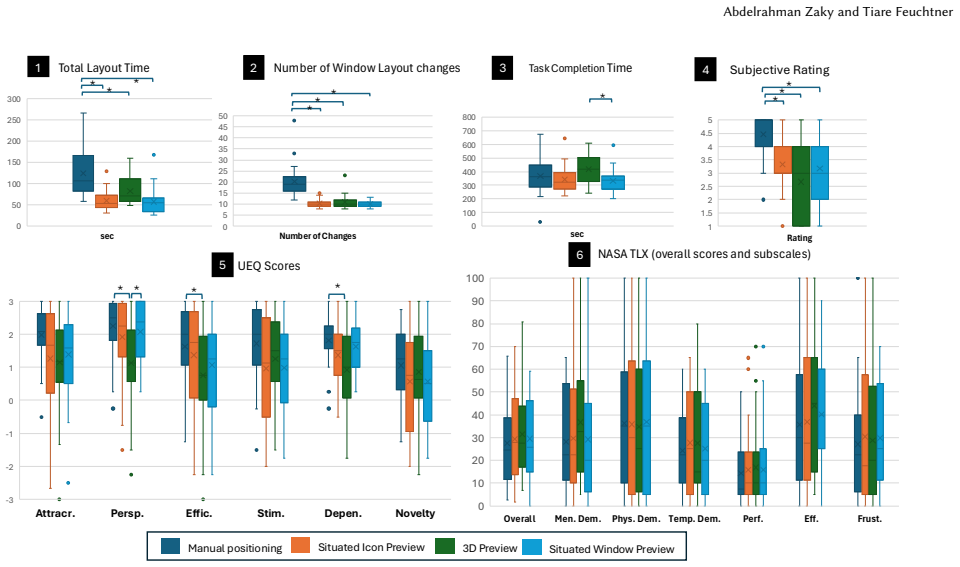
The paper's central claim is a preference–efficiency trade-off. With four fixed proposal positions per window (derived from a four-expert pilot and held constant across proposal conditions), Situated Icon Preview and Situated Window Preview reduced layouting time from a manual mean of 120.3 s to 58.8 s and 54.5 s respectively, and the situated window preview also beat the 3D preview (54.5 s vs 79.4 s) on both layouting time and overall task completion. Despite this, Manual Positioning was preferred by participants (mean 4.46/5) over every proposal technique, and the 3D preview scored worst on UEQ Perspicuity. Interviews attribute the preference to four factors: perceived control over placeme
What carries the argument
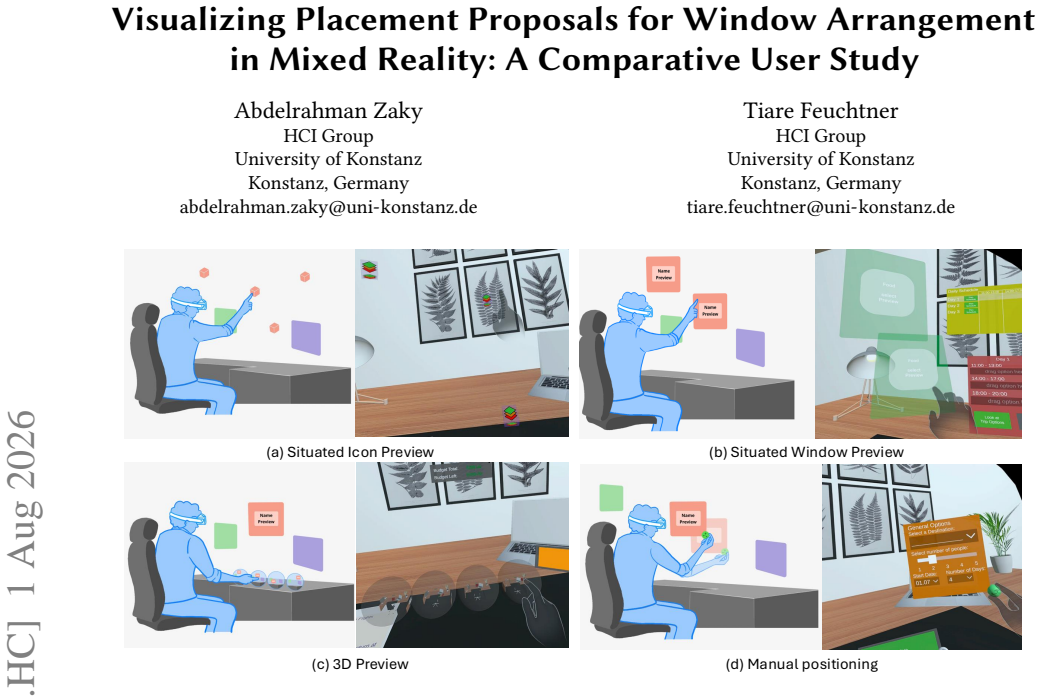
The evaluative machinery is a three-dimensional design space for proposal visualizations — degree of automation (semi-automated selection vs. full manual placement), level of detail (position-only icons vs. full-size window frames with content), and interaction-space awareness (first-person situated views vs. a world-in-miniature overview). To isolate visualization from algorithm, all three proposal conditions show the same four predefined positions per window, drawn from a pilot with four experienced MR users, so differences in time and preference are attributable to how the proposal is shown, not what is shown. The qualitative coding of post-study interviews supplies the four explanatory f
Load-bearing premise
The load-bearing premise is that the four fixed proposal positions, set once by a four-person pilot and reused for every proposal condition, are representative of what a real adaptive layout algorithm would suggest; if those positions were merely adequate or mismatched to participants' preferences, both the time savings and the preference for manual control could be artifacts of that fixed set rather than of the visualization designs.
What would settle it
Run the same seven-window trip-planning task in VR with proposals generated per participant by a multi-objective optimizer (e.g., optimizing reachability, visibility, and ergonomics) instead of the fixed pilot positions, while keeping the three visualizations and manual baseline unchanged. If manual positioning is still preferred over all dynamic-proposal conditions, the controllability explanation is confirmed; if a dynamic-proposal condition matches manual positioning's preference rating, the paper's central preference result was at least partly an artifact of the fixed proposal set.
If this is right
- Semi-automated proposal selection roughly halves window-layouting time in MR and cuts the number of layout adjustments by about half relative to manual positioning.
- Among proposal visualizations, full-size situated previews are the strongest: they beat the world-in-miniature 3D preview on layouting time and overall task completion, while position-only icons are fastest per selection but least informative.
- A world-in-miniature view is not inherently better: its overview benefit is offset by multi-step selection and unfamiliarity, producing worse perspicuity and no preference gain.
- User acceptance of automated assistance in spatial layout is governed by perceived control and familiarity, not raw efficiency; any deployed system should include a manual fine-tuning path.
- Layout assistance is most valuable when many windows accumulate: readjustments concentrated in the last two of seven task stages, suggesting a threshold near five or more windows.
Where Pith is reading between the lines
- My inference: the preference gap may partly be a fixed-set artifact; a system that generates proposals on the fly from the user's current activity, or from their prior adjustments, could close the gap, but this is precisely the condition the paper deliberately left untested.
- My inference: a hybrid interaction where proposals appear only on explicit request, and the user can grab and adjust any proposal before accepting it, would test whether the 'restrictive' feeling disappears while the time savings remain.
- My inference: since experienced VR/3D users liked position-only icons less, proposal visualizations could be adapted per-user or per-familiarity, e.g., content-aware icons for novices and minimal icons for experts.
- My inference: the same framework could generalize to non-window MR UI elements such as notifications, panels, and annotations, where the trade-off between preview informativeness and clutter is likely even starker.
Editorial analysis
A structured set of objections, weighed in public.
Referee Report
Summary. The paper reports a within-subjects user study (N=24) comparing three proposal-visualization techniques for placing windows in a VR-based MR environment—Situated Icon Preview, Situated Window Preview, and 3D Preview—against a Manual Positioning baseline. Participants completed a seven-window trip-planning task under each condition. The main quantitative findings are that Situated Icon Preview and Situated Window Preview significantly reduced layouting time relative to Manual Positioning, Situated Window Preview was faster than 3D Preview, and Manual Positioning nevertheless received significantly higher preference ratings. A thematic analysis of interviews identifies perceived control, cognitive cost, familiarity, and proposal informativeness as factors shaping preference, and a majority of participants endorsed combining proposals with manual fine-tuning. The paper includes Bonferroni-adjusted pairwise comparisons, a trial-order analysis, a post-hoc sensitivity analysis, and an open-science statement with data, instruments, and codebook.
Significance. If the results are taken at face value, the paper makes a useful empirical contribution to MR window-management design: it shows that the visualization format of layout proposals is a consequential design choice and that efficiency gains do not automatically translate into user preference, consistent with prior findings on controllability versus automation accuracy. The study is methodologically careful in several respects: full Latin-square counterbalancing, Bonferroni correction, a trial-order analysis, a sensitivity/power analysis, and a transparent limitations section. The qualitative analysis is reported with a detailed codebook. However, two issues temper the headline claims: the use of a single fixed set of expert-defined proposal positions confounds the manual-versus-proposal comparison, and one of the headline pairwise contrasts falls below the paper's own stated sensitivity threshold. Both are addressable, but they need substantive attention before the central claims can be accepted as stated.
major comments (2)
- [§3.5, §4, §7] The central comparison between proposal conditions and Manual Positioning rests on a fixed set of four expert-defined proposal positions per window, held identical across all three proposal conditions. This is clean for between-proposal contrasts, but the Manual-versus-proposal comparisons are only interpretable if those positions are representative of what users would consider good proposals. The paper itself concedes in §7 that 'the preference for Manual Positioning may therefore partly reflect the constraint of choosing from a fixed set, rather than a principled rejection of proposal-based interaction.' The qualitative data do not resolve the ambiguity: 20/24 found the positions reachable and visible, but 11/24 called the proposals restrictive and 20/24 wanted manual fine-tuning. Because the headline conclusion is that users prefer manual control despite time savings, the manuscript n
- [§5.1.1, Appendix C, Table A.1] Appendix C states that the study has approximately 80% power to detect pairwise effect sizes of r ≥ .50 after Bonferroni correction. Under that threshold, the headline contrast that Situated Window Preview is faster than 3D Preview (Table A.1: z = 2.795, p_adj = .031, r = .40) is below the stated detectable effect. The same applies to the UEQ Perspicuity contrast 3D vs. Situated Window Preview (r = .43) and the Dependability/Efficiency contrasts (r = .41–.44). These are nevertheless reported as significant main findings in §5.1.1 and §5.2.2, while the authors explicitly caution that two nonsignificant omnibus effects (Stimulation, Attractiveness) sit below the detection threshold. This is internally inconsistent. Either the Appendix C thresholds should be recomputed or explained (e.g., in terms of achieved power for the observed effects), or the below-threshold significant contrasts shou
minor comments (5)
- [Title/Abstract] The title and abstract say 'Mixed Reality' while the study is conducted in VR with a seated, desk-based setup. The limitations section acknowledges this, but the main text would benefit from explicitly using 'VR' in the title or at least in the abstract's first sentence.
- [§4.5/§5.2.3] Preference was rated once at the end of the session after all four conditions. The trial-order analysis in Appendix B covers layouting time, layout changes, and overall task completion, but not preference ratings. A sentence explaining how the retrospective preference measure interacts with condition order would strengthen the reporting.
- [§5.2.2] Minor typographical inconsistency: the Stimulation omnibus reports χ²(3) = 8.12, p = .044 without a Kendall's W value, while the Attractiveness omnibus reports W = .13. Providing W for both would make the effect sizes comparable.
- [§3.5] The pilot study with four experts is described as determining both the number of proposals and the specific positions. It would be helpful to state explicitly how the 'maximally distant non-occluding positions' were extracted and whether the four experts were authors or external users, since this affects the independence of the proposal set.
- [Appendix E] The correlations between prior experience and preference are exploratory and based on N=24. The paper already labels them as indicative; consider adding a sentence in the main text to prevent readers from over-interpreting the marginal p = .051 result.
Circularity Check
No circularity: this is an empirical comparative study whose measured outcomes are not derived from fitted parameters, definitions, or self-citation.
full rationale
The paper is a within-subjects user study comparing three proposal-visualization techniques against manual positioning. Its headline results—layouting time, number of layout changes, task-completion time, NASA-TLX, UEQ, and preference ratings—are directly measured from participant behavior, not derived from any fitted parameter or from the pilot data. The four preference factors (perceived control, cognitive cost, familiarity, informativeness) are presented as post-hoc qualitative themes from interviews, explicitly labeled as findings rather than predictions. The pilot-defined fixed proposal positions (Sec. 3.5, Sec. 4) are a controlled experimental input, not a model fitted to the outcome; the paper openly acknowledges in Sec. 7 that the preference for Manual Positioning 'may therefore partly reflect the constraint of choosing from a fixed set,' which is a stated validity limitation, not a circular reduction of the conclusion to its own inputs. Self-citations (e.g., [60], and Feuchtner co-authored works) appear as background motivation and do not carry the load-bearing argument. There is no fitted parameter renamed as a prediction, no uniqueness theorem imported from the authors' prior work, and no ansatz smuggled in via citation. The central claim is an empirical observation about user preference and timing under specified conditions, so no significant circularity is present.
Axiom & Free-Parameter Ledger
free parameters (2)
- Number of proposals per window =
4
- Proposal positions per window (set of 4) =
four maximally distant, non-occluding positions; not numerically reported
axioms (4)
- domain assumption Pilot-derived fixed proposal positions are representative of adaptive-algorithm output
- domain assumption Layout-change counts are comparable across conditions
- domain assumption Seated VR evaluation supports claims about MR window arrangement
- standard math Standard frequentist assumptions and instruments are valid
Cite this review
Pith. "Pith review of Visualizing Placement Proposals for Window Arrangement in Mixed Reality: A Comparative User Study." pith.science (2026). https://pith.science/paper/CMWVZ3SI
@misc{pith2026260800403,
  author       = {Pith},
  title        = {Pith review of: Visualizing Placement Proposals for Window Arrangement in Mixed Reality: A Comparative User Study},
  year         = {2026},
  howpublished = {\url{https://pith.science/paper/CMWVZ3SI}},
  note         = {Machine review of arXiv:2608.00403}
}
read the original abstract
Adaptive mixed reality (MR) interfaces typically optimize window layouts on behalf of the user, with limited consideration for individual preferences. A promising alternative keeps users in the loop by presenting layout proposals for them to select from, but how these proposals should be visualized remains underexplored. We compare three proposal-visualization techniques for window placement, Situated Icon Preview, Situated Window Preview, and 3D Preview, against a Manual Positioning baseline. The techniques differ in level of detail and degree of interaction-space context. In a within-subjects user study, 24 participants completed a multi-stage trip-planning task in VR, individually placing seven sequentially introduced windows using each technique. We thereby focus on single-window placement under predefined proposal positions. We measured layouting time, number of layout changes, task load, user experience, and preference, complemented by semi-structured interviews. Although Situated Icon Preview and Situated Window Preview reduced layouting time compared to Manual Positioning - with Situated Window Preview also faster than 3D Preview - participants preferred direct manual control. We discuss the factors shaping this preference (perceived control, cognitive cost, familiarity, and informativeness of the proposal) and outline implications for hybrid approaches, as a promising combination of proposal-based suggestions with manual refinement.
Figures




Reference graph
Works this paper leans on
-
[1]
AirBnb. 2007. AirBnb. https://www.airbnb.com. accessed: 11.02.2026
work page 2007
-
[2]
Myroslav Bachynskyi, Gregorio Palmas, Antti Oulasvirta, and Tino Weinkauf
-
[3]
Mark Billinghurst, Hirokazu Kato, and Ivan Poupyrev. 2001. The MagicBook: a transitional AR interface.Computers & Graphics25, 5 (2001), 745–753. doi:10. 1016/S0097-8493(01)00117-0 Mixed realities - beyond conventions
work page 2001
-
[4]
Booking. 1996. Booking. https://www.booking.com. accessed: 11.02.2026
work page 1996
-
[5]
Virginia Braun and Victoria Clarke. 2006. Using thematic analysis in psy- chology.Qualitative research in psychology3, 2 (2006), 77–101. doi:10.1191/ 1478088706qp063oa Visualizing Placement Proposals for Window Arrangement in MR
work page 2006
-
[6]
Marco Cavallo, Mishal Dolakia, Matous Havlena, Kenneth Ocheltree, and Mark Podlaseck. 2019. Immersive Insights: A Hybrid Analytics System forCollabora- tive Exploratory Data Analysis. InProceedings of the 25th ACM Symposium on Virtual Reality Software and Technology(Parramatta, NSW, Australia)(VRST ’19). Association for Computing Machinery, New York, NY, ...
-
[7]
Xi Chen, Wei Zeng, Yanna Lin, Hayder Mahdi AI-maneea, Jonathan Roberts, and Remco Chang. 2021. Composition and Configuration Patterns in Multiple-View Visualizations.IEEE Transactions on Visualization and Computer Graphics27, 2 (2021), 1514–1524. doi:10.1109/TVCG.2020.3030338
arXiv 2021
-
[8]
Yifei Cheng, Yukang Yan, Xin Yi, Yuanchun Shi, and David Lindlbauer. 2021. SemanticAdapt: Optimization-based Adaptation of Mixed Reality Layouts Lever- aging Virtual-Physical Semantic Connections. InThe 34th Annual ACM Sym- posium on User Interface Software and Technology(Virtual Event, USA)(UIST ’21). Association for Computing Machinery, New York, NY, US...
arXiv 2021
-
[9]
Parisa Daeijavad. 2024. Investigating the Impact of Multiple View Layouts on Users’ Visual Task Performance in Extended Reality. InProceedings of the 2024 International Conference on Advanced Visual Interfaces(Arenzano, Genoa, Italy) (A VI ’24). Association for Computing Machinery, New York, NY, USA, Article 112, 3 pages. doi:10.1145/3656650.3656756
-
[10]
Kurtis Danyluk, Barrett Ens, Bernhard Jenny, and Wesley Willett. 2021. A Design Space Exploration of Worlds in Miniature. InProceedings of the 2021 CHI Conference on Human Factors in Computing Systems(Yokohama, Japan)(CHI ’21). Association for Computing Machinery, New York, NY, USA, Article 122, 15 pages. doi:10.1145/3411764.3445098
arXiv 2021
-
[12]
João Marcelo Evangelista Belo, Anna Maria Feit, Tiare Feuchtner, and Kaj Grøn- bæk. 2021. XRgonomics: Facilitating the Creation of Ergonomic 3D Interfaces. In Proceedings of the 2021 CHI Conference on Human Factors in Computing Systems (Yokohama, Japan)(CHI ’21). Association for Computing Machinery, New York, NY, USA, Article 290, 11 pages. doi:10.1145/34...
arXiv 2021
-
[13]
Lystbæk, Anna Maria Feit, Ken Pfeuf- fer, Peter Kán, Antti Oulasvirta, and Kaj Grønbæk
João Marcelo Evangelista Belo, Mathias N. Lystbæk, Anna Maria Feit, Ken Pfeuf- fer, Peter Kán, Antti Oulasvirta, and Kaj Grønbæk. 2022. AUIT – the Adaptive User Interfaces Toolkit for Designing XR Applications. InProceedings of the 35th Annual ACM Symposium on User Interface Software and Technology(Bend, OR, USA)(UIST ’22). Association for Computing Machi...
arXiv 2022
-
[14]
Andreas Fender, Philipp Herholz, Marc Alexa, and Jörg Müller. 2018. OptiSpace: Automated Placement of Interactive 3D Projection Mapping Content. InPro- ceedings of the 2018 CHI Conference on Human Factors in Computing Systems (Montreal QC, Canada)(CHI ’18). Association for Computing Machinery, New York, NY, USA, 1–11. doi:10.1145/3173574.3173843
arXiv 2018
-
[15]
Leah Findlater and Joanna McGrenere. 2004. A comparison of static, adaptive, and adaptable menus. InProceedings of the SIGCHI Conference on Human Factors in Computing Systems(Vienna, Austria)(CHI ’04). Association for Computing Machinery, New York, NY, USA, 89–96. doi:10.1145/985692.985704
arXiv 2004
-
[16]
Daniel Immanuel Fink, Johannes Zagermann, Harald Reiterer, and Hans- Christian Jetter. 2022. Re-locations: Augmenting Personal and Shared Workspaces to Support Remote Collaboration in Incongruent Spaces.Proc. ACM Hum.-Comput. Interact.6, ISS, Article 556 (nov 2022), 30 pages. doi:10.1145/ 3567709
work page 2022
-
[17]
Ran Gal, Lior Shapira, Eyal Ofek, and Pushmeet Kohli. 2014. FLARE: Fast lay- out for augmented reality applications. In2014 IEEE International Symposium on Mixed and Augmented Reality (ISMAR). 207–212. doi:10.1109/ISMAR.2014. 6948429
-
[18]
Zeinab Ghaemi, Kadek Ananta Satriadi, Ulrich Engelke, Barrett Ens, and Bernhard Jenny. 2023. Visualization Placement for Outdoor Augmented Data Tours. In Proceedings of the 2023 ACM Symposium on Spatial User Interaction(Sydney, NSW, Australia)(SUI ’23). Association for Computing Machinery, New York, NY, USA, Article 9, 14 pages. doi:10.1145/3607822.3614518
-
[19]
Google. 2011. Google Flights. https://www.google.com/travel/flight. accessed: 11.02.2026
work page 2011
-
[20]
Jens Grubert, Matthias Heinisch, Aaron Quigley, and Dieter Schmalstieg. 2015. MultiFi: Multi Fidelity Interaction with Displays On and Around the Body. In Proceedings of the 33rd Annual ACM Conference on Human Factors in Comput- ing Systems(Seoul, Republic of Korea)(CHI ’15). Association for Computing Machinery, New York, NY, USA, 3933–3942. doi:10.1145/2...
arXiv 2015
-
[21]
Violet Yinuo Han, Hyunsung Cho, Kiyosu Maeda, Alexandra Ion, and David Lindlbauer. 2023. BlendMR: A Computational Method to Create Ambient Mixed Reality Interfaces.Proc. ACM Hum.-Comput. Interact.7, ISS, Article 436 (nov 2023), 25 pages. doi:10.1145/3626472
doi:10.1145/3626472 2023
-
[22]
Chris Harrison, Hrvoje Benko, and Andrew D. Wilson. 2011. OmniTouch: wear- able multitouch interaction everywhere. InProceedings of the 24th Annual ACM Symposium on User Interface Software and Technology(Santa Barbara, California, USA)(UIST ’11). Association for Computing Machinery, New York, NY, USA, 441–450. doi:10.1145/2047196.2047255
-
[23]
Sandra G. Hart. 2006. NASA-Task Load Index (NASA-TLX); 20 Years Later. In Proceedings of the Human Factors and Ergonomics Society Annual Meeting, Vol. 50. 904–908. doi:10.1177/154193120605000909
-
[24]
Sandra G. Hart and Lowell E. Staveland. 1988. Development of NASA-TLX (Task Load Index): Results of Empirical and Theoretical Research. InHuman Mental Workload, Peter A. Hancock and Najmedin Meshkati (Eds.). Advances in Psychology, Vol. 52. North-Holland, 139–183. doi:10.1016/S0166-4115(08)62386-9
-
[25]
Juan David Hincapié-Ramos, Xiang Guo, Paymahn Moghadasian, and Pourang Irani. 2014. Consumed endurance: a metric to quantify arm fatigue of mid-air interactions. InProceedings of the SIGCHI Conference on Human Factors in Com- puting Systems(Toronto, Ontario, Canada)(CHI ’14). Association for Computing Machinery, New York, NY, USA, 1063–1072. doi:10.1145/2...
arXiv 2014
-
[26]
Sebastian Hubenschmid, Johannes Zagermann, Daniel Leicht, Harald Reiterer, and Tiare Feuchtner. 2023. ARound the Smartphone: Investigating the Effects of Virtually-Extended Display Size on Spatial Memory. InProceedings of the 2023 CHI Conference on Human Factors in Computing Systems(Hamburg, Germany) (CHI ’23). Association for Computing Machinery, New Yor...
arXiv 2023
-
[27]
IBM Corp. 2022. IBM SPSS Statistics for Windows
work page 2022
-
[28]
Cory Ilo, Stephen DiVerdi, and Doug Bowman. 2024. Goldilocks Zoning: Eval- uating a Gaze-Aware Approach to Task-Agnostic VR Notification Placement. InProceedings of the 2024 ACM Symposium on Spatial User Interaction(Trier, Germany)(SUI ’24). Association for Computing Machinery, New York, NY, USA, Article 13, 12 pages. doi:10.1145/3677386.3682087
-
[29]
Christoph Albert Johns, João Marcelo Evangelista Belo, Anna Maria Feit, Clemens Nylandsted Klokmose, and Ken Pfeuffer. 2023. Towards Flexible and Robust User Interface Adaptations With Multiple Objectives. InProceedings of the 36th Annual ACM Symposium on User Interface Software and Technology(San Francisco, CA, USA)(UIST ’23). Association for Computing M...
arXiv 2023
-
[30]
Christoph Albert Johns, João Marcelo Evangelista Belo, Clemens Nylandsted Klokmose, and Ken Pfeuffer. 2023. Pareto Optimal Layouts for Adaptive Mixed Reality. InExtended Abstracts of the 2023 CHI Conference on Human Factors in Com- puting Systems(Hamburg, Germany)(CHI EA ’23). Association for Computing Ma- chinery, New York, NY, USA, Article 223, 7 pages....
arXiv 2023
-
[31]
Bettina Laugwitz, Theo Held, and Martin Schrepp. 2008. Construction and evaluation of a user experience questionnaire. InHCI and Usability for Education and Work: 4th Symposium of the Workgroup Human-Computer Interaction and Usability Engineering of the Austrian Computer Society, USAB 2008, Graz, Austria, November 20-21, 2008. Proceedings 4. Springer, 63–...
-
[33]
Sikun Lin, Hao Fei Cheng, Weikai Li, Zhanpeng Huang, Pan Hui, and Christoph Peylo. 2017. Ubii: Physical World Interaction Through Augmented Reality.IEEE Transactions on Mobile Computing16, 3 (2017), 872–885. doi:10.1109/TMC.2016. 2567378
-
[34]
David Lindlbauer, Anna Maria Feit, and Otmar Hilliges. 2019. Context-Aware Online Adaptation of Mixed Reality Interfaces. InProceedings of the 32nd Annual ACM Symposium on User Interface Software and Technology(New Orleans, LA, USA)(UIST ’19). Association for Computing Machinery, New York, NY, USA, 147–160. doi:10.1145/3332165.3347945
arXiv 2019
-
[35]
Feiyu Lu and Yan Xu. 2022. Exploring Spatial UI Transition Mechanisms with Head-Worn Augmented Reality. InProceedings of the 2022 CHI Conference on Human Factors in Computing Systems(New Orleans, LA, USA)(CHI ’22). Asso- ciation for Computing Machinery, New York, NY, USA, Article 550, 16 pages. doi:10.1145/3491102.3517723
arXiv 2022
-
[36]
Weizhou Luo, Mats Ole Ellenberg, Marc Satkowski, and Raimund Dachselt
-
[37]
Mykola Maslych, Yahya Hmaiti, Ryan Ghamandi, Paige Leber, Ravi Kiran Kattoju, Jacob Belga, and Joseph J. LaViola. 2023. Toward Intuitive Acquisi- tion of Occluded VR Objects Through an Interactive Disocclusion Mini-map. In2023 IEEE Conference Virtual Reality and 3D User Interfaces (VR). 460–470. doi:10.1109/VR55154.2023.00061
arXiv 2023
-
[38]
Aziz Niyazov, Barrett Ens, Kadek Ananta Satriadi, Nicolas Mellado, Loic Barthe, Tim Dwyer, and Marcos Serrano. 2023. User-Driven Constraints for Layout Optimisation in Augmented Reality. InProceedings of the 2023 CHI Conference on Human Factors in Computing Systems(Hamburg, Germany)(CHI ’23). Association Abdelrahman Zaky and Tiare Feuchtner for Computing ...
arXiv 2023
-
[39]
Omio. 2013. Omio. https://www.omio.com. accessed: 11.02.2026
work page 2013
-
[40]
Leonardo Pavanatto. 2021. Designing Augmented Reality Virtual Displays for Productivity Work. In2021 IEEE International Symposium on Mixed and Augmented Reality Adjunct (ISMAR-Adjunct). 459–460. doi:10.1109/ISMAR- Adjunct54149.2021.00107
arXiv 2021
-
[41]
Leonardo Pavanatto, Jens Grubert, and Doug A. Bowman. 2025. Spatial Bar: Exploring Window Switching Techniques for Large Virtual Displays. In2025 IEEE Conference Virtual Reality and 3D User Interfaces (VR). 186–194. doi:10.1109/ VR59515.2025.00043
arXiv 2025
-
[42]
Leonardo Pavanatto, Feiyu Lu, Chris North, and Doug A. Bowman. 2025. Multi- ple Monitors or Single Canvas? Evaluating Window Management and Layout Strategies on Virtual Displays.IEEE Transactions on Visualization and Computer Graphics31, 3 (2025), 1713–1730. doi:10.1109/TVCG.2024.3368930
-
[43]
Bowman, Carmen Badea, and Richard Stoakley
Leonardo Pavanatto, Chris North, Doug A. Bowman, Carmen Badea, and Richard Stoakley. 2021. Do we still need physical monitors? An evaluation of the usability of AR virtual monitors for productivity work. In2021 IEEE Virtual Reality and 3D User Interfaces (VR). 759–767. doi:10.1109/VR50410.2021.00103
arXiv 2021
-
[44]
Patrick Reipschläger and Raimund Dachselt. 2019. DesignAR: Immersive 3D- Modeling Combining Augmented Reality with Interactive Displays. InProceed- ings of the 2019 ACM International Conference on Interactive Surfaces and Spaces (Daejeon, Republic of Korea)(ISS ’19). Association for Computing Machinery, New York, NY, USA, 29–41. doi:10.1145/3343055.3359718
arXiv 2019
-
[45]
Jie Ren, Yueting Weng, Chengchi Zhou, Chun Yu, and Yuanchun Shi. 2020. Understanding Window Management Interactions in AR Headset + Smartphone Interface. InExtended Abstracts of the 2020 CHI Conference on Human Factors in Computing Systems(Honolulu, HI, USA)(CHI EA ’20). Association for Computing Machinery, New York, NY, USA, 1–8. doi:10.1145/3334480.3382812
-
[46]
J. C. Roberts, H. Al-maneea, P. W. S. Butcher, R. Lew, G. Rees, N. Sharma, and A. Frankenberg-Garcia. 2019. Multiple Views: different meanings and collocated words.Computer Graphics Forum38, 3 (2019), 79–93. arXiv:https://onlinelibrary.wiley.com/doi/pdf/10.1111/cgf.13673 doi:10.1111/cgf. 13673
-
[47]
Quentin Roy, Futian Zhang, and Daniel Vogel. 2019. Automation Accuracy Is Good, but High Controllability May Be Better. InProceedings of the 2019 CHI Conference on Human Factors in Computing Systems(Glasgow, Scotland Uk)(CHI ’19). Association for Computing Machinery, New York, NY, USA, 1–8. doi:10.1145/3290605.3300750
arXiv 2019
- [48]
-
[49]
Zhangfan Shen, Linghao Zhang, Xing Xiao, Rui Li, and Ruoyu Liang. 2020. Icon Familiarity Affects the Performance of Complex Cognitive Tasks.i-Perception 11, 2 (2020). doi:10.1177/2041669520910167
-
[50]
Ludwig Sidenmark, Tianyu Zhang, Leen Al Lababidi, Jiannan Li, and Tovi Gross- man. 2024. Desk2Desk: Optimization-based Mixed Reality Workspace Integration for Remote Side-by-side Collaboration. InProceedings of the 37th Annual ACM Symposium on User Interface Software and Technology(Pittsburgh, PA, USA) (UIST ’24). Association for Computing Machinery, New ...
arXiv 2024
-
[51]
Yao Song, Christoph Gebhardt, Yi-Chi Liao, and Christian Holz. 2025. Preference- Guided Multi-Objective UI Adaptation. InProceedings of the 38th Annual ACM Symposium on User Interface Software and Technology (UIST ’25). Association for Computing Machinery, New York, NY, USA, Article 120, 13 pages. doi:10.1145/ 3746059.3747645
arXiv 2025
-
[52]
Richard Stoakley, Matthew J. Conway, and Randy Pausch. 1995. Virtual reality on a WIM: interactive worlds in miniature. InProceedings of the SIGCHI Conference on Human Factors in Computing Systems(Denver, Colorado, USA)(CHI ’95). ACM Press/Addison-Wesley Publishing Co., USA, 265–272. doi:10.1145/223904.223938
-
[53]
Tianchen Sun, Yucong Ye, Issei Fujishiro, and Kwan-Liu Ma. 2019. Collaborative Visual Analysis with Multi-level Information Sharing Using a Wall-Size Display and See-Through HMDs. In2019 IEEE Pacific Visualization Symposium (PacificVis). 11–20. doi:10.1109/PacificVis.2019.00010
arXiv 2019
-
[54]
Markus Tatzgern, Valeria Orso, Denis Kalkofen, Giulio Jacucci, Luciano Gam- berini, and Dieter Schmalstieg. 2016. Adaptive information density for augmented reality displays. In2016 IEEE Virtual Reality (VR). 83–92. doi:10.1109/VR.2016. 7504691
-
[55]
Unity. Year Published/ Last Updated. Unity Technologies. https://unity.com. Aaccessed: 11.02.2026
work page 2026
-
[56]
Wanderlog. 2019. Wanderlog. https://wanderlog.com. accessed: 11.02.2026
work page 2019
-
[57]
Wang Baldonado, Allison Woodruff, and Allan Kuchinsky
Michelle Q. Wang Baldonado, Allison Woodruff, and Allan Kuchinsky. 2000. Guidelines for using multiple views in information visualization. InProceedings of the Working Conference on Advanced Visual Interfaces(Palermo, Italy)(A VI ’00). Association for Computing Machinery, New York, NY, USA, 110–119. doi:10. 1145/345513.345271
arXiv 2000
-
[58]
Zhen Wen, Wei Zeng, Luoxuan Weng, Yihan Liu, Mingliang Xu, and Wei Chen
-
[59]
Frederik Winther, Linoj Ravindran, Kasper Paabøl Svendsen, and Tiare Feuchtner
-
[60]
Abdelrahman Zaky, Johannes Zagermann, Harald Reiterer, and Tiare Feuchtner
-
[61]
Lei Zhang, Jin Pan, Jacob Gettig, Steve Oney, and Anhong Guo. 2024. VRCopilot: Authoring 3D Layouts with Generative AI Models in VR. InProceedings of the 37th Annual ACM Symposium on User Interface Software and Technology(Pittsburgh, PA, USA)(UIST ’24). Association for Computing Machinery, New York, NY, USA, Article 96, 13 pages. doi:10.1145/3654777.36764...
arXiv 2024
-
[65]
In2023 IEEE International Symposium on Mixed and Augmented Reality Adjunct (ISMAR-Adjunct)
Opportunities and Challenges of Hybrid User Interfaces for Optimization of Mixed Reality Interfaces. In2023 IEEE International Symposium on Mixed and Augmented Reality Adjunct (ISMAR-Adjunct). 215–219. doi:10.1109/ISMAR- Adjunct60411.2023.00050
arXiv 2023
-
[2015]
Informing the Design of Novel Input Methods with Muscle Coactivation Clustering.ACM Trans. Comput.-Hum. Interact.21, 6, Article 30 (jan 2015), 25 pages. doi:10.1145/2687921
-
[2020]
Design and Evaluation of a VR Training Simulation for Pump Maintenance. InExtended Abstracts of the 2020 CHI Conference on Human Factors in Computing Systems(Honolulu, HI, USA)(CHI EA ’20). Association for Computing Machinery, New York, NY, USA, 1–8. doi:10.1145/3334480.3375213
-
[2023]
Effects of View Layout on Situated Analytics for Multiple-View Repre- sentations in Immersive Visualization.IEEE Transactions on Visualization and Computer Graphics29, 1 (2023), 440–450. doi:10.1109/TVCG.2022.3209475
arXiv 2023
-
[2025]
InProceedings of the 2025 CHI Conference on Human Factors in Computing Systems (CHI ’25)
Documents in Your Hands: Exploring Interaction Techniques for Spatial Arrangement of Augmented Reality Documents. InProceedings of the 2025 CHI Conference on Human Factors in Computing Systems (CHI ’25). Association for Computing Machinery, New York, NY, USA, Article 1218, 22 pages. doi:10.1145/ 3706598.3713518
arXiv 2025
discussion (0)
Sign in with ORCID, Apple, or X to comment. Anyone can read and Pith papers without signing in.