REVIEW 3 major objections 4 minor 35 references
Ekova: A Personality-Support Agent for Self-Discovery Dialogue
T0 review · 3 major / 4 minor · reviewed 2026-08-05 · deepseek-v4-flash
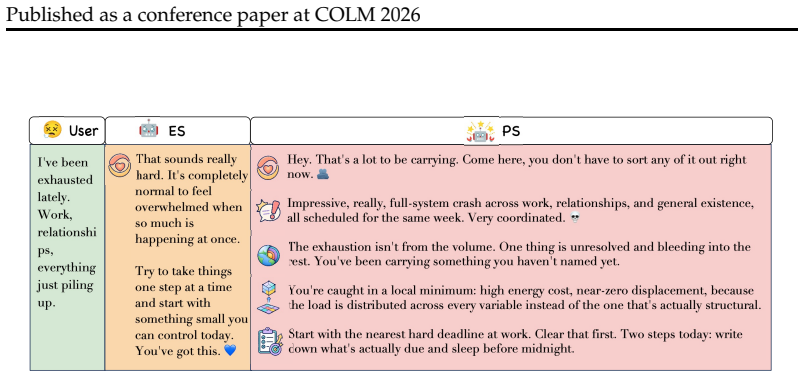
Pith's one-line read This paper proposes a distinct 'personality support' paradigm—helping users articulate how they see themselves—and reports that a five-style agent trained with parameter-level adapters beats style-prompted baselines by 16.3% on average.
desk verdict Genuinely new PS framing and five-style taxonomy, but the headline gains are compromised because the same Kimi judge trains the model and grades it. read the letter →
The pith
A machine-rendered reading of the paper's core claim, the machinery that carries it, and where it could break.
The reading
What carries the argument
The central mechanism is the minimal-unit decomposition of Personality Support, enforced by OrthoTune, a training framework that gives each style its own LoRA adapter on a shared Qwen2.5-32B base and adds a style-consistency regularizer: a frozen LLM judge outside the baseline pool scores each response's conformity to the target style, and that score enters the training loss. At inference, each persona has a dedicated guard—Coach retrieves exemplars from a style bank, Warm retrieves from a conversation memory buffer, Tsukkomi filters out non-ironic register, and Gonzo rejects outputs without cross-domain analogy markers—while Real runs without post-processing. Ekova then unifies the five per
What would settle it
Give Ekova to a new cohort of users and compare per-user PCL/SDI gains and style accuracy against the best style-prompted baseline; the central claim fails if the 9.5-point style-accuracy gap shrinks, the LPS-helpfulness correlation drops well below 0.9, or Tsukkomi and Gonzo are rated as unhelpful by most participants.
Extended reading notes
Core claim
The paper's central claim is that Personality Support is a measurable and trainable objective distinct from affect regulation. It formalizes PS as LPS(U,A) = λ·PCL(U,A) + (1−λ)·SDI(U,A), where PCL measures convergence of the user's problem statement to an actionable formulation and SDI measures movement from generic to personal disclosure. The Minimal Unit Hypothesis then asserts that five conversational styles—Warm, Tsukkomi, Real, Gonzo, Coach—each make a non-replicable contribution to LPS, such that removing any one strictly reduces the system's ability to advance PCL or SDI. The reported evidence for this is a 63.0-point gap between diagonal and off-diagonal style-accuracy, with OrthoTun
Load-bearing premise
The load-bearing premise is that the five style definitions, the training data, and the evaluations are all grounded in one person's interaction stream, so the style boundaries and the 16.3% gain are inferred from a single user's data.
Editorial extensions
If this is right
- Multi-style support requires parameter-level specialization and inference guards; prompt descriptions alone don't instantiate minimal-unit boundaries.
- PS has its own evaluation metrics—PCL and SDI—so progress in this paradigm should be measured by self-articulation, not just affect.
- Ekova's cross-session memory means a persistent PS agent can carry disclosed context across sessions, compounding self-understanding; this motivates longitudinal evaluation.
- The five units and their guard designs provide a reusable recipe for building adaptive, user-customizable support agents.
Reading between the lines
- The paper's single-user grounding means the five-style decomposition is a hypothesis about conversational cognition, not a proven universal typology; a multi-participant replication with the same data collection protocol would test whether Coach, Warm, Tsukkomi, Real, and Gonzo remain the minimal covering set for other people's self-discovery processes.
- Because LPS is a weighted sum with λ tuned to human helpfulness, a natural extension is per-user λ adaptation: users who respond better to irony or analogy would get different blends, which the paper's architecture already supports through manual persona selection.
- If cross-session memory compounds self-understanding, the agent's value should increase with usage; a longitudinal study could measure whether PCL/SDI gains accumulate over weeks rather than plateauing after the first session.
- The claimed 16.3% average relative gain is against prompt-based baselines on a single-user test set; the margin could shrink or grow with other base models, other languages, or other users, so the headline number should be read as evidence for the mechanism, not a fixed performance guarantee.
Editorial analysis
A structured set of objections, weighed in public.
Referee Report
Summary. The paper introduces a new paradigm, Personality Support (PS), distinct from Emotional Support (ES), targeting cognitive clarity and self-articulation. It presents DSD, a Chinese single-user longitudinal dataset of 8,590 samples across five 'minimal units' (Coach, Warm, Tsukkomi, Real, Gonzo); DeepSupport, a multi-persona system trained with OrthoTune, which uses style-specific LoRA adapters and a style-consistency regularizer driven by a frozen Kimi K2.5 judge p_phi (Eq. 2); and Ekova, a persistent agent with cross-session memory and adaptive routing. The headline result is that OrthoTune-trained models outperform the strongest prompt-based baseline by 16.3% average relative gain, with a 9.5 percentage-point SA gap and a 16.6% relative SDI improvement. The paper claims that style prompting alone cannot instantiate the minimal-unit boundaries, and that parameter-level specialization plus inference-time guards are required.
Significance. If the empirical claims held, this would be a substantive contribution: it proposes a new task family (PS), a novel multi-style fine-tuning framework with a style-consistency regularizer, and a persistent-agent architecture that routes across support personas. The paper is explicit about its limitations (single-participant design, Chinese-native scope, non-clinical positioning), and it ships code, which is a strength. The key difficulty is that the central automatic metrics are entangled with the training signal, and the evaluation is built on a single user's data. Thus the significance is conditional on whether the style-boundary results survive an independent evaluation protocol.
major comments (3)
- [§5, Eq. (2) and §6 Metrics] The central claim that OrthoTune achieves a 9.5pp SA gain and a 63.0pp diagonal-vs-off-diagonal cross-style gap is compromised by training/evaluation leakage. The style-consistency regularizer in Eq. (2) explicitly maximizes log p_phi(s_i | a_{1:|A|}) with p_phi = frozen Kimi K2.5, and the SA metric is defined as the fraction of responses whose top p_phi confidence score matches the target style. PCL is also rated by the same Kimi K2.5. The paper's justification that Kimi K2.5 is absent from the baseline pool addresses self-evaluation among baselines, but not the fact that the metric is optimized during training. This threatens validity even on the author's own test set. The human SC ratings (4.36 vs 4.18) show a much smaller advantage, suggesting the automatic SA gap may overstate the true style-boundary difference. Please re-evaluate with a judge not used in training, or report human S
- [§4 and §7] The single-participant design is a load-bearing limitation for the generalizability of the 'minimal unit' hypothesis and the 16.3% average relative gain. All training and test data come from one user's longitudinal stream; the five style definitions, the style judge, and the DSD dataset are all derived from that individual. The conclusion acknowledges this ('The single-participant design limits generalizability'), but the manuscript's broader claims about PS as a general paradigm and about the necessity of parameter-level specialization would require at least a second user's data or an explicitly framed proof-of-concept status. Please either extend the evaluation to multiple participants or substantially temper the general claims.
- [§4 Warm subset and Table 1] Warm is the largest subset (5,200 samples) and is augmented with '30% template-based synthetic data for cold-start and low-disclosure scenarios.' It is unclear whether this synthetic data is included in the 90/10 train/test split. If synthetic templates appear in the test set, the Warm SA/SDI/PCL numbers (Table 3) and the ablation results (w/o Synthetic Data, Table 5) could be inflated. Please clarify the split and, if synthetic data is in the test set, report results on the human-only portion.
minor comments (4)
- [Figure 3] Typo: 'Conversation' is misspelled as 'Coversation' in two places in the figure. Also, the figure is dense and the flow from 'Users' to the style subsets is hard to follow; consider simplifying or adding numbered steps.
- [§6 p-value claim] The text states 'OrthoTune outperforms all baselines on every metric at p < 0.01' but does not specify the statistical test, the number of samples, or how multiple comparisons were handled. Please provide test details (e.g., paired bootstrap or Wilcoxon) and report effect sizes.
- [§6 Human evaluation] Krippendorff's alpha is reported as 'above 0.7' globally, but Table 3 and the method description state that 3 raters were used while Appendix B mentions 9 annotators. Please reconcile the rater count and report per-metric alpha values.
- [References] Several 2026 references (e.g., GPT-5.5, Claude Sonnet 4.6, Kimi K2.5) are cited without version identifiers or full author lists, making reproducibility harder. If these are preprints or model cards, please include stable identifiers or access dates.
Circularity Check
SA is scored by the same Kimi K2.5 judge that Eq. (2) optimizes, so the headline style-boundary gains are partly forced by construction.
-
fitted input called prediction
[Section 5 Eq. (2); Section 6 'Metrics'; Table 4]
"To penalize style drift beyond standard next-token prediction, we introduce a style regularization term using a frozen style judge p ϕ as an auxiliary training signal: L(θ) =− 1|A| ∑ t logp θ(at |a <t,u,s i)−εlogp ϕ(si |a 1:|A| ), (2) ... SA measures style conformity by querying pϕ independently per candidate style, normalizing the resulting confidence scores, and computing the fraction of responses where the top-scoring style matches the target."
The SA metric is the same function that the training objective maximizes: Eq. (2) adds eps*log p_phi(s_i | response), and SA is defined as the fraction of responses whose top p_phi confidence score matches the target style. OrthoTune is therefore trained to maximize SA under p_phi, then SA is reported as evidence of style-boundary generalization. The 9.5 pp SA advantage over style-prompted baselines and the 63.0 pp diagonal/off-diagonal gap in the cross-style matrix are measured with the very judge used inside the training loop. This is not an independent prediction; it is a fitted objective reported as an evaluation. The paper's defense that Kimi K2.5 is 'absent from the baseline pool' addresses baseline self-evaluation, not training/evaluation leakage: the judge is simultaneously the reg
full rationale
The paper is mostly a systems and data paper: DSD is a collected dataset, OrthoTune is a training procedure, and Ekova is an interface. There is no load-bearing self-citation chain and no imported uniqueness theorem; prior work is cited conventionally. The one substantive circularity is the automatic SA metric. In Eq. (2) the style-consistency regularizer is exactly -eps*log p_phi(s_i|a), and in §6 SA is exactly 'top p_phi confidence matches target.' Thus the headline SA gains and the cross-style matrix are evaluations on the same judge the training loop optimized. This partially forces the central claim that 'style prompting alone cannot instantiate minimal-unit boundaries': the boundary criterion was the training signal. The human SC gap (4.36 vs 4.18) and the human Help/SDI differences are independent and much smaller, so the system is not wholly circular. PCL also uses Kimi K2.5, but since PCL is not the regularizer target, I do not count it as a separate by-construction reduction. Overall: one central metric reduces by construction, giving partial circularity rather than full collapse.
Assumptions & free parameters
free parameters (4)
- lambda in LPS =
0.5 (equal weighting) or optimized to 0.82
- epsilon in style regularizer =
0.1
- 30% template-based synthetic data for Warm =
30%
- LoRA hyperparameters =
rank 16, alpha 32, lr 2e-4, batch 32, max len 2048, 20 epochs
assumptions (4)
- domain assumption Self-disclosure induction measured by user-side disclosure shift is a valid proxy for psychological growth.
- domain assumption The five minimal units are functionally independent and collectively sufficient.
- domain assumption Kimi K2.5 style-judge scores are reliable proxies for style conformity and PCL.
- domain assumption The participant's chat logs are representative of PS-relevant dialogue.
invented entities (4)
-
Personality Support (PS) paradigm
-
Five minimal units (Warm, Tsukkomi, Real, Gonzo, Coach)
-
DSD dataset
-
OrthoTune
Cite this review
Pith. "Pith review of Ekova: A Personality-Support Agent for Self-Discovery Dialogue." pith.science (2026). https://pith.science/paper/5TQ4RSRK
@misc{pith2026260800478,
  author       = {Pith},
  title        = {Pith review of: Ekova: A Personality-Support Agent for Self-Discovery Dialogue},
  year         = {2026},
  howpublished = {\url{https://pith.science/paper/5TQ4RSRK}},
  note         = {Machine review of arXiv:2608.00478}
}
read the original abstract
Emotional Support (ES) systems have long optimized a single objective: alleviating the user's emotional distress in the moment. We argue that a complementary need, helping users see themselves more clearly, defines a distinct paradigm we call Personality Support (PS). PS is not counseling or clinical intervention: it targets cognitive clarity and self-articulation, not symptom relief or diagnosis. We instantiate this paradigm in three layers. First, we present DSD, a Chinese self-discovery PS Dataset of 8,590 samples collected through real longitudinal interaction across five minimal units, Coach, Warm, Tsukkomi, Real, and Gonzo. Second, we build DeepSupport, a multi-persona PS system trained with OrthoTune, a PS-tailored framework with style-specific adapters and a style-consistency regularizer. Third, we unify the five DeepSupport personas into Ekova, a persistent personality-support agent with a unified cross-session memory layer, supporting both adaptive routing and user-customized persona selection. Experiments show that OrthoTune-trained models outperform all baselines with an average relative gain of 16.3% across all metrics over the strongest prompt-based baseline. Code is available at https://github.com/Yukyin/Ekova.
Figures


Figures from the paper (1 more)

Reference graph
Works this paper leans on
-
[1]
Proceedings of the 59th Annual Meeting of the Association for Computational Linguistics , pages =
Towards Emotional Support Dialog Systems , author =. Proceedings of the 59th Annual Meeting of the Association for Computational Linguistics , pages =. 2021 , address =
work page 2021
-
[2]
Proceedings of the 57th Annual Meeting of the Association for Computational Linguistics , pages =
Towards Empathetic Open-domain Conversation Models: A New Benchmark and Dataset , author =. Proceedings of the 57th Annual Meeting of the Association for Computational Linguistics , pages =. 2019 , address =
work page 2019
-
[3]
Peng, Yirong and Wang, Zhuo and Song, Wenyu and Zhao, Ziru and Zheng, Chujie and Li, Yanbin and Huang, Minlie , journal =
-
[4]
Sun, Jianquan and Shi, Xiaoting and Yu, Houqiang and Liu, Pengjun , booktitle =. 2021 , publisher =
work page 2021
-
[5]
Zheng, Chujie and Sabour, Sahand and Wen, Jiaxin and Zhang, Zheng and Huang, Minlie , booktitle =. 2023 , address =
work page 2023
-
[6]
Chen, Yirong and Xing, Xiaofen and Lin, Jingkai and Zheng, Huimin and Wang, Zhenyu and Liu, Qi and Xu, Xiangmin , booktitle =. 2023 , address =
work page 2023
-
[7]
Zhang, Chenhao and Jiang, Renhao and Dou, Lifeng and Lv, Jishen and Li, Luning and Yu, Weidong and Fan, Yunan , booktitle =. 2024 , address =
work page 2024
-
[8]
Hu, Edward J and Shen, Yelong and Wallis, Phillip and Allen-Zhu, Zeyuan and Li, Yuanzhi and Wang, Shean and Chen, Weizhu , booktitle =
Show all 35 references
-
[9]
Advances in Neural Information Processing Systems , volume =
Language Models are Few-Shot Learners , author =. Advances in Neural Information Processing Systems , volume =
-
[10]
arXiv preprint arXiv:1707.02633 , year =
Controlling Linguistic Style Aspects in Neural Language Generation , author =. arXiv preprint arXiv:1707.02633 , year =
-
[11]
Proceedings of the 2016 Conference on Empirical Methods in Natural Language Processing , pages =
Deep Reinforcement Learning for Dialogue Generation , author =. Proceedings of the 2016 Conference on Empirical Methods in Natural Language Processing , pages =. 2016 , address =
2016
-
[12]
2022 , address =
Tu, Quan and Liu, Yanran and Shen, Xiaoqiang and Yu, Cunliang and Shi, Cheng and Hu, Shuo and Li, Jinpeng and Liu, Yi and Zhao, Dongyan and Yan, Rui , booktitle =. 2022 , address =
2022
-
[13]
2023 , address =
Li, Junjie and Wang, Jiannong and Si, Zhiyong and Su, Lu and Hou, Yuanzhe , booktitle =. 2023 , address =
2023
-
[14]
Psychological Science , volume =
Writing about Emotional Experiences as a Therapeutic Process , author =. Psychological Science , volume =. 1997 , publisher =
1997
-
[15]
European Journal of Social Psychology , volume =
Self-Disclosure in Computer-Mediated Communication: The Role of Self-Awareness and Visual Anonymity , author =. European Journal of Social Psychology , volume =. 2001 , publisher =
2001
-
[16]
2022 , address =
Kim, Bokyung and Kim, Minjin and Kim, Jaehong and Kim, Jungyun , booktitle =. 2022 , address =
2022
-
[17]
Proceedings of the 57th Annual Meeting of the Association for Computational Linguistics , pages =
Observing Dialogue in Therapy: Categorizing and Forecasting Behavioral Codes , author =. Proceedings of the 57th Annual Meeting of the Association for Computational Linguistics , pages =. 2019 , address =
2019
-
[18]
Communications of the ACM , volume =
Datasheets for Datasets , author =. Communications of the ACM , volume =
-
[19]
and Zhang, Hao and Gonzalez, Joseph E
Zheng, Lianmin and Chiang, Wei-Lin and Sheng, Ying and Zhuang, Siyuan and Wu, Zhanghao and Zhuang, Yonghao and Lin, Zi and Li, Zhuohan and Li, Dacheng and Xing, Eric P. and Zhang, Hao and Gonzalez, Joseph E. and Stoica, Ion , booktitle =. Judging
-
[20]
Findings of the Association for Computational Linguistics: ACL 2024 , year=
Emotionqueen: A benchmark for evaluating empathy of large language models , author=. Findings of the Association for Computational Linguistics: ACL 2024 , year=
2024
-
[21]
Proceedings of the 34th ACM International Conference on Information and Knowledge Management , year=
High-Context Empathy in Conversations for Large Language Models , author=. Proceedings of the 34th ACM International Conference on Information and Knowledge Management , year=
-
[22]
Proceedings of the AAAI Conference on Artificial Intelligence , year=
Talk funny! a large-scale humor response dataset with chain-of-humor interpretation , author=. Proceedings of the AAAI Conference on Artificial Intelligence , year=
-
[23]
Proceedings of the Nineteenth ACM International Conference on Web Search and Data Mining , year=
Constructing Commonsense Knowledge Graph for Persona Consistency , author=. Proceedings of the Nineteenth ACM International Conference on Web Search and Data Mining , year=
-
[24]
Journal of Medical Internet Research , volume =
Vivian Ta and Caroline Griffith and Carolynn Boatfield and Xinyu Wang and Maria Civitello and Haley Bader and Esther DeCero and Alexia Loggarakis , title =. Journal of Medical Internet Research , volume =. 2020 , doi =
2020
-
[25]
2025 , eprint =
Angel Hsing-Chi Hwang and Fiona Li and Jacy Reese Anthis and Hayoun Noh , title =. 2025 , eprint =
2025
-
[26]
Proceedings of the 56th Annual Meeting of the Association for Computational Linguistics (Volume 1: Long Papers) , pages =
Saizheng Zhang and Emily Dinan and Jack Urbanek and Arthur Szlam and Douwe Kiela and Jason Weston , title =. Proceedings of the 56th Annual Meeting of the Association for Computational Linguistics (Volume 1: Long Papers) , pages =. 2018 , doi =
2018
-
[27]
Proceedings of the 18th Conference of the European Chapter of the Association for Computational Linguistics (Volume 2: Short Papers) , pages =
Hana Kim and Kai Ong and Seoyeon Kim and Dongha Lee and Jinyoung Yeo , title =. Proceedings of the 18th Conference of the European Chapter of the Association for Computational Linguistics (Volume 2: Short Papers) , pages =. 2024 , doi =
2024
-
[28]
Computing
Krippendorff, Klaus , institution =. Computing. 2011 , url =
2011
-
[29]
2026 , month = apr, howpublished =
GPT-5.5 System Card , author =. 2026 , month = apr, howpublished =
2026
-
[30]
2026 , month = feb, howpublished =
Introducing Claude Sonnet 4.6 , author =. 2026 , month = feb, howpublished =
2026
-
[31]
2026 , month = feb, howpublished =
Gemini 3.1 Pro Model Card , author =. 2026 , month = feb, howpublished =
2026
-
[32]
2026 , month = mar, howpublished =
Grok 4.20 and Grok 4.20 Multi-agent Release Notes , author =. 2026 , month = mar, howpublished =
2026
-
[33]
2026 , month = apr, howpublished =
DeepSeek-V4-Pro , author =. 2026 , month = apr, howpublished =
2026
-
[34]
arXiv preprint arXiv:2412.15115 , year =
Qwen2.5 Technical Report , author =. arXiv preprint arXiv:2412.15115 , year =
-
[35]
2026 , month = feb, howpublished =
Qwen3.5: Towards Native Multimodal Agents , author =. 2026 , month = feb, howpublished =
2026
Reviewed August 5, 2026 · model on record in the stance chip above.
Discussion (0). Sign in to comment.