REVIEW 3 major objections 4 minor 55 references
A single model can extend speech bandwidth at any cutoff by treating the observed low band as a spectral prompt and filling the missing high band.
Reviewed by Pith at T0; open to challenge. T0 means a machine referee read the full paper against a public rubric. the ladder, T0–T4 →
A single flow-matching model performs speech bandwidth extension across continuously varying cutoff frequencies by treating the observed low-band spectrum as an in-context prompt and infilling the masked high band.
T0 review reviewed 2026-08-05 challenge →
load-bearing objection Solid, well-ablated BWE paper whose real novelty is the continuous-cutoff infilling framing; the clean-observed-band assumption narrows applicability but doesn't break the core result. the 3 major comments →
AnyBand: Unified Multi-Bandwidth Speech Extension via Frequency-Aware In-Context Spectral Infilling
The pith
A machine-rendered reading of the paper's core claim, the machinery that carries it, and where it could break.
The reading
Core claim
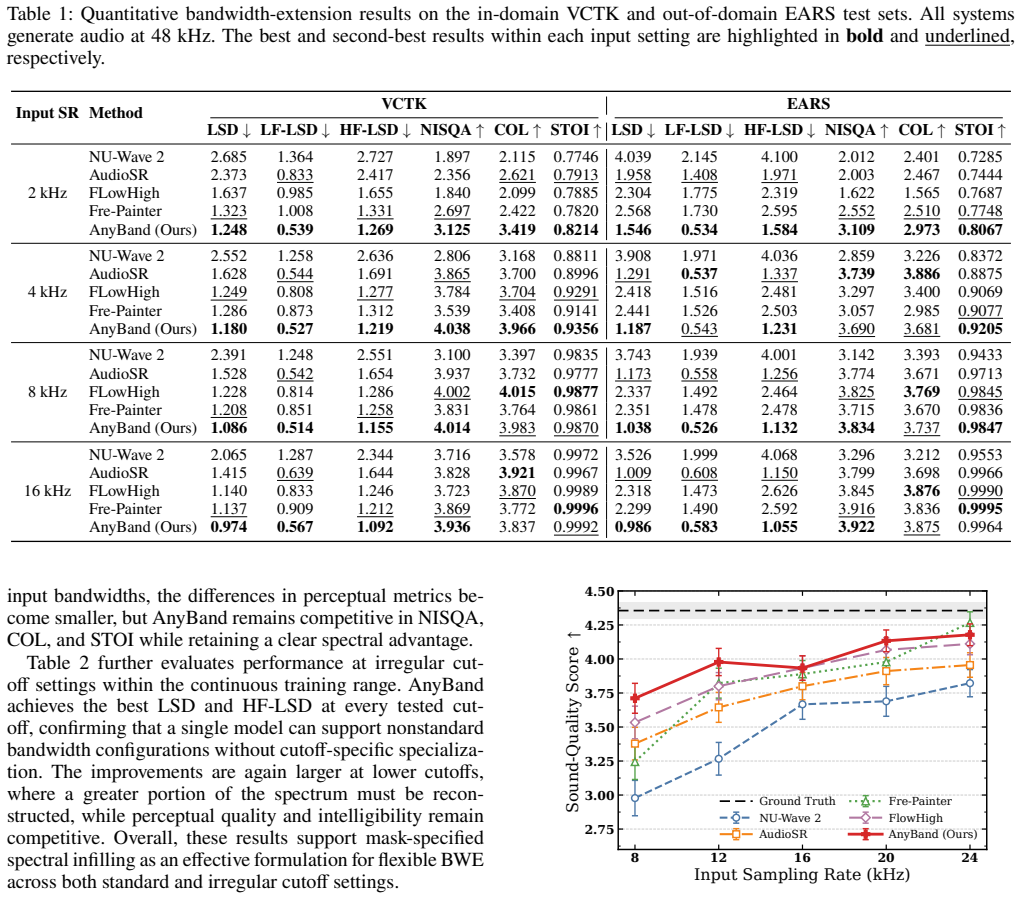
AnyBand's central claim is that recasting BWE as in-context spectral infilling unifies multi-bandwidth extension in one model: the observed low-frequency spectrum is the prompt, a binary mask (1 above the cutoff) marks the missing region, and a flow-matching model generates the high band conditioned on that prompt. Trained over continuously sampled 1-16 kHz cutoffs with a missing-band objective and an Easy-to-Balanced curriculum, a frequency-aware transformer (frequency-axis encoder and decoder around a temporal DiT) captures cross-frequency cues, while three discriminators refine realism. The evidence: lowest LSD and HF-LSD at every standard and irregular cutoff on VCTK and EARS, with compe
What carries the argument
The central mechanism is the spectral prompt plus a frequency mask: the retained low-band spectrum is fed to the generator as conditioning, and the binary mask specifies which mel bins to reconstruct, making every cutoff the same continuation task. Around this core, frequency-aware encoder/decoder with frequency-axis attention, a temporal DiT backbone, missing-band conditional flow matching with velocity prediction, an Easy-to-Balanced cutoff curriculum, and endpoint-focused adversarial refinement with three discriminators (multi-scale spectral, cross-band envelope, F0-aligned harmonic) carry the argument.
Load-bearing premise
AnyBand assumes the observed low-frequency band is clean and trustworthy: the output copies that band verbatim, and all experiments create band-limited inputs by masking clean 48 kHz speech, so noisy or codec-degraded low bands are not validated.
What would settle it
Take a frozen AnyBand model and compare two test sets built from the same clean utterances: one masked with the paper's clean-cutoff protocol, and one whose low band is first passed through a telephone codec or corrupted with additive noise before masking. If high-band LSD and listening scores degrade sharply on the corrupted-prompt set, the spectral-prompt assumption fails. Separately, fine-tune a fixed-bandwidth baseline per cutoff (e.g., one model at 4 kHz, one at 8 kHz) and compare at those cutoffs; if the per-cutoff specialists clearly beat the single AnyBand, the unification claim loses
If this is right
- A single model can produce 48 kHz full-band speech from any input cutoff in the 1-16 kHz training range, including irregular cutoffs never seen as discrete training conditions.
- Spectral reconstruction (LSD and HF-LSD) is consistently better than the compared fixed-bandwidth and flexible BWE baselines, with perceptual and intelligibility metrics remaining competitive.
- Out-of-domain generalization to EARS speakers holds, suggesting that the spectral prompt carries speaker, content, and prosody cues rather than memorized cutoff-specific patterns.
- The gains are largest when the missing band is wide, which is exactly the regime where practical telephony and archival audio suffer most.
- The Easy-to-Balanced curriculum specifically lifts low- and medium-cutoff performance relative to both discrete and continuous uniform cutoff sampling.
Where Pith is reading between the lines
- If the observed spectrum really conveys speaker, prosody, and envelope cues, the same prompt-plus-mask infilling formulation could extend to music or general audio super-resolution by swapping the spectral prompt and mask.
- Because the low band is copied verbatim into the output, real noisy or codec-degraded inputs would propagate low-band artifacts into the reconstructed high band; testing on degraded low bands is the natural stress test not covered by the clean-masking protocol.
- The mask-conditioned formulation could let one deployed model serve devices with different bandwidth budgets by choosing the cutoff at inference time, without retraining.
- The explicit frequency-axis attention suggests the model may be learning harmonic continuation rather than pure interpolation; a direct probe would be to evaluate cutoffs outside the trained 1-16 kHz range to see whether the harmonic structure extrapolates or silently collapses.
Editorial analysis
A structured set of objections, weighed in public.
Referee Report
Summary. The paper proposes AnyBand, a bandwidth-extension (BWE) framework that treats the observed low-frequency mel spectrum as a spectral prompt and reconstructs the missing high-frequency region via masked conditional flow matching. A single model is trained over continuously sampled cutoff frequencies using an Easy-to-Balanced curriculum, with a frequency-aware Diffusion Transformer encoder/decoder and three auxiliary discriminators for spectral realism, cross-band envelope coherence, and harmonic consistency. Experiments on VCTK and EARS report consistent LSD/HF-LSD improvements over NU-Wave 2, AudioSR, FLowHigh, and Fre-Painter at both standard and irregular cutoffs, with competitive NISQA, COL, and STOI scores and a small listening test.
Significance. If the claims hold, AnyBand is a useful step toward practical BWE: a single model handles a continuous range of cutoffs without cutoff-specific retraining, and the spectral-infilling formulation is simple and general. The paper's strengths include the continuous-cutoff training scheme, explicit frequency-axis modeling, a physically motivated discriminator set, out-of-domain evaluation, and honest reporting of ablation results where individual components produce mixed effects. The measured gains are empirical rather than derived, so the central contribution is the architecture/training recipe plus the comparative evaluation. The main risks are the clean-low-band assumption, an underspecified classifier-free guidance procedure, and the lack of an ablation isolating the spectral-prompt mechanism.
major comments (3)
- [Eq. (10) / Experiment Settings] The final output copies the observed band (1-M)⊙fM verbatim, and all training/evaluation inputs are clean 48 kHz mel spectrograms with bins above the cutoff masked. The abstract's claim that the method addresses 'practical scenarios' with diverse cutoffs is therefore broader than the validated scope. On noisy or codec-degraded low bands (telephony, archival audio), AnyBand has no denoising pathway and would propagate low-band artifacts into the output; the spectral prompt and F0/UV conditioning (A.1) are also extracted from the same degraded input. Either add experiments with noisy/codec-degraded low-band inputs or restrict the claims to clean band-limited speech.
- [Eq. (12) / Training and Sampling] Classifier-free guidance is applied in velocity space, but no unconditional training scheme is described. Eq. (8) trains only the conditional velocity Gθ(Mt, fM, t, c); nothing in the architecture or losses specifies how v̂∅ is obtained (e.g., prompt dropout, mask dropout, or setting fM/c to a null token). Since CFG with scale 1.4 is used for all reported results, the inference procedure is not reproducible until this is specified.
- [Table 4 / Component Analysis] The core 'in-context prompt' hypothesis is not ablated. The closest variants remove frequency modules or F0/UV, but no experiment replaces the observed-spectrum prompt with a scalar cutoff embedding or otherwise removes the prompt while keeping the mask. Without such an ablation, the paper does not demonstrate that conditioning on the low-band spectrum per se, rather than on the cutoff/mask, drives the continuous-cutoff capability.
minor comments (4)
- [Introduction] The phrase 'may therefore may require retraining' contains a duplicated 'may'.
- [Eq. (15)] LSD is defined as the RMS of log10-power differences, but the standard log-spectral distance is expressed in dB (10 log10). Please clarify the units or add the factor 10 so the reported absolute values are interpretable.
- [B.4 Subjective Evaluation] The protocol describes 5 input rates × 5 utterances × 5 systems plus ground-truth references, which gives 150 samples (or 125 without references), but the text states each listener rates 130 audio samples. Please reconcile the count.
- [Table 6] At 4 kHz, removing D_cross improves LSD/HF-LSD over the full model. The text acknowledges isolated improvements, but the bolding/underlining in the table makes the pattern visually confusing; a footnote would help.
Circularity Check
No significant circularity: the central BWE claim is supported by external-baseline comparisons and internal ablations, not by a self-citation chain or a fitted prediction.
full rationale
AnyBand's derivation chain is self-contained with respect to its central claims. The method trains a flow-matching generator on masked mel spectrograms (Eqs. 6-8) with continuously sampled cutoffs, and the reported improvements are measured by held-out LSD/HF-LSD/NISQA/STOI against external baselines (NU-Wave 2, AudioSR, FLowHigh, Fre-Painter). No metric improvement is a refit of a parameter from the test set, and no 'prediction' is equivalent to a training input by construction. The in-context formulation—observed low band as prompt, mask defining the missing region—is a design choice, not a derived result that presupposes its own conclusion. Equation (10) copies the observed band into the output, but this is an explicit BWE preservation step; the headline spectral claims are evaluated in the missing high-frequency region (HF-LSD) and therefore are not trivial consequences of the copy operation. The self-citations (CodecFlow for F0/UV conditioning, PACE for feature extraction) concern auxiliary conditioning components, and the paper's ablations (Tables 4 and 6) empirically quantify their contribution, showing degradation when removed; thus the citations are not load-bearing assertions of the core claim. No uniqueness theorem, forced ansatz, or renamed known result is imported from the authors' prior work. The clean-low-band premise is a real scope limitation for noisy or codec-degraded inputs, but it is not circularity: it narrows the validated operating range without making the reported comparisons equivalent to the training objective. Overall, no circular step can be exhibited from the paper's own equations or citation dependencies.
Axiom & Free-Parameter Ledger
free parameters (6)
- Easy-to-Balanced curriculum bias beta =
4
- Curriculum annealing duration rho =
0.7
- Classifier-free guidance scale w_cfg =
1.4
- Inference steps and Heun solver grid =
50 steps, gamma=2.0
- Adversarial and feature-matching weights =
lambda_adv=0.1, lambda_fm=2.0
- Endpoint timestep and rollout length =
t_e=0.8, 8-step Heun rollout
axioms (6)
- standard math Flow matching with linear interpolation path Mt=tM+(1-t)eps provides a valid conditional probability path with target velocity v=M-eps.
- domain assumption 128-bin mel spectrogram over 0-24 kHz is a sufficient representation for BWE quality, and Vocos inversion introduces no material artifact.
- domain assumption F0 and V/UV can be extracted from band-limited input and are valid auxiliary conditions.
- domain assumption MSE on missing bins only is a sufficient training objective for the flow model.
- domain assumption Adversarial refinement near the endpoint (t_e=0.8) improves realism without biasing spectral metrics.
- ad hoc to paper Classifier-free guidance can be applied in velocity space without a described unconditional training scheme.
Cite this review
Pith. "Pith review of AnyBand: Unified Multi-Bandwidth Speech Extension via Frequency-Aware In-Context Spectral Infilling." pith.science (2026). https://pith.science/paper/4LFH3AU3
@misc{pith2026260800572,
  author       = {Pith},
  title        = {Pith review of: AnyBand: Unified Multi-Bandwidth Speech Extension via Frequency-Aware In-Context Spectral Infilling},
  year         = {2026},
  howpublished = {\url{https://pith.science/paper/4LFH3AU3}},
  note         = {Machine review of arXiv:2608.00572}
}
read the original abstract
Bandwidth extension (BWE) aims to recover missing high-frequency content from band-limited speech. Existing methods often formulate BWE as a fixed or predefined bandwidth conversion problem, potentially requiring cutoff-specific models or retraining when the input bandwidth changes. This assumption limits their applicability to practical scenarios where speech may arrive with diverse cutoff frequencies. We propose AnyBand, a unified BWE framework that recasts bandwidth extension as in-context spectral infilling. Motivated by prompt-based zero-shot speech generation, AnyBand conditions high-frequency generation on the observed low-frequency spectrum, using the available band as a frequency-domain prompt that conveys content, speaker, prosodic, and spectral-envelope cues. This formulation enables a single model to perform cutoff-conditioned generation over a continuous range of input bandwidths. AnyBand is trained with missing-band conditional flow matching and an Easy-to-Balanced cutoff curriculum over continuously sampled cutoff frequencies. To better exploit the spectral prompt, we introduce a frequency-aware Diffusion Transformer that models cross-frequency interactions and long-range temporal dependencies, followed by a physically motivated multi-view adversarial refinement stage to enhance spectral realism, envelope coherence, and harmonic consistency. Experiments on multiple datasets and bandwidth settings show that AnyBand consistently improves spectral reconstruction over existing baselines while achieving competitive perceptual quality across both standard and irregular input cutoffs. Audio samples are available.
Figures




Reference graph
Works this paper leans on
-
[1]
F5- TTS : A Fairytaler that Fakes Fluent and Faithful Speech with Flow Matching
Chen, Yushen and Niu, Zhikang and Ma, Ziyang and Deng, Keqi and Wang, Chunhui and JianZhao, JianZhao and Yu, Kai and Chen, Xie. F5- TTS : A Fairytaler that Fakes Fluent and Faithful Speech with Flow Matching. Proceedings of the 63rd Annual Meeting of the Association for Computational Linguistics (Volume 1: Long Papers). 2025. doi:10.18653/v1/2025.acl-long.313
-
[2]
arXiv preprint arXiv:2603.02022 , year=
Codecflow: Efficient bandwidth extension via conditional flow matching in neural codec latent space , author=. arXiv preprint arXiv:2603.02022 , year=
-
[3]
Accelerating High-Fidelity Waveform Generation via Adversarial Flow Matching Optimization
Accelerating high-fidelity waveform generation via adversarial flow matching optimization , author=. arXiv preprint arXiv:2408.08019 , year=
work page internal anchor Pith review Pith/arXiv arXiv
-
[4]
arXiv preprint arXiv:2602.12155 , year=
FAIL: Flow Matching Adversarial Imitation Learning for Image Generation , author=. arXiv preprint arXiv:2602.12155 , year=
-
[5]
Zengwei Yao and Wei Kang and Han Zhu and Liyong Guo and Lingxuan Ye and Fangjun Kuang and Weiji Zhuang and Zhaoqing Li and Zhifeng Han and Long Lin and Daniel Povey , booktitle=. Flow2
-
[6]
Advances in neural information processing systems , volume=
Hifi-gan: Generative adversarial networks for efficient and high fidelity speech synthesis , author=. Advances in neural information processing systems , volume=
- [7]
-
[8]
Won Jang and Dan Lim and Jaesam Yoon and Bongwan Kim and Juntae Kim , title =. 22nd Annual Conference of the International Speech Communication Association, Interspeech 2021 , pages =. 2021 , doi =
work page 2021
-
[9]
Responses of auditory-cortex neurons to structural features of natural sounds , author=. Nature , volume=. 1999 , publisher=
work page 1999
-
[10]
Sound texture perception via statistics of the auditory periphery: evidence from sound synthesis , author=. Neuron , volume=. 2011 , publisher=
work page 2011
-
[11]
National Conference on Man-Machine Speech Communication , pages=
Source-filter-based generative adversarial neural vocoder for high fidelity speech synthesis , author=. National Conference on Man-Machine Speech Communication , pages=. 2022 , organization=
work page 2022
-
[12]
arXiv preprint arXiv:2309.09493 , year=
Hiftnet: A fast high-quality neural vocoder with harmonic-plus-noise filter and inverse short time fourier transform , author=. arXiv preprint arXiv:2309.09493 , year=
- [13]
-
[14]
Proceedings of the IEEE/CVF Conference on Computer Vision and Pattern Recognition , pages=
Back to basics: Let denoising generative models denoise , author=. Proceedings of the IEEE/CVF Conference on Computer Vision and Pattern Recognition , pages=
-
[15]
The Eleventh International Conference on Learning Representations,
Flow matching for generative modeling , author=. The Eleventh International Conference on Learning Representations,
-
[16]
The Eleventh International Conference on Learning Representations,
Diffusion-gan: Training gans with diffusion , author=. The Eleventh International Conference on Learning Representations,
-
[17]
arXiv preprint arXiv:2605.16681 , year=
A survey of advancing audio super-resolution and bandwidth extension from discriminative to generative models , author=. arXiv preprint arXiv:2605.16681 , year=
-
[18]
5th International Conference on Learning Representations , year=
Audio super resolution using neural networks , author=. 5th International Conference on Learning Representations , year=
-
[19]
2019 IEEE workshop on applications of signal processing to audio and acoustics (WASPAA) , pages=
Speech bandwidth extension with wavenet , author=. 2019 IEEE workshop on applications of signal processing to audio and acoustics (WASPAA) , pages=. 2019 , organization=
work page 2019
-
[20]
Real-time speech frequency bandwidth extension , author=. ICASSP 2021-2021 IEEE International Conference on Acoustics, Speech and Signal Processing (ICASSP) , pages=. 2021 , organization=
work page 2021
-
[21]
Bandwidth extension is all you need , author=. ICASSP 2021-2021 IEEE International Conference on Acoustics, Speech and Signal Processing (ICASSP) , pages=. 2021 , organization=
work page 2021
-
[22]
Junhyeok Lee and Seungu Han , title =. 22nd Annual Conference of the International Speech Communication Association, Interspeech 2021 , pages =. 2021 , doi =
work page 2021
-
[23]
Kexun Zhang and Yi Ren and Changliang Xu and Zhou Zhao , title =. 22nd Annual Conference of the International Speech Communication Association, Interspeech 2021 , pages =. 2021 , doi =
work page 2021
-
[24]
Hifi++: A unified framework for bandwidth extension and speech enhancement , author=. ICASSP 2023-2023 IEEE International Conference on Acoustics, Speech and Signal Processing (ICASSP) , pages=. 2023 , organization=
work page 2023
-
[25]
IEEE Transactions on Audio, Speech and Language Processing , volume=
Towards high-quality and efficient speech bandwidth extension with parallel amplitude and phase prediction , author=. IEEE Transactions on Audio, Speech and Language Processing , volume=. 2024 , publisher=
work page 2024
-
[26]
Vector quantized diffusion model based speech bandwidth extension , author=. ICASSP 2025-2025 IEEE International Conference on Acoustics, Speech and Signal Processing (ICASSP) , pages=. 2025 , organization=
work page 2025
-
[27]
Seungu Han and Junhyeok Lee , title =. 23rd Annual Conference of the International Speech Communication Association, Interspeech 2022 , pages =. 2022 , doi =
work page 2022
-
[28]
Haohe Liu and Woosung Choi and Xubo Liu and Qiuqiang Kong and Qiao Tian and DeLiang Wang , title =. 23rd Annual Conference of the International Speech Communication Association, Interspeech 2022 , pages =. 2022 , doi =
work page 2022
-
[29]
Haohe Liu and Xubo Liu and Qiuqiang Kong and Qiao Tian and Yan Zhao and DeLiang Wang and Chuanzeng Huang and Yuxuan Wang , title =. 23rd Annual Conference of the International Speech Communication Association, Interspeech 2022 , pages =. 2022 , doi =
work page 2022
-
[30]
AudioSR: Versatile audio super-resolution at scale , author=. ICASSP 2024-2024 IEEE International Conference on Acoustics, Speech and Signal Processing (ICASSP) , pages=. 2024 , organization=
work page 2024
-
[31]
Speech Bandwidth Expansion Via High Fidelity Generative Adversarial Networks , author=. 2025 1st International Conference on Computational Intelligence Approaches and Applications (ICCIAA) , pages=. 2025 , organization=
work page 2025
-
[32]
arXiv preprint arXiv:2603.07285 , year=
Fast and Flexible Audio Bandwidth Extension via Vocos , author=. arXiv preprint arXiv:2603.07285 , year=
-
[33]
arXiv preprint arXiv:2301.02111 , year=
Neural codec language models are zero-shot text to speech synthesizers , author=. arXiv preprint arXiv:2301.02111 , year=
-
[34]
Advances in neural information processing systems , volume=
Voicebox: Text-guided multilingual universal speech generation at scale , author=. Advances in neural information processing systems , volume=
-
[35]
2024 IEEE spoken language technology workshop (SLT) , pages=
E2 tts: Embarrassingly easy fully non-autoregressive zero-shot tts , author=. 2024 IEEE spoken language technology workshop (SLT) , pages=. 2024 , organization=
2024
-
[36]
TED-TTS: Training-Free Intra-Utterance Emotion and Duration Control for Text-to-Speech Synthesis , author=. Proceedings of the 64th Annual Meeting of the Association for Computational Linguistics (Volume 1: Long Papers) , pages=
-
[37]
IEEE/ACM Transactions on Audio, Speech, and Language Processing , volume=
Blind audio bandwidth extension: A diffusion-based zero-shot approach , author=. IEEE/ACM Transactions on Audio, Speech, and Language Processing , volume=. 2024 , publisher=
work page 2024
-
[38]
2018 IEEE International Conference on Acoustics, Speech and Signal Processing (ICASSP) , pages=
Time-frequency networks for audio super-resolution , author=. 2018 IEEE International Conference on Acoustics, Speech and Signal Processing (ICASSP) , pages=. 2018 , organization=
work page 2018
-
[39]
doi:10.21437/Interspeech.2024-11 , issn =
Ye-Xin Lu and Yang Ai and Zheng-Yan Sheng and Zhen-Hua Ling , year =. doi:10.21437/Interspeech.2024-11 , issn =
-
[40]
Shichao Hu and Bin Zhang and Beici Liang and Ethan Zhao and Simon Lui , title =. 21st Annual Conference of the International Speech Communication Association, Interspeech 2020 , pages =. 2020 , doi =
work page 2020
-
[41]
Aero: Audio super resolution in the spectral domain , author=. ICASSP 2023-2023 IEEE International Conference on Acoustics, Speech and Signal Processing (ICASSP) , pages=. 2023 , organization=
work page 2023
-
[42]
A2SB: Audio-to-Audio Schrodinger Bridges
A2sb: Audio-to-audio schrodinger bridges , author=. arXiv preprint arXiv:2501.11311 , year=
work page internal anchor Pith review Pith/arXiv arXiv
-
[43]
FlashSR: One-step Versatile Audio Super-resolution via Diffusion Distillation , author=. ICASSP 2025-2025 IEEE International Conference on Acoustics, Speech and Signal Processing (ICASSP) , pages=. 2025 , organization=
work page 2025
-
[44]
Universr: Unified and versatile audio super-resolution via vocoder-free flow matching , author=. ICASSP 2026-2026 IEEE International Conference on Acoustics, Speech and Signal Processing (ICASSP) , pages=. 2026 , organization=
work page 2026
-
[45]
Richter, Julius and Wu, Yi-Chiao and Krenn, Steven and Welker, Simon and Lay, Bunlong and Watanabe, Shinjii and Richard, Alexander and Gerkmann, Timo , booktitle=
-
[46]
Junchuan Zhao and Xintong Wang and Ye Wang , title =. 26th Annual Conference of the International Speech Communication Association, Interspeech 2025 , publisher =. 2025 , doi =
work page 2025
-
[47]
arXiv preprint arXiv:2603.05373 , year=
Hierarchical Decoding for Discrete Speech Synthesis with Multi-Resolution Spoof Detection , author=. arXiv preprint arXiv:2603.05373 , year=
-
[48]
Yamagishi, Junichi and Veaux, Christophe and MacDonald, Kirsten , title=
-
[49]
The Twelfth International Conference on Learning Representations,
Hubert Siuzdak , title =. The Twelfth International Conference on Learning Representations,
-
[50]
IEEE Transactions on audio, speech, and language processing , volume=
An algorithm for intelligibility prediction of time--frequency weighted noisy speech , author=. IEEE Transactions on audio, speech, and language processing , volume=. 2011 , publisher=
work page 2011
-
[51]
Gabriel Mittag and Babak Naderi and Assmaa Chehadi and Sebastian M. 22nd Annual Conference of the International Speech Communication Association, Interspeech 2021 , pages =. 2021 , doi =
work page 2021
-
[52]
IEEE Transactions on Acoustics, Speech, and Signal Processing , volume=
Distance measures for speech processing , author=. IEEE Transactions on Acoustics, Speech, and Signal Processing , volume=. 1976 , publisher=
work page 1976
-
[53]
FLowHigh: Towards efficient and high-quality audio super-resolution with single-step flow matching , author=. ICASSP 2025-2025 IEEE International Conference on Acoustics, Speech and Signal Processing (ICASSP) , pages=. 2025 , organization=
work page 2025
-
[54]
IEEE/ACM Transactions on Audio, Speech, and Language Processing , volume=
Audio super-resolution with robust speech representation learning of masked autoencoder , author=. IEEE/ACM Transactions on Audio, Speech, and Language Processing , volume=. 2024 , publisher=
work page 2024
-
[55]
IEEE Transactions on Audio, Speech and Language Processing , year=
Comelsinger: Discrete token-based zero-shot singing synthesis with structured melody control and guidance , author=. IEEE Transactions on Audio, Speech and Language Processing , year=
This paper was first reviewed by deepseek-v4-flash on August 5, 2026.
discussion (0)
Sign in with ORCID, Apple, or X to comment. Anyone can read and Pith papers without signing in.