REVIEW 2 major objections 5 minor 46 references
This paper claims a fast FFT-based spectral algorithm for multidimensional 3-wave kinetic and C12 quantum Boltzmann equations, reducing collision-operator cost from O((2N)^{3d}) to O((2N)^{2d} log(2N)).
Reviewed by Pith at T0; open to challenge. T0 means a machine referee read the full paper against a public rubric. the ladder, T0–T4 →
2026-08-05 00:30 UTC pith:VWOXGGQY
load-bearing objection Algorithm 2 is a genuine and practically significant FFT acceleration for 3-wave and C12 quantum Boltzmann collisions, but the paper's energy-cascade claim rests on an unvalidated sinc approximation of the resonance delta that breaks energy conservation, so the physics result is not established. the 2 major comments →
Spectral Algorithms for 3-Wave Kinetic and C₁₂ Quantum Boltzmann Equations with General Resonance Manifolds in mathbb{R}^d
The pith
A machine-rendered reading of the paper's core claim, the machinery that carries it, and where it could break.
Core claim
The central claim is that the resonance constraint of the collision operator can be approximated by a truncated Fourier (sinc) representation of the Dirac delta, and that with this approximation the entire operator is recovered from selected Fourier coefficients of four kernel-weighted tensors defined on the 2d-dimensional pair-variable domain. The fast spectral algorithm builds these tensors pointwise and applies multidimensional FFTs, reducing the per-step cost from O((2N)^{3d}) to O((2N)^{2d} log(2N)). In 2D it matches the direct method to about 1e-12 and runs 93–2200+ times faster; in 3D it remains feasible at 2N=32. Stabilized simulations of the C12 equation reproduce expected gain–loss
What carries the argument
The key object is the truncated Fourier (sinc) representation of the resonance delta, W(k2,k3) = (1/pi) sin(M(omega(k2+k3)-omega(k2)-omega(k3))) / (omega(k2+k3)-omega(k2)-omega(k3)) times the kernel |omega(k1)omega(k2)omega(k3)|^rho. The second object is the family of kernel-weighted tensors T = W f(k2)f(k3), Y = W f(k1)f(k2), U = W f(k1)f(k3), I = W f(k1); the collision operator is recovered from Fourier coefficients of these tensors at index pairs (n,n), (n,0), and (0,n), which is exactly what makes the multidimensional FFT acceleration possible.
Load-bearing premise
The claim that replacing the exact resonance delta with the truncated sinc kernel (M=4) faithfully approximates the collision dynamics for the time horizons and resolutions used; the paper gives no error bound and defers consistency analysis to future work.
What would settle it
Run the fast algorithm on the 3-wave test with M = 2, 4, 8, and 16 and compare the onset time of the apparent cascade and the converged spectrum; alternatively, compare against a direct quadrature on the resonance manifold at low resolution. If the evolution changes materially with M, the sinc approximation is not faithful.
If this is right
- Three-dimensional simulations of 3-wave and C12 quantum Boltzmann equations become feasible at resolutions where the direct method would require terabytes of memory.
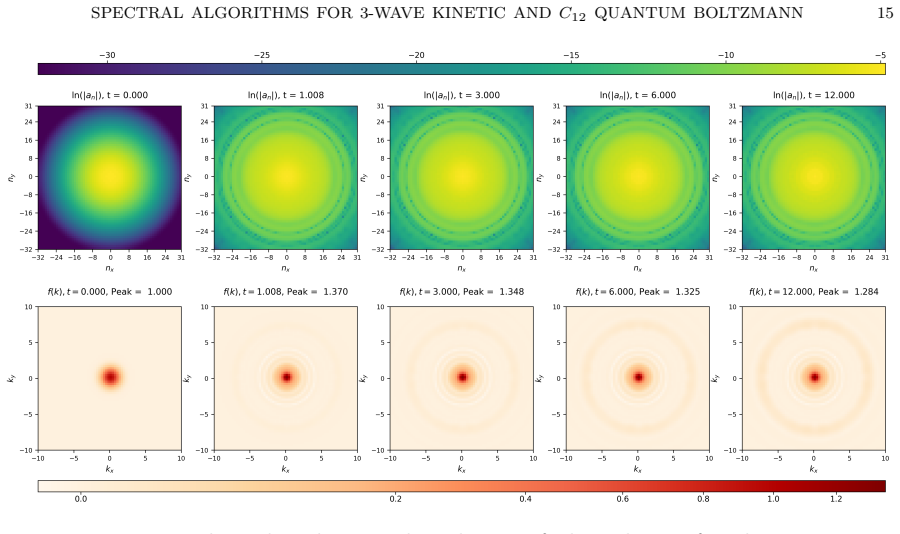
- The numerical evidence of an energy cascade in the non-radial 3-wave equation supports theoretical cascade results beyond the previously studied radial setting.
- The pre-FFT 2/3-rule stabilization provides a template for other spectral methods that assemble nonlinear terms in the physical domain.
- The sinc-approximated resonance manifold handles arbitrary polynomial dispersion relations without explicit parametrization of the manifold.
Where Pith is reading between the lines
- The M=4 truncation effectively broadens the resonance; tuning M could connect the exact-resonance model to resonance-broadening kinetic equations, making the algorithm a bridge between the two regimes.
- The apparent finite-time blow-up in the 3-wave tests may be an early numerical manifestation of rigorous finite-time cascade results, but establishing this requires convergence studies in both M and resolution that the paper does not provide.
- The idea of applying the 2/3-rule before the FFT rather than after generalizes: any spectral method that forms physical-domain products of band-limited inputs can move dealiasing earlier at no extra cost.
Editorial analysis
A structured set of objections, weighed in public.
Referee Report
Summary. The paper develops two Fourier spectral discretizations for the 3-wave kinetic and C12 quantum Boltzmann collision operators (2) with polynomial dispersion relations (3)-(4). The Dirac delta enforcing the resonance condition is replaced in Eq. (7) by a truncated sinc representation with parameter M, producing the weight W in Eq. (8). Algorithm 1 expands f in Fourier series and precomputes a multi-index kernel, with complexity O(L(2N)^{3d}); Algorithm 2 assembles kernel-weighted products on the 2d-dimensional pair-variable domain and applies multidimensional FFTs, reducing complexity to O(L(2N)^{2d} log(2N)). In two-dimensional tests the two methods agree to about 1e-12, and speedups from about 93 to over 2200 are reported. A stabilization strategy combining pre-FFT 2/3 dealiasing and exponential filtering is introduced. Simulations of the C12 equation are stable and well resolved; simulations of the 3-wave equation with rho=2 produce rapid spectral broadening and growth, interpreted as an apparent energy cascade.
Significance. If the results are correct, the fast algorithm is a genuinely useful contribution: it avoids parametrizing the resonance manifold and reduces the collision-operator cost by a factor of order (2N)^d / log(2N). The algebraic derivation of Algorithm 2 from the weak form is clear, and the machine-precision agreement between the two algorithms, together with the reported speedups, provides strong internal validation that both discretizations solve the same discrete problem. However, the fidelity of the sinc-regularized operator to the original delta-constrained operator is not established; the paper's own conclusion (Section 4) defers consistency and convergence to future work. Consequently, the numerical evidence for the energy cascade is conditional and needs additional support before the physical claim can be accepted.
major comments (2)
- [§2.1, Eq. (7); §3.1, Table 3] The replacement of the Dirac delta by (1/pi) sin(M Delta-omega)/Delta-omega with M=4 is the central approximation. For the exact delta, testing against phi=omega gives zero because delta(Delta-omega)*Delta-omega=0 as a distribution; with the sinc kernel the same test gives sin(M Delta-omega)/pi, which is not small off resonance. Since the 3-wave kernel is |omega1 omega2 omega3|^2 (rho=2), the regularized operator can pump energy into high modes. Both algorithms use the same W in (8), so their agreement to 1e-12 only validates that they solve the same regularized problem, not fidelity to the original equation. Section 4 explicitly defers a consistency/convergence analysis of this approximation to future work. Please provide an error bound for the sinc approximation and/or a numerical study in M (e.g., M=2,4,8,16) for the 3-wave test, with diagnostics of energy drift. Without this, the 'ap
- [§3.5] The energy-cascade interpretation is inferred from growth of max|f| and spectral broadening, but no conserved quantity is monitored. For a kinetic equation, a genuine cascade should conserve (or nearly conserve) the total energy integral f omega dk while spreading the spectrum. Please report time series of integral f omega dk and integral f dk, and quantify the drift due to the sinc regularization and the exponential filter. This would help distinguish a physical cascade from numerical instability of the explicit Euler scheme or from the off-resonant artifact identified in Eq. (7).
minor comments (5)
- [§3.1 vs Table 3] Section 3.1 states Delta t=0.005, while Table 3 lists Delta t=0.0005. The 3-wave output times (e.g., t=0.0035) are inconsistent with Delta t=0.005. Please specify the time step used in each experiment.
- [§3.3, Eq. (28)] The definition of kmax=sqrt(2N) is unclear for d-dimensional Fourier indices in [-N,N-1]^d, where the maximum Euclidean mode magnitude is O(N). Please define kmax in terms of the mode set and the computational box [-R,R]^d; as written the filter cutoff is not reproducible.
- [Table 1] The agreement test between Algorithms 1 and 2 does not state the equation, initial data, dispersion relation, time horizon, or stabilization settings. Specify these so the 1e-12 result is reproducible.
- [§2.2, after Eq. (21)] The modulo-2N wrap for out-of-range Fourier indices is stated without justification. Please add a remark on the aliasing error this introduces and, ideally, test its effect on accuracy for modes near the boundary.
- [Throughout] There are numerous typos and formatting issues (e.g., 'acostic waves', 'phenonmenon', inconsistent 'C12' rendering) that should be corrected. Also, reference [28] appears to duplicate reference [27].
Circularity Check
No significant circularity: the algorithmic claims are self-contained; only minor self-citation appears in the interpretive framing of the energy cascade.
full rationale
The core derivation is self-contained. The paper starts from the weak form (5), represents the resonant Dirac distribution via its Fourier integral, truncates the auxiliary variable to obtain the sinc-regularized kernel W in (8), and then derives two spectral discretizations. Algorithm 1 and Algorithm 2 are two numerical implementations of the same regularized operator; their agreement to ~1e-12 is a consistency check between discretizations, not a prediction of the original kinetic equation. The complexity statements follow from explicit operation counts and measured timings, and no fitted parameter is relabeled as a prediction. The 'energy cascade' interpretation in Section 3.5 cites the authors' own theoretical papers [35,37], but the numerical growth and spectral broadening are independently observed in the simulations; the citation is used as contextual consistency, not as the source of the numerical result. The paper explicitly defers a rigorous consistency/convergence analysis of the sinc approximation to future work (Section 4), which is a limitation but not circularity. The filter parameters (eta=7.5, p=8) are selected empirically for stabilization, not to manufacture the cascade. Overall, the central claims remain independent of their inputs; the only minor circularity signal is the self-citation in interpreting the cascade, which does not affect the algorithmic contributions.
Axiom & Free-Parameter Ledger
free parameters (6)
- R (domain cutoff) =
10
- M (Fourier truncation of Dirac delta) =
4
- time step dt =
0.005 (Sec 3.1) vs 0.0005 (Table 3)
- exponential filter parameters (kmax, p, eta) =
kmax=sqrt(2N), p=8, eta=7.5
- kernel exponent rho =
rho=1 for C12 QBE, rho=2 for 3-wave
- dispersion exponents alpha, beta, c1, c2 =
alpha=1 for QBE; alpha=1.5 or alpha=1,beta=1.5,c1=0.6,c2=0.4 for 3-wave
axioms (5)
- standard math Weak formulation of the kinetic equation with test functions (eq 5) is well-posed for the considered f.
- domain assumption The Dirac delta on the resonance manifold can be replaced by the sinc kernel (1/pi) sin(M(...))/(...) with no error bound.
- domain assumption f and W can be represented by their truncated Fourier series on [-R,R]^d and the extension is periodic.
- ad hoc to paper Fourier indices outside the range can be wrapped modulo 2N without significant loss.
- domain assumption The observed spectral broadening in the 3-wave case represents a physical energy cascade rather than numerical instability.
Cite this review
Pith. "Pith review of Spectral Algorithms for 3-Wave Kinetic and $C_{12}$ Quantum Boltzmann Equations with General Resonance Manifolds in $\mathbb{R}^d$." pith.science (2026). https://pith.science/paper/VWOXGGQY
@misc{pith2026260800603,
  author       = {Pith},
  title        = {Pith review of: Spectral Algorithms for 3-Wave Kinetic and $C_12$ Quantum Boltzmann Equations with General Resonance Manifolds in $\mathbbR^d$},
  year         = {2026},
  howpublished = {\url{https://pith.science/paper/VWOXGGQY}},
  note         = {Machine review of arXiv:2608.00603}
}
read the original abstract
Following recent developments in numerical schemes for 3-wave kinetic equations [2, 7, 42, 44, 43], we develop spectral algorithms for multidimensional 3-wave kinetic equations and $C_{12}$ quantum Boltzmann equations with general polynomial dispersion relations. The principal numerical difficulty arises from the resonance constraint, supported on a nonlinear manifold in wave-vector space. We approximate the Dirac distribution by a truncated Fourier representation and derive two spectral discretizations of the collision operator. The first is a direct spectral method with complexity $\mathcal{O}\big(L(2N)^{3d}\big)$, while the second exploits multidimensional FFTs to reduce the complexity to $\mathcal{O}\big(L(2N)^{2d}\log(2N)\big)$. Numerical tests show excellent agreement between the two methods, with the fast algorithm providing substantial computational savings. To suppress unresolved high-frequency modes, we combine the classical $2/3$-rule with exponential spectral filtering. Simulations in two and three dimensions capture the gain--loss dynamics of the $C_{12}$ quantum Boltzmann equation for both rapidly and algebraically decaying initial data. For the 3-wave kinetic equation, the computations exhibit strong oscillations and rapid spectral broadening, providing numerical evidence of an apparent energy cascade toward high frequencies. The results also show that the dispersion relation and spatial dimension strongly influence the transient resonant dynamics.
Figures




Reference graph
Works this paper leans on
-
[1]
R. Alonso, I. M. Gamba, and M.-B. Tran. The Cauchy problem and BEC stability for the quantum Boltzmann-Gross-Pitaevskii system for bosons at very low temperature.arXiv preprint arXiv:1609.07467, 2016
Pith/arXiv arXiv 2016
-
[2]
J. W. Banks and J. Shatah. A new approach to direct discretization of wave kinetic equations with appli- cation to a nonlinear schrodinger system in 2d.arXiv preprint arXiv:2509.03432, 2025
Pith/arXiv arXiv 2025
-
[3]
D. J. Benney and A. C. Newell. Random wave closures.Studies in Applied Mathematics, 48(1):29–53, 1969
1969
-
[4]
D. J. Benney and P. G. Saffman. Nonlinear interactions of random waves in a dispersive medium.Proc. R. Soc. Lond. A, 289(1418):301–320, 1966
1966
-
[5]
E. Cort´ es and M. Escobedo. On a system of equations for the normal fluid-condensate interaction in a bose gas.Journal of Functional Analysis, 278(2):108315, 2020
work page 2020
-
[6]
G. Craciun and M.-B. Tran. A reaction network approach to the convergence to equilibrium of quantum Boltzmann equations for Bose gases.ESAIM: Control, Optimisation and Calculus of Variations, 2021
work page 2021
-
[7]
A. Das and M.-B. Tran. Numerical schemes for a fully nonlinear coagulation–fragmentation model coming from wave kinetic theory.Proceedings of the Royal Society A, 481(2316):20250197, 2025. SPECTRAL ALGORITHMS FOR 3-W A VE KINETIC ANDC 12 QUANTUM BOLTZMANN 21
work page 2025
-
[8]
Y. Deng and Z. Hani. On the derivation of the wave kinetic equation for nls.arXiv preprint arXiv:1912.09518, 2019
Pith/arXiv arXiv 1912
-
[9]
Y. Deng and Z. Hani. Derivation of the wave kinetic equation: full range of scaling laws.arXiv preprint arXiv:2110.04565, 2021
Pith/arXiv arXiv 2021
-
[10]
Y. Deng and Z. Hani. Full derivation of the wave kinetic equation.arXiv preprint arXiv:2104.11204, 2021
Pith/arXiv arXiv 2021
-
[11]
Y. Deng and Z. Hani. Long time justification of wave turbulence theory.arXiv preprint arXiv:2311.10082, 2023
Pith/arXiv arXiv 2023
-
[12]
Y. Deng and Z. Hani. Propagation of chaos and the higher order statistics in the wave kinetic theory.arXiv preprint arXiv:2301.07063, 2023
Pith/arXiv arXiv 2023
-
[13]
Escobedo
M. Escobedo. On the linearized system of equations for the condensate–normal fluid interaction at very low temperature.Studies in Applied Mathematics, 150(2):448–456, 2023
2023
-
[14]
Escobedo
M. Escobedo. On the linearized system of equations for the condensate-normal fluid interaction near the critical temperature.Archive for Rational Mechanics and Analysis, 247(5):92, 2023
2023
-
[15]
M. Escobedo, F. Pezzotti, and M. Valle. Analytical approach to relaxation dynamics of condensed Bose gases.Ann. Physics, 326(4):808–827, 2011
work page 2011
-
[16]
Escobedo and M.-B
M. Escobedo and M.-B. Tran. Convergence to equilibrium of a linearized quantum Boltzmann equation for bosons at very low temperature.Kinetic and Related Models, 8(3):493–531, 2015
2015
- [17]
-
[18]
I. M. Gamba, L. M. Smith, and M.-B. Tran. On the wave turbulence theory for stratified flows in the ocean. M3AS: Mathematical Models and Methods in Applied Sciences. Vol. 30, No. 1 105-137, 2020
2020
-
[19]
I. M. Gamba and S. H. Tharkabhushanam. Spectral–lagrangian methods for collisional models of non- equilibrium statistical states.Journal of Computational Physics, 228(6):2012–2036, 2009
work page 2012
-
[20]
Hasselmann
K. Hasselmann. On the non-linear energy transfer in a gravity-wave spectrum part 1. general theory.Journal of Fluid Mechanics, 12(04):481–500, 1962
1962
-
[21]
K. Hasselmann. On the spectral dissipation of ocean waves due to white capping.Boundary-Layer Meteo- rology, 6(1-2):107–127, 1974
work page 1974
-
[22]
Y. H. Kim, Y. V. Lvov, L. M. Smith, and M.-B. Tran. On a wave kinetic equation with resonance broadening in oceanography and atmospheric sciences.Studies in Applied Mathematics, 156(4):e70223, 2026
2026
-
[23]
C. Mouhot and L. Pareschi. Fast algorithms for computing the Boltzmann collision operator.Mathematics of Computation, 75(256):1833–1852, 2006
work page 2006
-
[24]
A. Munaf` o, J. R. Haack, I. M. Gamba, and T. E. Magin. A spectral-Lagrangian Boltzmann solver for a multi-energy level gas.J. Comput. Phys., 264:152–176, 2014
work page 2014
-
[25]
Nazarenko.Wave turbulence, volume 825 ofLecture Notes in Physics
S. Nazarenko.Wave turbulence, volume 825 ofLecture Notes in Physics. Springer, Heidelberg, 2011
2011
-
[26]
T. T. Nguyen and M.-B. Tran. On the Kinetic Equation in Zakharov’s Wave Turbulence Theory for Capillary Waves.SIAM J. Math. Anal., 50(2):2020–2047, 2018
2020
-
[27]
T. T. Nguyen and M-B. Tran. Uniform in time lower bound for solutions to a quantum boltzmann equation of bosons.Archive for Rational Mechanics and Analysis, 231(1):63–89, 2019
2019
-
[28]
T. T. Nguyen and M.-B. Tran. Uniform in time lower bound for solutions to a quantum boltzmann equation of bosons.Archive for Rational Mechanics and Analysis, 231(1):63–89, 2019
work page 2019
-
[29]
L. Pareschi and G. Russo. Numerical solution of the Boltzmann equation I: Spectrally accurate approxi- mation of the collision operator.SIAM Journal on Numerical Analysis, 37(4):1217–1245, 2000
work page 2000
-
[30]
R. Peierls. Zur kinetischen theorie der warmeleitung in kristallen.Annalen der Physik, 395(8):1055–1101, 1929
1929
-
[31]
Pomeau and M.-B
Y. Pomeau and M.-B. Tran. Statistical physics of non equilibrium quantum phenomena.Lecture Notes in Physics, Springer, 2019
2019
-
[32]
L. E. Reichl and M.-B. Tran. A kinetic equation for ultra-low temperature bose–einstein condensates. Journal of Physics. A, Mathematical and Theoretical (Online), 52(6), 2019
work page 2019
- [33]
-
[34]
A. Soffer and M.-B. Tran. On the dynamics of finite temperature trapped bose gases.Advances in Mathe- matics, 325:533–607, 2018
work page 2018
-
[35]
Soffer and M.-B
A. Soffer and M.-B. Tran. On the energy cascade of 3-wave kinetic equations: beyond kolmogorov–zakharov solutions.Communications in Mathematical Physics, pages 1–48, 2019
2019
-
[36]
G. Staffilani and M-B. Tran. Evolution of finite temperature bose–einstein condensates: Some rigorous studies on condensate growth.arXiv preprint arXiv:2512.19525, 2025
-
[37]
G. Staffilani and M.-B. Tran. Finite time energy cascade for mixed 3−and 4−wave kinetic equations. arXiv preprint arXiv:2512.19531, 2025. 22 T. T. LE AND M.-B. TRAN
arXiv 2025
-
[38]
G. Staffilani and M.-B. Tran. Formation of condensations for non-radial solutions to 3-wave kinetic equa- tions.arXiv preprint arXiv:2503.17066, 2025
Pith/arXiv arXiv 2025
-
[39]
G. Staffilani and M.-B. Tran. Entropy structures and long-time relaxation for 3-wave kinetic equations. arXiv e-prints, pages arXiv–2605, 2026
work page 2026
-
[40]
M.-B. Tran, G. Craciun, L. M. Smith, and S. Boldyrev. A reaction network approach to the theory of acoustic wave turbulence.Journal of Differential Equations, 269(5):4332–4352, 2020
2020
-
[41]
M.-B. Tran and Y. Pomeau. Boltzmann-type collision operators for bogoliubov excitations of bose-einstein condensates: A unified framework.Physical Review E, 101(3):032119, 2020
work page 2020
-
[42]
Walton and M.-B
S. Walton and M.-B. Tran. A numerical scheme for wave turbulence: 3-wave kinetic equations.SIAM Journal on Scientific Computing, 45(4):B467–B492, 2023
2023
-
[43]
S. Walton and M.-B. Tran. Numerical schemes for 3-wave kinetic equations: A complete treatment of the collision operator.Journal of Computational Physics, page 114147, 2025
work page 2025
-
[44]
S. Walton, M.-B. Tran, and A. Bensoussan. A deep learning approximation of non-stationary solutions to wave kinetic equations.Applied Numerical Mathematics, 199:213–226, 2024
work page 2024
-
[45]
V. E. Zakharov and N. N. Filonenko. Weak turbulence of capillary waves.Journal of applied mechanics and technical physics, 8(5):37–40, 1967
1967
-
[46]
V. E. Zakharov, V. S. L’vov, and G. Falkovich.Kolmogorov spectra of turbulence I: Wave turbulence. Springer Science & Business Media, 2012. School of Mathematics and Statistics, University of Economics Ho Chi Minh City, Ho Chi Minh City 700000, Vietnam Email address:thanhtrungle@ueh.edu.vn Department of Mathematics, Texas A&M University, College Station, ...
work page 2012
This paper was first reviewed by deepseek-v4-flash on August 5, 2026.
discussion (0)
Sign in with ORCID, Apple, or X to comment. Anyone can read and Pith papers without signing in.