REVIEW 4 major objections 5 minor 32 references
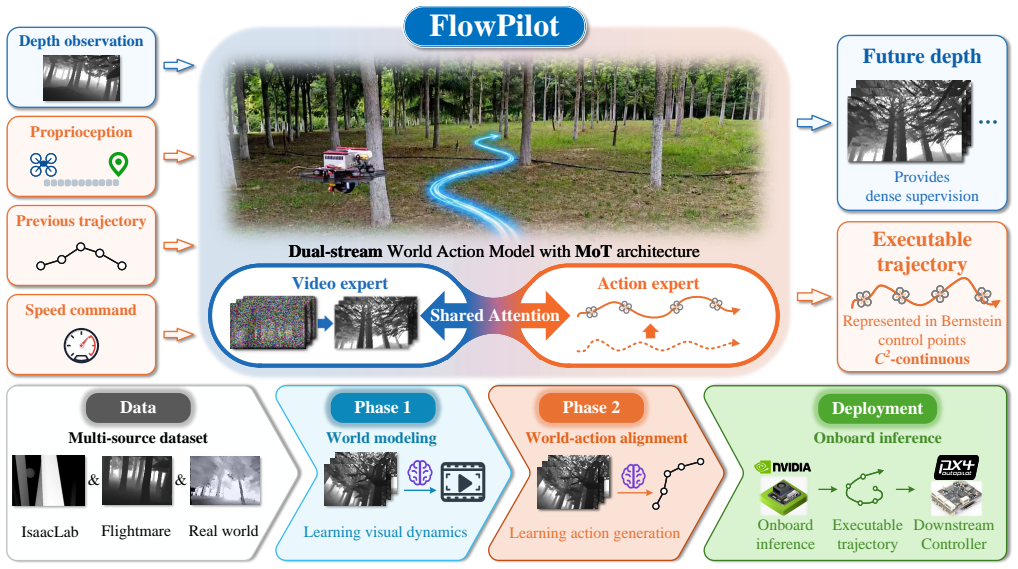
FlowPilot claims that jointly denoising future depth observations and executable trajectories with flow matching yields an action-centric policy that runs in under 18 ms onboard and reaches 5.5 m/s in clutter.
Reviewed by Pith at T0; open to challenge. T0 means a machine referee read the full paper against a public rubric. the ladder, T0–T4 →
T0 review · deepseek-v4-flash
2026-08-04 01:36 UTC pith:BCMNZMXM
load-bearing objection Solid within-subfield advance; the future-depth ablation supports the causal claim, but a missing SUPER baseline and an overclaim in the conclusion need attention. the 4 major comments →
FlowPilot: Real-Time World-Action Modeling for Agile UAV Navigation
The pith
A machine-rendered reading of the paper's core claim, the machinery that carries it, and where it could break.
Core claim
FlowPilot establishes that joint flow-matching denoising of future-depth latents and trajectory control points, inside a dual-stream mixture-of-transformers with shared attention, yields an action-centric navigation policy: at deployment the future-depth stream is not decoded, and the network outputs a degree-7 Bernstein polynomial trajectory whose first three control points are fixed by the drone's current position, velocity, and acceleration and whose five free control points are predicted. This produces C2-continuous references with closed-form velocity, acceleration, and jerk, so the plan is trackable by a downstream controller without a smoothing stage. In closed-loop simulation the mod
What carries the argument
The central mechanism is the dual-stream mixture-of-transformers: a video expert and an action expert keep separate weights and feed-forward paths but exchange information through joint attention, with independent flow-matching timesteps for each stream. The action expert predicts five free control points of a state-constrained degree-7 Bernstein polynomial, giving smooth, state-consistent references; the video expert predicts future-depth latents during training, providing dense supervision of scene evolution and conditioning the action denoising through the shared attention. Training uses a three-level depth pyramid (broad inexpensive simulation, photorealistic simulation, and real onboard
Load-bearing premise
The policy is trained by imitation on expert trajectories collected only in forest-style simulation environments, so the real-world generalization depends on those demonstrations being representative of the cluttered indoor and forest scenes the drone actually flies through.
What would settle it
Run the depth-frozen ablation (future-depth latents held at noise) against the full model in the densest simulated scenario at a commanded speed of 8 m/s over at least 100 trials; if the success rates are statistically indistinguishable, the paper's central claim that synchronous future-depth denoising drives the improvement is falsified.
If this is right
- The drone can navigate without building a local map or decoding future video: the world-model supervision is consumed at training time, and the deployed network emits only a smooth trajectory.
- The Bernstein free-control-point parameterization makes generative action sampling controller-friendly: every sampled plan is C2-continuous with closed-form derivatives, removing the need for a downstream smoother.
- The depth-frozen ablation (future-depth latents held at noise) degrades collision rate and speed, indicating that synchronous future-depth denoising actively guides action generation rather than acting as an auxiliary task.
- A sub-18 ms perception-to-action budget on an embedded processor shows that joint video-action transformers can fit the real-time loop of small aerial robots.
- The two-phase curriculum, from world-model prediction to joint world-action alignment, suggests a training recipe that grounds policy learning on a predictive scene prior.
Where Pith is reading between the lines
- The same co-train-then-drop-future-decoder recipe likely applies beyond depth cameras: RGB, radar, or fused-sensing variants could inherit the policy improvement while keeping deployment fast.
- Because the imitation supervision comes only from forest-style expert trajectories, the indoor transfer shown is suggestive rather than a bound on structural novelty; a systematic sweep over obstacle families (thin poles, transparent panels, tight man-made layouts) would test how far the world-model prior generalizes.
- The degeneracy under hard warm-starting (replan collapse) reveals a design space for replan consistency: soft conditioning is one remedy, but latent-level noise injection or consistency regularization could preserve multimodality more aggressively.
- The trained future-depth stream could be repurposed as a safety filter—decode predicted depth to score candidate trajectories for collision before execution—a direct extension the paper does not pursue.
Editorial analysis
A structured set of objections, weighed in public.
Referee Report
Summary. FlowPilot proposes a dual-stream mixture-of-transformers world-action model for onboard depth-based UAV navigation. It jointly denoises future-depth VAE latents and Bernstein-polynomial trajectory free control points using flow matching, with shared attention between video and action experts. Training uses a three-level data pyramid and a two-phase schedule: world-model pretraining first, then world-action alignment with SUPER expert trajectories. At deployment the model runs action-centrically, outputting only five Bernstein control points that are sent to a 100 Hz MPC. The paper reports closed-loop simulation comparisons against EGO-Planner, YOPO, an action-only variant, and a depth-frozen ablation, along with onboard latency measurements and real indoor/forest flights. The central claim is that synchronous future-depth denoising improves action generation, transfers zero-shot to unseen indoor scenes, and runs the full perception-to-action pipeline in under 18 ms on a Jetson Orin NX.
Significance. If the central claim is fully substantiated, this is a significant contribution: a compact single network that couples future-depth prediction and executable trajectory generation for agile UAV navigation, with 18 ms onboard latency and 5.5 m/s flights, would be a meaningful advance over map-then-optimize pipelines and purely reactive end-to-end policies. The paper has genuine strengths: it includes a controlled depth-frozen ablation, an action-only baseline, closed-loop success-rate comparisons at multiple speeds and sparsity levels, measured onboard timing, and real physical flights on a custom quadrotor. These elements make the central empirical claim potentially convincing. However, the attribution of the benefit to future-depth co-training — rather than to imitation of a privileged expert — is not fully established by the current experiments, and several empirical comparisons lack statistical confidence intervals. With additional analysis, the contribution would be quite strong.
major comments (4)
- [Sec. IV-B, Table I; Sec. III-Fb] The paper's central attribution claim — that synchronous future-depth denoising causally improves action generation and enables generalization — is underdetermined because no privileged-expert (SUPER) baseline is reported. Both FlowPilot and the depth-frozen variant are trained on the same SUPER trajectories collected only in forested Flightmare environments, and the text itself states that the depth-frozen variant's 'best achievable behavior is therefore bounded by the privileged planner, SUPER.' The same label-bounding statement applies to the full model's action supervision, yet the paper never measures how far FlowPilot's closed-loop decisions deviate from SUPER, nor whether SUPER itself would succeed in the indoor-like scenarios or in the PX4 SITL evaluation. Consequently, the improvement of FlowPilot over the depth-frozen variant could be interpreted as a better imitation learner r
- [Fig. 6 and Table I] The success-rate curves in Fig. 6 are point estimates from only 20 trials per condition with no confidence intervals, error bars, or significance tests. At high commanded speeds (7–8 m/s), the differences between FlowPilot and the baselines may be small relative to trial noise, so the headline claim of 'outperforms learning- and optimization-based baselines under increasing clutter and commanded speeds up to 8 m/s' is not statistically grounded. Similarly, Table I reports collision rates and metrics without sample size, confidence intervals, or paired comparisons between the full and depth-frozen variants. Provide bootstrap confidence intervals or repeated-seed data for the simulation success rates, and report the number of runs for the ablation. This is load-bearing because the main scientific claim is an empirical comparison.
- [Sec. V vs. Sec. III-C] The conclusion states that the generated trajectories are 'dynamically feasible by construction,' but Sec. III-C explicitly states the opposite: 'Dynamic feasibility still depends on the downstream tracking controller and vehicle limits; the role of the Bernstein representation is to provide a smooth, state-consistent reference with analytic derivatives.' This is an internal contradiction in a central claim. The conclusion should be corrected to say that the trajectories are C^2-continuous and state-consistent by construction, while feasibility is contingent on the tracking controller and vehicle limits. The current wording overstates the contribution and should be fixed.
- [Sec. IV-C] The real-world zero-shot transfer claim is supported by only two indoor obstacle layouts and two forest flights, with no quantitative completion criteria, no obstacle-distance margins, no tracking-error metrics, and no indication of whether each flight was repeated. The paper says FlowPilot 'navigates both zero-shot' and reaches 3.8 m/s and 3.1 m/s indoors, but without task metrics or repetition counts it is difficult to assess the reliability of this transfer result. Add at least quantitative metrics (e.g., minimum distance to obstacles, tracking error, success/failure per run, number of runs) and clarify whether the reported speeds are peaks or sustained values. This concern is directly relevant to the claim of generalizing to 'arbitrary, unstructured obstacle distributions.'
minor comments (5)
- [Sec. III-C] The action latent is described as 'normalized Bernstein space,' but the normalization is never defined. Please specify how the control points are normalized (e.g., relative to commanded speed c or a fixed maximum) and how the trajectory is denormalized at deployment.
- [Sec. III-Ba, Sec. IV-C] The video expert uses a frozen Wan2.2 VAE during training, while deployment uses a 'distilled depth encoder' reported in Table II. The distillation process is not described: what is the training target, and does it exactly match the frozen VAE encoder distribution? This matters for train-deployment consistency.
- [Table I] The metric 'Normalized jerk' is not defined. Provide the normalization factor and whether it is computed from the reference trajectory or the executed state.
- [Sec. III-Fb] The text says Phase 2 uses SUPER trajectories 'rather than the optimizer used only for coarse coverage in Phase 1.' Phase 1 is described as world-modeling pretraining with no action supervision, so it is unclear what 'optimizer' produced in Phase 1. Clarify whether this refers to the trajectory data used in the depth pyramid or to an initial action-supervision stage.
- [Fig. 6] The x-axis is labeled 'Velocity (m/s)' without specifying whether this is the commanded speed or the mean executed speed. Please state this clearly in the caption or text.
Circularity Check
No significant circularity: FlowPilot's central claims are empirical, tested against external baselines and an ablation; self-citations are not load-bearing.
full rationale
FlowPilot's derivation chain is self-contained in the relevant sense. The action output is trained by flow-matching imitation on SUPER expert trajectories (Sec. III-Fb) and evaluated in closed-loop simulation against EGO-Planner, YOPO, and an action-only variant (Sec. IV-B), plus physical flights (Sec. IV-C). The future-depth co-training claim is directly tested by the depth-frozen ablation (Table I), so its contribution is measured rather than assumed. No equation or parameter is fitted to the metric it is then said to predict: the Bernstein free-control-point parameterization is a representation choice, not a fit to the evaluation outcomes, and the future-depth latent is supervised from ground-truth depth frames rather than from the action labels. The only self-citations ([15], [29]) are to related work and the simulation infrastructure; neither is invoked as an external uniqueness theorem or as the justification for a central premise, so they are not load-bearing. The conclusion's phrase 'dynamically feasible by construction' is inconsistent with Sec. III-C's explicit caveat that feasibility still depends on the downstream controller and vehicle limits; that is an overclaim about correctness, not a circular step.
Axiom & Free-Parameter Ledger
free parameters (8)
- flow-matching shift s =
5
- video loss weight lambda =
not reported
- Euler denoising steps =
3
- trajectory horizon T =
1.6 s
- Bernstein degree and free control points =
degree 7, 5 free points (15-dim action)
- classifier-free drop probability =
0.2
- depth resolution =
160x96
- data pyramid hours =
16h IsaacLab / 8h Flightmare / 2h real
axioms (7)
- standard math Linear-interpolation flow matching (Eq. 8) is a valid generative objective for both video and action latents.
- standard math Bernstein polynomial derivative identities (Eqs. 5-7) are correct by construction.
- domain assumption A frozen Wan2.2 VAE, pretrained on natural RGB video, provides a useful latent space for depth-image future prediction.
- domain assumption The three-level depth pyramid (16h IsaacLab + 8h Flightmare + 2h real) plus SUPER expert trajectories is representative of all deployment conditions.
- domain assumption A 15-dimensional action latent (five free Bernstein control points) is expressive enough for agile avoidance maneuvers in the evaluated conditions.
- domain assumption VINS-Fusion state estimates and the 100 Hz OMMPC controller remain within operating bounds during real flights.
- domain assumption Three Euler denoising steps at deployment are sufficient to sample from the learned flow distribution.
read the original abstract
We present FlowPilot, a compact world-action model for real-time onboard UAV navigation from depth. Unlike map-then-optimize pipelines that require local reconstruction or end-to-end policies that lack explicit scene prediction, FlowPilot jointly denoises future depth observations and executable trajectories with flow matching. A dual-stream mixture-of-transformers couples video and action experts through shared attention, allowing future-scene prediction and trajectory generation to inform each other. At deployment, the model runs action-centrically and outputs only a trajectory. To ensure trackability, actions are parameterized as degree-7 Bernstein polynomials: the current state constrains the initial control points, and the network predicts five free control points, yielding C^2-continuous references with closed-form velocity, acceleration and jerk. FlowPilot is trained on a three-level depth pyramid spanning high-throughput simulation, photorealistic simulation, and real onboard data. In closed-loop simulation, it outperforms learning- and optimization-based baselines under increasing clutter and commanded speeds up to 8m/s. On a physical quadrotor, the full perception-to-action pipeline runs in under 18ms on a Jetson Orin NX and reaches 5.5m/s in cluttered indoor and forest environments using only onboard sensing and computation.
Figures


Reference graph
Works this paper leans on
-
[1]
EGO-Planner: An ESDF-free gradient-based local planner for quadrotors,
X. Zhou, Z. Wang, H. Ye, C. Xu, and F. Gao, “EGO-Planner: An ESDF-free gradient-based local planner for quadrotors,”IEEE Robot. Autom. Lett., vol. 6, no. 2, pp. 478–485, 2021
2021
-
[2]
Learning high-speed flight in the wild,
A. Loquercio, E. Kaufmann, R. Ranftl, M. M ¨uller, V . Koltun, and D. Scaramuzza, “Learning high-speed flight in the wild,”Sci. Robot., vol. 6, no. 59, p. eabg5810, 2021
2021
-
[3]
Geometrically constrained trajectory optimization for multicopters,
Z. Wang, X. Zhou, C. Xu, and F. Gao, “Geometrically constrained trajectory optimization for multicopters,”IEEE Trans. Robot., vol. 38, no. 5, pp. 3259–3278, 2022
2022
-
[4]
Safety-assured high-speed navigation for MA Vs,
Y . Renet al., “Safety-assured high-speed navigation for MA Vs,”Sci. Robot., vol. 10, no. 98, p. eado6187, 2025
2025
-
[5]
You only plan once: A learning-based one-stage planner with guidance learning,
J. Luet al., “You only plan once: A learning-based one-stage planner with guidance learning,”IEEE Robot. Autom. Lett., vol. 9, no. 7, pp. 6083–6090, 2024
2024
-
[6]
iPlanner: Imperative path planning,
F. Yang, C. Wang, C. Cadena, and M. Hutter, “iPlanner: Imperative path planning,” inProc. Robot. Sci. Syst., Daegu, Republic of Korea, Jul. 10–14 2023
2023
-
[7]
NoMaD: Goal masked diffusion policies for navigation and exploration,
A. Sridhar, D. Shah, C. Glossop, and S. Levine, “NoMaD: Goal masked diffusion policies for navigation and exploration,” arXiv:2310.07896, 2023
Pith/arXiv arXiv 2023
-
[8]
World action models are zero-shot policies,
S. Ye, Y . Ge, K. Zhenget al., “World action models are zero-shot policies,”arXiv:2602.15922, 2026
Pith/arXiv arXiv 2026
-
[9]
Motus: A unified latent action world model,
H. Bi, H. Tan, S. Xie, Z. Wang, S. Huang, H. Liu, R. Zhao, Y . Feng, C. Xiang, Y . Ronget al., “Motus: A unified latent action world model,” arXiv:2512.13030, 2025
Pith/arXiv arXiv 2025
-
[10]
Fast-W AM: Do world action models need test-time future imagination?
T. Yuan, Z. Dong, Y . Liu, and H. Zhao, “Fast-W AM: Do world action models need test-time future imagination?”arXiv:2603.16666, 2026
Pith/arXiv arXiv 2026
-
[11]
GigaWorld-Policy: An efficient action- centered world-action model,
A. Ye, B. Wang, C. Niet al., “GigaWorld-Policy: An efficient action- centered world-action model,”arXiv:2603.17240, 2026
arXiv 2026
-
[12]
Perception-aware time-optimal planning for quadro- tor waypoint flight,
C. Qin, J. Xing, R. Reiter, A. Romero, Y . Lin, H. H.-T. Liu, and D. Scaramuzza, “Perception-aware time-optimal planning for quadro- tor waypoint flight,”arXiv:2603.04305, 2026
arXiv 2026
-
[13]
Vision transformers for end-to-end vision- based quadrotor obstacle avoidance,
A. Bhattacharya, N. Rao, D. Parikh, P. Kunapuli, Y . Wu, Y . Tao, N. Matni, and V . Kumar, “Vision transformers for end-to-end vision- based quadrotor obstacle avoidance,” inIEEE Int. Conf. Robot. Autom., Atlanta, GA, USA, May 19-23 2025, pp. 1–8
2025
-
[14]
Champion-level drone racing using deep reinforce- ment learning,
E. Kaufmann, L. Bauersfeld, A. Loquercio, M. M ¨uller, V . Koltun, and D. Scaramuzza, “Champion-level drone racing using deep reinforce- ment learning,”Nature, vol. 620, no. 7976, pp. 982–987, 2023
2023
-
[15]
MAD: Mapping-aware world models for agile quadrotor flight,
X. Zhang, R. Wang, Y . Ren, D. Yu, B. Zhou, J. Sun, F. Deng, J. Chen, and G. Wang, “MAD: Mapping-aware world models for agile quadrotor flight,”arXiv:2606.04534, 2026
Pith/arXiv arXiv 2026
-
[16]
Feed- back favors the generalization of neural ODEs,
J. Jia, Z. Yang, M. Wang, K. Guo, J. Yang, X. Yu, and L. Guo, “Feed- back favors the generalization of neural ODEs,”arXiv:2410.10253, 2024
Pith/arXiv arXiv 2024
-
[17]
Unified meta-representation and feedback calibration for general disturbance estimation,
Z. Yang, J. Jia, M. Wang, Y . Liu, K. Guo, and X. Yu, “Unified meta-representation and feedback calibration for general disturbance estimation,”arXiv:2601.02762, 2026
Pith/arXiv arXiv 2026
-
[18]
Mastering diverse control tasks through world models,
D. Hafner, J. Pasukonis, J. Ba, and T. Lillicrap, “Mastering diverse control tasks through world models,”Nature, vol. 640, no. 8059, pp. 647–653, 2025
2025
-
[19]
Navigation world models,
A. Bar, G. Zhou, D. Tran, T. Darrell, and Y . LeCun, “Navigation world models,” inProc. IEEE/CVF Conf. Comput. Vis. Pattern Recogn., Nashville, TN, USA, Jun. 11–15 2025, pp. 15 791–15 801
2025
-
[20]
Dream to fly: Model-based reinforcement learning for vision-based drone flight,
A. Romero, A. Shenai, I. Geles, E. Aljalbout, and D. Scaramuzza, “Dream to fly: Model-based reinforcement learning for vision-based drone flight,”arXiv:2501.14377, 2025
Pith/arXiv arXiv 2025
-
[21]
One transformer fits all distributions in multi- modal diffusion at scale,
F. Bao, S. Nie, K. Xue, C. Li, S. Pu, Y . Wang, G. Yue, Y . Cao, H. Su, and J. Zhu, “One transformer fits all distributions in multi- modal diffusion at scale,” inProc. Int. Conf. Mach. Learn., vol. 202, Honolulu, HI, USA, Jul. 23–29 2023, pp. 1692–1717
2023
-
[22]
Aerial world model for long-horizon visual generation and navigation in 3D space,
W. Zhang, P. Tang, X. Zenget al., “Aerial world model for long-horizon visual generation and navigation in 3D space,” arXiv:2512.21887, 2025
arXiv 2025
-
[23]
Minimum snap trajectory generation and control for quadrotors,
D. Mellinger and V . Kumar, “Minimum snap trajectory generation and control for quadrotors,” inProc. IEEE Int. Conf. Robot. Autom., Shanghai, China, May 9–13 2011, pp. 2520–2525
2011
-
[24]
Optimizing control-friendly trajectories with self-supervised residual learning,
K. Guo, Z. Yang, Y . Liu, J. Jia, and X. Yu, “Optimizing control-friendly trajectories with self-supervised residual learning,” arXiv:2601.02738, 2026
Pith/arXiv arXiv 2026
-
[25]
Diffusion policy: Visuomotor policy learning via action diffusion,
C. Chi, Z. Xu, S. Feng, E. Cousineau, Y . Du, B. Burchfiel, R. Tedrake, and S. Song, “Diffusion policy: Visuomotor policy learning via action diffusion,”Int. J. Robot. Res., vol. 44, no. 10–11, pp. 1684–1704, 2025
2025
-
[26]
Flow matching for generative modeling,
Y . Lipman, R. T. Q. Chen, H. Ben-Hamu, M. Nickel, and M. Le, “Flow matching for generative modeling,” inProc. Int. Conf. Learn. Represent., Kigali, Rwanda, May 1–5 2023
2023
-
[27]
Wan: Open and advanced large-scale video generative models,
Wan Team, A. Wang, B. Ai, B. Wen, C. Mao, C.-W. Xie, D. Chen, F. Yu, H. Zhao, J. Yanget al., “Wan: Open and advanced large-scale video generative models,”arXiv:2503.20314, 2025
Pith/arXiv arXiv 2025
-
[28]
RoFormer: Enhanced transformer with rotary position embedding,
J. Su, M. Ahmed, Y . Lu, S. Pan, W. Bo, and Y . Liu, “RoFormer: Enhanced transformer with rotary position embedding,”Neurocomput., vol. 568, p. 127063, 2024
2024
-
[29]
X. Zhang, R. Wang, Y . Ren, J. Sun, H. Fang, J. Chen, and G. Wang, “DiffAero: A GPU-accelerated differentiable simulation framework for efficient quadrotor policy learning,”arXiv:2509.10247, 2025
Pith/arXiv arXiv 2025
-
[30]
Classifier-free diffusion guidance,
J. Ho and T. Salimans, “Classifier-free diffusion guidance,” inProc. NeurIPS Wksp. Deep Generative Models Downstream Appl., Virtual event, Dec. 14 2021
2021
-
[31]
A general optimization-based framework for local odometry estimation with multiple sensors,
T. Qin, J. Pan, S. Cao, and S. Shen, “A general optimization-based framework for local odometry estimation with multiple sensors,” arXiv:1901.03638, 2019
Pith/arXiv arXiv 1901
-
[32]
On-manifold model predictive control for trajectory tracking on robotic systems,
G. Lu, W. Xu, and F. Zhang, “On-manifold model predictive control for trajectory tracking on robotic systems,”IEEE Trans. Ind. Electron., vol. 70, no. 9, pp. 9192–9202, 2023
2023
discussion (0)
Sign in with ORCID, Apple, or X to comment. Anyone can read and Pith papers without signing in.