REVIEW 4 major objections 5 minor 85 references
No persistent circadian oscillator at genome resolution: pseudo-coherence in gut microbiome dynamics
T0 review · 4 major / 5 minor · reviewed 2026-08-04 · deepseek-v4-flash
Pith's one-line read This paper argues that apparent circadian rhythms in genome-resolved gut microbiome data stem from transient non-normal amplification of noise in a stable system, not from microbial oscillators.
desk verdict A provocative negative claim about microbiome circadian rhythms that hangs on a 3-sample Jacobian — intriguing cluster recovery, but the inference is too underdetermined to carry it. read the letter →
The pith
A machine-rendered reading of the paper's core claim, the machinery that carries it, and where it could break.
The reading
What carries the argument
The central device is the commutator of the estimated local Jacobian, B = Â Âᵀ - Âᵀ Â, computed from short sliding windows of four hourly samples. Because the dynamics are assumed to have real negative eigenvalues, non-orthogonal eigenvectors make perturbations transiently grow; diagonalising this traceless symmetric commutator isolates the rank-two subspace of maximal non-normal amplification and defines the two modes — the non-normal mode that injects noise and the reaction mode onto which fluctuations are redirected. All diagnostics (support, phase coherence, lead-lag imbalance, and the phase-agnostic co-membership recovery) flow from this rank-two geometric object.
What would settle it
A persistent ridge in the Morlet scalogram of either animal, surviving long-time averaging, would falsify the no-oscillator claim; the decisive test is a clock-gene knockout cohort where pseudo-coherence predicts a weakened 24-hour component but preserved transient amplification and lead-lag asymmetry, while an autonomous-oscillator picture predicts a surviving coherent near-24-hour ridge.
Extended reading notes
Core claim
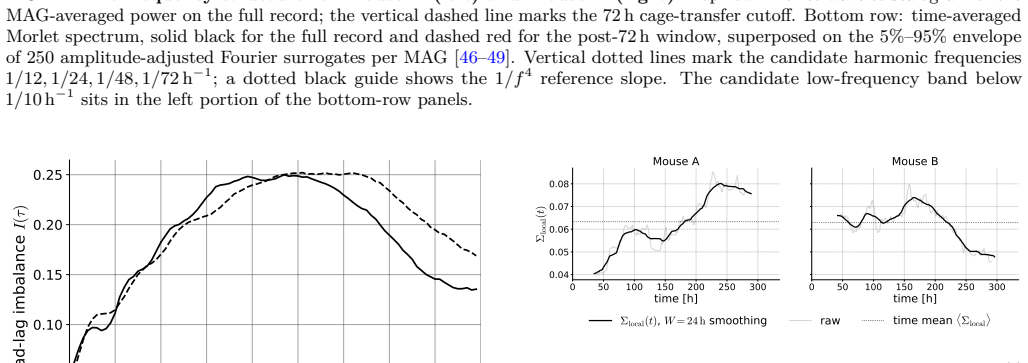
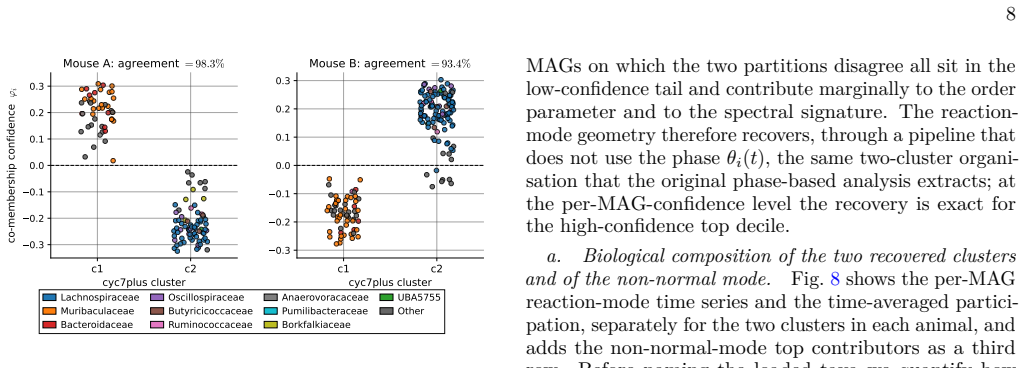
At genome resolution, both animals' time series carry no persistent time-frequency ridge; the time-averaged spectrum is enhanced at low frequencies and depleted at intermediate frequencies; the lagged covariance is markedly asymmetric with a peak near tens of hours; and a phase-free clustering based only on the sign of an inferred reaction mode recovers the same two functional guilds (primary polysaccharide-degrading Bacteroidota versus secondary butyrate/propionate-fermenting Bacillota A) that a phase-based method finds, with 98.3% and 93.4% agreement, well above surrogate null maxima. The paper interprets this conjunction as evidence for pseudo-coherence: geometric, non-normal amplificatio
Load-bearing premise
The argument rests on local interaction matrices inferred from only three effective hourly differences in over a hundred species; if those matrices are dominated by estimation noise, the inferred non-normal modes and the cluster recovery built on their signs would be artifacts.
Editorial extensions
If this is right
- MAG-level rhythmic structure should not be read as oscillator evidence: the null hypothesis to beat is a stable, strongly non-normal stochastic process.
- The two anti-phased microbial clusters become the upstream and downstream halves of a directed cross-feeding cascade, not circadian subpopulations.
- A positive, quasi-stationary entropy production rate follows from the reaction-mode support, placing the microbiome in a non-equilibrium steady state sustained by host-supplied free energy.
- Clock-gene-knockout cohorts should show a selective dissociation: the 24-hour clock-locked component weakens while transient amplification, lead-lag asymmetry, and mode-based guild recovery persist.
Reading between the lines
- Because the estimator relies on short windows, a stress test worth running is re-estimation at denser sampling or with a state-space filter; if the rank-two structure is stable, the geometric reading is strengthened.
- The re-reading of 'night' and 'day' clusters as a cross-feeding delay suggests that published circadian microbiome datasets sampled at lower resolution may have been interpreting a trophic pipeline delay as a clock; re-running these diagnostics on such data would reveal how general the pseudo-coherent regime is.
- The same diagnostic battery could be applied to neural or ecological data with directed interactions, predicting that their rhythmic-looking output may also be pseudo-coherent rather than oscillatory.
Editorial analysis
A structured set of objections, weighed in public.
Referee Report
Summary. The paper reanalyzes an hourly, genome-resolved (MAG-level) mouse-gut microbiome time series from two animals and argues that the apparent circadian organization is not evidence of a persistent microbial oscillator. It proposes instead a 'pseudo-coherence' regime: a linearly stable, strongly non-normal stochastic system in which transient non-normal amplification produces intermittent phase alignment, broken time-reversal symmetry, low-frequency spectral enhancement without a stationary ridge, and phase-agnostic recovery of two functional guilds (Bacteroidota primary degraders vs. Bacillota A secondary fermenters). The core evidence is a local Jacobian estimated from four-hour windows, a rank-two commutator subspace, K/Kc diagnostics, wavelet scalograms, AAFT surrogate testing, and a co-membership clustering that recovers the cyc7plus partition with 98.3%/93.4% agreement. The paper closes with a falsifiable clock-gene-knockout prediction.
Significance. If the central claim held, the paper would substantively challenge oscillator-based interpretations of MAG-resolution microbiome rhythmicity and would provide a concrete statistical-mechanics alternative grounded in non-normal amplification. The study is genuinely interdisciplinary, uses public data, and proposes a discriminating experiment, which are strengths. The manuscript is also unusually candid in parts, e.g., in acknowledging that the surrogate test is not itself an oscillator discriminator. However, the current evidentiary support is not yet commensurate with the strength of the conclusions: the headline surrogate claim is contradicted by the appendix table, and the mode-inference pipeline rests on a severely underdetermined local Jacobian whose calibration does not rule out plausible nulls. The result would be important if the required robustness checks were supplied.
major comments (4)
- [Sec. II.e, Eq. (10); Sec. III.D] The local Jacobian Â_k is estimated from four consecutive hourly samples, i.e., only three lagged state vectors, in N=118–181 dimensions. Hence rank(Â_k)≤3 and the commutator B_k=[Â_k,Â_k^T] has rank at most 6, so its top two eigenvectors—the inferred 'reaction' and 'non-normal' modes—are extracted from an object that is almost entirely null space plus noise projection. The claim that this 'robustly extracts' the non-normal amplification is not justified: the noise term ΞX_k^+ is amplified by ||X_k^+||, which is large for strongly autocorrelated hourly samples. The synthetic calibration of Fig. 9 draws from the same linear model class and does not include a null with a shared diurnal drive and a normal (or zero) Jacobian. Because every mode-based result (K/Kc, supports, co-membership clusters, guild identities) depends on this estimator, the paper needs (i) a bias/variance analysis of th
- [Sec. III.B; Appendix Table S5] The main text states that the AAFT surrogate test 'does establish in both animals that the low-frequency band carries a marginal excess over the AAFT null.' Table S5 reports that after Benjamini–Hochberg correction at FDR=0.05, Mouse A has no significant bin in either the full record or the post-72h window, and Mouse B is significant only in the full record (two bands: ~22–28h and ~79–95h), with no significant bin after removing the first 72h. Thus the surrogate test does not establish an excess in both animals, and the post-transient record shows no significant excess in either mouse. This directly contradicts the abstract's 'AAFT surrogate test identifies a weak time-averaged construction in the candidate circadian band.' The claim must be weakened or the analysis changed. The 1/f^4 tail in Fig. 4 is also presented as validation without any quantitative goodness-of-fit or significance
- [Sec. III.D; Sec. V.k] The co-membership surrogate null (chance agreement 60.2% in Mouse A and 63.5% in Mouse B) is built from AAFT surrogates that destroy inter-MAG phase coherence but preserve each MAG's marginal spectrum. Such a null does not rule out the most relevant alternative: a common host-driven low-frequency/diurnal signal with per-MAG phase delays, in a system with a normal or zero Jacobian. Under that alternative, both the phase-based cyc7plus clusters and the reaction-mode sign series could align without any non-normal amplification geometry. To make the cluster-recovery result load-bearing, the paper should add a null in which a shared slow/diurnal envelope (with random per-MAG phase delays) is superimposed on independent AR(1) or OU processes, then run the full co-membership pipeline; if agreement remains near 98%, the 'phase-agnostic recovery' does not support pseudo-coherence.
- [Sec. III.C, Eqs. (18)–(20)] The entropy-production proxy Σ_local(t) is defined as the small-τ slope of I(τ,t). Because I(τ) is a norm of an antisymmetric matrix, it is nonnegative and typically increasing at small τ, so 'strictly positive at 100% of windows' is not, by itself, evidence of a non-equilibrium steady state. The identification of Σ_local with the geometric non-normality index K_σ and the entropy production Φ rests on the closed forms of the reduced 2×2 model, whose parameters (α, β, κ, σ₁, σ₂, ρ) are not estimated with uncertainties, and which is derived from the same noisy Jacobian. The claim that the two mice agree to 0.5% is based on n=2 animals and is not a meaningful consistency check. The authors should either provide a direct validation of the exponential form in Eq. (18) against the empirical C(τ) (e.g., a fit of the full τ-dependence with confidence intervals) or soften the thermodynamic interp
minor comments (5)
- [References] References [12] and [39] are the same paper (R. Muolo, M. Asllani, D. Fanelli, P. K. Maini, T. Carletti, J. Theor. Biol. 480, 81 (2019)) and should be merged or renumbered.
- [Abstract] The abstract contains a typo: 'constructionin the candidate circadian band' should be 'construction in the candidate circadian band.'
- [Fig. 4] The 1/f^4 guide line is described as validating the pseudo-coherent picture 'independently of the low-frequency band,' but no statistical test of the high-frequency slope is reported. Please state that this is a qualitative guide and add a quantitative slope comparison or remove the word 'independently.'
- [Sec. III.C.a] The forward reference to 'Sec. IIID' (with Roman numerals) before Section III.D is introduced is confusing; use 'Section III.D' consistently and define the section before referencing it.
- [Table I and Sec. III.A.a] The wavelet coherence values in Table I (0.55–0.70) are presented without confidence intervals or a null-comparison. Given the nonstationary and autocorrelated data, a significance test or at least a bootstrapped CI would help the reader assess the 'support controls coherence' claim.
Circularity Check
Rank-deficient Jacobian fit manufactures the rank-two non-normal subspace; the pseudo-coherence interpretation is imported from self-cited theory.
-
self citation load bearing
[Sec. I; Sec. II.b; Sec. IV; Methods g-h; Refs. [13-16]]
"The framework we use here [13, 14] differs in two respects from this tradition: (i) the linearised operator that produces pseudo-coherent organisation is taken to have strictly real negative eigenvalues, so there is no pre-existing complex mode to resonate with, and (ii) the collective observable is a time-resolved cluster order parameter, not a spatial wavenumber or a stationary peak."
The paper's central positive claim—that the observed signatures constitute pseudo-coherence—is defined and supported almost entirely by the authors' own prior work: the Γ reduction, Kc threshold, support-as-order-parameter, the closed forms for I(τ) and Φ, the 1/f^4 tail, and the entropy-production interpretation all cite Refs. [13-16], all by Troude and/or Sornette. No independent, machine-checked, code-reproduced, or parameter-free derivation is cited. Thus the conclusion 'the appropriate null is a stable, strongly non-normal stochastic system' is an import of the authors' framework rather than a reduction from independent first principles or from the data alone. The data themselves show absence of a persistent ridge and an asymmetric lagged covariance, but those facts alone do not entai
-
fitted input called prediction
[Sec. II.e Eq. (10); Methods d, j; Sec. III.D]
"The full Jacobian Â_k is high-dimensional and ill-conditioned, but the non-normal amplification is rank two and is robustly extracted by diagonalising the commutator B_k = [Â_k, Â^⊤_k] from Eq.(2), which is small and well-conditioned even when Â_k is itself nearly degenerate."
Â_k = Y_k X_k^+ is an N×N matrix of rank at most 3 because only three effective lagged vectors are used, so the commutator B_k has rank at most 6 and a top eigenpair always exists for any data. Calling this guaranteed eigenpair the 'non-normal amplification geometry' and then using its per-MAG signs to 'recover' the cyc7plus guilds (Sec. III.D) presents a construction of the estimator as an empirical prediction. The AAFT surrogate null (Methods k) preserves each MAG's marginal spectrum and only destroys cross-MAG phase coherence; it does not include a driven normal null with a shared diurnal input, so the 98.3%/93.4% recovery could reflect sensitivity to the shared low-frequency signal rather than genuine non-normal dynamics. The existence of the rank-two subspace is by construction, altho
full rationale
The negative empirical result (no persistent circadian ridge in the Morlet scalograms; AAFT surrogates do not support a fixed 24h ridge) is data-driven and not circular. Circularity enters in the positive interpretation. First, the theoretical vocabulary of pseudo-coherence—the Γ reduction, Kc, support-as-order-parameter, closed forms for I(τ) and Φ, the 1/f^4 tail, and the entropy-production reading—is taken verbatim from the authors' own prior papers [13-16], making the interpretative frame self-referential rather than independently verified. Second, the rank-two 'non-normal amplification' subspace is a guaranteed output of the estimator: Â_k is a rank-≤3 least-squares fit from four consecutive samples, so B_k = [Â_k, Â_k^T] has rank at most 6 and always possesses a top eigenpair; interpreting that eigenpair as biological reaction/non-normal geometry is therefore a construction, not a falsifiable inference. The co-membership cluster recovery (98.3%/93.4%) is then offered as evidence for the rank-two structure, but the surrogate null it is compared against does not include a driven normal model with shared diurnal input, so the evidence does not rule out the estimator's sensitivity to common low-frequency structure. These issues make the central positive claim partially circular rather than fully forced. A further in-manuscript limitation is Supplementary Table S5: after Benjamini-Hochberg correction, Mouse A shows no significant surrogate-exceedance bin, and Mouse B's significant ~22-28h band disappears after removing the first 72h, contradicting the abstract's claim of a 'weak time-averaged construction in the candidate circadian band' in both animals. This is a missing-support flag rather than a circularity. Overall, the paper has independent empirical content (the absence of a persistent ridge and the asymmetry measures), so it is not entirely circular, but the load-bearing interpretive framework and the rank-two extraction are both self-referential.
Assumptions & free parameters
free parameters (5)
- Per-window non-normality index K/Kc =
record means 1.86 (Mouse A), 1.63 (Mouse B)
- Reduced-operator coefficients α, β, κ and noise covariance σ1, σ2, ρ =
not tabulated
- 24 h moving-median detrending window (NPPD) =
24 h
- Post-72h cage-transfer exclusion cutoff =
72 h
- Morlet scalogram grid and 1/f^4 guide slope =
cmor1.5-1.0, 100 scales over 1–100 h
assumptions (5)
- domain assumption Linear overdamped OU model ẋ = Ax + ξ with strictly real, stable eigenvalues adequately represents MAG-level abundance fluctuations
- ad hoc to paper Pseudo-coherence theory of Refs [13–16] (rank-two commutator subspace, support as order parameter, geometric threshold Kc, 1/f^4 tail, Eqs. 18/20 closed forms)
- domain assumption 4-sample local Jacobian estimates (Eq. 10) are informative despite rank ≤ 3 in N = 118–181 dimensions
- domain assumption NPPD non-parametric phase extraction of Ref [45] yields valid phases for MAGs
- standard math AAFT surrogates and Benjamini–Hochberg FDR are appropriate nulls
invented entities (2)
-
Pseudo-coherence regime (stable, strongly non-normal stochastic state generating oscillator-like signatures)
independent evidence
-
Inferred reaction mode and non-normal mode pair (per-MAG loadings r_i(t), n_i(t))
Cite this review
Pith. "Pith review of No persistent circadian oscillator at genome resolution: pseudo-coherence in gut microbiome dynamics." pith.science (2026). https://pith.science/paper/WXKMYMZL
@misc{pith2026260800662,
  author       = {Pith},
  title        = {Pith review of: No persistent circadian oscillator at genome resolution: pseudo-coherence in gut microbiome dynamics},
  year         = {2026},
  howpublished = {\url{https://pith.science/paper/WXKMYMZL}},
  note         = {Machine review of arXiv:2608.00662}
}
read the original abstract
Diurnal rhythms in the gut microbiome are commonly read as evidence of host-driven entrainment or of microbial oscillators that synchronise to a common clock. We reanalyse hourly genome-resolved (MAG-level) mouse-gut time series with diagnostics tailored to test that interpretation. At this resolution and for both animals in the dataset, the time-frequency representation carries no persistent ridge; the time-averaged spectrum is enhanced at low frequencies and depleted at intermediate frequencies; the lagged covariance is markedly time-asymmetric, with a global imbalance peak near tens of hours; and an amplitude-adjusted Fourier surrogate test identifies a weak time-averaged construction in the candidate circadian band, never as a fixed time-frequency ridge. The two functional guilds that carry the inferred non-normal amplification are identified independently by the rankings of two inferred dynamical modes (the reaction mode, into which fluctuations are transiently amplified, and the non-normal mode, which injects them), and recover the primary polysaccharide degraders of Bacteroidota and the secondary butyrate and propionate fermenters of Bacillota A without invoking any phase information. The conjunction of these signatures matches a stable but strongly non-normal stochastic regime, that is, pseudo-coherence: geometric amplification reshapes stochastic fluctuations onto a low-dimensional reaction subspace, producing intermittent synchronisation-like episodes, broken time-reversal symmetry, and emergent time-averaged characteristic scales without an underlying oscillator. We propose a falsifiable test via high-resolution clock-gene-knockout cohorts.
Figures


Figures from the paper (5 more)



Reference graph
Works this paper leans on
-
[1]
Thaiss, D
C. Thaiss, D. Zeevi, M. Levy, G. Zilberman-Schapira, J. Suez, A. Tengeler, L. Abramson, M. Katz, T. Korem, N. Zmora, Y. Kuperman, I. Biton, S. Gilad, A. Harmelin, H. Shapiro, Z. Halpern, E. Segal, and E. Elinav, Cell159, 514 (2014)
2014
-
[2]
Zarrinpar, A
A. Zarrinpar, A. Chaix, S. Yooseph, and S. Panda, Cell Metabolism20, 1006 (2014)
2014
-
[3]
Liang, F
X. Liang, F. D. Bushman, and G. A. FitzGerald, Proc. Natl. Acad. Sci. USA112, 10479 (2015)
2015
-
[4]
Leone, S
V. Leone, S. Gibbons, K. Martinez, A. Hutchison, E. Huang, C. Cham, J. Pierre, A. Heneghan, A. Nadim- palli, N. Hubert, E. Zale, Y. Wang, Y. Huang, B. The- riault, A. Dinner, M. Musch, K. Kudsk, B. Prendergast, J. Gilbert, and E. Chang, Cell Host Microbe17, 681 (2015)
2015
-
[5]
Asher and P
G. Asher and P. Sassone-Corsi, Cell161, 84 (2015)
2015
-
[6]
Kuramoto, International Symposium on Mathematical Problems in Theoretical Physics , 420 (1975)
Y. Kuramoto, International Symposium on Mathematical Problems in Theoretical Physics , 420 (1975)
1975
-
[7]
J. A. Acebrón, L. L. Bonilla, C. J. P. Vicente, F. Ritort, and R. Spigler, Reviews of Modern Physics77, 137 (2005)
2005
-
[8]
Pikovsky, M
A. Pikovsky, M. Rosenblum, and J. Kurths,Synchro- nization: A Universal Concept in Nonlinear Sciences (Cambridge University Press, 2001)
2001
Show all 85 references
-
[9]
L. N. Trefethen and M. Embree,Spectra and Pseudospec- tra(Princeton University Press, 2005)
2005
-
[10]
B. F. Farrell and P. J. Ioannou, Journal of the Atmo- spheric Sciences53, 2025 (1996)
2025
-
[11]
L. N. Trefethen, A. E. Trefethen, S. C. Reddy, and T. A. Driscoll, Science261, 578 (1993)
1993
-
[13]
Troude and D
V. Troude and D. Sornette, arXiv preprint arXiv:2603.07206 (2026), arXiv:2603.07206
2026
-
[14]
Troude and D
V. Troude and D. Sornette, Phys. Rev. Res.7, L042048 (2025)
2025
-
[15]
Troude, S
V. Troude, S. C. Lera, K. Wu, and D. Sornette, Illu- sions of criticality: Crises without tipping points (2025), arXiv:2412.01833 [nlin.CD]
2025
-
[16]
Sornette and V
D. Sornette and V. Troude, Life as a non-normal chemi- cal accelerator (2025), arXiv:2512.18438 [cond-mat.stat- mech]
2025
-
[17]
N. M. Koropatkin, E. A. Cameron, and E. C. Martens, Nat. Rev. Microbiol.10, 323 (2012)
2012
-
[18]
Rakoff-Nahoum, M
S. Rakoff-Nahoum, M. Coyne, and L. Comstock, Curr. Biol.24, 40 (2014)
2014
-
[19]
Rakoff-Nahoum, K
S. Rakoff-Nahoum, K. R. Foster, and L. E. Comstock, Nature533, 255 (2016)
2016
-
[20]
M. A. Mahowald, F. E. Rey, H. Seedorf, P. J. Turnbaugh, R. S. Fulton, A. Wollam, N. Shah, C. Wang, V. Magrini, R. K. Wilson, B. L. Cantarel, P. M. Coutinho, B. Henris- sat, L. W. Crock, A. Russell, N. C. Verberkmoes, R. L. Hettich, and J. I. Gordon, Proc. Natl. Acad. Sci. USA ...
2009
-
[21]
H. J. Flint, K. P. Scott, S. H. Duncan, P. Louis, and E. Forano, Gut Microbes3, 289 (2012)
2012
-
[22]
Sonnenburg and J
E. Sonnenburg and J. Sonnenburg, Cell Metab.20, 779 (2014)
2014
-
[23]
Belenguer, S
A. Belenguer, S. H. Duncan, A. G. Calder, G. Holtrop, P. Louis, G. E. Lobley, and H. J. Flint, Appl. Environ. Microbiol.72, 3593 (2006)
2006
-
[24]
Falony, A
G. Falony, A. Vlachou, K. Verbrugghe, and L. D. Vuyst, Appl. Environ. Microbiol.72, 7835 (2006)
2006
-
[25]
Louis and H
P. Louis and H. J. Flint, Environ. Microbiol.19, 29 (2016)
2016
-
[26]
den Besten, K
G. den Besten, K. van Eunen, A. K. Groen, K. Venema, D.-J. Reijngoud, and B. M. Bakker, J. Lipid Res.54, 2325 (2013)
2013
-
[27]
Iebba, F
V. Iebba, F. Santangelo, V. Totino, M. Nicoletti, A. Gagliardi, R. V. D. Biase, S. Cucchiara, L. Nencioni, M. P. Conte, and S. Schippa, PLoS ONE8, e61608 (2013)
2013
-
[28]
M. A. Riley and J. E. Wertz, Annu. Rev. Microbiol.56, 117 (2002)
2002
-
[29]
Wahlström, S
A. Wahlström, S. Sayin, H.-U. Marschall, and F. Bäckhed, Cell Metab.24, 41 (2016)
2016
-
[30]
R. R. Stein, V. Bucci, N. C. Toussaint, C. G. Buffie, G. Rätsch, E. G. Pamer, C. Sander, and J. B. Xavier, PLoS Comput. Biol.9, e1003388 (2013)
2013
-
[31]
Bucci and J
V. Bucci and J. B. Xavier, J. Mol. Biol.426, 3907 (2014)
2014
-
[32]
K. Z. Coyte, J. Schluter, and K. R. Foster, Science350, 663 (2015)
2015
-
[33]
Goyal and S
A. Goyal and S. Maslov, Phys. Rev. Lett.120, 10.1103/physrevlett.120.158102 (2018)
2018 doi
-
[34]
Goyal, V
A. Goyal, V. Dubinkina, and S. Maslov, ISME J.12, 2823 (2018). 15
2018
-
[35]
M. G. Neubert and H. Caswell, Ecology78, 653 (1997)
1997
-
[36]
R. M. Nisbet and W. S. C. Gurney, Nature263, 319 (1976)
1976
-
[37]
A. J. McKane and T. J. Newman, Physical Review Letters 94, 218102 (2005)
2005
-
[38]
Nicoletti, N
S. Nicoletti, N. Zagli, D. Fanelli, R. Livi, T. Carletti, and G. Innocenti, Physical Review E98, 032214 (2018)
2018
-
[39]
Muolo, M
R. Muolo, M. Asllani, D. Fanelli, P. K. Maini, and T. Car- letti, Journal of Theoretical Biology480, 81 (2019)
2019
-
[40]
Biancalani, F
T. Biancalani, F. Jafarpour, and N. Goldenfeld, Physical Review Letters118, 018101 (2017)
2017
-
[41]
Poggialini, S
A. Poggialini, S. D. Santo, P. Villegas, A. Gabrielli, and M. A. M. noz, arXiv preprint arXiv:2507.19127 10.48550/arXiv.2507.19127 (2025)
2025 doi
-
[42]
Hennequin, T
G. Hennequin, T. P. Vogels, and W. Gerstner, Neuron 82, 1394 (2014)
2014
-
[43]
B. K. Murphy and K. D. Miller, Neuron61, 635 (2009)
2009
-
[44]
Ganguli, D
S. Ganguli, D. Huh, and H. Sompolinsky, Proceedings of the National Academy of Sciences105, 18970 (2008)
2008
-
[45]
Kurokawa, R
R. Kurokawa, R. Maskawa, M. Arakawa, H. Ma- suoka, H. Takayasu, Y. Yoshikawa, T. Raihan, C. Shindo, K. Kaida, M. Takagi, M. Tanokura, L. Takayasu, M. Takayasu, and W. Suda, bioRxiv 10.64898/2026.03.26.714232 (2026), preprint, under re- view at Microbiome (2026)
2026 doi
-
[46]
Theiler, S
J. Theiler, S. Eubank, A. Longtin, B. Galdrikian, and J. D. Farmer, Physica D58, 77 (1992)
1992
-
[47]
Schreiber and A
T. Schreiber and A. Schmitz, Phys. Rev. Lett.77, 635 (1996)
1996
-
[48]
Schreiber and A
T. Schreiber and A. Schmitz, Physica D142, 346 (2000)
2000
-
[49]
Lancaster, D
G. Lancaster, D. Iatsenko, A. Pidde, V. Ticcinelli, and A. Stefanovska, Phys. Rep.748, 1 (2018)
2018
-
[50]
Carmody, G
R. Carmody, G. Gerber, J. Luevano, D. Gatti, L. Somes, K. Svenson, and P. Turnbaugh, Cell Host Microbe17, 72 (2015)
2015
-
[51]
M. K. Friswell, H. Gika, I. J. Stratford, G. Theodoridis, B. Telfer, I. D. Wilson, and A. J. McBain, PLoS ONE5, e8584 (2010)
2010
-
[52]
L. A. David, C. F. Maurice, R. N. Carmody, D. B. Gooten- berg, J. E. Button, B. E. Wolfe, A. V. Ling, A. S. Devlin, Y. Varma, M. A. Fischbach, S. B. Biddinger, R. J. Dutton, and P. J. Turnbaugh, Nature505, 559 (2013)
2013
-
[53]
Seifert, Reports on Progress in Physics75, 126001 (2012)
U. Seifert, Reports on Progress in Physics75, 126001 (2012)
2012
-
[54]
F. S. Gnesotto, F. Mura, J. Gladrow, and C. P. Broedersz, Reports on Progress in Physics81, 066601 (2018)
2018
-
[55]
Y. V. Fyodorov, E. Gudowska-Nowak, M. A. Nowak, and W. Tarnowski, Phys. Rev. Lett.134, 087102 (2025)
2025
-
[56]
M. E. V. Johansson, M. Phillipson, J. Petersson, A. Vel- cich, L. Holm, and G. C. Hansson, Proc. Natl. Acad. Sci. USA105, 15064 (2008)
2008
-
[57]
M. E. Johansson and G. C. Hansson, Dig. Dis.31, 305 (2013)
2013
-
[58]
Korem, D
T. Korem, D. Zeevi, J. Suez, A. Weinberger, T. Avnit- Sagi, M. Pompan-Lotan, E. Matot, G. Jona, A. Harmelin, N. Cohen, A. Sirota-Madi, C. A. Thaiss, M. Pevsner- Fischer, R. Sorek, R. J. Xavier, E. Elinav, and E. Segal, Science349, 1101 (2015)
2015
-
[59]
Biotechnol.34, 1256 (2016)
C.T.Brown, M.R.Olm, B.C.Thomas,andJ.F.Banfield, Nat. Biotechnol.34, 1256 (2016)
2016
-
[60]
M. C. Marchetti, J. F. Joanny, S. Ramaswamy, T. B. Liverpool, J. Prost, M. Rao, and R. A. Simha, Reviews of Modern Physics85, 1143 (2013)
2013
-
[61]
Ramaswamy, Annual Review of Condensed Matter Physics1, 323 (2010)
S. Ramaswamy, Annual Review of Condensed Matter Physics1, 323 (2010)
2010
-
[62]
Toner and Y
J. Toner and Y. Tu, Physical Review Letters75, 4326 (1995)
1995
-
[63]
M. E. Cates and J. Tailleur, Annual Review of Condensed Matter Physics6, 219 (2015)
2015
-
[64]
Fodor, C
É. Fodor, C. Nardini, M. E. Cates, J. Tailleur, P. Visco, and F. van Wijland, Physical Review Letters117, 038103 (2016)
2016
-
[65]
B. F. Farrell and P. J. Ioannou, Journal of the Atmo- spheric Sciences60, 2101 (2003)
2003
-
[66]
Buzsáki and A
G. Buzsáki and A. Draguhn, Science304, 1926 (2004)
1926
-
[67]
Buzsáki and E
G. Buzsáki and E. I. Moser, Nat. Neurosci.16, 130 (2013)
2013
-
[68]
Mukherji, A
A. Mukherji, A. Kobiita, T. Ye, and P. Chambon, Cell 153, 812 (2013)
2013
-
[69]
Heddes, B
M. Heddes, B. Altaha, Y. Niu, S. Reitmeier, K. Klei- grewe, D. Haller, and S. Kiessling, Nat. Commun.13, 10.1038/s41467-022-33609-x (2022)
2022 doi
-
[70]
Kuang, Y
Z. Kuang, Y. Wang, Y. Li, C. Ye, K. A. Ruhn, C. L. Behrendt, E. N. Olson, and L. V. Hooper, Science365, 1428 (2019)
2019
-
[71]
Reitmeier, S
S. Reitmeier, S. Kiessling, T. Clavel, M. List, E. L. Almeida, T. S. Ghosh, K. Neuhaus, H. Grallert, J. Lin- seisen, T. Skurk, B. Brandl, T. A. Breuninger, M. Troll, W. Rathmann, B. Linkohr, H. Hauner, M. Laudes, A. Franke, C. I. L. Roy, J. T. Bell, T. Spector, J. Baum- bach, ...
2020
-
[72]
Tuganbaev, U
T. Tuganbaev, U. Mor, S. Bashiardes, T. Liwinski, S. P. Nobs, A. Leshem, M. Dori-Bachash, C. A. Thaiss, E. Y. Pinker, K. Ratiner, L. Adlung, S. Federici, C. Kleimeyer, C. Moresi, T. Yamada, Y. Cohen, X. Zhang, H. Massalha, E. Massasa, Y. Kuperman, P. A. Koni, A. Harmelin, N. G...
2020
-
[73]
R. M. Voigt, C. B. Forsyth, S. J. Green, E. Mutlu, P. En- gen, M. H. Vitaterna, F. W. Turek, and A. Keshavarzian, PLoS ONE9, e97500 (2014)
2014
-
[74]
J. A. Deaver, S. Y. Eum, and M. Toborek, Front. Micro- biol.9, 10.3389/fmicb.2018.00737 (2018)
2018
-
[75]
Altaha, M
B. Altaha, M. Heddes, V. Pilorz, Y. Niu, E. Gor- bunova, M. Gigl, K. Kleigrewe, H. Oster, D. Haller, and S. Kiessling, Mol. Metab.66, 101628 (2022)
2022
-
[76]
C. A. Thaiss, M. Levy, T. Korem, L. Dohnalová, H. Shapiro, D. A. Jaitin, E. David, D. R. Winter, M. Gury-BenAri, E.Tatirovsky, T.Tuganbaev, S.Federici, N. Zmora, D. Zeevi, M. Dori-Bachash, M. Pevsner-Fischer, E. Kartvelishvily, A. Brandis, A. Harmelin, O. Shibolet, Z. Halpern,...
2016
-
[77]
J. K. Paulose, J. M. Wright, A. G. Patel, and V. M. Cassone, PLoS ONE11, e0146643 (2016)
2016
-
[78]
Bishehsari, R
F. Bishehsari, R. M. Voigt, and A. Keshavarzian, Nat. Rev. Endocrinol.16, 731 (2020)
2020
-
[79]
E. M. Teichman, K. J. O’Riordan, C. G. Gahan, T. G. Dinan, and J. F. Cryan, Cell Metab.31, 448 (2020)
2020
-
[80]
Voigt, C
R. Voigt, C. Forsyth, S. Green, P. Engen, and A. Ke- shavarzian, Int. Rev. Neurobiol. , 193 (2016)
2016
-
[81]
Chaumeil, A
P.-A. Chaumeil, A. J. Mussig, P. Hugenholtz, and D. H. Parks, Bioinformatics36, 1925 (2019). 16 Appendix A: Supplementary Material No persistent circadian oscillator at genome resolution: pseudo-coherence in gut microbiome dynamics This Supplementary Material provides the full...
1925
-
[82]
Top-25 MAGs by mean absolute reaction-mode loading⟨|ri|⟩t (which genomes absorb the amplified excursion)
Top reaction-mode loadings (Mouse A) TABLE S1. Top-25 MAGs by mean absolute reaction-mode loading⟨|ri|⟩t (which genomes absorb the amplified excursion). Cluster labels are the cyc7plus assignment of Maskawa et al. Rank⟨|r i|⟩t Cluster Genus Family 1 0.108 2MGBC157735Pumilibact...
-
[83]
Top-25 MAGs by mean absolute non-normal-mode loading⟨|ni|⟩t (which genomes drive the amplified excursion)
Top non-normal-mode loadings (Mouse A) 17 TABLE S2. Top-25 MAGs by mean absolute non-normal-mode loading⟨|ni|⟩t (which genomes drive the amplified excursion). Rank⟨|n i|⟩t Cluster Genus Family 1 0.122 1PrevotellaBacteroidaceae 2 0.120 2PseudobutyricicoccusButyricicoccaceae 3 0...
-
[84]
Top-15 genera by aggregated squared reaction-mode loading ∑ i|ri|2 over their MAGs
Genus-level aggregation 18 TABLE S3. Top-15 genera by aggregated squared reaction-mode loading ∑ i|ri|2 over their MAGs. Rank Genus # MAGs ∑ i|ri|2 Family 1Sporofaciens5 0.0326 Lachnospiraceae 2CAG-4855 0.0283 Muribaculaceae 3COE16 0.0243 Lachnospiraceae 4UBA34024 0.0238 Lachn...
-
[85]
Concentration of the unit-norm modes, time-averaged: cumulative energy (pi =r2 i) in the top-5/10/20 MAGs, and inverse participation ratioNeff = 1/ ∑ ip2 i
Mode concentration vs a random-unit-vector null TABLE S4. Concentration of the unit-norm modes, time-averaged: cumulative energy (pi =r2 i) in the top-5/10/20 MAGs, and inverse participation ratioNeff = 1/ ∑ ip2 i. A random unit vector inN dimensions hasNeff≈N/ 3. The empirica...
-
[86]
Frequency bins exceeding the amplitude-adjusted Fourier surrogate null (Nsurr = 250) after Benjamini–Hochberg correction at FDR0.05, on the full record
Surrogate spectral test (Benjamini–Hochberg corrected) TABLE S5. Frequency bins exceeding the amplitude-adjusted Fourier surrogate null (Nsurr = 250) after Benjamini–Hochberg correction at FDR0.05, on the full record. Mouse A: no significant bin in either window. Mouse B (full...
Reviewed August 4, 2026 · model on record in the stance chip above.
Discussion (0). Continue with ORCID to comment.