REVIEW 3 major objections 5 minor 31 references
Push-Wiper: Toward General-Purpose Robotic Cleaning across Varied Stains and Surfaces with Segmented Pushing Trajectories
T0 review · 3 major / 5 minor · reviewed 2026-08-15 · deepseek-v4-flash
Pith's one-line read Viscous stains come off fastest when a robot first pushes them into one compact blob, the paper argues.
desk verdict A plausible new cleaning paradigm whose headline number is measured by an unvalidated stain detector; worth refereeing after the metric is grounded. read the letter →
The pith
A machine-rendered reading of the paper's core claim, the machinery that carries it, and where it could break.
The reading
What carries the argument
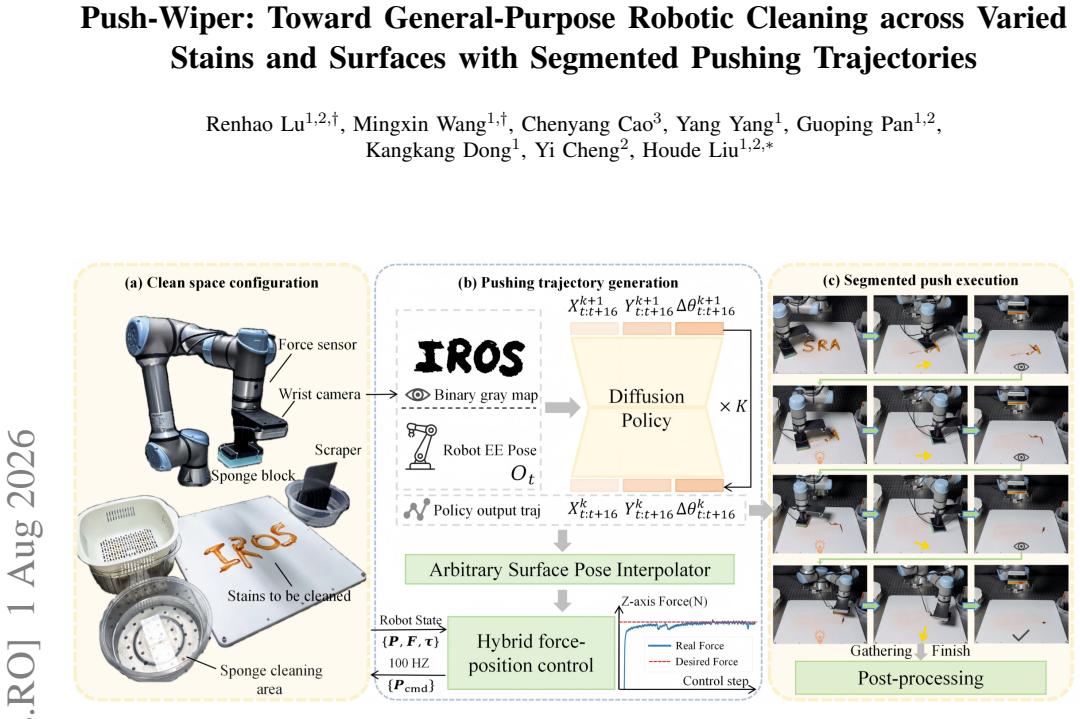
The load-bearing mechanism is the aggregate-then-finish loop with segmented pushing. At each macro-step, the policy infers a single complete pushing stroke that acts as a local optimizer for $D(S_t)+\lambda K(S_t)$, the stain's maximal spatial diameter plus fragmentation; ASPI then converts the predicted 2D translation plus yaw into a 6D pose trajectory aligned with the local surface normal, and the admittance controller keeps the sponge in stable contact at a constant normal force. This decoupling separates 2D topological planning from 3D geometric execution, so the policy can be trained entirely on planar data and still generalize to curved surfaces.
What would settle it
Run matched ketchup and peanut butter trials for Push-Wiper and the two baselines, then measure residue by an independent method, for example weighing the surface before and after cleaning under controlled conditions or photographing under fixed illumination and hand-labeling the wetted area, and compare rankings against the pixel-based Cleaning Score. If full-coverage wiping leaves less physically removable material than the detector suggests, the aggregation advantage shrinks or vanishes.
Extended reading notes
Core claim
The paper's central claim is that cleaning performance for high-viscosity contaminants is determined less by contact modeling than by the topological strategy of aggregation: repeatedly pushing the stain's boundary inward shrinks its spatial diameter and merges disconnected fragments, converting a smeary removal problem into a localized removal problem. A Diffusion Policy trained on segmented expert strokes outputs low-dimensional actions $a=(x_b,y_b,\Delta\theta)$ from a texture-free binary stain map, deliberately ignoring visual appearance and 3D geometry. The Arbitrary Surface Pose Interpolator (ASPI) maps those 2D actions onto the measured surface normal to produce smooth 6D trajectories, and an admittance controller holds the normal force at a setpoint while tracking the remaining axes. The paper reports that this decoupling yields near-complete cleaning on planar, convex, and concave surfaces and argues that aggregation, not wiping or scrubbing, is the right abstraction for general-purpose cleaning.
Load-bearing premise
The load-bearing premise, stated in Section IV-A, is that the Cleaning Score, computed from a custom HSV/Lab/grayscale stain detector with morphology filtering, faithfully measures true stain-area reduction; if that detector misses the thin smear films the baselines leave while seeing Push-Wiper's compact blob, the reported advantage would be inflated.
Editorial extensions
If this is right
- If the central claim is correct, coverage-style wiping, the default for many cleaning robots, is the wrong primitive for semi-solid stains; aggregation strokes should come first.
- Because the policy plans only in 2D plus yaw, expert demonstrations collected on flat tabletops can be reused for convex and concave surfaces without additional curved-surface training data.
- Keeping force feedback in the execution layer rather than in the policy means the same learned pushing behavior can be ported to different manipulators by adjusting the force setpoint.
- The post-processing primitives, dab, scrape, rinse, squeeze, and final wipe, turn a near-complete gathering result into an almost complete clean, raising average Cleaning Score from 89.44 to 99.25 in the reported trials.
Reading between the lines
- Inference: The binary-map abstraction suggests the learned skill is geometric herding rather than material-specific contact behavior, so the same trajectory policy might aggregate granular debris or deformable objects whenever the tool can push them; the paper only demonstrates this for rigid disks.
- Inference: The reported advantage over wiping may be partly detector-dependent: if the stain detector undercounts thin residual films, the method that leaves a compact blob will look cleaner than one that smears a thin layer. An independent mass-based or hand-labeled ground-truth measurement would separate true removal from perceptual convenience.
- Inference: The finish phase could itself be learned or coverage-planned rather than fixed primitives, which may extend the framework to stains too large or too sticky to gather into one small region.
Signed reviews
Editorial analysis
A structured set of objections, weighed in public.
Referee Report
Summary. Push-Wiper proposes a framework for robotic cleaning of viscous stains that reformulates the task as an aggregation problem. The system uses a Diffusion Policy over binary stain maps to generate segmented pushing trajectories, an Arbitrary Surface Pose Interpolator (ASPI) to map 2D actions onto 3D surfaces, and a hybrid force–position admittance controller for execution. The gathering phase is followed by a post-processing phase with predefined primitives. Experiments on ketchup and peanut butter compare Push-Wiper against two baselines (Full-Cover and PushAll-Onetime) using a Cleaning Score (CS), defined as the percentage reduction in detected stain pixels. The paper reports an overall average CS of 89.88 for Push-Wiper versus 32.64 and 44.98 for the baselines, and demonstrates zero-shot generalization to curved surfaces, solids, liquids, and unseen viscous stains.
Significance. If the reported results hold, the aggregate-then-finish paradigm is a valuable and potentially transformative contribution to robotic surface cleaning, where viscous stains have resisted simple wiping or scrubbing strategies. The decoupled design, in which the policy reasons only about 2D binary topology while geometric execution is handled by ASPI and force control, is elegant and leads to a genuinely impressive zero-shot transfer to curved surfaces and unobserved stain types without retraining. The experimental setup is fair in important ways: all methods share the same perception and execution stack, the same force controller, and the same wall-clock time budget per trial, with baselines evaluated at their best CS within that budget. The paper also makes concrete falsifiable claims and provides a project website, which supports reproducibility. However, the central quantitative claim rests on a custom stain detector that is not validated, and the headline improvement is not supported by statistical tests, so the significance of the numerical advantage is not yet firmly established.
major comments (3)
- [Section IV-A, Eq. (6)] The Cleaning Score is computed from an unvalidated stain detector. The detector fuses HSV/Lab/grayscale cues with morphology and connected-component filtering, but the paper provides no calibration of this detector against ground-truth stain area, no manual validation subset, and no sensitivity analysis. This is load-bearing because the baselines' characteristic failure mode is smearing into thin, low-contrast films (Fig. 4 shows severe smearing for Full-Cover and residual fragments for PushAll-Onetime), while Push-Wiper produces a compact, high-contrast aggregated blob. A thresholding/morphology pipeline can systematically erase faint smears while preserving the blob, inflating the measured CS gap (89.88 versus 32.64 and 44.98). The authors should report a validation of the detector on a held-out set with ground-truth stain area (e.g., known printed stain sizes or manual pixel annotation) and show that the reported qualitative conclusions are robust to detector parameters.
- [Table I] No statistical significance tests are reported despite large baseline variance. For example, Full-Cover on peanut butter complex stains has mean 6.11 with standard deviation 38.45, so the mean is not even one standard error above zero, and the paper's claim that Push-Wiper 'significantly outperforms' the baselines is unsupported by the reported statistics. The paper should provide paired per-trial comparisons (since the same stain distributions are used across methods), or at least bootstrap confidence intervals for the mean differences, for each stain type and complexity level. Without such tests, the 'up to 130% higher' claim is a point estimate with unknown reliability.
- [Section IV-B] The PushAll-Onetime baseline is trained on synthetic Pygame-generated global sweep trajectories, while Push-Wiper is trained on teleoperated expert demonstrations. This confounds the comparison: the performance gap could be due to the aggregation strategy itself, or due to the distribution shift and lower quality of synthetic supervision for the baseline. The paper states this design enables 'a controlled comparison' of global sweep versus aggregation-first, but the training data differ in a way that is not controlled. To support the attribution of the improvement to the segmented pushing strategy, the authors should either train PO on the same expert demonstrations (e.g., with experts performing global sweeps) or provide an additional ablation that controls for the supervision source.
minor comments (5)
- [Abstract] The phrase 'up to 130% higher' is ambiguous. Table I shows much larger relative improvements (e.g., peanut-butter complex: 89.13 vs 6.11 is a roughly 1300% increase), so '130%' likely refers to the improvement over the average of the two baselines rather than over either individual baseline. Please state the reference used for the percentage improvement.
- [Section IV-C] The protocol of reporting the 'best CS each baseline attains at any stopping point within T' is a post-hoc selection that can inflate baseline performance and is not a standard evaluation protocol. Please specify how the stopping point is chosen (e.g., whether it is selected by an oracle after observing the full run) and discuss the effect on the comparison.
- [Table IV] The post-processing evaluation reports only five trials per stain type with no standard deviation. Please include variance or individual trial results, especially since the reported improvement from post-processing (e.g., peanut butter 85.12 to 98.51) is based on small samples.
- [Equation (2)] The aggregation objective J_t = D(S_t) + λK(S_t) is introduced as the formal goal, but it is not directly measured during experiments. Please clarify how λ and the stopping threshold ϵ are chosen and provide a sensitivity analysis, or explicitly state that this objective is only a design motivation.
- [Section IV-D] The curved-surface experiments use 10 trials per geometry (5 ketchup, 5 peanut butter), which is a small sample. Given the strong claims about zero-shot generalization, it would be helpful to report individual trial results or confidence intervals, and to include more than two geometries.
Circularity Check
No significant circularity: the policy is trained by imitation learning on expert demonstrations, the evaluation metric is an external physical measurement, and no self-citations or fitted parameters are renamed as predictions.
full rationale
The claimed contributions are empirical and do not reduce to their inputs by construction. The Diffusion Policy is trained by teleoperated expert demonstrations on binary stain maps, not by optimizing the Cleaning Score or the aggregation objective of Eq. (2); therefore the reported CS values are genuine out-of-sample measurements of physical cleaning performance. The hand-set constants (force setpoint 20 N, stopping threshold 100 pixels) are experimental execution settings rather than parameters fitted to the metric. The CS metric itself, while computed from a custom morphology-based detector, is an external measurement instrument rather than a term in the derivation; its validity could be questioned as a correctness risk, but that is not circularity because the policy does not optimize or derive CS from the detector. The zero-shot generalization experiments use surfaces and substances not present in training, and the ASPI mapping is a deterministic geometric transform, not a learned fit to the evaluation outcomes. No self-citations are load-bearing, no uniqueness theorem is imported from the authors' prior work, and no known result is merely renamed. The paper's evidence chain is self-contained in the sense that its central claims are supported by direct experiments rather than by definitional or self-referential reductions.
Assumptions & free parameters
free parameters (3)
- F_des_z =
20 N
- q_th =
100 pixels
- admittance gains (m, b, k)
assumptions (5)
- domain assumption The binary stain map M_t retains sufficient information for generating effective pushing actions.
- domain assumption A sponge pushed against a viscous stain aggregates it rather than smearing it, for the tested substances.
- domain assumption The 2D-to-3D projection (ASPI) correctly maps planar actions onto smooth curved surfaces with a well-defined surface normal.
- domain assumption The stain detector measures true stain area accurately enough to compare methods.
- standard math Standard results from diffusion policy and admittance control apply as cited.
Cite this review
Pith. "Pith review of Push-Wiper: Toward General-Purpose Robotic Cleaning across Varied Stains and Surfaces with Segmented Pushing Trajectories." pith.science (2026). https://pith.science/paper/WPVN75LX
@misc{pith2026260800730,
  author       = {Pith},
  title        = {Pith review of: Push-Wiper: Toward General-Purpose Robotic Cleaning across Varied Stains and Surfaces with Segmented Pushing Trajectories},
  year         = {2026},
  howpublished = {\url{https://pith.science/paper/WPVN75LX}},
  note         = {Machine review of arXiv:2608.00730}
}
read the original abstract
Viscous stains, characterized by high viscosity and complex rheological properties, remain a major challenge for robotic surface cleaning. Conventional wiping often spreads the stain, while scrubbing provides stronger friction but risks damaging the surface. In this paper, we propose Push-Wiper, a framework that reformulates viscous stain cleaning as an aggregation problem. Push-Wiper employs a sponge to progressively gather stains through segmented pushing trajectories, followed by a post-processing phase that detaches the aggregated material and enables sponge self-cleaning. We adopt a stepwise strategy for stain gathering and leverage Diffusion Policy to generate adaptive pushing action sequences. These sequences are executed through our Arbitrary Surface Pose Interpolator (ASPI) and a hybrid force-position controller, allowing the method to generalize to stains with diverse spatial distributions. Push-Wiper achieves a cleaning score (CS), defined as the percentage of stain area removed, up to 130% higher than baseline methods. Without additional training, Push-Wiper also transfers in a zero-shot manner to solid residues, liquid spills, unseen viscous stains, and curved surfaces with varying geometries. Our experiments demonstrate the cleaning effectiveness of Push-Wiper and its strong generalization ability. The project website is available at https://push-wiper.github.io/.
Figures


Figures from the paper (4 more)


Reference graph
Works this paper leans on
-
[1]
Cleaning robots: A review of sensor technologies and intelligent control strategies for cleaning,
R. K. Megalingam, S. R. R. Vadivel, S. S. Kotaprolu, B. Nithul, D. V . Kumar, and G. Rudravaram, “Cleaning robots: A review of sensor technologies and intelligent control strategies for cleaning,”Journal of Field Robotics, 2025
work page 2025
-
[2]
A floor cleaning robot for domestic environments,
A. K. Bordoloi, M. F. Islam, J. Zaman, N. Phukan, and N. M. Kakoty, “A floor cleaning robot for domestic environments,” inProceedings of the 2017 3rd International Conference on Advances in Robotics, 2017, pp. 1–5
work page 2017
-
[3]
A survey on techniques and applica- tions of window-cleaning robots,
Z. Li, Q. Xu, and L. M. Tam, “A survey on techniques and applica- tions of window-cleaning robots,”IEEE Access, vol. 9, pp. 111 518– 111 532, 2021
work page 2021
-
[4]
Hybrid force-position control of an elastic tendon-driven scrubbing robot (tedsr),
N. Harmatz, A. Zahra, A. Abdelmalak, S. Purohit, T. Shin, and A. D. Mazzeo, “Hybrid force-position control of an elastic tendon-driven scrubbing robot (tedsr),” in2024 IEEE International Conference on Robotics and Automation (ICRA). IEEE, 2024, pp. 4693–4699
work page 2024
-
[5]
Sccrub: Surface cleaning compliant robot utilizing bristles,
J. F. Kowalewski, K. Hajjafar, A. Ugent, and J. I. Lipton, “Sccrub: Surface cleaning compliant robot utilizing bristles,”arXiv preprint arXiv:2507.06053, 2025
arXiv 2025
-
[6]
The fluid mechanics of cleaning and decontamination of surfaces,
J. R. Landel and D. I. Wilson, “The fluid mechanics of cleaning and decontamination of surfaces,”Annual Review of Fluid Mechanics, vol. 53, no. 1, pp. 147–171, 2021
work page 2021
-
[7]
Control strategies for cleaning robots in domestic applications: A comprehensive review,
J. Kim, A. K. Mishra, R. Limosani, M. Scafuro, N. Cauli, J. Santos- Victor, B. Mazzolai, and F. Cavallo, “Control strategies for cleaning robots in domestic applications: A comprehensive review,”Inter- national Journal of Advanced Robotic Systems, vol. 16, no. 4, p. 1729881419857432, 2019
work page 2019
-
[8]
S. Wakabayashi, K. Kawaharazuka, K. Okada, and M. Inaba, “Behav- ioral learning of dish rinsing and scrubbing based on interruptive direct teaching considering assistance rate,”Advanced Robotics, vol. 38, no. 15, pp. 1052–1065, 2024
work page 2024
Show all 31 references
-
[9]
Johansson and P
I. Johansson and P. Somasundaran,Handbook for clean- ing/decontamination of surfaces. Elsevier, 2007
2007
-
[10]
Table cleaning task by human support robot using deep learning technique,
J. Yin, K. G. S. Apuroop, Y . K. Tamilselvam, R. E. Mohan, B. Rama- lingam, and A. V . Le, “Table cleaning task by human support robot using deep learning technique,”Sensors, vol. 20, no. 6, p. 1698, 2020
2020
-
[11]
Robotic table wiping via reinforcement learning and whole-body trajectory optimization,
T. Lew, S. Singh, M. Prats, J. Bingham, J. Weisz, B. Holson, X. Zhang, V . Sindhwani, Y . Lu, F. Xia, P. Xu, T. Zhang, J. Tan, and M. Gonzalez, “Robotic table wiping via reinforcement learning and whole-body trajectory optimization,” in2023 IEEE International Conference on Rob...
2023
-
[12]
Diffusion policy: Visuomotor policy learning via ac- tion diffusion,
C. Chi, Z. Xu, S. Feng, E. Cousineau, Y . Du, B. Burchfiel, R. Tedrake, and S. Song, “Diffusion policy: Visuomotor policy learning via ac- tion diffusion,”The International Journal of Robotics Research, p. 02783649241273668, 2023
2023
-
[13]
Null space optimization for effective coverage of 3d surfaces using redundant manipulators,
J. Hess, G. D. Tipaldi, and W. Burgard, “Null space optimization for effective coverage of 3d surfaces using redundant manipulators,” in 2012 IEEE/RSJ International Conference on Intelligent Robots and Systems. IEEE, 2012, pp. 1923–1928
2012
-
[14]
Hierarchically accelerated coverage path planning for redundant manipulators,
Y . Wang and M. Gleicher, “Hierarchically accelerated coverage path planning for redundant manipulators,” in2025 IEEE International Conference on Robotics and Automation (ICRA), 2025, pp. 12 098– 12 104
2025
-
[15]
An experimental study of robot control during environmental contacts based on projected operational space dynamics,
V . Ortenzi, M. Adjigble, J. A. Kuo, R. Stolkin, and M. Mistry, “An experimental study of robot control during environmental contacts based on projected operational space dynamics,” in2014 IEEE-RAS International Conference on Humanoid Robots. IEEE, 2014, pp. 407–412
2014
-
[16]
Knowledge- enabled parameterization of whole-body control strategies for compli- ant service robots,
D. Leidner, A. Dietrich, M. Beetz, and A. Albu-Sch ¨affer, “Knowledge- enabled parameterization of whole-body control strategies for compli- ant service robots,”Autonomous Robots, vol. 40, no. 3, pp. 519–536, 2016
2016
-
[17]
Impedance control: An approach to manipulation,
N. Hogan, “Impedance control: An approach to manipulation,” in1984 American control conference. IEEE, 1984, pp. 304–313
1984
-
[18]
Variable impedance control in end-effector space: An action space for reinforcement learning in contact-rich tasks,
R. Mart ´ın-Mart´ın, M. A. Lee, R. Gardner, S. Savarese, J. Bohg, and A. Garg, “Variable impedance control in end-effector space: An action space for reinforcement learning in contact-rich tasks,” in2019 IEEE/RSJ international conference on intelligent robots and systems (IROS...
2019
-
[19]
Adaptive contact- rich manipulation through few-shot imitation learning with force- torque feedback and pre-trained object representations,
C. Tsuji, E. Coronado, P. Osorio, and G. Venture, “Adaptive contact- rich manipulation through few-shot imitation learning with force- torque feedback and pre-trained object representations,”IEEE Robotics and Automation Letters, 2024
2024
-
[20]
Imitation learning based on disentangled representation learning of behavioral characteristics,
R. Oishi, S. Sakaino, and T. Tsuji, “Imitation learning based on disentangled representation learning of behavioral characteristics,” arXiv preprint arXiv:2509.04737, 2025
2025 arXiv
-
[21]
A survey on diffusion policy for robotic manipulation: Taxonomy, analysis, and future directions,
M. Song, X. Deng, Z. Zhou, J. Wei, W. Guan, and L. Nie, “A survey on diffusion policy for robotic manipulation: Taxonomy, analysis, and future directions,”Authorea Preprints, 2025
2025
-
[22]
Admittance visuomotor policy learning for general-purpose contact-rich manipu- lations,
B. Zhou, R. Jiao, Y . Li, X. Yuan, F. Fang, and S. Li, “Admittance visuomotor policy learning for general-purpose contact-rich manipu- lations,”IEEE Transactions on Industrial Electronics, 2025
2025
-
[23]
Foar: Force-aware reactive policy for contact-rich robotic manipulation,
Z. He, H. Fang, J. Chen, H.-S. Fang, and C. Lu, “Foar: Force-aware reactive policy for contact-rich robotic manipulation,”IEEE Robotics and Automation Letters, 2025
2025
-
[24]
Reactive diffusion policy: Slow-fast visual-tactile policy learning for contact-rich manipulation,
H. Xue, J. Ren, W. Chen, G. Zhang, Y . Fang, G. Gu, H. Xu, and C. Lu, “Reactive diffusion policy: Slow-fast visual-tactile policy learning for contact-rich manipulation,” inProceedings of Robotics: Science and Systems (RSS), 2025
2025
-
[25]
Trends and challenges in robot manipula- tion,
A. Billard and D. Kragic, “Trends and challenges in robot manipula- tion,”Science, vol. 364, no. 6446, p. eaat8414, 2019
2019
-
[26]
Fluidlab: A differentiable environment for benchmarking complex fluid manipulation,
Z. Xian, B. Zhu, Z. Xu, H.-Y . Tung, A. Torralba, K. Fragkiadaki, and C. Gan, “Fluidlab: A differentiable environment for benchmarking complex fluid manipulation,” inInternational Conference on Learning Representations, 2023
2023
-
[27]
Distortion-free robotic surface-drawing using conformal mapping,
D. Song and Y . J. Kim, “Distortion-free robotic surface-drawing using conformal mapping,” in2019 International Conference on Robotics and Automation (ICRA), 2019, pp. 627–633
2019
-
[28]
Unified impedance and ad- mittance control,
C. Ott, R. Mukherjee, and Y . Nakamura, “Unified impedance and ad- mittance control,” in2010 IEEE international conference on robotics and automation. IEEE, 2010, pp. 554–561
2010
-
[29]
Rheological proper- ties of tomato ketchup
V . Kumb ´ar, S. Ondru ˇs´ıkov´a, and ˇS. Nedomov ´a, “Rheological proper- ties of tomato ketchup.” 2019
2019
-
[30]
Rheological properties of peanut butter,
G. P. Citerne, P. J. Carreau, and M. Moan, “Rheological properties of peanut butter,”Rheologica Acta, vol. 40, no. 1, pp. 86–96, 2001
2001
-
[31]
Denoising diffusion implicit models,
J. Song, C. Meng, and S. Ermon, “Denoising diffusion implicit models,” inInternational Conference on Learning Representations (ICLR), 2021
2021
Reviewed August 15, 2026 · model on record in the stance chip above.
Discussion (0). Continue with ORCID to comment.