REVIEW 3 major objections 5 minor 15 references
AOSpec: Action and Observation Co-Speculation for Low-Latency Agent Serving
T0 review · 3 major / 5 minor · reviewed 2026-08-15 · deepseek-v4-flash
Pith's one-line read The paper claims AOSpec is a lossless framework that co-speculates observations and actions, cutting mean end-to-end latency by 11.8-32.5% and p99 latency by up to 42.8% without changing agent outputs.
desk verdict Solid systems paper with a genuinely new co-speculation mechanism; the main caveat is that 'lossless' is scoped to filesystem-observable state, and the 'breaking the lookahead-accuracy tradeoff' claim is stronger than Figure 8 supports. read the letter →
The pith
A machine-rendered reading of the paper's core claim, the machinery that carries it, and where it could break.
The reading
What carries the argument
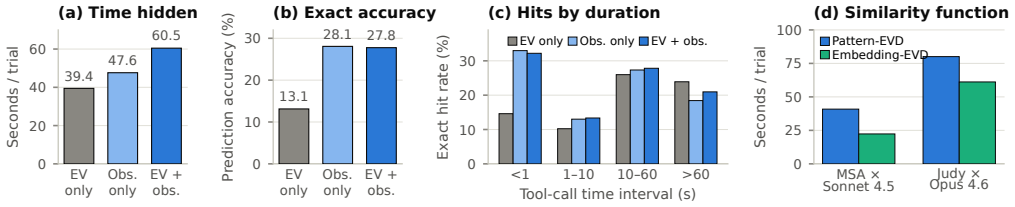
Three mechanisms carry the argument. Expected Value Decoding (EVD) is a ranking rule $V_o(c) = p_\theta(c | H_t, a_t) \hat{T}(c)$, where $\hat{T}(c)$ estimates a candidate observation's tool time from historical executions weighted by outcome similarity; it selects drafts to maximize expected hidden time rather than hit rate. Joint Action-State Verification (JASV) is the acceptance rule $[\hat{a}_f = a_i] \wedge [\nu(S_f) = \nu(S_i)]$: a speculative fork $f$ is reused only if its predicted action equals the actor's emitted action and the fork's origin environment version equals the committed environment version. The runtime support is a copy-on-write sandbox whose filesystem image has an immutable root-hash version, making JASV a cheap version comparison rather than a recursive state scan; non-filesystem inputs and effects are explicitly excluded. Together these mechanisms turn long-chain action prediction into target-action verification, and observation prediction into a latency-weighted draft race against execution.
What would settle it
Run an agent task where a speculated tool call mutates an external service, for example a request that increments a counter on a remote server, and a later action depends on that counter. In serial execution the external change is visible; under AOSpec the speculative fork's filesystem version is unchanged, so JASV can accept the fork even though the external state differs, producing a different later action. A direct check is to compare the environment version function before and after such an external mutation while the filesystem is untouched; the paper's root-hash design implies the version would not change, which would falsify the losslessness claim.
Extended reading notes
Core claim
The central claim, stated on the paper's own terms, is that action-only or observation-only speculation is insufficient for stateful tool workloads, and that jointly speculating both with verification is lossless and faster. AOSpec treats a speculative tool call as a fork of a versioned environment: the fork runs the predicted action in isolation, and JASV accepts it only when the action string and the environment version both equal the committed ones at the moment the actor emits the action. This converts a multi-step lookahead problem, which would require the entire intervening action chain to be predicted correctly, into a target action-state verification problem. Observations that can be predicted from context are handled by Expected Value Decoding, which scores candidate observations by $p_\theta \cdot \hat{T}$, the product of predicted probability and estimated tool time, so the system drafts the outcomes whose correct prediction hides the most wall-clock time rather than the most likely ones. Because mismatched forks are discarded and the action is re-executed from the committed state, the paper argues the committed trajectory is identical to serial execution, and the trace-replay experiments across 45 harness-model-TPOT configurations report latency savings that grow as decoding accelerates.
Load-bearing premise
The lossless claim rests on the premise that a sandboxed fork contains every effect of a speculative tool call, because the paper versions only the filesystem and states in Section 4.3 that non-filesystem inputs and effects are excluded; if a tool call changes something outside the filesystem, such as a network service, an external database, or a process outside the sandbox, the version check will not see the divergence.
Editorial extensions
If this is right
- If the claims hold, agent workloads whose tool time is concentrated in a few long calls can hide most of that time: the paper reports that 17% of calls lasting at least one second account for 97% of total tool time, and EVD aims drafts specifically at those calls.
- Faster decoding makes the method more valuable, not less: AOSpec's mean end-to-end saving rises from 11.8% at 20 ms/token to 32.5% at 1 ms/token, so it complements rather than competes with inference accelerators.
- The lookahead ceiling is no longer the multiplicative accuracy of a predicted action chain: JASV can accept a fork launched several steps earlier as long as the target action and origin environment match, and the ablations report target-action accuracy of 7.7% at distance ten, a regime where full-chain prediction is effectively zero.
- Tail latency improves more than median latency, with p99 reduction up to 42.8% versus about 10.7% median reduction at 10 ms/token, so the benefit is strongest for the slowest, most user-visible trials.
- The observation model transfers across benchmarks: trained only on Terminal-Bench, it still yields 18.9% end-to-end savings at 1 ms/token on SWE-bench Verified against 4.2% for the strongest baseline, suggesting the value structure of tool observations is not benchmark-specific.
Reading between the lines
- The paper reports that its copy-on-write runtime comes from concurrent work under anonymous review and will be cited later; until that runtime is public, the isolation contract cannot be re-implemented or audited from the paper alone.
- Because EVD produces a per-step expected-time score, a natural extension is an adaptive draft budget that spends more observation branches on steps with high predicted tool time and uncertain outcomes, rather than the fixed five-branch budget used in the experiments.
- The byte-identical observation verification is conservative; canonicalizing inconsequential fields such as process IDs or timestamps, which the paper mentions as a possibility, would raise the acceptance rate without changing application semantics and is a direct testable modification.
Signed reviews
Editorial analysis
A structured set of objections, weighed in public.
Referee Report
Summary. AOSpec proposes a framework for reducing end-to-end latency in LLM-agent serving by speculating both observations and actions. Observation speculation uses Expected Value Decoding (EVD) to rank candidate observations by expected hidden tool time, while action speculation executes latency-critical target actions in isolated sandboxed forks; Joint Action-State Verification (JASV) accepts a fork only if the speculative action equals the emitted action and the fork's origin environment version equals the committed environment version. The paper claims AOSpec is lossless, breaks the lookahead-accuracy tradeoff, and reduces mean end-to-end latency by 11.8-32.5% with p99 reductions up to 42.8% across Terminal-Bench harness/model configurations, with the observation model transferring to SWE-bench Verified without retraining.
Significance. If the stated results hold, AOSpec addresses a practically important bottleneck in agent serving: tool execution time increasingly dominates as decoding accelerates. The paper's strengths include a concrete measurement of latency concentration, a clear two-level speculation design, an objective (EVD) that targets expected time hidden rather than hit rate, and a broad trace-replay evaluation spanning multiple harnesses, models, and TPOT settings. The transfer experiment to SWE-bench is a useful generalization check. However, the central losslessness guarantee is established only for filesystem-managed state, and the evaluation uses fixed actor trajectories, so the contribution should be framed as latency optimization under a constrained semantics rather than a universally lossless serving system. With appropriate scoping and additional validation, the framework is a meaningful step for low-latency agent serving.
major comments (3)
- [Section 4.3, Eq. (4)] The losslessness claim in the abstract and in Section 4.3 is not supported as stated. The environment-equality test in Eq. (4) is ν(S_f)=ν(S_i), and the text immediately defines ν as a copy-on-write filesystem root hash, stating 'Non-filesystem inputs and effects are excluded.' A speculative fork can therefore be accepted even when network, process, clock, or other non-filesystem state differs from serial execution. If the observation produced in the fork differs from what serial execution would return, Algorithm 1 (lines 21-23) commits that observation and the trajectory diverges. The losslessness claim must be explicitly scoped to filesystem-managed state, or the runtime must isolate and verify non-filesystem effects before the abstract's unqualified claim can stand.
- [Section 5.5, Figure 8(b)] The claim that JASV 'breaks the lookahead--accuracy tradeoff' is contradicted by the paper's own data. Figure 8(b) shows target-action accuracy declining from 23.7% at distance one to 7.7% at distance ten. JASV removes the multiplicative failure of full-chain prediction, but the accuracy of predicting even a single distant target still degrades with distance. The paper should reframe this as mitigating or reducing the cost of the tradeoff, and it should quantify the net end-to-end latency benefit at the lookahead distances where accuracy has already decayed.
- [Section 5.1] The evaluation replays all methods on identical actor trajectories, as the authors acknowledge. Because AOSpec's benefit depends on continuing generation from speculative observations and then discarding mismatched branches, this protocol cannot measure the effect of wrong speculations on the actor's future trajectory. The reported 11.8-32.5% savings are therefore conditional on trajectories not diverging, and the lossless claim is not validated end-to-end under live scheduling. A live or partially-live evaluation, or at minimum an analysis of how often the commit logic produces a different trajectory than serial execution, is needed before the serving-latency claim can be taken at face value.
minor comments (5)
- [Abstract] The word 'lossless' appears in the abstract before the filesystem-only qualification introduced in Section 4.3; consider qualifying it at first use to avoid overclaiming.
- [Section 4.3] The sentence 'Our implementation adopts a CoW agent runtime from concurrent work under anonymous review' and the Judy harness footnote make the evaluation depend on artifacts that cannot be inspected; please provide a public implementation or a detailed runtime interface specification.
- [Section 5.5, Figure 8(b)] The text says the accuracy of intervening action chains is 'effectively zero at this distance,' but Figure 8(b) reports 7.7% at distance ten; the wording should match the reported data.
- [Table 2] The rows in Table 2 are misaligned (for example, 'Task query28.7 33.6'); fix the formatting so each removed-input condition and its two metrics are readable.
- [Equation (2)] The similarity kernel K(c,o_j) is not defined; specify how Pattern-EVD mines regular-expression patterns and what representation Embedding-EVD uses, since both are compared in Figure 6(d).
Circularity Check
Minor definitional circularity in the filesystem-scoped losslessness guarantee; latency results are independently evaluated.
-
self definitional
[Section 4.3, Eq. (4), Runtime Support; Abstract]
"JASV accepts the fork only if both actions and pre-execution environments match: ValidAct(f, ai, Si) = [âf = ai] ∧ [ν(Sf) = ν(Si)]. ... A valid fork executed the same action from the same environment, so its observation and effects can be reused ... Our implementation assigns each sandbox's copy-on-write (CoW) filesystem image an immutable version, which is uniquely identified by its root hash. ... Non-filesystem inputs and effects are excluded. ... AOSpec's execution is semantically identical to the serial execution, making it a lossless speculation."
Eq. (4) defines the 'same environment' condition as ν(Sf) = ν(Si), and Runtime Support defines ν as a copy-on-write filesystem root hash, explicitly excluding non-filesystem inputs and effects. The later sentence 'A valid fork executed the same action from the same environment, so its observation and effects can be reused' therefore converts root-hash equality into a claim of full semantic identity by construction, not by independent verification. The 'lossless' guarantee holds only inside the filesystem-only state abstraction chosen by the implementation; any non-filesystem difference (network, process, clock, external service state) between fork origin and committed environment is invisible to Eq.
full rationale
The core derivation chain is not circular. The latency reductions are measured on Terminal-Bench and SWE-bench with explicitly disjoint training and test sets ('We split Terminal-Bench tasks into disjoint training and test sets'), and predictors use only training tasks. The observation model is fine-tuned on Terminal-Bench traces but evaluated on held-out Terminal-Bench tasks and transferred to SWE-bench Verified without retraining, so the generalization claim is externally grounded. EVD's tool-time estimator is trained on historical executions, not on the test traces being predicted, and the paper compares against baselines and oracles rather than reporting fitted values as predictions. JASV's verification logic is a runtime check, not a fitted parameter. The only reductive step is the losslessness guarantee: Eq. (4) equates 'same environment' with a filesystem root-hash match, and the paper itself states 'Non-filesystem inputs and effects are excluded,' so the semantic-identity conclusion is true by definition of the state abstraction, not by a full-environment proof. This is a disclosed scoping limitation rather than a hidden circular dependency, and it does not invalidate the measured latency comparisons. The self-references present (e.g., prior parallel decoding work, an anonymous concurrent runtime) are not load-bearing for the empirical claims, and the runtime dependency's missing citation is a reproducibility concern, not circularity.
Assumptions & free parameters
free parameters (3)
- Observation branch width =
5
- Action fork width =
8
- Pattern-EVD regex pattern set =
mined from training traces
assumptions (4)
- domain assumption The sandbox snapshot, fork, execute, commit, and discard operations exactly capture and restore all environment state relevant to future actions.
- domain assumption Byte-identical observation matching implies application-level equivalence of trajectories.
- domain assumption Trace replay with recorded actor trajectories is representative of live serving behavior.
- domain assumption The CoW agent runtime adopted from anonymous concurrent work behaves as described.
Cite this review
Pith. "Pith review of AOSpec: Action and Observation Co-Speculation for Low-Latency Agent Serving." pith.science (2026). https://pith.science/paper/TWOO3OCE
@misc{pith2026260800881,
  author       = {Pith},
  title        = {Pith review of: AOSpec: Action and Observation Co-Speculation for Low-Latency Agent Serving},
  year         = {2026},
  howpublished = {\url{https://pith.science/paper/TWOO3OCE}},
  note         = {Machine review of arXiv:2608.00881}
}
read the original abstract
Large language model agents increasingly act through stateful tools, yet model generation and environment execution remain serialized at every step. As decoding accelerates, tool execution becomes a growing bottleneck. Existing action- or observation-only speculation leaves much of this latency exposed: value is concentrated in a few slow calls, some outcomes emerge only through execution, and longer lookahead typically requires an increasingly unlikely chain of action predictions. We present AOSpec, a lossless framework that co-speculates actions and observations across the full agent-environment loop. Expected Value Decoding (EVD) directs observation speculation toward outcomes with the greatest expected latency benefit, optimizing expected time hidden rather than hit rate. For outcomes only execution can reveal, AOSpec launches latency-critical target actions in isolated forks that contain their effects, while Joint Action-State Verification (JASV) verifies both the action and its origin state against committed execution before reuse. JASV recasts long-horizon action dependency from full-chain prediction into target action-state verification, breaking the lookahead--accuracy tradeoff and unlocking long-range overlap without sacrificing serial semantics. Across Terminal-Bench serving settings spanning four harnesses, five actor models, and five serving speeds, AOSpec outperforms every practical baseline, reducing mean end-to-end latency by 11.8-32.5% and p99 latency by up to 42.8%. Its gains increase as decoding accelerates, and its observation model transfers from Terminal-Bench to SWE-bench Verified without retraining.
Figures


Figures from the paper (4 more)



Reference graph
Works this paper leans on
-
[3]
The Auton Agentic AI Framework.arXiv preprint arXiv:2602.23720. Cerebras Systems
-
[4]
Dong, Y.; He, J.; Liu, S.; Hou, Y.; Du, D.; Xu, Z.; Yu, S.; Yang, B.; Xia, Y.; and Chen, H
Hardware-aware parallel prompt decoding for memory-efficient acceleration of llm inference.arXiv preprint arXiv:2405.18628. Dong, Y.; He, J.; Liu, S.; Hou, Y.; Du, D.; Xu, Z.; Yu, S.; Yang, B.; Xia, Y.; and Chen, H
-
[5]
DeltaBox: Scaling Stateful AI Agents with Millisecond-Level Sandbox Check- point/Rollback.arXiv preprint arXiv:2605.22781. Google
-
[6]
Groq First Generation 14nm Chip Just Got a 6x Speed Boost: Introducing Llama 3.1 70B Speculative Decoding on GroqCloud. https://groq.com/blog/groq-first-generation-14nm-chip- just-got-a-6x-speed-boost-introducing-llama-3-1-70b- speculative-decoding-on-groqcloud. Jimenez, C. E.; Yang, J.; Wettig, A.; Yao, S.; Pei, K.; Press, O.;andNarasimhan,K.R.2024.SWE-b...
work page 2024
-
[7]
Nichols,D.;Singhania,P.;Jekel,C.;Bhatele,A.;andMenon, H.2025
Terminal-bench: Benchmarking agents on hard, realistic tasks in command line interfaces.arXiv preprint arXiv:2601.11868. Nichols,D.;Singhania,P.;Jekel,C.;Bhatele,A.;andMenon, H.2025. OptimizingAgenticLanguageModelInferencevia Speculative Tool Calls.arXiv preprint arXiv:2512.15834. OpenClaw Foundation
arXiv 2025
-
[8]
SpecHop: Con- tinuous Speculation for Accelerating Multi-Hop Retrieval Agents.arXiv preprint arXiv:2605.21965. Song, Y
-
[9]
B-PASTE: Beam-Aware Pattern-Guided Speculative Execution for Resource-Constrained LLM Agents
B-PASTE: Beam-Aware Pattern-Guided Speculative Execution for Resource-Constrained LLM Agents.arXiv preprint arXiv:2604.16469. Sui, Y.; Zhao, H.; Ma, R.; He, Z.; Wang, H.; Li, J.; Xu, K.; Chen, K.; and Yang, Y
-
[10]
Parallelizing Tool Execution andLLMGenerationforLow-LatencyAgentServing.arXiv preprint arXiv:2603.18897. Tencent Cloud
Show all 15 references
-
[11]
https://github.com/tile-ai/TileRT
TileRT: Tile-Based Runtime for Ultra-Low- Latency LLM Inference. https://github.com/tile-ai/TileRT. Wang, X.; Li, B.; Song, Y.; Xu, F. F.; Tang, X.; Zhuge, M.; Pan,J.;Song,Y.;Li,B.;Singh,J.;etal.2025.Openhands:An openplatformforaisoftwaredevelopersasgeneralistagents. InInterna...
2025
-
[12]
Yang, J.; Jimenez, C
Idleness is Relative: Exploiting Tool- Call Idle Windows for Offloading in Agentic Systems with MORI.arXiv preprint arXiv:2606.00866. Yang, J.; Jimenez, C. E.; Wettig, A.; Lieret, K.; Yao, S.; Narasimhan, K. R.; and Press, O
-
[15]
DualSpec: Accelerating Deep Research AgentsviaDual-ProcessActionSpeculation.arXivpreprint arXiv:2603.07416
-
[2022]
InNeurIPS 2022 Foundation Models for Decision Making Workshop
React: Synergizing reasoning and acting in language models. InNeurIPS 2022 Foundation Models for Decision Making Workshop. Ye, N.; Ahuja, A.; Liargkovas, G.; Lu, Y.; Kaffes, K.; and Peng, T
2022
-
[2024]
Cao, S.; Chang, Z.; Li, C.; Li, H.; Fu, L.; and Tang, J
Medusa: Simple llm inference acceleration framework with multiple decoding heads.arXiv preprint arXiv:2401.10774. Cao, S.; Chang, Z.; Li, C.; Li, H.; Fu, L.; and Tang, J
-
[2025]
Zhong, S.; Lu, B.; Chen, Q.; Liu, C.; Yang, F.; and Li, M
Speculative Actions: A Lossless Framework for Faster Agentic Systems.arXiv preprint arXiv:2510.04371. Zhong, S.; Lu, B.; Chen, Q.; Liu, C.; Yang, F.; and Li, M
-
[2026]
Artificial Analysis. 2026a. Anthropic: Models Intelligence, Performance & Price Analysis. https://artificialanalysis.ai/ providers/anthropic. Artificial Analysis. 2026b. OpenAI: Models Intelligence, Performance & Price Analysis. https://artificialanalysis.ai/ providers/openai....
2026 arXiv
Reviewed August 15, 2026 · model on record in the stance chip above.
Discussion (0). Continue with ORCID to comment.