REVIEW 3 major objections 4 minor 47 references
FinHardBench: Can LLMs Generate Latency-Aware Hardware for Financial Computing?
T0 review · 3 major / 4 minor · reviewed 2026-08-06 · deepseek-v4-flash
Pith's one-line read LLMs can search FPGA design space more reliably than classical baselines at the same budget.
desk verdict Solid, well-scoped benchmark that adds post-P&R timing and system-level DSE to HDL evaluation; the main caveats are disclosed and fixable. read the letter →
The pith
A machine-rendered reading of the paper's core claim, the machinery that carries it, and where it could break.
The reading
What carries the argument
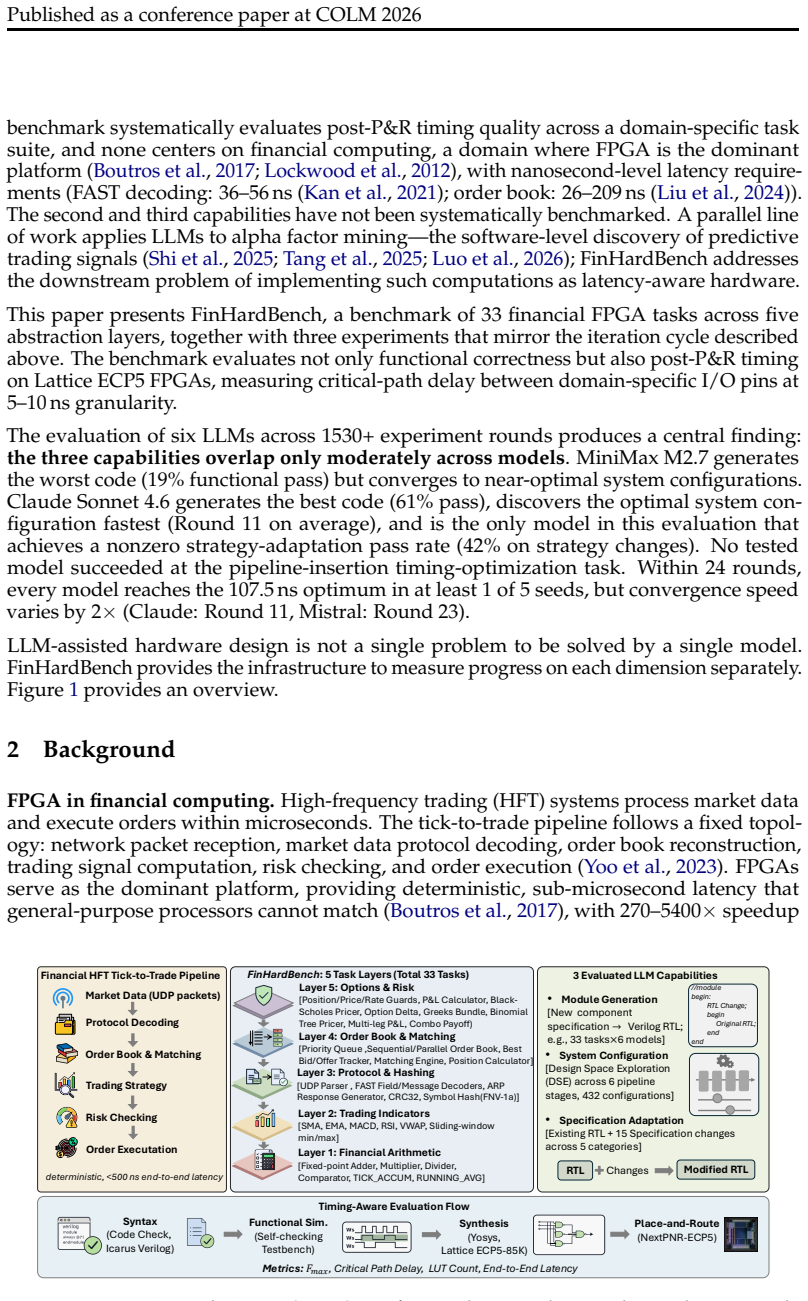
The load-bearing object is the fixed six-stage HFT pipeline (UDP RX, FAST decode, order book, strategy, risk check, match), parameterized by per-stage knobs into 432 configurations, evaluated under the structural latency objective $E2E = \sum_i \text{depth}_i / \min_i \text{Fmax}_i$ with a 5000-LUT budget. The benchmark also supplies per-task domain-specific critical I/O paths and golden references, so timing is measured between financial pins such as order valid and match valid rather than on generic register-to-register paths. This setup lets the DSE experiment isolate the LLM's ability to search a discrete space from its ability to write RTL.
What would settle it
Measure the actual end-to-end latency of the DSE-optimal configuration (combinational FAST decoder, DEPTH=4 sequential order book) under bursty market-data arrivals with real queue occupancy, or re-run Experiment 2 with per-stage FIFO depths as additional knobs and a backpressure-aware simulator; if the 107.5 ns configuration is no longer optimal or top LLMs no longer reach it on all seeds, the ranking rests on an idealized objective.
Extended reading notes
Core claim
FinHardBench claims that LLM-assisted hardware design is not one problem but three separable capabilities, and measures each. On module generation, functional pass rates range from 19% to 61%, and timing degradation is pattern-specific rather than uniform: 6 of 11 passing tasks stay within 1.2× of the golden reference, while VWAP and RSI collapse because LLMs use combinational 48-bit division instead of iterative fixed-point division. On system-level design space exploration, the top LLMs reach the 107.5 ns optimum on all 5 seeds within 24 rounds, exceeding simulated annealing (4/5), Bayesian optimization (2/5), and random search (0/5); the optimal configuration requires a combinational rath
Load-bearing premise
The headline DSE result depends on the structural latency model $E2E = \sum_i \text{depth}_i / \min_i \text{Fmax}_i$, which ignores queue fill, stall propagation, and data-dependent timing and treats the strategy stage as one cycle; if real backpressure at the order-book-to-strategy handoff dominates, the 107.5 ns optimum and the LLM-over-baseline ranking could change.
Editorial extensions
If this is right
- At a fixed 24-round budget, only the top two LLMs reach the 107.5 ns optimum on all five seeds; simulated annealing needs 48 rounds and Bayesian optimization 96 to reach the same reliability, so the LLM advantage is budget-conditional sample efficiency.
- The DSE failure mode of weaker models is local oscillation on a single knob, while stronger models explore broadly, identify the bottleneck, and change several knobs at once, suggesting search strategy rather than code quality drives the DSE result.
- Functional correctness is the gating metric: 34.7% of generated designs synthesize and route but fail simulation, so toolchain success alone cannot be a deployment gate for financial hardware.
- Timing degradation is concentrated in tasks whose efficient implementations, such as pipelined or iterative fixed-point division and transcendental approximations, are rare in training data; difficulty tracks data-pattern availability more than abstraction level.
- Strategy-level adaptation and performance optimization remain unsolved: only one model achieves a nonzero pass rate on strategy changes, and no model succeeds at pipeline insertion, so these stages still require human expertise.
Reading between the lines
- If the DSE reliability result transfers beyond 432 configurations, LLMs could serve as cheap search priors in larger microarchitectural spaces where Bayesian optimization is sample-starved; a direct test would scale the knob count and compare first-optimum rounds.
- The paper's own limitation suggests a testable extension: add per-stage FIFO depths and a backpressure-aware latency model; if bursty order-book updates make the combinational FAST decoder stall, the optimal configuration and the LLM-versus-baseline ranking could shift.
- The deployable-but-wrong population implies that production LLM-assisted flows should gate on functional simulation before place-and-route, since routed-but-wrong modules produce plausible timing reports while computing incorrect values.
- The moderate overlap between generation, DSE, and adaptation rankings suggests a specialized multi-model pipeline—one model to search configurations, another to write RTL, and a human for adaptation—rather than a single all-purpose model.
Editorial analysis
A structured set of objections, weighed in public.
Referee Report
Summary. The paper introduces FinHardBench, a 33-task financial FPGA benchmark across five abstraction layers, and evaluates six LLMs on three capabilities that mirror a production iteration cycle: module generation (594 trials), system-level design-space exploration (720 DSE rounds), and specification adaptation (270 trials). The main findings are: (1) functional correctness is 19-61% with timing degradation up to 13.7x on specific tasks; (2) top LLMs reach the 107.5 ns DSE optimum on 5/5 seeds within 24 rounds, versus 0-4/5 for random search, simulated annealing, and Bayesian optimization; (3) strategy changes remain unsolved except for Claude (42%). The paper includes a cross-toolchain pilot, a budget sensitivity sweep, an agentic pilot, and an open-source release.
Significance. FinHardBench fills a real gap: existing HDL benchmarks mostly measure functional correctness and resources, whereas this work adds post-P&R timing, system-level DSE, and specification adaptation in a financially relevant domain. The strongest contributions are the reproducible open-source infrastructure, the full synthesis/P&R evaluation, the cross-toolchain rank agreement (rho=0.982), the budget sweep, and the honest limitation statements. If the results hold, the paper gives the community a useful benchmark and a non-obvious separation of code-generation versus architecture-search capability. The main caveat is the external validity of the DSE latency objective, which is structural and does not model queueing/backpressure; the paper discloses this but does not quantify its impact.
major comments (3)
- [Section 4.3 and Limitations] The DSE objective E2E = sum_i depth_i / min_i Fmax_i omits queue fill, stall propagation, and data-dependent timing, and idealizes the STRATEGY stage as one cycle. The abstract's headline claim that top LLMs 'converge to the optimal configuration' is a search result over this structural proxy. The paper itself identifies the ORDER BOOK-to-STRATEGY handoff as the place where production systems buffer bursty updates. Because the 107.5 ns optimum and the 5/5-vs-0-4/5 ranking are outcomes of searching this specific landscape, the benchmark currently demonstrates optimization of a structural latency proxy, not necessarily latency-aware hardware for financial computing. Please either add a sensitivity analysis (for example, include per-stage FIFO depths and stall probabilities, and recompute the optimum and the LLM/baseline rankings under that model) or consistently reframe the external-validi
- [Section 4.3 and Appendix B] The baseline comparison uses untuned library-default implementations. The budget sweep shows that SA reaches 5/5 at 48 rounds and BO reaches 5/5 only at 96 rounds, while at the 24-round budget SA is at 4/5. Thus the claim that top LLMs have 'higher reliability than random search, simulated annealing, and Bayesian optimization baselines' is conditional on both the 24-round budget and untuned baseline hyperparameters. The abstract states only the budget condition, which overstates the comparison. Please either tune the baselines (or report a small sensitivity sweep over baseline defaults) and show whether the 5/5 result persists, or qualify the claim in the abstract and conclusion to 'out-of-the-box baselines at a 24-round budget'.
- [Abstract and Section 5] The claim that task difficulty 'tracks training data pattern availability more closely than abstraction level' is not tested in the paper. No quantitative measure of pattern availability is defined, and abstraction level is not operationalized either. The evidence is qualitative (e.g., efficient fixed-point division is rare in open-source Verilog corpora). This is a central interpretation claim, not a side remark. Please either define a measurable proxy (such as n-gram or token overlap with public HDL corpora, or occurrence counts of the required operator/algorithm patterns) and test the claim, or downgrade it from a finding to a stated hypothesis.
minor comments (4)
- [Table 2] The first two rows appear to have lost their column separators: 'GPT-5.4 926157 54 141 1573' and 'Claude Sonnet 4.6 8661 61 57165 1096'. Please repair the table formatting so Syn%, Sim%, Synth%, Routed%, Fmax, and LUTs are all readable and consistent.
- [Section 4.3] The E2E latency formula is given inline rather than as a numbered equation. Please number it and define Fmax_i and depth_i explicitly (e.g., which stages are covered, and how depth is counted for combinational stages).
- [Figure 1] There is a typo in the figure: 'Order Executation' should be 'Order Execution'.
- [Section 4.5] The cross-experiment correlations are computed at n=6 with p=0.27 and p=0.16. The paper does acknowledge the limited power, but the phrase 'moderate correlation' still reads as a substantive finding. Please label this analysis explicitly as exploratory and avoid drawing comparative conclusions from it.
Circularity Check
No significant circularity: FinHardBench's headline results are measured against an external open-source toolchain and golden references, and its structural latency model is a disclosed assumption rather than a self-derived prediction.
full rationale
FinHardBench is an empirical benchmark rather than a derivation chain, and none of its headline results reduce to its inputs by construction. Experiment 1 evaluates functional correctness and post-P&R timing against golden references and the open-source Icarus/Yosys/NextPNR toolchain, which are external, falsifiable metrics rather than quantities fitted to produce the reported pass rates. Experiment 2's 107.5 ns optimum is defined by the stated structural latency equation E2E = sum_i depth_i / min_i Fmax_i over cached per-stage P&R results, and the LLMs, SA, BO, and random search are all evaluated on exactly the same cache and budget; the LLM advantage is measured, not manufactured. The paper explicitly discloses the limitation that this latency model ignores queueing, stall propagation, and backpressure, which is a correctness/validity concern for the benchmark's real-world proxy, not a circularity. Experiment 3 again uses deterministic self-checking testbenches. The only self-referential element is the post-hoc interpretation that task difficulty tracks training-data pattern availability, which is an empirical analysis of the authors' own task suite, not an equation or fitted prediction. The paper contains no fitted-parameter-called-prediction step and no load-bearing self-citation: its citations to VeriGen and other prior work are contextual, not used to prove the benchmark's claims. Accordingly, no circular step can be exhibited.
Assumptions & free parameters
free parameters (2)
- DSE round budget B =
24 rounds
- LLM sampling temperature =
0.7
assumptions (4)
- domain assumption ECP5 open-source flow timing ranks transfer to production Xilinx UltraScale+ flows.
- domain assumption Exp-2 objective E2E = sum_i depth_i / min_i Fmax_i captures the relevant system latency.
- domain assumption The 6-stage tick-to-trade pipeline topology and per-stage variants represent production HFT FPGA systems.
- domain assumption Author-written golden references and self-checking testbenches are correct.
Cite this review
Pith. "Pith review of FinHardBench: Can LLMs Generate Latency-Aware Hardware for Financial Computing?." pith.science (2026). https://pith.science/paper/WUBHKREO
@misc{pith2026260800909,
  author       = {Pith},
  title        = {Pith review of: FinHardBench: Can LLMs Generate Latency-Aware Hardware for Financial Computing?},
  year         = {2026},
  howpublished = {\url{https://pith.science/paper/WUBHKREO}},
  note         = {Machine review of arXiv:2608.00909}
}
abstract
Can large language models generate not just correct, but fast hardware? This paper investigates the question in financial FPGA design, where 5-10 nanoseconds of latency determines competitive advantage and designs iterate continuously as protocols, strategies, and regulations evolve. FinHardBench, a benchmark of 33 financial computing tasks, is presented together with three experiments that mirror the real-world FPGA iteration cycle: generating new modules from specifications, tuning system-level configurations across a 6-stage trading pipeline, and adapting existing modules to specification changes. Evaluation of six LLMs on 1530+ experiment rounds yields three findings: (1) models achieve 19-61% functional correctness with timing degradation up to 13.7$\times$ on specific tasks; (2) in system-level design space exploration, top LLMs converge to the optimal configuration with higher reliability than random search, simulated annealing, and Bayesian optimization baselines (5/5 seeds vs. 0-4/5 at the same 24-round budget); (3) strategy-level specification changes remain unsolved for most models. Across the six models, generation and DSE rankings overlap moderately: the strongest code generator is not the fastest architecture optimizer, and the weakest code generator (MiniMax M2.7) still reaches the system optimum on 4 of 5 seeds. On the tasks in FinHardBench, difficulty tracks training data pattern availability more closely than abstraction level. FinHardBench is released as an open-source benchmark.
Figures


Figures from the paper (1 more)

Reference graph
Works this paper leans on
-
[1]
Liu, Mingjie and Ene, Teodor-Dumitru and Kirby, Robert and Cheng, Chris and Pinckney, Nathaniel Ross and Liang, Rongjian and Alben, Jonah and Anand, Himyanshu and Banerjee, Sanmitra and Bayraktaroglu, Ismet and others , journal=. 2023 , doi=
work page 2023
-
[2]
Information Sciences , volume=
Large language model assisted evolutionary neural architecture search with population knowledge base enhancement , author=. Information Sciences , volume=. 2026 , doi=
work page 2026
-
[3]
O Mahony, Aidan and Hanzon, Bernard and Popovici, Emanuel , journal=. The Role of. 2024 , doi=
work page 2024
-
[4]
Pinckney, Nathaniel Ross and Deng, Chenhui and Ho, Chia-Tung and Tsai, Yun-Da and Liu, Mingjie and Zhou, Wenfei and Khailany, Brucek and Ren, Haoxing , journal=. Comprehensive. 2025 , doi=
work page 2025
-
[5]
Thakur, Shailja and Ahmad, Baleegh and Fan, Zhenxing and Pearce, Hammond and Finkbeiner, Bernd and Tan, Benjamin , journal=
-
[6]
Lu, Yao and Liu, Shang and Zhang, Qijun and Xie, Zhiyao , booktitle=
-
[7]
Liu, Mingjie and Pinckney, Nathaniel and Khailany, Brucek and Ren, Haoxing , booktitle=
-
[8]
Guo, Ce and Zhao, Tong , booktitle=
Show all 47 references
-
[9]
Thorat, Kiran and Zhao, Jiahui and Liu, Yaotian and Hasan, Arif and Peng, Hongwu and Xie, Xi and Lei, Bin and Ding, Caiwen , booktitle=
-
[10]
Advances in Neural Information Processing Systems (NeurIPS) , year=
Mercury: A code efficiency benchmark for code large language models , author=. Advances in Neural Information Processing Systems (NeurIPS) , year=
-
[11]
Exploring code language models for automated
Gai, Jiahao and Chen, Hao and Wang, Zhican and Zhou, Hongyu and Zhao, Wanru and Lane, Nicholas and Fan, Hongxiang , booktitle=. Exploring code language models for automated
-
[12]
Build fast, trade fast:
Boutros, Andrew and Grady, Brett and Abbas, Mustafa and Chow, Paul , booktitle=. Build fast, trade fast:
-
[13]
A low-latency library in
Lockwood, John W and Gupte, Adwait and Mehta, Nishit and Blott, Michaela and English, Tom and Vissers, Kees , booktitle=. A low-latency library in
-
[14]
Oliveira, Caio C. S. and Bonato, Vanderlei , journal=. A. 2023 , doi=
2023
-
[15]
2021 , doi=
Kan, Hongwei and Hao, Rui and Wang, Jiangwei and Mei, Guoqiang and Su, Dongdong and Deng, Songqing , booktitle=. 2021 , doi=
2021
-
[16]
Yoo, Sungyeob and Kim, Hyunsung and Kim, Jinseok and Park, Sunghyun and Kim, Joo-Young and Oh, Jinwook , booktitle=
-
[17]
Real-time order book building and snapshot generating for high frequency trading on
Liu, Yang and Chen, Shuai and Ma, Lei and Yang, Ge and others , booktitle=. Real-time order book building and snapshot generating for high frequency trading on
-
[18]
Large language model for
Yang, Guang and Zheng, Wei and Chen, Xin and Liang, Dong and Hu, Peng and others , journal=. Large language model for
-
[19]
Liu, Shang and Fang, Wenji and Lu, Yao and Zhang, Qijun and Zhang, Hongce and Xie, Zhiyao , journal=
-
[20]
2026 , doi=
Zhao, Yang and Huang, Di and Li, Chongxiao and Jin, Pengwei and Song, Muxin and Xu, Yinan and Nan, Ziyuan and Gao, Mingju and Ma, Tianyun and Qi, Lei and Pan, Yansong and Zhang, Zhenxing and Zhang, Rui and Zhang, Xishan and Du, Zidong and Guo, Qi and Hu, Xing , journal=. 2026 , doi=
2026
-
[21]
NAECON , year=
Automated synthesis of hardware designs using symbolic feedback and grammar-constrained decoding in large language models , author=. NAECON , year=
-
[22]
IEEE International Performance Computing and Communications Conference (IPCCC) , year=
A pipelined market data processing architecture to overcome financial data dependency , author=. IEEE International Performance Computing and Communications Conference (IPCCC) , year=
- [23]
-
[24]
Weilin Fang and Yu Xue and Lilian Yuan and Mohammad Kamrul Hasan and Khursheed Aurangzeb , title =. Inf. Sci. , volume =. 2026 , url =. doi:10.1016/J.INS.2026.123110 , timestamp =
2026
-
[25]
Electronics , VOLUME =
O Mahony, Aidan and Hanzon, Bernard and Popovici, Emanuel , TITLE =. Electronics , VOLUME =. 2024 , NUMBER =
2024
- [26]
-
[27]
VeriGen:
Shailja Thakur and Baleegh Ahmad and Hammond Pearce and Benjamin Tan and Brendan Dolan. VeriGen:. 2024 , url =. doi:10.1145/3643681 , timestamp =
2024 doi
-
[28]
Proceedings of the 29th Asia and South Pacific Design Automation Conference,
Yao Lu and Shang Liu and Qijun Zhang and Zhiyao Xie , title =. Proceedings of the 29th Asia and South Pacific Design Automation Conference,. 2024 , url =. doi:10.1109/ASP-DAC58780.2024.10473904 , timestamp =
2024
-
[29]
2023 , url =
Mingjie Liu and Nathaniel Ross Pinckney and Brucek Khailany and Haoxing Ren , title =. 2023 , url =. doi:10.1109/ICCAD57390.2023.10323812 , timestamp =
2023
-
[30]
ResBench:
Ce Guo and Tong Zhao , editor =. ResBench:. Proceedings of the 15th International Symposium on Highly Efficient Accelerators and Reconfigurable Technologies,. 2025 , url =. doi:10.1145/3728179.3728192 , timestamp =
2025
-
[31]
Kiran Thorat and Jiahui Zhao and Yaotian Liu and Amit Hasan and Hongwu Peng and Xi Xie and Bin Lei and Caiwen Ding , title =. 7th. 2025 , url =. doi:10.1109/MLCAD65511.2025.11189158 , timestamp =
2025
-
[32]
Mercury:
Mingzhe Du and Anh Tuan Luu and Bin Ji and Qian Liu and See. Mercury:. Advances in Neural Information Processing Systems 38: Annual Conference on Neural Information Processing Systems 2024, NeurIPS 2024, Vancouver, BC, Canada, December 10 - 15, 2024 , year =
2024
-
[33]
Lane and Hongxiang Fan , editor =
Jiahao Gai and Hao Chen and Zhican Wang and Hongyu Zhou and Wanru Zhao and Nicholas D. Lane and Hongxiang Fan , editor =. Exploring Code Language Models for Automated HLS-based Hardware Generation: Benchmark, Infrastructure and Analysis , booktitle =. 2025 , url =. doi:10.1145...
2025
-
[34]
International Conference on ReConFigurable Computing and FPGAs, ReConFig 2017, Cancun, Mexico, December 4-6, 2017 , pages =
Andrew Boutros and Brett Grady and Mustafa Abbas and Paul Chow , title =. International Conference on ReConFigurable Computing and FPGAs, ReConFig 2017, Cancun, Mexico, December 4-6, 2017 , pages =. 2017 , url =. doi:10.1109/RECONFIG.2017.8279781 , timestamp =
2017
-
[35]
Lockwood and Adwait Gupte and Nishit Mehta and Michaela Blott and Tom English and Kees A
John W. Lockwood and Adwait Gupte and Nishit Mehta and Michaela Blott and Tom English and Kees A. Vissers , title =. 2012 , url =. doi:10.1109/HOTI.2012.15 , timestamp =
2012 doi
-
[36]
Caio C. S. Oliveira and Vanderlei Bonato , title =. J. Signal Process. Syst. , volume =. 2023 , url =. doi:10.1007/S11265-023-01850-2 , timestamp =
2023 doi
-
[37]
2021 , url =
Hongwei Kan and Rui Hao and Jiangwei Wang and Guoqiang Mei and Dongdong Su and Songqing Deng , editor =. 2021 , url =. doi:10.1145/3487075.3487150 , timestamp =
2021
-
[38]
LightTrader:
Sungyeob Yoo and Hyunsung Kim and Jinseok Kim and Sunghyun Park and Joo. LightTrader:. 2023 , url =. doi:10.1109/HPCA56546.2023.10070930 , timestamp =
2023
-
[39]
Yao Liu and Shiyang Chen and Long Ma and Guolong Yang and Kun Wan , title =. 35th. 2024 , url =. doi:10.1109/ASAP61560.2024.00025 , timestamp =
2024
-
[40]
CoRR , volume =
Guang Yang and Wei Zheng and Xiang Chen and Dong Liang and Peng Hu and Yukui Yang and Shaohang Peng and Zhenghan Li and Jiahui Feng and Xiao Wei and Kexin Sun and Deyuan Ma and Haotian Cheng and Yiheng Shen and Xing Hu and Terry Yue Zhuo and David Lo , title =. CoRR , volume =...
2025 doi
-
[41]
2025 , url =
Shang Liu and Wenji Fang and Yao Lu and Jing Wang and Qijun Zhang and Hongce Zhang and Zhiyao Xie , title =. 2025 , url =. doi:10.1109/TCAD.2024.3483089 , timestamp =
2025
-
[42]
CodeV: Empowering
Zhao, Yang and Huang, Di and Li, Chongxiao and Jin, Pengwei and Song, Muxin and Xu, Yinan and Nan, Ziyuan and Gao, Mingju and Ma, Tianyun and Qi, Lei and Pan, Yansong and Zhang, Zhenxing and Zhang, Rui and Zhang, Xishan and Du, Zidong and Guo, Qi and Hu, Xing , journal=. CodeV...
2026
-
[43]
NAECON 2024-IEEE National Aerospace and Electronics Conference , pages=
Automated synthesis of hardware designs using symbolic feedback and grammar-constrained decoding in large language models , author=. NAECON 2024-IEEE National Aerospace and Electronics Conference , pages=. 2024 , organization=
2024
-
[44]
Qiu Tang and Lei Jiang and Majing Su and Qiong Dai , title =. 35th. 2016 , url =. doi:10.1109/PCCC.2016.7820632 , timestamp =
2016
-
[45]
AlphaForge:
Hao Shi and Weili Song and Xinting Zhang and Jiahe Shi and Cuicui Luo and Xiang Ao and Hamid Arian and Luis Angel Seco , editor =. AlphaForge:. Thirty-Ninth. 2025 , url =. doi:10.1609/AAAI.V39I12.33365 , timestamp =
2025 doi
-
[46]
AlphaAgent: LLM-Driven Alpha Mining with Regularized Exploration to Counteract Alpha Decay , booktitle =
Ziyi Tang and Zechuan Chen and Jiarui Yang and Jiayao Mai and Yongsen Zheng and Keze Wang and Jinrui Chen and Liang Lin , editor =. AlphaAgent: LLM-Driven Alpha Mining with Regularized Exploration to Counteract Alpha Decay , booktitle =. 2025 , url =. doi:10.1145/3711896.37368...
2025
-
[47]
The Fourteenth International Conference on Learning Representations , year =
AlphaBench: Benchmarking Large Language Models in Formulaic Alpha Factor Mining , author =. The Fourteenth International Conference on Learning Representations , year =
Reviewed August 6, 2026 · model on record in the stance chip above.
Discussion (0). Sign in to comment.