REVIEW 2 major objections 5 minor
Subtype Robustness Is Not Just Accuracy: Calibration Under Unseen Subtype Shift
T0 review · 2 major / 5 minor · reviewed 2026-08-15 · deepseek-v4-flash
Pith's one-line read This paper shows that classifiers lose far more accuracy than confidence on unseen fine-grained subtypes, becoming overconfident exactly where they fail, and that this miscalibration resists recalibration and detection.
desk verdict Solid, careful empirical paper showing calibration collapses under unseen subtype shift; the matched-corruption control is the one soft spot that needs a robustness check. read the letter →
The pith
A machine-rendered reading of the paper's core claim, the machinery that carries it, and where it could break.
The reading
What carries the argument
The argument is carried by three matched gaps computed on seen and unseen subtype splits of the same coarse classifier: $\Delta_{\mathrm{acc}}$, $\Delta_{\mathrm{conf}}$, and $\Delta_{\mathrm{cal}} \approx \Delta_{\mathrm{acc}} - \Delta_{\mathrm{conf}}$ in the paper's accounting. When $\Delta_{\mathrm{conf}} \ll \Delta_{\mathrm{acc}}$, the model exhibits what the authors call silent overconfidence. To show the effect is specific, the paper builds a matched-corruption arm in which each ImageNet-C corruption is interpolated along its severity curve to the exact accuracy loss of the subtype shift, so the only difference between arms is the kind of shift, not the amount of accuracy lost. A secondary mechanism is the per-supertype seen-subtype count $n_j$: overconfidence on unseen subtypes scales roughly as $1/\sqrt{n_j}$ (Spearman $\rho = -0.82$).
What would settle it
Train a coarse classifier on seen subtypes, then take a matched unseen-subtype test set and a corrupted version of the seen test set whose accuracy loss equals the subtype arm's. If the corrupted arm's confidence drop equals or falls below the subtype arm's, the paper's dissociation fails; a direct check would vary the severity grid and the choice of corruptions to see whether the iNat-25 result flips when more than 3 corruptions reach its small accuracy loss.
Extended reading notes
Core claim
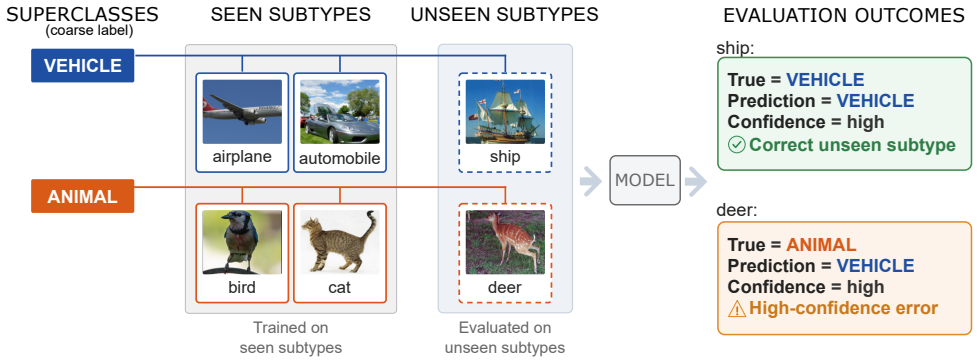
The central discovery is silent overconfidence under unseen-subtype shift: across ImageNet-25, BREEDS (Living-17, Nonliving-26), iNaturalist-25, and CIFAR-100, and across five architectures, coarse accuracy falls on held-out fine subtypes while mean confidence stays high, so expected calibration error rises by 5–28 percentage points. The dissociation is quantified by three matched gaps, $\Delta_{\mathrm{acc}}$ (seen minus unseen accuracy), $\Delta_{\mathrm{conf}}$ (seen minus unseen mean confidence), and $\Delta_{\mathrm{cal}}$ (unseen minus seen ECE), and it holds per sample: failure-detection AUROC drops by 0.05–0.18 and risk–coverage AURC rises 2.3×–18×. A matched-corruption control shows that at equal accuracy loss, ImageNet-C corruption costs roughly twice the confidence that subtype novelty costs, so the effect is not a generic consequence of losing accuracy. Seen-tuned recalibration narrows the gap without closing it, and MSP, energy, and Mahalanobis scores separate seen from unseen subtypes only weakly, with Mahalanobis near chance. The authors conclude that subtype robustness must be evaluated as a joint requirement on prediction and confidence.
Load-bearing premise
The matched-corruption comparison assumes that interpolating each ImageNet-C corruption along its severity curve to the subtype shift's accuracy loss, and then averaging over the corruptions whose severities bracket that loss, yields an unbiased estimate of the confidence drop generic corruption would cause; on iNat-25 only 3 of 15 corruptions survive this bracketing, so the 'generic corruption' mean there rests on a very small, possibly unrepresentative set.
Editorial extensions
If this is right
- Subtype robustness evaluations that report only coarse accuracy will miss the failure: a model can lose 30 or more points of accuracy and almost no confidence, so the claimed robustness is overstated.
- Post-hoc recalibration tuned on seen subtypes cannot be relied on to restore calibration on unseen subtypes; it narrows but does not close the seen–unseen gap.
- Standard OOD scores (MSP, energy, Mahalanobis) are not an adequate safety net: they separate seen from unseen subtypes at AUROC around 0.56–0.74, and the feature-based score is at chance.
- The size of the collapse depends on how densely the coarse class is sampled in training: supertypes with few seen subtypes collapse more than well-sampled ones, so ranking by seen-subtype count works as a coarse triage signal.
Reading between the lines
- The authors do not claim this, but the matched-corruption result suggests a diagnostic: measuring the confidence drop per unit accuracy loss under a corruption sweep could serve as a cheap calibrated-trust test for deployed models facing novel subtypes.
- Extension: because the paper studies images only, an immediate test is whether language or tabular models show the same dissociation when novel subtypes arrive as new vocabulary or as new sparse categorical values.
- Extension: the observed $1/\sqrt{n_j}$ scaling of overconfidence implies a testable law—doubling the number of seen subtypes per supertype should shrink unseen overconfidence by roughly $1/\sqrt{2}$—which a controlled diversity sweep could confirm.
- Extension: in dense prediction, where subtype novelty acts at pixel or region level, calibration collapse may be sharper still; measuring per-pixel ECE under unseen-object-part shift would be a concrete test.
Signed reviews
Editorial analysis
A structured set of objections, weighed in public.
Referee Report
Summary. The paper studies coarse-label prediction when test inputs come from fine-grained subtypes absent from training but still belonging to a known coarse category. It defines subtype robustness through matched accuracy, confidence, and calibration gaps, and measures these across ImageNet-25, BREEDS, iNaturalist-25, and CIFAR-100 using five architectures. The principal findings are: (1) coarse accuracy drops on unseen subtypes while confidence barely moves, producing systematic overconfidence; (2) at matched accuracy loss, generic ImageNet-C corruption lowers confidence far more than subtype novelty does; and (3) post-hoc temperature/vector scaling tuned on seen subtypes narrows but does not close the seen–unseen calibration gap, while standard OOD scores detect unseen subtypes only weakly. The paper includes protocol and initialization controls, binning-free proper scores, a per-supertype analysis of the collapse, and a k-sweep relating seen-subtype diversity to calibration.
Significance. If the findings hold, the paper makes a strong and useful case that subtype robustness should be evaluated with calibration metrics and not accuracy alone. Its strengths are substantial: this is the first systematic study of calibration under unseen subtype shift across four datasets and five architectures; the central RQ1 result is a direct measurement on held-out splits, corroborated by equal-mass binning and two binning-free proper scores (Appendix D); protocol and initialization controls (Appendix B) show the effect is not a training-protocol artifact; and the k-sweep and per-supertype analysis give a plausible mechanistic direction. The weakness is that the specificity claim—that the effect is not a general consequence of losing accuracy—rests entirely on RQ2, and the RQ2 evidence on iNat-25 is thin: only 3 of 15 corruptions bracket the subtype accuracy gap, and the manuscript reports only the mean confidence drop over those survivors. The paper's headline claim is therefore defensible in its RQ1 half but currently overstated in its RQ2 half.
major comments (2)
- [Experiments, RQ2 (Figure 3)] RQ2 is the only evidence for the claim that the calibration failure is not a general consequence of losing accuracy. On iNat-25 only 3 of the 15 ImageNet-C corruptions bracket the ResNet-50 subtype accuracy gap of 12.6 points, and the manuscript reports only the mean confidence drop over those survivors (8.3 points versus 3.8 for subtype shift), with no per-corruption values, median, or characterization of which corruptions survive. The survivors are likely a nonrandom subset, so the iNat-25 "generic corruption" mean may not represent generic corruption at all. The linear interpolation between the two bracketing severities also assumes an approximately linear accuracy–confidence trade-off, which is not tested. I ask the authors to report the per-corruption distribution (e.g., a scatter or box plot over all 15 corruptions), to list the surviving corruptions on each dataset, to test the linearity assumption, and ideally to extend the severity grid (or use corruptions whose severity-1 accuracy cost is below the iNat gap) so that more than three corruptions can be matched on iNat-25.
- [Experiments, RQ2] The matched-accuracy control matches only aggregate accuracy. The corruption arm is applied to seen-subtype images, whereas the subtype arm is measured on images of unseen subtypes, so the two arms differ not only in shift type but also in the per-supertype composition and difficulty of the evaluated images. If the unseen subtypes concentrate in supertypes where the accuracy loss is 'cheap' in confidence terms, the reported difference could reflect dataset composition rather than shift type. A per-supertype version of RQ2, or at least a report of per-supertype confidence drops in both arms, would make the specificity conclusion considerably more solid.
minor comments (5)
- [Table 5, Seeds row; Appendix B] The table states that every reported number is a single run at seed42 and that a second-seed check appears in Appendix B, but Appendix B gives only one sentence saying the gaps are 'closely matched' with no numbers. Please provide the second-seed table or soften the claim.
- [Table 5, Input resolution] The row says '32 (CIFAR-100, except AlexNet/ViT-B/16 upsampled to 224)', yet CIFAR-100 uses only AlexNet and ResNet-18. The mention of ViT-B/16 is confusing and should be corrected.
- [Figure 3 and RQ2 text] Reporting only the mean confidence drop over surviving corruptions hides the spread, especially on iNat-25 where only three corruptions survive. Error bars or a per-corruption plot would help readers judge whether the reported means are stable.
- [Appendix C, Equation (1)] The ECE formula contains a typographical inconsistency: the second term is written as 'dconf(Bb)' rather than 'conf(Bb)'. Please define the bin notation and use consistent symbols throughout.
- [Analysis section, regression sentence] The claim that 1/sqrt(nj) dominates seen accuracy as a predictor (t=4.2) should report the regression R^2 and coefficient standard errors, since the regression uses only 25 supertypes from a single seed.
Circularity Check
No significant circularity: the central claims are direct measurements on held-out splits, with no fitted parameter renamed as a prediction and no load-bearing self-citation.
full rationale
The paper's central claims are empirical measurements, not derivations whose conclusions are built into their inputs. RQ1 directly compares accuracy, confidence, and ECE on seen versus unseen subtype splits of held-out test images; RQ3a fits post-hoc calibrators on seen-val and evaluates them on unseen splits, which is a standard train/test separation rather than a circular reuse of the target data; and RQ3b evaluates standard detection scores on held-out inputs. RQ2's matched-corruption control interpolates each ImageNet-C corruption to the subtype accuracy loss, but this is a methodological design choice with clearly stated assumptions and admitted limitations (e.g., only 3 of 15 corruptions bracket the iNat-25 gap), not a circular reduction: the confidence drop under corruption is still independently measured on the same seen images, and the subtype arm is independently measured on unseen subtypes. The paper's self-citations (Hu and Khan 2021; Hu et al. 2021) appear only in related-work context and are not load-bearing for the main claims. No equation in the paper is equivalent by construction to an input, and no fitted parameter is renamed as a prediction. The reported weaknesses, such as the small surviving corruption set on iNat-25 and the linear severity interpolation, are statistical-validity concerns, not circularity.
Assumptions & free parameters
assumptions (3)
- domain assumption The image taxonomies used (ImageNet and ImageNet-22K hierarchy, BREEDS superclasses, iNaturalist orders) correctly place unseen subtypes inside the same coarse categories as seen subtypes.
- domain assumption ImageNet-C corruptions are a representative sample of generic image corruption.
- standard math Standard calibration metrics (ECE, NLL, Brier) and detection metrics (AUROC, AURC) are accepted measures of the quantities claimed.
Cite this review
Pith. "Pith review of Subtype Robustness Is Not Just Accuracy: Calibration Under Unseen Subtype Shift." pith.science (2026). https://pith.science/paper/F4WNJYSF
@misc{pith2026260800928,
  author       = {Pith},
  title        = {Pith review of: Subtype Robustness Is Not Just Accuracy: Calibration Under Unseen Subtype Shift},
  year         = {2026},
  howpublished = {\url{https://pith.science/paper/F4WNJYSF}},
  note         = {Machine review of arXiv:2608.00928}
}
read the original abstract
Subtype robustness asks whether a model keeps the correct coarse prediction when test examples come from fine-grained subtypes absent from training but still inside a known coarse category. Prior work studies this almost entirely through accuracy. We ask whether the model also stays calibrated. We present the first systematic study of the question across ImageNet, BREEDS, iNaturalist and CIFAR-100 with five architectures. Calibration breaks down on unseen subtypes, where accuracy drops while confidence barely follows, leaving the model systematically overconfident exactly where it has become less accurate. At matched accuracy loss, generic image corruption causes a much larger drop in confidence, so the effect is not a general consequence of losing accuracy. The model reacts to visible degradation but not to in-taxonomy novelty. Recalibration tuned on seen subtypes narrows the gap but does not close it, and out-of-distribution scores flag the affected inputs only weakly. Subtype robustness should therefore be evaluated through calibration, not accuracy alone.
Figures


Figures from the paper (3 more)


Reviewed August 15, 2026 · model on record in the stance chip above.
Discussion (0). Continue with ORCID to comment.