REVIEW 3 major objections 4 minor 24 references
EviSD: Evidence-Conditioned Self-Distillation for Search-Augmented Agents
T0 review · 3 major / 4 minor · reviewed 2026-08-06 · deepseek-v4-flash
Pith's one-line read Evidence-conditioned self-distillation turns per-instance supporting evidence into a bounded, action-localized correction to the GRPO advantage, yielding top exact-match scores on all seven QA benchmarks across three backbones.
desk verdict EviSD is a clean, well-specified combination of evidence-conditioned teacher context and bounded action-localized advantage modulation; the empirical gains are plausible but the paper never documents when the search-action privilege is actually available, which is a load-bearing gap. read the letter →
The pith
A machine-rendered reading of the paper's core claim, the machinery that carries it, and where it could break.
The reading
What carries the argument
The central object is the outcome-anchored, action-localized credit rule $\widehat{A}_{i,k,t} = A_{i,k,t} + \lambda |A_{i,k,t}| \tanh(\tau \delta_{i,k,t}) m^{\mathrm{act}}_{i,k,t}$, where $A$ is the group-relative GRPO advantage broadcast to response tokens, $\delta$ is the detached token-level teacher–student gap (log-probability under the evidence- or answer-conditioned privileged context minus log-probability under the original context), $\tau$ controls how sharply credit responds to the gap, $\lambda$ caps the correction at a fraction of $|A|$, and $m^{\mathrm{act}}$ is a binary mask selecting only the content tokens of generated search and answer actions. The detached gap says whether t
What would settle it
Train the 7B model for 300 steps on all seven benchmarks with the gold supporting evidence replaced by randomly sampled non-supporting passages (not the 'relevant documents' used in the paper's RQ4), keeping the retriever and reward unchanged. If the margin over the answer-only-context ablation (2.1 EM points in the paper) does not collapse, or if performance stays above the no-privilege GRPO baseline, then the claim that evidence content — rather than mere context perturbation or extra scoring variance — drives the gains is falsified. A cheaper check: permute evidence-to-question assignment w
Extended reading notes
Core claim
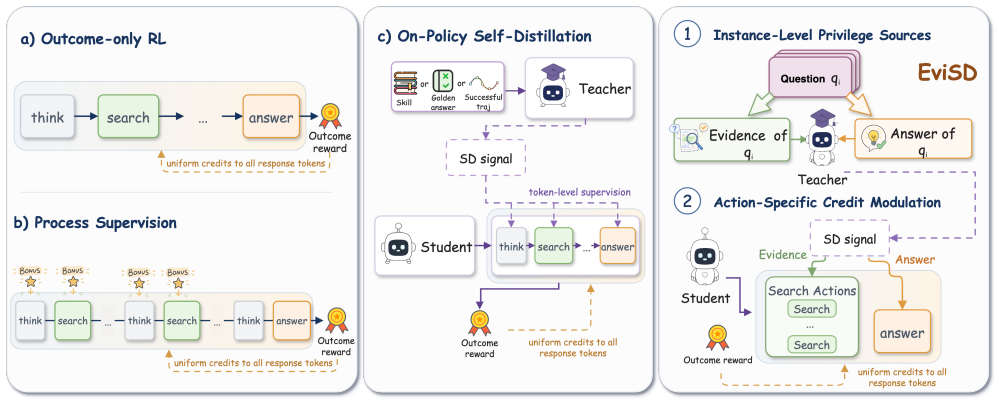
EviSD establishes that instance-level supporting evidence can act as privileged information that refines, rather than replaces, outcome-derived credit in RL-trained search agents. The student samples a trajectory under the ordinary inference context; the same model, acting as a detached teacher, re-scores each search action under a context prefixed with the supporting evidence, and each answer action under a context prefixed with the golden answer. The teacher–student gap $\delta_{i,k,t}$ — the difference in log-probability of the sampled token between the two views — is mapped through $\tanh(\tau\delta)$ and scaled by $\lambda |A_{i,k,t}|$ to form the correction, which is added to the GRPO
Load-bearing premise
The method depends on training instances carrying supporting evidence that reliably indicates what a useful search should retrieve: when that annotation is missing, the search-action teacher signal disappears, and when it is noisy or mismatched with the retrieval environment, the signal can mislead the credit update. The paper's robustness check for evidence quality covers only one model and one dataset.
Editorial extensions
If this is right
- Existing QA evidence annotations become a usable training signal: the same 300-step GRPO loop, with one extra re-scoring pass per action, beats all compared outcome-only and credit-assignment methods on every benchmark and backbone tested.
- Evidence-conditioned credit yields more efficient search behavior: the 7B model reaches higher success at 1.87 searches per trajectory versus 2.16–2.27 for the strongest self-distillation baselines, indicating fewer redundant retrievals.
- Because the correction is bounded by $\lambda < 1$ and applied only to action spans, the method preserves the update direction and token coverage of GRPO, inheriting its robustness to reward gaming while concentrating credit on decision tokens.
- Relevant retrieved documents can substitute for gold supporting evidence with only a 0.6-point drop on the tested setting (44.2 → 43.6 EM), suggesting the method transfers to training data without hand-annotated evidence.
Reading between the lines
- I infer the modulating term would compose with finer-grained estimators of $A$: since EviSD only rescales whatever advantage is supplied, a turn-level or step-level advantage (e.g., an information-gain or confidence-based variant) could be substituted inside $|A|$ without changing the distillation machinery, potentially stacking the paper's evidence signal on top of existing credit-assignment refi
- The extreme token-level contrasts shown in the case studies (e.g., $\delta \approx 0.12$ for an evidence-supported entity versus $\delta \approx -11.6$ for an unsupported association) suggest the detached gap could serve as a training-time diagnostic for annotation quality — systematically large negative gaps on tokens that match gold evidence would flag mislabeled or misaligned instances.
- A natural testable extension is to apply the same action-aligned privilege construction to other agentic loops — tool use, code execution, or database access — where the 'search action' is any external call and the privileged context is the relevant schema or documentation; the bounded, sign-preserving design should transfer, though the reported 1.3–2.3 point margins may shrink when the teacher co
- The paper's robustness test of evidence quality covers one model and one dataset, so I would expect the margin over the answer-only baseline to be most fragile on multi-hop benchmarks, where a single misdirecting evidence document can bias several subsequent queries before the answer action.
Editorial analysis
A structured set of objections, weighed in public.
Referee Report
Summary. The paper introduces EviSD, a training-time method for multi-turn search-augmented QA agents. EviSD constructs a privileged teacher context that appends instance-level supporting evidence E_q for search actions and golden answers for answer actions, re-scores each sampled action under this context, and converts the detached teacher–student log-likelihood gap into a bounded credit modulation added to the GRPO advantage. The modulation is applied only to generated action tokens, with magnitude lambda|A| tanh(tau delta), so the sign of the outcome-derived advantage is preserved. Experiments across seven QA benchmarks and three backbones report the highest macro-average exact match in all settings, with ablations indicating that evidence-conditioned context and action localization are the main contributors.
Significance. If the empirical claims hold, EviSD is a clean and practically useful contribution to credit assignment for search agents: it requires no inference-time changes, modulates only 6.7-15.1% of response tokens, and is supported by controlled ablations, training diagnostics, and code release. The idea of using dataset-annotated supporting evidence as privileged information for search actions is well motivated. The bounded, sign-preserving modulation rule is mathematically sound. However, the strength of the empirical case is limited by single-run reporting without error bars and by an unresolved dependence on per-instance evidence availability, so the claims need verification before the paper can be accepted.
major comments (3)
- [Method, Eq. (3); Supplementary Material] The search-action correction is identically zero whenever E_q is empty, as the supplement states: 'Without supporting evidence, teacher and student contexts coincide and the resulting gap is zero.' The paper never reports the coverage of E_q across the seven benchmarks. Standard releases of PopQA and Bamboogle are not annotated with HotpotQA-style supporting sentences, and the setup only says 'dataset-annotated supporting sentences' without describing a per-dataset fallback. If E_q is missing for a large fraction of instances, the reported gains cannot be attributed to the evidence-conditioned teacher; the method degenerates to answer-only privilege plus GRPO. Table 4 (RQ4) tests only Qwen3-1.7B and only HotpotQA-style distractor substitutions, so it does not establish per-dataset E_q availability or mechanism activity where gains are observed.
- [Experimental Setup, Implementation Details; Tables 1-3] The paper states that 'All reported metrics are obtained from a single evaluation run.' Given that the headline claim is a 1.3-2.3 point average-EM margin over the strongest comparator, a single run provides no estimate of variance or statistical significance. This is load-bearing for the main claim of consistent improvement across settings. Reporting at least a few seeds with means and ranges, or significance tests, is necessary to rule out that the observed margins are within run-to-run noise.
- [Tables 1 and 2; Experimental Setup, Baselines] The OPSD_Skill and OPSD_Ans baselines report average EM of 6.2/8.4 at 7B and 0.0/0.0 at 3B, which are orders of magnitude below all other self-distillation baselines. This pattern suggests training collapse or a misconfiguration rather than a faithful comparison. The implementation details do not describe whether these baselines were tuned or reproduced under the same budget. Since these are the direct self-distillation competitors, the fairness of the comparison is important; the reader cannot tell whether the comparison is at comparable optimization effort.
minor comments (4)
- [Tables 1-2] StepSearch and CriticSearch are marked with a diamond as trained on only one multi-hop dataset; their missing single-hop entries make the aggregate comparison incomplete. Please state exactly how the average is computed over different column sets for these rows, or exclude them from the average.
- [Experimental Setup, Implementation Details] Please define the 'dataset-annotated supporting sentences' for each of the seven datasets explicitly, including whether NQ, PopQA, and Bamboogle have such annotations or whether they were derived from a retriever or heuristics. This is needed to interpret Eq. (3).
- [Table 3] The columns S-hop and M-hop are not defined in the table caption. Please state which datasets are aggregated into each macro-average.
- [Method, Outcome-Anchored Modulation] For the sign-preservation statement, the paper says 'For 0<lambda<1' but elsewhere uses lambda=0.2. Consider stating the exact admissible range in the main text and noting that the experiments use lambda=0.2, tau=5.
Circularity Check
No significant circularity: EviSD's credit-modulation rule is a stated design choice, and the headline results are held-out EM evaluations that do not reduce to the privileged-context inputs.
full rationale
I walked the paper's derivation chain and found no step in which a claimed prediction or first-principles result is equivalent, by construction or by self-citation, to its own inputs. The core credit rule is introduced definitionally, not derived as a prediction: the paper states that EviSD "maps the detached gap through a bounded function and uses it to modulate the magnitude of the outcome-derived advantage," and gives bA = A + lambda|A|tanh(tau delta)m_act. This is a proposed objective, not a theorem inferred from the inputs. The sign-preservation claim for lambda<1 is a direct consequence of the definition, not a circular prediction. The outcome reward A_i is computed by comparing terminal answers against golden answers, and the answer-action teacher is also conditioned on golden answers. There is an information overlap, but it is not circular: no parameter is fitted to the held-out EM numbers, the teacher gap is detached, and the modulation only rescales the outcome-anchored advantage. The teacher signal cannot create an update when A_i=0, and for lambda<1 it cannot flip the sign of A_i. Thus the student's update direction remains determined by the outcome reward, not by the teacher. The search-action privilege depends on annotated supporting evidence E_q. The supplementary material explicitly says: "Without supporting evidence, teacher and student contexts coincide and the resulting gap is zero." This is a real limitation: the paper does not report per-dataset E_q coverage, and RQ4 tests only Qwen3-1.7B and HotpotQA-style substitutions. However, this is an empirical robustness concern, not circularity. The claim is conditional on E_q being available and useful; E_q is not defined in terms of EviSD's outputs, nor is the method's evaluation constructed from E_q. Self-citations appear in the related-work and RAG motivation (e.g., Sun et al. 2025, 2026a, 2026b, 2026c; Du et al. 2026), but none is load-bearing. No uniqueness theorem is imported from the authors' prior work, and no ansatz is smuggled in via citation: the teacher-context construction and modulation function are fully specified in the paper. The method is compared against external baselines on standard benchmarks, so the central empirical claim is self-contained and falsifiable. Overall, the paper's contribution is an empirically evaluated training objective, not a derivation that reduces to its inputs. Score 0.
Assumptions & free parameters
free parameters (3)
- lambda (modulation strength) =
0.2
- tau (teacher gap sharpness) =
5
- privileged evidence budget =
2 documents x 2 sentences, 400 char per entry, 1000 char total
assumptions (4)
- standard math GRPO group-relative advantage and the clipped policy objective correctly train the policy.
- domain assumption Annotated supporting evidence and golden answers are available and reliable for training instances.
- domain assumption The detached teacher-student log-likelihood gap is a meaningful token-level action-quality signal.
- domain assumption Re-scoring sampled actions under a privileged context with the same policy does not collapse or mislead optimization.
Cite this review
Pith. "Pith review of EviSD: Evidence-Conditioned Self-Distillation for Search-Augmented Agents." pith.science (2026). https://pith.science/paper/XYDQUKQZ
@misc{pith2026260801359,
  author       = {Pith},
  title        = {Pith review of: EviSD: Evidence-Conditioned Self-Distillation for Search-Augmented Agents},
  year         = {2026},
  howpublished = {\url{https://pith.science/paper/XYDQUKQZ}},
  note         = {Machine review of arXiv:2608.01359}
}
read the original abstract
Outcome-based reinforcement learning enables search-augmented language agents to learn from verifiable final answers, but its trajectory-level credit cannot distinguish the contributions of individual actions in a multi-turn search process. We propose EviSD, an evidence-conditioned self-distillation framework that uses instance-level supporting evidence as privileged information for search actions and golden answers as complementary privilege for answer actions. During training, the student samples actions from the original context, while the same model re-scores them as a privileged teacher under an action-aligned context. EviSD converts the detached teacher--student gap into a bounded correction to the outcome-derived GRPO advantage and applies it only to generated action spans. This design localizes privileged guidance while preserving the update direction determined by the outcome reward, without an auxiliary distillation objective or any change at inference time. Across seven question-answering benchmarks and three backbones spanning model scales and generations, EviSD achieves the highest macro-average Exact Match in all evaluated settings, outperforming the strongest compared methods by 1.3--2.3 points while modulating only 6.7%--15.1% of response tokens. Code is available at https://github.com/JiananXie/EviSD.
Figures


Figures from the paper (4 more)


Reference graph
Works this paper leans on
-
[1]
AcceptedatKDD 2026, arXiv:2505.12574
Chen,L.;Yang,X.;Lu,Y.;Zhang,J.;Sun,X.;Liu,Q.;Wu,S.; Dong,J.;andWang,L.2025.UncoveringCompetingPoisoning AttacksinRetrieval-AugmentedGeneration. AcceptedatKDD 2026, arXiv:2505.12574. Cheng, X.; He, S.; Feng, L.; Xu, H.; Yan, M.; Feng, L.; and An, B
arXiv 2025
-
[3]
Multimodal Adaptive Retrieval Aug- mented Generation through Internal Representation Learning. arXiv:2603.00511. Feng, L.; Xue, Z.; Liu, T.; and An, B
-
[5]
Search-R1: Training LLMs to Reason and Leverage Search Engines with Reinforcement Learning. arXiv:2503.09516. Joshi, M.; Choi, E.; Weld, D.; and Zettlemoyer, L
-
[8]
Search-E1: Self-Distillation Drives Self-Evolution in Search-Augmented Reasoning
Search-E1: Self-Distillation Drives Self-Evolution in Search-Augmented Reasoning. arXiv:2605.22511. Liu, D.; Niu, Y.; Wang, Q.; Xiao, H.; and Li, J
-
[9]
PiCA: Pivot-Based Credit Assignment for Search Agentic Reinforcement Learning
PiCA: Pivot-Based Credit Assignment for Search Agentic Reinforce- ment Learning. arXiv:2605.09287. Lu, Z.; Yao, Z.; Han, Z.; Wang, Z.-H.; Wu, J.; Gu, Q.; Cai, X.; Lu,W.;Xiao,J.;Zhuang,Y.;andShen,Y.2026. Self-Distilled Agentic Reinforcement Learning. arXiv:2605.15155. Ma, Y.; Liang, Z.; Chen, B.; Qian, Z.; Dai, H.; Mao, L.; Zhang, X.; Lei, C.; and Ou, W
work page Pith review arXiv 2026
-
[10]
SD-Search: On-Policy Hindsight Self-Distillation for Search-Augmented Reasoning
SD-Search: On-Policy Hindsight Self-Distillation for Search-Augmented Reasoning. arXiv:2605.18299. Mallen, A.; Asai, A.; Zhong, V.; Das, R.; Khashabi, D.; and Hajishirzi, H
-
[12]
Qwen2.5 Technical Report. arXiv:2412.15115. Shao, Z.; Wang, P.; Zhu, Q.; Xu, R.; Song, J.; Bi, X.; Zhang, H.;Zhang,M.;Li,Y.K.;Wu,Y.;andGuo,D.2024. DeepSeek- Math: Pushing the Limits of Mathematical Reasoning in Open Language Models. arXiv:2402.03300. Shi,Y.;Li,S.;Wu,C.;Liu,Z.;Fang,J.;Cai,H.;Zhang,A.;and Wang, X
arXiv 2024
-
[13]
Search and Refine During Think: Facilitating Knowledge Refinement for Improved Retrieval-Augmented Reasoning. arXiv:2505.11277. 8 Song, H.; Jiang, J.; Min, Y.; Chen, J.; Chen, Z.; Zhao, W. X.; Fang, L.; and Wen, J.-R
Show all 24 references
-
[14]
arXiv:2503.05592
R1-Searcher: Incentivizing the Search Capability in LLMs via Reinforcement Learning. arXiv:2503.05592. Song, M.; and Zheng, M
-
[15]
arXiv:2604.00626
A Survey of On-Policy Distillation for Large Language Models. arXiv:2604.00626. Sun, X.; Chen, Z.; Liu, Q.; Wu, S.; Song, B.; Wang, W.; Wang, Z.; and Wang, L. 2026a. Predict the Retrieval! Test Time Adaptation for Retrieval Augmented Generation. In 2026IEEEInternationalConfere...
2026 arXiv
-
[16]
InProceedings of the 63rd Annual Meeting of the Association for Computational Linguistics (Volume 1: Long Papers), 11461–11480
Divide-Then- Align: Honest Alignment based on the Knowledge Boundary of RAG. InProceedings of the 63rd Annual Meeting of the Association for Computational Linguistics (Volume 1: Long Papers), 11461–11480. Vienna, Austria: Association for Computational Linguistics. Sun,X.;Xie,J...
-
[18]
arXiv:2505.15107
StepSearch: Igniting LLMs Search Ability via Step-Wise Proximal Policy Optimization. arXiv:2505.15107. Xie, Y.; Thomas, N.; Hansen, N.; Fu, Y.; Li, L. E.; and Wang, X
-
[19]
arXiv:2603.22293
TIPS: Turn-Level Information-Potential Reward Shaping for Search-Augmented LLMs. arXiv:2603.22293. Yang, C.; Qin, C.; Si, Q.; Chen, M.; Gu, N.; Yao, D.; Lin, Z.; Wang, W.; Wang, J.; and Duan, N
-
[20]
arXiv:2604.03128
Self-Distilled RLVR. arXiv:2604.03128. Yang, Z.; Qi, P.; Zhang, S.; Bengio, Y.; Cohen, W. W.; Salakhutdinov, R.; and Manning, C. D
-
[22]
arXiv:2511.12159
CriticSearch: Fine-Grained Credit Assignment for Search Agents via a Retrospective Critic. arXiv:2511.12159. Zhao, S.; Xie, Z.; Liu, M.; Huang, J.; Pang, G.; Chen, F.; and Grover, A
-
[23]
arXiv:2601.18734
Self-Distilled Reasoner: On-Policy Self- Distillation for Large Language Models. arXiv:2601.18734. 9 Supplementary Material Rollout Prompt and Privileged Teacher Scoring Rollout prompt.At each turn, the environment reconstructs the interaction as a single user message and appl...
-
[300]
Harry Potter and the Deathly Hallows
Each question has one instance-specific evidence set shared by all of its sampled rollouts. The first case examines a single incorrect- outcomerolloutwhosesearchcombinesanevidence-supported entity with a logically inconsistent title. Boldface marks each analyzed key token and ...
2003
-
[2018]
arXiv:1809.09600
HotpotQA: A Dataset for Diverse, Explainable Multi-hop Question An- swering. arXiv:1809.09600. Zhang, Y.; Huang, H.; Song, Z.; Zhu, Y.; Zhang, Q.; Zhao, Z.; and Zhao, D
-
[2019]
Transactions of the Association for Computational Linguistics, 7: 452–466
Natural Questions: A Benchmark for Question Answering Research. Transactions of the Association for Computational Linguistics, 7: 452–466. Li,X.;Lyu,T.;Li,Y.;Ma,Y.;Li,P.;Li,L.;Guo,Q.;Lin,D.;and Chen,K.2026. WhatandWhentoDistill:SelectiveHindsight Distillation for Multi-Turn Ag...
2026 arXiv
-
[2020]
In Webber, B.; Cohn, T.; He, Y.; and Liu, Y., eds.,Proceedings of the 2020 Confer- ence on Empirical Methods in Natural Language Processing (EMNLP), 6769–6781
Dense Passage Retrieval for Open-Domain Question Answering. In Webber, B.; Cohn, T.; He, Y.; and Liu, Y., eds.,Proceedings of the 2020 Confer- ence on Empirical Methods in Natural Language Processing (EMNLP), 6769–6781. Online: Association for Computational Linguistics. Kwiatk...
2020
-
[2022]
arXiv:2108.00573
MuSiQue: Multihop Questions via Single-hop Question Composition. arXiv:2108.00573. Wang, G.; Dai, S.; Ye, G.; Gan, Z.; Yao, W.; Deng, Y.; Wu, X.; and Ying, Z. 2026a. Information Gain-based Policy Optimiza- tion: A Simple and Effective Approach for Multi-Turn Search Agents. arX...
2024 arXiv
-
[2023]
arXiv:2210.03350
Measuring and Narrowing the Composition- ality Gap in Language Models. arXiv:2210.03350. Qwen; :; Yang, A.; Yang, B.; Zhang, B.; Hui, B.; Zheng, B.; Yu, B.; Li, C.; Liu, D.; Huang, F.; Wei, H.; Lin, H.; Yang, J.; Tu, J.; Zhang, J.; Yang, J.; Yang, J.; Zhou, J.; Lin, J.; Dang, ...
-
[2025]
arXiv:2505.10978
Group- in-Group Policy Optimization for LLM Agent Training. arXiv:2505.10978. He,S.;Feng,L.;Wei,Q.;Cheng,X.;Feng,L.;andAn,B.2026. Hierarchy-of-Groups Policy Optimization for Long-Horizon Agentic Tasks. arXiv:2602.22817. Ho,X.;Nguyen,A.-K.D.;Sugawara,S.;andAizawa,A.2020. Constr...
2026 arXiv
-
[2026]
arXiv:2605.26684
Beyond Trajectory-Level Attribution: Graph- BasedCreditAssignmentforAgenticReinforcementLearning. arXiv:2605.26684. Du, R.; Sun, X.; Liu, Q.; Song, B.; Chen, Z.; Wang, W.; and Wang, L
Reviewed August 6, 2026 · model on record in the stance chip above.
Discussion (0). Sign in to comment.