REVIEW 4 major objections 6 minor 45 references
FineMoLA: Towards Fine-Grained Motion-Language Alignment from Clip-Level Supervision
T0 review · 4 major / 6 minor · reviewed 2026-08-06 · deepseek-v4-flash
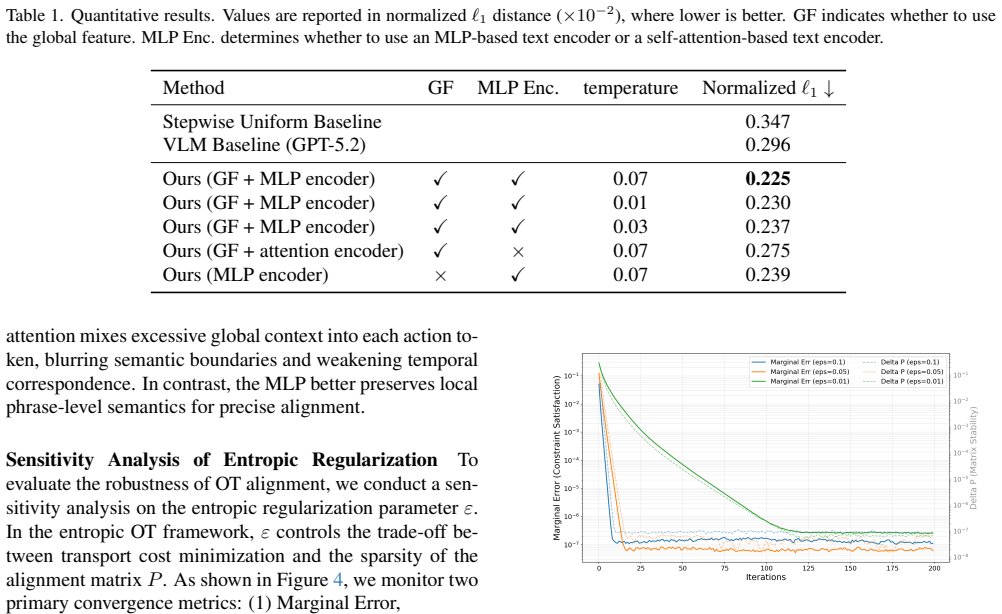
Pith's one-line read FineMoLA learns frame–phrase alignment from clip-level captions using an entropic optimal transport objective, beating stepwise-uniform and VLM baselines on SnapMoGen.
desk verdict Plausible combination of existing ideas, but the evaluation metric normalizes away the temporal extent information the paper claims to recover. read the letter →
The pith
A machine-rendered reading of the paper's core claim, the machinery that carries it, and where it could break.
The reading
What carries the argument
The load-bearing object is the entropy-regularized optimal transport plan $P$ between $T_m$ motion frames and $T_t$ text units (action units plus a global [UNK] feature). The cost is $C_{uv} = 1 - \cos(z^m_u, z^t_v)$; Sinkhorn iterations solve for $P$; and the estimated transport cost $J_{\mathrm{EOT}}$ serves as the pairwise logit in a CLIP-style contrastive loss. The [UNK] global feature prevents forcing unpaired frames onto real actions.
What would settle it
Run FineMoLA on a dataset with frame-level action labels (e.g., BABEL) and compute whether its transport plan assigns frames to correct action labels with lower error than the stepwise-uniform baseline; if the advantage disappears, the reported gain does not generalize beyond the 30 hand-picked SnapMoGen pairs.
Extended reading notes
Core claim
FineMoLA establishes that fine-grained frame–phrase correspondence can be recovered purely from clip-level motion–language supervision by casting alignment as an entropic optimal transport problem. The transport plan between motion frames and LLM-segmented action phrases is optimized under marginal constraints, and a global [UNK] feature absorbs frames not described by any phrase. The resulting OT cost serves as the pairwise logit in a CLIP-style symmetric contrastive objective. On SnapMoGen, the learned transport matrices attain a normalized L1 distance of 0.225 to manually labeled ground truth, compared with 0.347 for stepwise uniform allocation and 0.296 for a GPT-5.2 vision-language base
Load-bearing premise
The 30 manually labeled SnapMoGen test pairs are representative of the dataset and are labeled accurately enough to serve as ground truth; the paper reports no inter-annotator agreement, so noisy or unrepresentative labels would undercut the reported L1 comparisons.
Editorial extensions
If this is right
- Dense pseudo-alignments become available for any clip-level motion–text dataset, enabling training for temporal localization and dense motion captioning.
- The same OT contrastive objective can be plugged into text-to-motion generation models to condition generation on phrase-level timing.
- The [UNK] token mechanism offers a general way to handle unmatched elements in weakly supervised alignment.
- The improvement over both heuristic division and zero-shot VLM segmentation suggests that a learned, data-driven alignment is worth the added complexity.
- The method adds a principled, differentiable alignment objective to CLIP-style multimodal pretraining, so it extends to other modalities where token-level labels are absent.
Reading between the lines
- The method could transfer to video–text grounding, where frame-label scarcity is even more severe; only the motion encoder would need to be swapped for a video encoder.
- The results suggest that with a good pretrained feature space, the OT objective mostly has to learn how to assign frames to phrases rather than what the phrases mean; ablating the frozen T5 encoder would reveal how much of the gain comes from the pretrained text features.
- The quantitative claim rests on 30 manually labeled pairs; an independent re-annotation or a larger labeled set would show whether the margin persists beyond those pairs.
- A natural next experiment is to use the learned pseudo-alignments as supervision for a temporally structured text-to-motion generator and measure whether it produces actions at the right times.
Editorial analysis
A structured set of objections, weighed in public.
Referee Report
Summary. FineMoLA proposes a weakly supervised framework for learning fine-grained frame–phrase alignment between human motion and long-form text from clip-level supervision. The method segments captions into action-bearing phrases with an LLM, encodes motion and text with a VQ-VAE-based encoder and a frozen T5 encoder, pools phrase tokens into action-unit features plus a global '[UNK]' feature, and computes a soft alignment via entropic optimal transport with Sinkhorn iterations. The transport cost is used as a pairwise logit in a CLIP-style batch contrastive loss. Experiments on SnapMoGen use 30 manually labeled test pairs to compare FineMoLA against a stepwise uniform baseline and a GPT-based VLM baseline, reporting normalized L1 distances, with the best FineMoLA variant achieving 0.225 versus 0.347 and 0.296 for the baselines.
Significance. If the empirical claims were solid, FineMoLA would be a useful contribution to weakly supervised motion–language grounding: the combination of LLM-based phrase decomposition, entropic OT for many-to-many alignment, and CLIP-style contrastive training is a sensible pipeline, and the problem of learning dense alignment without frame labels is relevant to motion generation and understanding. The paper does not ship code or a reproducible evaluation protocol beyond the described prompts and settings, and the theoretical result (Theorem 1) is purely definitional. The main value lies in the empirical proposal, but the evaluation as currently designed is unable to support the fine-grained grounding claim.
major comments (4)
- [Sec. 4.1 / Eq. (2) and Sec. 5.3] The claimed '[UNK]' mechanism cannot absorb a variable amount of transitional frames. Eq. (2) fixes uniform marginals a=1/Tm and b=1/Tt, so the global '[UNK]' column receives exactly 1/Tt of the total motion mass in every plan. The Sec. 5.3 statement that the global feature 'acts as an [UNK] token to absorb transitional or semantically ambiguous frames' is therefore not implementable as stated: the amount of absorbed mass is constant, not data-dependent. The ablation improvement may come from the extra text feature providing a generic sink, but it does not demonstrate variable-duration absorption.
- [Sec. 5.1 / Eq. (19) and Sec. 9] The evaluation metric normalizes away exactly the variable-duration information that fine-grained alignment should capture. Both the predicted P and the binary ground-truth P_gt are Sinkhorn-Knopp normalized to the same doubly stochastic marginals. With Tt≈5, every action unit is forced to receive total mass 1/Tt in the ground-truth normalized target, regardless of the true duration of the action interval. Thus Table 1 measures how well a method places equal-mass blocks, not whether it recovers real temporal extents. Since FineMoLA is trained under the same uniform marginals, it is structurally aligned with this normalized metric. The additional evaluation-time reassignment of '[UNK]' mass to the preceding action token (Sec. 5.3) is applied to FineMoLA but not to the baselines, further biasing the comparison. The central claim of fine-grained grounding is not supported by this metric.
- [Sec. 5.1 / Table 1] The quantitative evaluation rests on 30 manually selected test pairs with no error bars, no confidence intervals, and no inter-annotator agreement. The paper does not specify the selection procedure, and the labels are a single annotator's intervals. Differences of 0.225 vs. 0.296 could easily be within annotation noise or sample variability. A more rigorous evaluation with a larger or randomized test set, multiple annotators, and per-pair or bootstrap confidence intervals is needed before the reported improvement can be considered reliable.
- [Sec. 4.2 / Theorem 1 and supplementary proof] Theorem 1 is a definitional tautology. Under Assumption 1, which assumes a perfect bijection with similarity 1 and equal lengths, the permutation matrix is by construction feasible and achieves zero cost. This does not provide any insight into why the training objective should induce meaningful alignments under the actual many-to-many, variable-duration setting. The theorem is not load-bearing for the empirical claim, but presenting it as a theoretical justification is misleading.
minor comments (6)
- [Supplementary Sec. 7] The supplementary restates Theorem 1 from the main text as 'Theorem 2', creating a numbering conflict. Renumber consistently.
- [Eq. (9)] The notation JEOT is used before P' is formally defined. Specify that P' is the Sinkhorn approximation from Eq. (4).
- [Fig. 4] The convergence analysis uses a randomly initialized cost matrix. Its relevance to the trained model's alignment behavior is unclear; state whether this is an analysis of the Sinkhorn solver alone or of the full system.
- [Table 1] No error bars or significance tests are reported for any of the L1 values. This is a presentation issue that compounds the small test set.
- [Sec. 4.3] The sentence 'we do not force every motion frame to align with an action-unit representation alone' is technically true only if the [UNK] token is counted as an action-unit representation; the uniform-marginal constraint still forces all frames to be allocated. Clarify.
- [References] Reference formatting is inconsistent (e.g., 'PmLR' for PMLR, incomplete author lists for some entries).
Circularity Check
Core learning and evaluation are externally grounded; one theoretical 'proof' is a definitional tautology.
-
self definitional
[Sec. 4.2 (Assumption 1 / Theorem 1), proof in Sec. 7 (supplementary)]
"Assumption 1 (Perfect Frame–Token Correspondence). Assume that the motion and text sequences have equal lengths, i.e., T_m = T_t. Further assume that there exist encoder parameters θ_m and θ_t such that ... there exists a bijection π ... satisfying s(z^m_u, z^t_{π(u)}) = 1 ... Theorem 1 (Zero OT Cost under Perfect Alignment). Under Assumption 1, the OT objective J_OT(m, t) admits a feasible transport plan with zero cost."
The 'perfect alignment' assumption is defined as the existence of a bijection with cosine similarity 1. With the cost C_uv = 1 − s(z^m_u, z^t_v) from Eq. (7), this assumption makes the matched entries of C zero by definition. Theorem 1 then constructs P_uv = (1/T_m) 1{v=π(u)} and observes that <P,C> = 0. The theorem is therefore a direct restatement of the definitions of the cost and of 'perfect correspondence'; it does not independently establish that minimizing J_OT yields meaningful temporal alignment. It is presented as an idealized illustration rather than as a load-bearing empirical derivation.
full rationale
The central claim does not reduce to its inputs. FineMoLA's transport plan is learned from clip-level paired data through a CLIP-style contrastive objective, and the reported comparison is against 30 manually labeled test pairs that are never used in training. No load-bearing argument depends on a self-citation chain or an imported uniqueness theorem. The skeptic's concern about uniform marginals is a real validity limitation: Eq. (2) fixes each text column (including [UNK]) to total mass 1/T_t, and Sec. 5.1 normalizes the ground-truth binary interval matrix into the same U(a,b) via Sinkhorn-Knopp, so the metric cannot measure variable-duration coverage; the Sec. 5.3 [UNK]-reassignment rule is also applied only to the model. However, these are evaluation-validity issues, not derivation-level circularity: the compared matrices are not definitionally equal to the labels, and baselines are assessed on the same normalized target. The single genuinely circular item is Theorem 1, which is a tautology used only for intuition. Score 2 reflects one minor, non-load-bearing circular step.
Assumptions & free parameters
free parameters (4)
- entropy regularization epsilon =
0.1
- contrastive temperature tau =
0.07
- Sinkhorn iterations =
50
- [UNK] reassignment rule =
preceding valid action token
assumptions (5)
- standard math Sinkhorn iterations converge to the entropic OT solution for the chosen epsilon and 50 iterations
- domain assumption Frozen T5-base and pre-trained VQ-VAE motion features are semantically aligned enough that cosine cost is meaningful
- domain assumption LLM phrase segmentation preserves temporal order and action boundaries
- domain assumption Manual 30-pair ground truth is reliable and representative
- ad hoc to paper Reassigning [UNK] mass to the preceding action token is a valid post-processing step
invented entities (1)
-
Global feature / [UNK] token
Cite this review
Pith. "Pith review of FineMoLA: Towards Fine-Grained Motion-Language Alignment from Clip-Level Supervision." pith.science (2026). https://pith.science/paper/MSBKTCEY
@misc{pith2026260801392,
  author       = {Pith},
  title        = {Pith review of: FineMoLA: Towards Fine-Grained Motion-Language Alignment from Clip-Level Supervision},
  year         = {2026},
  howpublished = {\url{https://pith.science/paper/MSBKTCEY}},
  note         = {Machine review of arXiv:2608.01392}
}
read the original abstract
Text-conditioned human motion generation has made rapid progress with the emergence of large-scale motion--language datasets. However, even datasets with rich long-form descriptions typically provide supervision only at the clip level, without explicit temporal correspondence between motion frames and language. This limits fine-grained motion--text grounding and temporally precise generation. We propose FineMoLA, a weakly supervised framework that learns fine-grained frame--phrase correspondence directly from clip-level annotations. Our method first segments long-form descriptions into action-bearing phrases, and then formulates motion--language alignment as an optimal transport problem, which naturally models many-to-many relations between motion frames and text under global constraints. With entropic regularization and Sinkhorn iterations, FineMoLA efficiently infers pseudo frame-level alignments without human labeling. Experiments on SnapMoGen demonstrate that the learned alignments outperform baselines in motion--text grounding.
Figures


Figures from the paper (3 more)


Reference graph
Works this paper leans on
-
[1]
Vivit: A video vision transformer
Anurag Arnab, Mostafa Dehghani, Georg Heigold, Chen Sun, Mario Lu ˇci´c, and Cordelia Schmid. Vivit: A video vision transformer. InProceedings of the IEEE/CVF inter- national conference on computer vision, pages 6836–6846,
-
[2]
Seamless human motion composition with blended posi- tional encodings
German Barquero, Sergio Escalera, and Cristina Palmero. Seamless human motion composition with blended posi- tional encodings. InProceedings of the IEEE/CVF Confer- ence on Computer Vision and Pattern Recognition, 2024. 3
work page 2024
-
[3]
A cross- dataset study for text-based 3d human motion retrieval
L ´eore Bensabath, Mathis Petrovich, and Gul Varol. A cross- dataset study for text-based 3d human motion retrieval. In Proceedings of the IEEE/CVF Conference on Computer Vi- sion and Pattern Recognition, pages 1932–1940, 2024. 2, 3
work page 1932
-
[4]
Is space-time attention all you need for video understanding? InIcml, page 4, 2021
Gedas Bertasius, Heng Wang, and Lorenzo Torresani. Is space-time attention all you need for video understanding? InIcml, page 4, 2021. 3
2021
-
[5]
Marco Cuturi. Sinkhorn distances: Lightspeed computation of optimal transport.Advances in neural information pro- cessing systems, 26, 2013. 1, 2, 3
work page 2013
-
[6]
Segmo: Segment-aligned text to 3d human motion generation
Bowen Dang, Lin Wu, Xiaohang Yang, Zheng Yuan, and Zhixiang Chen. Segmo: Segment-aligned text to 3d human motion generation. InProceedings of the IEEE/CVF Win- ter Conference on Applications of Computer Vision, pages 6946–6955, 2026. 3
work page 2026
-
[7]
Masked autoencoders as spatiotemporal learners.Advances in neural information processing systems, 35:35946–35958,
Christoph Feichtenhofer, Yanghao Li, Kaiming He, et al. Masked autoencoders as spatiotemporal learners.Advances in neural information processing systems, 35:35946–35958,
-
[8]
Generating diverse and natural 3d human motions from text
Chuan Guo, Shihao Zou, Xinxin Zuo, Sen Wang, Wei Ji, Xingyu Li, and Li Cheng. Generating diverse and natural 3d human motions from text. InProceedings of the IEEE/CVF conference on computer vision and pattern recognition, pages 5152–5161, 2022. 1, 2
work page 2022
Show all 45 references
-
[9]
Momask: Generative masked model- ing of 3d human motions
Chuan Guo, Yuxuan Mu, Muhammad Gohar Javed, Sen Wang, and Li Cheng. Momask: Generative masked model- ing of 3d human motions. InProceedings of the IEEE/CVF Conference on Computer Vision and Pattern Recognition, pages 1900–1910, 2024. 1, 3
1900
-
[10]
Snapmogen: Human motion generation from expressive texts.arXiv preprint arXiv:2507.09122, 2025
Chuan Guo, Inwoo Hwang, Jian Wang, and Bing Zhou. Snapmogen: Human motion generation from expressive texts.arXiv preprint arXiv:2507.09122, 2025. 1, 2, 5, 6
2025
-
[11]
Amd: Autoregressive motion diffusion
Bo Han, Hao Peng, Minjing Dong, Yi Ren, Yixuan Shen, and Chang Xu. Amd: Autoregressive motion diffusion. InPro- ceedings of the AAAI Conference on Artificial Intelligence, pages 2022–2030, 2024. 1
2022
-
[12]
Como: Controllable motion generation through language guided pose code edit- ing
Yiming Huang, Weilin Wan, Yue Yang, Chris Callison- Burch, Mark Yatskar, and Lingjie Liu. Como: Controllable motion generation through language guided pose code edit- ing. InEuropean Conference on Computer Vision, pages 180–196. Springer, 2024. 3
2024
-
[13]
Motiongpt: Human motion as a foreign lan- guage.Advances in Neural Information Processing Systems, 36:20067–20079, 2023
Biao Jiang, Xin Chen, Wen Liu, Jingyi Yu, Gang Yu, and Tao Chen. Motiongpt: Human motion as a foreign lan- guage.Advances in Neural Information Processing Systems, 36:20067–20079, 2023. 3
2023
-
[14]
Unimotion: Unifying 3d human motion synthesis and understanding
Chuqiao Li, Julian Chibane, Yannan He, Naama Pearl, An- dreas Geiger, and Gerard Pons-Moll. Unimotion: Unifying 3d human motion synthesis and understanding. In2025 In- ternational Conference on 3D Vision (3DV), pages 240–249. IEEE, 2025. 3
2025
-
[15]
Frankenmotion: Part-level hu- man motion generation and composition.arXiv preprint arXiv:2601.10909, 2026
Chuqiao Li, Xianghui Xie, Yong Cao, Andreas Geiger, and Gerard Pons-Moll. Frankenmotion: Part-level hu- man motion generation and composition.arXiv preprint arXiv:2601.10909, 2026. 1, 3
2026
-
[16]
Motion-x: A large-scale 3d expressive whole-body human motion dataset
Jing Lin, Ailing Zeng, Shunlin Lu, Yuanhao Cai, Ruimao Zhang, Haoqian Wang, and Lei Zhang. Motion-x: A large-scale 3d expressive whole-body human motion dataset. Advances in Neural Information Processing Systems, 36: 25268–25280, 2023. 2
2023
-
[17]
Multi-granularity correspondence learning from long-term noisy videos.arXiv preprint arXiv:2401.16702,
Yijie Lin, Jie Zhang, Zhenyu Huang, Jia Liu, Zujie Wen, and Xi Peng. Multi-granularity correspondence learning from long-term noisy videos.arXiv preprint arXiv:2401.16702,
-
[18]
Rethinking diffusion for text-driven human motion generation: Redundant representations, evaluation, and masked autoregression
Zichong Meng, Yiming Xie, Xiaogang Peng, Zeyu Han, and Huaizu Jiang. Rethinking diffusion for text-driven human motion generation: Redundant representations, evaluation, and masked autoregression. InProceedings of the Computer Vision and Pattern Recognition Conference, pages 2...
2025
-
[19]
Proposal-free temporal action detection via global segmen- tation mask learning
Sauradip Nag, Xiatian Zhu, Yi-Zhe Song, and Tao Xiang. Proposal-free temporal action detection via global segmen- tation mask learning. InEuropean Conference on Computer Vision, pages 645–662. Springer, 2022. 3
2022
-
[20]
Tmr: Text-to-motion retrieval using contrastive 3d human motion synthesis
Mathis Petrovich, Michael J Black, and G ¨ul Varol. Tmr: Text-to-motion retrieval using contrastive 3d human motion synthesis. InProceedings of the IEEE/CVF International Conference on Computer Vision, pages 9488–9497, 2023. 2, 3
2023
-
[21]
Now Foun- dations and Trends, 2019
Gabriel Peyr ´e and Marco Cuturi.Computational optimal transport: With applications to data science. Now Foun- dations and Trends, 2019. 1, 3
2019
-
[22]
Mmm: Generative masked motion model
Ekkasit Pinyoanuntapong, Pu Wang, Minwoo Lee, and Chen Chen. Mmm: Generative masked motion model. InPro- ceedings of the IEEE/CVF Conference on Computer Vision and Pattern Recognition, pages 1546–1555, 2024. 3
2024
-
[23]
The kit motion-language dataset.Big data, 4(4):236–252,
Matthias Plappert, Christian Mandery, and Tamim Asfour. The kit motion-language dataset.Big data, 4(4):236–252,
-
[24]
Babel: Bodies, action and behavior with english la- bels
Abhinanda R Punnakkal, Arjun Chandrasekaran, Nikos Athanasiou, Alejandra Quiros-Ramirez, and Michael J Black. Babel: Bodies, action and behavior with english la- bels. InProceedings of the IEEE/CVF conference on com- puter vision and pattern recognition, pages 722–731, 2021. 1, 2
2021
-
[25]
Learning transferable visual models from natural language supervi- sion
Alec Radford, Jong Wook Kim, Chris Hallacy, Aditya Ramesh, Gabriel Goh, Sandhini Agarwal, Girish Sastry, Amanda Askell, Pamela Mishkin, Jack Clark, et al. Learning transferable visual models from natural language supervi- sion. InInternational conference on machine learning, p...
2021
-
[26]
Colin Raffel, Noam Shazeer, Adam Roberts, Katherine Lee, Sharan Narang, Michael Matena, Yanqi Zhou, Wei Li, and Peter J. Liu. Exploring the limits of transfer learning with a unified text-to-text transformer.Journal of Machine Learn- ing Research, 21(140):1–67, 2020. 4
2020
-
[27]
Ot-clip: Un- derstanding and generalizing clip via optimal transport
Liangliang Shi, Jack Fan, and Junchi Yan. Ot-clip: Un- derstanding and generalizing clip via optimal transport. In Forty-first International Conference on Machine Learning,
-
[28]
Openai gpt-5 system card.arXiv preprint arXiv:2601.03267, 2025
Aaditya Singh, Adam Fry, Adam Perelman, Adam Tart, Adi Ganesh, Ahmed El-Kishky, Aidan McLaughlin, Aiden Low, AJ Ostrow, Akhila Ananthram, et al. Openai gpt-5 system card.arXiv preprint arXiv:2601.03267, 2025. 7
2025 arXiv
-
[29]
Optimal transport on discrete domains
Justin Solomon. Optimal transport on discrete domains. AMS Short Course on Discrete Differential Geometry, 3,
-
[30]
Coma: Compositional human motion generation with multi-modal agents.arXiv preprint arXiv:2412.07320, 2024
Shanlin Sun, Gabriel De Araujo, Jiaqi Xu, Shenghan Zhou, Hanwen Zhang, Ziheng Huang, Chenyu You, and Xiaohui Xie. Coma: Compositional human motion generation with multi-modal agents.arXiv preprint arXiv:2412.07320, 2024. 3
2024 arXiv
-
[31]
Motionclip: Exposing human motion generation to clip space
Guy Tevet, Brian Gordon, Amir Hertz, Amit H Bermano, and Daniel Cohen-Or. Motionclip: Exposing human motion generation to clip space. InEuropean Conference on Com- puter Vision, pages 358–374. Springer, 2022. 3
2022
-
[32]
Human motion dif- fusion model.arXiv preprint arXiv:2209.14916, 2022
Guy Tevet, Sigal Raab, Brian Gordon, Yonatan Shafir, Daniel Cohen-Or, and Amit H Bermano. Human motion dif- fusion model.arXiv preprint arXiv:2209.14916, 2022. 1, 3
2022 arXiv
-
[33]
Scaling large motion models with million-level human motions.arXiv preprint arXiv:2410.03311, 2024
Ye Wang, Sipeng Zheng, Bin Cao, Qianshan Wei, Weishuai Zeng, Qin Jin, and Zongqing Lu. Scaling large motion models with million-level human motions.arXiv preprint arXiv:2410.03311, 2024. 1, 2
2024 arXiv
-
[34]
Mg-motionllm: A unified framework for motion comprehension and gener- ation across multiple granularities
Bizhu Wu, Jinheng Xie, Keming Shen, Zhe Kong, Jianfeng Ren, Ruibin Bai, Rong Qu, and Linlin Shen. Mg-motionllm: A unified framework for motion comprehension and gener- ation across multiple granularities. InProceedings of the Computer Vision and Pattern Recognition Conference,...
2025
-
[35]
Dense motion captioning
Shiyao Xu, Benedetta Liberatori, G ¨ul Varol, and Paolo Rota. Dense motion captioning. InThirteenth International Con- ference on 3D Vision, 2025. 1, 2, 3
2025
-
[36]
Filip: Fine-grained interactive language-image pre-training.arXiv preprint arXiv:2111.07783, 2021
Lewei Yao, Runhui Huang, Lu Hou, Guansong Lu, Minzhe Niu, Hang Xu, Xiaodan Liang, Zhenguo Li, Xin Jiang, and Chunjing Xu. Filip: Fine-grained interactive language-image pre-training.arXiv preprint arXiv:2111.07783, 2021. 2, 3
2021 arXiv
-
[37]
Generating human motion from textual descrip- tions with discrete representations
Jianrong Zhang, Yangsong Zhang, Xiaodong Cun, Yong Zhang, Hongwei Zhao, Hongtao Lu, Xi Shen, and Ying Shan. Generating human motion from textual descrip- tions with discrete representations. InProceedings of the IEEE/CVF conference on computer vision and pattern recognition, p...
2023
-
[38]
Re- modiffuse: Retrieval-augmented motion diffusion model
Mingyuan Zhang, Xinying Guo, Liang Pan, Zhongang Cai, Fangzhou Hong, Huirong Li, Lei Yang, and Ziwei Liu. Re- modiffuse: Retrieval-augmented motion diffusion model. In Proceedings of the IEEE/CVF International Conference on Computer Vision, pages 364–373, 2023. 3
2023
-
[39]
Finemogen: Fine-grained spatio- temporal motion generation and editing.Advances in Neural Information Processing Systems, 36:13981–13992, 2023
Mingyuan Zhang, Huirong Li, Zhongang Cai, Jiawei Ren, Lei Yang, and Ziwei Liu. Finemogen: Fine-grained spatio- temporal motion generation and editing.Advances in Neural Information Processing Systems, 36:13981–13992, 2023. 1, 3
2023
-
[40]
Pre- training clip against data poisoning with optimal transport- based matching and alignment
Tong Zhang, Kuofeng Gao, Jiawang Bai, Leo Yu Zhang, Xin Yin, Zonghui Wang, Shouling Ji, and Wenzhi Chen. Pre- training clip against data poisoning with optimal transport- based matching and alignment. InProceedings of the 2025 Conference on Empirical Methods in Natural Languag...
2025
-
[41]
DartControl: A diffusion-based autoregressive motion model for real-time text-driven motion control
Kaifeng Zhao, Gen Li, and Siyu Tang. DartControl: A diffusion-based autoregressive motion model for real-time text-driven motion control. InThe Thirteenth International Conference on Learning Representations (ICLR), 2025. 3 FineMoLA: Towards Fine-Grained Motion-Language Alignm...
2025
-
[42]
Proof of Theorem 1 Theorem 2(Zero OT Cost under Perfect Alignment).Un- der Assumption 1, the OT objectiveJOT (m, t)admits a fea- sible transport plan with zero cost. Specifically, the trans- port plan defined by Puv = 1 Tm 1{v=π(u)}(22) is feasible and achieves JOT (m, t) = 0....
-
[43]
Caption Segmentation To bridge the gap between long-form narrative descriptions and local temporal motion segments, we first decompose each caption into multipleaction-bearing phrasesusing an LLM-based caption segmentation pipeline, as illustrated in Fig. 5. Specifically, GPT-...
-
[44]
The annotation process involves man- ual segment-level boundary identification: for each action segmentj, human annotators specify the temporal interval [tstart, tend]in seconds
Ground Truth Annotation To quantitatively evaluate the temporal alignment perfor- mance, we manually label the ground truth alignment ma- trixP gt ∈R Tm×Tt. The annotation process involves man- ual segment-level boundary identification: for each action segmentj, human annotato...
-
[45]
specialized human motion analyst
VLM Baseline For the VLM baseline, motion videos are first downsam- pled to a fixed temporal resolution of 2.0 FPS. For motion sequences spanning 30 to 40 seconds, this sampling strat- egy yields approximately 60 to 80 frames, which provides sufficient visual density to captur...
Reviewed August 6, 2026 · model on record in the stance chip above.
Discussion (0). Sign in to comment.