REVIEW 2 major objections 4 minor 75 references
Ground, Cover, and Refine: Evidence-Centric Frame Selection for Long-Video Question Answering
T0 review · 2 major / 4 minor · reviewed 2026-08-15 · deepseek-v4-flash
Pith's one-line read GCR treats fixed-budget frame selection for long-video question answering as a joint evidence-curation problem, grounding timestamped text onto its source frames, covering visual gaps, and refining the selection by swapping in stronger…
desk verdict GCR is a solid, well-ablated frame selector; the hidden d_q prior is a real reproducibility gap that should be fixed before acceptance. read the letter →
The pith
A machine-rendered reading of the paper's core claim, the machinery that carries it, and where it could break.
The reading
What carries the argument
The load-bearing objects are: timestamped text events converted from subtitles or ASR, each scored by fused textual and visual relevance and anchored to the highest-scoring real frame in its interval; event-aligned rendering, which paints the event text onto a bottom band of its own anchor frame, binding language to vision in the same image; a protected evidence core of grounded and visual anchors, surrounded by revisable context frames chosen by global maximal marginal relevance, which balances query relevance against pairwise visual redundancy; and omitted-evidence recovery, which summarizes each skipped temporal gap by a real-frame medoid and swaps it in only when its normalized relevance, novelty, and local-change score exceeds the weakest context frame's. These mechanisms together enforce the fixed budget, chronology, and training-free constraint while making the selection revisable.
What would settle it
Run GCR on a fresh long-video QA benchmark whose question stems are written to avoid the keyword vocabulary used to set the visual-demand prior, and compare against the strongest baseline; if the margin collapses or reverses, the prior rather than the grounded-overlay pipeline is responsible for the gains.
Extended reading notes
Core claim
The central discovery is that textual and visual evidence reinforce each other best when timestamped language is rendered directly into the image slot of its temporally aligned frame, rather than supplied as a separate prompt, and that a fixed-budget frame set can be made revisable after initial construction. The paper demonstrates through controlled ablations that aligned subtitle overlay beats visual-only input, global subtitle prompts, frame-tagged prompts, and shuffled overlay, and that removing any of the three stages lowers accuracy. It further claims that revisiting omitted temporal regions with real-frame medoids yields consistent, if modest, gains while keeping the downstream VLM input fixed at exactly B chronologically ordered real frames.
Load-bearing premise
The load-bearing premise is that the empirically set visual-demand prior, which uses hand-coded keyword rules to decide how much each question leans on visual versus textual evidence, transfers to new questions; if those rules were tuned to the benchmark question patterns, the reported gains would not generalize.
Editorial extensions
If this is right
- With a 32-frame budget, GCR lifts a 7B backbone to 64.25% on LongVideoBench and 62.15% on Video-MME, surpassing the strongest reproduced baseline by 2.54 and 1.93 percentage points respectively.
- Gains grow on long-duration videos: at 64 frames it adds 5.85 points over the baseline on LongVideoBench-Long and 6.33 points on Video-MME-Long.
- The improvement is not from added text: aligned overlay outperforms both global subtitle prompts and frame-tagged prompts, and a blank-band control shows the gain is not a layout artifact.
- The default budget allocation is stable across a broad range, with overall accuracy varying by at most about one percentage point under the tested ground, visual, and refine ratios.
- Selector-side cost stays modest: the refine stage adds about 0.1 seconds per QA while giving a 0.45-point improvement.
Reading between the lines
- Beyond the paper, replacing the hand-coded visual-demand prior with a learned or fixed default on fresh question distributions would test how much of the gain is pipeline versus benchmark-specific fitting.
- Beyond the paper, the pixel-level text-binding idea could extend to other aligned modalities, such as audio-event captions or detected-object labels, potentially covering videos without usable subtitles.
- Beyond the paper, the one-for-one replacement rule is a general principle for any fixed-budget evidence set, applicable to retrieval-augmented generation or extractive summarization.
- A quantitative stress test the paper does not run: questions deliberately contradicted by subtitle text, forcing the visual pathway to dominate; the reported category gains suggest reasoning and OCR benefit most, but this adversarial split remains untested.
Signed reviews
Editorial analysis
A structured set of objections, weighed in public.
Referee Report
Summary. The paper introduces GCR, a training-free, fixed-budget frame-selection framework for long-video QA. It operates in three stages: Ground (convert timestamped subtitles/ASR into events, score them by a text-visual fusion, and render selected event text onto the corresponding real frame), Cover (add top visual anchors and fill the remaining budget with global MMR-based diverse frames), and Refine (summarize omitted temporal regions by real-frame medoids and conditionally swap them for the weakest revisable context frame). The method uses frozen SigLIP features, keeps a chronological real-frame set of size B, and requires no VLM training or architectural change. Experiments on LongVideoBench and Video-MME with LLaVA-OV, Qwen2.5-VL-7B, and LLaVA-Video-7B under budgets of 8, 32, and 64 report consistent overall gains over reproduced baselines, with the headline LLaVA-OV/32-frame results of 64.25% and 62.15%. The paper also reports leave-one-stage-out ablations, an evidence-integration study with blank-band and shuffled-overlay controls, category-wise analysis, sensitivity to budget ratios, and efficiency measurements.
Significance. If the results hold, GCR is a practically valuable contribution: it improves long-video QA without training, is architecture-agnostic, and directly addresses the revisability and text-visual alignment limitations of prior selectors. The paper's controlled experimental design is a genuine strength: same budget, VLM, and decoding configuration for all methods; leave-one-stage-out ablations; a blank-band control that isolates the effect of adding image area; a shuffled-overlay control that isolates temporal alignment; and a budget-sensitivity sweep. The Refine stage's marginal but positive contribution (0.22/0.45 pp) and the low selector-side cost (0.141 s/QA) are reported honestly. The central limitation is that two important knobs of the method—the question-dependent fusion prior d_q (Eq. 7) and the refinement gate tau_g (Eq. 17)—are either described only by reference to the supplementary material or never given a value, and neither is subjected to sensitivity analysis. Because the paper's main empirical claim is generality across benchmarks and backbones, this gap is load-bearing.
major comments (2)
- [Methodology, Eq. (7)] The visual-demand prior d_q controls the fusion of textual and visual event scores in the Ground stage, yet the paper only says it is "empirically determined according to the visual and textual reliance implied by keywords within each question stem" and defers the rules to the supplementary material, which was not available for review. This is load-bearing because d_q directly determines which events are grounded; if the keyword rules were derived from the question patterns of LongVideoBench and Video-MME, the reported gains (e.g., 2.54 pp and 1.93 pp) could reflect benchmark-specific calibration rather than a general evidence-curation principle. Please include the full d_q rules in the main text or appendix, and add an analysis that either sweeps d_q or evaluates on held-out question categories, to demonstrate that the method is not brittle to this prior.
- [Refine stage, Eq. (17)] The refinement gate threshold tau_g is named and used to decide whether refinement is activated, but its value is never reported or swept. Since the Refine stage is a claimed contribution and the ablation attributes only 0.22/0.45 pp to it, the reader cannot tell whether this small gain is robust or is the result of a particular threshold choice. Please report the default tau_g and include it in the sensitivity analysis; Figure 5 currently sweeps only alpha_g, alpha_v, and alpha_r.
minor comments (4)
- [Table 1] The claim that GCR "consistently achieves the best overall performance" is supported at the dataset level, but several subgroup cells are below the strongest baseline (e.g., LLaVA-OV, B=8, LongVideoBench Long: 51.77 vs. WFS-SB 53.90; Qwen2.5-VL-7B, B=8, Short: 67.87 vs. WFS-SB 68.70). Please add a note clarifying that the consistency claim refers to overall accuracy, not every duration split.
- [Figure 5] The figure caption reports "Overall span" in percentage points, while the y-axis label reads "Accuracy (%)"; please clarify that the plotted values are LongVideoBench overall accuracy with LLaVA-OV at B=32, and state that the horizontal line is the strongest reproduced baseline.
- [Table 2] In Table 2, the "w/o Ground" and "Full GCR" rows both report 51.77 for the Long/8-frame condition; if this is correct, it is consistent with the small overall contribution of the later stages at this budget, but it should be noted explicitly.
- [Table 4] The text reports a 1.593s total-latency increase for GCR over WFS-SB, but the displayed totals (29.487 vs. 27.893) give a difference of 1.594s; please align the rounding.
Circularity Check
No circularity: GCR is an empirical, externally benchmarked selection pipeline; the unreleased d_q prior is a reproducibility concern, not a construction that equals its input.
full rationale
GCR is an engineering method, not a derivation whose outputs are assumed in its inputs. The selection stages are given by explicit formulas (Eqs. 3-18) with fixed weights: 0.5 in the MMR objective (Eq. 11), equal thirds in the unified evidence value (Eq. 16), and the default budget allocation (alpha_g, alpha_v, alpha_r) = (1/4, 1/8, 1/8). All headline numbers are measured on external benchmarks (LongVideoBench and Video-MME) under frozen downstream VLMs, so no fitted parameter is renamed as a prediction. The only fragile element is the question-only visual-demand prior d_q in Eq. (7), which is 'empirically determined' with detailed rules relegated to the supplementary material, and the sensitivity analysis (Figure 5) sweeps budget ratios but not d_q. This is a legitimate reproducibility and possible benchmark-fitting concern, but it is not circularity: the paper does not define d_q in terms of the benchmark answers, nor does any other step reduce an output to an input by construction. No load-bearing self-citation or imported uniqueness theorem appears. The stated limitation (reliance on timestamped text) concerns scope, not circular reasoning.
Assumptions & free parameters
free parameters (3)
- d_q visual-demand prior =
not specified (rules in supplementary)
- tau_g refinement gate threshold =
not specified
- budget ratios (alpha_g, alpha_v, alpha_r) =
(1/4, 1/8, 1/8)
assumptions (4)
- domain assumption Timestamped subtitles or ASR transcripts provide temporally aligned textual events that are relevant to question answering.
- domain assumption Sampling candidate frames at 1 FPS captures the evidence needed to answer the question.
- domain assumption A real-frame representative (medoid) in feature space adequately represents an omitted temporal region for downstream QA.
- domain assumption The downstream VLM can exploit text rendered at the pixel level on a frame without being confused by it.
Cite this review
Pith. "Pith review of Ground, Cover, and Refine: Evidence-Centric Frame Selection for Long-Video Question Answering." pith.science (2026). https://pith.science/paper/ZKWGHNK7
@misc{pith2026260801660,
  author       = {Pith},
  title        = {Pith review of: Ground, Cover, and Refine: Evidence-Centric Frame Selection for Long-Video Question Answering},
  year         = {2026},
  howpublished = {\url{https://pith.science/paper/ZKWGHNK7}},
  note         = {Machine review of arXiv:2608.01660}
}
read the original abstract
Long-video question answering requires identifying sparse yet critical evidence from videos containing thousands of frames under a constrained visual-token budget. Existing methods either select query-aware frames in a single pass or rely on timestamped text solely as retrieval guidance, leading to two key limitations. First, selected frames tend to cluster around local relevance peaks, and once the budget is exhausted, omitted evidence cannot be recovered. Second, textual and visual evidence remain weakly aligned. We propose GCR, a training-free framework that casts fixed-budget frame selection as a joint evidence curation problem. Ground converts timestamped text into temporal events, selects query-relevant real frame anchors, and renders each event text onto its temporally aligned frame. Cover supplements grounded events with direct visual anchors for complementary visual evidence and applies global maximal marginal relevance to preserve diverse context. Refine revisits omitted temporal regions and replaces the weakest revisable context frame with a real-frame medoid---but only when the medoid offers greater evidence value. GCR maintains a fixed number of chronologically ordered frames and requires no VLM training or architectural modification. Experiments on LongVideoBench and Video-MME, across three 7B backbones and frame budgets of 8, 32, and 64, demonstrate consistent improvements in long-video QA. With the 7B LLaVA-OV backbone and 32 frames, GCR achieves 64.25% and 62.15% on the two benchmarks, outperforming the strongest reproduced baselines by 2.54 and 1.93 percentage points, respectively.
Figures
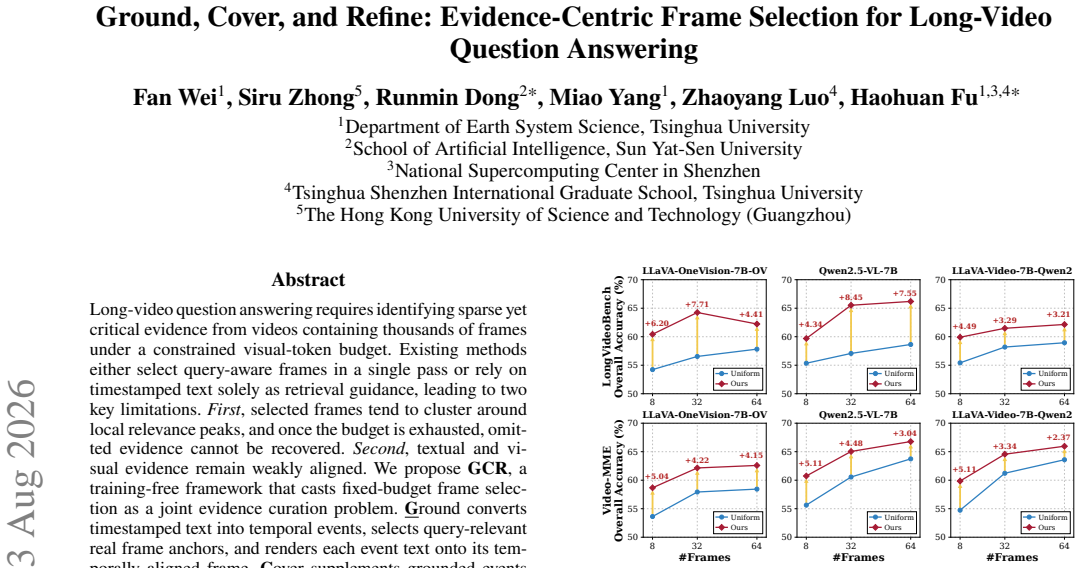


Figures from the paper (2 more)


Reference graph
Works this paper leans on
-
[1]
European Conference on Computer Vision , pages=
Longvlm: Efficient long video understanding via large language models , author=. European Conference on Computer Vision , pages=. 2024 , organization=
work page 2024
-
[2]
2023 , eprint=
Sigmoid Loss for Language Image Pre-Training , author=. 2023 , eprint=
2023
-
[3]
Logic-in-Frames: Dynamic Keyframe Search via Visual Semantic-Logical Verification for Long Video Understanding , author=. 2025 , eprint=
work page 2025
-
[4]
MovieChat+: Question-Aware Sparse Memory for Long Video Question Answering , year=
Song, Enxin and Chai, Wenhao and Ye, Tian and Hwang, Jenq-Neng and Li, Xi and Wang, Gaoang , journal=. MovieChat+: Question-Aware Sparse Memory for Long Video Question Answering , year=
-
[5]
MemoryCard: Topic-Aware Multi-Modal Clue Compression for Long-Video Question Answering , author=. 2026 , eprint=
work page 2026
-
[7]
Proceedings of the 21st annual international ACM SIGIR conference on Research and development in information retrieval , pages=
The use of MMR, diversity-based reranking for reordering documents and producing summaries , author=. Proceedings of the 21st annual international ACM SIGIR conference on Research and development in information retrieval , pages=
-
[8]
Classification Problem Solving
Clancey, William J. Classification Problem Solving. Proceedings of the Fourth National Conference on Artificial Intelligence
-
[9]
, title =
Robinson, Arthur L. , title =. 1980 , doi =. https://science.sciencemag.org/content/208/4447/1019.full.pdf , journal =
1980
Show all 75 references
-
[10]
New Ways to Make Microcircuits Smaller---Duplicate Entry
Robinson, Arthur L. New Ways to Make Microcircuits Smaller---Duplicate Entry. Science
-
[11]
Clancey and Glenn Rennels , abstract =
Diane Warner Hasling and William J. Clancey and Glenn Rennels , abstract =. Strategic explanations for a diagnostic consultation system , journal =. 1984 , issn =. doi:https://doi.org/10.1016/S0020-7373(84)80003-6 , url =
1984 doi
-
[12]
and Rennels, Glenn R
Hasling, Diane Warner and Clancey, William J. and Rennels, Glenn R. and Test, Thomas. Strategic Explanations in Consultation---Duplicate. The International Journal of Man-Machine Studies
-
[13]
Proceedings of the AAAI Conference on Artificial Intelligence , volume=
Tspo: Temporal sampling policy optimization for long-form video language understanding , author=. Proceedings of the AAAI Conference on Artificial Intelligence , volume=
-
[14]
Poligon: A System for Parallel Problem Solving
Rice, James. Poligon: A System for Parallel Problem Solving
-
[15]
Transfer of Rule-Based Expertise through a Tutorial Dialogue
Clancey, William J. Transfer of Rule-Based Expertise through a Tutorial Dialogue
-
[16]
The Engineering of Qualitative Models
Clancey, William J. The Engineering of Qualitative Models
-
[17]
2023 , eprint=
Attention Is All You Need , author=. 2023 , eprint=
2023
-
[18]
Pluto: The 'Other' Red Planet
NASA. Pluto: The 'Other' Red Planet
-
[19]
Proceedings of the 19th Conference of the European Chapter of the Association for Computational Linguistics (Volume 1: Long Papers) , pages=
Too many frames, not all useful: Efficient strategies for long-form video qa , author=. Proceedings of the 19th Conference of the European Chapter of the Association for Computational Linguistics (Volume 1: Long Papers) , pages=
-
[20]
2025 IEEE/CVF Conference on Computer Vision and Pattern Recognition (CVPR) , year=
BOLT: Boost Large Vision-Language Model Without Training for Long-Form Video Understanding , author=. 2025 IEEE/CVF Conference on Computer Vision and Pattern Recognition (CVPR) , year=
2025
-
[21]
Logic-in-Frames: Dynamic Keyframe Search via Visual Semantic-Logical Verification for Long Video Understanding , url =
Guo, Weiyu and Chen, Ziyang and WANG, Shaoguang and He, Jianxiang and Xu, Yijie and Ye, Jinhui and Sun, Ying and Xiong, Hui , booktitle =. Logic-in-Frames: Dynamic Keyframe Search via Visual Semantic-Logical Verification for Long Video Understanding , url =
-
[22]
2025 IEEE/CVF Conference on Computer Vision and Pattern Recognition (CVPR) , year=
Re-thinking Temporal Search for Long-Form Video Understanding , author=. 2025 IEEE/CVF Conference on Computer Vision and Pattern Recognition (CVPR) , year=
2025
-
[23]
2025 IEEE/CVF International Conference on Computer Vision (ICCV) , year=
Mdp3: a Training-Free Approach for List-Wise Frame Selection in Video-Llms , author=. 2025 IEEE/CVF International Conference on Computer Vision (ICCV) , year=
2025
-
[24]
European Conference on Computer Vision , pages=
Videoagent: Long-form video understanding with large language model as agent , author=. European Conference on Computer Vision , pages=. 2024 , organization=
2024
-
[25]
Proceedings of the IEEE/CVF Conference on Computer Vision and Pattern Recognition , year=
Adaptive Keyframe Sampling for Long Video Understanding , author=. Proceedings of the IEEE/CVF Conference on Computer Vision and Pattern Recognition , year=
-
[26]
2026 , eprint=
Where to Focus: Query-Modulated Multimodal Keyframe Selection for Long Video Understanding , author=. 2026 , eprint=
2026
-
[27]
Proceedings of the IEEE/CVF Conference on Computer Vision and Pattern Recognition (CVPR) , month =
Wang, Ziyang and Yu, Shoubin and Stengel-Eskin, Elias and Yoon, Jaehong and Cheng, Feng and Bertasius, Gedas and Bansal, Mohit , title =. Proceedings of the IEEE/CVF Conference on Computer Vision and Pattern Recognition (CVPR) , month =. 2025 , pages =
2025
-
[28]
Proceedings of the IEEE/CVF Conference on Computer Vision and Pattern Recognition (CVPR) Findings , month =
He, Jianxiang and Hong, Meisheng and Li, Jungang and Guo, Weiyu and Hu, Xuming and Xiong, Hui , title =. Proceedings of the IEEE/CVF Conference on Computer Vision and Pattern Recognition (CVPR) Findings , month =. 2026 , pages =
2026
-
[29]
Proceedings of the IEEE/CVF Conference on Computer Vision and Pattern Recognition (CVPR) , month =
Chen, Wang and Zeng, Yuhui and Luo, Yongdong and Xie, Tianyu and Lin, Luojun and Ji, Jiayi and Zhang, Yan and Zheng, Xiawu , title =. Proceedings of the IEEE/CVF Conference on Computer Vision and Pattern Recognition (CVPR) , month =. 2026 , pages =
2026
-
[30]
Proceedings of the 2023 conference on empirical methods in natural language processing: system demonstrations , pages=
Video-llama: An instruction-tuned audio-visual language model for video understanding , author=. Proceedings of the 2023 conference on empirical methods in natural language processing: system demonstrations , pages=
2023
-
[31]
Proceedings of the 2024 conference on empirical methods in natural language processing , pages=
Video-llava: Learning united visual representation by alignment before projection , author=. Proceedings of the 2024 conference on empirical methods in natural language processing , pages=
2024
-
[32]
2024 , eprint=
LLaVA-NeXT-Interleave: Tackling Multi-image, Video, and 3D in Large Multimodal Models , author=. 2024 , eprint=
2024
-
[33]
2024 , eprint=
Qwen2-VL: Enhancing Vision-Language Model's Perception of the World at Any Resolution , author=. 2024 , eprint=
2024
-
[34]
International Conference on Learning Representations , volume=
Longvila: Scaling long-context visual language models for long videos , author=. International Conference on Learning Representations , volume=
-
[35]
Proceedings of the IEEE/CVF Conference on Computer Vision and Pattern Recognition (CVPR) , month =
Shu, Yan and Liu, Zheng and Zhang, Peitian and Qin, Minghao and Zhou, Junjie and Liang, Zhengyang and Huang, Tiejun and Zhao, Bo , title =. Proceedings of the IEEE/CVF Conference on Computer Vision and Pattern Recognition (CVPR) , month =. 2025 , pages =
2025
-
[36]
European Conference on Computer Vision , pages=
Llama-vid: An image is worth 2 tokens in large language models , author=. European Conference on Computer Vision , pages=. 2024 , organization=
2024
-
[37]
2024 , eprint=
LongVU: Spatiotemporal Adaptive Compression for Long Video-Language Understanding , author=. 2024 , eprint=
2024
-
[38]
Proceedings of the IEEE/CVF Conference on Computer Vision and Pattern Recognition (CVPR) , month =
Tao, Keda and Qin, Can and You, Haoxuan and Sui, Yang and Wang, Huan , title =. Proceedings of the IEEE/CVF Conference on Computer Vision and Pattern Recognition (CVPR) , month =. 2025 , pages =
2025
-
[39]
Proceedings of the IEEE/CVF Conference on Computer Vision and Pattern Recognition (CVPR) , month =
Song, Enxin and Chai, Wenhao and Wang, Guanhong and Zhang, Yucheng and Zhou, Haoyang and Wu, Feiyang and Chi, Haozhe and Guo, Xun and Ye, Tian and Zhang, Yanting and Lu, Yan and Hwang, Jenq-Neng and Wang, Gaoang , title =. Proceedings of the IEEE/CVF Conference on Computer Vis...
2024
-
[40]
Proceedings of the IEEE/CVF International Conference on Computer Vision , pages=
Hermes: temporal-coherent long-form understanding with episodes and semantics , author=. Proceedings of the IEEE/CVF International Conference on Computer Vision , pages=
-
[41]
Proceedings of the IEEE/CVF Conference on Computer Vision and Pattern Recognition (CVPR) , month =
Islam, Md Mohaiminul and Ho, Ngan and Yang, Xitong and Nagarajan, Tushar and Torresani, Lorenzo and Bertasius, Gedas , title =. Proceedings of the IEEE/CVF Conference on Computer Vision and Pattern Recognition (CVPR) , month =. 2024 , pages =
2024
-
[42]
Video Summarization with Long Short-Term Memory
Zhang, Ke and Chao, Wei-Lun and Sha, Fei and Grauman, Kristen. Video Summarization with Long Short-Term Memory. Computer Vision -- ECCV 2016. 2016
2016
-
[43]
DSNet: A Flexible Detect-to-Summarize Network for Video Summarization , year=
Zhu, Wencheng and Lu, Jiwen and Li, Jiahao and Zhou, Jie , journal=. DSNet: A Flexible Detect-to-Summarize Network for Video Summarization , year=
-
[44]
IEEE Transactions on Multimedia , year=
Long video understanding with learnable retrieval in video-language models , author=. IEEE Transactions on Multimedia , year=
-
[45]
Advances in Neural Information Processing Systems , volume=
Longvideobench: A benchmark for long-context interleaved video-language understanding , author=. Advances in Neural Information Processing Systems , volume=
-
[46]
Proceedings of the IEEE/CVF Conference on Computer Vision and Pattern Recognition (CVPR) , month =
Fu, Chaoyou and Dai, Yuhan and Luo, Yongdong and Li, Lei and Ren, Shuhuai and Zhang, Renrui and Wang, Zihan and Zhou, Chenyu and Shen, Yunhang and Zhang, Mengdan and Chen, Peixian and Li, Yanwei and Lin, Shaohui and Zhao, Sirui and Li, Ke and Xu, Tong and Zheng, Xiawu and Chen...
2025
-
[47]
Proceedings of the IEEE/CVF Conference on Computer Vision and Pattern Recognition (CVPR) , month =
Zhou, Junjie and Shu, Yan and Zhao, Bo and Wu, Boya and Liang, Zhengyang and Xiao, Shitao and Qin, Minghao and Yang, Xi and Xiong, Yongping and Zhang, Bo and Huang, Tiejun and Liu, Zheng , title =. Proceedings of the IEEE/CVF Conference on Computer Vision and Pattern Recogniti...
2025
-
[48]
Proceedings of the IEEE/CVF Conference on Computer Vision and Pattern Recognition , pages=
Mvbench: A comprehensive multi-modal video understanding benchmark , author=. Proceedings of the IEEE/CVF Conference on Computer Vision and Pattern Recognition , pages=
-
[49]
and Han, Rilyn and Fei-Fei, Li and Xie, Saining , title =
Yang, Jihan and Yang, Shusheng and Gupta, Anjali W. and Han, Rilyn and Fei-Fei, Li and Xie, Saining , title =. Proceedings of the IEEE/CVF Conference on Computer Vision and Pattern Recognition (CVPR) , month =. 2025 , pages =
2025
-
[50]
2025 , eprint=
Video-Holmes: Can MLLM Think Like Holmes for Complex Video Reasoning? , author=. 2025 , eprint=
2025
-
[51]
2024 , eprint=
LLaVA-OneVision: Easy Visual Task Transfer , author=. 2024 , eprint=
2024
-
[52]
2025 , eprint=
Qwen2.5-VL Technical Report , author=. 2025 , eprint=
2025
-
[53]
Bai, S.; Chen, K.; Liu, X.; Wang, J.; Ge, W.; Song, S.; Dang, K.; Wang, P.; Wang, S.; Tang, J.; Zhong, H.; Zhu, Y.; Yang, M.; Li, Z.; Wan, J.; Wang, P.; Ding, W.; Fu, Z.; Xu, Y.; Ye, J.; Zhang, X.; Xie, T.; Cheng, Z.; Zhang, H.; Yang, Z.; Xu, H.; and Lin, J. 2025. Qwen2.5-VL T...
2025 arXiv
-
[54]
Carbonell, J.; and Goldstein, J. 1998. The use of MMR, diversity-based reranking for reordering documents and producing summaries. In Proceedings of the 21st annual international ACM SIGIR conference on Research and development in information retrieval, 335--336
1998
-
[55]
Chen, W.; Zeng, Y.; Luo, Y.; Xie, T.; Lin, L.; Ji, J.; Zhang, Y.; and Zheng, X. 2026. Wavelet-based Frame Selection by Detecting Semantic Boundary for Long Video Understanding. In Proceedings of the IEEE/CVF Conference on Computer Vision and Pattern Recognition (CVPR), 24052--24061
2026
-
[56]
Chen, Y.; Xue, F.; Li, D.; Hu, Q.; Zhu, L.; Li, X.; Fang, Y.; Tang, H.; Yang, S.; Liu, Z.; et al. 2025. Longvila: Scaling long-context visual language models for long videos. In International Conference on Learning Representations, volume 2025, 18227--18246
2025
-
[57]
Fu, C.; Dai, Y.; Luo, Y.; Li, L.; Ren, S.; Zhang, R.; Wang, Z.; Zhou, C.; Shen, Y.; Zhang, M.; Chen, P.; Li, Y.; Lin, S.; Zhao, S.; Li, K.; Xu, T.; Zheng, X.; Chen, E.; Shan, C.; He, R.; and Sun, X. 2025. Video-MME: The First-Ever Comprehensive Evaluation Benchmark of Multi-mo...
2025
-
[58]
Guo, W.; Chen, Z.; Wang, S.; He, J.; Xu, Y.; Ye, J.; Sun, Y.; and Xiong, H. 2025. Logic-in-Frames: Dynamic Keyframe Search via Visual Semantic-Logical Verification for Long Video Understanding. arXiv:2503.13139
2025 arXiv
-
[59]
He, J.; Hong, M.; Li, J.; Guo, W.; Hu, X.; and Xiong, H. 2026. VSI: Visual-Subtitle Integration for Keyframe Selection to Enhance Long Video Understanding. In Proceedings of the IEEE/CVF Conference on Computer Vision and Pattern Recognition (CVPR) Findings, 9003--9012
2026
-
[60]
Li, B.; Zhang, Y.; Guo, D.; Zhang, R.; Li, F.; Zhang, H.; Zhang, K.; Zhang, P.; Li, Y.; Liu, Z.; and Li, C. 2024. LLaVA-OneVision: Easy Visual Task Transfer. arXiv:2408.03326
2024 arXiv
-
[61]
Li, Y.; Wang, C.; and Jia, J. 2024. Llama-vid: An image is worth 2 tokens in large language models. In European Conference on Computer Vision, 323--340. Springer
2024
-
[62]
Liu, S.; Zhao, C.; Xu, T.; and Ghanem, B. 2025. BOLT: Boost Large Vision-Language Model Without Training for Long-Form Video Understanding. 2025 IEEE/CVF Conference on Computer Vision and Pattern Recognition (CVPR), 3318--3327
2025
-
[63]
Song, E.; Chai, W.; Wang, G.; Zhang, Y.; Zhou, H.; Wu, F.; Chi, H.; Guo, X.; Ye, T.; Zhang, Y.; Lu, Y.; Hwang, J.-N.; and Wang, G. 2024. MovieChat: From Dense Token to Sparse Memory for Long Video Understanding. In Proceedings of the IEEE/CVF Conference on Computer Vision and ...
2024
-
[64]
Song, E.; Chai, W.; Ye, T.; Hwang, J.-N.; Li, X.; and Wang, G. 2026. MovieChat+: Question-Aware Sparse Memory for Long Video Question Answering. IEEE Transactions on Pattern Analysis and Machine Intelligence, 48(1): 374--389
2026
-
[65]
Sun, H.; Lu, S.; Wang, H.; Chen, Q.-G.; Xu, Z.; Luo, W.; Zhang, K.; and Li, M. 2025. Mdp3: a Training-Free Approach for List-Wise Frame Selection in Video-Llms. 2025 IEEE/CVF International Conference on Computer Vision (ICCV), 24090--24101
2025
-
[66]
Tang, C.; Han, Z.; Sun, H.; Zhou, S.; Zhang, X.; Wei, X.; Yuan, Y.; Zhang, H.; Xu, J.; and Sun, H. 2026. Tspo: Temporal sampling policy optimization for long-form video language understanding. In Proceedings of the AAAI Conference on Artificial Intelligence, volume 40, 9368--9376
2026
-
[67]
Tang, X.; Qiu, J.; Xie, L.; Tian, Y.; Jiao, J.; and Ye, Q. 2025. Adaptive Keyframe Sampling for Long Video Understanding. In Proceedings of the IEEE/CVF Conference on Computer Vision and Pattern Recognition, 29118--29128
2025
-
[68]
Wang, S.; Guo, W.; Chen, Z.; Hu, X.; and Xiong, H. 2026. Where to Focus: Query-Modulated Multimodal Keyframe Selection for Long Video Understanding. arXiv:2604.17422
2026 arXiv
-
[69]
Wang, X.; Zhang, Y.; Zohar, O.; and Yeung-Levy, S. 2024. Videoagent: Long-form video understanding with large language model as agent. In European Conference on Computer Vision, 58--76. Springer
2024
-
[70]
Wang, Z.; Yu, S.; Stengel-Eskin, E.; Yoon, J.; Cheng, F.; Bertasius, G.; and Bansal, M. 2025. VideoTree: Adaptive Tree-based Video Representation for LLM Reasoning on Long Videos. In Proceedings of the IEEE/CVF Conference on Computer Vision and Pattern Recognition (CVPR), 3272--3283
2025
-
[71]
Weng, Y.; Han, M.; He, H.; Chang, X.; and Zhuang, B. 2024. Longvlm: Efficient long video understanding via large language models. In European Conference on Computer Vision, 453--470. Springer
2024
-
[72]
Wu, H.; Li, D.; Chen, B.; and Li, J. 2024. Longvideobench: A benchmark for long-context interleaved video-language understanding. Advances in Neural Information Processing Systems, 37: 28828--28857
2024
-
[73]
Yang, Q.; Huang, P.; Li, X.; Liu, Z.; Yan, Y.; Gu, Y.; Yu, G.; Li, G.; and Sun, M. 2026. MemoryCard: Topic-Aware Multi-Modal Clue Compression for Long-Video Question Answering. arXiv:2606.05917
2026 arXiv
-
[74]
C.; Adeli, E.; Li, F.-F.; Wu, J.; and Li, M
Ye, J.; Wang, Z.; Sun, H.; Chandrasegaran, K.; Durante, Z.; Eyzaguirre, C.; Bisk, Y.; Niebles, J. C.; Adeli, E.; Li, F.-F.; Wu, J.; and Li, M. 2025. Re-thinking Temporal Search for Long-Form Video Understanding. 2025 IEEE/CVF Conference on Computer Vision and Pattern Recogniti...
2025
-
[75]
Zhai, X.; Mustafa, B.; Kolesnikov, A.; and Beyer, L. 2023. Sigmoid Loss for Language Image Pre-Training. arXiv:2303.15343
2023 arXiv
-
[76]
Zhang, Y.; Wu, J.; Li, W.; Li, B.; Ma, Z.; Liu, Z.; and Li, C. 2024. Video Instruction Tuning with Synthetic Data. arXiv preprint arXiv:2410.02713
2024 arXiv
Reviewed August 15, 2026 · model on record in the stance chip above.
Discussion (0). Continue with ORCID to comment.