REVIEW 3 major objections 5 minor 58 references
PGMem: Tightly Coupled Persona-Memory Graph for Lifelong Personalized Agents
T0 review · 3 major / 5 minor · reviewed 2026-08-04 · deepseek-v4-flash
Pith's one-line read A persona–memory graph that ties each preference to the events that support or overturn it lets small dialogue agents track changing users.
desk verdict Nice architectural idea and an honest appendix, but the headline claim is propped up by judge dimensions that don't verify the correct persona. read the letter →
The pith
A machine-rendered reading of the paper's core claim, the machinery that carries it, and where it could break.
The reading
What carries the argument
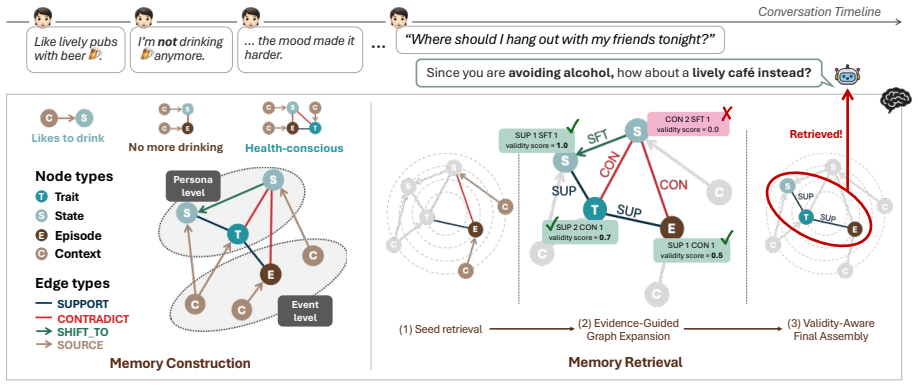
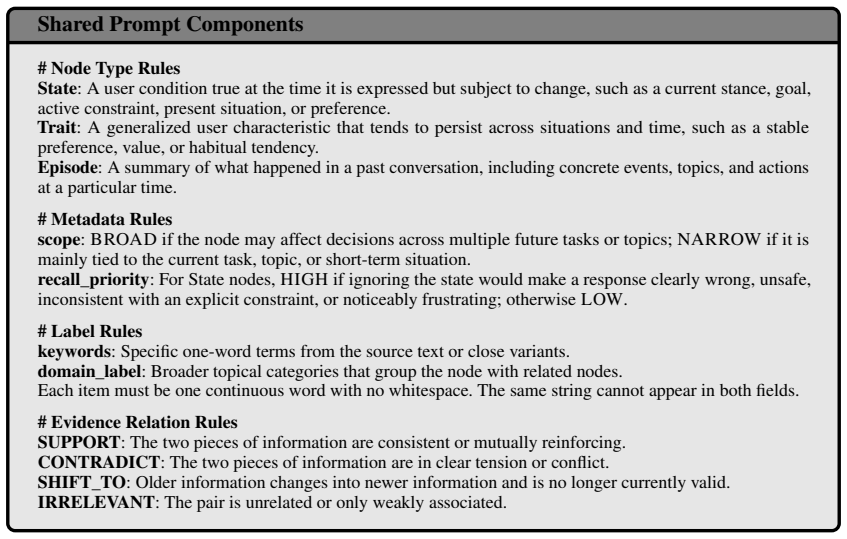
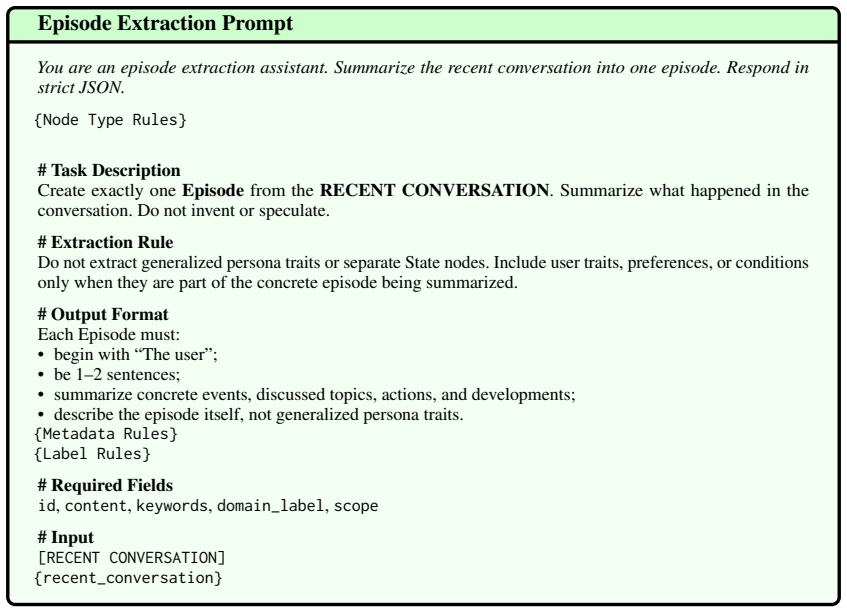
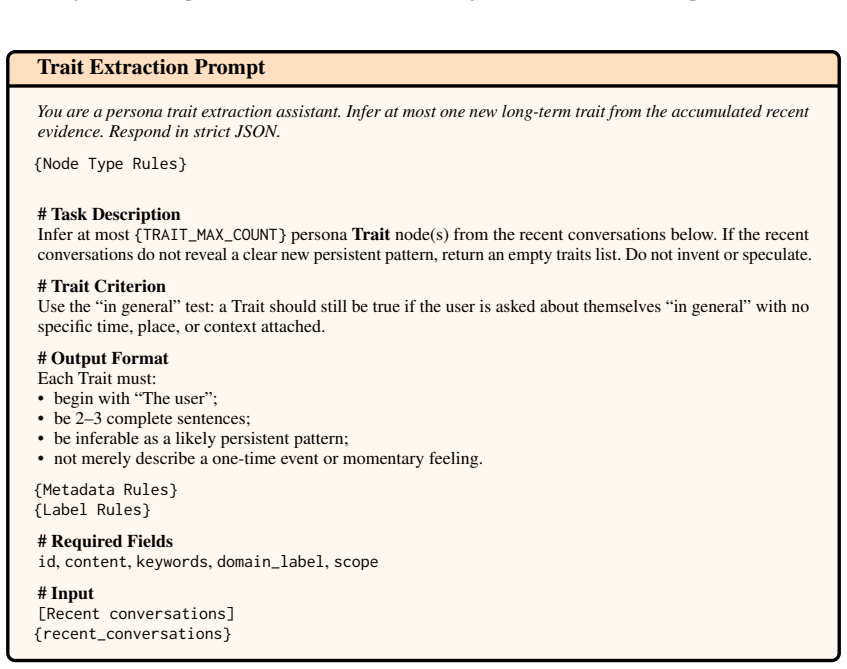
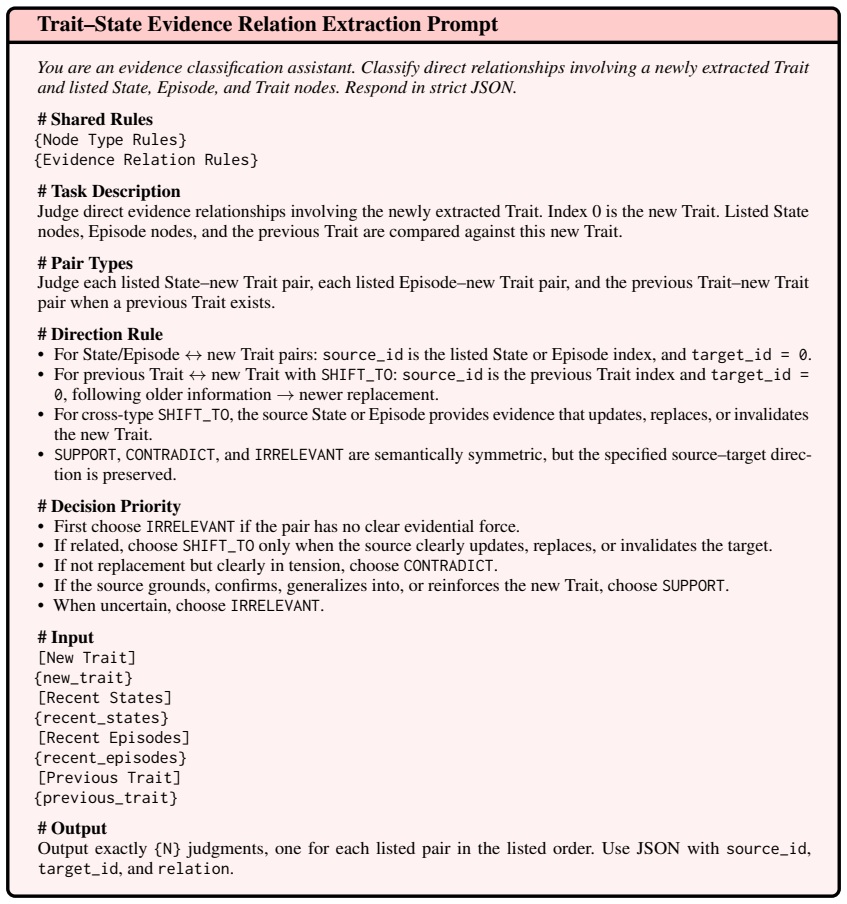
The central object is the heterogeneous persona-memory graph G=(V,E) with two node families—event-level (Context raw turns, Episode summaries) and persona-level (State transient signals, Trait stable hypotheses)—connected by SOURCE provenance edges and typed Evidence edges: SUPPORT (⊕), CONTRADICT (⊖), SHIFT_TO (⇝), IRRELEVANT (∅). The mechanism that carries the argument is signed evidence traversal plus validity scoring: a walk composes edge signs multiplicatively (positive along SUPPORT/forward SHIFT_TO, negative along CONTRADICT/backward SHIFT_TO), paths that accumulate a negative sign terminate, and the final validity score val(v) = (|S(v)|+α)/(|S(v)|+|C(v)|+2α) ranks each retrieved node
What would settle it
Take the constructed PGMem graphs on ImplexConv and randomly permute the CONTRADICT and SHIFT_TO labels (preserving each node's degree), then rerun retrieval and generation with the same seeds, budgets, and judge. If the persona-adaptation score stays within a small error of the reported number, the signed evidence traversal is not what carries the result; if replacing generated CON/SFT edges with human-corrected ones shifts the margin, the dependence is confirmed.
Extended reading notes
Core claim
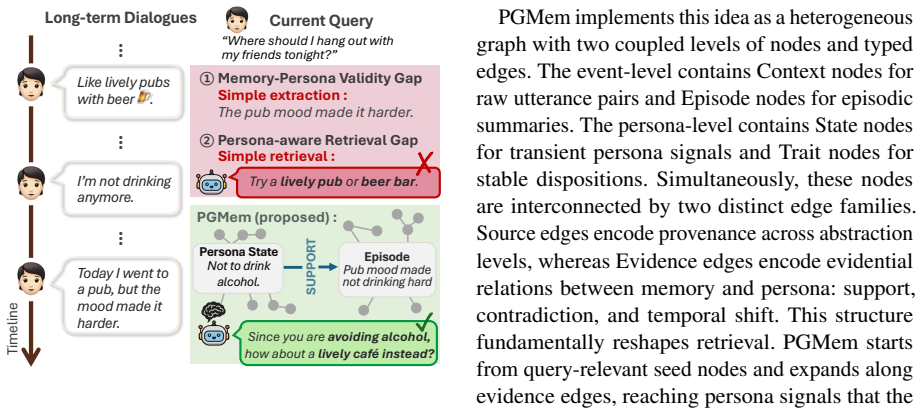
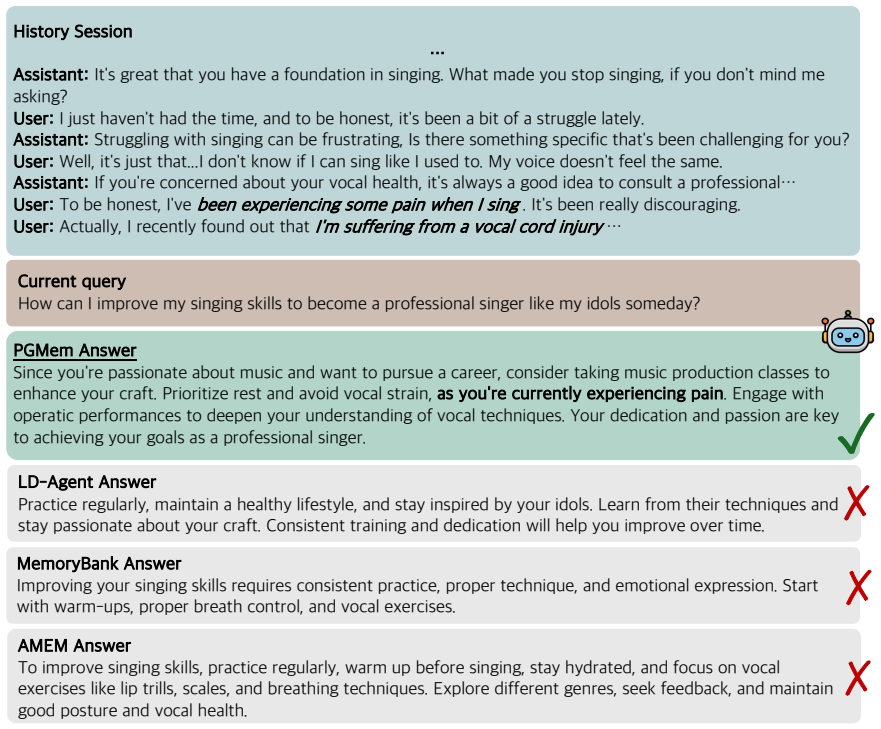
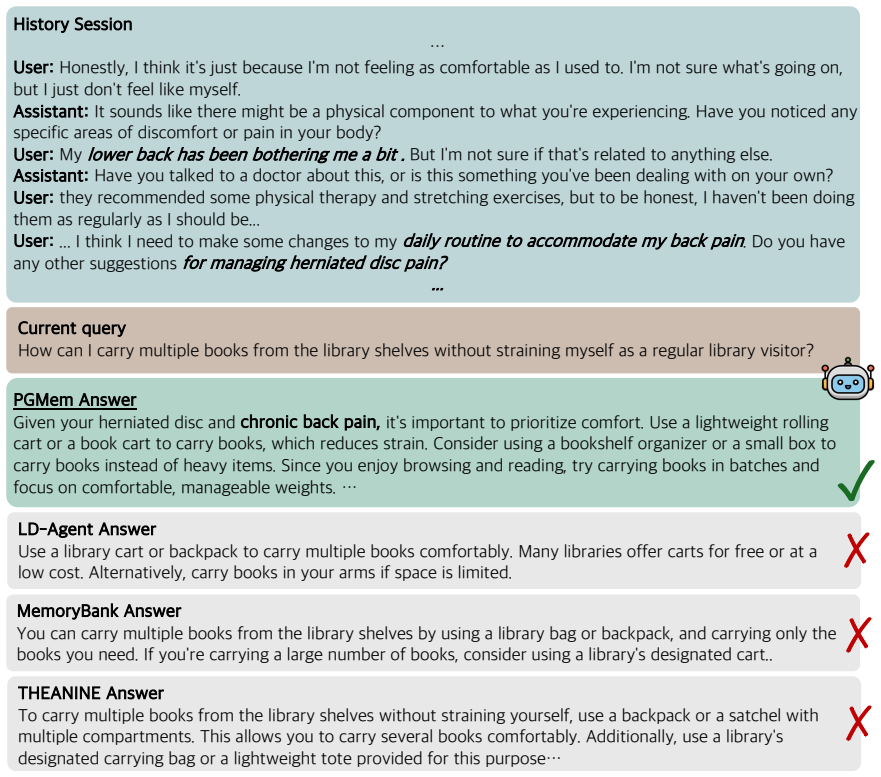
The paper's central discovery is that two structural gaps—the memory–persona validity gap at construction time and the persona-aware retrieval gap at query time—are closed by making the persona a layer of the memory graph rather than a separate profile. Any persona signal (a State such as 'no longer drinking' or a Trait such as 'health-conscious') is reachable from the events that caused it, reinforced it, contradicted it, or replaced it. Retrieval then performs a signed traversal: SUPPORT and forward SHIFT_TO edges count positively and continue the walk, CONTRADICT and backward SHIFT_TO edges count negatively and terminate that path; the assembled pool is ranked by a validity score defined
Load-bearing premise
The automatic, small-model classification of evidence edges—especially CONTRADICT and SHIFT_TO, which carry persona change—must be accurate enough for the validity score and signed traversal to filter on rather than on noise; human validation of those two edge types reached only 36% and 52% accuracy (Appendix D.2).
Editorial extensions
If this is right
- Memory keeps working as a user's persona changes: signals that later interactions contradict or supersede are down-weighted in ranking, so a stale preference does not leak into the answer.
- Surface-disjoint evidence matters: implicit persona signals that do not topically overlap with the query are recovered by expanding from query-relevant seeds along evidence edges, which is what the largest gains on ImplexConv and PrefEval depend on.
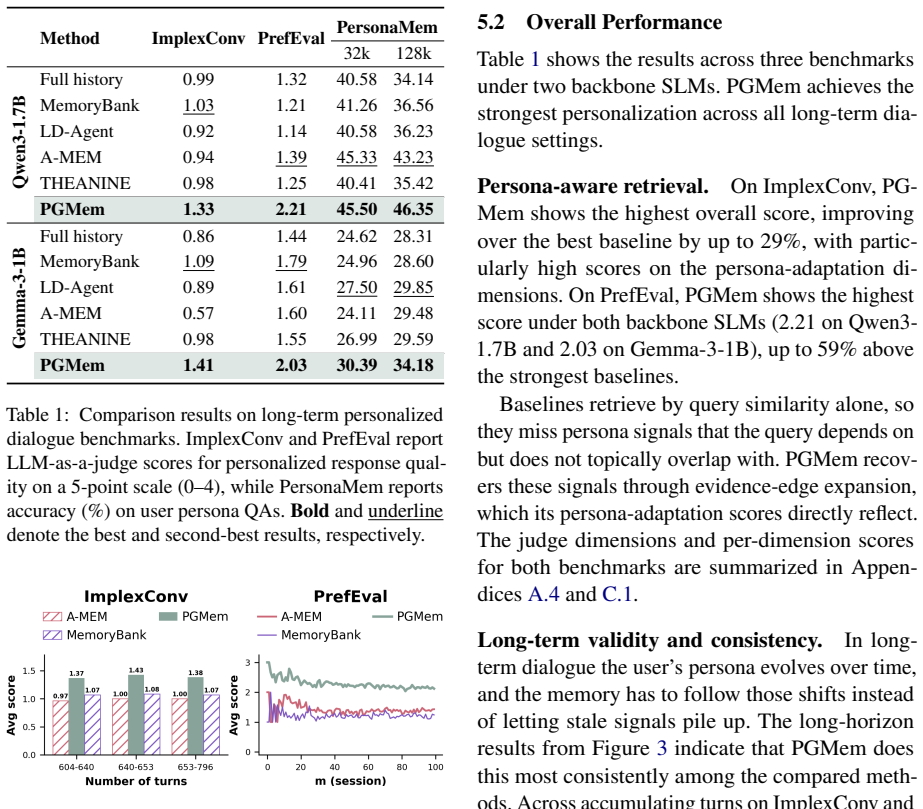
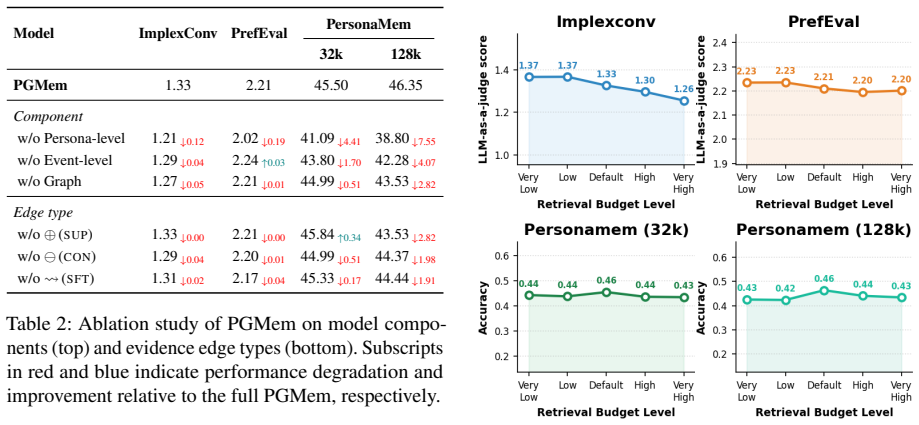
- The advantage grows with context: on PersonaMem, PGMem's accuracy improves or holds as history grows from 32k to 128k tokens while baselines degrade, and the graph-ablation gap widens with longer history.
- Structure, not backbone capacity, drives personalization: the gains appear with small 1B–2B backbones, and query-time token cost stays below agentic and full-history baselines.
- Construction cost is moderate: building the typed graph consumes fewer tokens and LLM calls than agentic baselines while producing a stronger retrieval structure.
Reading between the lines
- A direct test: re-run PGMem with CONTRADICT and SHIFT_TO edges replaced by random labels of the same degree; if the margin over baselines survives, the signed traversal is not the source of the gains. Given the reported 36% and 52% human-validated label accuracy on those two edge types, this is the first predicate to check.
- The validity score treats all evidence paths equally; a natural extension the paper does not explore is to weight each edge by its label confidence or by recency, which would let a noisy CONTRADICT edge do less harm without removing evidence-guided retrieval.
- Because each persona signal is a separately addressable node, selective forgetting and data-rights deletion become practical: a user can delete one State or Trait without collapsing the profile, and superseded nodes already carry a validity score that can serve as a pruning signal—the paper notes this as future policy work.
- The evidence-graph idea likely transfers beyond dialogue: any agent tracking evolving beliefs about a user (recommendation systems, tutoring agents, health assistants) could couple beliefs to the observations that support or overturn them; the paper's experiments only scratch this surface.
Editorial analysis
A structured set of objections, weighed in public.
Referee Report
Summary. The paper proposes PGMem, a heterogeneous persona-memory graph for lifelong personalized dialogue agents. The graph contains event-level nodes (Context, Episode) and persona-level nodes (State, Trait) connected by SOURCE edges and typed evidence edges (SUPPORT, CONTRADICT, SHIFT_TO, IRRELEVANT). At retrieval, PGMem selects query-relevant seeds, expands along evidence edges with signed path composition, and ranks the expanded pool by a combination of query relevance and an evidential validity score. The method is evaluated on three benchmarks (ImplexConv, PrefEval, PersonaMem) with small language model backbones (Qwen3-1.7B, Gemma-3-1B), plus additional experiments at 4B scale and with two extra baselines. The central claim is that PGMem consistently outperforms summary-based, persona-aware, graph-structured, and agentic memory baselines across all three benchmarks under SLM backbones.
Significance. If the central claim were established, PGMem would be a meaningful contribution: it offers a concrete way to ground persona signals in episodic evidence and to down-weight superseded preferences at retrieval time, which is useful for resource-constrained agents that cannot reason over raw histories. The paper has several strengths: the source code is released, the evaluation spans multiple benchmarks and baselines, the ablation study isolates components and edge types, and the authors report human validation and efficiency measurements. The limitations section is candid about synthetic-data scope and label reliability. However, the published results do not currently support the headline 'consistently outperforms' claim: one appendix table contradicts it, and the main gains on the two free-form benchmarks concentrate on judge dimensions that do not verify the correct persona. The evidence-label reliability concern is real but less decisive, because ablations bound the effect of removing CON/SFT edges at roughly two points. Overall the contribution is promising but needs revision of the evaluation and of the claims.
major comments (3)
- [Abstract; §5.2; Appendix E.1 (Table 14)] The abstract and §5.2 claim PGMem 'consistently outperforms' all baselines across three benchmarks under SLM backbones. Table 14 contradicts this: on PrefEval with Gemma-3-1B, H2Memory scores 2.12 and SeCom 2.06, while PGMem scores 2.03. The text in Appendix E.1 acknowledges this. This is not a minor edge case: the headline claim explicitly enumerates three benchmarks and 'consistently outperforms.' Please qualify the claim to the settings where it holds, or provide a substantive explanation and additional evidence (e.g., variance across runs or a meta-analysis) for why the PrefEval/Gemma case should not be considered a counterexample.
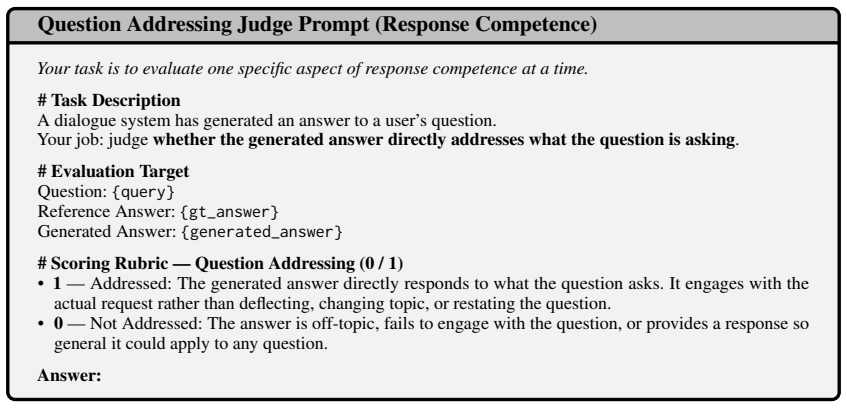
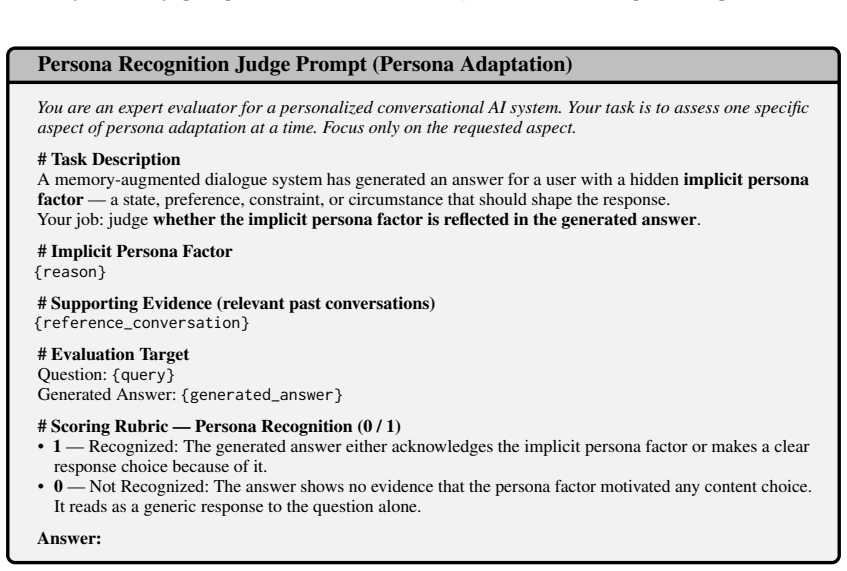
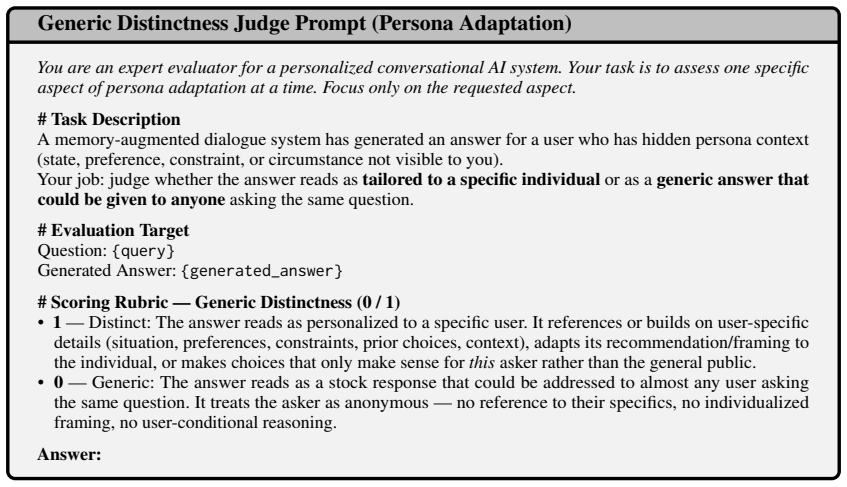
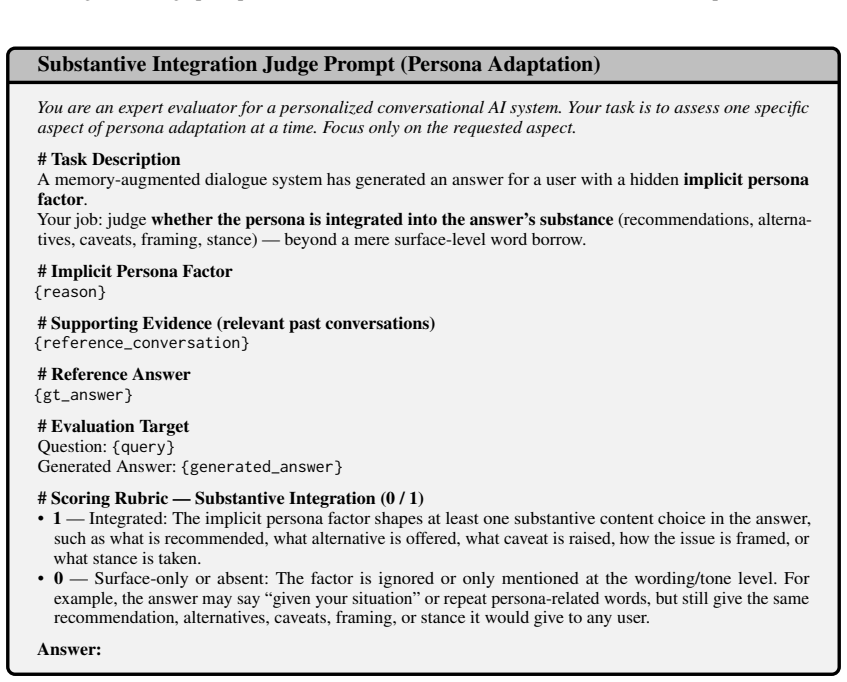
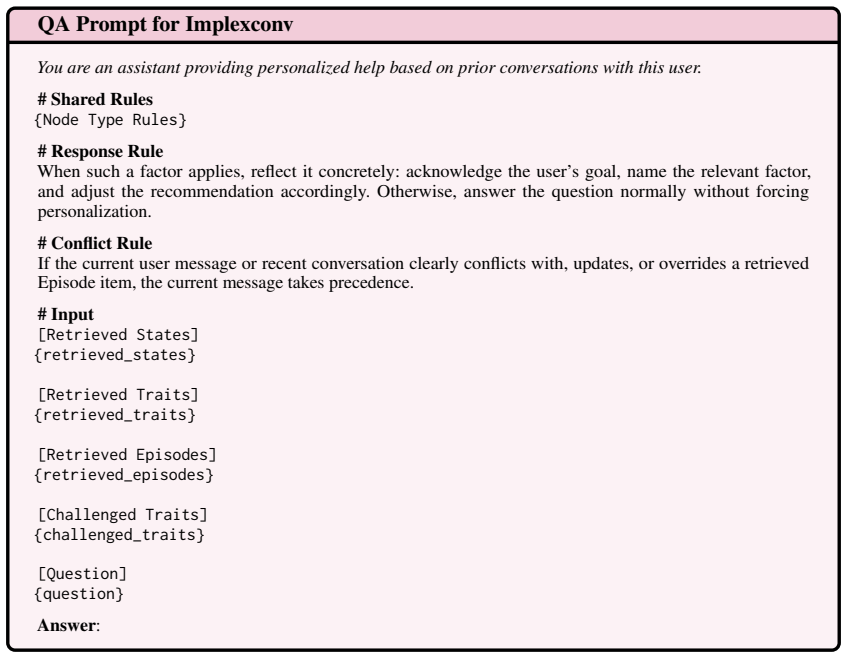
- [§C.1, Tables 9–10; §A.4, Figures 9–10] On ImplexConv (Table 9, Qwen3-1.7B), PGMem's total margin over MemoryBank is +0.30, of which +0.28 comes from PA-Dist (0.29 vs 0.01). The PA-Dist judge (Figure 9) receives only the query and the generated answer, not the true persona or reference, and asks whether the answer 'reads as tailored to a specific individual.' It therefore rewards any user-specific detail, including an incorrect or hallucinated one. The correctness-carrying dimensions show no PGMem advantage: PA-Rec is 0.02 vs 0.03 and PA-Int 0.06 vs 0.03. The human validation in Table 11 replicates this pattern (PGMem PA-Rec 0.23 vs MemoryBank 0.27; PA-Int 0.23 vs 0.40; PA-Dist 0.80 vs 0.37). The same issue appears on PrefEval (Table 10): PGMem's gain is almost entirely Preference Acknowledgement (0.94 vs A-MEM 0.23), a dimension judged without the true preference (Table 8). The current evaluation does not establish that PGMem
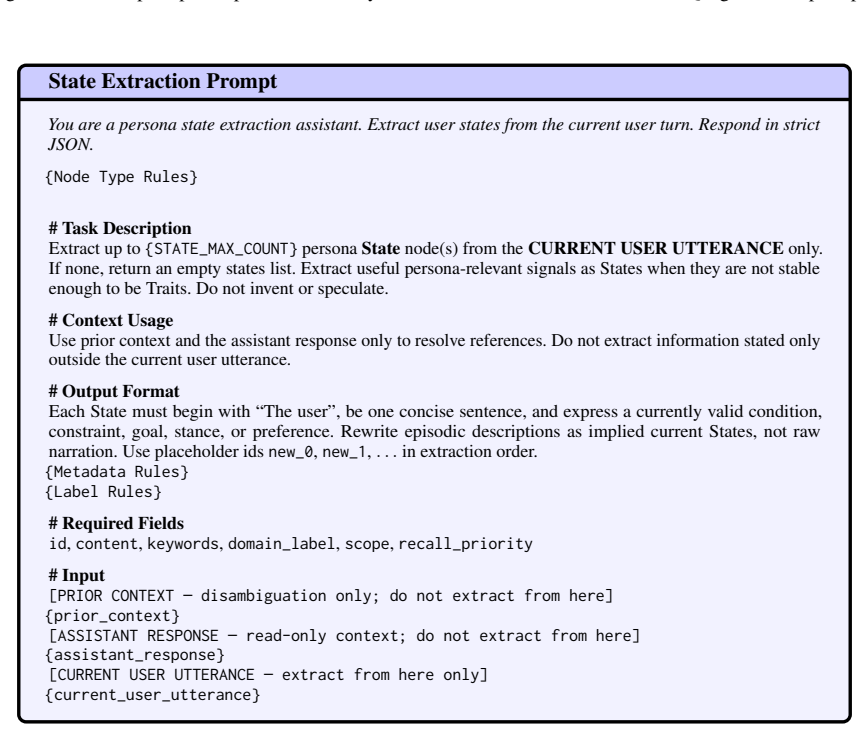
- [§4.3.2–4.3.3; Appendix D.2 (Table 13)] The signed traversal in Eq. (7) and the validity score in Eq. (9) depend on the correctness of evidence labels, especially CONTRADICT and SHIFT_TO. Table 13 reports human-validated accuracy of 36% for CON and 52% for SFT edges generated by Qwen3-1.7B. If these labels are largely noise, then the validity score partly filters noise rather than evidential structure, and the mechanism's claimed benefit is unverified. The ablation in Table 2 bounds the cost of removing CON or SFT edges at about two points, which shows these edges contribute to the score, but it does not establish that the contribution comes from meaningful evidential semantics. I would like to see an oracle-label experiment (e.g., replacing SLM labels with human/gold labels on a subset) or a confidence-threshold analysis for CON/SFT edges, to separate label noise from the traversal mechanism.
minor comments (5)
- [§1, Introduction] Typo: 'loosely coupledcomponents' is missing a space.
- [§A.3, Implementation Details] The sentence 'As personalized agents move toward on-device and privacy-preserving deployment, SLMs are the practical backbone as personalized agents move toward on-device and privacy-preserving deployment' repeats the same phrase twice.
- [§3, Eq. (1)] The notation uρt t is confusing; it should be written as u_t^{(ρ_t)} (or similar) to avoid ambiguity with subscripts/superscripts.
- [§C.2, Human Validation] The human validation is performed by two of the authors on only 30 samples. This is fine as a sanity check, but the report should not present it as a neutral third-party evaluation.
- [Appendix D.2] Table 13's human-validation sample is only 25 edges per type. The confidence intervals around 36% and 52% are therefore wide; please report agreement statistics (e.g., Cohen's kappa) and confidence intervals.
Circularity Check
No circular derivation; one minor self-citation in evaluation protocol. Hyperparameter sweeps and low evidence-label accuracy are correctness risks, not circularity.
full rationale
PGMem's derivation is self-contained: Eqs. (5)-(10) define seed scoring, signed traversal, and validity ranking as design choices over graph nodes, and the central claim is tested against external benchmarks (ImplexConv, PrefEval, PersonaMem) and external baselines, not derived from its own outputs. The only author-overlapping citation is the CheckEval judge framework (Lee et al., 2025) used to score ImplexConv; this is a minor self-citation, but it is not load-bearing because the checklist is applied identically to all methods and Appendix C.2 reports human validation on the same dimensions. The lambda=0.5 default and budget are chosen by sweeping the same benchmarks, which is model selection rather than a fitted prediction, and the paper's own Table 13 admits low human-validated accuracy on CONTRADICT (36%) and SHIFT_TO (52%) edges; these are correctness/overfitting risks, not circular steps. No equation reduces to its input by construction, and no uniqueness theorem or ansatz is imported from the authors' prior work.
Assumptions & free parameters
free parameters (7)
- Seed scoring weights (wsem, wov) =
Context (0.65, 0.35); State/Episode/Trait NARROW (0.60, 0.40), BROAD (0.85, 0.15)
- Ranking weight lambda =
0.5 default
- Retrieval budget (kseed per type, kaps, final counts) =
20/6/17/6 seeds, kaps=6, final 5 traits/18 states/4 episodes
- Hop cap H =
10
- Validity smoothing constant alpha =
not reported
- Chunk size C and trait interval B =
not reported
- State/Trait extraction maxima =
not reported
assumptions (5)
- domain assumption LLM-as-a-judge scores (gpt-4o-mini) reflect human judgment of personalization quality
- ad hoc to paper SLM-generated evidence labels are accurate enough to drive validity scoring and graph expansion
- ad hoc to paper Signed path composition is a valid model of evidential validity
- domain assumption The imposed temporal normalization is neutral across methods
- domain assumption Benchmark datasets and evaluation protocols are valid proxies for lifelong personalization
Cite this review
Pith. "Pith review of PGMem: Tightly Coupled Persona-Memory Graph for Lifelong Personalized Agents." pith.science (2026). https://pith.science/paper/VDIUU5AB
@misc{pith2026260801708,
  author       = {Pith},
  title        = {Pith review of: PGMem: Tightly Coupled Persona-Memory Graph for Lifelong Personalized Agents},
  year         = {2026},
  howpublished = {\url{https://pith.science/paper/VDIUU5AB}},
  note         = {Machine review of arXiv:2608.01708}
}
read the original abstract
Long-term personalized dialogue agents must track user preferences as their personas evolve. Existing memory systems organize past events well, but store personas as flat profiles detached from the events that justify them. This loose coupling leads to the memory-persona validity gap and the persona-aware retrieval gap. We propose PGMem, a heterogeneous persona-memory graph that connects event and persona nodes through typed provenance and evidence edges, keeping each persona signal traceable to the events that support or revise it. At retrieval time, PGMem expands from query-relevant seeds and ranks signals by evidential validity. Across three benchmarks with small language model backbones, PGMem consistently outperforms summary-based, persona-aware, graph-structured, and agentic memory baselines, and improves performance as the context grows. The source code of PGMem is available at https://github.com/wonjunchoi23/pgmem/
Figures
Figures from the paper (13 more)
Reference graph
Works this paper leans on
-
[1]
Nuo Chen, Hongguang Li, Jianhui Chang, Juhua Huang, Baoyuan Wang, and Jia Li. 2025. https://aclanthology.org/2025.coling-main.51/ Compress to impress: Unleashing the potential of compressive memory in real-world long-term conversations . In Proceedings of the 31st International Conference on Computational Linguistics, pages 755--773, Abu Dhabi, UAE. Assoc...
work page 2025
-
[2]
Prateek Chhikara, Dev Khant, Saket Aryan, Taranjeet Singh, and Deshraj Yadav. 2025. https://api.semanticscholar.org/CorpusID:278165315 Mem0: Building production-ready ai agents with scalable long-term memory . In European Conference on Artificial Intelligence
work page 2025
-
[3]
Jizhan Fang, Xinle Deng, Haoming Xu, Ziyan Jiang, Yuqi Tang, Ziwen Xu, Shumin Deng, Yunzhi Yao, Mengru Wang, Shuofei Qiao, Huajun Chen, and Ningyu Zhang. 2026. https://openreview.net/forum?id=dyJ0GWpjJB LightMem : Lightweight and efficient memory-augmented generation . In The Fourteenth International Conference on Learning Representations
work page 2026
-
[4]
William Fleeson. 2001. Toward a structure-and process-integrated view of personality: Traits as density distributions of states. Journal of personality and social psychology, 80(6):1011
work page 2001
-
[5]
Zhaopei Huang, Qifeng Dai, Guozheng Wu, Xiaopeng Wu, Xubin Li, Tiezheng Ge, Wenxuan Wang, and Qin Jin. 2026. Mem-PAL : Towards memory-based personalized dialogue assistants for long-term user-agent interaction. In Proceedings of the AAAI Conference on Artificial Intelligence, volume 40, pages 31229--31237
work page 2026
-
[6]
Jena D Hwang, Chandra Bhagavatula, Ronan Le Bras, Jeff Da, Keisuke Sakaguchi, Antoine Bosselut, and Yejin Choi. 2021. C omet- A tomic 2020: On symbolic and neural commonsense knowledge graphs. In Proceedings of the AAAI Conference on Artificial Intelligence, volume 35, pages 6384--6392. Association for the Advancement of Artificial Intelligence (AAAI)
work page 2021
-
[7]
Bowen Jiang, Zhuoqun Hao, Young Min Cho, Bryan Li, Yuan Yuan, Sihao Chen, Lyle Ungar, Camillo Jose Taylor, and Dan Roth. 2025. https://openreview.net/forum?id=6ox8XZGOqP Know me, respond to me: Benchmarking LLM s for dynamic user profiling and personalized responses at scale . In Second Conference on Language Modeling
work page 2025
-
[9]
Oliver P John and Sanjay Srivastava. 1999. The big five trait taxonomy: History, measurement, and theoretical perspective. Hand Book of Personality: Theory and Research
work page 1999
Show all 58 references
-
[10]
Aishwarya Kamath, Johan Ferret, Shreya Pathak, Nino Vieillard, Ramona Merhej, Sarah Perrin, Tatiana Matejovicova, Alexandre Ramé, Morgane Rivière, Louis Rouillard, and 1 others. 2025. https://arxiv.org/abs/2503.19786 Gemma 3 technical report . Preprint, arXiv:2503.19786
2025 arXiv
-
[17]
Patil, Ion Stoica, and Joseph E
Charles Packer, Sarah Wooders, Kevin Lin, Vivian Fang, Shishir G. Patil, Ion Stoica, and Joseph E. Gonzalez. 2023. MemGPT : Towards LLM s as operating systems. arXiv preprint arXiv:2310.08560
2023 arXiv
-
[18]
Vicky Zhao, Lili Qiu, and Jianfeng Gao
Zhuoshi Pan, Qianhui Wu, Huiqiang Jiang, Xufang Luo, Hao Cheng, Dongsheng Li, Yuqing Yang, Chin-Yew Lin, H. Vicky Zhao, Lili Qiu, and Jianfeng Gao. 2025. https://openreview.net/forum?id=xKDZAW0He3 SeCom : On memory construction and retrieval for personalized conversational age...
2025
-
[21]
Endel Tulving. 1972. Episodic and semantic memory. Organization of memory
1972
-
[26]
Wujiang Xu, Zujie Liang, Kai Mei, Hang Gao, Juntao Tan, and Yongfeng Zhang. 2025. https://openreview.net/forum?id=FiM0M8gcct A - M em: Agentic memory for LLM agents . In The Thirty-ninth Annual Conference on Neural Information Processing Systems
2025
-
[28]
An Yang, Anfeng Li, Baosong Yang, Beichen Zhang, Binyuan Hui, Bo Zheng, Bowen Yu, Chang Gao, Chengen Huang, Chenxu Lv, Chujie Zheng, Dayiheng Liu, Fan Zhou, Fei Huang, Feng Hu, Hao Ge, Haoran Wei, Huan Lin, Jialong Tang, and 41 others. 2025. https://arxiv.org/abs/2505.09388 Qw...
2025 arXiv
-
[31]
Zeyu Zhang, Quanyu Dai, Xiaohe Bo, Chen Ma, Rui Li, Xu Chen, Jieming Zhu, Zhenhua Dong, and Ji-Rong Wen. 2025 b . A survey on the memory mechanism of large language model-based agents. ACM Transactions on Information Systems, 43(6):1--47
2025
-
[32]
Siyan Zhao, Mingyi Hong, Yang Liu, Devamanyu Hazarika, and Kaixiang Lin. 2025. https://openreview.net/forum?id=QWunLKbBGF Do LLM s recognize your preferences? evaluating personalized preference following in LLM s . In The Thirteenth International Conference on Learning Representations
2025
-
[33]
Junhao Zheng, Chengming Shi, Xidi Cai, Qiuke Li, Duzhen Zhang, Chenxing Li, Dong Yu, and Qianli Ma. 2026. https://doi.org/10.1109/TPAMI.2025.3650546 Lifelong learning of large language model based agents: A roadmap . IEEE Transactions on Pattern Analysis and Machine Intelligen...
2026
-
[35]
Wanjun Zhong, Lianghong Guo, Qiqi Gao, He Ye, and Yanlin Wang. 2024. M emory B ank: Enhancing large language models with long-term memory. In Proceedings of the AAAI conference on artificial intelligence, volume 38, pages 19724--19731
2024
-
[36]
H yper M em: Hypergraph Memory for Long-Term Conversations
Yue, Juwei and Hu, Chuanrui and Sheng, Jiawei and Zhou, Zuyi and Zhang, Wenyuan and Liu, Tingwen and Guo, Li and Deng, Yafeng. H yper M em: Hypergraph Memory for Long-Term Conversations. Proceedings of the 64th Annual Meeting of the A ssociation for C omputational L inguistics...
2026 doi
-
[37]
2025 , url=
Wujiang Xu and Zujie Liang and Kai Mei and Hang Gao and Juntao Tan and Yongfeng Zhang , booktitle=. 2025 , url=
2025
-
[38]
Flexibly Utilize Memory for Long-Term Conversation via a Fragment-then-Compose Framework
Ke, Cai and Du, Yiming and Liang, Bin and Xiang, Yifan and Gui, Lin and Li, Zhongyang and Wang, Baojun and Yu, Yue and Wang, Hui and Wong, Kam-Fai and Xu, Ruifeng. Flexibly Utilize Memory for Long-Term Conversation via a Fragment-then-Compose Framework. Proceedings of the 2025...
2025 doi
-
[39]
Hello Again! LLM -powered Personalized Agent for Long-term Dialogue
Li, Hao and Yang, Chenghao and Zhang, An and Deng, Yang and Wang, Xiang and Chua, Tat-Seng. Hello Again! LLM -powered Personalized Agent for Long-term Dialogue. Proceedings of the 2025 Conference of the Nations of the Americas Chapter of the Association for Computational Lingu...
2025 doi
-
[40]
Towards Lifelong Dialogue Agents via Timeline-based Memory Management
Ong, Kai Tzu-iunn and Kim, Namyoung and Gwak, Minju and Chae, Hyungjoo and Kwon, Taeyoon and Jo, Yohan and Hwang, Seung-won and Lee, Dongha and Yeo, Jinyoung. Towards Lifelong Dialogue Agents via Timeline-based Memory Management. Proceedings of the 2025 Conference of the Natio...
2025 doi
-
[41]
Zhong, Wanjun and Guo, Lianghong and Gao, Qiqi and Ye, He and Wang, Yanlin , booktitle=
-
[42]
Evaluating Very Long-Term Conversational Memory of LLM Agents
Maharana, Adyasha and Lee, Dong-Ho and Tulyakov, Sergey and Bansal, Mohit and Barbieri, Francesco and Fang, Yuwei. Evaluating Very Long-Term Conversational Memory of LLM Agents. Proceedings of the 62nd Annual Meeting of the Association for Computational Linguistics (Volume 1: ...
2024 doi
-
[43]
Vicky Zhao and Lili Qiu and Jianfeng Gao , booktitle=
Zhuoshi Pan and Qianhui Wu and Huiqiang Jiang and Xufang Luo and Hao Cheng and Dongsheng Li and Yuqing Yang and Chin-Yew Lin and H. Vicky Zhao and Lili Qiu and Jianfeng Gao , booktitle=. 2025 , url=
2025
-
[44]
Toward Multi-Session Personalized Conversation: A Large-Scale Dataset and Hierarchical Tree Framework for Implicit Reasoning
Li, Xintong and Bantupalli, Jalend and Dharmani, Ria and Zhang, Yuwei and Shang, Jingbo. Toward Multi-Session Personalized Conversation: A Large-Scale Dataset and Hierarchical Tree Framework for Implicit Reasoning. Proceedings of the 2025 Conference on Empirical Methods in Nat...
2025 doi
-
[45]
In Prospect and Retrospect: Reflective Memory Management for Long-term Personalized Dialogue Agents
Tan, Zhen and Yan, Jun and Hsu, I-Hung and Han, Rujun and Wang, Zifeng and Le, Long and Song, Yiwen and Chen, Yanfei and Palangi, Hamid and Lee, George and Iyer, Anand Rajan and Chen, Tianlong and Liu, Huan and Lee, Chen-Yu and Pfister, Tomas. In Prospect and Retrospect: Refle...
2025 doi
-
[46]
European Conference on Artificial Intelligence , year=
Mem0: Building Production-Ready AI Agents with Scalable Long-Term Memory , author=. European Conference on Artificial Intelligence , year=
-
[47]
Compress to Impress: Unleashing the Potential of Compressive Memory in Real-World Long-Term Conversations
Chen, Nuo and Li, Hongguang and Chang, Jianhui and Huang, Juhua and Wang, Baoyuan and Li, Jia. Compress to Impress: Unleashing the Potential of Compressive Memory in Real-World Long-Term Conversations. Proceedings of the 31st International Conference on Computational Linguistics. 2025
2025
-
[48]
2026 , url=
Jizhan Fang and Xinle Deng and Haoming Xu and Ziyan Jiang and Yuqi Tang and Ziwen Xu and Shumin Deng and Yunzhi Yao and Mengru Wang and Shuofei Qiao and Huajun Chen and Ningyu Zhang , booktitle=. 2026 , url=
2026
-
[49]
Huang, Zhaopei and Dai, Qifeng and Wu, Guozheng and Wu, Xiaopeng and Li, Xubin and Ge, Tiezheng and Wang, Wenxuan and Jin, Qin , booktitle=
-
[50]
M em I nsight: Autonomous Memory Augmentation for LLM Agents
Salama, Rana and Cai, Jason and Yuan, Michelle and Currey, Anna and Sunkara, Monica and Zhang, Yi and Benajiba, Yassine. M em I nsight: Autonomous Memory Augmentation for LLM Agents. Proceedings of the 2025 Conference on Empirical Methods in Natural Language Processing. 2025. ...
2025 doi
-
[51]
and Stoica, Ion and Gonzalez, Joseph E
Packer, Charles and Wooders, Sarah and Lin, Kevin and Fang, Vivian and Patil, Shishir G. and Stoica, Ion and Gonzalez, Joseph E. , journal=
-
[52]
MAGMA : A Multi-Graph based Agentic Memory Architecture for AI Agents
Jiang, Dongming and Li, Yi and Li, Guanpeng and Li, Bingzhe. MAGMA : A Multi-Graph based Agentic Memory Architecture for AI Agents. Proceedings of the 64th Annual Meeting of the A ssociation for C omputational L inguistics (Volume 1: Long Papers). 2026. doi:10.18653/v1/2026.ac...
2026 doi
-
[53]
2509.21212 , archivePrefix=
Yaxiong Wu and Yongyue Zhang and Sheng Liang and Yong Liu , year=. 2509.21212 , archivePrefix=
-
[54]
Pre-Storage Reasoning for Episodic Memory: Shifting Inference Burden to Memory for Personalized Dialogue
Kim, Sangyeop and Lee, Yohan and Kim, Sanghwa and Kim, Hyunjong and Cho, Sungzoon. Pre-Storage Reasoning for Episodic Memory: Shifting Inference Burden to Memory for Personalized Dialogue. Findings of the Association for Computational Linguistics: EMNLP 2025. 2025. doi:10.1865...
2025 doi
-
[55]
Recursively summarizing enables long-term dialogue memory in large language models , journal =
Qingyue Wang and Yanhe Fu and Yanan Cao and Shuai Wang and Zhiliang Tian and Liang Ding , keywords =. Recursively summarizing enables long-term dialogue memory in large language models , journal =. 2025 , issn =. doi:https://doi.org/10.1016/j.neucom.2025.130193 , url =
2025
-
[56]
Bridging Intuitive Associations and Deliberate Recall: Empowering LLM Personal Assistant with Graph-Structured Long-term Memory
Zhang, Yujie and Yuan, Weikang and Jiang, Zhuoren. Bridging Intuitive Associations and Deliberate Recall: Empowering LLM Personal Assistant with Graph-Structured Long-term Memory. Findings of the Association for Computational Linguistics: ACL 2025. 2025. doi:10.18653/v1/2025.f...
2025 doi
-
[57]
ACM Transactions on Information Systems , volume=
A survey on the memory mechanism of large language model-based agents , author=. ACM Transactions on Information Systems , volume=. 2025 , publisher=
2025
-
[58]
2026 , eprint=
Graph-based Agent Memory: Taxonomy, Techniques, and Applications , author=. 2026 , eprint=
2026
-
[59]
Know Me, Respond to Me: Benchmarking
Bowen Jiang and Zhuoqun Hao and Young Min Cho and Bryan Li and Yuan Yuan and Sihao Chen and Lyle Ungar and Camillo Jose Taylor and Dan Roth , booktitle=. Know Me, Respond to Me: Benchmarking. 2025 , url=
2025
-
[60]
Hand Book of Personality: Theory and Research , year=
The Big Five Trait Taxonomy: History, Measurement, and Theoretical Perspective , author=. Hand Book of Personality: Theory and Research , year=
-
[61]
, author=
Toward a structure-and process-integrated view of personality: Traits as density distributions of states. , author=. Journal of personality and social psychology , volume=. 2001 , publisher=
2001
-
[62]
Organization of memory , year=
Episodic and semantic memory , author=. Organization of memory , year=
-
[63]
Siyan Zhao and Mingyi Hong and Yang Liu and Devamanyu Hazarika and Kaixiang Lin , booktitle=. Do. 2025 , url=
2025
-
[64]
C heck E val: A reliable LLM -as-a-Judge framework for evaluating text generation using checklists
Lee, Yukyung and Kim, JoongHoon and Kim, Jaehee and Cho, Hyowon and Kang, Jaewook and Kang, Pilsung and Kim, Najoung. C heck E val: A reliable LLM -as-a-Judge framework for evaluating text generation using checklists. Proceedings of the 2025 Conference on Empirical Methods in ...
2025 doi
-
[65]
2303.08774 , archivePrefix=
OpenAI and Josh Achiam and Steven Adler and Sandhini Agarwal and Lama Ahmad and Ilge Akkaya and Florencia Leoni Aleman and Diogo Almeida and Janko Altenschmidt and Sam Altman and 271 others , year=. 2303.08774 , archivePrefix=
-
[66]
International Conference on Learning Representations , year=
BERTScore: Evaluating Text Generation with BERT , author=. International Conference on Learning Representations , year=
-
[67]
2025 , eprint=
Gemma 3 Technical Report , author=. 2025 , eprint=
2025
-
[68]
2025 , eprint=
Qwen3 Technical Report , author=. 2025 , eprint=
2025
-
[69]
Beyond Goldfish Memory: Long-Term Open-Domain Conversation
Xu, Jing and Szlam, Arthur and Weston, Jason. Beyond Goldfish Memory: Long-Term Open-Domain Conversation. Proceedings of the 60th Annual Meeting of the Association for Computational Linguistics (Volume 1: Long Papers). 2022. doi:10.18653/v1/2022.acl-long.356
2022 doi
-
[70]
Long Time No See! Open-Domain Conversation with Long-Term Persona Memory
Xu, Xinchao and Gou, Zhibin and Wu, Wenquan and Niu, Zheng-Yu and Wu, Hua and Wang, Haifeng and Wang, Shihang. Long Time No See! Open-Domain Conversation with Long-Term Persona Memory. Findings of the Association for Computational Linguistics: ACL 2022. 2022. doi:10.18653/v1/2...
2022 doi
-
[71]
Personalized Response Generation via Generative Split Memory Network
Wu, Yuwei and Ma, Xuezhe and Yang, Diyi. Personalized Response Generation via Generative Split Memory Network. Proceedings of the 2021 Conference of the North American Chapter of the Association for Computational Linguistics: Human Language Technologies. 2021. doi:10.18653/v1/...
2021 doi
-
[72]
Less is More: Learning to Refine Dialogue History for Personalized Dialogue Generation
Zhong, Hanxun and Dou, Zhicheng and Zhu, Yutao and Qian, Hongjin and Wen, Ji-Rong. Less is More: Learning to Refine Dialogue History for Personalized Dialogue Generation. Proceedings of the 2022 Conference of the North American Chapter of the Association for Computational Ling...
2022 doi
-
[73]
Lifelong Learning of Large Language Model Based Agents: A Roadmap , year=
Zheng, Junhao and Shi, Chengming and Cai, Xidi and Li, Qiuke and Zhang, Duzhen and Li, Chenxing and Yu, Dong and Ma, Qianli , journal=. Lifelong Learning of Large Language Model Based Agents: A Roadmap , year=
-
[74]
2021 , organization=
Hwang, Jena D and Bhagavatula, Chandra and Le Bras, Ronan and Da, Jeff and Sakaguchi, Keisuke and Bosselut, Antoine and Choi, Yejin , booktitle=. 2021 , organization=
2021
-
[75]
ACM Trans
Wang, Fali and Zhang, Zhiwei and Zhang, Xianren and Wu, Zongyu and Mo, TzuHao and Lu, Qiuhao and Wang, Wanjing and Li, Rui and Xu, Junjie and Tang, Xianfeng and He, Qi and Ma, Yao and Huang, Ming and Wang, Suhang , title =. ACM Trans. Intell. Syst. Technol. , month = nov, arti...
2025 doi
Reviewed August 4, 2026 · model on record in the stance chip above.
Discussion (0). Sign in to comment.