REVIEW 4 major objections 4 minor 12 references
ReTouch: Empowering Contact-Rich Dexterous Manipulation with Online-Refined Tactile Prediction
T0 review · 4 major / 4 minor · reviewed 2026-08-15 · deepseek-v4-flash
Pith's one-line read ReTouch claims that treating future tactile predictions as a continuously refined control state—updated at 36 Hz from incoming contact feedback—raises average success by 18.4 percentage points over the strongest baseline in seven…
desk verdict Genuinely new control mechanism (recursive refinement of predicted tactile latents at 36 Hz) with strong real-robot ablations, but the headline gains are graded partial-credit scores, not binary success rates, and there are no error bars. read the letter →
The pith
A machine-rendered reading of the paper's core claim, the machinery that carries it, and where it could break.
The reading
What carries the argument
The load-bearing object is the future tactile latent: a compact internal code, aligned by cosine distance to a privileged expert's layer-12 representations, that stands in for the next contact states and conditions action generation. Three parts carry the argument. The Tactile-Patch Encoder splits each finger's 120 taxels into five functional patches (tip, center, base, left, right), pools them with soft contact weights, and adds finger-identity and patch-position embeddings so each finger token keeps local contact structure. During training, the Hindsight Action Expert uses ground-truth future tactile patch features to create target latents, and the Foresight Action Expert is trained to predict those latents from the cached VLM context, chunk-start state, and observed tactile history, with a directional attention mask so action tokens cannot leak into the tactile latents. At execution, a masked carry-over operation re-inserts the already-elapsed part of the previous latent estimate into the Foresight queries, letting the model recursively refine the forecast and the remaining action chunk at 36 Hz against the VLM's slower 9 Hz semantic updates; this is the mechanism the ablations credit for most of the reported gain.
What would settle it
Two checks would settle it: reproduce the Appendix D.3 sample-matched comparison on held-out trajectories and see whether recursive refinement still beats one-shot given the same fresh tactile history—if the latent cosine and action-MSE gains vanish, the refinement mechanism is not the carrier; and decode the refined latents into taxel-level contact maps, comparing them with the real future tactile frames, to verify that the alignment gain corresponds to physical contact fidelity rather than agreement with the privileged expert's code alone.
Extended reading notes
Core claim
The paper's central claim is that the limiting factor in tactile-aware dexterous manipulation is not how well the model can predict touch one more time, but whether it re-estimates that prediction as contact evolves. ReTouch therefore keeps the future tactile state inside the control loop: during training, a privileged Hindsight Action Expert sees the ground-truth future tactile frames and produces action-relevant target latents, while a Foresight Action Expert must predict the same latents from current observations; during deployment, only the Foresight expert runs, and at every 36 Hz call it updates the future tactile latents and re-predicts the remaining action chunk from the latest tactile history. The paper reports that this beats the strongest baseline by 18.4 points on average (83.6% vs 65.2%), by 23.8 points under challenging conditions, and that removing intra-chunk refinement drops average success by 23.6 points, while keeping the initial tactile prediction fixed but re-generating actions drops it by 15.2 points. The supporting offline diagnostic, on 100 held-out trajectories, shows the recursive refinement raises in-contact latent cosine similarity by 0.908% and lowers action-suffix error by 2.139% relative to a one-shot prediction that still re-infers actions from fresh tactile history.
Load-bearing premise
The load-bearing premise is that cosine-aligning the predicted tactile latents to the internal representations of a training-only expert that sees the true future touch transfers the contact information the actions actually need, even though the alignment is never checked against physical fidelity of the predicted touch; if that transfer is lossy, the online refinement loop would guide actions with a distorted forecast.
Editorial extensions
If this is right
- A tactile forecast generated once at chunk start goes stale during contact-rich execution; ReTouch claims the refinement of the forecast itself—not just re-inference of actions from new touch—is what restores accuracy, with a 15.2-point drop when the prediction is frozen.
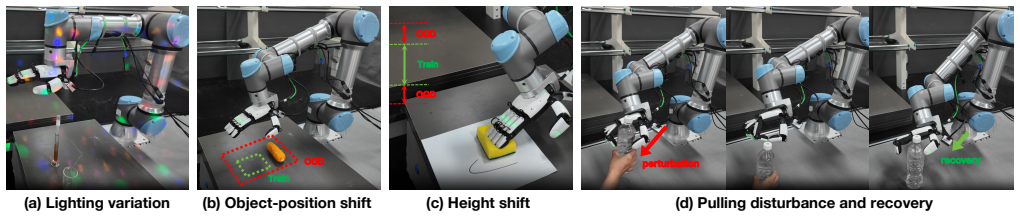
- Robustness gains are largest exactly where contact changes: 30.0 points over the strongest baseline under a post-grasp pulling disturbance, 20.0 points under lighting change, and 25.0 points on sustained-contact Sponge Wipe.
- Structured finger/patch encoding contributes 14.5 points; flattening raw taxels into an MLP input removes the finger identity and local contact structure the policy needs.
- The timing of refinement matters: delaying the joint update by roughly one action step (non-blocking variant) costs 7.8 points, so the value lies in updating before the next command is sent.
- The 9 Hz VLM / 36 Hz action-expert split is itself part of the claim: high-rate contact correction can happen without re-running the vision-language backbone.
Reading between the lines
- The cosine-alignment objective supervises latents only against the privileged expert's own internal code, so the method actually certifies action-relevant agreement, not physical fidelity of the predicted touch; a natural extension would be to decode the refined latents back to taxel-level contact maps and check them against real future frames.
- The same recursive-latent pattern could apply to any fast sensor stream—force/torque, proximity, strain—inside a slow semantic backbone, so the paper's contribution may generalize beyond tactile sensing to general asymmetric-rate control.
- Because gains concentrate in tasks with sustained or shifting contact (Sponge Wipe, Liquid Transfer, pulling recovery) and ReTouch does not clearly win the visually dominated Cabinet Retrieval task, a reader should expect the method's advantage to depend on how much contact drift a task contains.
- Treating the refined touch latent as a control state invites a comparison against an explicit model-based tactile predictor (e.g., a learned forward model that consumes the same tactile history); such a test would reveal how much of the gain comes from the learned latent representation versus the closed-loop re-estimation schedule.
Signed reviews
Editorial analysis
A structured set of objections, weighed in public.
Referee Report
Summary. The paper proposes ReTouch, a vision-language-action model for contact-rich dexterous manipulation that combines structured tactile patch encoding with online refinement of predicted tactile latents and action chunks. A Tactile-Patch Encoder partitions each finger's 120 taxels into five functional patches and pools them into finger tokens, preserving finger identity and local contact structure. During training, a privileged Hindsight Action Expert (HAE) produces action-relevant future-tactile latent targets from ground-truth future tactile signals, and a Foresight Action Expert (FAE) is trained, via cosine alignment and action losses, to predict and recursively refine those latents using only deployable observations. At execution, the FAE runs at 36 Hz and, at each refinement offset, updates the future tactile latents and regenerates the remaining action chunk, conditioned on the latest tactile feedback. The authors collect XHT-Dataset, 900 demonstrations across seven contact-rich tasks on an XHand--UR7e platform, and evaluate ReTouch in closed-loop real-robot experiments, reporting average normalized task scores of 83.6% versus 65.2% for the strongest baseline under standard settings and 73.1% versus 49.3% under challenging settings.
Significance. If the reported results hold, ReTouch would be a meaningful advance for contact-rich dexterous manipulation: it demonstrates that future tactile latents can serve as an execution-time control state that is recursively refined from incoming tactile feedback, and it provides a real-robot evaluation platform and dataset that are valuable to the community. The paper's strengths include genuinely closed-loop real-robot experiments with a dense tactile stream, a carefully decomposed ablation set that isolates individual mechanisms, and sample-matched offline diagnostics. The main quantitative claim, however, rests on a graded partial-credit task score rather than binary completion, and the reported numbers come from 20 rollouts per cell without uncertainty quantification. The mechanism-level validation of tactile-latent fidelity is also self-referential, since it compares predicted latents to HAE latents produced by the same training pipeline. These issues are addressable and do not, in my assessment, invalidate the central idea, but they do need to be fixed before the paper's stated claims can be considered fully supported.
major comments (4)
- [Section 4.1, Appendix B.3, Tables 1-3] The primary metric is the mean normalized task score with additive stage-based partial credit for six of seven tasks; only Button Press uses a binary criterion. The paper repeatedly calls this metric 'success rate,' and the headline gains of 18.4 and 23.8 percentage points are differences in this graded score, not in binary completion frequencies. For example, Sponge Wipe awards 0.5 when part of the marks is removed but visible traces remain, so an 87.5% score is compatible with no fully cleaned wipe. Because the partial-credit schedule can compress or expand differences between policies, the central claim is not as secure as the wording suggests. Please report binary task-completion rates alongside the graded scores, at least for the main comparison and the key ablations, and discuss how the credit schedule affects the reported gaps.
- [Tables 1-3 and Section 4.2] Each cell in Tables 1-3 is based on 20 real-robot rollouts, but no variance, confidence intervals, or significance tests are reported. Table 6 aggregates 100 trajectories without counts or intervals. The observed gaps, including the 23.6, 15.2, and 14.5 percentage point ablation drops, may be real, but with 20 trials per cell they are not statistically secure. Please add per-task and per-condition confidence intervals, or explicitly acknowledge the exploratory nature of the numbers and avoid unsupported precision in the abstract.
- [Section 3.3, Eq. (5), Fig. 5, Table 6] The mechanism-level claim that predicted tactile latents carry action-relevant contact information is validated only by cosine similarity to HAE latents produced by the same training pipeline. At deployment the HAE is removed, leaving the FAE latents as the sole carrier of future-contact information, so this validation is, as it stands, self-referential for the physical-fidelity claim. I note that the direct action loss on the FAE and the real-robot ablations partially mitigate this concern. Still, please add a direct check of predicted latents against ground-truth future tactile signals, for example by decoding predicted latents into patch-level forces and comparing them with measured future taxels, or explicitly state this limitation in the paper.
- [Section 3.4, Appendix A.3] Training samples refinement offsets only from {4, 8, 12}, but deployment invokes the FAE at the 36 Hz control rate and applies the unexecuted suffix at every call, which in principle includes intermediate offsets not seen during training. The paper does not justify that random-offset training on three offsets transfers to the full range of deployed offsets. Please clarify whether deployment calls are in fact restricted to offsets {4, 8, 12} within each 16-step chunk, or provide evidence that the model generalizes to all intermediate offsets.
minor comments (4)
- [Abstract and Sections 4.1-4.2] The term 'success rate' is used throughout for what Appendix B.3 defines as a normalized task score with partial credit. Please use 'normalized task score' or 'mean task score' in the abstract and main text wherever the graded metric is meant, and reserve 'success rate' for the binary Button Press task.
- [Figure 5] The panel labels in Figure 5 do not match the caption: the caption describes future tactile prediction and remaining-action MSE, while the figure contains repeated 'Pipette Press' labels. Please correct the figure so that the labels correspond to the caption and the plotted quantities.
- [Eq. (6)] The mask M_t is not defined precisely. Please specify its length, how it selects the latent prefix corresponding to the elapsed portion of the action chunk, and how it is constructed for the initial call and for deployment calls at arbitrary offsets.
- [Appendix D.3, Eq. (14)] The notation for the number of eligible samples N_o is not fully specified. Please state how samples are filtered and how cases with no eligible future-tactile tokens are handled in the aggregate statistics.
Circularity Check
Central real-robot success claim is independent; only the offline tactile-latent diagnostic is mildly self-referential because it scores predictions against the same HAE targets used as the training objective.
-
self definitional
[Section 4.2; Appendix D.3, Eq. (14); training objective Eq. (5), Section 3.3]
"We obtain the Target Tactile Latents by processing the ground-truth future tactile signals with the hindsight branch used during training. At each update, we evaluate tactile prediction using the cosine similarity between the suffixes of the predicted and target latent sequences, and action generation using the physical-space MSE between the predicted and ground-truth action suffixes."
The 'target tactile latents' are the HAE states that Eq. (5) trains the FAE to match via cosine alignment, and Appendix D.3's latent-cosine metric (Eq. 14) is the same cosine between the projected FAE states and the same HAE targets. Thus the reported +0.908% latent-similarity improvement measures how well recursive refinement optimizes the model's own training objective, not an externally defined physical tactile prediction. The HAE targets are derived from ground-truth future tactile signals, so this is a distillation objective rather than a pure tautology, but the diagnostic cannot independently validate the physical fidelity of the predicted tactile latents.
full rationale
The paper's central claim—18.4 and 23.8 percentage-point gains in average success rate—is evaluated on closed-loop real-robot rollouts using a fixed task rubric and compared against external baselines, so it does not reduce to the model's own outputs or fitted values. The ablation studies also use the same independent real-robot metric, and removing components causes substantial degradation, which is consistent with a genuine mechanism-level effect. The only mildly circular element is the offline diagnostic in Section 4.2 and Appendix D.3: predicted tactile latents are evaluated by cosine similarity to the Hindsight Action Expert latents that Eq. (5) uses as the training target. This makes the latent-similarity improvement a measure of fit to the model's own supervision objective rather than an independent measure of tactile prediction accuracy. However, the paper also reports physical-space action MSE (which is independent of the HAE latent space) and relies mainly on real-robot task scores for its headline claims. The use of 'success rate' to denote a graded normalized task score is a terminology and statistical-reporting concern, not circularity. There is no load-bearing self-citation chain, no imported uniqueness theorem, and no renamed known result. Overall circularity burden is low.
Assumptions & free parameters
free parameters (5)
- Contact threshold theta_c =
0.5 (encoder pretraining), 1.0 (policy training)
- Softening temperature gamma_c =
0.5
- Refinement offsets {4, 8, 12} =
4, 8, 12
- Alignment loss weight lambda_align =
0.1
- Encoder pretraining loss weights =
contact 0.5; active force 1.0; magnitude 0.5; inactive force 0.25
assumptions (5)
- domain assumption The five-patch partition (tip, center, base, left, right) of each finger's 120 taxels preserves the contact information needed for action control.
- ad hoc to paper Cosine alignment between FAE and HAE latents is a sufficient training signal for action-relevant tactile prediction.
- domain assumption Tactile force readings are meaningful after zeroing, without modeling sensor noise or calibration drift.
- ad hoc to paper Randomly sampled offsets {4, 8, 12} during training transfer to continuous online refinement at all intermediate timesteps.
- domain assumption A single combined policy trained on seven tasks for 80k steps reaches stable multi-task behavior that is comparable to task-specific baselines.
Cite this review
Pith. "Pith review of ReTouch: Empowering Contact-Rich Dexterous Manipulation with Online-Refined Tactile Prediction." pith.science (2026). https://pith.science/paper/SSST2PSX
@misc{pith2026260801824,
  author       = {Pith},
  title        = {Pith review of: ReTouch: Empowering Contact-Rich Dexterous Manipulation with Online-Refined Tactile Prediction},
  year         = {2026},
  howpublished = {\url{https://pith.science/paper/SSST2PSX}},
  note         = {Machine review of arXiv:2608.01824}
}
read the original abstract
Fusing tactile signals has proven effective for contact-rich manipulation, enabling robots to perceive contact states and adapt to rapidly changing physical interactions. Yet effectively integrating tactile feedback into dexterous manipulation remains underexplored. In this work, we introduce ReTouch, a vision-language-action model (VLA) that supports contact-rich dexterous manipulation through tactile predictions continually refined online using execution-time feedback. ReTouch builds on two main innovations for tactile representation and closed-loop action generation. First, its Tactile-Patch Encoder represents tactile observations as structured tactile patch features that preserve finger identity and local contact structure, providing contact cues for fine-grained dexterous control. Second, its high-frequency action module jointly predicts future tactile states and action chunks and refines both using incoming tactile feedback during execution. This closed-loop refinement keeps tactile predictions aligned with evolving physical interactions, enabling responsive action correction and improving robustness to contact changes and execution errors. We further introduce XHT-Dataset, comprising 900 real-world demonstrations across seven contact-rich tasks collected on an XHand--UR7e platform, and evaluate ReTouch through closed-loop real-robot experiments. ReTouch surpasses the strongest baseline by 18.4 and 23.8 percentage points in average success rate under standard and challenging conditions, respectively, demonstrating its effectiveness and robustness.
Figures


Figures from the paper (6 more)


Reference graph
Works this paper leans on
-
[1]
Black,K.;Brown,N.;Driess,D.;Esmail,A.;Equi,M.;Finn, C.; Fusai, N.; Groom, L.; Hausman, K.; Ichter, B.; et al. 2024.π 0: A Vision-Language-Action Flow Model for Gen- eral Robot Control.arXiv preprint arXiv:2410.24164. Calandra, R.; Owens, A.; Jayaraman, D.; Lin, J.; Yuan, W.; Malik, J.; Adelson, E. H.; and Levine, S
arXiv 2024
-
[4]
FAWAM: Force-Aware World Action Models for Closed-Loop Contact-Rich Manipulation
FAWAM: Force-Aware World Action Models for Closed- Loop Contact-Rich Manipulation. arXiv:2606.08555. Heng, L.; Geng, H.; Zhang, K.; Abbeel, P.; and Ma- lik, J
-
[5]
ViTacFormer: Learning Cross-Modal Representation for Visuo-Tactile Dexterous Manipulation. arXiv:2506.15953. Huang, B.; Wang, Y.; Yang, X.; Luo, Y.; and Li, Y. 2025a. 3D-ViTac:LearningFine-GrainedManipulationwithVisuo- Tactile Sensing. arXiv:2410.24091. Huang, J.; Wang, S.; Lin, F.; Hu, Y.; Wen, C.; and Gao, Y. 2025b. Tactile-VLA: unlocking vision-languag...
-
[7]
Lou,Y.;Ye,Y.;Fu,Y.;Cen,J.;Chi,X.;Lyu,Y.;Jia,P.;Han, S.;Lu,Z.;andZhang,S.2026
Favla: A force-adaptive fast-slow vla model for contact-rich robotic manipulation.arXiv preprint arXiv:2602.23648. Lou,Y.;Ye,Y.;Fu,Y.;Cen,J.;Chi,X.;Lyu,Y.;Jia,P.;Han, S.;Lu,Z.;andZhang,S.2026. Dream-Tac:AUnifiedTactile World Action Model for Contact-Rich Robot Manipulation. arXiv:2606.08737. Niu, D.; Liu, Z.; Wang, Z.; Shao, B.; Yin, Z.-H.; Pai, A.; Sharm...
arXiv 2026
-
[8]
Tactile-WAM: Touch- AwareWorldActionModelwithTactileAsymmetricAtten- tion. arXiv:2606.26663. Xue,H.;Ren,J.;Chen,W.;Zhang,G.;Fang,Y.;Gu,G.;Xu, H.; and Lu, C
-
[10]
Zhang, K.; Zhang, H.; Xu, Z.; Zhang, Z.; Prince, M
TacFore- Sight: Force-Guided Tactile World Model for Contact-Rich Manipulation.arXiv preprint arXiv:2606.11184. Zhang, K.; Zhang, H.; Xu, Z.; Zhang, Z.; Prince, M. R. I.; Li, X.; Han, X.; Zhou, Y.; Ajoudani, A.; and She, Y. 2026a. TacVLA: Contact-Aware Tactile Fusion for Robust Vision- Language-Action Manipulation. arXiv:2603.12665. Zhang,X.;Zhang,Y.;Shi,...
arXiv 2026
-
[12]
The reported∆ avg is computed from these aggregate values in the preferred metric direction, whereas∆4,∆ 8, and∆ 12 denote the corresponding per-offset relative changes. As shown in Table 6, neither metric exhibits a consistent changeacrossupdateoffsetsforpre-contactsamples.Forin- contactsamples,recursivetactile-latentrefinementincreases latent similarity...
-
[64]
During de- ployment,thepolicyusesACTtemporalensemblingateach control step
We use AdamW with learning rates of10−4 for the policy and10−5 for the visual backbone, and select the checkpoint with the lowest validation loss. During de- ployment,thepolicyusesACTtemporalensemblingateach control step. Reactive Diffusion Policy.For RDP, we retain its task- specifictwo-stageAT–LDPtrainingandslow–fastexecution scheme. Each finger’s 360-d...
Show all 12 references
-
[2024]
Li, Y.; Tang, P.; Zhang, W.; Zhu, C.; Duan, Y.; Shi, W.; Zhang, X.; Yang, Z.; Ji, J.; and Zhang, Y
Openvla: An open-source vision-language- action model.arXiv preprint arXiv:2406.09246. Li, Y.; Tang, P.; Zhang, W.; Zhu, C.; Duan, Y.; Shi, W.; Zhang, X.; Yang, Z.; Ji, J.; and Zhang, Y
-
[2025]
arXiv preprint arXiv:2503.02881
Reactive diffusion policy: Slow-fast visual-tactile policy learning for contact-rich manipulation. arXiv preprint arXiv:2503.02881. Zang, Y.; Zheng, Y.; Nie, X.; Zheng, Y.; Tian, S.; Gu, S.; Gao, C.; Wang, Z.; Yan, S.; and Ding, W
-
[2026]
arXiv:2508.08706
OmniVTLA: Vision-Tactile- Language-Action Models with Semantic-Aligned Tactile Sensing. arXiv:2508.08706. He, H.; Yan, Z.; Liu, Q.; Guo, N.; and Lian, W
-
[3307]
Calandra, R.; Owens, A.; Upadhyaya, M.; Yuan, W.; Lin, J.; Adelson,E.H.;andLevine,S.2017. TheFeelingofSuccess: DoesTouchSensingHelpPredictGraspOutcomes? InPro- ceedings of the 1st Annual Conference on Robot Learning, volume 78 ofProceedings of Machine Learning Research, 314–32...
2017
Reviewed August 15, 2026 · model on record in the stance chip above.
Discussion (0). Continue with ORCID to comment.