REVIEW 3 major objections 5 minor 61 references
Reinforcement-Learned Electric-Field Sensing with Asymmetrically Blockaded Rydberg Arrays
T0 review · 3 major / 5 minor · reviewed 2026-08-04 · deepseek-v4-flash
Pith's one-line read A microwave-dressed Rydberg array converts electric-field changes into a sharp all-excited population signal, giving near-quadratic Fisher-information scaling with atom number and, in a six-atom spherical configuration, full three-dimension
desk verdict A promising finite-size numerical study of scalar Rydberg electrometry, but the vector-sensing section rests on an un-derived and likely incorrect angular model. read the letter →
The pith
A machine-rendered reading of the paper's core claim, the machinery that carries it, and where it could break.
The reading
What carries the argument
The central object is the asymmetric blockade configuration. Two microwave fields dress each atom into a superposition of s and p Rydberg states with coefficients chosen so that the target-target dipole-dipole interaction vanishes while the control-target interaction survives. Near a Förster resonance (energy defect δ(E) tuned through zero by the field at Eres ≃ 3.14 V/cm), that surviving interaction scales as |V(E,R)| = (√(δ² + 4|C3|²/R⁶) − |δ|)/2, which crosses from R⁻⁶ to R⁻³ as the field approaches resonance. This field-tunable interaction, through the blockade radius it sets, controls the full-excitation population used as the measurement signal. The second key ingredient is the six-ato
What would settle it
Measure, in a planar array of two to ten atoms, the full-excitation probability near the 3.14 V/cm Förster resonance and fit the classical Fisher information to FC ∝ N^b. An exponent b ≈ 1 (the standard quantum limit) rather than ≈2 would refute the claimed near-Heisenberg scaling. Separately, in the six-atom sphere, record axial excitation versus field direction for a fixed field magnitude: the data must follow the (1 − 3cos²θ) shape, and applying a bias field along +z must split the ambiguous candidates exactly as predicted; any systematic deviation from this angular law invalidates the vect
Extended reading notes
Core claim
The central claim is that the asymmetric blockade—target-target interactions suppressed by microwave dressing while control-target interactions remain field-tunable near a Förster resonance—makes the Rydberg-blockade radius an electric-field-controlled resource. The field dependence of that radius produces a sharp resonance dip in the full-excitation population fτ(E), and this binary signal already gives classical Fisher information scaling almost quadratically with atom number in the simulated finite-size regime. For vector sensing, six target atoms on the Cartesian axes around one control atom encode the three direction cosines of an unknown field into three axial interaction energies Vi =
Load-bearing premise
The vector-sensing claim rests on the assumed exact angular dependence Vi = (C3/R^3)(1 − 3cos²θi) for the dressed control-target interaction, stated without derivation from the microwave-dressing model; if real dressing or the Förster channel distorts this (1 − 3cos²θ) form, the direction readout and bias-field disambiguation collapse. The paper also plainly labels its scaling results as finite-size, closed-system simulations.
Editorial extensions
If this is right
- Even a simple all-excited readout on planar asymmetric-blockade arrays gives near-Heisenberg scaling of classical Fisher information with atom number (b ≈ 1.88–2.09) for up to ten atoms, far beyond the standard quantum limit b = 1.
- Reinforcement-learning-designed composite pulse sequences increase the quantum Fisher information with pulse depth, with fitted exponents 1.90–2.44 approaching quadratic scaling.
- A single six-atom spherical array, together with one known bias field, reconstructs the full three-dimensional field direction without moving parts or multiple sensor orientations.
- Robustness checks at stated levels of Rabi error, positional error, residual target-target coupling, and projection noise show the protocol remains viable with current optical-tweezer Rydberg experiments.
- The paper itself cautions that the scaling statements are finite-size results from closed-system simulations; experimental benchmarking of the exponents is the next required step.
Reading between the lines
- If the near-quadratic scaling persists beyond N ≈ 10, the asymmetric-blockade mechanism could be a generic resource for many-body metrology, since it converts a single binary readout into Heisenberg-like sensitivity without GHZ-state preparation.
- The bias-field disambiguation suggests a natural extension: using the same six-atom sphere to measure both field magnitude and direction over a wide dynamic range by sweeping the bias field, or to sense alternating fields by modulating the bias.
- The reinforcement-learning pulse search might be viewed as automated generation of metrologically useful many-body entanglement; a testable extension is to characterize the entanglement (e.g., squeezing or multipartite witnesses) of the optimized final states.
- A practical experiment could relax the ideal Vtt = 0 condition, since residual target-target coupling is already treated as a noise source and the protocol tolerates it in the reported robustness tests.
Editorial analysis
A structured set of objections, weighed in public.
Referee Report
Summary. The paper proposes a Rydberg-array electric-field sensor based on microwave-dressing-induced asymmetric blockade. In a planar array, numerical simulations of the full-excitation probability yield a classical Fisher information that grows superlinearly with atom number (F_C ∝ N^b, b ≈ 1.88–2.09 for N ≤ 10) and a quantum Fisher information with similarly fitted exponents; reinforcement learning is used to optimize composite pulse phases, increasing QFI for the simulated pulse depths. A spherical six-atom array is then proposed for vector electrometry, where field direction is inferred from axial excitation populations and a weak bias field is introduced to resolve sign and magic-angle ambiguities. The manuscript closes with robustness simulations against Rabi-frequency, position, residual-interaction, and projection-noise errors. The central claims are that the protocol offers near-quadratic, Heisenberg-like finite-size scaling and full three-dimensional vector capability.
Significance. If the vector-sensing scheme and the scaling claims were fully supported, this would be a useful contribution to Rydberg electrometry: the planar-array simulation pipeline is coherent, the ARC-based Stark-map input is standard, and the robustness analysis covers several experimentally relevant imperfections. The finite-size scaling of F_C is an interesting numerical observation, and the RL pulse optimization, while not a fundamental discovery, demonstrates a practical control improvement within the simulated regime. The main value of the paper lies in the combined protocol rather than in a new analytical scaling law. However, the vector electrometry claim is currently not established because its angular interaction model is assumed rather than derived, and the headline 'Heisenberg limit' phrasing substantially exceeds what the finite-size fits can support. The paper is therefore promising but needs substantial revision to make the load-bearing assumptions explicit and verified.
major comments (3)
- [Sec. V, Eq. (10)] The vector-sensing model is asserted, not derived. Equation (10) takes V_i = (C_3/R^3)(1 - 3 cos^2 θ_i) with θ_i measured from the electric-field direction, and Eqs. (12) and Appendix C build the entire reconstruction on this form. Appendix A's Eq. (A2) is the bare dipole-dipole operator in a fixed quantization axis; it does not imply that the effective control-target interaction between the dressed states |c> and |t> has this angular form for arbitrary field orientation. The dressing condition V_tt = 0 and the dressed-state coefficients depend on the orientation of the quantization axis; if that axis follows E, the cancellation condition |t_+|^2 = 2M^2|t_0|^2 is not obviously invariant under rotation of E. The axial-population reconstruction and the bias-field disambiguation fail if Eq. (10) is not exact. Please provide a derivation or a full numerical calculation of V_i(E, r_i) for the
- [Sec. IV, Algorithm 1] The RL enhancement is tautological as stated: the reward in Algorithm 1 is the QFI of the final state, so the optimized sequence is, by construction, at least as good as the baseline according to the same figure of merit. The meaningful statement is the magnitude of the improvement and its dependence on pulse depth, but the fitted exponents γ = 1.90–2.44 in Fig. 4(c) are properties of the optimization landscape for N ≤ 10 and k ≤ 7, not a physical scaling law. The abstract's claim that the protocol 'approaches the Heisenberg limit' overstates what a finite-depth RL search with a QFI reward can establish. Please rephrase the RL claims as a numerical control result and soften the asymptotic language.
- [Sec. III, Fig. 4] The core scaling claims F_C ∝ N^b, F_Q ∝ N^α, and K_Q ∝ N^{-β} are power-law fits over the very limited range N ≤ 10 (and in Fig. 9, over two field intervals). The figure captions correctly state that these should not be interpreted as asymptotic laws, but the abstract and introduction do not carry this caveat. Please report the fitting window, the residuals, and how the exponents change when the smallest data points are excluded; otherwise the 'near-quadratic' and 'Heisenberg-limit' statements are indistinguishable from transient finite-size effects. A similar caveat applies to the SNR trend in Fig. 7(d).
minor comments (5)
- [Sec. II, Eq. (1)] The sentence after Eq. (1) ('Residual target-target couplings... will lead to systematic error') is grammatically incomplete and should be rewritten.
- [Eq. (6)] The finite-difference step δE is not specified. The QFI estimate depends on δE; please give the value used and check convergence.
- [Sec. V, Fig. 6] The caption of Fig. 6(b) says 'for an axial atom pair' but the axes and the exact observable (full-excitation probability or single-atom population) should be defined in the text before the figure is discussed.
- [Appendix C, Eq. (C1)] The bias-field formulas assume that the field magnitude E_0 and the direction cosines are known from the unbiased measurement. In practice the unbiased measurement supplies only |V| per axis; the propagation of the two-fold ambiguity into n_x, n_y in Eqs. (C2) should be spelled out explicitly.
- [Sec. VI, Eq. (14)] The SNR formula uses P(E) as the probability of the fully excited state, but the vector sensing uses axial populations. Please clarify which observable the SNR analysis refers to.
Circularity Check
No significant circularity; the derivation chain is self-contained against external Förster/dressing physics and openly labeled finite-size simulations.
full rationale
The paper's central chain is not circular. The Förster response and Stark maps are computed with the external ARC package [57]; the asymmetric-blockade dressing is taken from the external reference [60] and is not by the present authors. The Hamiltonian Eq. (1), the population signal Eq. (5), and the Fisher information expressions Eqs. (6)-(7) are standard definitions, and the scaling results are numerical evaluations of that model over finite N and pulse depth, explicitly labeled as finite-size fits (Sec. VI: 'The strongest scaling statements are obtained from closed-system simulations over finite atom numbers and finite pulse depths' and 'As with the Fisher-information fits, this is a finite-size trend that must be benchmarked experimentally'). The RL section is transparent that the reward is the QFI ('The RL agent searches over phase sequences to maximize the QFI of the final state'), so the reported improvement is an optimization result, not a disguised independent prediction. The vector scheme in Sec. V rests on the stated angular form Eq. (10); whether that form is correct is a model-assumption/correctness question, not a circular reduction, since no claim is made that this form was derived from the same data it is used to explain. No load-bearing self-citations or imported uniqueness theorems were found.
Assumptions & free parameters
free parameters (5)
- Microwave dressing parameters (Ω0, Δ0, Ω+, Δ+) =
-265, -223, 176, 200 MHz
- Probe laser Rabi frequency Ω =
not stated
- Interrogation time τ =
not stated (nominally π/Ω)
- Finite-difference step δE in QFI formula (Eq. 6) =
not stated
- Bias field E_b =
not stated (described as weak)
assumptions (5)
- domain assumption Target-target interactions are exactly canceled by microwave dressing (V_tt = 0 in Eq. (1))
- domain assumption The control-target interaction is described by the two-level Förster model (Eq. (2)) with energy defect δ(E) and C3(E) from ARC
- ad hoc to paper The vector sensing model assumes V_i = (C3/R^3)(1 - 3 cos^2 θ_i) with θ_i measured from the electric field direction (Eq. (10))
- domain assumption Quantum Fisher information is evaluated for the pure state (Eq. (6)); decoherence is ignored in the scaling results
- domain assumption The RL agent finds a near-optimal phase sequence (Algorithm 1)
Cite this review
Pith. "Pith review of Reinforcement-Learned Electric-Field Sensing with Asymmetrically Blockaded Rydberg Arrays." pith.science (2026). https://pith.science/paper/UZHDISPE
@misc{pith2026260801832,
  author       = {Pith},
  title        = {Pith review of: Reinforcement-Learned Electric-Field Sensing with Asymmetrically Blockaded Rydberg Arrays},
  year         = {2026},
  howpublished = {\url{https://pith.science/paper/UZHDISPE}},
  note         = {Machine review of arXiv:2608.01832}
}
abstract
We present a reinforcement learning-optimized Rydberg electrometer based on the asymmetric blockade effect and achieve high-sensitivity electric field sensing in Rydberg arrays. Microwave dressing induces asymmetric blockade to suppress interactions between target atoms, while keeping the coupling between the central control atom and target atoms field-tunable near F\"orster resonance. The field-regulated blockade radius affects the detectable atomic population signals, thereby enabling electric field sensing via state-selective readout. In planar atomic arrays, classical Fisher information exhibits near-quadratic scaling with atom number and approaches the Heisenberg limit. Reinforcement learning-designed composite pulses greatly enhance quantum Fisher information by up to one order of magnitude compared with single $\pi$ pulses. We further establish a compact six-atom spherical configuration for vector electrometry, in which field orientation is extracted from calibrated axial populations, and weak bias fields eliminate dipole-dipole-induced sign and magic-angle ambiguities. Numerical tests against Rabi frequency deviation, positional error, residual inter-target coupling and projection noise demonstrate the reliability of this scheme. This work provides an experimentally viable approach to realize high-precision three-dimensional Rydberg electric field sensing.
Figures


Figures from the paper (6 more)



Reference graph
Works this paper leans on
-
[1]
Upon com- pleting a sequence of lengthK, the QFI (re) is calculated to generate the rewardRcurr
Specifically, the agent interacts with the Rydberg en- vironment by selecting a phase indexat from the setA at each stept, which transitions the statest tos t+1 by encoding the action into the sequence vector. Upon com- pleting a sequence of lengthK, the QFI (re) is calculated to generate the rewardRcurr. A distinctive feature of our approachisthedual-sta...
-
[2]
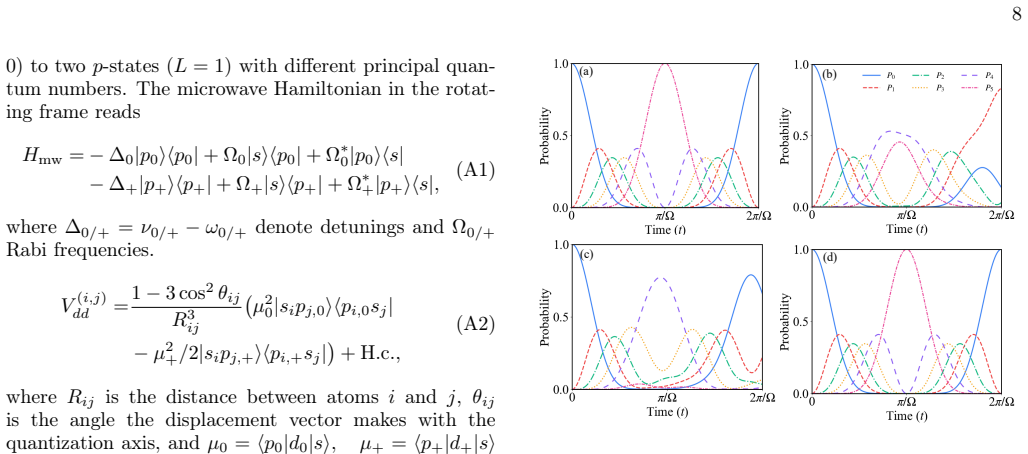
to twop-states (L= 1) with different principal quan- tum numbers. The microwave Hamiltonian in the rotat- ing frame reads Hmw =−∆ 0|p0⟩⟨p0|+ Ω 0|s⟩⟨p0|+ Ω ∗ 0|p0⟩⟨s| −∆ +|p+⟩⟨p+|+ Ω +|s⟩⟨p+|+ Ω ∗ +|p+⟩⟨s|, (A1) where∆ 0/+ =ν 0/+ −ω 0/+ denote detunings andΩ 0/+ Rabi frequencies. V (i,j) dd = 1−3 cos 2 θij R3 ij µ2 0|sipj,0⟩⟨pi,0sj| −µ 2 +/2|sipj,+⟩⟨pi,+sj...
-
[3]
R.T.Hitchcock, Patty’s Toxicology(2012)Chap.101, pp. 133–168
2012
-
[4]
Heinrich hertz-theorist and experimenter,
J.D. Kraus, “Heinrich hertz-theorist and experimenter,” IEEE Trans. Microwave Theory Tech.36, 824–829 (1988)
1988
-
[5]
Photonic signal processing of microwave signals,
R.A. Minasian, “Photonic signal processing of microwave signals,” IEEE Trans. Microwave Theory Tech.54, 832– 846 (2006)
2006
-
[6]
Quantum sensing,
C. L. Degen, F. Reinhard, and P. Cappellaro, “Quantum sensing,” Rev. Mod. Phys.89, 035002 (2017)
2017
-
[7]
Introduction to quantum noise, measurement, and amplification,
A. A. Clerk, M. H. Devoret, S. M. Girvin, F. Marquardt, and R. J. Schoelkopf, “Introduction to quantum noise, measurement, and amplification,” Rev. Mod. Phys.82, 1155–1208 (2010)
2010
-
[8]
The physical implementation of quan- tum computation,
D.P. DiVincenzo, “The physical implementation of quan- tum computation,” Fortschr. Phys.48, 771–783 (2000)
2000
Show all 61 references
-
[9]
Observation of criticality-enhanced quantum sensing in nonunitary quantum walks,
L. Xiao, S. Sarkar, K.K. Wang, A. Bayat, and P. Xue, “Observation of criticality-enhanced quantum sensing in nonunitary quantum walks,” Phys. Rev. Lett.136, 060802 (2026)
2026
-
[10]
Observation of critical phenomena in parity-time-symmetric quantum dynam- ics,
L. Xiao, K.K. Wang, X. Zhan, Z.H. Bian, K. Kawabata, M. Ueda, W. Yi, and P. Xue, “Observation of critical phenomena in parity-time-symmetric quantum dynam- ics,” Phys. Rev. Lett.123, 230401 (2019)
2019
-
[11]
Re- view: Quantum metrology and sensing with many-body systems,
V. Montenegro, C. Mukhopadhyay, R. Yousefjani, S. Sarkar, U. Mishra, M. G.A. Paris, and A. Bayat, “Re- view: Quantum metrology and sensing with many-body systems,” Phys. Rep.1134, 1–62 (2025)
2025
-
[12]
Op- timal measurements for quantum multiparameter esti- mation with general states,
J. Yang, S.S. Pang, Y.Y. Zhou, and A.N. Jordan, “Op- timal measurements for quantum multiparameter esti- mation with general states,” Phys. Rev. A100, 032104 (2019)
2019
-
[13]
Nonadiabatic noncyclic geometric quantum computation in rydberg atoms,
B.J. Liu, S.L. Su, and M.H. Yung, “Nonadiabatic noncyclic geometric quantum computation in rydberg atoms,” Phys. Rev. Res.2, 043130 (2020)
2020
-
[14]
Rydberg atom quantum technologies,
C.S. Adams, J.D. Pritchard, and J.P. Shaffer, “Rydberg atom quantum technologies,” J. Phys. B: At. Mol. Opt. Phys.53, 012002 (2019)
2019
-
[15]
Complete and nonde- structive distinguishment of many-body rydberg entan- glementviarobustgeometricquantumoperations,
F.Q. Guo, J.L. Wu, X.Y. Zhu, Z. Jin, Y. Zeng, S. Zhang, L.L. Yan, M. Feng, and S.L. Su, “Complete and nonde- structive distinguishment of many-body rydberg entan- glementviarobustgeometricquantumoperations,” Phys. Rev. A102, 062410 (2020)
2020
-
[16]
Atom based rf elec- tric field sensing,
H.Q. Fan, S. Kumar, J. Sedlacek, H. Kübler, S. Karimkashi, and J.P. Shaffer, “Atom based rf elec- tric field sensing,” J. Phys. B: At. Mol. Opt. Phys.48, 202001 (2015)
2015
-
[17]
Sensing electric fields through rydberg atom networks,
P. Kitson, W. J. C., G. Birkl, L. Amico, and J. Polo, “Sensing electric fields through rydberg atom networks,” (2025), arXiv:2509.01665 [quant-ph]
2025 arXiv
-
[18]
Broadbandrydbergatom-basedelectric-field probe for si-traceable, self-calibrated measurements,
C.L. Holloway, J.A. Gordon, S. Jefferts, A. Schwarzkopf, D.A. Anderson, S.A. Miller, N. Thaicharoen, and G.Raithel,“Broadbandrydbergatom-basedelectric-field probe for si-traceable, self-calibrated measurements,” 10 IEEE Trans. Antennas Propag.62, 6169–6182 (2014)
2014
-
[19]
Quantum computation via flo- quet tailored rydberg interactions,
J. Wu, J.L. Wu, F.Q. Guo, B.B. Liu, S.L. Su, X.K. Song, L. Ye, and D. Wang, “Quantum computation via flo- quet tailored rydberg interactions,” npj Quantum Inf.11 (2025), 10.1038/s41534-025-01068-z
2025 doi
-
[20]
A dual-species rydberg array,
S. Anand, C.E. Bradley, R. White, V. Ramesh, K. Singh, and H. Bernien, “A dual-species rydberg array,” Nat. Phys.20, 1744–1750 (2024)
2024
-
[21]
Geometric quantum gates via dark paths in rydberg atoms,
Z.Y. Jin and J. Jing, “Geometric quantum gates via dark paths in rydberg atoms,” Phys. Rev. A109, 012619 (2024)
2024
-
[22]
Fast quantum gates for neutral atoms,
D. Jaksch, J. I. Cirac, P. Zoller, S. L. Rolston, R. Côté, and M. D. Lukin, “Fast quantum gates for neutral atoms,” Phys. Rev. Lett.85, 2208–2211 (2000)
2000
-
[23]
Dipole block- ade and quantum information processing in mesoscopic atomic ensembles,
M. D. Lukin, M. Fleischhauer, R. Cote, L. M. Duan, D. Jaksch, J. I. Cirac, and P. Zoller, “Dipole block- ade and quantum information processing in mesoscopic atomic ensembles,” Phys. Rev. Lett.87, 037901 (2001)
2001
-
[24]
Gallagher, Rydberg Atoms (Cambridge University Press, 1994)
T.F. Gallagher, Rydberg Atoms (Cambridge University Press, 1994)
1994
-
[25]
Rydberg-rydberginteractionstrengthsanddipoleblock- ade radii in the presence of förster resonances,
C.E. Wu, T. Kirova, M. Auzins, and Y.H. Chen, “Rydberg-rydberginteractionstrengthsanddipoleblock- ade radii in the presence of förster resonances,” Opt. Ex- press31, 37094 (2023)
2023
-
[26]
Observation of rydbergblockadebetweentwoatoms,
E. Urban, T. A. Johnson, T. Henage, L. Isenhower, D. D. Yavuz, T. G. Walker, and M. Saffman, “Observation of rydbergblockadebetweentwoatoms,” Nat. Phys.5,110– 114 (2009)
2009
-
[27]
Rabi- and blockade-error-resilient all-geometric rydberg quantum gates,
S.L. Su, L.N. Sun, B. J. Liu, L.L. Yan, M.H. Yung, W. Li, and M. Feng, “Rabi- and blockade-error-resilient all-geometric rydberg quantum gates,” Phys. Rev. Appl. 19, 044007 (2023)
2023
-
[28]
Dephasing of resonant energy transfer in a cold rydberg gas,
W. R. Anderson, M. P. Robinson, J. D. D. Martin, and T. F. Gallagher, “Dephasing of resonant energy transfer in a cold rydberg gas,” Phys. Rev. A65, 063404 (2002)
2002
-
[29]
Atomic pair-state interferometer: Controlling and measuring an interaction-induced phase shift in rydberg-atom pairs,
J. Nipper, J. B. Balewski, A. T. Krupp, S. Hofferberth, R. Löw, and T. Pfau, “Atomic pair-state interferometer: Controlling and measuring an interaction-induced phase shift in rydberg-atom pairs,” Phys. Rev. X2, 031011 (2012)
2012
-
[30]
Chapter 2 - en- tanglement of two atoms using rydberg blockade,
T. G. Walker and M. Saffman, “Chapter 2 - en- tanglement of two atoms using rydberg blockade,” in Advances in Atomic, Molecular, and Optical Physics, Vol. 61 (Academic Press, 2012) pp. 81–115
2012
-
[31]
Fast realization of high-fidelity nona- diabatic holonomic quantum gates with a time-optimal- control technique in rydberg atoms,
P.Y. Song, J.F. Wei, P. Xu, L.L. Yan, M. Feng, S.L. Su, and G. Chen, “Fast realization of high-fidelity nona- diabatic holonomic quantum gates with a time-optimal- control technique in rydberg atoms,” Phys. Rev. A109, 022613 (2024)
2024
-
[32]
Protocols for rydberg entangling gates featuring robustness against quasistatic errors,
C. Fromonteil, D. Bluvstein, and H. Pichler, “Protocols for rydberg entangling gates featuring robustness against quasistatic errors,” PRX Quantum4, 020335 (2023)
2023
-
[33]
Real-time near-field terahertz imaging with atomic optical fluorescence,
C. G. Wade, N. Šibalić, N. R. de Melo, J. M. Kondo, C. S. Adams, and K. J. Weatherill, “Real-time near-field terahertz imaging with atomic optical fluorescence,” Nat. Photonics11, 40–43 (2016)
2016
-
[34]
A sensitive elec- trometer based on a rydberg atom in a schrödinger-cat state,
A. Facon, E.K. Dietsche, D. Grosso, S. Haroche, J.M. Raimond, M. Brune, and S. Gleyzes, “A sensitive elec- trometer based on a rydberg atom in a schrödinger-cat state,” Nature535, 262–265 (2016)
2016
-
[35]
Rydberg states of alkali atoms in atomic vapour as si-traceable field probes and communications receivers,
N. Schlossberger, N. Prajapati, S. Berweger, A. P. Ro- tunno, A.B. Artusio-Glimpse, M.T. Simons, A.A. Sheikh, E.B. Norrgard, S. P. Eckel, and C.L. Holloway, “Rydberg states of alkali atoms in atomic vapour as si-traceable field probes and communications receivers,” Nat. Rev. P...
2024
-
[36]
Research on high-sensitivity sensing technology of 10 mhz radio frequency electric field based on rydberg atoms,
Y.L. Han, Z.Y. Shan, K. Zhang, J.F. Sun, L.H. Zhang, B. Liu, and D.S. Ding, “Research on high-sensitivity sensing technology of 10 mhz radio frequency electric field based on rydberg atoms,” Acta Phys. Sin.75(2026), 10.7498/aps.75.20260151
2026 doi
-
[38]
Probing hilbert space fragmentation with strongly interacting rydberg atoms,
F. Yang, H. Yarloo, H.C. Zhang, K. Mølmer, and A. E. B. Nielsen, “Probing hilbert space fragmentation with strongly interacting rydberg atoms,” Phys. Rev. B 111, 144313 (2025)
2025
-
[39]
Atomic superheterodyne receiver based on microwave-dressed rydberg spectroscopy,
M.Y Jing, Y. Hu, J. Ma, H. Zhang, L.J. Zhang, L.T. Xiao, and S.T Jia, “Atomic superheterodyne receiver based on microwave-dressed rydberg spectroscopy,” Nat. Phys.16, 911–915 (2020)
2020
-
[40]
Enhance- ment of electromagnetically induced transparency based rydberg-atom electrometry through population repump- ing,
N. Prajapati, A.K. Robinson, S. Berweger, M.T. Simons, A.B. Artusio-Glimpse, and C. L. Holloway, “Enhance- ment of electromagnetically induced transparency based rydberg-atom electrometry through population repump- ing,” Appl. Phys. Lett.119, 214001 (2021)
2021
-
[41]
Effective fieldtheoryforrydbergpolaritons,
M. J. Gullans, J. D. Thompson, Y. Wang, Q.Y. Liang, V. Vuletić, M. D. Lukin, and A. V. Gorshkov, “Effective fieldtheoryforrydbergpolaritons,” Phys.Rev.Lett.117, 113601 (2016)
2016
-
[42]
Broadband heterodyne microwave detec- tion using rydberg atoms with high sensitivity,
H.J.Su, S.C.Fang, T.A.Li, C.H.Chang, Y.C.Chen, and Y.H. Chen, “Broadband heterodyne microwave detec- tion using rydberg atoms with high sensitivity,” (2026), arXiv:2601.19305 [physics.atom-ph]
2026
-
[43]
Optimal atomic quantum sensing us- ing electromagnetically-induced-transparency readout,
D.H. Meyer, C. O’Brien, D. P. Fahey, K. C. Cox, and P. D. Kunz, “Optimal atomic quantum sensing us- ing electromagnetically-induced-transparency readout,” Phys. Rev. A104, 043103 (2021)
2021
-
[44]
Enhanced metrology at the critical point of a many-body rydberg atomic system,
D.S. Ding, Z.K. Liu, B.S. Shi, G.C. Guo, K. Mølmer, and C.S. Adams, “Enhanced metrology at the critical point of a many-body rydberg atomic system,” Nat. Phys.18, 1447–1452 (2022)
2022
-
[45]
Quantum- enhanced two-photon spectroscopy using two-mode squeezed light,
N. Prajapati, Z.Q. Niu, and I. Novikova, “Quantum- enhanced two-photon spectroscopy using two-mode squeezed light,” Opt. Lett.46, 1800–1803 (2021)
2021
-
[46]
Sub-shot-noise rydberg eit spectrum,
H.M. Yan, M.Y. Jing, Y.J. Tong, W.G. Yang, H. Zhang, Z.K. Liu, J.Y. Xie, Y.H. Zheng, L.T. Xiao, S.T. Jia, and L.J. Zhang, “Sub-shot-noise rydberg eit spectrum,” Pho- toniX6(2025), 10.1186/s43074-025-00215-1
2025 doi
-
[47]
Quantum en- hanced metrology based on flipping trajectory of cold ry- dberg gases,
Y.J. Wang, J. Zhang, Z.Y. Zhang, S.Y. Shao, Q. Li, H.C. Chen, Y.Ma, T.Y.Han, Q.F.Wang, J.D.Nan, Y.M.Yin, D.Y. Zhu, Q.Q. Fang, C. Yu, X. Liu, G.C. Guo, B. Liu, L.H. Zhang, D.S. Ding, and B.S. Shi, “Quantum en- hanced metrology based on flipping trajectory of cold ry- dberg gase...
2026 doi
-
[48]
Supercharged two-dimensional tweezer array with more than 1000 atomic qubits,
L. Pause, L. Sturm, M. Mittenbühler, S. Amann, T. Preuschoff, D. Schäffner, M. Schlosser, and G. Birkl, “Supercharged two-dimensional tweezer array with more than 1000 atomic qubits,” Optica11, 222–226 (2024)
2024
-
[49]
Scalable multilayer architecture of assembled single-atom qubit arrays in a three-dimensional talbot tweezer lattice,
M. Schlosser, S. Tichelmann, D. Schäffner, Da. O. deMello, M.Hambach, J.Schütz, andG.Birkl,“Scalable multilayer architecture of assembled single-atom qubit arrays in a three-dimensional talbot tweezer lattice,” Phys. Rev. Lett.130, 180601 (2023)
2023
-
[50]
Realization of a cavity-coupled rydberg array,
J.D. Santis, B. D. Kovács, M. Öncü, A. Bouscal, D. Vasileiadis, and J. Zeiher, “Realization of a cavity-coupled rydberg array,” (2026), arXiv:2602.12152 11 [quant-ph]
2026
-
[51]
Control and entanglement of individ- ual rydberg atoms near a nanoscale device,
P. L. Ocola, I. Dimitrova, B. Grinkemeyer, E. Guardado- Sanchez, T. Ðorđević, P. Samutpraphoot, V. Vuletić, and M. D. Lukin, “Control and entanglement of individ- ual rydberg atoms near a nanoscale device,” Phys. Rev. Lett.132, 113601 (2024)
2024
-
[52]
Toward heisenberg limit without critical slowing down via quantum reinforcement learning,
H. Xu, T.L. Xiao, J.Z Huang, M. He, J.P Fan, and G.H Zeng, “Toward heisenberg limit without critical slowing down via quantum reinforcement learning,” Phys. Rev. Lett.134, 120803 (2025)
2025
-
[53]
Reinforcement learning for optimal control of spin magnetometers,
L. W. Cooke and S. Czischek, “Reinforcement learning for optimal control of spin magnetometers,” Phys. Rev. A112, 062603 (2025)
2025
-
[54]
Applica- tions of model-aware reinforcement learning in bayesian quantum metrology,
F. Belliardo, F. Zoratti, and V. Giovannetti, “Applica- tions of model-aware reinforcement learning in bayesian quantum metrology,” Phys. Rev. A109, 062609 (2024)
2024
-
[55]
Gradient- ascent pulse engineering with feedback,
R. Porotti, V. Peano, and F. Marquardt, “Gradient- ascent pulse engineering with feedback,” PRX Quantum 4(2023), 10.1103/PRXQuantum.4.030305
2023 doi
-
[56]
Machine- learning-assisted many-body entanglement measure- ment,
J. Gray, L. Banchi, A. Bayat, and S. Bose, “Machine- learning-assisted many-body entanglement measure- ment,” Phys. Rev. Lett.121, 150503 (2018)
2018
-
[57]
Many-body physics with individually controlled rydberg atoms,
Antoine Browaeys and Thierry Lahaye, “Many-body physics with individually controlled rydberg atoms,” Nat. Phys.16, 132–142 (2020)
2020
-
[58]
Effect of förster resonances on the excitation statistics of many- body rydberg systems,
A. Reinhard, K. C. Younge, and G. Raithel, “Effect of förster resonances on the excitation statistics of many- body rydberg systems,” Phys. Rev. A78, 060702 (2008)
2008
-
[59]
Arc: An open-source library for calculating prop- erties of alkali rydberg atoms,
N. Šibalić, J.D. Pritchard, C.S. Adams, and K.J. Weath- erill, “Arc: An open-source library for calculating prop- erties of alkali rydberg atoms,” Comput. Phys. Commun. 220, 319–331 (2017)
2017
-
[60]
Statisti- cal distance and the geometry of quantum states,
Samuel L. Braunstein and Carlton M. Caves, “Statisti- cal distance and the geometry of quantum states,” Phys. Rev. Lett.72, 3439–3443 (1994)
1994
-
[61]
Composite pulses,
M.H. Levitt, “Composite pulses,” Prog. Nucl. Magn. Re- son. Spectrosc.18, 61–122 (1986)
1986
-
[62]
Asymmetric blockade and multi- qubit gates via dipole-dipole interactions,
J.T. Young, P. Bienias, R. Belyansky, A.M. Kaufman, and A.V. Gorshkov, “Asymmetric blockade and multi- qubit gates via dipole-dipole interactions,” Phys. Rev. Lett.127, 120501 (2021)
2021
Reviewed August 4, 2026 · model on record in the stance chip above.
Discussion (0). Continue with ORCID to comment.