REVIEW 3 major objections 4 minor 57 references
Teleopit: A Full-Embodiment Humanoid Teleoperation System
T0 review · 3 major / 4 minor · reviewed 2026-08-04 · deepseek-v4-flash
Pith's one-line read Teleopit claims that a single VR headset can drive a humanoid's whole body, dexterous hands, and active camera, and that 96 demonstrations collected this way train policies that succeed at 90–95% on a real bottle-placement task.
desk verdict A solid, useful humanoid teleoperation systems paper whose central claim survives scrutiny, with the main soft spot being no direct quantitative real-robot tracking evaluation. read the letter →
The pith
A machine-rendered reading of the paper's core claim, the machinery that carries it, and where it could break.
The reading
What carries the argument
The load-bearing machinery is a three-part pipeline. First, the learned whole-body tracker: a PPO policy that outputs 29 joint-target offsets toward a reference pose, with a 10-frame temporal history encoder and failure-aware rewind sampling that concentrates training on the transitions that make teleoperation fail; it is anchored at the torso and covers 14 body links. Second, the hand retargeter: an SLSQP optimizer minimizing a sum of three scale-free objectives—normalized finger-segment direction, one-sided fingertip-distance closure, and thumb-frame alignment—with the same weights, activation thresholds, and solver settings for every hand. Third, the asynchronous runtime: latest-only queu
What would settle it
Run the trained motion tracker on the real humanoid and measure success rate over a held-out set of live VR references using the paper's own termination criteria (anchor height error > 0.25 m, anchor orientation error > 1.0 rad, ankle/wrist height error > 0.25 m) instead of qualitative videos; if hardware success is well below the simulator's 91.7% (mocap) and 100% (PICO), the central claim fails. A second check: test the hand retargeter with the shared solver settings on a hand that shares the same semantic links but has substantially different bone lengths; if the shared settings fail to clo
Extended reading notes
Core claim
Teleopit claims that a consumer VR headset is a complete operator interface for full-embodiment humanoid teleoperation: body skeleton, hand keypoints, and head pose command a 29-DoF humanoid, dexterous hands of several morphologies, and a 2-DoF active camera in one loop. The body tracker is a single policy trained with a 10-step history encoder and failure-aware rewind sampling; it reports 91.7% success on mocap and 100% on live VR references in simulation. The hand retargeter is a shared SLSQP optimization of normalized finger directions, one-sided fingertip closure, and thumb-frame alignment, with fixed weights across six hand morphologies. From 96 successful bottle-placement demonstration
Load-bearing premise
The whole-body tracker is trained and evaluated in simulation on the target humanoid with domain randomization, and the real-robot tracking results are qualitative; if the real robot's dynamics, sensing, or the operator's VR reference distribution differ from the simulation more than the randomization covers, the 91.7%/100% simulator success rates will not hold on hardware.
Editorial extensions
If this is right
- Humanoid demonstration collection can be done with nothing more than a consumer VR headset, removing the need for inertial suits and instrumented gloves.
- Dexterous hands can be swapped or upgraded while keeping the same retargeting objective and solver settings, reducing integration effort.
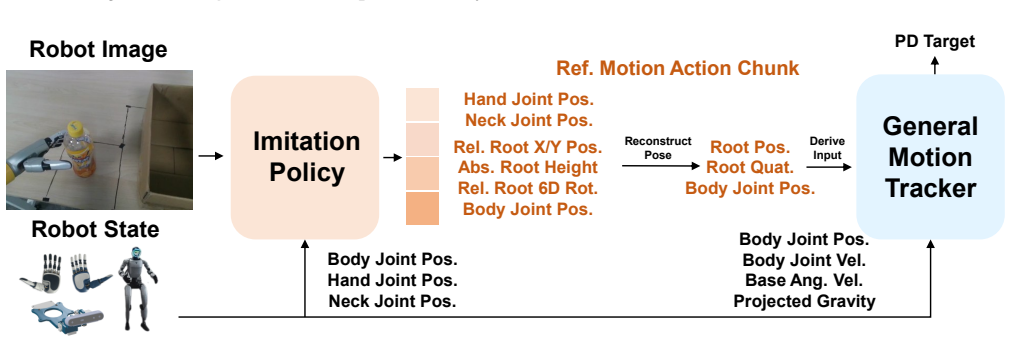
- Because the task policy commands the same reference interface that the operator drives, 96 demonstrations suffice for two different policy families to reach 90–95% success on a real loco-manipulation task.
- Head-driven viewpoint control lets the operator maintain situational awareness during whole-body tasks, supporting long-horizon demonstration collection.
- A single tracker policy covers static, running, sidestepping, turning, kneel-stand, and sit-stand transitions without motion-specific switching.
Reading between the lines
- Failure-aware rewind sampling is a general curriculum idea: retrying the transitions that caused past failures could improve any reference-tracking reinforcement learning problem, beyond teleoperation.
- The scale-free normalized-direction objective might extend to non-anthropomorphic hands or grippers, although the paper only tests six anthropomorphic designs.
- The paper's tracking success figures come from simulation; a quantitative hardware evaluation with the same termination criteria would reveal how much of the sim-to-real gap remains.
- The relative-root action space may be a key reason ACT and GR00T transfer from only 96 demonstrations, since it removes absolute-position variation across starting poses.
Editorial analysis
A structured set of objections, weighed in public.
Referee Report
Summary. Teleopit is presented as a VR-driven full-embodiment humanoid teleoperation system. It combines a learned whole-body motion tracker trained with PPO (history encoder, failure-aware rewind sampling) to map PICO body/head/hand signals to a Unitree G1, an optimization-based hand retargeter using normalized finger-direction, fingertip-distance, and thumb-frame objectives, and a 2-DoF head-driven active vision module. The paper reports tracker comparisons and ablations on held-out mocap and PICO references, cross-embodiment retargeting results on six dexterous hands, qualitative real-robot teleoperation with latency measurements, and downstream policy learning: ACT and GR00T N1.7 trained on 96 successful demonstrations achieve 90.0% and 95.0% success on a real bottle-placement task.
Significance. If the full set of claims holds, the paper makes a useful systems contribution: a commodity-VR interface for collecting whole-body, dexterous-hand, and viewpoint demonstrations on a real humanoid, with a hand retargeter that transfers across morphologies without hand-specific tuning. The downstream policy-learning experiment is a genuine external validation: the recorded demonstrations are consumed by two different policies and evaluated in closed-loop deployment on the robot. The component experiments for the retargeter (Tables 8-10) directly support the claimed design choices, and the use of held-out validation windows for the tracker is methodologically sound. The main weaknesses are the absence of quantitative sim-to-real tracking evidence on hardware and the small trial counts behind the headline success rates, both of which are load-bearing for the central claims.
major comments (3)
- [§4.1 Real-Robot Tracking / §3.2 Domain Randomization] The load-bearing claim that the learned tracker provides dynamically feasible whole-body control on the real G1 is not quantitatively supported. The simulator results (Table 6, 91.7% mocap / 100.0% PICO success) and the domain randomization of Table 3 are plausible, but the only hardware evidence is Figure 8, which is described qualitatively. No real-robot tracking error, repeated-trial success rate, or comparison against the Section 3.2 termination criteria is reported. Since every downstream result (teleoperation demos and autonomous policy deployment) assumes the tracker transfers to hardware, this unmeasured sim-to-real gap is central. Please add quantitative hardware tracking evaluation, e.g., n repeated trials with measured root/joint errors and termination rate, and a check of whether the Table 3 randomization covers the observed real-world reference distribution; otherwise the re
- [§4.4 Policy Learning, Table 13] The headline success rates are point estimates from only 20 trials per policy. For 18/20, a 95% binomial confidence interval spans roughly 68-99%; for 19/20, roughly 75-99.9%. The abstract and conclusion state '90.0% and 95.0%' with no uncertainty, and the comparison between ACT and GR00T N1.7 cannot be assessed from these numbers. Please report confidence intervals and/or increase the number of evaluation trials; at minimum, avoid implying a reliable ordering between the two policies. The same concern applies to the 96/100 teleoperation yield rate, which is also a single binomial estimate.
- [§4.1 Table 7] The ablation results are reported without repeated-seed variance. Full (reduced) attains 74.0% success versus 72.9% without rewind sampling and 73.5% without the history encoder; these are gaps of 0.5-1.1 percentage points and may be within run-to-run noise. Moreover, 'w/o rewind' improves root-position and root-velocity errors, complicating the interpretation. The claim that the history encoder and failure-aware rewind sampling improve tracking is not established by the current evidence. Please provide multiple training seeds with mean ± std (or a significance test) for the ablations, or soften the corresponding claims.
minor comments (4)
- [§5 Conclusion] The conclusion states that 'retargeting experiments cover more than a dozen dexterous hands,' but Table 8 evaluates six hands and the text elsewhere consistently says six. Please correct this overstatement.
- [§4.2, Eq. (4)] The activation a_k in the distance objective is said to 'increase smoothly' when the human fingertips approach a 4 cm contact threshold, but the functional form is not given. Please specify the activation formula so the retargeter is reproducible.
- [§4.3 End-to-End Latency] The latency values are estimated from manually labeled video events on four paths. Please report the number of repeated measurements per path and the uncertainty more explicitly; as written, the 0.05-0.15 s figures are single observations.
- [§4.1 Table 6] The text says Teleopit provides a 'favorable balance,' but HoloMotion has lower root-position error on both subsets and SONIC has lower MPJPE on mocap. Please state more precisely in which sense the balance is favorable, especially given the different training data and budgets of the baselines.
Circularity Check
No significant circularity: the evaluation is empirical and externally benchmarked; the unquantified sim-to-real gap is a generalization risk, not a circular derivation.
full rationale
Teleopit is an engineering/system paper whose claims are supported by held-out empirical evaluation rather than by a derivation chain that reduces to its inputs. The whole-body tracker is trained in the mjlab simulator with PPO on a mixture of public mocap data and its own PICO recordings, but the reported success rates are computed on validation windows explicitly disjoint from training, and all baselines (TWIST2, SONIC, HoloMotion) are re-evaluated under the same termination criteria; no success-rate value is fitted from or defined in terms of the reported result. The hand retargeter optimizes geometric objectives (normalized directions, fingertip distance, thumb-frame alignment) and is then evaluated with independent metrics and ablations; the fact that the metrics resemble the objective terms reflects the design intent, not a circular prediction, and the cross-embodiment claim is tested on six different hands with shared settings. The downstream ACT and GR00T N1.7 policies are trained on 96 recorded demonstrations and deployed on the real robot, giving external success rates (90% and 95%) that cannot be derived from the system's own parameters by construction. There is no load-bearing self-citation, no imported uniqueness theorem, and no ansatz smuggled in via the authors' prior work; the cited prior systems and simulator are independent external artifacts. The main weakness is the absence of quantitative real-robot tracker error and an unmeasured sim-to-real gap, which is a correctness/generalization concern, not circularity.
Assumptions & free parameters
free parameters (8)
- Tracker reward weights and Gaussian sigmas =
weights and sigma values in Table 2
- Tracker termination thresholds =
0.25 m position, 1.0 rad orientation, 0.25 m ankle/wrist height
- Rewind probability and rewind offset =
rewind_prob = 0.8; random offset
- History length H =
10
- Action scale s and default pose q_def =
per-joint scale and default pose for Unitree G1
- Hand retargeter weights, activation threshold, smoothing, solver settings =
shared constants: w_i, w_k, w_p, w_s, 4 cm threshold, lambda, SLSQP settings
- Domain randomization ranges =
Table 3 values
- Imitation hyperparameters =
batch sizes, learning rates, action chunk lengths in Table 11
assumptions (6)
- domain assumption SLSQP with analytic gradients converges to a good retargeting solution for all six hands
- domain assumption PICO headset hand, body, and head tracking is sufficiently accurate for teleoperation
- domain assumption mjlab simulation with Table 3 domain randomization transfers to the real Unitree G1
- standard math Gram-Schmidt orthonormalization of thumb-base axes is well-defined and meaningful across hands
- domain assumption PD controllers at 200 Hz track the 50 Hz policy joint targets
- domain assumption The 52D reference action space is sufficient for the bottle-placement task and preserves demonstration information
Cite this review
Pith. "Pith review of Teleopit: A Full-Embodiment Humanoid Teleoperation System." pith.science (2026). https://pith.science/paper/5C5ZTVKM
@misc{pith2026260801834,
  author       = {Pith},
  title        = {Pith review of: Teleopit: A Full-Embodiment Humanoid Teleoperation System},
  year         = {2026},
  howpublished = {\url{https://pith.science/paper/5C5ZTVKM}},
  note         = {Machine review of arXiv:2608.01834}
}
read the original abstract
Humanoid teleoperation for demonstration collection requires coordinated whole-body motion, continuous dexterous hand control, and viewpoint control. Existing systems either simplify hand commands or depend on dedicated wearable sensors for fine-grained hand motion. We introduce Teleopit, a full-embodiment teleoperation system that maps body, hand, and head signals from VR to a humanoid body, configurable dexterous hands, and a 2-DoF active vision module. A history encoder and failure-aware rewind sampling improve the motion tracker on both motion-capture and live VR references. An optimization-based hand retargeter combines normalized finger directions, fingertip closure, and thumb-frame alignment to map human hand motion to different dexterous hands without tuning hand-specific objective or solver hyperparameters. Component experiments evaluate tracking success rate and retargeting behavior, while real-robot teleoperation demonstrates coordinated locomotion, manipulation, and viewpoint control. ACT and GR00T N1.7 policies trained on 96 successful demonstrations collected with Teleopit achieve task success rates of 90.0% and 95.0%, respectively, when deployed on the humanoid. The project page is available at https://botrunner64.github.io/teleopit-page.
Figures


Figures from the paper (11 more)



Reference graph
Works this paper leans on
-
[1]
Rt-1: Robotics transformer for real-world control at scale.arXiv preprint arXiv:2212.06817, 2022
Anthony Brohan, Noah Brown, Justice Carbajal, Yev- gen Chebotar, Joseph Dabis, Chelsea Finn, Keerthana Gopalakrishnan, Karol Hausman, Alex Herzog, Jasmine Hsu, et al. Rt-1: Robotics transformer for real-world control at scale.arXiv preprint arXiv:2212.06817, 2022
arXiv 2022
-
[2]
Rt-2: Vision-language- action models transfer web knowledge to robotic control
Brianna Zitkovich, Tianhe Yu, Sichun Xu, Peng Xu, Ted Xiao, Fei Xia, Jialin Wu, Paul Wohlhart, Stefan Welker, Ayzaan Wahid, et al. Rt-2: Vision-language- action models transfer web knowledge to robotic control. InConference on Robot Learning, pages 2165–2183. PMLR, 2023
2023
-
[3]
Open x-embodiment: Robotic learning datasets and rt-x models: Open x-embodiment collaboration 0
Abby O’Neill, Abdul Rehman, Abhiram Maddukuri, Ab- hishek Gupta, Abhishek Padalkar, Abraham Lee, Acorn Pooley, Agrim Gupta, Ajay Mandlekar, Ajinkya Jain, et al. Open x-embodiment: Robotic learning datasets and rt-x models: Open x-embodiment collaboration 0. In2024 IEEE International Conference on Robotics and Automation (ICRA), pages 6892–6903. IEEE, 2024
2024
-
[4]
Droid: A large-scale in-the-wild robot manipulation dataset
Alexander Khazatsky, Karl Pertsch, Suraj Nair, Ash- win Balakrishna, Sudeep Dasari, Siddharth Karam- cheti, Soroush Nasiriany, Mohan Kumar Srirama, Lawrence Yunliang Chen, Kirsty Ellis, et al. Droid: A large-scale in-the-wild robot manipulation dataset. arXiv preprint arXiv:2403.12945, 2024
arXiv 2024
-
[5]
Openvla: An open-source vision-language-action model.arXiv preprint arXiv:2406.09246, 2024
Moo Jin Kim, Karl Pertsch, Siddharth Karamcheti, Ted Xiao, Ashwin Balakrishna, Suraj Nair, Rafael Rafailov, EthanFoster,GraceLam,PannagSanketi,etal. Openvla: An open-source vision-language-action model.arXiv preprint arXiv:2406.09246, 2024
arXiv 2024
-
[6]
𝜋0: Avision- language-action flow model for general robot control
Kevin Black, Noah Brown, Danny Driess, Adnan Es- mail, Michael Equi, Chelsea Finn, Niccolo Fusai, Lachy Groom,KarolHausman,BrianIchter,etal. 𝜋0: Avision- language-action flow model for general robot control. arXiv preprint arXiv:2410.24164, 2024
arXiv 2024
-
[7]
GR00T n1: An open foundation model for generalist humanoid robots
Johan Bjorck, Fernando Castañeda, Nikita Cherniadev, Xingye Da, Runyu Ding, Linxi Fan, Yu Fang, Dieter Fox, Fengyuan Hu, Spencer Huang, et al. GR00T n1: An open foundation model for generalist humanoid robots. arXiv preprint arXiv:2503.14734, 2025
arXiv 2025
-
[8]
Xuxin Cheng, Jialong Li, Shiqi Yang, Ge Yang, and Xiaolong Wang. Open-television: Teleoperation with immersive active visual feedback.arXiv preprint arXiv:2407.01512, 2024
arXiv 2024
Show all 57 references
-
[9]
Twist2: Scalable, portable, and holistic humanoid data collection system.arXiv preprint arXiv:2511.02832, 2025
Yanjie Ze, Siheng Zhao, Weizhuo Wang, Angjoo Kanazawa, Rocky Duan, Pieter Abbeel, Guanya Shi, Jiajun Wu, and C Karen Liu. Twist2: Scalable, portable, and holistic humanoid data collection system.arXiv preprint arXiv:2511.02832, 2025
2025
-
[10]
Humdex: Humanoid dexterous manipulation made easy.arXiv preprint arXiv:2603.12260, 2026
Liang Heng, Yihe Tang, Jiajun Xu, Henghui Bao, Di Huang, and Yue Wang. Humdex: Humanoid dexterous manipulation made easy.arXiv preprint arXiv:2603.12260, 2026
2026
-
[11]
Xrobotoolkit: A cross-platform framework for robot tele- operation
Zhigen Zhao, Liuchuan Yu, Ke Jing, and Ning Yang. Xrobotoolkit: A cross-platform framework for robot tele- operation. In2026 IEEE/SICE International Symposium on System Integration (SII), pages 15–20. IEEE, 2026
2026
-
[12]
Dexpilot: Vision-based teleoperation of dexterous robotic hand-arm system
Ankur Handa, Karl Van Wyk, Wei Yang, Jacky Liang, Yu-Wei Chao, Qian Wan, Stan Birchfield, Nathan Ratliff, and Dieter Fox. Dexpilot: Vision-based teleoperation of dexterous robotic hand-arm system. In2020 IEEE International Conference on Robotics and Automation (ICRA), pages 91...
2020
-
[13]
Anyteleop: A general vision-based dexterous robot arm- hand teleoperation system
Yuzhe Qin, Wei Yang, Binghao Huang, Karl Van Wyk, Hao Su, Xiaolong Wang, Yu-Wei Chao, and Dieter Fox. Anyteleop: A general vision-based dexterous robot arm- hand teleoperation system. InProceedings of Robotics: Science and Systems, Daegu, Republic of Korea, July
-
[14]
Geometricretargeting: Aprincipled,ultrafast neural hand retargeting algorithm
Zhao-Heng Yin, Changhao Wang, Luis Pineda, Krishna Bodduluri, Tingfan Wu, Pieter Abbeel, and Mustafa Mukadam. Geometricretargeting: Aprincipled,ultrafast neural hand retargeting algorithm. In2025 IEEE/RSJ In- ternationalConferenceonIntelligentRobotsandSystems (IROS), pages 173...
2025
-
[15]
mjlab: A lightweightframeworkforgpu-acceleratedrobotlearning
Kevin Zakka, Qiayuan Liao, Brent Yi, Louis Le Lay, Koushil Sreenath, and Pieter Abbeel. mjlab: A lightweightframeworkforgpu-acceleratedrobotlearning. arXiv preprint arXiv:2601.22074, 2026
2026
-
[16]
Nathan Miller, Odest Chadwicke Jenkins, Marcelo Kall- mann, and Maja J. Mataric. Motion capture from inertial sensing for untethered humanoid teleoperation. InPro- ceedings of the IEEE-RAS International Conference on Humanoid Robots, 2004
2004
-
[17]
Sreeni- vasa, and Jean-Paul Laumond
Francisco-Javier Montecillo-Puente, Manish N. Sreeni- vasa, and Jean-Paul Laumond. On real-time whole- body human to humanoid motion transfer. InPro- ceedings of the 7th International Conference on In- formatics in Control, Automation and Robotics, pages 22–31, 2010. doi: 10.5...
2010 doi
-
[18]
Learning human- to-humanoidreal-timewhole-bodyteleoperation.In2024 IEEE/RSJInternationalConferenceonIntelligentRobots and Systems (IROS), 2024
TairanHe,ZhengyiLuo,WenliXiao,ChongZhang,Kris Kitani, Changliu Liu, and Guanya Shi. Learning human- to-humanoidreal-timewhole-bodyteleoperation.In2024 IEEE/RSJInternationalConferenceonIntelligentRobots and Systems (IROS), 2024. doi: 10.1109/IROS58592. 2024.10801984. URL https:...
2024
-
[19]
Omnih2o: Universal and dexterous human- to-humanoid whole-body teleoperation and learning
Tairan He, Zhengyi Luo, Xialin He, Wenli Xiao, Chong Zhang, Weinan Zhang, Kris Kitani, Changliu Liu, and Guanya Shi. Omnih2o: Universal and dexterous human- to-humanoid whole-body teleoperation and learning. In Proceedings of the 8th Conference on Robot Learning, volume 270 of...
2025
-
[20]
Humanplus: Humanoid shadowing and imitation from humans
Zipeng Fu, Qingqing Zhao, Qi Wu, Gordon Wetzstein, and Chelsea Finn. Humanplus: Humanoid shadowing and imitation from humans. InProceedings of the 8th Conference on Robot Learning, volume 270 ofPro- ceedings of Machine Learning Research, pages 2828– 2844.PMLR,2025.URL https://...
2025
-
[21]
Twist: Teleoperated whole-body imitation system.arXiv preprint arXiv:2505.02833, 2025
Yanjie Ze, Zixuan Chen, JoÃG, o Pedro AraÚjo, Zi- ang Cao, Xue Bin Peng, Jiajun Wu, and C Karen Liu. Twist: Teleoperated whole-body imitation system.arXiv preprint arXiv:2505.02833, 2025
2025 arXiv
-
[22]
Deep imi- tation learning for humanoid loco-manipulation through human teleoperation
MingyoSeo,SteveHan,KyutaeSim,SeungHyeonBang, Carlos Gonzalez, Luis Sentis, and Yuke Zhu. Deep imi- tation learning for humanoid loco-manipulation through human teleoperation. In2023 IEEE-RAS 22nd Interna- tional Conference on Humanoid Robots (Humanoids), pages 1–8, 2023. URL h...
2023 arXiv
-
[23]
Homie: Humanoid loco- manipulationwithisomorphicexoskeletoncockpit.arXiv preprint arXiv:2502.13013, 2025
Qingwei Ben, Feiyu Jia, Jia Zeng, Junting Dong, Dahua Lin, and Jiangmiao Pang. Homie: Humanoid loco- manipulationwithisomorphicexoskeletoncockpit.arXiv preprint arXiv:2502.13013, 2025
2025 arXiv
-
[24]
Clone: Closed-loop whole-body humanoid teleoperation for long-horizon tasks
Yixuan Li, Yutang Lin, Jieming Cui, Tengyu Liu, Wei Liang, Yixin Zhu, and Siyuan Huang. Clone: Closed-loop whole-body humanoid teleoperation for long-horizon tasks. In9th Annual Conference on Robot Learning, 2025
2025
-
[25]
Humanoid ma- nipulation interface: Humanoid whole-body manipu- lation from robot-free demonstrations.arXiv preprint arXiv:2602.06643, 2026
Ruiqian Nai, Boyuan Zheng, Junming Zhao, Haodong Zhu, Sicong Dai, Zunhao Chen, Yihang Hu, Yingdong Hu, Tong Zhang, Chuan Wen, et al. Humanoid ma- nipulation interface: Humanoid whole-body manipu- lation from robot-free demonstrations.arXiv preprint arXiv:2602.06643, 2026
2026
-
[26]
Bifrostumi: Bridging robot-free demonstrations and humanoid whole-body manipulation.arXiv preprint arXiv:2605.03452, 2026
ChenhaoYu,HongwuWang,YouhaoHu,JiachenZhang, Yuanyuan Li, and Shaqi Luo. Bifrostumi: Bridging robot-free demonstrations and humanoid whole-body manipulation.arXiv preprint arXiv:2605.03452, 2026
2026 arXiv
-
[27]
Deepmimic: Example-guided deep reinforcement learning of physics-based charac- ter skills.ACM Transactions on Graphics, 37(4): 1–14, 2018
Xue Bin Peng, Pieter Abbeel, Sergey Levine, and Michiel van de Panne. Deepmimic: Example-guided deep reinforcement learning of physics-based charac- ter skills.ACM Transactions on Graphics, 37(4): 1–14, 2018. doi: 10.1145/3197517.3201311. URL https://doi.org/10.1145/3197517.3201311
2018
-
[28]
Amp: Adversarial motion pri- ors for stylized physics-based character control.ACM Transactions on Graphics, 40(4):1–20, 2021
Xue Bin Peng, Ze Ma, Pieter Abbeel, Sergey Levine, and Angjoo Kanazawa. Amp: Adversarial motion pri- ors for stylized physics-based character control.ACM Transactions on Graphics, 40(4):1–20, 2021. doi: 10.1145/3450626.3459670. URL https://doi.org/ 10.1145/3450626.3459670
2021
-
[29]
Perpetualhumanoidcontrolforreal-timesimulated avatars
Zhengyi Luo, Jinkun Cao, Kris Kitani, Weipeng Xu, etal. Perpetualhumanoidcontrolforreal-timesimulated avatars. InProceedings of the IEEE/CVF International Conference on Computer Vision, pages 10895–10904, 2023
2023
-
[30]
Univer- sal humanoid motion representations for physics-based control
Zhengyi Luo, Jinkun Cao, Josh Merel, Alexander Win- kler, Jing Huang, Kris Kitani, and Weipeng Xu. Univer- sal humanoid motion representations for physics-based control. InInternational Conference on Learning Repre- sentations, volume 2024, pages 56766–56782, 2024
2024
-
[31]
Expressive whole- body control for humanoid robots.arXiv preprint arXiv:2402.16796, 2024
Xuxin Cheng, Yandong Ji, Junming Chen, Ruihan Yang, Ge Yang, and Xiaolong Wang. Expressive whole- body control for humanoid robots.arXiv preprint arXiv:2402.16796, 2024
2024 arXiv
-
[32]
Ex- body2: Advanced expressive humanoid whole-body control.arXiv preprint arXiv:2412.13196, 2024
Mazeyu Ji, Xuanbin Peng, Fangchen Liu, Jialong Li, Ge Yang, Xuxin Cheng, and Xiaolong Wang. Ex- body2: Advanced expressive humanoid whole-body control.arXiv preprint arXiv:2412.13196, 2024
2024 arXiv
-
[33]
Hover: Versatile neural whole- body controller for humanoid robots
Tairan He, Wenli Xiao, Toru Lin, Zhengyi Luo, Zhenjia Xu, Zhenyu Jiang, Jan Kautz, Changliu Liu, Guanya Shi, Xiaolong Wang, et al. Hover: Versatile neural whole- body controller for humanoid robots. In2025 IEEE International Conference on Robotics and Automation (ICRA), pages ...
2025
-
[34]
Gmt: General motiontrackingforhumanoidwhole-bodycontrol.arXiv preprint arXiv:2506.14770, 2025
Zixuan Chen, Mazeyu Ji, Xuxin Cheng, Xuanbin Peng, Xue Bin Peng, and Xiaolong Wang. Gmt: General motiontrackingforhumanoidwhole-bodycontrol.arXiv preprint arXiv:2506.14770, 2025
2025 arXiv
-
[35]
Track any motions un- der any disturbances.arXiv preprint arXiv:2509.13833, 2025
Zhikai Zhang, Jun Guo, Chao Chen, Jilong Wang, Chenghuai Lin, Yunrui Lian, Han Xue, Zhenrong Wang, Maoqi Liu, Jiangran Lyu, et al. Track any motions un- der any disturbances.arXiv preprint arXiv:2509.13833, 2025
2025
-
[36]
Robustandgeneralizedhumanoid motion tracking.arXiv preprint arXiv:2601.23080, 2026
YubiaoMa,HanYu,JiayinXie,ChangtaiLv,QiangLuo, Chi Zhang, Yunpeng Yin, Boyang Xing, Xuemei Ren, andDongdongZheng. Robustandgeneralizedhumanoid motion tracking.arXiv preprint arXiv:2601.23080, 2026
2026
-
[37]
Telegate: Whole-body humanoid teleoperation via gated expert selection with motion prior.arXiv preprint arXiv:2602.09628, 2026
Jie Li, Bing Tang, and Feng Wu. Telegate: Whole-body humanoid teleoperation via gated expert selection with motion prior.arXiv preprint arXiv:2602.09628, 2026
2026 arXiv
-
[38]
Sonic: Supersizing motiontrackingfornaturalhumanoidwhole-bodycontrol
Zhengyi Luo, Ye Yuan, Tingwu Wang, Chenran Li, Fernando Castañeda, Sirui Chen, Zi-Ang Cao, Jiefeng Li, David Minor, Qingwei Ben, et al. Sonic: Supersizing motiontrackingfornaturalhumanoidwhole-bodycontrol. arXiv preprint arXiv:2511.07820, 2025. 16
2025 arXiv
-
[39]
Holomotion-1 techni- cal report.arXiv preprint arXiv:2605.15336, 2026
Maiyue Chen, Kaihui Wang, Bo Zhang, Xihan Ma, Zhiyuan Yang, Yi Ren, Qijun Huang, Zihao Zhu, Yucheng Wang, and Zhizhong Su. Holomotion-1 techni- cal report.arXiv preprint arXiv:2605.15336, 2026
2026 arXiv
-
[40]
Calibrating human hand for teleoperating the hit/dlr hand
Haiying Hu, Xiaohui Gao, Jiawei Li, Jie Wang, and Hong Liu. Calibrating human hand for teleoperating the hit/dlr hand. InProceedings of the IEEE Interna- tionalConferenceonRoboticsandAutomation,volume5, pages 4571–4576, 2004. doi: 10.1109/ROBOT.2004. 1302438. URL https://doi.o...
2004 arXiv
-
[41]
Intuitive hand teleoperation by novice operators using a continuous teleoperation subspace
Cassie Meeker, Thomas Rasmussen, and Matei Ciocar- lie. Intuitive hand teleoperation by novice operators using a continuous teleoperation subspace. In2018 IEEE International Conference on Robotics and Au- tomation (ICRA), pages 5821–5827, 2018. doi: 10. 1109/ICRA.2018.8460506....
2018
-
[42]
Combined joint- cartesian mapping for simultaneous shape and preci- sion teleoperation of anthropomorphic robotic hands
Roberto Meattini, Dario Chiaravalli, Luigi Biagiotti, Gianluca Palli, and Claudio Melchiorri. Combined joint- cartesian mapping for simultaneous shape and preci- sion teleoperation of anthropomorphic robotic hands. IFAC-PapersOnLine, 53(2):10052–10057, 2020. doi: 10.1016/j.ifa...
2020 doi
-
[43]
Human to robot hand motion mapping methods: Review and classification.IEEE Transactions on Robotics, 39(2):842–861, 2023
Roberto Meattini, Raúl Suárez, Gianluca Palli, and Claudio Melchiorri. Human to robot hand motion mapping methods: Review and classification.IEEE Transactions on Robotics, 39(2):842–861, 2023. doi: 10.1109/TRO.2022.3205510. URLhttps://doi.org/ 10.1109/TRO.2022.3205510
2023
-
[44]
Robotic telekinesis: Learning a robotic hand imitator by watching humans on youtube
Aravind Sivakumar, Kenneth Shaw, and Deepak Pathak. Robotic telekinesis: Learning a robotic hand imitator by watching humans on youtube. InProceedings of Robotics: Science and Systems, 2022. URL https: //arxiv.org/abs/2202.10448
2022 arXiv
-
[45]
Anydexrt: Calibration-free dexterous hand retargeting with few- shot human guidance.arXiv preprint arXiv:2607.08341, 2026
Chenxi Wang, Ying Feng, Hongjie Fang, Shangning Xia, Lixin Yang, Chuan Wen, and Cewu Lu. Anydexrt: Calibration-free dexterous hand retargeting with few- shot human guidance.arXiv preprint arXiv:2607.08341, 2026
2026 arXiv
-
[46]
Dexmachina: Func- tional retargeting for bimanual dexterous manipulation
Zhao Mandi, Yifan Hou, Dieter Fox, Yashraj Narang, Ajay Mandlekar, and Shuran Song. Dexmachina: Func- tional retargeting for bimanual dexterous manipulation. arXiv preprint arXiv:2505.24853, 2025
2025 arXiv
-
[47]
Spider: Scalable physics-informed dexterous retargeting.arXiv preprint arXiv:2511.09484, 2025
Chaoyi Pan, Changhao Wang, Haozhi Qi, Zixi Liu, Homanga Bharadhwaj, Akash Sharma, Tingfan Wu, GuanyaShi,JitendraMalik,andFrancoisHogan. Spider: Scalable physics-informed dexterous retargeting.arXiv preprint arXiv:2511.09484, 2025
2025
-
[48]
Dex- twist: Dexterous hand retargeting for twist motion via mixedreality-basedteleoperation
Dongmyoung Lee, Chengxi Li, and Dongheui Lee. Dex- twist: Dexterous hand retargeting for twist motion via mixedreality-basedteleoperation. In2026IEEEInterna- tional Conference on Advanced Robotics and its Social Impacts (ARSO), pages 149–154. IEEE, 2026
2026
-
[49]
Genhand: Generalised human grasp kinematic retargeting.npj Robotics, 4, 2026
Liyuan Qi, Olaoluwa Popoola, Muhammad Ali Imran, and Wasim Ahmad. Genhand: Generalised human grasp kinematic retargeting.npj Robotics, 4, 2026. doi: 10. 1038/s44182-026-00076-1. URL https://doi.org/ 10.1038/s44182-026-00076-1
2026 doi
-
[50]
Proximalpolicyoptimization algorithms.arXiv preprint arXiv:1707.06347, 2017
John Schulman, Filip Wolski, Prafulla Dhariwal, Alec Radford,andOlegKlimov. Proximalpolicyoptimization algorithms.arXiv preprint arXiv:1707.06347, 2017
2017 arXiv
-
[51]
Dexterousteleoperationof20-dof bytedexter hand via human motion retargeting.arXiv preprint arXiv:2507.03227, 2025
Ruoshi Wen, Jiajun Zhang, Guangzeng Chen, Zhongren Cui,MinDu, YangGou,ZhigangHan, JunkaiHu,Liqun Huang,HaoNiu,etal. Dexterousteleoperationof20-dof bytedexter hand via human motion retargeting.arXiv preprint arXiv:2507.03227, 2025
2025 arXiv
-
[52]
BONES-SEED: Skeletal every- day embodiment dataset
BONES Studio. BONES-SEED: Skeletal every- day embodiment dataset. https://bones.studio/ datasets/seed, 2026. Accessed 2026-07-14
2026
-
[53]
Harvey, Mike Yurick, Derek Nowrouzezahrai, andChristopherPal
Félix G. Harvey, Mike Yurick, Derek Nowrouzezahrai, andChristopherPal. Robustmotionin-betweening.ACM Transactions on Graphics, 39(4), 2020. doi: 10.1145/ 3386569.3392480. URL https://arxiv.org/abs/ 2102.04942
2020
-
[54]
Learning fine-grained bimanual manipulation with low-cost hardware
TonyZ.Zhao,VikashKumar,SergeyLevine,andChelsea Finn. Learning fine-grained bimanual manipulation with low-cost hardware. InProceedings of Robotics: Science and Systems, Daegu, Republic of Korea, July 2023. doi: 10.15607/RSS.2023.XIX.016
2023 doi
-
[55]
On the continuity of rotation representations in neural networks
Yi Zhou, Connelly Barnes, Jingwan Lu, Jimei Yang, and Hao Li. On the continuity of rotation representations in neural networks. InProceedings of the IEEE/CVF ConferenceonComputerVisionandPatternRecognition, pages 5745–5753, 2019
2019
-
[56]
LeRobot: An open-source library for end- to-end robot learning
Rémi Cadene, Simon Alibert, Francesco Capuano, Michel Aractingi, Adil Zouitine, Pepijn Kooijmans, Jade Choghari, Martino Russi, Caroline Pascal, Steven Palma, Mustafa Shukor, Jess Moss, Alexander Soare, Dana Aubakirova, Quentin Lhoest, Quentin Gallouédec, and Thomas Wolf. LeRo...
2026
-
[2023]
URLhttps: //doi.org/10.15607/RSS.2023.XIX.015
doi: 10.15607/RSS.2023.XIX.015. URLhttps: //doi.org/10.15607/RSS.2023.XIX.015
2023 doi
Reviewed August 4, 2026 · model on record in the stance chip above.
Discussion (0). Sign in to comment.