REVIEW 3 major objections 5 minor 45 references
Event ActivityNet: A Large-Scale Simulated-Event Benchmark for Untrimmed Action Understanding
T0 review · 3 major / 5 minor · reviewed 2026-08-04 · deepseek-v4-flash
Pith's one-line read Event ActivityNet establishes a scalable simulated-event benchmark for untrimmed action understanding, and shows that staged pretraining on it transfers to native event recognition.
desk verdict A serious, honestly scoped simulated-event benchmark for untrimmed action understanding; the native-camera transfer gap is real but the paper says so itself. read the letter →
The pith
A machine-rendered reading of the paper's core claim, the machinery that carries it, and where it could break.
The reading
What carries the argument
The load-bearing object is the event-voxel tensor: each X_q in R^(B×H×W) quantizes signed log-intensity changes between consecutive decoded grayscale frames into B temporal bins using fixed contrast thresholds c+=c-=0.2, with no frame-rate conversion, interpolation, or continuous raw-event list. This direct video-to-voxel construction is what lets the benchmark reuse ActivityNet's human annotations at scale. Around it, three mechanisms carry the experiments: AEF-Split&Merge, a nonparametric adaptive windowing procedure that splits and merges voxel windows by activity-rate and polarity-histogram dissimilarity; a contrastive objective that aligns event embeddings to frozen class prompts and te
What would settle it
Re-run the staged-pretraining versus target-only comparison from Table 5 on a native untrimmed event-action dataset with temporal action annotations: if simulated-event pretraining no longer beats target-only training (or hurts), or if the online-TAL conclusions from simulated streams reverse on native streams, the central transfer claim fails. A more targeted check: find a video where the released LPIPS audit passes but the per-frame timestamp mapping misaligns annotated boundaries, which would expose the approximate frame-index-to-seconds assumption.
Extended reading notes
Core claim
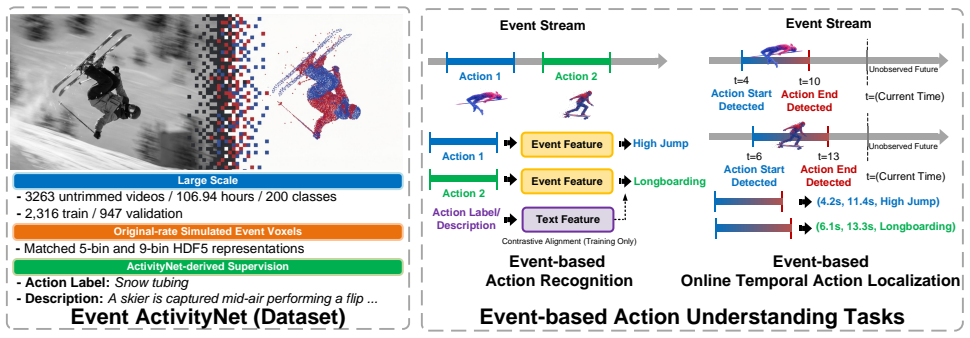
The central claim is that long-horizon event-based action understanding can be studied at scale through discrete event voxels generated directly from non-interpolated RGB frames, without expensive native event-camera recordings or intermediate high-frame-rate video. Each voxel tensor accumulates adjacent-frame log-intensity changes into B temporal bins (B=5 or 9) at a fixed contrast threshold c=0.2, and the dataset augments these tensors with per-video rational frame-rate metadata for approximate time mapping, inherited human action boundaries, timestamped captions, and a soft reconstruction-based quality audit at annotated action centers. On this testbed, reference models show steady gains
Load-bearing premise
The benchmark's value depends on the assumption that discrete event voxels simulated from RGB frames at a fixed contrast threshold preserve enough native event-stream structure that conclusions, especially the pretraining-transfer and online-localization results, carry over to real event cameras; the paper explicitly disclaims native equivalence and tests transfer only for recognition.
Editorial extensions
If this is right
- If correct, long-horizon event-based action understanding can be evaluated and developed at scale without native event recordings, making controlled comparisons of temporal discretization and streaming protocols possible on 3,263 untrimmed videos.
- Staged pretraining on these simulated event voxels is a viable recipe for native event recognition: it beats target-only and joint-from-scratch training at every supervision budget tested (10%, 50%, 100%), with gains of 2.61 to 7.65 Top-1 points.
- Increasing training data on this benchmark yields consistent improvements: recognition Top-1 rises from 52.25 to 66.42 and online TAL average mAP from 21.7 to 29.0 as scale grows from about 10 to 106.94 hours.
- Voxel granularity (5-bin vs 9-bin) changes online localization metrics by up to 1.8 mAP@30 while leaving recognition nearly unchanged, so temporal discretization choices are consequential for streaming tasks.
- Causal RGB–event fusion via cross-attention outperforms matched RGB-only and event-only online TAL, indicating that event cues add measurable value under strict prefix-only inference.
Reading between the lines
- A natural extension the paper leaves implicit is testing whether staged simulated-event pretraining also transfers to native causal online temporal action localization, not just recognition; the paper's own limitation statement highlights that this transfer direction is untested.
- The benchmark's curation enriches for videos whose captions mention motion or whose first frames are dark, and the paper reports a source-to-subset class-frequency correlation around r=0.64; downstream users should probe whether scale and transfer conclusions hold on the full ActivityNet distribution.
- Because the simulator resets its random seed per call, equal-shaped calls reuse the same pseudorandom perturbation patterns; this artifact could affect experiments that rely on stochastic variation, and a sensitivity analysis over seeds would clarify its impact.
- If the transfer advantage persists on larger native datasets, simulated-event pretraining could lower the annotation cost barrier for event-camera action understanding, since the pretraining corpus is derived from freely available RGB video with existing human labels.
Editorial analysis
A structured set of objections, weighed in public.
Referee Report
Summary. The paper introduces Event ActivityNet, a simulated-event benchmark derived from ActivityNet v1.3 and ActivityNet Captions, with 3,263 untrimmed videos, 200 action classes, 106.94 hours of video, matched 5-bin and 9-bin event-voxel representations, temporal action annotations, and timestamped captions. It defines three tasks: annotated-segment action recognition, auxiliary event–language alignment, and causal online temporal action localization (TAL). Voxels are generated directly from decoded RGB frames using a fixed contrast threshold, with rational-rate metadata for approximate time mapping and a center-frame LPIPS reconstruction audit. Reference baselines include adaptive event framing (AEF-Split&Merge), contrastive prompt/caption alignment, and SimOn/MATR online TAL with RGB-only, event-only, and RGB–event fused inputs. Main empirical results are: recognition Top-1 improves from 52.25 to 66.42 across progressive scales, online TAL avg mAP improves from 21.7 to 29.0, 5-bin vs 9-bin granularity has small effects, and staged Event ActivityNet pretraining outperforms target-only and joint-from-scratch training on HARDVS and SeAct recognition across 10/50/100% supervision budgets. The paper explicitly disclaims native-camera equivalence and repeatedly states that native evaluation remains necessary for deployment-oriented conclusions.
Significance. If the results hold, the benchmark fills a genuine gap: large-scale untrimmed event-based action understanding with temporal annotations, captions, and a causal online TAL protocol. The evaluation design is careful in several respects: 3-run means, fixed schedules, final-checkpoint reporting without early stopping, matched modality rows sharing the same SimOn head, public-dataset sanity checks, and a held-out generator comparison. The paper is also transparent about limitations in Sec. E and Appendix B.4/B.9. I found no circularity in the main evaluation: AEF-SM thresholds are calibrated on the training split and evaluated on the fixed validation split, and 5/9-bin comparisons vary only temporal grouping. The main risk is external validity: transfer to native event cameras is demonstrated only for trimmed recognition, not for the online TAL task that is a signature offering. This is a scope limitation rather than an internal inconsistency, but it needs to be reflected precisely in the paper's claims.
major comments (3)
- [Abstract; §5.3, Table 5] The abstract states that staged Event ActivityNet pretraining followed by native-event fine-tuning 'consistently outperforms target-only and joint-from-scratch training across multiple supervision budgets.' As written this suggests a general result, but Table 5 only supports it for trimmed recognition on HARDVS and SeAct. Causal online TAL—a core task defined in §3.1—is never validated on native event data, and §E explicitly disclaims native equivalence. Please restrict the transfer claim to recognition, or provide native online-TAL evidence. The current wording overstates the empirical support, even though the limitation is acknowledged elsewhere.
- [§3.1] The recognition protocol says 'we select the target ActivityNet v1.3 action instance' but never defines how the target is chosen or how multi-instance videos are handled. Is one annotated segment used per video, or are all action instances used as recognition samples? This changes the effective training-set size and directly affects the meaning of every recognition number in Tables 2, 4, and Figure 3. Please specify the selection rule and report the number of recognition samples per split.
- [§5.3, Table 5] The Event ActivityNet pretraining protocol for the native-transfer experiments is not specified. Which nested scale (diagnostic, Small, Medium, or Large) is used, for how many epochs, and with which objective (with or without caption alignment)? Since §5.3 shows large performance differences across scales, the transfer gains in Table 5 cannot be reproduced or interpreted without this information. Please report the exact pretraining protocol, or state that it is fixed across all native datasets and supervision budgets.
minor comments (5)
- [§3.2, Fig. 2] The pipeline diagram labels the LPIPS check as a 'High-quality Data Guarantee,' but Table S7 shows that zero videos exceed the δ=0.30 threshold and the text describes δ as a soft audit flag rather than an exclusion rule. Suggest rewording to avoid implying a stricter quality gate.
- [§5.3, Fig. 3] The paragraph reports recognition rising 'from 52.25 to 66.42' but does not explicitly state which scale corresponds to the lower value. Since the figure labels include 10h, Small, Medium, and Large, please clarify whether 52.25 is the diagnostic scale or the Small scale.
- [§B.4, Sec. E] The deterministic RNG reset (seed 42 per simulator call) means that equal-shaped videos reuse the same pseudorandom perturbations for base noise, initial residual, and hot pixels. This is disclosed in Sec. E, but because it is a data-generation property, it should also be stated in the main construction section with a note on the expected impact on cross-video comparisons.
- [Table 3] The streaming-step sweep rows clearly specify Δ∈{0.25,0.5,1.0}s, but the subsequent encoder/fusion rows do not state which default step is used. Please add the default step to the table or the caption.
- [§5.2, Eq. S6] The seconds-to-voxel mapping is explicitly approximate for variable-frame-rate streams. This is properly acknowledged; a one-sentence note in the main text that annotation misalignment can affect online TAL absolute numbers would help readers weigh the reported mAP values.
Circularity Check
No significant circularity: the benchmark construction and transfer results are empirical evaluations on external annotations and held-out splits.
full rationale
The paper's central claims are the creation of a simulated-event benchmark and the observed performance ordering of reference models. Neither reduces to its own inputs by construction. Event voxels are produced by a fixed, fully specified video-to-voxel simulator from ActivityNet RGB videos, and the action labels, temporal boundaries, and captions are inherited from ActivityNet v1.3 and ActivityNet Captions rather than inferred from the voxels. The recognition and online-TAL results are measured on a fixed validation split with final-checkpoint reporting and three-run means; AEF-SM thresholds are calibrated on the training split, which is standard hyperparameter selection, not fitted-input prediction. The transfer experiment in Table 5 compares target-only, joint, and staged pretraining under matched native-data budgets, so the reported ordering is an empirical outcome rather than a mathematical identity. The LPIPS reconstruction audit is explicitly a soft diagnostic of retained content and is not used as an exclusion rule or as a prediction target. The paper repeatedly and explicitly disclaims native-event equivalence in Sec. E and App. B.4, so the sim-to-real gap is a correctness/limitation concern rather than circularity. No load-bearing self-citation is evident; the cited generators and backbones are external prior work. Accordingly, no specific step in the derivation chain is equivalent to its inputs by definition or by construction.
Assumptions & free parameters
free parameters (6)
- Contrast thresholds c+ = c- =
0.2 (fixed)
- Base noise sigma and hot-pixel rate/amplitude =
sigma=0.1, p=0.001, amp=0.1
- Caption-action tIoU threshold eta =
0.1 (swept 0.1/0.3/0.5)
- Voxel-to-frame accumulation mass =
100,000 (L1 mass)
- AEF-SM thresholds and statistics =
tau_split=95th pct, tau_merge=20th pct, d_min=0.5s, K=8x8x2, omega=1
- LPIPS audit threshold delta =
0.30
assumptions (5)
- domain assumption Discrete event voxels simulated from RGB frames with a fixed contrast threshold preserve enough event structure for training recognition and online TAL models.
- domain assumption Temporal overlap (tIoU) between caption segments and action instances is a usable proxy for semantic correspondence.
- domain assumption Nominal or average frame-rate metadata map annotation seconds to voxel indices accurately enough.
- domain assumption HyperE2VID reconstruction plus LPIPS measures retained reconstructable content representative of overall data quality.
- domain assumption Inherited ActivityNet v1.3 action labels and ActivityNet Captions descriptions are correct.
Cite this review
Pith. "Pith review of Event ActivityNet: A Large-Scale Simulated-Event Benchmark for Untrimmed Action Understanding." pith.science (2026). https://pith.science/paper/CWTMZGDI
@misc{pith2026260801948,
  author       = {Pith},
  title        = {Pith review of: Event ActivityNet: A Large-Scale Simulated-Event Benchmark for Untrimmed Action Understanding},
  year         = {2026},
  howpublished = {\url{https://pith.science/paper/CWTMZGDI}},
  note         = {Machine review of arXiv:2608.01948}
}
read the original abstract
Long-horizon event-based action understanding remains underexplored because existing datasets largely comprise short, trimmed clips, while collecting native event streams with dense temporal annotations is costly. We introduce Event ActivityNet, a large-scale simulated-event benchmark derived from human-annotated, untrimmed ActivityNet videos. It comprises 3,263 videos, 200 action classes, and 106.94 hours, with matched 5-bin and 9-bin event-voxel representations, temporal action annotations, and timestamped captions. The benchmark supports annotated-segment action recognition, auxiliary event-language alignment, and causal online temporal action localization. We generate event voxels directly from non-interpolated source videos in decoded frame order, retain per-video rational nominal or average frame-rate metadata for approximate time mapping, and use action-center reconstruction LPIPS as a soft diagnostic of retained reconstructable content. We establish baselines for adaptive event framing, prompt-caption alignment, and event-only, RGB-only, and RGB-event localization. Under a progressive nested-scale training protocol, recognition Top-1 accuracy increases from 52.25 to 66.42, while online temporal localization average mAP improves from 21.7 to 29.0. Moreover, staged Event ActivityNet pretraining followed by native-event fine-tuning consistently outperforms target-only and joint-from-scratch training across multiple supervision budgets. Event ActivityNet provides a scalable benchmark for long-horizon event modeling, although native-camera evaluation remains essential for deployment-oriented conclusions.
Figures


Reference graph
Works this paper leans on
-
[1]
Berg and Timothy Melano and Jeffrey L
Arnon Amir and Brian Taba and David J. Berg and Timothy Melano and Jeffrey L. McKinstry and Carmelo di Nolfo and Tapan K. Nayak and Alexander Andreopoulos and Guillaume Garreau and Marcela Mendoza and Jeff Kusnitz and Michael DeBole and Steven K. Esser and Tobi Delbruck and Myron Flickner and Dharmendra S. Modha , title =
-
[2]
Event-Based Vision:
Guillermo Gallego and Tobi Delbr. Event-Based Vision:
-
[3]
Fabian Caba Heilbron and Victor Escorcia and Bernard Ghanem and Juan Carlos Niebles , title =
-
[4]
Alex Zihao Zhu and Liangzhe Yuan and Kenneth Chaney and Kostas Daniilidis , title =
-
[5]
Qi Wang and Zhou Xu and Yuming Lin and Jingtao Ye and Hongsheng Li and Guangming Zhu and Syed Afaq Ali Shah and Mohammed Bennamoun and Liang Zhang , editor =
-
[6]
Xiao Wang and Shiao Wang and Pengpeng Shao and Bo Jiang and Lin Zhu and Yonghong Tian , title =
-
[7]
Shaoyu Liu and Jianing Li and Guanghui Zhao and Yunjian Zhang and Xin Meng and Fei Richard Yu and Xiangyang Ji and Ming Li , title =
-
[8]
Learning Transferable Visual Models From Natural Language Supervision , booktitle = ICML, year =
Alec Radford and Jong Wook Kim and Chris Hallacy and Aditya Ramesh and Gabriel Goh and Sandhini Agarwal and Girish Sastry and Amanda Askell and Pamela Mishkin and Jack Clark and Gretchen Krueger and Ilya Sutskever , editor =. Learning Transferable Visual Models From Natural Language Supervision , booktitle = ICML, year =
Show all 45 references
-
[9]
Real-time Online Video Detection with Temporal Smoothing Transformers , booktitle = ECCV, year =
Yue Zhao and Philipp Kr. Real-time Online Video Detection with Temporal Smoothing Transformers , booktitle = ECCV, year =
-
[10]
Zamir and Yu
Haroon Idrees and Amir R. Zamir and Yu. The
-
[11]
Patrick Lichtsteiner and Christoph Posch and Tobi Delbruck , title =
-
[12]
Rebecq, Henri and Ranftl, Ren
-
[13]
Knoll , title =
Shu Miao and Guang Chen and Xiangyu Ning and Yang Zi and Kejia Ren and Zhenshan Bing and Alois C. Knoll , title =
-
[14]
Xiao Wang and Zongzhen Wu and Bo Jiang and Zhimin Bao and Lin Zhu and Guoqi Li and Yaowei Wang and Yonghong Tian , editor =
-
[15]
Jiazhou Zhou and Xu Zheng and Yuanhuiyi Lyu and Lin Wang , title =
-
[16]
Hyolim Kang and Kyungmin Kim and Yumin Ko and Seon Joo Kim , title =
-
[17]
Tang and Jungin Park and Kwonyoung Kim and Kwanghoon Sohn , title =
Tuan N. Tang and Jungin Park and Kwonyoung Kim and Kwanghoon Sohn , title =. CoRR , year =
-
[18]
Yansong Peng and Yueyi Zhang and Zhiwei Xiong and Xiaoyan Sun and Feng Wu , title =
-
[19]
CoRR , year =
Hanyue Lou and Jinxiu Liang and Minggui Teng and Yi Wang and Boxin Shi , title =. CoRR , year =
-
[20]
Zhongyang Zhang and Shuyang Cui and Kaidong Chai and Haowen Yu and Subhasis Dasgupta and Upal Mahbub and Tauhidur Rahman , title =
-
[21]
Efros and Eli Shechtman and Oliver Wang , title =
Richard Zhang and Phillip Isola and Alexei A. Efros and Eli Shechtman and Oliver Wang , title =
-
[22]
Burak Ercan and Onur Eker and Canberk Saglam and Aykut Erdem and Erkut Erdem , title =
-
[23]
Yue Gao and Jiaxuan Lu and Siqi Li and Yipeng Li and Shaoyi Du , title =
-
[24]
Hyolim Kang and Yunsu Park and Youngbeom Yoo and Yeeun Choi and Seon Joo Kim , title =
-
[25]
Xiao Yu and Yan Fang and Xiaojie Jin and Yao Zhao and Yunchao Wei , title =
-
[26]
Combining Events and Frames Using Recurrent Asynchronous Multimodal Networks for Monocular Depth Prediction , journal =
Daniel Gehrig and Michelle R. Combining Events and Frames Using Recurrent Asynchronous Multimodal Networks for Monocular Depth Prediction , journal =
-
[27]
Grounded Video Description , author=
-
[28]
Yue Gao and Jiaxuan Lu and Siqi Li and Nan Ma and Shaoyi Du and Yipeng Li and Qionghai Dai , title =
-
[29]
Event-based Action Recognition Using Motion Information and Spiking Neural Networks , booktitle = IJCAI, year =
Qianhui Liu and Dong Xing and Huajin Tang and De Ma and Gang Pan , editor =. Event-based Action Recognition Using Motion Information and Spiking Neural Networks , booktitle = IJCAI, year =
-
[30]
Dense-Captioning Events in Videos , booktitle = ICCV, year =
Ranjay Krishna and Kenji Hata and Frederic Ren and Li Fei. Dense-Captioning Events in Videos , booktitle = ICCV, year =
-
[31]
Temporal Segment Networks: Towards Good Practices for Deep Action Recognition , booktitle = ECCV, year =
Limin Wang and Yuanjun Xiong and Zhe Wang and Yu Qiao and Dahua Lin and Xiaoou Tang and Luc Van Gool , editor =. Temporal Segment Networks: Towards Good Practices for Deep Action Recognition , booktitle = ECCV, year =
-
[32]
DVS-Voltmeter: Stochastic Process-Based Event Simulator for Dynamic Vision Sensors , booktitle = ECCV, year =
Songnan Lin and Ye Ma and Zhenhua Guo and Bihan Wen , editor =. DVS-Voltmeter: Stochastic Process-Based Event Simulator for Dynamic Vision Sensors , booktitle = ECCV, year =
-
[33]
Ego4D: Around the World in 3,600 Hours of Egocentric Video , journal = PAMI, year =
Kristen Grauman and Andrew Westbury and Eugene Byrne and Vincent Cartillier and Zachary Chavis and Antonino Furnari and Rohit Girdhar and Jackson Hamburger and Hao Jiang and Devansh Kukreja and Miao Liu and Xingyu Liu and Miguel Martin and Tushar Nagarajan and Ilija Radosavovi...
-
[34]
CoRR , year =
Dima Damen and Hazel Doughty and Giovanni Maria Farinella and Sanja Fidler and Antonino Furnari and Evangelos Kazakos and Davide Moltisanti and Jonathan Munro and Toby Perrett and Will Price and Michael Wray , title =. CoRR , year =
-
[35]
Ego-Exo4D: Understanding Skilled Human Activity from First- and Third-Person Perspectives , journal = IJCV, year =
Kristen Grauman and Andrew Westbury and Lorenzo Torresani and Kris Kitani and Jitendra Malik and Triantafyllos Afouras and Kumar Ashutosh and Vijay Baiyya and Siddhant Bansal and Bikram Boote and Eugene Byrne and Zachary Chavis and Joya Chen and Feng Cheng and Fu. Ego-Exo4D: U...
-
[36]
Francesco Ragusa and Antonino Furnari and Giovanni Maria Farinella , title =
-
[37]
CoRR , year =
Shaoyu Liu and Jianing Li and Guanghui Zhao and Yunjian Zhang and Xiangyang Ji , title =. CoRR , year =
-
[38]
Shaoyu Liu and Jianing Li and Guanghui Zhao and Yunjian Zhang and Wen Jiang and Ming Li and Xiangyang Ji , title =
-
[39]
Representation Learning with Contrastive Predictive Coding , journal =
A. Representation Learning with Contrastive Predictive Coding , journal =
-
[40]
Supervised Contrastive Learning , booktitle = NeurIPS, year =
Prannay Khosla and Piotr Teterwak and Chen Wang and Aaron Sarna and Yonglong Tian and Phillip Isola and Aaron Maschinot and Ce Liu and Dilip Krishnan , editor =. Supervised Contrastive Learning , booktitle = NeurIPS, year =
-
[41]
Yi Liu and Limin Wang and Yali Wang and Xiao Ma and Yu Qiao , title =
-
[42]
and Eker, O
Ercan, B. and Eker, O. and Saglam, C. and Erdem, A. and Erdem, E. , title =
-
[43]
and Shechtman, Eli and Wang, Oliver , title =
Zhang, Richard and Isola, Phillip and Efros, Alexei A. and Shechtman, Eli and Wang, Oliver , title =
-
[44]
Qi, Zekun and Dong, Runpei and Fan, Guofan and Ge, Zheng and Zhang, Xiangyu and Ma, Kaisheng and Yi, Li , title =
-
[45]
Online Temporal Action Localization with Memory-Augmented Transformer , author =
Reviewed August 4, 2026 · model on record in the stance chip above.
Discussion (0). Sign in to comment.