REVIEW 3 major objections 3 minor 61 references
Grounding and Explaining Visual Evidence for AI-Generated Image Detection in Human-Centric Scenes
T0 review · 3 major / 3 minor · reviewed 2026-08-04 · deepseek-v4-flash
Pith's one-line read The paper claims a single vision-language model can decide whether an image is AI-generated, box the supporting artifact, and explain that region in plain language—and that aligning these three outputs makes all three more accurate.
desk verdict The HAVE dataset is a real resource and PAVE works, but the grounded-explanation claims need a human-agreement audit before they fully land. read the letter →
The pith
A machine-rendered reading of the paper's core claim, the machinery that carries it, and where it could break.
The reading
What carries the argument
The load-bearing object is the judge-guided alignment reward: a frozen multimodal judge assigns a content-consistency score between the explanation and the cropped predicted region, plus a box-validity score for whether the region contains real generation evidence; these are averaged into an explanation reward. The second mechanism is perception-aware regularization, which maximizes token-level divergence between the model's outputs on the original image and on a patch-masked version, forcing the model to actually use the visual input. Together they convert explainable detection into a constraint on the policy: a correct verdict only earns its reward if the box is right and the words describ
What would settle it
Take a random sample of HAVE test images, have independent human annotators draw the artifact boxes and write the explanations, then score PAVE against those human labels instead of the dataset's model-generated labels. If IoU/F1 and explanation CSS drop to the level of the strongest baseline rather than staying near the reported 31.11%/42.66%/62.74%, the central claim is falsified: PAVE would be matching the annotation model's notion of evidence, not human-perceived artifacts.
Extended reading notes
Core claim
The central claim is that region–explanation alignment can be turned into a training signal rather than treated as a post-hoc text-generation problem. PAVE first fine-tunes a vision-language model to emit a JSON-formatted verdict with evidence boxes and reasons, then uses reinforcement learning with a judge-guided alignment reward that scores each predicted box twice: whether the explanation matches what is actually inside the box, and whether the boxed content is genuine generation evidence. A second mechanism, perception-aware regularization, compares token-level predictions on the original image versus a randomly masked version and penalizes the model when destroying visual evidence barel
Load-bearing premise
HAVE's ground-truth boxes and explanations—produced by a large multimodal model, filtered by another, and manually corrected—are accurate enough to serve as training and evaluation truth for region-aligned evidence, but the paper does not quantify how often human correction changed a label or report inter-annotator agreement.
Editorial extensions
If this is right
- A detector can be audited: every 'AI-generated' verdict comes with at least one bounding box and a reason tied to that box, so a user can check the evidence instead of trusting a black-box label.
- Dense region-aligned supervision also improves plain classification: on the Banana2 ablation subset, accuracy rises from 93.6% after supervised fine-tuning to 98.7% in the full model.
- The approach transfers across generators and datasets: zero-shot grounding F1 is 29.12% on SynthScars, RichHF, LOKI, and X-AIGD, beating the second-best method by 8.64 points.
- Models trained this way can be small: PAVE at 4B parameters matches or beats much larger explainable detectors on cross-dataset explanation quality.
- Real-image behavior is explicit: for real photographs the target output is 'real' with an empty evidence set, so false positives are penalized at both the verdict and grounding levels.
Reading between the lines
- If the AI-generated annotations in HAVE are as reliable as the paper assumes, PAVE-style training could be used in content-moderation pipelines where a human reviewer needs to see the artifact before acting; the box-plus-reason output is directly reviewable.
- A testable extension is to stress the perception-aware regularizer with compressed, resized, or cropped versions of HAVE images; the claim that the model depends on visual evidence predicts graceful degradation rather than collapse.
- The judge-guided reward introduces a possible circularity: training and evaluation both lean on multimodal-model judgments. An independent human-labeled evidence subset would let the community measure how much of the reported grounding gain is genuine versus aligned to the judge's notion of evidence.
- The same 'mask the input, penalize unchanged output' regularizer could transfer to other hallucination-prone vision-language tasks, such as medical or forensic image reporting, where ignoring the image is the main failure mode.
Editorial analysis
A structured set of objections, weighed in public.
Referee Report
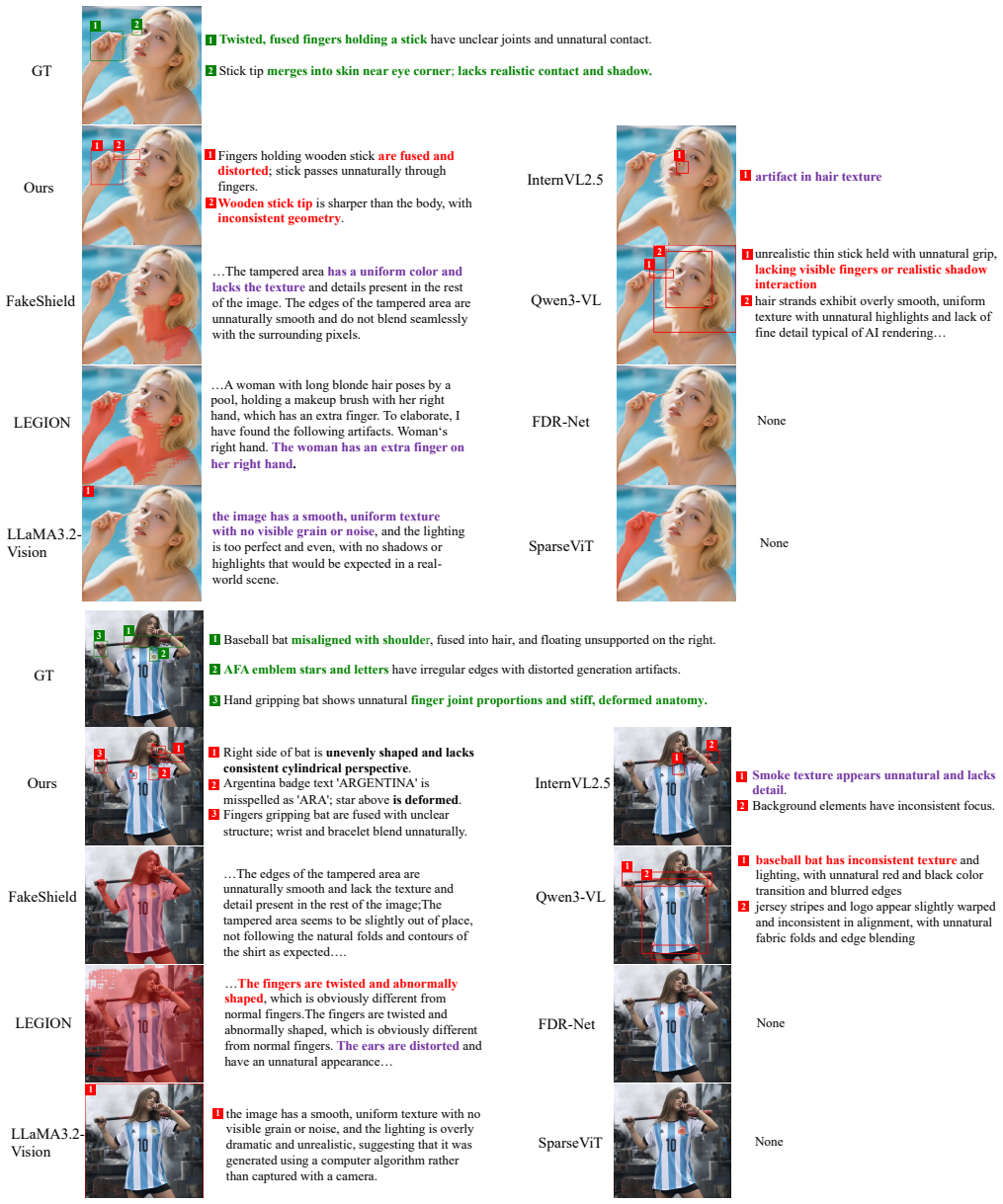
Summary. The paper introduces HAVE, a large benchmark of human-centric images (40K real, 39.5K AI-generated from 10 recent generators) with 106,609 localized evidence annotations consisting of bounding boxes, evidence categories, and region-aligned explanations. It also proposes PAVE, a VLM-based framework initialized from Qwen3-VL-Instruct-4B that jointly performs authenticity prediction, visual evidence grounding, and explanation generation. PAVE is trained with SFT followed by two RL stages: one using a localization/classification reward, the second using a judge-guided alignment reward (with Qwen3-VL-32B as judge) plus perception-aware regularization that penalizes the model when its output is insensitive to masked image patches. Experiments on HAVE report 96.11% detection accuracy, 31.11% grounding IoU, 42.66% grounding F1, and 62.74% explanation CSS, with cross-dataset results on SynthScars, RichHF, LOKI, and X-AIGD.
Significance. If the HAVE evidence labels are valid, the dataset is a valuable resource: it covers recent generators, high resolutions, structured prompts, and human-centric scenes, and it is substantially larger than existing evidence-annotated benchmarks. The PAVE framework is technically coherent, and the cross-dataset results, especially the grounding gains on external benchmarks, suggest that the training signal transfers beyond HAVE. The paper ships no code or data yet, but the promised release would help the community. The main weakness is that the central evaluation—grounding and explanation quality on HAVE—depends on annotations that are produced and filtered by the same VLM family used as PAVE's reward judge, and the manuscript does not quantify human correction or agreement. This makes the headline grounding/explanation numbers hard to interpret as evidence about human-perceived artifacts.
major comments (3)
- [§3, Figure 1, and §4.2, Eqs. (6)–(7)] The HAVE evidence annotations are initially proposed by Gemini-3.1-pro, scored and filtered by Qwen3-VL, and manually corrected, while PAVE is initialized from Qwen3-VL-4B and its explanation reward uses Qwen3-VL-32B as judge. The same VLM family therefore defines what counts as 'visual evidence' both in the training/evaluation targets and in the reward that shapes the model. The paper reports no statistics on how many candidates were manually corrected, re-localized, or rejected, no inter-annotator agreement, and no human validation of the final labels. As a result, the reported IoU/F1 and CSS improvements on HAVE may partly reflect alignment with Qwen3-VL's notion of evidence rather than human-perceived artifacts. This is the load-bearing issue for the paper's central claim. Please report the refinement outcome distribution and conduct an independent human-agreement study, or at minimu
- [Tables 2–4 and Table 7] All performance claims are point estimates from a single test split, with no error bars, confidence intervals, or significance tests. The per-generator differences in Table 2 are sometimes small (e.g., Qwen-Z: PAVE 95.62 vs. DGS-Net 96.10), so statistical significance is not established. The ablation study in Table 7 is conducted only on the Banana2 subset, leaving open whether the reported complementary effects of the four training stages hold across the ten generators and across the broader HAVE test set. Please report variance over at least multiple random seeds or bootstrap intervals, and run the ablation on a wider generator sample.
- [§3, Stage 1–4] The annotation pipeline only keeps evidence instances proposed by Gemini-3.1-pro; any artifacts that Gemini misses are simply absent from the ground truth. There is no estimate of the recall of evidence instances per image, so a model that predicts fewer but valid boxes can be penalized relative to an incomplete reference. The paper should report per-image annotation counts and, ideally, a sample-based human re-annotation study to estimate missed evidence and annotation noise. Without this, the absolute IoU/F1 numbers (31.11% / 42.66%) are difficult to interpret.
minor comments (3)
- [Supplementary Table 10] The supplementary text states that PAVE 'ranks first on all ten generator subsets,' but the table shows DGS-Net has higher accuracy on Qwen-Z (96.10 vs. 95.62) and Wan-2.7 (95.00 vs. 94.79). Please correct this claim or the table.
- [§4.2, Eq. (5)] With R_loc in [0,1] and α=1.1, R_loc^α is smaller than R_loc for every non-extreme value, so it is not immediately clear why the text says α 'emphasizes high-quality evidence grounding.' Please clarify the intended effect or add a short sensitivity analysis.
- [§4 and §5] The method introduces several hyperparameters (α, η, λ_exp, λ_loc, λ_cls, λ_vis, patch masking probability, annotation filtering thresholds) but no sensitivity analysis. A brief table or discussion of at least the main reward weights would improve reproducibility.
Circularity Check
No significant circularity: the training/evaluation loop is supervised learning with disjoint splits and external cross-dataset validation; the Qwen3-VL lineage is a benchmark-validity concern, not a derivation that reduces to its inputs.
full rationale
The paper's central claims are supported by a standard supervised pipeline: PAVE is SFT-trained and RL-trained on HAVE, then evaluated on a held-out 3:1 split of the same dataset plus four external benchmarks. The authenticity labels are defined by the image generators themselves, not by the model, and the grounding/explanation labels come from an annotation pipeline (Gemini-3.1-pro proposals, Qwen3-VL scoring, manual correction) that is independent of PAVE's outputs. The judge-guided reward does use Qwen3-VL-Instruct-32B, and the HAVE filter also uses Qwen3-VL, but this is a shared-model lineage rather than an equation-level reduction: the reward is not equal to the evaluation metric, the ground-truth boxes/text are not produced by PAVE, and the paper reports cross-dataset results on independently annotated benchmarks (SynthScars, LOKI, X-AIGD, RichHF) where PAVE also improves, providing external checkpoints. The absence of inter-annotator agreement or correction statistics is a legitimate benchmark-quality limitation, and the reliance on VLM-generated evidence labels is a construct-validity risk, but neither is a circular step in the derivation. No self-citation is load-bearing, no fitted parameter is renamed as a prediction, and no equation reduces to its own input. Therefore the circularity score is 0.
Assumptions & free parameters
free parameters (8)
- alpha (localization reward exponent) =
1.1
- eta (classification reward weight) =
0.5
- lambda_exp (explanation reward weight) =
0.7
- lambda_loc (localization reward weight) =
0.2
- lambda_cls (classification reward weight) =
0.1
- lambda_vis (perception regularization strength) =
0.01
- patch masking probability =
0.6
- annotation filtering threshold =
4 on a 1-5 scale
assumptions (4)
- domain assumption Large multimodal models (Gemini-3.1-pro, Qwen3-VL, GPT-4o) can produce reliable visual evidence annotations for AI-generated images when reviewed by humans.
- domain assumption Structured visual descriptions derived from real photographs, when used to generate images, yield a diverse and representative distribution of human-centric AI-generated scenes.
- domain assumption IoU, F1, ROUGE-L, and CSS measure the intended qualities of grounding and explanation.
- standard math The Qwen3-VL-Instruct 4B model and GRPO objective function operate as expected for this task.
Cite this review
Pith. "Pith review of Grounding and Explaining Visual Evidence for AI-Generated Image Detection in Human-Centric Scenes." pith.science (2026). https://pith.science/paper/P4RE6F64
@misc{pith2026260801988,
  author       = {Pith},
  title        = {Pith review of: Grounding and Explaining Visual Evidence for AI-Generated Image Detection in Human-Centric Scenes},
  year         = {2026},
  howpublished = {\url{https://pith.science/paper/P4RE6F64}},
  note         = {Machine review of arXiv:2608.01988}
}
read the original abstract
Rapid advances in image generation models call for interpretable AI-generated image detection methods that not only determine authenticity but also provide supporting visual evidence. Existing approaches may produce inconsistencies between generated explanations and localized evidence regions, undermining the reliability of explanations for authenticity decisions. Meanwhile, existing benchmarks provide limited coverage of the diverse human-centric scenes prevalent in generated imagery. To address these limitations, we investigate authenticity detection with grounded and explainable visual evidence in human-centric scenes. We present HAVE (Human-centric AI-generated Visual Evidence), a diverse human-centric dataset comprising 40K real and 39K AI-generated images from 10 recent generators, with 106K localized evidence instances across 8 evidence categories, each annotated with a bounding box and a region-aligned explanation. We further propose PAVE, a Perception-Aware Visual Evidence framework that jointly performs authenticity prediction, visual evidence grounding, and region-aligned explanation generation. PAVE employs a judge-guided alignment reward to assess region--explanation consistency and evidence validity, together with perception-aware regularization that contrasts token-level predictions between original and randomly masked images to promote reliance on visual input. Experiments on HAVE and external datasets demonstrate strong performance in authenticity detection, visual evidence grounding, and explanation quality. Code and data will be released upon publication.
Figures


Figures from the paper (7 more)


Reference graph
Works this paper leans on
-
[1]
and Pouget-Abadie, Jean and Mirza, Mehdi and Xu, Bing and Warde-Farley, David and Ozair, Sherjil and Courville, Aaron and Bengio, Yoshua , booktitle =
Goodfellow, Ian J. and Pouget-Abadie, Jean and Mirza, Mehdi and Xu, Bing and Warde-Farley, David and Ozair, Sherjil and Courville, Aaron and Bengio, Yoshua , booktitle =. Generative Adversarial Nets , year =
-
[2]
Prompt-to-prompt image editing with cross attention control , author=. 2208.01626 , year=
-
[3]
Advances in Neural Information Processing Systems , pages=
Denoising diffusion probabilistic models , author=. Advances in Neural Information Processing Systems , pages=
-
[4]
Lu, Cheng and Zhou, Yuhao and Bao, Fan and Chen, Jianfei and Li, Chongxuan and Zhu, Jun , booktitle=
-
[5]
Proceedings of the IEEE/CVF International Conference on Computer Vision , pages=
Scalable diffusion models with transformers , author=. Proceedings of the IEEE/CVF International Conference on Computer Vision , pages=
-
[6]
Tian, Keyu and Jiang, Yi and Yuan, Zehuan and Peng, Bingyue and Wang, Liwei , booktitle=
-
[7]
Fan, Lijie and Li, Tianhong and Qin, Siyang and Li, Yuanzhen and Sun, Chen and Rubinstein, Michael and Sun, Deqing and He, Kaiming and Tian, Yonglong , booktitle=
-
[8]
Nature , pages=
Fair human-centric image dataset for ethical AI benchmarking , author=. Nature , pages=. 2025 , publisher=
2025
Show all 61 references
-
[9]
2024 , archivePrefix =
Sun, Peize and Jiang, Yi and Chen, Shoufa and Zhang, Shilong and Peng, Bingyue and Luo, Ping and Yuan, Zehuan , eprint=. 2024 , archivePrefix =
2024
-
[10]
Proceedings of the ACM International Conference on Multimedia , pages=
Combating misinformation in the era of generative AI models , author=. Proceedings of the ACM International Conference on Multimedia , pages=
-
[11]
Momeni, Mina , journal=
-
[12]
Kaushik, Pooja and Garg, Vikas and Priya, Anu and Kant, Shashi , booktitle=
-
[13]
Zhu, Mingjian and Chen, Hanting and Yan, Qiangyu and Huang, Xudong and Lin, Guanyu and Li, Wei and Tu, Zhijun and Hu, Hailin and Hu, Jie and Wang, Yunhe , booktitle=
-
[14]
Proceedings of the International Conference on Learning Representations , year =
Xiao, Yao and Chen, Weiyan and Chen, Jiahao and Cao, Zijie and Deng, Weijian and Yang, Binbin and Dong, ZiYi and Ji, Xiangyang and Ke, Wei and Wei, Pengxu and Lin, Liang , title =. Proceedings of the International Conference on Learning Representations , year =
-
[15]
Kang, Hengrui and Wen, Siwei and Wen, Zichen and Ye, Junyan and Li, Weijia and Feng, Peilin and Zhou, Baichuan and Wang, Bin and Lin, Dahua and Zhang, Linfeng and others , booktitle=
-
[16]
Ye, Junyan and Zhou, Baichuan and Huang, Zilong and Zhang, Junan and Bai, Tianyi and Kang, Hengrui and He, Jun and Lin, Honglin and Wang, Zihao and Wu, Tong and others , booktitle=
-
[17]
Proceedings of the IEEE/CVF Conference on Computer Vision and Pattern Recognition , pages=
Rich human feedback for text-to-image generation , author=. Proceedings of the IEEE/CVF Conference on Computer Vision and Pattern Recognition , pages=
-
[18]
2024 , archivePrefix =
Cao, Bin and Yuan, Jianhao and Liu, Yexin and Li, Jian and Sun, Shuyang and Liu, Jing and Zhao, Bo , eprint=. 2024 , archivePrefix =
2024
-
[19]
Proceedings of the IEEE/CVF International Conference on Computer Vision , pages=
Perceptual artifacts localization for image synthesis tasks , author=. Proceedings of the IEEE/CVF International Conference on Computer Vision , pages=
-
[20]
IEEE Transactions on Image Processing , volume=
Toward Generalizable Forgery Detection and Reasoning , author=. IEEE Transactions on Image Processing , volume=
-
[21]
Li, Yixuan and Liu, Xuelin and Wang, Xiaoyang and Lee, Bu Sung and Wang, Shiqi and Rocha, Anderson and Lin, Weisi , journal=
-
[22]
Wen, Siwei and Feng, Peilin and Kang, Hengrui and Wen, Zichen and Chen, Yize and Wu, Jiang and He, Conghui and Li, Weijia and others , booktitle=
-
[23]
Ji, Yikun and Hong, Yan and Fan, Qi and Zhu, Huijia and Wang, Weiqiang and Zhang, Liqing and Zhang, Jianfu and others , booktitle=
-
[24]
Zhou, Ziyin and Luo, Yunpeng and Wu, Yuanchen and Sun, Ke and Ji, Jiayi and Yan, Ke and Ding, Shouhong and Sun, Xiaoshuai and Wu, Yunsheng and Ji, Rongrong , booktitle=
-
[25]
Are high-quality
Yao Xiao and Binbin Yang and Weiyan Chen and Jiahao Chen and Zijie Cao and ZiYi Dong and Xiangyang Ji and Liang Lin and Wei Ke and Pengxu Wei , booktitle=. Are high-quality. 2025 , url=
2025
-
[26]
Chen, Baoying and Zeng, Jishen and Yang, Jianquan and Yang, Rui , booktitle=
-
[27]
Proceedings of the International Conference on Learning Representations , pages=
A sanity check for ai-generated image detection , author=. Proceedings of the International Conference on Learning Representations , pages=
-
[28]
Proceedings of the IEEE/CVF Conference on Computer Vision and Pattern Recognition , pages=
Towards universal fake image detectors that generalize across generative models , author=. Proceedings of the IEEE/CVF Conference on Computer Vision and Pattern Recognition , pages=
-
[29]
Proceedings of the AAAI Conference on Artificial Intelligence , pages=
Explainable synthetic image detection through diffusion timestep ensembling , author=. Proceedings of the AAAI Conference on Artificial Intelligence , pages=
-
[30]
Tan, Chuangchuang and Zhao, Yao and Wei, Shikui and Gu, Guanghua and Wei, Yunchao , booktitle=
-
[31]
Zhong, Nan and Chen, Haoyu and Xu, Yiran and Qian, Zhenxing and Zhang, Xinpeng , booktitle=
-
[32]
Wang, Sheng-Yu and Wang, Oliver and Zhang, Richard and Owens, Andrew and Efros, Alexei A , booktitle=
-
[33]
Proceedings of the IEEE/CVF Conference on Computer Vision and Pattern Recognition , pages=
Rethinking the up-sampling operations in cnn-based generative network for generalizable deepfake detection , author=. Proceedings of the IEEE/CVF Conference on Computer Vision and Pattern Recognition , pages=
-
[34]
Wang, Zhendong and Bao, Jianmin and Zhou, Wengang and Wang, Weilun and Hu, Hezhen and Chen, Hong and Li, Houqiang , booktitle=
-
[35]
Xu, Zhipei and Zhang, Xuanyu and Li, Runyi and Tang, Zecheng and Huang, Qing and Zhang, Jian , booktitle=
-
[36]
Ji, Yikun and Hong, Yan and Deng, Bowen and Lan, Jun and Zhu, Huijia and Wang, Weiqiang and Zhang, Liqing and Zhang, Jianfu , booktitle=
-
[37]
Jiazhen Yan and Ziqiang Li and Fan Wang and Boyu Wang and Ziwen He and Zhangjie Fu , booktitle=
-
[38]
Orthogonal Subspace Decomposition for Generalizable
Yan, Zhiyuan and Wang, Jiangming and Wang, Zhendong and Jin, Peng and Zhang, Ke-Yue and Chen, Shen and Yao, Taiping and Ding, Shouhong and Wu, Baoyuan and Yuan, Li , booktitle=. Orthogonal Subspace Decomposition for Generalizable
-
[39]
Proceedings of the European Conference on Computer Vision , pages=
Leveraging representations from intermediate encoder-blocks for synthetic image detection , author=. Proceedings of the European Conference on Computer Vision , pages=
-
[40]
Chen, Zhe and Wu, Jiannan and Wang, Wenhai and Su, Weijie and Chen, Guo and Xing, Sen and Zhong, Muyan and Zhang, Qinglong and Zhu, Xizhou and Lu, Lewei and others , booktitle=
-
[41]
2025 , archivePrefix =
Bai, Shuai and Cai, Yuxuan and Chen, Ruizhe and Chen, Keqin and Chen, Xionghui and Cheng, Zesen and Deng, Lianghao and Ding, Wei and Gao, Chang and Ge, Chunjiang and others , eprint=. 2025 , archivePrefix =
2025
-
[42]
Grattafiori, Aaron and Dubey, Abhimanyu and Jauhri, Abhinav and Pandey, Abhinav and Kadian, Abhishek and Al-Dahle, Ahmad and Letman, Aiesha and Mathur, Akhil and Schelten, Alan and Vaughan, Alex and others , eprint=. The. 2024 , archivePrefix =
2024
-
[43]
Chen, Shenghao and Zhao, Yibo and Wang, Tianyi and Ma, Chunjie and Guan, Weili and Li, Ming and Gao, Zan , booktitle =
-
[44]
Can we get rid of handcrafted feature extractors?
Su, Lei and Ma, Xiaochen and Zhu, Xuekang and Niu, Chaoqun and Lei, Zeyu and Zhou, Ji-Zhe , booktitle=. Can we get rid of handcrafted feature extractors?
-
[45]
Advances in Neural Information Processing Systems , volume=
Visual instruction tuning , author=. Advances in Neural Information Processing Systems , volume=
-
[46]
Park, Jeongsoo and Owens, Andrew , booktitle=
-
[47]
Proceedings of the IEEE/CVF International Conference on Computer Vision , pages=
Segment Anything , author=. Proceedings of the IEEE/CVF International Conference on Computer Vision , pages=
-
[48]
2024 , publisher=
Jia, Zhen and Zhang, Zhang and Wang, Liang and Tan, Tieniu , journal=. 2024 , publisher=
2024
-
[49]
2026 , journal=
Human-centric content generation with diffusion models: A survey , author=. 2026 , journal=
2026
-
[50]
2026 , archivePrefix =
Sha, Yuyang and Lou, Zijie and Tang, Youyun and Qu, Xiaochao and Qu, Zheng and Xia, Ben and Li, Haoxiang and Liu, Ting and Liu, Luoqi , eprint=. 2026 , archivePrefix =
2026
-
[51]
2025 , note =
GoogleAI , title =. 2025 , note =
2025
-
[52]
2026 , note =
GoogleAI , title =. 2026 , note =
2026
-
[53]
2025 , archivePrefix =
Z-Image-Team , eprint=. 2025 , archivePrefix =
2025
-
[54]
2025 , note =
OpenAI , title =. 2025 , note =
2025
-
[55]
2026 , note =
OpenAI , title =. 2026 , note =
2026
- [56]
-
[57]
2509.20427 , year=
Seedream 4.0: Toward next-generation multimodal image generation , author=. 2509.20427 , year=
-
[58]
2026 , note =
ByteDance , title =. 2026 , note =
2026
-
[59]
2025 , note =
Wan-Team , title =. 2025 , note =
2025
-
[60]
2026 , note =
Wan-Team , title =. 2026 , note =
2026
-
[61]
Proceedings of the International Conference on Learning Representations , year=
Perception-Aware Policy Optimization for Multimodal Reasoning , author=. Proceedings of the International Conference on Learning Representations , year=
Reviewed August 4, 2026 · model on record in the stance chip above.
Discussion (0). Sign in to comment.