REVIEW 3 minor
Field-Free Transverse Aharonov--Bohm Phase Gate for an Orbital $l$-Qubit
T0 review · 0 major / 3 minor · reviewed 2026-08-04 · deepseek-v4-flash
Pith's one-line read A straight, field-free annular guide can write a flux-controlled relative phase between the opposite-winding modes |+l> and |-l> of an electron vortex, realizing an orbital l-qubit R_z(2δ_l) phase gate.
desk verdict A clean theoretical proposal for a transverse AB phase gate on an l-qubit; the physics is standard but the architecture is new and the derivation is sound. read the letter →
The pith
A machine-rendered reading of the paper's core claim, the machinery that carries it, and where it could break.
The reading
What carries the argument
The spin-resolved conserved Dirac current of a finite-wall annular mode: j_φ^(s) = s(eℏ/2m) dn/dρ - (eℏ l)/(mρ) n. The first (spin-dependent) term is a total derivative in the action, integrating to a boundary value that vanishes when the evanescent tail completes the mode; the second (orbital) term yields ⟨ρ^{-2}⟩ and is odd in l. Together with the gauge-covariant angular Hamiltonian H_φ(Φ) = (1/2mρ^2)(-iℏ∂_φ + ℏΦ/Φ0)^2, whose first derivative reproduces Eq. (12), this closes the derivation of the TAB phase and of the R_z(2δ_l) gate.
What would settle it
A numerical solution of the full two-component Dirac equation for the finite-step potential U(ρ) with the same parameters would settle the claim: if the phase accumulated by spin-up and spin-down guided modes differs (or if an l=0 mode shows any flux-dependent phase), the boundary cancellation underlying Eq. (12) fails. Experimentally, an l=0 null test — measuring zero contrast change under flux for an l=0 guided beam — would also falsify.
Extended reading notes
Core claim
The central claim is Eq. (12): for a straight, core-excluded annular Dirac guide with finite outer wall, the first-order flux-induced propagation phase is Δφ_ln = -(ℏ/m)(lΦ/Φ0)(L_int/v_z)⟨ρ^{-2}⟩_ln, spin-independent and gauge-invariant. The spin-dependent radial-gradient current in j_φ^(s) = s(eℏ/2m)dn/dρ - eℏ l/(mρ)n becomes, after integration, the boundary term s(eΦT/2m)[n(∞)-n(a)], which vanishes because the normalizable evanescent mode has n(a)=n(∞)=0. What survives is the orbital part, proportional to l and Φ. Encoding the matched pair |+l,n,k> and |-l,n,k> as logical states, the section acts as R_z(2δ_l), with δ_l = |Δφ_{l,n}|. The coherence, common-mode rejection, and m=±2l crosstalk
Load-bearing premise
The derivation rests on the assumption that a single radial envelope u(ρ) with the same functional form for both upper and lower Dirac components, and the relation χ = η σ·p φ, accurately describe the confined annulus including its evanescent tail; if the finite wall changes the lower-component structure, the boundary cancellation and the spin-independent phase would need revision.
Editorial extensions
If this is right
- The TAB phase is linear in l and Φ and odd under l→-l or Φ→-Φ, so reversing either sign flips the gate angle; l=0 modes have zero phase.
- Finite-wall confinement turns the previously free-space azimuthal current of Bessel modes into a reproducible, mode-resolved phase scale (⟨ρ^{-2}⟩_ln), enabling quantitative gate design.
- High-|l| encoding suppresses direct logical-state mixing: first-order matrix elements between |+l> and |-l> require angular harmonic m=±2l.
- The common-mode rejection of the differential readout (Eq. (20)–(21)) removes shared longitudinal phase and path-length drift, isolating the TAB signal.
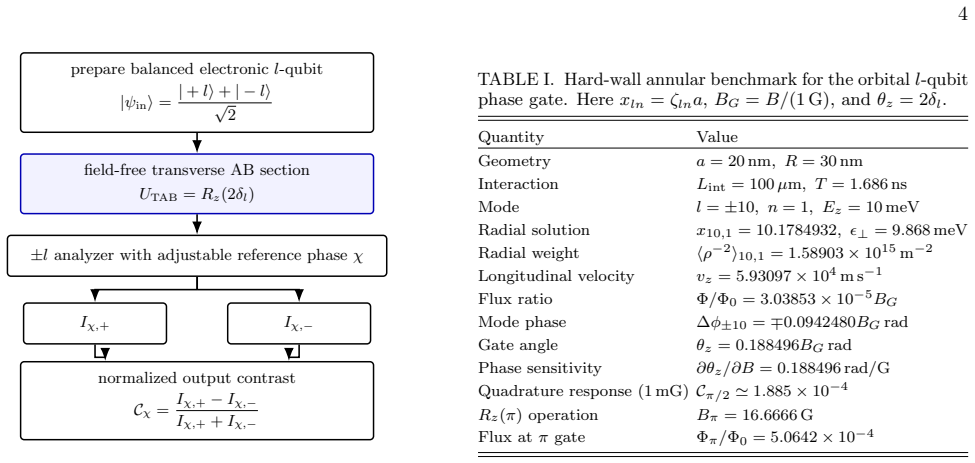
- For the benchmark geometry, R_z(π) occurs at 16.67 G and the quadrature contrast is 1.89×10^-4 per mG, placing coherent phase control in a nanoscale guided-electron setup.
Reading between the lines
- If Eq. (12) holds for the full Dirac spectrum, the same boundary-closure mechanism should work for any normalizable radial profile with vanishing density at the core and at infinity, suggesting electrostatic or surface-state waveguides could reproduce the gate without a magnetic core.
- The 1/v_z scaling implies dispersion engineering (slowing the longitudinal velocity, e.g., with periodic potentials or band-edge operation) could boost the gate angle per unit length; the paper lists v_z as a knob but does not optimize it.
- Because the phase is spin-independent, the gate could be operated on unpolarized or spin-mixed beams; conversely, a spin-dependent correction would be a signature that the spinor ansatz (Eq. (7)) breaks down — a testable deviation.
- The m=±2l crosstalk isolation suggests that high-l orbital encodings may act as an intrinsic protection layer against smooth disorder potentials, a design principle transferable to OAM-based quantum processing beyond this specific guide.
Editorial analysis
A structured set of objections, weighed in public.
Referee Report
Summary. The paper proposes a field-free transverse Aharonov–Bohm (TAB) phase gate for an orbital-angular-momentum qubit in a straight annular waveguide. It derives the propagation phase from the conserved Dirac current of a guided mode, showing that the spin-dependent radial-gradient contribution integrates to a boundary term that vanishes for the adopted core-excluded finite-wall geometry, leaving a spin-independent phase Δφ_ln = -(ℏ/m) l (Φ/Φ0) (L_int/v_z) ⟨ρ^{-2}⟩_ln (Eq. 12). The opposite-winding modes |±l⟩ are encoded as an l-qubit, the TAB section implements R_z(2δ_l), and a differential readout with common-mode rejection is proposed. A numerical benchmark for a=20 nm, R=30 nm, |l|=10, E_z=10 meV, and L_int=100 μm gives a gate angle 0.1885 rad/G and R_z(π) at 16.67 G.
Significance. If the result holds, it offers a concrete route to an Aharonov–Bohm-type phase gate that avoids closed-loop geometry, path separation, and centroid coupling to the vector potential, with explicit common-mode rejection. The central derivation is internally consistent: Eq. (15) independently reproduces the phase of Eq. (12) via the gauge-covariant transverse Hamiltonian, which allays the main concern about the nonrelativistic spinor ansatz in Eq. (7). The paper gives explicit, falsifiable predictions such as the l=0 null, l- and Φ-reversal signatures, and the projected sensitivity. The authors appropriately acknowledge that the numerical values are representative and that coherent preparation, guided transport, and analysis in such a nanoscale geometry remain experimental tasks. The contribution is incremental within the AB-effect literature but provides a clear device-oriented extension.
minor comments (3)
- [Eq. (2) and preceding text] The displayed definition Δφ_TAB = (1/ℏ)∫dt∫_Ve e j_φ A_ϕ dV contains an explicit factor e that is inconsistent with the charge-current definition j = -ec ψ†αψ used later. The sentence “ΔE^(1) = −∫_V e j·A dV” has the same spurious factor. Equation (10) and the final result use the correct form without the extra e. Please correct the displayed equations and the surrounding text so that the definition matches the subsequent derivation.
- [Eq. (7)] The spinor ansatz ψ↑ = N e^{ilϕ} e^{ikz}(u,0,ηku,-iη e^{iϕ}D_l u)^T is the standard leading nonrelativistic form, with χ = η σ·p φ. It would be helpful to state explicitly that this is valid to leading order in v/c and for barrier heights small compared with mc², and that the Dirac continuity conditions at ρ=R are satisfied only within this approximation. The independent Hamiltonian derivation in Eqs. (14)–(15) confirms the result, but this caveat should be stated for clarity.
- [Eq. (3)] The confinement potential U(ρ) is infinite for ρ<a and finite only for ρ>R. The abstract and gate description say “core-excluded finite-wall annular guide,” which could be misread as finite inner and outer walls. The exact spin-independence in Eq. (11) relies on n(a)=0. If a finite high inner barrier is later intended, the residual spin-dependent term n(a) does not vanish exactly and its magnitude should be estimated. Please clarify the phrase “finite-wall” in the introduction/abstract.
Circularity Check
No significant circularity: the TAB phase is derived independently from the current projection and the gauge-covariant Hamiltonian; self-citations are contextual and not load-bearing.
full rationale
The central result, Eq. (12), is derived from two independent routes. First, the Dirac current projection in Eqs. (8)–(11) computes the phase directly from the spinor ansatz and boundary conditions. Second, the complementary gauge-covariant Hamiltonian in Eqs. (14)–(15) yields the same first-order energy shift via an explicit expectation value, independent of the current-decomposition details. Neither route fits a parameter to the target result, and the final expression is not assumed but derived. The self-citations to Refs. [7] and [8] are used to place the work in context: Ref. [7] is described as prior derivation of a stationary coupling energy, but the present paper re-derives the equivalent phase shift from Eq. (15), and Ref. [8] is cited for the finite-wall continuation, while the essential boundary cancellation is established by the paper's own normalizable tail and the explicit nln(a)=nln(∞)=0 conditions. The benchmark numbers in Table I are illustrative hard-wall evaluations of the derived formula, not fitted inputs. No step reduces by construction to its own inputs, and no load-bearing premise is justified only by a same-author citation. The known AB phase appears as a consistency check, not as an input. Therefore, there is no circularity to report.
Assumptions & free parameters
free parameters (5)
- inner radius a =
20 nm
- outer radius R =
30 nm
- longitudinal energy E_z =
10 meV
- interaction length L_int =
100 µm
- orbital quantum number |l| =
10
assumptions (5)
- standard math Dirac minimal-coupling Hamiltonian H = c α·(p - eA) + β mc^2 + V(ρ) applies to the guided electron.
- domain assumption Nonrelativistic limit: lower component χ = (σ·p)/(2mc) φ, valid when E and V are much less than mc^2.
- domain assumption The flux is confined to the core ρ<a, so B=0 and A_φ = Φ/(2πρ) in the electron support.
- domain assumption Transverse and longitudinal motions separate, with longitudinal plane wave e^{ikz} and velocity v_z = ℏk/m.
- domain assumption The confining potential is infinite for ρ<a and finite U0 for ρ>R, with evanescent tail K_l(ξρ).
Cite this review
Pith. "Pith review of Field-Free Transverse Aharonov--Bohm Phase Gate for an Orbital $l$-Qubit." pith.science (2026). https://pith.science/paper/BMPFV47D
@misc{pith2026260802090,
  author       = {Pith},
  title        = {Pith review of: Field-Free Transverse Aharonov--Bohm Phase Gate for an Orbital $l$-Qubit},
  year         = {2026},
  howpublished = {\url{https://pith.science/paper/BMPFV47D}},
  note         = {Machine review of arXiv:2608.02090}
}
abstract
The Aharonov--Bohm (AB) effect is usually read out through phase differences associated with spatially distinct electron paths. We show that confined orbital modes provide a same-path alternative: a core-confined magnetic flux writes opposite propagation phases on the co-propagating modes $|\pm l\rangle$ of a straight annular electron guide while the transported electron-wave support remains field free. In a spin-resolved Dirac treatment, the phase is carried by the overlap of the field-free vector potential $A_\phi$ with the mode's azimuthal conserved-current texture. The spin-dependent radial-gradient current becomes a boundary term that cancels when the complete finite-wall evanescent tail is retained, leaving the spin-independent orbital phase $\Delta\phi_{ln}\propto l\Phi L_{\rm int}\langle\rho^{-2}\rangle_{ln}/v_z$. The matched $|\pm l\rangle$ modes therefore realize a same-path $R_z(2\delta_l)$ gate, with differential internal-mode readout and common-mode phase rejection. For $a=75\,\mathrm{nm}$, $R=95\,\mathrm{nm}$, $L_{\rm int}=1\,\mathrm{mm}$, $E_z=10\,\mathrm{meV}$, and $|l|=10$, the gate angle is $2.315\,\mathrm{rad/G}$ and $R_z(\pi)$ occurs at $1.357\,\mathrm{G}$. Finite-barrier, mode-spacing, disorder-mismatch, and readout-visibility checks quantify the main implementation constraints. More broadly, the result connects a mode-resolved AB energy shift to a measurable propagation operation and shows how the spatially distributed conserved current of a Dirac wave can become an operational quantum-control resource.
Figures

Reviewed August 4, 2026 · model on record in the stance chip above.
Discussion (0). Continue with ORCID to comment.