REVIEW 2 major objections 5 minor 98 references
An integral of a stable character against a shortest-word trace on a surface group decays as 1/n^k, yielding the vanishing of the linear coefficient in random cover fixed-point counts.
Reviewed by Pith at T0; open to challenge. T0 means a machine referee read the full paper against a public rubric. the ladder, T0–T4 →
2026-08-04 11:27 UTC pith:G3JNHIQ5
load-bearing objection New O(1/n^k) bounds for surface-relator stable-character integrals, with a genuine but likely patchable gap in the degenerate-boundary argument. the 2 major comments →
Word maps and surface relations in symmetric groups
The pith
A machine-rendered reading of the paper's core claim, the machinery that carries it, and where it could break.
Core claim
The paper proves Theorem 1.1: for fixed g, k, a word w that is a shortest representative of a non-trivial conjugacy class in Gamma_g, and any stable irreducible character lambda+(n) of S_n with lambda ⊢ k, the integral I_n(w, lambda, g) is O(1/n^k). Theorem 1.2 improves this to O(1/n^{k+1}) when the conjugacy class has a unique shortest representative word. The proof converts the integral into a finite sum over matching data, encodes each datum in a graph, and shows via angle structures and a piece inequality for shortest words that the maximum Euler characteristic is at most -k. As an application, the paper recovers the boundedness of expected fixed points of phi_n(gamma) (vanishing of the
What carries the argument
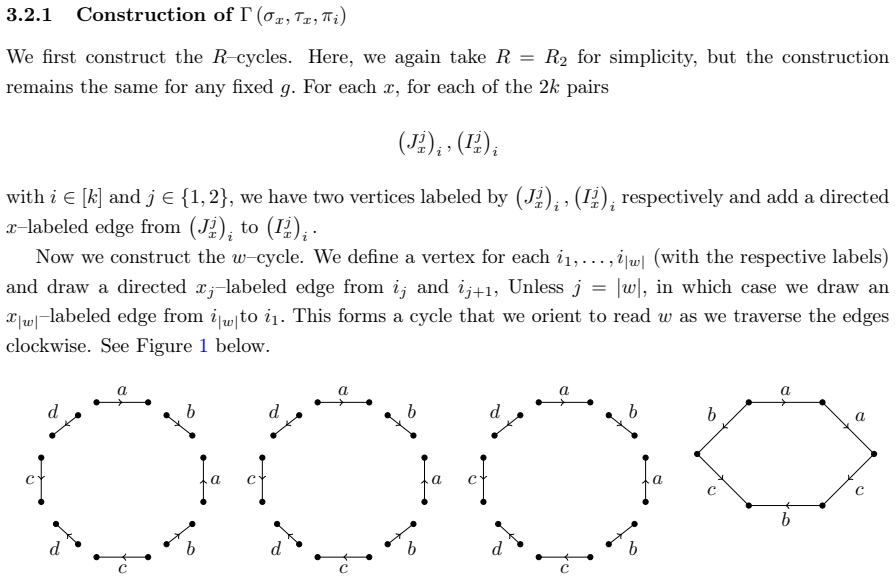
The central mechanism is a combinatorial integration scheme. A projection formula for stable representations, obtained from Schur–Weyl–Jones duality and the partition algebra, realizes chi_{lambda+(n)}(R_g(h)) as a trace on (C^n)^{otimes k}; Weingarten calculus for S_n then rewrites the integral as a finite sum indexed by matching data. Each datum determines a graph Gamma(sigma_x, sigma_x, pi_i) whose vertex count controls the number of index assignments and whose edge count controls the Weingarten factors, so the integral is bounded by n^{chi}. The heart of the proof is the bound max chi <= -k, obtained by framing Gamma as the 1-skeleton of a 2-complex and applying combinatorial Gauss–Bonne
Load-bearing premise
The load-bearing premise is the piece inequality for shortest words in surface groups—along any piece of the loop traced by w, the number of loop edges is at most (2g-1) times the number of hanging half-edges plus 2g—and the fact that this inequality survives the unzipping procedure; if either fails, the Euler characteristic bound, and hence the O(n^{-k}) decay, collapses.
What would settle it
Take a fixed shortest representative w, such as the example word [a,b]d^{-1}ab[d,c]d^{-1}ab for k=1, and compute I_n(w, lambda, g) for moderate n; if the magnitude decays slower than n^{-1}, Theorem 1.1 is wrong. Alternatively, enumerate all matching data for a given shortest w and find a graph Gamma with Euler characteristic exceeding -k, which would contradict Proposition 3.14 directly.
If this is right
- For any shortest representative w of a non-identity element gamma, the integral I_n(w, lambda, g) decays as 1/n^k, matching the dimension of the stable representation up to a single power.
- If the conjugacy class of gamma has a unique shortest representative up to cyclic permutation, the decay improves to 1/n^{k+1} for k >= 1.
- The expected number of fixed points of phi_n(gamma) in a uniformly random homomorphism Gamma_g -> S_n admits an asymptotic expansion whose linear term vanishes for gamma non-identity.
- In the unique-shortest-word case, the full expansion holds and the constant term a_0 equals d(b), the number of divisors of the maximal root b of gamma.
- There exist shortest representatives (such as w = [a,b]d^{-1}ab[d,c]d^{-1}ab) for which the O(1/n^k) bound is attained, so no sharper bound follows from the present method without further restrictions on the choice of w.
Where Pith is reading between the lines
- Extension: for other one-relator groups, the same machinery should work once a piece inequality for shortest representatives is known; the paper explicitly identifies this as the bottleneck, so a concrete next step is to search for such inequalities for other relators.
- Extension: the structure of the bound hints at a surface-group analogue of the primitivity rank: the first non-zero coefficient in the fixed-point expansion may be governed by an invariant of the pair (w, R_g), something the paper does not address.
- Extension: because the unzipping procedure only increases Euler characteristic, the method is robust to small perturbations of shortest words; one could test numerically whether 'almost shortest' words (with bounded excess over the minimal length) still yield O(n^{-k}) decay.
Editorial analysis
A structured set of objections, weighed in public.
Referee Report
Summary. The paper studies integrals of the form I_n(w,λ,g)=E_{S_n^{2g}}[χ_{λ+(n)}(R_g(h))Tr(w(h))], where R_g is the standard genus-g surface relator, w is a shortest representative of a nontrivial conjugacy class in Γ_g, and λ+(n) is a stable irreducible character of S_n. Theorem 1.1 claims I_n=O_{k,ℓ(w),g}(n^{-k}) for |λ|=k; Theorem 1.2 claims O(n^{-k-1}) when the shortest representative is unique up to cyclic permutation. The proof uses a projection formula (Proposition 2.1) to express χ_{λ+(n)}(R_g) as a trace on (C^n)^{⊗k}, Weingarten calculus for S_n, and a combinatorial graph expansion in which each matching datum gives a graph Γ whose Euler characteristic controls the n-dependence. The bound on χ(Γ) is proved by constructing a 2-complex X, assigning an angle structure, and invoking the Birman–Series/Magee–Puder inequality (Lemma 4.2). The paper then applies the main theorems to the Magee–Puder fixed-point statistic, recovering a_{-1}=0 for nontrivial γ and, under the uniqueness hypothesis, a_0=d(b).
Significance. If correct, the paper provides a new and largely self-contained path to the boundedness half of Magee and Puder's asymptotic theorem for random surface-group representations. The reduction to a finite matching-datum sum and the use of angle structures to bound Euler characteristics are elegant and potentially reusable for other relators. The paper also cleanly identifies the combinatorial property of w that governs the error rate, which is a useful contribution. The main reservations are gaps in the geometric arguments that convert pieces of the quotient complex into Birman–Series pieces; these are local but load-bearing for the central estimate.
major comments (2)
- [§4.3–§4.3.2; Lemma 4.4, inequality (19), Lemma 4.9] The proof of Proposition 3.14 requires applying Lemma 4.2 to pieces P of ∂X. The text asserts (after (15)) that any piece P made of WR-edges defines a piece \tilde P of L_w with e(P)=e(\tilde P) and he(\tilde P) ≤ he(P). This is not justified for the general case where a WR-edge is formed by gluing an R-edge to several w-edges: the preimage of P in the w-cycle may be a union of disjoint subpaths rather than a single Birman–Series piece, and the chosen hanging half-edges need not lie on one side of the loop. The situation is worse after the unzipping procedure in §4.3.2: pieces are extended through split vertices and RRW-edges are split, but no proof is given that the resulting extended pieces still correspond to genuine pieces of L_w satisfying the hypotheses of Lemma 4.2. Since inequality (19) and Lemma 4.9 use exactly e(P) ≤ (2g−1)he(P)+2g for these pieces, the bound ∑|V_P| ≤ 2(2g−1)k
- [Proof of Theorem 1.2 (end of §4.3.2)] The proof of Theorem 1.2 is a single paragraph: uniqueness of the shortest representative is said to imply that no subword is half the relator, and this is said to rule out equality in Lemma 4.2 for all pieces. Both claims require proof. It is not shown why uniqueness forbids a subword of length 2g that equals half of R_g, nor is it shown that equality in Lemma 4.2 can only occur for such half-relator subwords. Without a characterization of equality cases in Lemma 4.2, the improved O(n^{-k-1}) bound is not justified.
minor comments (5)
- [Lemma 4.9 proof] The notation 'E_WG', 'E_WW', 'E_WWG' appears inconsistent with the edge-type notation E_WR, E_RR, E_WW, E_RRW introduced earlier. Please correct the notation and check the incidence count.
- [§3.1 opening] The paper sets g=2 for exposition and says the proofs extend to arbitrary fixed g. Since the main theorems are stated for all g, a short remark detailing how the graph construction and the counting arguments adapt to general g would improve readability.
- [§1.2 'Sharper estimates'] Typo: 'primitvity rank' should be 'primitivity rank'.
- [References] [Mag25] is listed as 'Geometry and Toplology'; presumably 'Geometry and Topology'.
- [Proposition 2.1] The main formula is imported from the author's unpublished paper [Cas25a]. The statement is clear, but since the whole integration method depends on it, please either include a proof in an appendix or explicitly state that Theorem 1.1 relies on [Cas25a].
Circularity Check
No significant circularity: the central O(1/dim) bound is derived from an independent geometric input (Lemma 4.2) and from algebraic projection identities, not from a fitted parameter or from the target theorem.
full rationale
The claimed bound does not reduce to an input by construction. I_n(w,λ,g) is expanded into matching data (Theorem 3.5, Proposition 3.9), and the key Euler-characteristic estimate χ≤−k (Proposition 3.14) is proved through Gauss–Bonnet using Lemma 4.2, imported from Magee–Puder and Birman–Series rather than from the theorem being proved. The self-citation of Proposition 2.1 from [Cas25a] is a parameter-free projection identity: it supplies cancellations and coefficient bounds, but it does not itself assert the asymptotic O(1/d_{λ+(n)}) conclusion, so it is independent support rather than circular. The application in §1.1 uses [MPH25, Prop 4.4] only to truncate the Fourier sum and then applies Theorem 1.1, so it does not re-import Magee–Puder's boundedness conclusion. I do flag one load-bearing gap, but it is a correctness risk, not circularity: in §4.3.2 the 'piece unzipping' procedure asserts 'It is clear this unzipping procedure can only increase χ(Γ(σx,σx,πi))' and then applies Lemma 4.2 to unzipped pieces without proving that he(˜P)≤he(P) or that the iterated unzipping terminates; if that fails, Lemma 4.9 and hence the O(n^{−k}) bound would be unsupported. That is an omitted proof, not a by-construction equivalence, fitted-value prediction, or self-citation chain, so it does not make the derivation circular.
Axiom & Free-Parameter Ledger
axioms (5)
- domain assumption Proposition 2.1 (projection formula for stable representations, from [Cas25a])
- domain assumption Lemma 4.2 (piece inequality for shortest representatives, from [MP23] and [Mag25])
- standard math Weingarten calculus bounds for S_n (Theorem 2.2 and the bound Wg = O(n^{-|sigma∧tau|}))
- ad hoc to paper Unique shortest representative implies that no subword is 'half the relator' (used in Theorem 1.2)
- ad hoc to paper A unique shortest representative of gamma = delta^b is a proper power w = u^b (used in Corollary 1.4)
read the original abstract
We study the expected number of fixed points of a random permutation obtained via a word map, with surface group constraints imposed. For stable irreducible characters $\chi$ of the symmetric group $S_{n}$ and with $R_{g}=[a_{1},b_{1}]\dots[a_{g},b_{g}]$ and $w\in F_{2g}$, we compute $\mathbb{E}_{S_{n}^{2g}}\left[\chi\left(R_{g}(h)\right)\#\mathrm{fix}\left(w(h)\right)\right]$. We show that, if $w$ is a shortest representative for the conjugacy class of $\gamma\in\Gamma_{g}=\left\langle a_{1},b_{1},\dots,a_{g},b_{g}:R_{g}\right\rangle$, then this expectation is $O\left(1/\dim\chi\right)$. As an application, we recover a boundedness statement of Magee--Puder on the large $n$ limit of the expected number of fixed points of $\phi_{n}(\gamma)$, where $\gamma\in\Gamma_{g}$ is fixed and $\phi_{n}\in\hom\left(\Gamma_{g},S_{n}\right)$ is chosen uniformly at random.
Figures


Reference graph
Works this paper leans on
-
[1]
Characters of the partition algebras , volume =
Tom Halverson , journal =. Characters of the partition algebras , volume =
-
[2]
Representation Theory: A First Course , year =
William Fulton and Joe Harris , editor =. Representation Theory: A First Course , year =
-
[3]
The structure of the partition algebras , volume =
Paul Martin , journal =. The structure of the partition algebras , volume =
-
[4]
A new approach to the representation theory of the symmetric groups
Anatoly Vershik and Andrei Okounkov , journal =. A new approach to the representation theory of the symmetric groups
-
[5]
Decomposition results for
Teodor Banica and Stephen Curran , journal =. Decomposition results for
-
[6]
John . F. Humphreys , publisher =. A Course in Group Theory , year =
-
[7]
Linear Representations of Finite Groups , year =
Jean-Pierre Serre , publisher =. Linear Representations of Finite Groups , year =
-
[8]
On an algebraic approach to higher dimensional statistical mechanics , volume =
Paul Martin and Herbert Saleur , journal =. On an algebraic approach to higher dimensional statistical mechanics , volume =
-
[9]
Littlewood's formulas and their application to representations of classical
Kazuhiko Koike and Itaru Terada , journal =. Littlewood's formulas and their application to representations of classical
-
[10]
Benkart and M
G. Benkart and M. Chakrabarti and T. Halverson and R. Leduc and C.Y. Lee and J. Stroomer , journal =. Tensor product representations of general linear groups and their connections with
-
[11]
On the decomposition of tensor products of the representations of the classical groups: By means of the universal characters , volume =
Kazuhiko Koike , journal =. On the decomposition of tensor products of the representations of the classical groups: By means of the universal characters , volume =
-
[12]
Vaughan Frederick Randal Jones , journal =. The
-
[13]
Benoit Collins and Sho Matsumoto and Jonathan Novak , journal =. The
-
[14]
Integration with Respect to the Haar Measure on Unitary, Orthogonal and Symplectic Group , volume =
Benoit Collins and Piotr Sniady , journal =. Integration with Respect to the Haar Measure on Unitary, Orthogonal and Symplectic Group , volume =
-
[15]
Young Tableaux , year =
William Fulton , publisher =. Young Tableaux , year =
-
[16]
Musili , publisher =
C. Musili , publisher =. Representations of Finite Groups , volume =
-
[17]
Moments and cumulants of polynomial random variables on unitary groups, the
Benoit Collins , journal =. Moments and cumulants of polynomial random variables on unitary groups, the
-
[18]
Temperley--
Paul Martin , journal =. Temperley--
-
[19]
Primitive words, free factors and measure preservation , volume =
Doron Puder , journal =. Primitive words, free factors and measure preservation , volume =
-
[20]
Measure preserving words are primitive , volume =
Doron Puder and Ori Parzanchevski , journal =. Measure preserving words are primitive , volume =
-
[21]
Eigenvalues of random lifts and polynomials of random permutation matrices , volume =
Charles Bordenave and Benoit Collins , journal =. Eigenvalues of random lifts and polynomials of random permutation matrices , volume =
-
[22]
Rains , journal =
Jinho Baik and Eric M. Rains , journal =. Algebraic aspects of increasing subsequences , volume =
-
[23]
Issai Schur , title =
-
[24]
Sitzungsberichte Akad , title =
Issai Schur , address =. Sitzungsberichte Akad , title =
-
[25]
Random unitary representations of surface groups
Michael Magee , journal =. Random unitary representations of surface groups. 2025 , pages =
2025
-
[26]
On the foundations of combinatorial theory
Gian-Carlo Rota , journal =. On the foundations of combinatorial theory
-
[27]
Word measures on symmetric groups , volume =
Liam Hanany and Doron Puder , journal =. Word measures on symmetric groups , volume =
-
[28]
Asymptotic behavior of group integrals in the limit of infinite rank , volume =
Donald Weingarten , journal =. Asymptotic behavior of group integrals in the limit of infinite rank , volume =
-
[29]
A random matrix model from two dimensional
Feng Xu , journal =. A random matrix model from two dimensional
-
[30]
Ferdinand Georg Frobenius , journal =
-
[31]
Matrix group integrals, surfaces and mapping class groups
Michael Magee and Doron Puder , journal =. Matrix group integrals, surfaces and mapping class groups
-
[32]
Matrix group integrals, surfaces and mapping class groups
Michael Magee and Doron Puder , journal =. Matrix group integrals, surfaces and mapping class groups. 2022 , pages=
2022
-
[33]
A proof of
Friedman, Joel , year=. A proof of
-
[34]
A new proof of
Bordenave, Charles , booktitle=. A new proof of
-
[35]
Annals of Mathematics , volume=
A new approach to strong convergence , author=. Annals of Mathematics , volume=. 2026 , publisher=
2026
-
[36]
Discrete Mathematics , volume=
On the second eigenvalue of a graph , author=. Discrete Mathematics , volume=. 1991 , publisher=
1991
-
[37]
Combinatorica , volume=
Eigenvalues and expanders , author=. Combinatorica , volume=. 1986 , publisher=
1986
-
[38]
Duke Mathematical Journal , number =
Friedman, Joel , title =. Duke Mathematical Journal , number =
-
[39]
Marcus and Daniel A
Adam W. Marcus and Daniel A. Spielman and Nikhil Srivastava , journal =. Interlacing families
-
[40]
Combinatorica , volume=
Ramanujan graphs , author=. Combinatorica , volume=
-
[41]
Problemy Peredachi Informatsii , volume=
Explicit group--theoretic constructions of combinatorial schemes and their applications in the construction of expanders and concentrators , author=. Problemy Peredachi Informatsii , volume=
-
[42]
Projection formulas and a refinement of
Ewan Cassidy , year=. Projection formulas and a refinement of
-
[43]
Lectures on the Combinatorics of Free Probability , publisher=
Nica, Alexandru and Speicher, Roland , year=. Lectures on the Combinatorics of Free Probability , publisher=
-
[44]
Inventiones Mathematicae , volume=
Topology of finite graphs , author=. Inventiones Mathematicae , volume=. 1983 , publisher=
1983
-
[45]
Journal of Algebra , volume=
Stallings foldings and subgroups of free groups , author=. Journal of Algebra , volume=. 2002 , publisher=
2002
-
[46]
Canadian Mathematical Bulletin , author=
Stackings and the W--cycles Conjecture , volume=. Canadian Mathematical Bulletin , author=. 2017 , pages=
2017
-
[47]
Strong asymptotic freeness of
Michael Magee and Mikael de la Salle , year=. Strong asymptotic freeness of
-
[48]
An example of a non nuclear
Haagerup, Uffe , journal=. An example of a non nuclear. 1978 , publisher=
1978
-
[49]
Random Structures & Algorithms , volume =
Nica, Alexandru , title =. Random Structures & Algorithms , volume =. doi:https://doi.org/10.1002/rsa.3240050506 , year =
-
[50]
Random Structures & Algorithms , year=
Word maps and spectra of random graph lifts , author=. Random Structures & Algorithms , year=
-
[51]
Inventiones Mathematicae , year=
Symmetric groups and expander graphs , author=. Inventiones Mathematicae , year=
-
[52]
Random Structures & Algorithms , volume=
The action of a few permutations on r-tuples is quickly transitive , author=. Random Structures & Algorithms , volume=. 1998 , publisher=
1998
-
[53]
Selecta Mathematica , year=
Stable characters from permutation patterns , author=. Selecta Mathematica , year=
-
[54]
The Asymptotic Statistics of Random Covering Surfaces , volume=
Michael Magee and Doron Puder , year=. The Asymptotic Statistics of Random Covering Surfaces , volume=. doi:10.1017/fmp.2023.13 , journal=
-
[55]
On partition algebras for complex reflection groups , journal =. 2007 , issn =. doi:https://doi.org/10.1016/j.jalgebra.2007.03.037 , url =
-
[56]
Word Measures on Wreath Products
Shomroni, Yotam , journal=. Word Measures on Wreath Products
-
[57]
Explicit near--
Mohanty, Sidhanth and O'Donnell, Ryan and Paredes, Pedro , booktitle=. Explicit near--
-
[58]
Transactions of the American Mathematical Society , volume=
Aldous' spectral gap conjecture for normal sets , author=. Transactions of the American Mathematical Society , volume=
-
[59]
Proof of
Caputo, Pietro and Liggett, Thomas and Richthammer, Thomas , journal=. Proof of
-
[60]
On the eigenvalues of
Cesi, Filippo , journal=. On the eigenvalues of. 2010 , publisher=
2010
-
[61]
Inventiones Mathematicae , year=
Limit laws for Random matrices and free products , author=. Inventiones Mathematicae , year=
-
[62]
Random unitary representations of surface groups
Magee, Michael , journal=. Random unitary representations of surface groups. 2022 , publisher=
2022
-
[63]
Random permutations acting on
Ewan Cassidy , year=. Random permutations acting on
-
[64]
Physical Review A--Atomic, Molecular, and Optical Physics , volume=
Random unitaries give quantum expanders , author=. Physical Review A--Atomic, Molecular, and Optical Physics , volume=. 2007 , publisher=
2007
-
[65]
2023 , journal=
Stable Invariants and Their Role in Word Measures on Groups , author=. 2023 , journal=
2023
-
[66]
Proceedings of the Royal Society A , volume=
Rational curvature invariants for 2--complexes , author=. Proceedings of the Royal Society A , volume=. 2024 , publisher=
2024
-
[67]
International Mathematics Research Notices , volume=
Counting cycles in labeled graphs: the nonpositive immersion property for one-relator groups , author=. International Mathematics Research Notices , volume=. 2016 , publisher=
2016
-
[68]
The coherence of one-relator groups with torsion and the
Wise, Daniel T , journal=. The coherence of one-relator groups with torsion and the. 2005 , publisher=
2005
-
[69]
Advances in Mathematics , volume =
On blocks of. Advances in Mathematics , volume =. 2011 , author =
2011
-
[70]
Forum of Mathematics, Sigma , volume=
Stability patterns in representation theory , author=. Forum of Mathematics, Sigma , volume=. 2015 , organization=
2015
-
[71]
Canadian Journal of Mathematics , volume=
Products and plethysms of characters with orthogonal, symplectic and symmetric groups , author=. Canadian Journal of Mathematics , volume=. 1958 , publisher=
1958
-
[72]
Open Problems in Algebraic Combinatorics , volume=
The mystery of plethysm coefficients , author=. Open Problems in Algebraic Combinatorics , volume=
-
[73]
Inventiones Mathematicae , volume=
Expansion of random graphs: New proofs, new results , author=. Inventiones Mathematicae , volume=. 2015 , publisher=
2015
-
[74]
Annals of Mathematics , volume=
Near optimal spectral gaps for hyperbolic surfaces , author=. Annals of Mathematics , volume=
-
[75]
A new application of random matrices:
Haagerup, Uffe and Thorbj. A new application of random matrices:. Annals of Mathematics , pages=. 2005 , publisher=
2005
-
[76]
Proceedings 9ECM, to appear , year=
Strong convergence of unitary and permutation representations of discrete groups , author=. Proceedings 9ECM, to appear , year=
-
[77]
preprint, arXiv 2504.08988 , year=
Strong convergence of uniformly random permutation representations of surface groups , author=. preprint, arXiv 2504.08988 , year=
-
[78]
The strong asymptotic freeness of
Collins, Benoit and Male, Camille , booktitle=. The strong asymptotic freeness of
-
[79]
Inventiones Mathematicae , volume=
Limit laws for random matrices and free products , author=. Inventiones Mathematicae , volume=. 1991 , publisher=
1991
-
[80]
Second order freeness and fluctuations of random matrices:
Mingo, James A and. Second order freeness and fluctuations of random matrices:. Advances in Mathematics , volume=. 2007 , publisher=
2007
This paper was first reviewed by deepseek-v4-flash on August 4, 2026.
discussion (0)
Sign in with ORCID, Apple, or X to comment. Anyone can read and Pith papers without signing in.