REVIEW 2 major objections 3 minor 34 references
Discrete-Time Adaptive Control in High Dimensions: Near Dimension-Free Performance via Mirror Descent
T0 review · 2 major / 3 minor · reviewed 2026-08-04 · deepseek-v4-flash
Pith's one-line read Mirror descent keeps adaptive-control regret nearly dimension-free
desk verdict The mirror-descent adaptive-control machinery is real and the Lyapunov argument is clean, but the advertised log(d) regret is not established: the cumulative gradient term in the bound can scale linearly with d under the stated assumptions. read the letter →
The pith
A machine-rendered reading of the paper's core claim, the machinery that carries it, and where it could break.
The reading
What carries the argument
The central object is the mirror-descent adaptive law (7a) with the non-Euclidean Polyak step size (7b). The argument runs through the Lyapunov function V_t = D_f(Θ, Θ̂_t; Z_t), the Bregman divergence between the true parameter and its estimate; the identity ⟨∇J_t, Θ−Θ̂_t⟩ = −∥ẽ_{t+1}∥²_F converts the dual gradient step into a non-positive Lyapunov decrement, and the step size makes the decrease proportional to ∥ẽ∥⁴/(ϵ+∥∇J∥²_*), yielding stability and the general regret bound (26). The dimension-free nature comes from picking mirror maps whose dual norms are ℓ∞ or spectral, avoiding the √d factor of the Frobenius norm.
What would settle it
Vary k in the scalar motivating example while keeping Θ sparse and the regressor adversarial (e.g., all entries equal to the same value), fix a horizon T, and plot Reg(T) for k = 10, 100, 1000 under update (29). If the regret grows like √k (or linearly) rather than poly-logarithmically, the dimension-free claim is falsified.
Extended reading notes
Core claim
On its own terms, the paper's central discovery is that the dimension-dependence of adaptive-control transient performance is not an inherent cost of high-dimensional uncertainty but an artifact of Euclidean geometry in the parameter update. By choosing a mirror map whose Bregman divergence matches the parameter's structure—ℓp-norm for entrywise sparsity, mixed ℓ1/ℓ2 for group sparsity, Schatten-p for low rank, Shannon/von Neumann entropy for simplex/spectraplex—and pairing it with the non-Euclidean Polyak step size (7b), the update law attains asymptotic state convergence and regret bounds of the form O(s^{ln d/(1+ln d)}√(ln d)) up to the cumulative gradient-squared term.
Load-bearing premise
The logarithmic-in-dimension regret bound relies on the dual norm of the closed-loop gradient staying bounded uniformly as the ambient dimension grows; if the regressor can align so that the ℓ∞/spectral norm of ∇J_t scales like √d, the stated dimension-free performance is not actually delivered.
Editorial extensions
If this is right
- Adaptive controllers can safely operate in very high-dimensional parameter spaces provided the true parameter is structured: transient regret scales with the intrinsic complexity s (sparsity, rank) and log(d), not with d.
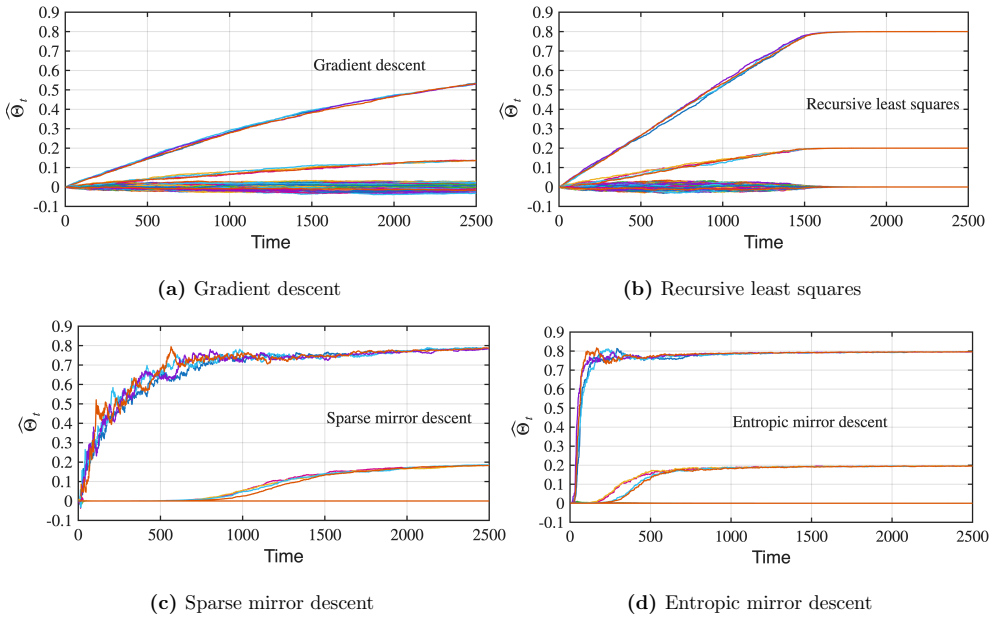
- The paper identifies Euclidean update laws (normalized gradient descent, recursive least squares) as the source of high-dimension degradation, and provides a direct replacement with the same certainty-equivalence controller.
- For each structure class, an explicit update law is given: ℓp-mirror descent for entrywise sparsity, block ℓp for group sparsity, Schatten-p for low rank, entropic (multiplicative) updates for simplex and row-stochastic sets, and matrix-exponential updates for density matrices.
- The general regret bound (26) implies O(√T) horizon scaling for any mirror map, with the dimension dependence confined to the Bregman term and the dual norm of the gradient.
- In the stochastic extension, the noisy gradient is conditionally unbiased, and the empirical comparisons suggest the method stays stable and dimension-robust where RLS becomes ill-conditioned.
Reading between the lines
- The 'at most logarithmic in dimension' statement presumes that the dual norm of the closed-loop gradient remains bounded uniformly in d. For worst-case regressors, ∥∇J_t∥_∞ can be as large as ∥B^⊤(ẽ)∥_F∥Ψ∥_F, which reintroduces a √d factor; the paper does not derive such a uniform bound from Assumption 1 alone.
- The step size (7b) uses the instantaneous residual twice—once in the loss and once in the gradient—so the stability proof leans on Lemma 2's denominator bound. A step size that separates these two appearances (e.g., using the previous residual) might make the analysis more robust and extend the guarantees to the noisy case without the coupling difficulty the paper notes.
- A practical consequence the authors leave implicit: any structured parameter set with a known mirror map whose dual norm is an ℓ∞-type or spectral norm yields an explicit controller with log-dimensional regret. Product sets, signed simplexes, or low-rank with nonnegativity are natural testbeds.
- The favourable empirical results use a parameter matrix with exactly two nonzero entries per row and do not compare against an oracle that knows the sparsity pattern, nor report regret growth as a function of d; the claimed dimension-free scaling is therefore not yet directly validated in the experiments.
Editorial analysis
A structured set of objections, weighed in public.
Referee Report
Summary. The paper proposes a mirror-descent adaptive control law with a non-Euclidean Polyak-type step size for discrete-time nonlinear systems with structured matrix uncertainty. The main results are: (i) a deterministic stability and asymptotic-tracking theorem (Theorem 1) based on a Lyapunov/Bregman-divergence argument; (ii) a general regret bound (Theorem 3) obtained by summing the descent inequality; and (iii) specialized regret bounds for entrywise-sparse, group-sparse, low-rank, simplex, and spectraplex parameter structures, advertised as having at most logarithmic dependence on the ambient parameter dimension d=mk. The paper also includes a motivating example against Euclidean schemes, a stochastic-extension section with explicit caveats, and numerical simulations. The deterministic Lyapunov analysis appears sound, but the dimension-free regret claim is not supported by the stated bounds, because the cumulative squared-gradient term in the regret bounds is left unquantified and can grow polynomially in the state dimension under the stated assumptions.
Significance. If the dimension-free claim were established, the paper would be a significant contribution to adaptive control for high-dimensional structured systems. The deterministic stability proof is clean and the general regret framework is potentially reusable; the explicit mirror-map update laws for sparse, low-rank, and entropy geometries are also useful. The paper also honestly acknowledges that the stochastic extension lacks theoretical guarantees. However, the headline claim of 'near dimension-free' regret is the paper's central selling point, and that claim is not justified by the theorems as stated. The general regret bound itself is a valid but weak statement; the specialized corollaries leave the dominant dimension-dependent factor uncontrolled. The paper also contains a constructive counterexample (described in the major comments) showing that the bound can scale linearly with the state dimension even for 1-sparse parameters. With an added assumption controlling the gradient norm or the state dimension, and with the title/abstract appropriately qualified, the framework could still be valuable.
major comments (2)
- [Corollary 4 / Eq. (26)] The advertised dimension-free claim is not supported. The bound in Corollary 4 (similarly Corollaries 5–8) has an unquantified factor [Σ_t(ϵ_{t+1}+∥∇J_t(θ̂_t)∥_∞²)]^{1/2} under the square root. Under Assumption 1 alone, this term can grow polynomially in the state dimension n2. For example, take m=1, n2=k=d, A=0, B=I, K=0, U^d=0, θ̂_0=0, X_0=(1,…,1), and let Ψ(X,t) be the d×d matrix whose first row is X and all other rows zero. Then Assumption 1 holds, a single nonzero entry of Θ is 1-sparse, but Reg(1)=d/2 and ∥∇J_0∥_∞=d. Thus the RHS is at least a constant times d√ln d, not logarithmic. Please either add an explicit bound on ∥∇J_t∥_∞ (or on n2), or revise the abstract/title to claim only that the explicit d-dependent constants in D_f and the norm are logarithmic.
- [Section V.A, Remark 3] The row-stochastic simplex bound is stated as Reg(T) ≤ m√(ln k / 2) √(Σ_t(ϵ_{t+1}+∥∇J_t∥_∞²)). Since d=mk, this has an explicit linear factor in m, a component of the ambient dimension. If m is allowed to grow, this is not dimension-free in d. Please clarify whether m is treated as a fixed problem constant or restrict the dimension-free claim to settings where m is bounded.
minor comments (3)
- [Appendix A, Lemma 2] The proof invokes a norm-equivalence constant c between ∥·∥_* and ∥·∥_F. For the specific dual norms used later (ℓ∞, spectral, mixed), the constant is 1; it would help to state this explicitly to avoid the impression that a hidden dimension-dependent constant is introduced.
- [Notation (end of Section I)] The notations 'ln el' and 'exp el' for entrywise functions are used without definition. Please define them explicitly, e.g., 'applied entrywise'.
- [Section II] The motivating scalar example uses a stochastic regressor, while the main theorem is deterministic. The text should make clear that the stochastic regressor is only for motivation and that the subsequent analysis treats Ψ as deterministic.
Circularity Check
No circularity: the mirror-descent analysis is self-contained; the dimension-free claim's gap is an unproven uniform gradient bound, not a circular reduction.
full rationale
The central derivation chain is a standard Lyapunov/regret argument, not a fitted or self-referential prediction. The mirror-descent update (7a) and non-Euclidean Polyak step size (7b) define the algorithm; the identity (20) is an exact algebraic consequence of the definitions of J_t and ∇J_t, and the dissipation inequality (22) follows by substituting that step size. Theorem 3's regret bound (26) is obtained by summing (22) and applying Cauchy-Schwarz; the appearance of J_t in the step size is the mechanism of the argument, not a hidden reintroduction of the target quantity. The corollaries in Sections IV-V only substitute explicit Bregman-divergence bounds for the chosen mirror maps, so their dependence on D_f and the dual norm is algebraically derived. There is no load-bearing self-citation: the only same-author reference ([34]) appears in a future-directions sentence, and the mirror-map constructions cite standard external sources (e.g., [6,7,10,11]). The paper's advertised 'logarithmic dependence on the ambient dimension' does rest on an unstated and unproven uniform bound on Σ(ϵ+∥∇J_t(Θhat_t)∥_*²) independent of d; in fact, admissible instances satisfying Assumption 1 can have ∥∇J_t∥_∞ grow with the state dimension n2, so the corollary bounds then carry a polynomial factor and the abstract's dimension-free phrasing overreaches. That is a correctness/overclaim gap, however, not a circularity: the displayed bounds are still consequences of the paper's own assumptions, and no output is equivalent to an input by construction, no fitted parameter is renamed as a prediction, and no claimed uniqueness or first-principles result is imported from the authors' prior work.
Assumptions & free parameters
free parameters (3)
- epsilon_t sequence =
not specified; suggested alpha(t+1)^{-beta}
- p = 1 + 1/ln(d) =
p = 1 + 1/ln(d)
- dimension-free constants e/2, ... =
e/2 ...
assumptions (5)
- standard math Mirror map f is μ-strongly convex with respect to the chosen norm and its Fenchel conjugate is differentiable on the relevant domain.
- domain assumption The closed-loop operator A − BK is Schur stable and the reference input U^d_t is bounded.
- domain assumption Assumption 1: the regressor Ψ grows at most linearly in the state.
- standard math The function x ↦ (1/2)∥x∥²_p is (p−1)-strongly convex and the composed f_{ℓp} is 1-strongly convex with respect to the ℓ1 norm, with analogous statements for the Schatten-p and entropic/spectraplex maps.
- ad hoc to paper The norm equivalence constant c in Lemma 2 does not depend on the ambient dimension in a way that destroys the log-d bound.
invented entities (1)
-
Non-Euclidean Polyak step size (7b)
Cite this review
Pith. "Pith review of Discrete-Time Adaptive Control in High Dimensions: Near Dimension-Free Performance via Mirror Descent." pith.science (2026). https://pith.science/paper/3PU5HEF6
@misc{pith2026260802256,
  author       = {Pith},
  title        = {Pith review of: Discrete-Time Adaptive Control in High Dimensions: Near Dimension-Free Performance via Mirror Descent},
  year         = {2026},
  howpublished = {\url{https://pith.science/paper/3PU5HEF6}},
  note         = {Machine review of arXiv:2608.02256}
}
read the original abstract
Motivated by the use of modern high-capacity models in real-time control problems, this paper studies the adaptive control of high-dimensional discrete-time nonlinear systems with an unknown matrix-valued parameter. We focus on regimes where the number of unknown parameter entries is large, but the parameter matrix possesses exploitable structure, such as entrywise sparsity, group sparsity, low rank, and row-stochastic or density-matrix structure. To quantify transient performance, we consider a regret criterion relative to a nominal controller with full knowledge of the true parameter. We show that standard Euclidean update schemes, including recursive least squares and gradient descent, are ill-suited to this setting: their transient performance deteriorates as the dimension increases, even when the true parameter has low intrinsic complexity. To address this limitation, we propose a novel class of mirror-descent-type adaptive laws equipped with a non-Euclidean Polyak-type step size that exploit the geometry induced by the parameter structure. For the proposed update laws, we establish asymptotic state convergence and derive regret bounds with at most logarithmic dependence on the ambient dimension. Numerical experiments demonstrate the effectiveness of the proposed schemes.
Figures


Figures from the paper (1 more)

Reference graph
Works this paper leans on
-
[1]
Krstic, I
M. Krstic, I. Kanellakopoulos, and P. Kokotovic,Nonlinear and Adaptive Control Design. John Wiley, 1995
1995
-
[2]
History of adaptive control,
K. J. ˚Astr¨ om, “History of adaptive control,” inEncyclopedia of Systems and Control, J. Baillieul and T. Samad, Eds. Cham: Springer International Publishing, 2021, pp. 902–909
2021
-
[3]
A historical perspective of adaptive control and learning,
A. M. Annaswamy and A. L. Fradkov, “A historical perspective of adaptive control and learning,” Annu. Rev. Control, vol. 52, pp. 18–41, 2021
2021
-
[4]
Adaptive nonlinear control without over- parametrization,
M. Krsti´ c, I. Kanellakopoulos, and P. V. Kokotovi´ c, “Adaptive nonlinear control without over- parametrization,”Systems & Control Letters, vol. 19, no. 3, pp. 177–185, 1992
1992
-
[5]
A. S. Nemirovski and D. B. Yudin,Problem Complexity and Method Efficiency in Optimization (Wiley-Interscience Series in Discrete Mathematics). Chichester, UK: John Wiley & Sons, 1983, Translated from Russian by E. R. Dawson
1983
-
[6]
Sparse recovery by reduced variance stochastic approximation,
A. Juditsky, J. Kwon, M. Molinaro, and C. Tauvel, “Sparse recovery by reduced variance stochastic approximation,”Information and Inference: A Journal of the IMA, vol. 12, no. 2, pp. 851–896, 2023
2023
-
[7]
On first-order algorithms forℓ 1/nuclear norm minimization,
Y. Nesterov and A. Nemirovski, “On first-order algorithms forℓ 1/nuclear norm minimization,”Acta Numerica, vol. 22, pp. 509–575, 2013
2013
-
[8]
Distributed online optimization in dynamic environments using mirror descent,
S. Shahrampour and A. Jadbabaie, “Distributed online optimization in dynamic environments using mirror descent,”IEEE Transactions on Automatic Control, vol. 63, no. 3, pp. 714–725, 2018
2018
Show all 34 references
-
[9]
Distributed mirror descent for online composite optimization,
D. Yuan, Y. Hong, D. W. C. Ho, and S. Xu, “Distributed mirror descent for online composite optimization,”IEEE Transactions on Automatic Control, vol. 66, no. 2, pp. 714–729, 2021
2021
-
[10]
Prox-method with rate of convergenceO(1/t) for variational inequalities with Lipschitz continuous monotone operators and smooth convex-concave saddle point problems,
A. Nemirovski, “Prox-method with rate of convergenceO(1/t) for variational inequalities with Lipschitz continuous monotone operators and smooth convex-concave saddle point problems,”SIAM Journal on Optimization, vol. 15, no. 1, pp. 229–251, 2004
2004
-
[11]
Robust stochastic approximation approach to stochastic programming,
A. Nemirovski, A. Juditsky, G. Lan, et al., “Robust stochastic approximation approach to stochastic programming,”SIAM Journal on Optimization, vol. 19, no. 4, pp. 1574–1609, 2009
2009
-
[12]
Introduction to online convex optimization,
E. Hazan, “Introduction to online convex optimization,”Foundations and Trends in Optimization, vol. 2, no. 3–4, pp. 157–325, 2016
2016
-
[13]
Lattimore and C
T. Lattimore and C. Szepesv´ ari,Bandit Algorithms. Cambridge University Press, 2020
2020
-
[14]
Regret analysis of stochastic and nonstochastic multi-armed bandit problems,
S. Bubeck and N. Cesa-Bianchi, “Regret analysis of stochastic and nonstochastic multi-armed bandit problems,”Foundations and Trends in Machine Learning, vol. 5, no. 1, pp. 1–122, 2012
2012
-
[15]
Hazan and K
E. Hazan and K. Singh,Introduction to Online Control. Cambridge University Press, 2026
2026
-
[16]
Regret bounds for the adaptive control of linear quadratic systems,
Y. Abbasi-Yadkori and C. Szepesv´ ari, “Regret bounds for the adaptive control of linear quadratic systems,” inProceedings of the 24th Annual Conference on Learning Theory, ser. Proceedings of Machine Learning Research, vol. 19, 2011, pp. 1–26
2011
-
[17]
Regret bounds for robust adaptive control of the linear quadratic regulator,
S. Dean, H. Mania, N. Matni, B. Recht, and S. Tu, “Regret bounds for robust adaptive control of the linear quadratic regulator,” inAdvances in Neural Information Processing Systems, vol. 31, 2018, pp. 4192–4201
2018
-
[18]
Optimism-based adaptive regulation of linear- quadratic systems,
M. K. S. Faradonbeh, A. Tewari, and G. Michailidis, “Optimism-based adaptive regulation of linear- quadratic systems,”IEEE Transactions on Automatic Control, vol. 66, no. 4, pp. 1802–1808, 2021
2021
-
[19]
Data-enabled policy optimization for direct adaptive learning of the LQR,
F. Zhao, F. D¨ orfler, A. Chiuso, and K. You, “Data-enabled policy optimization for direct adaptive learning of the LQR,”IEEE Transactions on Automatic Control, vol. 70, no. 11, pp. 7217–7232, 2025
2025
-
[20]
Certainty equivalence is efficient for linear quadratic control,
H. Mania, S. Tu, and B. Recht, “Certainty equivalence is efficient for linear quadratic control,” in Advances in Neural Information Processing Systems, vol. 32, 2019
2019
-
[21]
Regret bounds for adaptive nonlinear control,
N. M. Boffi, S. Tu, and J.-J. E. Slotine, “Regret bounds for adaptive nonlinear control,” inPro- ceedings of the 3rd Conference on Learning for Dynamics and Control, ser. Proceedings of Machine Learning Research, vol. 144, PMLR, Jul. 2021, pp. 471–483
2021
-
[22]
G. C. Goodwin and K. S. Sin,Adaptive Filtering Prediction and Control. Mineola, NY: Dover Publications, 2009
2009
-
[23]
K. J. ˚Astr¨ om and B. Wittenmark,Adaptive control, 2nd ed. Mineola, NY: Dover Publications, 2008
2008
-
[24]
I. D. Landau, R. Lozano, M. M’Saad, and A. Karimi,Adaptive Control: Algorithms, Analysis and Applications, 2nd ed. London: Springer, 2011
2011
-
[25]
R. T. Rockafellar,Convex Analysis. Princeton, NJ: Princeton University Press, 1970
1970
-
[26]
J. M. Borwein and A. S. Lewis,Convex Analysis and Nonlinear Optimization: Theory and Examples, 2nd ed. New York: Springer, 2006
2006
-
[27]
D. P. Bertsekas, A. Nedi´ c, and A. E. Ozdaglar,Convex Analysis and Optimization. Belmont, MA: Athena Scientific, 2003
2003
-
[28]
Boyd and L
S. Boyd and L. Vandenberghe,Convex Optimization. Cambridge: Cambridge University Press, 2004
2004
-
[29]
J. P. Hespanha,Linear Systems Theory, 2nd ed. Princeton, NJ: Princeton University Press, 2018
2018
-
[30]
B. T. Polyak,Introduction to Optimization. New York: Optimization Software, Inc., 1987
1987
-
[31]
Revisiting the polyak step size,
E. Hazan and S. Kakade, “Revisiting the polyak step size,”arXiv preprint arXiv:1905.00313, 2019
1905 arXiv
-
[32]
A note on persistency of excitation,
J. C. Willems, P. Rapisarda, I. Markovsky, and B. L. De Moor, “A note on persistency of excitation,” Systems & Control Letters, vol. 54, no. 4, pp. 325–329, 2005
2005
-
[33]
Online learning with predictable sequences,
A. Rakhlin and K. Sridharan, “Online learning with predictable sequences,” inAnnual Conference on Learning Theory, S. Shalev-Shwartz and I. Steinwart, Eds., vol. 30, 2013, pp. 993–1019
2013
-
[34]
Adaptive composite online optimiza- tion: Predictions in static and dynamic environments,
P. Z. Scroccaro, A. S. Kolarijani, and P. Mohajerin Esfahani, “Adaptive composite online optimiza- tion: Predictions in static and dynamic environments,”IEEE Transactions on Automatic Control, vol. 68, no. 5, pp. 2906–2921, 2023
2023
Reviewed August 4, 2026 · model on record in the stance chip above.
Discussion (0). Sign in to comment.