REVIEW 3 major objections 6 minor 57 references
Sen-Cap: Sensor-Flexible and Noise-Resilient Human Motion Capture via LiDAR-Camera Integration
T0 review · 3 major / 6 minor · reviewed 2026-08-04 · deepseek-v4-flash
Pith's one-line read Sen-Cap claims that one unified model can reconstruct full SMPL pose, shape, and global trajectory from an arbitrary mix of uncalibrated LiDARs and cameras, without retraining.
desk verdict A serious systems paper with real benchmark gains and a genuinely useful noise-robust tracker, but the headline 'calibration-free arbitrary deployment' claim is not yet demonstrated because alignment is rotation-only and unseen LiDAR extrinsics are never tested. read the letter →
The pith
A machine-rendered reading of the paper's core claim, the machinery that carries it, and where it could break.
The reading
What carries the argument
Three mechanisms carry the argument. (1) Human-Centric Space Alignment: a GRU per LiDAR predicts a rotation vector tau_i, and the LiDAR's joint features are transformed via x^H = R(tau_i)^{-1} x^L into one canonical frame, trained with an alignment loss against ground-truth sensor-to-human rotations. (2) Bottleneck Adaptive Fusion: all modality-specific features are concatenated and then aggregated by cross-attention from a single learnable token, which forces sensor contributions to be re-weighted by reliability rather than mixed unrestrictedly. (3) Noise-Resistant Trajectory Tracker (NTT): an offset predictor is applied iteratively, shifting the point cloud toward the predicted root joint
What would settle it
Take a trained model and at inference place a LiDAR at a height, distance, or azimuth far outside the training layout distribution while keeping the person fixed; if per-joint error rises to the level of a system that requires calibration, the learned alignment has not generalized. A cleaner protocol: hold out whole families of sensor layouts during training and test on them, comparing against a calibration-based upper bound.
Extended reading notes
Core claim
On its own terms, Sen-Cap's central discovery is that the geometric alignment between heterogeneous sensors can be learned as a rotation into a human-centric space rather than estimated as a calibration matrix. Each LiDAR's 3D joint features are rotated by a GRU-predicted rotation R(tau_i)^{-1} into a canonical frame centered on the person; 2D keypoints are encoded into the same space through bounding-box normalization; and all sensor features are squeezed through a single learnable latent token that re-weights unreliable inputs. The global trajectory is then recovered by an iterative refinement that doesn't assume the point-cloud centroid coincides with the pelvis. Under the paper's evaluat
Load-bearing premise
The claim collapses if the network's learned rotation into the human-centric frame does not generalize to sensor poses it has never seen, because no explicit calibration corrects the alignment at test time.
Editorial extensions
If this is right
- A single trained model can be deployed with one, two, or more LiDARs and cameras in any combination; the same weights handle fewer or additional sensors at test time, and adding sensors generally reduces error.
- The system degrades gracefully when a sensor is lost or its view is occluded, because training with Sensor Dropout teaches the fusion to lean on whichever sensors remain reliable.
- Trajectory estimates remain consistent under synthetic point-cloud clutter where standard centroid-normalization drifts, with the largest gains at the highest noise level.
- Because local pose and global trajectory are computed in a human-centric frame, the method transfers across environments and datasets without fine-tuning, at least within the tested domain gaps.
- The whole pipeline runs in real time, so the approach is suitable for live capture rather than offline processing.
Reading between the lines
- Because the learned alignment predicts only a rotation, not a translation, the 'human-centric space' is really a shared orientation frame; a sensor placed at a very different distance from the person may still need rough localization, so the flexibility claim is strongest for layouts that resemble the training distribution.
- The bottleneck fusion re-weights sensors implicitly, but it never estimates per-sensor uncertainty explicitly; a natural extension is to feed the fusion an explicit confidence signal per sensor, which could harden behavior beyond random dropout.
- The novel-viewpoint protocol changes camera extrinsics while 2D keypoints are bounding-box normalized, so the camera side of the calibration-free claim is partially stress-tested, but LiDAR extrinsics are not varied at test time; a direct experiment would rotate or displace the LiDARs themselves at inference and measure error.
- The noise evaluation uses synthetic clutter placed around the person; a harder, more realistic test is occluders that move like people, which would pressure both the fusion and the trajectory tracker in a way the current object-noise levels do not.
Editorial analysis
A structured set of objections, weighed in public.
Referee Report
Summary. Sen-Cap proposes a single motion-capture model that reconstructs local SMPL pose/shape and global trajectories from a variable, uncalibrated set of LiDARs and cameras. The method has two main components: a Unified Across-Sensor Motion Estimator (UAME), which aligns per-LiDAR 3D joint features into a human-centric space via a predicted rotation and fuses them with camera keypoint features through a bottleneck cross-attention token, and a Noise-Resistant Trajectory Tracker (NTT), which refines global translation by iterative offset prediction. The paper evaluates on FreeMotion, Human-M3, LiDARHuman26M, and RELI11D, reporting state-of-the-art or competitive results, and includes ablations for feature space, fusion strategy, NTT iterations, sensor-count scaling, and synthetic noise levels.
Significance. If validated, the paper addresses a practically important limitation of current hybrid LiDAR-camera mocap: removing explicit calibration at inference and permitting flexible, changing sensor configurations. The empirical evaluation is broad and internally consistent, with four public benchmarks, targeted sensor-flexibility and noise-resilience protocols, and a real-world deployment demo. The central scientific claim, however, rests on the human-centric alignment generalizing to unseen LiDAR extrinsics and on the alignment being a complete rigid transform; the current evidence for this is indirect. Because both issues are addressable with additional analysis and experiments, the contribution is potentially significant but not yet fully established.
major comments (3)
- [§3.1, Eqs. (1)-(2)] The alignment equation uses only a rotation: x^Hi_3d = R(τ_i)^{-1} x^Li_3d. A LiDAR-to-human rigid transform has six degrees of freedom. Unless x^Li_3d is explicitly pre-centered or uses a translation-invariant representation, applying only R(τ_i)^{-1} leaves each LiDAR's translational offset unresolved, so LiDARs at different positions cannot be brought into the same human-centric frame. The paper does not state that x^Li_3d is pre-centered, and §3.2 actually treats centroid normalization as problematic for NTT. Please specify the full SE(3) alignment or explicitly state and evaluate any implicit centering/normalization step.
- [§4.2, §4.6 and claims in §1/§3] No experiment varies LiDAR extrinsics at test time. The novel-view protocol changes only camera viewpoints, and the 2D keypoints are bbox-normalized, which largely absorbs camera translation/scale. The sensor-flexibility experiments change the number of sensors but keep the deployed sensor layouts fixed. Since the GRU that predicts τ_i is trained with ground-truth sensor-to-human rotations, the ability to infer τ_i for unseen LiDAR poses is unverified. Please add a held-out LiDAR-extrinsics protocol (e.g., train on one set of LiDAR placements, test on another) or substantially weaken the 'arbitrary sensor deployment' claim.
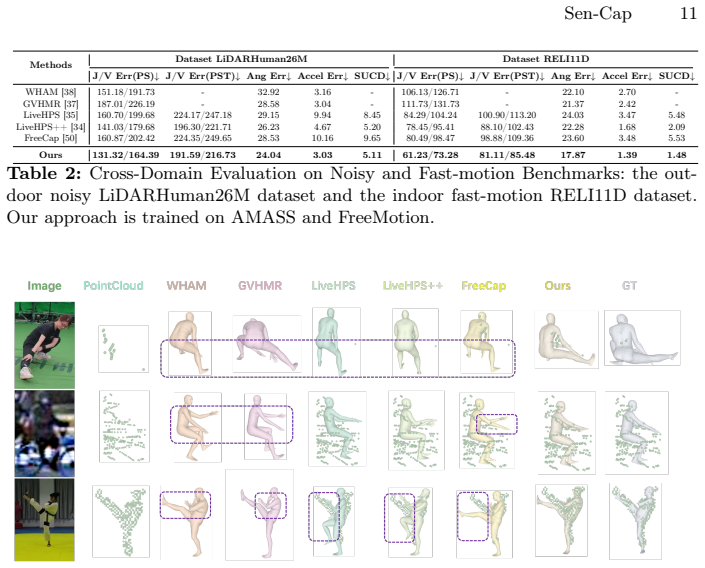
- [Table 2] The cross-domain evaluation does not state the training/evaluation protocol for the baselines. The caption says only that 'our approach is trained on AMASS and FreeMotion.' If WHAM, GVHMR, LiveHPS++, FreeCap, etc. are evaluated with different training data or with fine-tuning, the comparison is not apples-to-apples; if they are evaluated zero-shot, that should be stated explicitly. Without this, the 'strong cross-domain performance' claim is difficult to assess.
minor comments (6)
- [General] No error bars or repeated-run statistics are reported anywhere. Several differences in Tables 1-4 and Fig. 5 are small (e.g., Ang Err differences of about 1 degree). A single run is insufficient to establish that these differences are not noise; adding standard errors or significance tests would strengthen the empirical claims.
- [§3.1, Eq. (2)] The notation mixes τ_i (a rotation vector used in Eq. (1)) with τ^6d_i (a 6D rotation representation). Clarify the relationship between these quantities and how the 6D representation is supervised.
- [§4.5, Table 3] The NTT iteration count N is a free parameter, and the main text should state explicitly how N=3 was chosen beyond 'favorable balance.' Also, the table shows that repeat×4 and repeat×5 give further improvements; please report the computational cost of each setting.
- [Fig. 5] The legend 'Specialized (XC+YL)' uses X and Y without definition in the caption. Define what 'specialized' means and how the specialized models were trained.
- [§3.1] The 2D input alignment is described only as 'encoding the 2D keypoints into a human-centric feature space via the 2D Encoder.' It is unclear whether there is an explicit loss enforcing human-centric consistency for the camera branch, or whether the 2D branch is simply trained end-to-end through the downstream pose loss.
- [Abstract and §4.1] The abstract claims real-time operation, but no inference time or runtime comparison is reported. Please provide a runtime number or remove the claim.
Circularity Check
No circular derivation: UAME and NTT are supervised modules trained on ground-truth SMPL labels and evaluated on external benchmarks; the calibration-free generalization gap is an empirical-support issue, not a circular reduction.
full rationale
The paper's derivation chain is supervised learning from ground-truth labels, not a self-referential fit. Eq. (1) defines human-centric alignment via a predicted rotation R(τ_i)^{-1}, and Eq. (2) trains that GRU against ground-truth sensor-to-human rotations and joint coordinates; the later pose loss (Eq. 5) and trajectory loss (Eq. 7) are likewise supervised by ground-truth SMPL pose/shape and global translation. None of these predictions reduces by construction to a fitted constant: the GRU must generalize from point-cloud/2D-keypoint inputs to rotations, and NTT's iterative offsets are trained against residuals from GT, with evaluation on held-out benchmarks (Human-M3, FreeMotion, LiDARHuman26M, RELI11D) that provide external falsifiability. The overlapping-author citations (FreeCap, LiveHPS++) supply a matching subroutine and preprocessing choices, but the central claims—human-centric alignment, bottleneck fusion, and iterative trajectory refinement—are independently ablated and benchmarked. The noticeable weakness is evidential rather than circular: the rotation-only alignment of Eq. (1) is under-specified with respect to translation, and no experiment directly varies unseen LiDAR extrinsics, so the 'arbitrary deployment' claim is not fully demonstrated. That is a generalization/correctness concern, not a case where the output is equivalent to the input by definition. Score 0: no significant circularity.
Assumptions & free parameters
free parameters (7)
- NTT iteration count N =
3 (main results; 4-5 slightly better in Table 3)
- Trajectory penalty weight lambda_1
- Step-size penalty threshold delta
- Shape-term weight alpha in L_pose
- Sensor dropout masking rate
- LiDAR points per frame (FPS) =
256
- Synthetic noise levels L1/L2/L3 =
object sizes 0.1-0.5 m / 0.5-1 m
assumptions (7)
- domain assumption Calibrated training labels with per-sensor ground-truth rotations
- domain assumption GRU rotation predictor generalizes to unseen sensor extrinsics
- domain assumption Rotation-only alignment suffices (translation handled implicitly)
- domain assumption Upstream 2D keypoint detector with bounded error
- domain assumption SMPL parameterization adequacy
- domain assumption Iterative refinement converges
- domain assumption FreeCap-style matching + memory bank handles multi-person association
invented entities (2)
-
Learnable bottleneck fusion token F_token
independent evidence
-
Matching memory bank
Cite this review
Pith. "Pith review of Sen-Cap: Sensor-Flexible and Noise-Resilient Human Motion Capture via LiDAR-Camera Integration." pith.science (2026). https://pith.science/paper/67SKMAV6
@misc{pith2026260802285,
  author       = {Pith},
  title        = {Pith review of: Sen-Cap: Sensor-Flexible and Noise-Resilient Human Motion Capture via LiDAR-Camera Integration},
  year         = {2026},
  howpublished = {\url{https://pith.science/paper/67SKMAV6}},
  note         = {Machine review of arXiv:2608.02285}
}
read the original abstract
We propose Sen-Cap, a Sensor-Flexible and Noise-Resilient 3D human motion Capture framework that integrates multi-modal data from LiDAR and camera. While multi-modal sensors provide richer information than single-modal sensors, existing approaches still suffer from two core challenges. First, multi-modal alignment/matching across arbitrarily deployed sensors is typically handled by explicit calibration, which propagates errors under changing viewpoints and in turn constrains deployment to fixed, highly overlapped layouts. Second, prior methods degrade under severe noise or partial sensor failures, which are common in real-world environments. To address these challenges, Sen-Cap introduces a Unified Across-Sensor Motion Estimator that reconstructs local pose and shape in a human-centric space without calibrations between sensors, supporting a flexible number of sensors, as well as a Noise-Resistant Trajectory Tracker that maintains robustness under severe point cloud noise through iterative refinement. These sensor-flexible and noise-resilient features make Sen-Cap more practical in real-world deployment. Notably, operating in real time, Sen-Cap achieves state-of-the-art performance on major metrics on Human-M3 and FreeMotion, as well as strong cross-domain performance on LiDARHuman26M and RELI11D. This combination of flexibility and robustness opens new opportunities for motion capture in real-world scenarios, e.g. sports analytics, field robotics, and large-scale immersive environments.
Figures


Figures from the paper (2 more)


Reference graph
Works this paper leans on
-
[1]
In: GCPR
Alldieck, T., Kassubeck, M., Wandt, B., Rosenhahn, B., Magnor, M.: Optical flow- based 3d human motion estimation from monocular video. In: GCPR. pp. 347–360. Springer (2017)
2017
-
[2]
In: 2017 12th IEEE International Conference on Automatic Face & Gesture Recognition (FG 2017)
Belagiannis, V., Zisserman, A.: Recurrent human pose estimation. In: 2017 12th IEEE International Conference on Automatic Face & Gesture Recognition (FG 2017). pp. 468–475 (2017).https://doi.org/10.1109/FG.2017.64
-
[3]
Pervasive and Mobile Computing14, Pages–414 (2017)
Betancourt, A., Díaz-Rodríguez, N., Barakova, E., Marcenaro, L., Rauterberg, M., Regazzoni, C.: Unsupervised understanding of location and illumination changes in egocentric videos. Pervasive and Mobile Computing14, Pages–414 (2017)
2017
-
[4]
arXiv preprint arXiv:2308.14492 (2023)
Cai, Z., Pan, L., Wei, C., Yin, W., Hong, F., Zhang, M., Loy, C.C., Yang, L., Liu, Z.: Pointhps: Cascaded 3d human pose and shape estimation from point clouds. arXiv preprint arXiv:2308.14492 (2023)
arXiv 2023
-
[5]
In: CVPR
Cao, C., Zhang, Y., Wu, Y., Lu, H., Cheng, J.: Egocentric gesture recognition using recurrent 3d convolutional neural networks with spatiotemporal transformer modules. In: CVPR. pp. 3763–3771 (2017)
2017
-
[6]
In: CVPR
Charles, J., Pfister, T., Magee, D., Hogg, D., Zisserman, A.: Personalizing human video pose estimation. In: CVPR. pp. 3063–3072 (2016)
2016
-
[7]
ACM Trans
Dou, M., Davidson, P., Fanello, S.R., Khamis, S., Kowdle, A., Rhemann, C., Tankovich, V., Izadi, S.: Motion2fusion: Real-time volumetric performance cap- ture. ACM Trans. Graph.36(6), 246:1–246:16 (Nov 2017)
2017
-
[8]
mpi - inf
EgoCap: EgoCap dataset.http : / / gvv . mpi - inf . mpg . de / projects / EgoCap/ (2016), accessed 28 Jun 2026
2016
Show all 57 references
-
[9]
arXiv preprint arXiv:2308.00628 (2023)
Fan, B., Wang, S., Guo, W., Zheng, W., Feng, J., Zhou, J.: Human-m3: A multi- view multi-modal dataset for 3d human pose estimation in outdoor scenes. arXiv preprint arXiv:2308.00628 (2023)
2023 arXiv
-
[10]
arXiv preprint arXiv:2311.11971 (2023)
Fan, B., Zheng, W., Feng, J., Zhou, J.: Lidar-hmr: 3d human mesh recovery from lidar. arXiv preprint arXiv:2311.11971 (2023)
2023
-
[11]
In: International Confer- ence on Computer Vision (ICCV) (2023)
Goel, S., Pavlakos, G., Rajasegaran, J., Kanazawa*, A., Malik*, J.: Humans in 4D: Reconstructing and tracking humans with transformers. In: International Confer- ence on Computer Vision (ICCV) (2023)
2023
-
[12]
ACM Transactions on Graphics (TOG)37(6), 1–15 (2018)
Huang, Y., Kaufmann, M., Aksan, E., Black, M.J., Hilliges, O., Pons-Moll, G.: Deep inertial poser: Learning to reconstruct human pose from sparse inertial mea- surements in real time. ACM Transactions on Graphics (TOG)37(6), 1–15 (2018)
2018
-
[13]
In: ECCV (September 2018)
Huang, Z., Li, T., Chen, W., Zhao, Y., Xing, J., LeGendre, C., Luo, L., Ma, C., Li, H.: Deep volumetric video from very sparse multi-view performance capture. In: ECCV (September 2018)
2018
-
[14]
arXiv preprint arXiv:2309.09314 (2023)
Jang, D.K., Yang, D., Jang, D.Y., Choi, B., Jin, T., Lee, S.H.: Movin: Real-time motion capture using a single lidar. arXiv preprint arXiv:2309.09314 (2023)
2023 arXiv
-
[15]
In: 2017 IEEE Conference on Computer Vision and Pattern Recog- nition (CVPR)
Jiang, H., Grauman, K.: Seeing invisible poses: Estimating 3d body pose from ego- centric video. In: 2017 IEEE Conference on Computer Vision and Pattern Recog- nition (CVPR). pp. 3501–3509 (2017).https://doi.org/10.1109/CVPR.2017.373
2017 doi
-
[16]
arXiv preprint arXiv:2303.07399 (2023)
Jiang, T., Lu, P., Zhang, L., Ma, N., Han, R., Lyu, C., Li, Y., Chen, K.: Rtm- pose: Real-time multi-person pose estimation based on mmpose. arXiv preprint arXiv:2303.07399 (2023)
2023 arXiv
-
[17]
In: CVPR (2018)
Kanazawa, A., Black, M.J., Jacobs, D.W., Malik, J.: End-to-end recovery of human shape and pose. In: CVPR (2018)
2018
-
[18]
In: ICCV
Kaufmann, M., Zhao, Y., Tang, C., Tao, L., Twigg, C., Song, J., Wang, R., Hilliges, O.: Em-pose: 3d human pose estimation from sparse electromagnetic trackers. In: ICCV. pp. 11510–11520 (2021) Sen-Cap 17
2021
-
[19]
IRAL4(2), 1940– 1947 (2019)
Kim, W., Ramanagopal, M.S., Barto, C., Yu, M.Y., Rosaen, K., Goumas, N., Vasudevan, R., Johnson-Roberson, M.: Pedx: Benchmark dataset for metric 3-d pose estimation of pedestrians in complex urban intersections. IRAL4(2), 1940– 1947 (2019)
1940
-
[20]
arXiv preprint arXiv:2203.14698 (2022)
Li, J., Zhang, J., Wang, Z., Shen, S., Wen, C., Ma, Y., Xu, L., Yu, J., Wang, C.: Lidarcap: Long-range marker-less 3d human motion capture with lidar point clouds. arXiv preprint arXiv:2203.14698 (2022)
2022 arXiv
-
[21]
In: Proceedings of the IEEE/CVF International Conference on Computer Vision
Li,J., Cao,J., Zhang, H., Rempe, D.,Kautz, J., Iqbal, U.,Yuan,Y.: Genmo: Agen- eralist model for human motion. In: Proceedings of the IEEE/CVF International Conference on Computer Vision. pp. 11766–11776 (2025)
2025
-
[22]
ACM Trans
Loper, M., Mahmood, N., Romero, J., Pons-Moll, G., Black, M.J.: Smpl: A skinned multi-person linear model. ACM Trans. Graph.34(6), 248:1–248:16 (Oct 2015)
2015
-
[23]
ACM Transactions on Graphics, (Proc
Loper, M.M., Mahmood, N., Black, M.J.: MoSh: Motion and shape capture from sparse markers. ACM Transactions on Graphics, (Proc. SIGGRAPH Asia)33(6), 220:1–220:13 (Nov 2014).https://doi.org/10.1145/2661229.2661273
2014
-
[24]
In: ICCV (October 2019)
Mahmood, N., Ghorbani, N., Troje, N.F., Pons-Moll, G., Black, M.J.: Amass: Archive of motion capture as surface shapes. In: ICCV (October 2019)
2019
-
[25]
Malleson, C., Collomosse, J., Hilton, A.: Real-time multi-person motion capture from multi-view video and imus. IJCV pp. 1–18 (2019)
2019
-
[26]
In: 3DV (2017).https://doi.org/10.1109/3dv.2017.00064
Mehta, D., Rhodin, H., Casas, D., Fua, P., Sotnychenko, O., Xu, W., Theobalt, C.: Monocular 3d human pose estimation in the wild using improved cnn supervision. In: 3DV (2017).https://doi.org/10.1109/3dv.2017.00064
2017
-
[27]
Mehta, D., Rhodin, H., Casas, D., Fua, P., Sotnychenko, O., Xu, W., Theobalt, C.: Monocular 3d human pose estimation in the wild using improved cnn supervision. In: 3DV. pp. 506–516. IEEE (2017)
2017
-
[28]
OptiTrack Motion Capture Systems.https://www.optitrack.com/(2009), ac- cessed 28 Jun 2026
2009
-
[29]
ACM Trans
Park, S.I., Hodgins, J.K.: Data-driven modeling of skin and muscle deformation. ACM Trans. Graph.27(3), 1–6 (Aug 2008).https://doi.org/10.1145/1360612. 1360695
2008 doi
-
[30]
In: CVPR (Jun 2014).https://doi.org/10.1109/CVPR.2014.300
Pons-Moll, G., Fleet, D.J., Rosenhahn, B.: Posebits for monocular human pose estimation. In: CVPR (Jun 2014).https://doi.org/10.1109/CVPR.2014.300
2014 doi
-
[31]
Qiu, H., Wang, C., Wang, J., Wang, N., Zeng, W.: Cross view fusion for 3d human poseestimation.In:2019IEEE/CVFInternationalConferenceonComputerVision (ICCV). pp. 4341–4350 (2019).https://doi.org/10.1109/ICCV.2019.00444
2019
-
[32]
In: Proceedings of the IEEE/CVF Con- ference on Computer Vision and Pattern Recognition
Rajasegaran, J., Pavlakos, G., Kanazawa, A., Malik, J.: Tracking people by pre- dicting 3d appearance, location and pose. In: Proceedings of the IEEE/CVF Con- ference on Computer Vision and Pattern Recognition. pp. 2740–2749 (2022)
2022
-
[33]
ACM Trans
Raskar, R., Nii, H., deDecker, B., Hashimoto, Y., Summet, J., Moore, D., Zhao, Y., Westhues, J., Dietz, P., Barnwell, J., Nayar, S., Inami, M., Bekaert, P., Noland, M., Branzoi, V., Bruns, E.: Prakash: lighting aware motion capture using photosensing markers and multiplexed il...
2007
-
[34]
ArXivabs/2407.09833 (2024)
Ren, Y., Han, X., Yao, Y., Long, X., Sun, Y., Ma, Y.: Livehps++: Robust and coherent motion capture in dynamic free environment. ArXivabs/2407.09833 (2024)
2024 arXiv
-
[35]
arXiv preprint arXiv:2402.17171 (2024) 18 Xue and Sun, A
Ren, Y., Han, X., Zhao, C., Wang, J., Xu, L., Yu, J., Ma, Y.: Livehps: Lidar-based scene-level human pose and shape estimation in free environment. arXiv preprint arXiv:2402.17171 (2024) 18 Xue and Sun, A. et al
2024 arXiv
-
[36]
TVCG (2023)
Ren, Y., Zhao, C., He, Y., Cong, P., Liang, H., Yu, J., Xu, L., Ma, Y.: Lidar- aid inertial poser: Large-scale human motion capture by sparse inertial and lidar sensors. TVCG (2023)
2023
-
[37]
In: SIGGRAPH Asia Conference Proceedings (2024)
Shen,Z.,Pi,H.,Xia,Y.,Cen,Z.,Peng,S.,Hu,Z.,Bao,H.,Hu,R.,Zhou,X.:World- grounded human motion recovery via gravity-view coordinates. In: SIGGRAPH Asia Conference Proceedings (2024)
2024
-
[38]
In: IEEE/CVF Conf
Shin, S., Kim, J., Halilaj, E., Black, M.J.: WHAM: Reconstructing world-grounded humans with accurate 3D motion. In: IEEE/CVF Conf. on Computer Vision and Pattern Recognition (CVPR) (Jun 2024)
2024
-
[39]
PLOS ONE11(3) (03 2016)
Song, M.H., Godøy, R.I.: How fast is your body motion? determining a sufficient frame rate for an optical motion tracking system using passive markers. PLOS ONE11(3) (03 2016)
2016
-
[40]
In: IEEE/CVF Conf
Sun, Y., Bao, Q., Liu, W., Mei, T., Black, M.J.: TRACE: 5D Temporal Regression of Avatars with Dynamic Cameras in 3D Environments. In: IEEE/CVF Conf. on Computer Vision and Pattern Recognition (CVPR) (June 2023)
2023
-
[41]
In: Proceedings of the computer vision and pattern recognition conference
Wang, Y., Sun, Y., Patel, P., Daniilidis, K., Black, M.J., Kocabas, M.: Prompthmr: Promptable human mesh recovery. In: Proceedings of the computer vision and pattern recognition conference. pp. 1148–1159 (2025)
2025
-
[42]
arXiv preprint arXiv:2403.17346 (2024)
Wang, Y., Wang, Z., Liu, L., Daniilidis, K.: Tram: Global trajectory and motion of 3d humans from in-the-wild videos. arXiv preprint arXiv:2403.17346 (2024)
2024 arXiv
-
[43]
IEEE Sensors Journal 24(9), 15531–15539 (2024).https://doi.org/10.1109/JSEN.2024.3373192
Wu, X., Zhang, H., Kong, C., Wang, Y., Ju, Y., Zhao, C.: Lidar-based 3-d human pose estimation and action recognition for medical scenes. IEEE Sensors Journal 24(9), 15531–15539 (2024).https://doi.org/10.1109/JSEN.2024.3373192
2024
-
[44]
In: 2024 IEEE International Conference on Robotics and Au- tomation (ICRA)
Xin, S., Zhang, Z., Wang, M., Hou, X., Guo, Y., Kang, X., Liu, L., Liu, Y.: Multi- modal 3d human tracking for robots in complex environment with siamese point- video transformer. In: 2024 IEEE International Conference on Robotics and Au- tomation (ICRA). pp. 337–344 (2024).ht...
2024
-
[45]
TPAMI pp
Xu, L., Su, Z., Han, L., Yu, T., Liu, Y., FANG, L.: Unstructuredfusion: Realtime 4d geometry and texture reconstruction using commercialrgbd cameras. TPAMI pp. 1–1 (2019)
2019
-
[46]
In: CVPR (June 2020)
Xu, L., Xu, W., Golyanik, V., Habermann, M., Fang, L., Theobalt, C.: Eventcap: Monocular 3d capture of high-speed human motions using an event camera. In: CVPR (June 2020)
2020
-
[47]
In: 2018 3rd International Conference on Advanced Robotics and Mechatronics (ICARM)
Xu, W., Li, X., Xu, W., Gong, L., Huang, Y., Zhao, Z., Zhao, L., Chen, B., Yang, H., Cao, L., Liu, C.: Human-robot interaction oriented human-in-the-loop real-time motion imitation on a humanoid tri-co robot. In: 2018 3rd International Conference on Advanced Robotics and Mecha...
2018
-
[48]
In: Proceedings of the IEEE/CVF International Conference on Computer Vision
Xu, Y., Cong, P., Yao, Y., Chen, R., Hou, Y., Zhu, X., He, X., Yu, J., Ma, Y.: Human-centric scene understanding for 3d large-scale scenarios. In: Proceedings of the IEEE/CVF International Conference on Computer Vision. pp. 20349–20359 (2023)
2023
-
[49]
In: Advances in Neural Information Processing Systems (2022)
Xu,Y.,Zhang,J.,Zhang,Q.,Tao,D.:ViTPose:Simplevisiontransformerbaselines for human pose estimation. In: Advances in Neural Information Processing Systems (2022)
2022
-
[50]
v39i9.32977 Sen-Cap 19
Xue, A., Ren,Y., Song,Z., Ye, M., Zhu, X.,Ma, Y.:Freecap:hybridcalibration-free motion capture in open environments (2025).https://doi.org/10.1609/aaai. v39i9.32977 Sen-Cap 19
2025 doi
-
[51]
In: Proceedings of the IEEE/CVF Conference on Computer Vision and Pattern Recognition (CVPR)
Yan, M., Zhang, Y., Cai, S., Fan, S., Lin, X., Dai, Y., Shen, S., Wen, C., Xu, L., Ma, Y., Wang, C.: Reli11d: A comprehensive multimodal human motion dataset and method. In: Proceedings of the IEEE/CVF Conference on Computer Vision and Pattern Recognition (CVPR). pp. 2250–2262...
2024
-
[52]
In: IEEE Conference on Computer Vision and Pattern Recognition (CVPR) (June 2023)
Ye, V., Pavlakos, G., Malik, J., Kanazawa, A.: Decoupling human and camera motion from videos in the wild. In: IEEE Conference on Computer Vision and Pattern Recognition (CVPR) (June 2023)
2023
-
[53]
In: CVPR (June 2022)
Yi, X., Zhou, Y., Habermann, M., Shimada, S., Golyanik, V., Theobalt, C., Xu, F.: Physical inertial poser (pip): Physics-aware real-time human motion tracking from sparse inertial sensors. In: CVPR (June 2022)
2022
-
[54]
ACM Transactions on Graphics (TOG)40(4), 1–13 (2021)
Yi, X., Zhou, Y., Xu, F.: Transpose: Real-time 3d human translation and pose estimation with six inertial sensors. ACM Transactions on Graphics (TOG)40(4), 1–13 (2021)
2021
-
[55]
In: Proceedings of the IEEE/CVF Conference on Computer Vision and Pattern Recognition (CVPR) (2022)
Yuan, Y., Iqbal, U., Molchanov, P., Kitani, K., Kautz, J.: Glamr: Global occlusion- aware human mesh recovery with dynamic cameras. In: Proceedings of the IEEE/CVF Conference on Computer Vision and Pattern Recognition (CVPR) (2022)
2022
-
[56]
In: ECCV (Sept 2018)
Zheng, Z., Yu, T., Li, H., Guo, K., Dai, Q., Fang, L., Liu, Y.: Hybridfusion: Real- time performance capture using a single depth sensor and sparse imus. In: ECCV (Sept 2018)
2018
-
[57]
2019 IEEE/CVF Conference on Computer Vision and Pattern Recognition (CVPR) pp
Zhou, Y., Barnes, C., Lu, J., Yang, J., Li, H.: On the continuity of rotation rep- resentations in neural networks. 2019 IEEE/CVF Conference on Computer Vision and Pattern Recognition (CVPR) pp. 5738–5746 (2018)
2019
Reviewed August 4, 2026 · model on record in the stance chip above.
Discussion (0). Sign in to comment.