REVIEW 4 major objections 3 minor 120 references
TRACE: Ergodic Trajectory Optimization for Active Scene Reconstruction
T0 review · 4 major / 3 minor · reviewed 2026-08-07 · deepseek-v4-flash
Pith's one-line read Ergodic trajectory optimization lifts active 3D reconstruction quality by 1.5 dB PSNR, and the resulting paths run directly on physical robots.
desk verdict Solid integration of ergodic search into active GS reconstruction with honest ablations, but missing variance and a map-ablation leaves the central mechanism only partially supported. read the letter →
The pith
A machine-rendered reading of the paper's core claim, the machinery that carries it, and where it could break.
The reading
What carries the argument
The load-bearing machinery is a differentiable, horizon-level trajectory objective $J_t(u_t)$ (Eq. 7) whose core is the depletion-aware kernel-ergodic metric $E_{\mathrm{dep}}^{\mathrm{kernel}}$ (Eqs. 3 and 6): the first term rewards placing waypoints where the time-discounted information map $\phi_t^k$ is high, and the second term spreads waypoints out with a pairwise Gaussian repulsion. That metric acts on an information map $\phi_t$ (Eq. 2) built online at each horizon from voxel classes—unexplored, frontier, unbuilt, and low-confidence-Gaussian voxels—then box-filtered and masked to collision-free space so the volume the sensor body can occupy carries the information mass that actually lives on surfaces. Footprint-overlap depletion (Eqs. 3–4) discounts already-covered surface samples within the horizon, and a gaze reward (Eq. 5) aims the camera at high-information surfaces while the position stays governed by the ergodic metric. All terms are differentiable in the control sequence, which is optimized by Adam with a warm start from the previous horizon.
What would settle it
On the eight Replica scenes, run TRACE with the information map of Eq. (2) replaced by a uniform distribution over the same free-space mask (all weights equal), keeping every other parameter fixed; if the PSNR gain over ActiveGS persists, the claim that map-guided dwell time drives the improvement is falsified.
Extended reading notes
Core claim
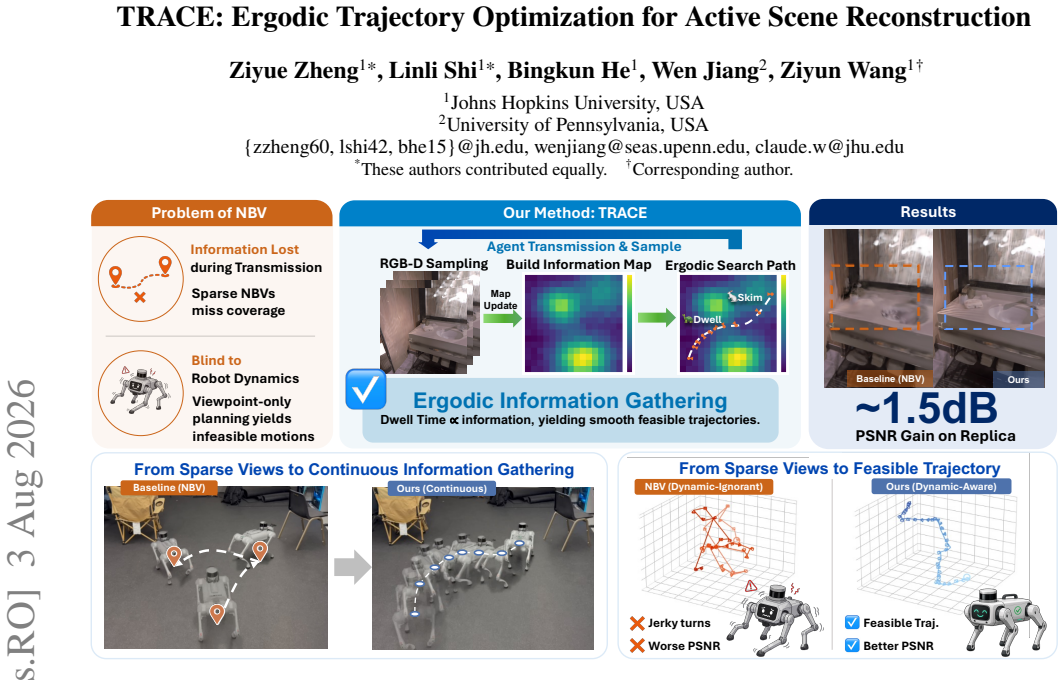
The paper's central claim is that active 3D reconstruction with Gaussian-splatting maps is better posed as an ergodic coverage problem than as a sequence of next-best-view selections: instead of committing to the most informative discrete viewpoint and routing between such views, the agent should optimize a continuous trajectory whose time-averaged spatial statistics match a target information distribution. TRACE derives that distribution online from the current 2DGS map and voxel map, using a weighted sum of unexplored, frontier, unbuilt, and low-confidence regions (Eq. 2), then projects it into traversable free space by diffusion and masking. The trajectory is obtained by gradient-descent optimization of a kernel-ergodic objective with a footprint-overlap depletion term that suppresses re-coverage within the horizon and a gaze reward that orients the camera at under-covered surfaces. Under a matched mapper, budget, and evaluation protocol on eight Replica scenes, the author reports a mean +1.5 dB PSNR improvement over the ActiveGS NBV baseline, with better SSIM and LPIPS on every scene, and trajectories that execute directly on a Unitree Go2 and a Franka FR3 without an intermediate path planner.
Load-bearing premise
The load-bearing premise is that the online information map of Eq. (2), after diffusion and masking, faithfully ranks where new observations will most improve reconstruction quality; if that ranking is wrong, the ergodic trajectory will dwell in the wrong places and the PSNR gain will not transfer to other scenes or settings.
Editorial extensions
If this is right
- Under the same mapper, sensor, and time budget, trajectory-level ergodic planning beats greedy NBV on eight Replica scenes by 1.5 dB average PSNR, with SSIM and LPIPS improving on every scene.
- Because the planned trajectory is the optimization variable, the output is dynamically feasible by construction and can be sent directly to a robot controller, eliminating the separate path-planner step of NBV pipelines.
- Simply adding more observations along the NBV path—random or uniform interpolation—does not close the gap to TRACE, so the gain comes from where the trajectory dwells, not from sheer frame count.
- The footprint-depletion mechanism is necessary: without it, the kernel-ergodic version loses 2.1 dB and falls below the NBV baseline on six of eight scenes, whereas with it the planner deliberately re-visits under-confident surfaces.
- The same objective transfers to joint-space planning on a manipulator, where forward kinematics map the information map into the joint trajectory, keeping every planned view reachable.
Reading between the lines
- A natural next test is whether the hand-crafted weights in Eq. (2) are near-optimal: replacing them with a learned map trained to predict per-voxel reduction in reconstruction error could either improve the PSNR gain or reveal a ceiling set by the ergodic objective itself.
- The direct-execution result suggests that the information loss between discrete viewpoints, not just viewpoint selection, is a major source of inefficiency in NBV pipelines; the same ergodic objective could be applied to TSDF or NeRF mappers by substituting their uncertainty proxies.
- The depletion mechanism is local to the current horizon; a persistent coverage memory across horizons might extend the approach to long-horizon missions where the map updates alone are too slow to suppress re-coverage.
- One could also test whether ergodic trajectories generalize across scenes and robots without retuning: the paper reports weights but not their values, so the sensitivity of the 1.5 dB gain to $\alpha_u, \alpha_f, \alpha_b, \beta$ is an open empirical question.
Signed reviews
Editorial analysis
A structured set of objections, weighed in public.
Referee Report
Summary. TRACE replaces greedy next-best-view selection in active 2D Gaussian-splatting reconstruction with ergodic trajectory optimization. The method builds an online target information distribution phi_t from per-Gaussian rendering confidence, frontier/unexplored/unbuilt voxel states, and a low-confidence gate (Eq. 2); it then optimizes a kernel-ergodic horizon cost with footprint-overlap depletion and a gaze reward (Eqs. 3-7). The paper reports +1.5 dB average PSNR over ActiveGS on eight Replica scenes, ablations showing the footprint mechanism is worth 2.1 dB and that densifying the baseline's sampling does not close the gap, and direct trajectory execution on a Unitree Go2 and Franka FR3 without an intermediate path planner.
Significance. If the claims hold, the paper makes a useful contribution: it moves active reconstruction from discrete viewpoint selection to trajectory-level ergodic optimization, and the ablation in Table 2 gives concrete evidence that footprint depletion matters (2.1 dB) and that the gain is not explained by sampling density. The real-robot demonstrations, while somewhat under-quantified, indicate a practical payoff of trajectory-level planning. The main technical risk is the unvalidated information map: phi_t is the sole bridge from map state to trajectory objective, yet the paper never tests whether its ranking of informative regions actually reduces reconstruction error. The reader's stress-test concern lands on this point, and it is the main reason the paper needs revision.
major comments (4)
- [§3.2, Eq. (2); §4.4] The information map phi_t is never ablated. Table 2 removes the footprint-depletion mechanism and densifies the baseline's sampling, but no experiment replaces phi_t with a uniform target, drops the low-confidence gate 1_low(v), or varies the weights (alpha_u, alpha_f, alpha_b, beta). Because ActiveGS also uses per-Gaussian confidence and frontier signals, the +1.5 dB PSNR gain cannot be attributed to phi_t's specific ranking of informative regions; it could instead be carried by footprint depletion, continuous-pose optimization, or the gaze reward. The paper should validate that high-phi voxels are the voxels whose observation reduces reconstruction error, and it must report the parameter values (alpha_u, alpha_f, alpha_b, beta, eta, sigma_fp, sigma, lambda_g, lambda_s, lambda_r, kappa, D, depth samples, box-filter width, well-built threshold). This is load-bearing for the central causal story.
- [Table 1, §4.1] The table reports PSNR, SSIM, and LPIPS averaged over five independent runs but gives no standard deviations or confidence intervals. Several per-scene PSNR gains are under 1 dB (e.g., Of4: 34.92 vs 34.08; R0: 31.55 vs 29.93). Without variance, the reader cannot judge whether the mean +1.5 dB advantage and the per-scene gains are statistically significant. Please report error bars or paired per-run comparisons.
- [Table 1, §4.1] NARUTO and FisherRF numbers are cited from Jin et al. (2025) rather than re-run under the same mapper, budget, and evaluation protocol. Since ActiveGS is the central baseline this is not fatal, but the text should clearly distinguish re-run results from cited results and state that the NARUTO/FisherRF comparison inherits the original protocol. This matters for the claim that ActiveGS is the strongest NBV baseline.
- [§4.5 and supplementary Table 3] The main text asserts a 100% success rate and that every planned waypoint is dynamically consistent, but the quantitative collision-free evidence in the supplementary is a simulation result on the FR3 (Table 3), not a hardware measurement, and the real Go2 deployment is described qualitatively for a single 42 m^2 scene. Please clarify what was measured on the physical platforms (tracking error, contact detection, reconstruction metrics, number of executed horizons/trials) and separate simulated collision counts from real-robot observations. Also, the Go2 planner uses single-integrator motion, so 'dynamically consistent by construction' is stronger than what the model actually enforces.
minor comments (3)
- [Figure 2 caption] The labels 'H' and 'L' in the left panel are not defined in the caption; please define them as high- and low-information regions.
- [§3.2, Eq. (2)] The 'well-built' threshold used in 1_low(v) is never specified, so the low-confidence gate is not reproducible. Please give the criterion or the threshold value.
- [References and formatting] Several references have broken line breaks (e.g., the ActiveNeRF entry) and the table captions use inconsistent highlighting descriptions; please clean these up at revision.
Circularity Check
No significant circularity: the central PSNR claim is measured externally, not derived from Eq. (2); the only self-citation is contrastive and not load-bearing.
full rationale
TRACE does not contain any step in which a fitted parameter is renamed as a prediction or in which an equation is defined in terms of its own output. The target information distribution φ_t (Eq. 2) is built from per-Gaussian confidence and voxel states; it is an input to the ergodic objective (Eqs. 6–7), not a quantity fit to the evaluation metric. The reported +1.5 dB PSNR gain is computed on a fixed set of 1000 test viewpoints after the full missions, so it is external evidence rather than a consequence of optimizing that metric. The ablations compare against ActiveGS and variants; even the kernel-ergodic baseline uses the independently published metric of Sun et al. (2025), and the claim that with matched diffusion width the objective becomes exactly that published metric is a mathematical equivalence, not a self-imported uniqueness theorem. The only self-referential element is a contrastive mention of Zheng et al. (2025) to clarify that the footprint enters via depletion rather than as a kernel replacement; that citation does not carry the derivation of the method or the benchmark result. Concerns about whether φ_t faithfully ranks informative regions, and about unreported weights in Eq. (2), are empirical validation gaps and reproducibility risks, not circularity: even a wrong information map would still be an input, and a PSNR benchmark could falsify it. No load-bearing reduction exists, so the score is 1 due solely to the minor, non-load-bearing self-citation.
Assumptions & free parameters
free parameters (9)
- alpha_u, alpha_f, alpha_b, beta (information map weights) =
not reported
- eta (per-visit discount rate) =
not reported
- sigma_fp (footprint overlap bandwidth) =
not reported
- sigma (kernel bandwidth in ergodic metric) =
not reported
- lambda_g, lambda_s, lambda_r (cost weights) =
not reported
- kappa (footprint occlusion attenuation) =
not reported
- D and depth samples {d_1...d_D} =
not reported
- box filter width for information map diffusion =
not reported
- well-built threshold for 1_low(v) =
not reported
assumptions (8)
- domain assumption The kernel-ergodic metric (Sun et al. 2025) drives trajectory time-averaged statistics to match a target distribution, and this improves information gathering.
- domain assumption The information map from Eq. (2), after diffusion and masking, is a valid proxy for expected information gain.
- domain assumption Box-filter diffusion plus masking projects surface information into free space without losing the ranking of informative regions.
- domain assumption The sensor footprint model (D depth samples along the optical axis) and overlap kernel capture co-visibility and re-coverage.
- domain assumption Single-integrator dynamics plus soft penalties is an adequate model of the Go2's and FR3's feasibility.
- ad hoc to paper Adam converges to a good local optimum of the nonconvex cost Eq. (7) in 40 iterations per horizon.
- ad hoc to paper The per-Gaussian rendering confidence gamma_g inherited from ActiveGS is a reliable uncertainty measure.
- standard math Basic calculus and optimization: gradients of Eq. (7) are computable via autodiff and Adam converges.
Cite this review
Pith. "Pith review of TRACE: Ergodic Trajectory Optimization for Active Scene Reconstruction." pith.science (2026). https://pith.science/paper/N2QU3ZFA
@misc{pith2026260802304,
  author       = {Pith},
  title        = {Pith review of: TRACE: Ergodic Trajectory Optimization for Active Scene Reconstruction},
  year         = {2026},
  howpublished = {\url{https://pith.science/paper/N2QU3ZFA}},
  note         = {Machine review of arXiv:2608.02304}
}
read the original abstract
Existing active reconstruction systems with Gaussian-splatting maps select observations greedily, optimizing a single next-best-view (NBV) at each step and connecting the chosen views by short-horizon path planning. This greedy decoupling disregards the global structure of scene information, producing inefficient trajectories that waste sensing capacity in transit between selected views. In this work, we study active reconstruction as an ergodic coverage problem: the time-averaged spatial statistics of the sensor trajectory should match a target information distribution induced by the current map. Our approach derives this target distribution online from uncertainty and visibility, and calculates ergodic trajectories via a kernel-ergodic horizon planner with gradient flow and footprint depletion, closing the loop between mapping and trajectory optimization. We thoroughly evaluate TRACE on the Replica dataset against the Next-Best-View (NBV) baselines, improving PSNR by 1.5 dB. Code: https://github.com/spikelab-jhu/trace-active-reconstruction.
Figures


Figures from the paper (4 more)


Reference graph
Works this paper leans on
-
[1]
Gauss's Theoria Motus , Year =
Theory of the motion of the heavenly bodies moving about the sun in conic sections , Author =. Gauss's Theoria Motus , Year =
-
[2]
Joseph-Louis Lagrange , publisher =. M
-
[3]
ActiveGAMER: Active GAussian Mapping through Efficient Rendering , year=
Chen, Liyan and Zhan, Huangying and Chen, Kevin and Xu, Xiangyu and Yan, Qingan and Cai, Changjiang and Xu, Yi , booktitle=. ActiveGAMER: Active GAussian Mapping through Efficient Rendering , year=
-
[4]
, booktitle=
Connolly, C. , booktitle=. The determination of next best views , year=
-
[5]
An information gain formulation for active volumetric 3D reconstruction , year=
Isler, Stefan and Sabzevari, Reza and Delmerico, Jeffrey and Scaramuzza, Davide , booktitle=. An information gain formulation for active volumetric 3D reconstruction , year=
-
[6]
2018 , eprint=
Active Object Reconstruction Using a Guided View Planner , author=. 2018 , eprint=
2018
-
[7]
View planning in robot active vision: A survey of systems, algorithms, and applications , year=
Zeng, Rui and Wen, Yuhui and Zhao, Wang and Liu, Yong-Jin , journal=. View planning in robot active vision: A survey of systems, algorithms, and applications , year=
-
[8]
ActiveSplat: High-Fidelity Scene Reconstruction Through Active Gaussian Splatting , volume=
Li, Yuetao and Kuang, Zijia and Li, Ting and Hao, Qun and Yan, Zike and Zhou, Guyue and Zhang, Shaohui , year=. ActiveSplat: High-Fidelity Scene Reconstruction Through Active Gaussian Splatting , volume=. IEEE Robotics and Automation Letters , publisher=. doi:10.1109/lra.2025.3580331 , number=
Show all 120 references
-
[9]
2011 , author =
Metrics for ergodicity and design of ergodic dynamics for multi-agent systems , journal =. 2011 , author =
2011
-
[10]
and Silverman, Yonatan and MacIver, Malcolm A
Miller, Lauren M. and Silverman, Yonatan and MacIver, Malcolm A. and Murphey, Todd D. , journal=. Ergodic Exploration of Distributed Information , year=
-
[11]
2025 , eprint=
Ergodic Trajectory Planning with Dynamic Sensor Footprints , author=. 2025 , eprint=
2025
-
[12]
The International Journal of Robotics Research , pages=
Time-optimal ergodic search: Multiscale coverage in minimum time , author=. The International Journal of Robotics Research , pages=. 2024 , publisher=
2024
-
[13]
2017 , eprint=
Ergodic Coverage In Constrained Environments Using Stochastic Trajectory Optimization , author=. 2017 , eprint=
2017
-
[14]
Fast Ergodic Search With Kernel Functions , year=
Sun, Max Muchen and Gaggar, Ayush and Trautman, Pete and Murphey, Todd , journal=. Fast Ergodic Search With Kernel Functions , year=
-
[15]
2017 , eprint=
Adam: A Method for Stochastic Optimization , author=. 2017 , eprint=
2017
-
[16]
Proceedings of Robotics: Science and Systems , year =
Liu, Yongce and Ren, Zhongqiang , title =. Proceedings of Robotics: Science and Systems , year =
-
[17]
Robotics and Autonomous Systems , volume=
Adaptive path planning for UAVs for multi-resolution semantic segmentation , author=. Robotics and Autonomous Systems , volume=. 2023 , publisher=
2023
-
[18]
2015 IEEE international conference on robotics and automation (ICRA) , pages=
Fractal trajectories for online non-uniform aerial coverage , author=. 2015 IEEE international conference on robotics and automation (ICRA) , pages=. 2015 , organization=
2015
-
[19]
2012 IEEE/RSJ International Conference on Intelligent Robots and Systems , pages=
Efficient seabed coverage path planning for ASVs and AUVs , author=. 2012 IEEE/RSJ International Conference on Intelligent Robots and Systems , pages=. 2012 , organization=
2012
-
[20]
and Murphy, R.R
Casper, J. and Murphy, R.R. , journal=. Human-robot interactions during the robot-assisted urban search and rescue response at the World Trade Center , year=
-
[21]
Enhanced multi-objective
Ren, Zhongqiang and Zhan, Richard and Rathinam, Sivakumar and Likhachev, Maxim and Choset, Howie , booktitle=. Enhanced multi-objective
-
[22]
Multi-Objective Safe-Interval Path Planning With Dynamic Obstacles , year=
Ren, Zhongqiang and Rathinam, Sivakumar and Likhachev, Maxim and Choset, Howie , journal=. Multi-Objective Safe-Interval Path Planning With Dynamic Obstacles , year=
-
[23]
A Conflict-Based Search Framework for Multiobjective Multiagent Path Finding , year=
Ren, Zhongqiang and Rathinam, Sivakumar and Choset, Howie , journal=. A Conflict-Based Search Framework for Multiobjective Multiagent Path Finding , year=
-
[24]
Multi-Objective Path-Based
Ren, Zhongqiang and Rathinam, Sivakumar and Likhachev, Maxim and Choset, Howie , journal=. Multi-Objective Path-Based. 2022 , publisher=
2022
-
[25]
2021 IEEE International Conference on Robotics and Automation (ICRA) , pages=
Multi-objective conflict-based search for multi-agent path finding , author=. 2021 IEEE International Conference on Robotics and Automation (ICRA) , pages=. 2021 , organization=
2021
-
[26]
2021 IEEE International Conference on Robotics and Automation (ICRA) , pages=
Ergodic imitation: Learning from what to do and what not to do , author=. 2021 IEEE International Conference on Robotics and Automation (ICRA) , pages=. 2021 , organization=
2021
-
[27]
2019 IEEE 27th International Symposium on Modeling, Analysis, and Simulation of Computer and Telecommunication Systems (MASCOTS) , pages=
Practical design space exploration , author=. 2019 IEEE 27th International Symposium on Modeling, Analysis, and Simulation of Computer and Telecommunication Systems (MASCOTS) , pages=. 2019 , organization=
2019
-
[28]
IEEE Robotics and Automation Letters , volume=
Coverage control for multirobot teams with heterogeneous sensing capabilities , author=. IEEE Robotics and Automation Letters , volume=. 2018 , publisher=
2018
-
[29]
Algorithmic foundation of robotics VIII , pages=
Simultaneous coverage and tracking (SCAT) of moving targets with robot networks , author=. Algorithmic foundation of robotics VIII , pages=. 2009 , publisher=
2009
-
[30]
2013 American Control Conference , pages=
Trajectory optimization for continuous ergodic exploration , author=. 2013 American Control Conference , pages=. 2013 , organization=
2013
-
[31]
Twenty-Seventh International Conference on Automated Planning and Scheduling , year=
Multi-agent ergodic coverage with obstacle avoidance , author=. Twenty-Seventh International Conference on Automated Planning and Scheduling , year=
-
[32]
IEEE Transactions on Automation Science and Engineering , year=
An ergodic measure for active learning from equilibrium , author=. IEEE Transactions on Automation Science and Engineering , year=
-
[33]
IEEE Robotics and Automation Letters , volume=
Decentralized ergodic control: distribution-driven sensing and exploration for multiagent systems , author=. IEEE Robotics and Automation Letters , volume=. 2018 , publisher=
2018
-
[34]
IEEE Transactions on Robotics , volume=
Real-time area coverage and target localization using receding-horizon ergodic exploration , author=. IEEE Transactions on Robotics , volume=. 2017 , publisher=
2017
-
[35]
Journal of Intelligent & Robotic Systems , volume=
Robotic urban search and rescue: A survey from the control perspective , author=. Journal of Intelligent & Robotic Systems , volume=. 2013 , publisher=
2013
-
[36]
Journal of Field Robotics , volume=
A multirobot system for distributed area coverage and signal searching in large outdoor scenarios , author=. Journal of Field Robotics , volume=. 2016 , publisher=
2016
-
[37]
The international journal of robotics research , volume=
Morse decompositions for coverage tasks , author=. The international journal of robotics research , volume=. 2002 , publisher=
2002
-
[38]
The International Journal of Robotics Research , volume=
Decentralized, adaptive coverage control for networked robots , author=. The International Journal of Robotics Research , volume=. 2009 , publisher=
2009
-
[39]
The International Journal of Robotics Research , volume=
Distributed robotic sensor networks: An information-theoretic approach , author=. The International Journal of Robotics Research , volume=. 2012 , publisher=
2012
-
[40]
Proceedings of Robotics: Science and Systems , YEAR =
Weizhe Chen AND Lantao Liu , TITLE =. Proceedings of Robotics: Science and Systems , YEAR =
-
[41]
2018 Annual American Control Conference (ACC) , pages=
Receding-horizon multi-objective optimization for disaster response , author=. 2018 Annual American Control Conference (ACC) , pages=. 2018 , organization=
2018
-
[42]
IEEE transactions on evolutionary computation , volume=
A fast and elitist multiobjective genetic algorithm: NSGA-II , author=. IEEE transactions on evolutionary computation , volume=. 2002 , publisher=
2002
-
[43]
Natural computing , volume=
A tutorial on multiobjective optimization: fundamentals and evolutionary methods , author=. Natural computing , volume=. 2018 , publisher=
2018
-
[44]
ACM Computing Surveys (CSUR) , volume=
Many-objective evolutionary algorithms: A survey , author=. ACM Computing Surveys (CSUR) , volume=. 2015 , publisher=
2015
-
[45]
IEEE Transactions on evolutionary computation , volume=
MOEA/D: A multiobjective evolutionary algorithm based on decomposition , author=. IEEE Transactions on evolutionary computation , volume=. 2007 , publisher=
2007
-
[46]
2005 , publisher=
Multicriteria optimization , author=. 2005 , publisher=
2005
-
[47]
Subdimensional Expansion for Multi-Objective Multi-Agent Path Finding , year=
Ren, Zhongqiang and Rathinam, Sivakumar and Choset, Howie , journal=. Subdimensional Expansion for Multi-Objective Multi-Agent Path Finding , year=
-
[48]
2013 IEEE International Conference on Robotics and Automation , pages=
Expensive multiobjective optimization for robotics , author=. 2013 IEEE International Conference on Robotics and Automation , pages=. 2013 , organization=
2013
-
[49]
Journal of Artificial Intelligence Research , volume=
A survey of multi-objective sequential decision-making , author=. Journal of Artificial Intelligence Research , volume=
-
[50]
IEEE Access , title=
J. IEEE Access , title=. 2020 , volume=
2020
-
[51]
2017 IEEE/RSJ International Conference on Intelligent Robots and Systems (IROS) , pages=
Deformed state lattice planning , author=. 2017 IEEE/RSJ International Conference on Intelligent Robots and Systems (IROS) , pages=. 2017 , organization=
2017
-
[52]
Ergodic Exploration Using Tensor Train: Applications in Insertion Tasks , year=
Shetty, Suhan and Silvério, João and Calinon, Sylvain , journal=. Ergodic Exploration Using Tensor Train: Applications in Insertion Tasks , year=
-
[53]
IEEE transactions on cybernetics , volume=
Ergodicity-based cooperative multiagent area coverage via a potential field , author=. IEEE transactions on cybernetics , volume=. 2016 , publisher=
2016
-
[54]
arXiv preprint arXiv:2410.10599 , year=
Ergodic Trajectory Optimization on Generalized Domains Using Maximum Mean Discrepancy , author=. arXiv preprint arXiv:2410.10599 , year=
-
[55]
2023 IEEE/RSJ International Conference on Intelligent Robots and Systems (IROS) , pages=
Multi-Objective Sparse Sensing with Ergodic Optimization , author=. 2023 IEEE/RSJ International Conference on Intelligent Robots and Systems (IROS) , pages=. 2023 , organization=
2023
-
[56]
Science robotics , volume=
Robot operating system 2: Design, architecture, and uses in the wild , author=. Science robotics , volume=. 2022 , publisher=
2022
-
[57]
CrazySim: A Software-in-the-Loop Simulator for the Crazyflie Nano Quadrotor , author=. Int. Conf. Rob. Aut , year=
-
[58]
Crazyflie 2.0 quadrotor as a platform for research and education in robotics and control engineering , year=
Giernacki, Wojciech and Skwierczyński, Mateusz and Witwicki, Wojciech and Wroński, Paweł and Kozierski, Piotr , booktitle=. Crazyflie 2.0 quadrotor as a platform for research and education in robotics and control engineering , year=
-
[59]
IEEE Robotics and Automation Letters , volume=
C-opt: Coverage-aware trajectory optimization under uncertainty , author=. IEEE Robotics and Automation Letters , volume=. 2016 , publisher=
2016
-
[60]
IEEE Transactions on Robotics , volume=
A pareto-optimal local optimization framework for multiobjective ergodic search , author=. IEEE Transactions on Robotics , volume=. 2023 , publisher=
2023
-
[61]
International Journal of Aerospace Engineering , volume=
An efficient energy constraint based UAV path planning for search and coverage , author=. International Journal of Aerospace Engineering , volume=. 2017 , publisher=
2017
-
[62]
IEEE Robotics and Automation Letters , volume=
Viewpoint evaluation for online 3-D active object classification , author=. IEEE Robotics and Automation Letters , volume=. 2015 , publisher=
2015
-
[63]
IEEE Robotics and Automation Letters , volume=
Trajectory optimization using learned robot-terrain interaction model in exploration of large subterranean environments , author=. IEEE Robotics and Automation Letters , volume=. 2022 , publisher=
2022
-
[64]
2021 IEEE International Conference on Robotics and Automation (ICRA) , pages=
Team assignment for heterogeneous multi-robot sensor coverage through graph representation learning , author=. 2021 IEEE International Conference on Robotics and Automation (ICRA) , pages=. 2021 , organization=
2021
-
[65]
Sensors , volume=
Improving SLAM techniques with integrated multi-sensor fusion for 3D reconstruction , author=. Sensors , volume=. 2024 , publisher=
2024
-
[66]
2024 IEEE International Conference on Robotics and Automation (ICRA) , pages=
Sensor-based Multi-Robot Coverage Control with Spatial Separation in Unstructured Environments , author=. 2024 IEEE International Conference on Robotics and Automation (ICRA) , pages=. 2024 , organization=
2024
-
[67]
2021 IEEE/RSJ International Conference on Intelligent Robots and Systems (IROS) , pages=
Overlap displacement error: Are your SLAM poses map-consistent? , author=. 2021 IEEE/RSJ International Conference on Intelligent Robots and Systems (IROS) , pages=. 2021 , organization=
2021
-
[68]
2019 International Conference on Robotics and Automation (ICRA) , pages=
Search-based 3d planning and trajectory optimization for safe micro aerial vehicle flight under sensor visibility constraints , author=. 2019 International Conference on Robotics and Automation (ICRA) , pages=. 2019 , organization=
2019
-
[69]
2021 IEEE/AIAA 40th Digital Avionics Systems Conference (DASC) , pages=
Enhancing Detection Performance through Sensor Model-based Trajectory Optimization for UAVs , author=. 2021 IEEE/AIAA 40th Digital Avionics Systems Conference (DASC) , pages=. 2021 , organization=
2021
-
[70]
IEEE Transactions on Robotics , volume=
Motion planning for multitarget surveillance with mobile sensor agents , author=. IEEE Transactions on Robotics , volume=. 2005 , publisher=
2005
-
[71]
2022 International Conference on Robotics and Automation (ICRA) , pages=
Multi-agent dynamic ergodic search with low-information sensors , author=. 2022 International Conference on Robotics and Automation (ICRA) , pages=. 2022 , organization=
2022
-
[72]
2017 IEEE International Conference on Robotics and Automation (ICRA) , pages=
Crazyswarm: A large nano-quadcopter swarm , author=. 2017 IEEE International Conference on Robotics and Automation (ICRA) , pages=. 2017 , organization=
2017
-
[73]
arXiv preprint arXiv:1608.05786 , year=
Design of a trajectory tracking controller for a nanoquadcopter , author=. arXiv preprint arXiv:1608.05786 , year=
-
[74]
Control Engineering Practice , volume=
Multi-robot exploration under the constraints of wireless networking , author=. Control Engineering Practice , volume=. 2007 , publisher=
2007
-
[75]
2016 American Control Conference (ACC) , pages=
Ergodic exploration with stochastic sensor dynamics , author=. 2016 American Control Conference (ACC) , pages=. 2016 , organization=
2016
-
[76]
IEEE Robotics and Automation Letters , volume=
Whole-body ergodic exploration with a manipulator using diffusion , author=. IEEE Robotics and Automation Letters , volume=. 2023 , publisher=
2023
-
[77]
arXiv preprint arXiv:2402.04862 , year=
Tactile Ergodic Control Using Diffusion and Geometric Algebra , author=. arXiv preprint arXiv:2402.04862 , year=
-
[78]
arXiv preprint arXiv:2503.05026 , year=
Ergodic Exploration over Meshable Surfaces , author=. arXiv preprint arXiv:2503.05026 , year=
-
[79]
2018 , publisher=
Mathematical theory of optimal processes , author=. 2018 , publisher=
2018
-
[80]
2019 IEEE/RSJ International Conference on Intelligent Robots and Systems (IROS) , pages=
ALTRO: A fast solver for constrained trajectory optimization , author=. 2019 IEEE/RSJ International Conference on Intelligent Robots and Systems (IROS) , pages=. 2019 , organization=
2019
-
[81]
Automation in Construction , volume=
Multi-UAV trajectory planning for 3D visual inspection of complex structures , author=. Automation in Construction , volume=. 2023 , publisher=
2023
-
[82]
, author=
Minimization of functions having Lipschitz continuous first partial derivatives. , author=. Pacific Journal of Mathematics , year=
-
[83]
2018 , month =
Hadi Salman , title =. 2018 , month =
2018
-
[84]
and Tancik, Matthew and Barron, Jonathan T
Mildenhall, Ben and Srinivasan, Pratul P. and Tancik, Matthew and Barron, Jonathan T. and Ramamoorthi, Ravi and Ng, Ren , booktitle =. 2020 , publisher =
2020
-
[85]
and Mildenhall, Ben and Verbin, Dor and Srinivasan, Pratul P
Barron, Jonathan T. and Mildenhall, Ben and Verbin, Dor and Srinivasan, Pratul P. and Hedman, Peter , booktitle =
-
[86]
ACM Transactions on Graphics , volume =
Instant Neural Graphics Primitives with a Multiresolution Hash Encoding , author =. ACM Transactions on Graphics , volume =. 2022 , doi =
2022
-
[87]
Proceedings of the IEEE/CVF Conference on Computer Vision and Pattern Recognition (CVPR) , pages =
Plenoxels: Radiance Fields Without Neural Networks , author =. Proceedings of the IEEE/CVF Conference on Computer Vision and Pattern Recognition (CVPR) , pages =
-
[88]
2022 , publisher =
Chen, Anpei and Xu, Zexiang and Geiger, Andreas and Yu, Jingyi and Su, Hao , booktitle =. 2022 , publisher =
2022
-
[89]
ACM Transactions on Graphics , volume =
Kerbl, Bernhard and Kopanas, Georgios and Leimk. ACM Transactions on Graphics , volume =. 2023 , doi =
2023
-
[90]
2024 , publisher =
Huang, Binbin and Yu, Zehao and Chen, Anpei and Geiger, Andreas and Gao, Shenghua , booktitle =. 2024 , publisher =
2024
-
[91]
ACM Computing Surveys , volume =
View Planning for Automated Three-Dimensional Object Reconstruction and Inspection , author =. ACM Computing Surveys , volume =. 2003 , doi =
2003
-
[92]
IEEE Transactions on Pattern Analysis and Machine Intelligence , volume =
A Solution to the Next Best View Problem for Automated Surface Acquisition , author =. IEEE Transactions on Pattern Analysis and Machine Intelligence , volume =. 1999 , doi =
1999
-
[93]
Proceedings of the IEEE International Symposium on Computational Intelligence in Robotics and Automation (CIRA) , pages =
A Frontier-Based Approach for Autonomous Exploration , author =. Proceedings of the IEEE International Symposium on Computational Intelligence in Robotics and Automation (CIRA) , pages =. 1997 , publisher =
1997
-
[94]
and Bennewitz, Maren and Stachniss, Cyrill and Burgard, Wolfram , journal =
Hornung, Armin and Wurm, Kai M. and Bennewitz, Maren and Stachniss, Cyrill and Burgard, Wolfram , journal =. 2013 , doi =
2013
-
[95]
The International Journal of Robotics Research , volume =
Sampling-Based Robotic Information Gathering Algorithms , author =. The International Journal of Robotics Research , volume =. 2014 , doi =
2014
-
[96]
Receding Horizon ``Next-Best-View'' Planner for
Bircher, Andreas and Kamel, Mina and Alexis, Kostas and Oleynikova, Helen and Siegwart, Roland , booktitle =. Receding Horizon ``Next-Best-View'' Planner for. 2016 , publisher =
2016
-
[97]
and Isler, Stefan and Sabzevari, Reza and Scaramuzza, Davide , journal =
Delmerico, Jeffrey A. and Isler, Stefan and Sabzevari, Reza and Scaramuzza, Davide , journal =. A Comparison of Volumetric Information Gain Metrics for Active. 2018 , doi =
2018
-
[98]
ACM Transactions on Graphics , volume =
Hepp, Benjamin and Nie. ACM Transactions on Graphics , volume =. 2018 , doi =
2018
-
[99]
and Patten, Timothy and Mettu, Ramgopal R
Best, Graeme and Cliff, Oliver M. and Patten, Timothy and Mettu, Ramgopal R. and Fitch, Robert , journal =. 2019 , doi =
2019
-
[100]
2022 , publisher =
Pan, Xuran and Lai, Zihang and Song, Shiji and Huang, Gao , booktitle =. 2022 , publisher =
2022
-
[101]
IEEE Robotics and Automation Letters , volume =
Active Implicit Object Reconstruction Using Uncertainty-Guided Next-Best-View Optimization , author =. IEEE Robotics and Automation Letters , volume =. 2023 , doi =
2023
-
[102]
Proceedings of the IEEE/CVF Conference on Computer Vision and Pattern Recognition (CVPR) , pages =
Neural Visibility Field for Uncertainty-Driven Active Mapping , author =. Proceedings of the IEEE/CVF Conference on Computer Vision and Pattern Recognition (CVPR) , pages =
-
[103]
2024 , publisher =
Jiang, Wen and Lei, Boshu and Daniilidis, Kostas , booktitle =. 2024 , publisher =
2024
-
[104]
Feng, Ziyue and Zhan, Huangying and Chen, Zheng and Yan, Qingan and Xu, Xiangyu and Cai, Changjiang and Li, Bing and Zhu, Qilun and Xu, Yi , booktitle =
-
[105]
2024 , doi =
Chen, Xiao and Li, Quanyi and Wang, Tai and Xue, Tianfan and Pang, Jiangmiao , booktitle =. 2024 , doi =
2024
-
[106]
IEEE Robotics and Automation Letters , volume =
Jin, Liren and Zhong, Xingguang and Pan, Yue and Behley, Jens and Stachniss, Cyrill and Popovi. IEEE Robotics and Automation Letters , volume =. 2025 , doi =
2025
-
[107]
2025 , address =
Xie, Yuhan and Cai, Yixi and Zhang, Yinqiang and Yang, Lei and Pan, Jia , booktitle =. 2025 , address =
2025
-
[108]
2025 , eprint=
Flow Matching Ergodic Coverage , author=. 2025 , eprint=
2025
-
[109]
and Bennewitz, Maren and Stachniss, Cyrill and Burgard, Wolfram , journal=
Hornung, Armin and Wurm, Kai M. and Bennewitz, Maren and Stachniss, Cyrill and Burgard, Wolfram , journal=
-
[110]
and Mur-Artal, Raul and Ren, Carl and Verma, Shobhit and others , journal=
Straub, Julian and Whelan, Thomas and Ma, Lingni and Chen, Yufan and Wijmans, Erik and Green, Simon and Engel, Jakob J. and Mur-Artal, Raul and Ren, Carl and Verma, Shobhit and others , journal=. The
-
[111]
Savva, Manolis and Kadian, Abhishek and Maksymets, Oleksandr and Zhao, Yili and Wijmans, Erik and Jain, Bhavana and Straub, Julian and Liu, Jia and Koltun, Vladlen and Malik, Jitendra and Parikh, Devi and Batra, Dhruv , booktitle=
-
[112]
Proceedings of the AAAI Conference on Artificial Intelligence , volume=
Active3D: Active High-Fidelity 3D Reconstruction via Multi-Level Uncertainty Quantification , author=. Proceedings of the AAAI Conference on Artificial Intelligence , volume=
-
[113]
Advances in Neural Information Processing Systems (NeurIPS) , year =
SCONE: Surface Coverage Optimization in Unknown Environments by Volumetric Integration , author =. Advances in Neural Information Processing Systems (NeurIPS) , year =
-
[114]
IEEE/RSJ International Conference on Intelligent Robots and Systems (IROS) , year =
NeU-NBV: Next Best View Planning Using Uncertainty Estimation in Image-Based Neural Rendering , author =. IEEE/RSJ International Conference on Intelligent Robots and Systems (IROS) , year =
-
[115]
POp-GS: Next Best View in 3D-Gaussian Splatting with P-Optimality , year=
Wilson, Joey and Almeida, Marcelino and Mahajan, Sachit and Labrie, Martin and Ghaffari, Maani and Ghasemalizadeh, Omid and Sun, Min and Kuo, Cheng-Hao and Sen, Arnab , booktitle=. POp-GS: Next Best View in 3D-Gaussian Splatting with P-Optimality , year=
-
[116]
Conference on Robot Learning (CoRL) , year =
Affordance-Driven Next-Best-View Planning for Robotic Grasping , author =. Conference on Robot Learning (CoRL) , year =
-
[117]
IEEE/CVF International Conference on Computer Vision (ICCV) , year =
Active Neural Mapping , author =. IEEE/CVF International Conference on Computer Vision (ICCV) , year =
-
[118]
International Conference on Learning Representations (ICLR) , year =
Learning to Explore using Active Neural SLAM , author =. International Conference on Learning Representations (ICLR) , year =
-
[119]
FrontierNet: Learning Visual Cues to Explore , year=
Sun, Boyang and Chen, Hanzhi and Leutenegger, Stefan and Cadena, Cesar and Pollefeys, Marc and Blum, Hermann , journal=. FrontierNet: Learning Visual Cues to Explore , year=
-
[120]
and Hsu, Christopher D
Siming, H. and Hsu, Christopher D. and Ong, Dexter and Shao, Yifei Simon and Chaudhari, Pratik , booktitle=. Active Perception using Neural Radiance Fields , year=
Reviewed August 7, 2026 · model on record in the stance chip above.
Discussion (0). Continue with ORCID to comment.