REVIEW 3 major objections 4 minor 24 references
Synthesis and structural validation of close-to-stoichiometric NiTe$_2$ single crystals
T0 review · 3 major / 4 minor · reviewed 2026-08-04 · deepseek-v4-flash
Pith's one-line read Single-crystal X-ray diffraction finds no detectable interstitial nickel in NiTe2, confirming a close-to-stoichiometric composition.
desk verdict Plausible and useful structural benchmark, but the inconsistent reflection counts in Table 1 mean the 'no interstitial Ni' claim needs a careful second look before it's cited as definitive. read the letter →
The pith
A machine-rendered reading of the paper's core claim, the machinery that carries it, and where it could break.
The reading
What carries the argument
The argument rests on single-crystal X-ray diffraction with a multiscan absorption correction, followed by least-squares refinement of atomic coordinates and occupancies against F^2. The decisive step is a second refinement in which an interstitial nickel atom is placed at (0,0,1/2); the occupancy converges to -0.001(5), which the authors read as the absence of excess nickel. This site-specific test is what carries the stoichiometry claim.
What would settle it
A neutron diffraction or resonant X-ray scattering experiment on a large NiTe2 crystal that resolves a statistically significant interstitial nickel occupancy (or a Ni1 occupancy below 0.98) would contradict the close-to-stoichiometric claim. Alternatively, a careful refinement that scans all plausible interstitial positions—not just (0,0,1/2)—and finds a site with occupancy above a few percent would serve as a falsifier.
Extended reading notes
Core claim
The central finding is that close-to-stoichiometric NiTe2 single crystals can be synthesized, and high-resolution single-crystal XRD refinement shows no evidence of interstitial nickel. The nickel site occupancy is 0.988(9), and when an interstitial nickel atom is introduced at the previously suggested (0,0,1/2) position, its occupancy refines to -0.001(5), i.e., no detectable occupation. The authors interpret this as direct evidence for a stoichiometric composition within experimental uncertainty, establishing a reference crystal structure for future studies.
Load-bearing premise
The claim depends on the assumption that the single-crystal X-ray refinement yields unbiased occupancies for the nickel sites after the multiscan absorption correction, despite a goodness-of-fit of 2.50, a data completeness of 84.77%, and the fact that only one interstitial site was tested.
Editorial extensions
If this is right
- The refined lattice parameters and atomic coordinates become a benchmark for future experimental and theoretical work on NiTe2.
- The absence of interstitial nickel implies that physical properties measured on such crystals—such as the reported 261 mK intrinsic superconductivity—are not caused by nickel excess or deficiency.
- The demonstration that stoichiometric NiTe2 can be grown removes a long-standing doubt about the existence of the stoichiometric compound.
- The refined Te positional parameter, z(Te) = 0.25156(3), offers a precise comparison point for band-structure and topological calculations.
Reading between the lines
- The EDX composition of Ni0.93(4)Te2, which appears nickel-deficient, highlights how much less accurate EDX is than single-crystal diffraction; composition claims for this material based on EDX alone should be treated cautiously.
- The refinement only probes one specific interstitial site; a full difference-Fourier map or a search over other plausible interstitial positions would further strengthen the claim that no excess nickel exists anywhere.
- If independent methods confirm the stoichiometric structure, future theoretical models of NiTe2's electronic structure can be anchored to these measured coordinates rather than to non-stoichiometric variants.
Editorial analysis
A structured set of objections, weighed in public.
Referee Report
Summary. The paper reports the synthesis of NiTe2 single crystals by chemical vapor transport and their structural characterization by powder and single-crystal X-ray diffraction. Rietveld refinement of powder data gives lattice parameters a = 3.85543(13) Å, c = 5.26708(18) Å. Single-crystal refinement yields a Ni1 site occupancy of 0.988(9) and an interstitial Ni2 occupancy of -0.001(5) at (0,0,1/2), from which the authors conclude that the crystals are close-to-stoichiometric and that there is no evidence of interstitial nickel. The paper claims to establish a reliable structural benchmark for stoichiometric NiTe2.
Significance. If the structural refinement is reliable, the paper provides a useful data point in a literature where detailed single-crystal studies are scarce and prior reports describe 3–8% interstitial Ni. The combined powder/single-crystal analysis is appropriate, and the explicit test of the (0,0,1/2) interstitial site directly addresses the long-standing stoichiometry question. The value of the contribution lies mainly in the experimental benchmark. However, the central claim depends entirely on the credibility of the single-crystal refinement, and the manuscript contains internal inconsistencies and quality indicators that currently preclude full confidence. The paper does not ship code or machine-checkable artifacts, but the diffraction data and refinement table are available for scrutiny; a corrected, internally consistent table would make the claim verifiable.
major comments (3)
- [Table 1] The reflection counts are internally inconsistent. The table lists 'Reflections in total / independent 256 / 256' and, two rows later, 'Observed reflections / independent 2825 / 2825' with redundancy 11. If the independent set is 256, the total observed should be approximately 256×11 ≈ 2800, which matches the 2825 only if the second row's 'independent' is a typo for 'observed' (or vice versa). If the independent set is actually 2825, the stated index ranges (h: -8→7, k: -7→8, l: -11→11) and trigonal symmetry make that implausible. This inconsistency undermines the reliability of Rint, the goodness-of-fit, and the e.s.d.'s on the Ni1 and Ni2 occupancies, which are the direct evidence for the close-to-stoichiometric conclusion. The authors must correct the counts, explain the merging, and re-evaluate whether the reported uncertainties are trustworthy.
- [Table 1 / §3] The goodness-of-fit of 2.50 is unusually high for a well-described structure with only a few refined parameters (Ni1 occupancy, interstitial occupancy, z(Te1), and displacement parameters). A GooF this large indicates either an incorrect weighting scheme, an inadequate absorption correction, or unmodeled systematic errors. Since the central claim rests on the occupancy value and its e.s.d., the authors should demonstrate that the e.s.d.'s are not underestimated, for example by comparing refinements with alternative absorption corrections, by performing a high-angle/low-angle consistency check, or by refining a standard reflection set. Without this, the reported uncertainty on the interstitial occupancy (-0.001(5)) cannot be taken at face value.
- [§3, Table 1] The conclusion 'no evidence of interstitial nickel' is stronger than what the refinement actually tests. Only a single interstitial site at (0,0,1/2) was examined. The abstract's claim of 'no evidence of interstitial nickel' is therefore overbroad; other possible interstitial positions (e.g., tetrahedral or other octahedral voids) were not tested, and a difference Fourier map is not presented. The authors should either restrict the claim to 'no detectable occupancy at the (0,0,1/2) site' or provide difference Fourier maps covering the full unit cell to substantiate the absence of interstitial Ni. Additionally, the refined occupancy of -0.001(5) is unphysical; it should be constrained to non-negative values or fixed at zero, and the resulting change in R-factors should be reported.
minor comments (4)
- [Fig. 2] The label 'Br agg peak' should be 'Bragg peak'.
- [§2 / caption Table 1] There is a missing space: 'Janawas' should be 'Jana was'.
- [Throughout] The manuscript has several typographical inconsistencies (e.g., '2Θ' vs '2θ', 'NiTe 2' with inconsistent spacing). A careful proofread is suggested.
- [§3] The paper reports an EDX composition of Ni0.93(4)Te2 but immediately cautions against its accuracy. This is appropriate but could be more explicit: EDX is not a reliable quantitative probe for such small deviations, and the sentence as written may confuse readers. Consider stating the EDX result as indicative only and not used in the stoichiometry determination.
Circularity Check
No circularity: the occupancy conclusions are direct refinements of measured single-crystal XRD intensities, with no parameter imported from prior work forcing the result.
full rationale
The paper's central claims—Ni1 occupancy 0.988(9) and interstitial Ni2 occupancy -0.001(5)—are obtained by least-squares refinement against measured single-crystal X-ray diffraction intensities. These are fitted outputs, not predictions derived from the conclusions themselves. The only structurally loaded input is the choice of the interstitial site (0,0,1/2), which is explicitly justified by reference [20], an external prior crystallographic study, not by the authors' own work. Refining that site and obtaining zero occupancy is a falsifiable measurement outcome, not a circular step. References to prior studies are contextual (lattice parameters, physical properties, previous non-stoichiometric refinements) and are not used to force the present result. The high goodness-of-fit (2.50) and the internally inconsistent reflection-count entries in Table 1 are legitimate concerns about data quality and uncertainty estimation, but they are correctness risks, not circularity. The conclusion follows from the experiment as reported, and no equation in the paper reduces to its own input. Therefore the circularity score is 0.
Assumptions & free parameters
free parameters (4)
- Ni1 site occupancy =
0.988(9)
- Interstitial Ni2 occupancy =
-0.001(5)
- z(Te1) positional parameter =
0.25156(3)
- Lattice parameters a, c =
a=3.85543(13) Å, c=5.26708(18) Å
assumptions (4)
- domain assumption The crystal structure adopts space group P-3m1 (No. 164) with Ni at (0,0,0) and Te at (1/3,2/3,z).
- standard math Kinematic X-ray diffraction theory and tabulated atomic scattering factors apply.
- domain assumption The multiscan absorption correction (SADABS) adequately models systematic errors.
- domain assumption The small single crystal measured is representative of the entire batch.
Cite this review
Pith. "Pith review of Synthesis and structural validation of close-to-stoichiometric NiTe$_2$ single crystals." pith.science (2026). https://pith.science/paper/LVXOOBOZ
@misc{pith2026260802334,
  author       = {Pith},
  title        = {Pith review of: Synthesis and structural validation of close-to-stoichiometric NiTe$_2$ single crystals},
  year         = {2026},
  howpublished = {\url{https://pith.science/paper/LVXOOBOZ}},
  note         = {Machine review of arXiv:2608.02334}
}
abstract
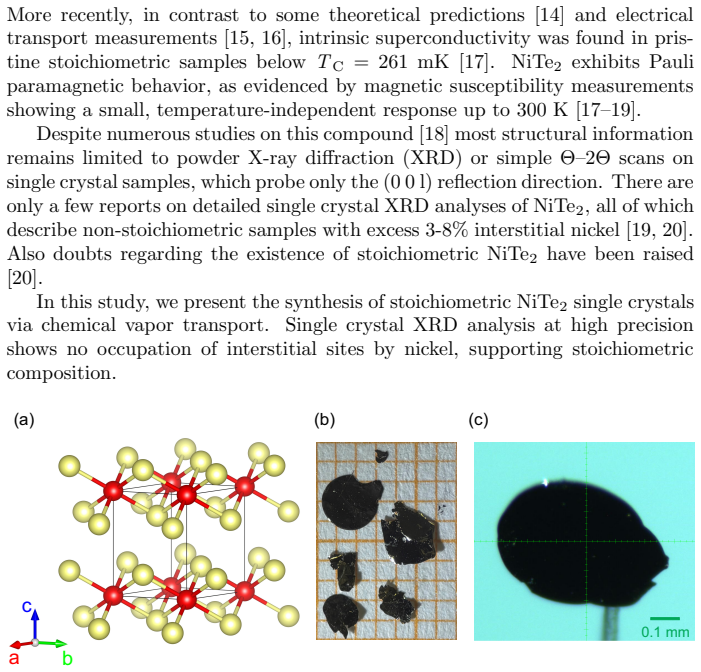
We report the synthesis of stoichiometric NiTe$_{2}$ single crystals via chemical vapor transport together with precise structural characterization. A combined analysis using powder X-ray diffraction (XRD) and single crystal XRD was performed to determine lattice parameters and structural details. High-resolution single crystal XRD reveals no evidence of interstitial nickel, confirming a close-to-stoichiometric composition. This work establishes a reliable benchmark for the crystal structure of stoichiometric NiTe$_{2}$, offering a reference for future studies on its physical properties.
Figures


Reference graph
Works this paper leans on
-
[1]
Q. H. Wang, K. Kalantar-Zadeh, A. Kis, J. N. Coleman, and M. S. Strano, Nature Nanotechnology7, 699 (2012)
2012
-
[2]
A. Kuc, T. Heine, and A. Kis, MRS Bulletin40, 577 (2015)
2015
-
[3]
Manzeli, D
S. Manzeli, D. Ovchinnikov, D. Pasquier, O. V. Yazyev, and A. Kis, Nature Reviews Materials2, 17033 (2017)
2017
-
[4]
Fujisawa, M
Y. Fujisawa, M. Pardo-Almanza, J. Garland, K. Yamagami, X. Zhu, X. Chen, K. Araki, T. Takeda, M. Kobayashi, Y. Takeda, C. H. Hsu, F. C. Chuang, R. Laskowski, K. H. Khoo, A. Soumyanarayanan, and Y. Okada, Phys. Rev. Mater.4, 114001 (2020)
2020
-
[5]
Zhang, P
X. Zhang, P. Li, and G. Bian, Reports on Progress in Physics88, 086501 (2025)
2025
-
[6]
de Lima, R
B. de Lima, R. de Cassia, F. Santos, L. Correa, T. Grant, A. Manesco, G. Martins, L. Eleno, M. Torikachvili, and A. Machado, Solid State Com- munications283, 27 (2018)
2018
-
[7]
C. Xu, B. Li, W. Jiao, W. Zhou, B. Qian, R. Sankar, N. D. Zhigadlo, Y. Qi, D. Qian, F.-C. Chou, and X. Xu, Chemistry of Materials30, 4823 (2018)
2018
-
[8]
Ghosh, D
B. Ghosh, D. Mondal, C.-N. Kuo, C. S. Lue, J. Nayak, J. Fujii, I. Vobornik, A. Politano, and A. Agarwal, Phys. Rev. B100, 195134 (2019)
2019
Show all 24 references
-
[9]
Mukherjee, S
S. Mukherjee, S. W. Jung, S. F. Weber, C. Xu, D. Qian, X. Xu, P. K. Biswas, T. K. Kim, L. C. Chapon, M. D. Watson, J. B. Neaton, and C. Ca- cho, Scientific Reports10, 12957 (2020)
2020
-
[10]
Nurmamat, S
M. Nurmamat, S. V. Eremeev, X. Wang, T. Yoshikawa, T. Kono, M. Kakoki, T. Muro, Q. Jiang, Z. Sun, M. Ye, and A. Kimura, Phys. Rev. B104, 155133 (2021)
2021
-
[11]
Bhatt, A
N. Bhatt, A. Ali, D. Sharma, S. Bansal, M. Mandal, R. P. Singh, and R. S. Singh, Phys. Rev. B111, 245157 (2025)
2025
-
[12]
Z. Feng, J. Si, T. Li, H. Dong, C. Xu, J. Yang, Z. Zhang, K. Wang, H. Wu, Q. Hou, J.-J. Xing, S. Wan, S. Li, W. Deng, J. Feng, A. Pal, F. Chen, S. Hu, J.-Y. Ge, C. Dong, S. Wang, W. Ren, S. Cao, Y. Liu, X. Xu, J. Zhang, B. Chen, and N.-C. Yeh, Materials Today Physics17, 100339 (2021)
2021
-
[13]
Mandal and R
M. Mandal and R. P. Singh, Journal of Physics: Condensed Matter33, 135602 (2021)
2021
-
[14]
Zheng, X.-B
F. Zheng, X.-B. Li, P. Tan, Y. Lin, L. Xiong, X. Chen, and J. Feng, Phys. Rev. B101, 100505 (2020)
2020
-
[15]
V. D. Esin, O. O. Shvetsov, A. V. Timonina, N. N. Kolesnikov, and E. V. Deviatov, Nanomaterials12, 10.3390/nano12234114 (2022). 6
2022 doi
-
[16]
E. C. McFarlane, A. Sanna, M. J. Gilbert, J. A. Krieger, M. Date, G. Do- maine, B. Pal, A. Chakraborty, P. K. Sivakumar, P. C. Constantinou, A. Hartl, E. G. Della Valle, C. Pellegrini, V. N. Strocov, S. S. P. Parkin, and N. B. M. Schr¨ oter, Phys. Rev. Lett.136, 086401 (2026)
2026
-
[17]
He, J.-Z
C. He, J.-Z. Zhao, M. Du, L.-Z. Zhang, J.-Y. Zhang, K. Yang, N. F. Q. Yuan, A. Seliverstov, E. Janssens, J.-Y. Ge, and Z. Li, Phys. Rev. Lett. 135, 126607 (2025)
2025
-
[18]
Q. Mao, Y. Zhang, Q. Chen, R. Li, X. Geng, J. Yang, H. Hao, and M. Fang, physica status solidi (b)257, 1900224 (2020)
2020
-
[19]
Zheng, R
W. Zheng, R. Sch¨ onemann, S. Mozaffari, Y.-C. Chiu, Z. B. Goraum, N. Aryal, E. Manousakis, T. M. Siegrist, K. Wei, and L. Balicas, Phys. Rev. B102, 125103 (2020)
2020
-
[20]
Bensch, W
W. Bensch, W. Heid, M. Muhler, S. Jobic, R. Brec, and J. Rouxel, Journal of Solid State Chemistry121, 87 (1996)
1996
-
[21]
Momma and F
K. Momma and F. Izumi, Journal of Applied Crystallography44, 1272 (2011)
2011
-
[22]
K. O. Klepp and K. L. Komarek, Monatshefte fuer Chemie103, 934 (1972)
1972
-
[23]
Krause, R
L. Krause, R. Herbst-Irmer, G. Sheldrick, and D. Stalke, J. Appl. Cryst. 48, 3 (2015)
2015
-
[24]
Petˇ r ´ ıˇ cek, M
V. Petˇ r ´ ıˇ cek, M. Duˇ sek, and L. Palatinus, Zeitschrift f¨ ur Kristallographie - Crystalline Materials229, 345 (2014). 7
2014
Reviewed August 4, 2026 · model on record in the stance chip above.
Discussion (0). Continue with ORCID to comment.