REVIEW 4 major objections 6 minor 21 references
Wi-Fi's legacy 54 Mbps broadcast cap is the hidden bottleneck for collaborative edge LLM inference; simulations suggest optimal rates up to 64x higher.
Reviewed by Pith at T0; open to challenge. T0 means a machine referee read the full paper against a public rubric. the ladder, T0–T4 →
T0 review · deepseek-v4-flash
2026-08-04 08:57 UTC pith:G733NEIX
load-bearing objection A real wired broadcast speedup plus a plausible wireless bottleneck claim, but the 32–64× numbers rest on unvalidated NS-3 and should not yet be taken as measured limits. the 4 major comments →
Broadcast Rate Limits in Wi-Fi: A Forgotten Bottleneck for Collaborative Edge LLM Inference
The pith
A machine-rendered reading of the paper's core claim, the machinery that carries it, and where it could break.
Core claim
On its own terms, the central discovery is that the 54 Mbps basic-rate cap on Wi-Fi broadcast traffic—a policy inherited from an era of sparse control messages—is the decisive bottleneck for distributed MoE inference over Wi-Fi. The paper simulates the dispatch-and-gather pattern with a retry-enabled multicast mechanism across distances and modulations, and every distance yields an optimal broadcast rate far above the cap (64x, 43x, and 32x at 1 m, 2 m, and 5 m). The wired result, a 1.4x speedup from replacing serial unicast dispatch with a single UDP broadcast, corroborates that one-to-many delivery is the right pattern; the wireless result identifies where the standard itself gets in the w
What carries the argument
The argument is carried by two linked mechanisms. First, a UDP broadcast replaces the ring-based serial dispatch of embeddings with a single one-to-many transmission; reliability is restored by a timeout-driven retransmission that exploits MoE's near-deterministic computation latency, and unordered gathering keeps the shared uplink busy even when expert prefetching mispredicts. Second, the wireless bottleneck is the IEEE 802.11 basic-rate cap—broadcast frames are forced to 54 Mbps regardless of physical capacity. The proposed Dual-Mode Broadcast Framework decouples control-plane broadcast (legacy low-rate, compatible) from data-plane broadcast (dynamic, higher MCS for targeted nodes), and in
Load-bearing premise
The whole wireless claim rests on the simulator's channel statistics faithfully reproducing the real testbed's broadcast link; the paper never states or validates the propagation model, noise level, or retry behavior against a real high-rate broadcast, so the 32-64x optimal rates could be simulator artifacts.
What would settle it
Conduct a controlled broadcast test on Wi-Fi hardware whose firmware permits MCS rates above the 54 Mbps cap—or use a software-defined radio—and measure goodput versus packet-error rate at 1, 2, and 5 m. If the throughput-optimal rate at any of those distances falls at or below 54 Mbps, or if error rates at high MCS erase the gains, the claimed cap-induced bottleneck is not real.
If this is right
- Raising the Wi-Fi broadcast rate cap would remove the dominant bottleneck for distributed MoE inference over Wi-Fi, with simulated optimal rates 32-64x above current limits.
- UDP broadcast with timeout retransmission and unordered gathering yields a consistent 1.4x speedup over serial-unicast baselines on wired edge clusters, and the advantage should widen as MoE models activate more experts.
- The wireless penalty of collective-communication ring broadcast is severe: it uses 2N-2 wireless medium transmissions vs one for UDP, and its tight synchronization breaks under channel jitter.
- Standards bodies and firmware vendors should support data-plane broadcast with dynamically selected modulation, rather than forcing all broadcast traffic onto a legacy low basic rate.
- Distributed MoE over Wi-Fi could move from impractical to practical if broadcast rate selection is decoupled from worst-case coverage assumptions.
Where Pith is reading between the lines
- The same 54 Mbps broadcast ceiling likely throttles other edge workloads with fan-out traffic—federated-learning gradient sharing, group software updates, or multi-device sensor fusion—so the payoff of a high-rate data-plane broadcast extends beyond LLM inference.
- If implemented, the dual-mode idea would need a reliability mechanism for high-rate multicast beyond unsolicited retries, such as block acknowledgements for groups, since retransmission costs grow with rate.
- The 1.4x wired speedup is measured with eight workers and top-8 expert activation; scaling to more workers or more activated experts should make the UDP-broadcast advantage larger, a testable prediction.
- The optimal-rate curves (U-shaped with MCS) suggest an adaptive controller could track target-node channel conditions and set the broadcast rate per group; the paper proposes the framework but does not build that controller, so a real-AP implementation is the natural next validation.
Editorial analysis
A structured set of objections, weighed in public.
Referee Report
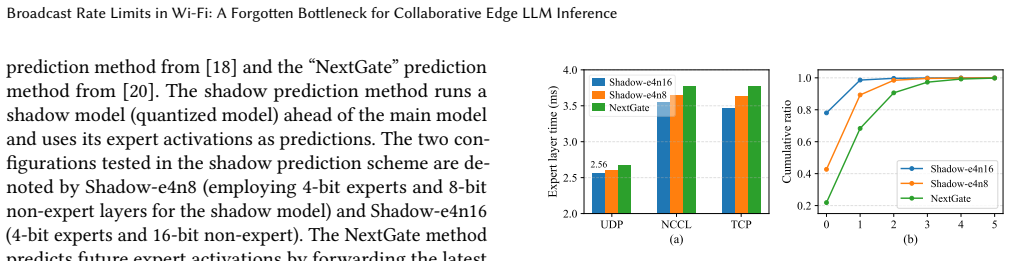
Summary. The paper proposes a UDP-broadcast-based one-to-many dispatch scheme for distributed MoE inference, augmented with timeout-driven retransmission and unordered result gathering. In a wired 8-node cluster it reports a 1.4× speedup over NCCL and TCP baselines across three expert-prediction schemes. In wireless deployments, it argues that IEEE 802.11's broadcast rate cap (≤54 Mbps) is a major bottleneck, and uses NS-3 simulations to claim that the throughput-optimal MCS rates are 32–64× higher than this cap at 1–5 m distances. Based on this, it proposes a Dual-Mode Broadcast Framework that decouples control-plane and data-plane broadcasts. The central wireless claim rests entirely on an unvalidated NS-3 simulation, and the wired claim lacks statistical reporting.
Significance. The paper addresses an important and timely problem: one-to-many embedding dispatch in edge-distributed MoE inference. The wired UDP-broadcast design with timeout retransmission is simple, and the measured 1.4× speedup, if reproducible, is a meaningful engineering result. The identification of the broadcast basic-rate limit as a potential wireless bottleneck, and the suggestion to allow high-MCS data-plane broadcasts via a dual-mode framework, are valuable and actionable. The theoretical speedup upper-bound analysis and the timing diagrams are clear and add pedagogical value. However, the paper's headline wireless numbers are simulation-only, with unstated channel parameters and no hardware validation; until those are supplied, the quantitative contribution remains conditional.
major comments (4)
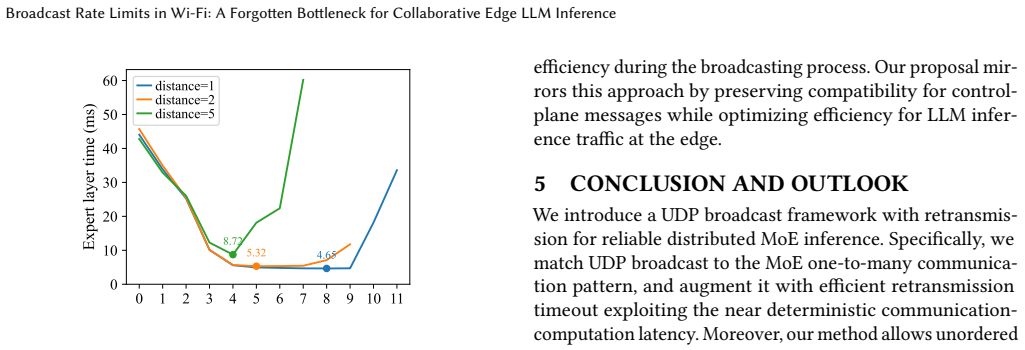
- [§4.1 Simulation Configuration] The central wireless finding—optimal MCS indices 8/5/4 at 1/2/5 m, yielding 3459/2306/1729 Mbps—is presented with no statement of the propagation-loss model, path-loss exponent, shadowing, noise floor, transmit power, antenna gains, number of simulated nodes, or retry limits. The paragraph lists only distances, GCR-UR mode, and the MCS range. Without these parameters, the U-shaped curves in Fig. 9 and the derived optima cannot be reproduced or assessed for realism. The paper should provide the full NS-3 configuration and either validate the simulated PER-versus-MCS tradeoff against a real over-the-air broadcast measurement on the ASUS RT-BE96U/QCNCM865 testbed, or explicitly restrict the claims to 'in this simulated scenario.'
- [§4.1 Simulation Workflow] The workflow captures NS-3 latency, jitter, and packet error rate, then 'applies the simulated channel statistics to the wired testbed using traffic control tools.' The paper does not describe the mapping from NS-3 statistics to tc/netem parameters (delay distribution, loss model, queue discipline), nor does it validate that the emulated path faithfully reproduces the simulated wireless channel. This is load-bearing because Fig. 9's expert-layer times come from this emulation; an inaccurate mapping could change the ranking of MCS indices. Please specify the tc configuration and provide an end-to-end validation (e.g., compare emulated throughput/PER against a real wireless link).
- [§3.2 Baseline Comparison] The wired 1.4× speedup is described as 'consistent' across three prediction methods, but Fig. 6(a) shows a single measurement per condition with no error bars, no number of repetitions, and no statistical test. As the only direct experimental validation of the proposed method, this is insufficient to establish the claim's stability. Report mean ± standard deviation over multiple runs, and state the number of trials for each method.
- [§1 and §4.1 Broadcast rate cap premise] The paper states that 'IEEE 802.11 caps broadcast rates at 54 Mbps regardless of physical-layer capacity' and 'The limit is written into the standard.' This is an oversimplification: IEEE 802.11 permits group-addressed frames to be transmitted at rates included in the BSSBasicRateSet, which is configurable, and the 54 Mbps ceiling is more accurately described as a common firmware default than a hard standard mandate. This distinction matters because the proposed Dual-Mode Broadcast Framework and the 'forgotten bottleneck' framing partly depend on whether the restriction is a standard requirement or an implementation choice. Please clarify the relevant standard clauses and the specific firmware behavior of the tested NICs.
minor comments (6)
- [Abstract] Remove the comma in 'broadcast, is no longer a control-plane relic'.
- [Fig. 6(a)] Add error bars and the number of runs. The current single-bar presentation does not support the 'consistent' wording.
- [Fig. 9] The text says 'optimal indexes highlighted,' but the figure does not show visible markers or a legend indicating which bars are optimal. Add explicit markers.
- [§4.1] The claim that UDP broadcast incurs a 12.5× penalty compared to its wired performance is not directly supported by the plotted numbers in Fig. 6(a) and Fig. 8. Clarify the exact comparison (which prediction method, which condition).
- [§4.2] The Dual-Mode Broadcast Framework is only a conceptual sketch. Provide at least a high-level description of how the AP selects the MCS for data-plane broadcasts and how targeted nodes are identified, to make the proposal concrete enough for implementation.
- [References] When discussing the broadcast basic-rate rules, cite the IEEE 802.11 standard itself (e.g., IEEE 802.11-2020) rather than relying solely on the secondary source [6].
Circularity Check
No significant circularity; the wired and simulated results are self-contained, with only a minor non-load-bearing self-citation.
full rationale
The central claims—the wired 1.4x UDP-broadcast speedup over NCCL/TCP and the NS-3 optimal MCS/rate results (MCS 8/5/4 giving 3459/2306/1729 Mbps at 1/2/5 m)—are derived from direct measurements and from an NS-3 sweep that trades off transmission time against packet error rate. The optimal MCS is an emergent output of the simulator, not a parameter fitted to reproduce the 54 Mbps cap, so the comparison to 54 Mbps is not self-definitional. The wired benchmark is an independent empirical comparison, and the theoretical speedup bound (16/9) is only used as a sanity check. The paper's one notable self-citation is [18] (OD-MoE), used as one of three expert-prediction schemes; the speedup also holds with the external NextGate scheme [20], so [18] is not load-bearing. The main weakness—unreported NS-3 propagation-loss model, noise floor, retry limits, and lack of hardware validation of the simulated channel—is a correctness/validation concern, not a circularity: nothing in the derivation defines the conclusion as equivalent to an input. Accordingly, the paper is not circular beyond a minor self-citation that does not carry the argument.
Axiom & Free-Parameter Ledger
free parameters (1)
- retransmission timeout threshold =
not reported
axioms (6)
- domain assumption Near-deterministic compute and communication latency in distributed MoE
- domain assumption Ethernet switch replicates a broadcast to all workers in one step
- domain assumption NS-3 simulation with unspecified propagation/error model is faithful to the ASUS RT-BE96U/QCNCM865 testbed
- domain assumption Commodity Wi-Fi firmware cannot override the 54 Mbps basic-rate cap for broadcast
- domain assumption GCR-UR gives reliability equivalent to the proposed timeout retransmission
- standard math NCCL/TCP baselines in wireless require N and N-1 medium uses, respectively
invented entities (1)
-
Dual-Mode Broadcast Framework
no independent evidence
read the original abstract
LLM deployment is migrating from data centers to edge devices, where Mixture-of-Experts (MoE) models offer a promising path: sparse expert activation allows the model to be spread across multiple low-cost edge nodes. Distributed MoE inference repeatedly dispatches embeddings from one main node to many workers - a one-to-many pattern poorly served by the sequential unicasts of mainstream stacks (NCCL, TCP), yet naturally matched by UDP broadcast. We propose a UDP broadcast method for collaborative edge MoE inference, augmented with timeout-driven retransmission exploiting near deterministic latency in distributed MoE for reliability and unordered result gathering for robustness to expert mispredictions, yielding a consistent 1.4x speedup over NCCL and TCP on a wired 8-node cluster. In wireless settings, however, we uncover a deeper, long-forgotten bottleneck: IEEE 802.11 caps broadcast rates at 54 Mbps regardless of physical-layer capacity - a legacy policy built for sparse control traffic, not edge AI. NS-3 simulations at distances 1m, 2m and 5m show that the optimal rates are much higher (64x, 43x, and 32x, respectively) than the 54 Mbps cap applied in standard. Thus, we argue that broadcast is no longer a control-plane relic: it is time for Wi-Fi standards to treat it as a high-throughput data-plane citizen.
Figures



Reference graph
Works this paper leans on
-
[1]
Keivan Alizadeh, Seyed Iman Mirzadeh, Dmitry Belenko, S Khatam- ifard, Minsik Cho, Carlo C Del Mundo, Mohammad Rastegari, and Mehrdad Farajtabar. 2024. Llm in a flash: Efficient large language model inference with limited memory. InProceedings of the 62nd An- nual Meeting of the Association for Computational Linguistics (Volume 1: Long Papers). 12562–12584
2024
-
[2]
Apple. 2024. Introducing Apple’s On-Device and Server Foundation Models. https://machinelearning.apple.com/research/introducing- apple-foundation-models. Accessed: 2025-11-20. 7 Liujianfu Wang, Yuyang Du, Shiqi Xu, and Soung Chang Liew
2024
-
[3]
Nicola Baldo, Marco Miozzo, Manuel Requena-Esteso, and Jaume Nin- Guerrero. 2011. An open source product-oriented LTE network sim- ulator based on ns-3. InProceedings of the 14th ACM international conference on Modeling, analysis and simulation of wireless and mobile systems. 293–298
2011
-
[4]
Boris Bellalta, Luciano Bononi, Raffaele Bruno, and Andreas Kassler
-
[5]
Yuanhao Cui, Xiaowen Cao, Guangxu Zhu, Jiali Nie, and Jie Xu. 2025. Edge perception: Intelligent wireless sensing at network edge.IEEE Communications Magazine63, 3 (2025), 166–173
2025
-
[6]
Yousri Daldoul, Djamal-Eddine Meddour, Toufik Ahmed, and Raouf Boutaba. 2016. Performance and scalability evaluation of IEEE 802.11 v/aa multicast transport.Wireless Communications and Mobile Com- puting16, 14 (2016), 1987–2000
2016
-
[7]
Zhixu Du, Shiyu Li, Yuhao Wu, Xiangyu Jiang, Jingwei Sun, Qilin Zheng, Yongkai Wu, Ang Li, Hai H Li, and Yiran Chen. 2024. Sida: Sparsity-inspired data-aware serving for efficient and scalable large mixture-of-experts models.Proceedings of Machine Learning and Sys- tems6 (2024), 224–238
2024
-
[8]
Artyom Eliseev and Denis Mazur. 2023. Fast inference of mixture- of-experts language models with offloading.arXiv preprint arXiv:2312.17238(2023)
Pith/arXiv arXiv 2023
-
[9]
Zhiyi Hu, Siyuan Shen, Tommaso Bonato, Sylvain Jeaugey, Cedell Alexander, Eric Spada, James Dinan, Jeff Hammond, and Torsten Hoe- fler. 2025. Demystifying NCCL: An in-depth analysis of GPU com- munication protocols and algorithms. In2025 IEEE Symposium on High-Performance Interconnects (HOTI). IEEE, 48–59
2025
-
[10]
Albert Q Jiang, Alexandre Sablayrolles, Antoine Roux, Arthur Mensch, Blanche Savary, Chris Bamford, Devendra Singh Chaplot, Diego de las Casas, Emma Bou Hanna, Florian Bressand, et al . 2024. Mixtral of experts.arXiv preprint arXiv:2401.04088(2024)
Pith/arXiv arXiv 2024
-
[11]
Zonghang Li, Wenjiao Feng, Mohsen Guizani, and Hongfang Yu. 2025. TPI-LLM: Serving 70B-scale LLMs efficiently on low-resource mobile devices.IEEE Transactions on Services Computing(2025)
2025
-
[12]
2010.Principles of Broadband Switching and Networking
Soung C Liew and Tony T Lee. 2010.Principles of Broadband Switching and Networking. John Wiley & Sons, Chapter 8
2010
-
[13]
Aixin Liu, Bei Feng, Bing Xue, Bingxuan Wang, Bochao Wu, Chengda Lu, Chenggang Zhao, Chengqi Deng, Chenyu Zhang, Chong Ruan, et al . 2024. Deepseek-v3 technical report.arXiv preprint arXiv:2412.19437(2024)
Pith/arXiv arXiv 2024
-
[14]
Haoxiang Luo, Yinqiu Liu, Ruichen Zhang, Jiacheng Wang, Gang Sun, Dusit Niyato, Hongfang Yu, Zehui Xiong, Xianbin Wang, and Xuemin Shen. 2025. Toward edge general intelligence with multiple-large lan- guage model (Multi-LLM): architecture, trust, and orchestration.IEEE Transactions on Cognitive Communications and Networking(2025)
2025
-
[15]
Qualcomm Technologies, Inc. 2023. World’s first on- device demonstration of Stable Diffusion on Android. https://www.qualcomm.com/news/onq/2023/02/worlds-first- on-device-demonstration-of-stable-diffusion-on-android. Accessed: 2025-11-20
2023
-
[16]
Peng Tang, Jiacheng Liu, Xiaofeng Hou, Yifei Pu, Jing Wang, Pheng- Ann Heng, Chao Li, and Minyi Guo. 2024. Hobbit: A mixed preci- sion expert offloading system for fast moe inference.arXiv preprint arXiv:2411.01433(2024)
Pith/arXiv arXiv 2024
-
[17]
Jingyu Wang, Xuming Fang, Dusit Niyato, and Tie Liu. 2024. Next- generation wi-fi networks with generative ai: Design and insights. arXiv preprint arXiv:2408.04835(2024)
Pith/arXiv arXiv 2024
-
[18]
Liujianfu Wang, Yuyang Du, Yuchen Pan, Soung Chang Liew, Ji- acheng Liu, and Kexin Chen. 2025. OD-MoE: On-Demand Expert Loading for Cacheless Edge-Distributed MoE Inference.arXiv preprint arXiv:2512.03927(2025)
arXiv 2025
-
[19]
An Yang, Anfeng Li, Baosong Yang, Beichen Zhang, Binyuan Hui, Bo Zheng, Bowen Yu, Chang Gao, Chengen Huang, Chenxu Lv, et al. 2025. Qwen3 technical report.arXiv preprint arXiv:2505.09388(2025)
Pith/arXiv arXiv 2025
-
[20]
Shuzhang Zhong, Ling Liang, Yuan Wang, Runsheng Wang, Ru Huang, and Meng Li. 2024. Adapmoe: Adaptive sensitivity-based expert gating and management for efficient moe inference. InProceedings of the 43rd IEEE/ACM International Conference on Computer-Aided Design. 1–9. 8
2024
-
[2016]
Next generation IEEE 802.11 Wireless Local Area Networks: Current status, future directions and open challenges.Computer Communications75 (2016), 1–25
2016
discussion (0)
Sign in with ORCID, Apple, or X to comment. Anyone can read and Pith papers without signing in.