REVIEW 2 major objections 4 minor 24 references
High-dimensional quantum process tomography with undetected photons
T0 review · 2 major / 4 minor · reviewed 2026-08-04 · deepseek-v4-flash
Pith's one-line read A path-identity interferometer can fully reconstruct a linear quantum process on a high-dimensional photonic state without detecting the photon that the process acts on.
desk verdict Extends path-identity QPT to lossy passive linear optics, but the 'arbitrary operation' claim is too broad and needs a fix before publication. read the letter →
The pith
A machine-rendered reading of the paper's core claim, the machinery that carries it, and where it could break.
The reading
What carries the argument
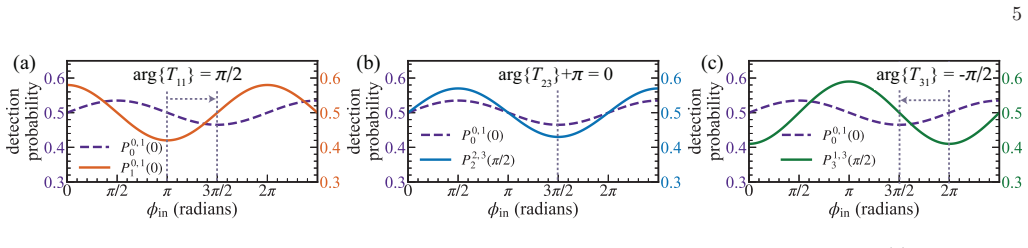
The central object is the decomposition of a non-unitary field transformation as b(l) = Σ_γ (T_lγ a(γ) + A_lγ a0(γ)), with A A† = I − T T†, which preserves the bosonic commutation relation by embedding the missing probability into vacuum modes. The second piece is the single-photon interference formula P_d ∝ 1 + Σ_γ |U_dγ||T_dγ| sin(φ_in + arg U_dγ + arg T_dγ), which maps interference visibility to |T_dγ| and fringe phase to arg T_dγ. Two-mode rotations of the signal modes (angle 0 or π/2) select individual off-diagonal elements, so each setting yields four matrix elements.
What would settle it
Run the procedure on a channel known to have two Kraus operators, say a 50/50 mixture of two different passive lossy transformations. If the measured single-photon fringes cannot be described by the single-matrix visibility-phase formula, or the fitted T matches neither Kraus operator, the claim of full reconstruction of arbitrary operations is refuted.
Extended reading notes
Core claim
The paper shows that when the transformed idler beam from one source is aligned with the idler beam from a second source (path identity), the single-photon interference pattern of the two signal beams encodes every matrix element of an unknown operation T acting on the idler. Detecting the transformed idler photon is unnecessary: its magnitude enters through the visibility and its phase through the position of the interference fringes. With two-mode rotations applied to the signal modes, the diagonal and off-diagonal elements of T are individually retrieved; N(N-1)/2 rotation settings reconstruct a full N-dimensional operation. The vacuum-field completion of the mode transformation ensures a
Load-bearing premise
The operation must be a passive linear mode transformation of the form b = T a + A a0 with A A† = I − T T†; a general noisy process with multiple Kraus operators (e.g., depolarizing) has no such T, so for such a process the reconstructed matrix would not be the full quantum process.
Editorial extensions
If this is right
- Full N-dimensional non-unitary operations can be reconstructed from N(N−1)/2 choices of two-mode rotation, e.g., six choices for a four-dimensional qudit.
- No coincidence counting, postselection, or detection of the transformed idler photon is required; only a single-photon interference pattern on the signal side is measured.
- The scheme covers unitary and non-unitary operations in one formalism, since the vacuum completion reduces to the unitary case when the vacuum matrix A vanishes.
- Because detection happens at the signal wavelength, the method can in principle be applied when the transformed photon lies in a spectral region lacking efficient single-photon detectors.
- Since the derivation is based on quantum field theory, the approach is in principle extendable to non-photonic quantum systems.
- For a given operation, each reconstructed matrix element is obtained independently, making the procedure naturally parallelizable.
Reading between the lines
- The phrase 'any linear quantum operation' should be read narrowly: the model covers operations with one Kraus operator (passive linear mode transformations with loss). A general completely positive map, such as depolarizing noise, has no single matrix T, so this scheme would not reconstruct the full process for such channels.
- The method is mode-agnostic: the same derivation applies to OAM, time-bin, or frequency-bin qudits, provided the sources emit entangled pairs and the required two-mode rotations can be implemented in that basis.
- A natural extension is to replace pairwise rotations with a fully programmable unitary on the signal mode, potentially reducing the number of required settings below N(N−1)/2.
- The most immediate experimental test would use a mid-infrared idler and a near-infrared signal, demonstrating tomography in a spectral region where the idler photon cannot be practically detected.
Editorial analysis
A structured set of objections, weighed in public.
Referee Report
Summary. The paper proposes an interferometric method for characterizing a photonic qudit operation without detecting the qudit on which the operation acts. The unknown operation is modeled as a passive linear field transformation, Eq. (5), supplemented by auxiliary vacuum modes satisfying Eq. (7). The authors derive a single-photon interference formula, Eq. (17), and show that by applying known two-mode rotations to the signal photon and measuring interference visibilities and phases, all matrix elements of the unknown matrix T can be retrieved. A four-dimensional numerical example with a lossy Hadamard operation is presented as a self-consistency check.
Significance. If the scope is correctly stated, this is a meaningful extension of the authors' earlier unitary characterization protocol to non-unitary passive linear optical operations. The method avoids detecting the transformed idler photon, which is of practical interest for spectral regions where single-photon detectors are unavailable. The derivation is internally consistent: Eq. (17) follows from the model, and the reconstruction procedure is explicit with a clear counting N(N-1)/2. The numerical example is a legitimate consistency check with no fitted parameters. However, the central claim of characterizing 'any linear quantum operation' is not supported by the model, and this overstatement undermines the presentation as a general quantum process tomography method.
major comments (2)
- [Abstract and Eqs. (5)-(7)] The paper claims in the abstract and conclusion that 'any linear quantum operation' or 'arbitrary operation' can be fully reconstructed. This is not supported by the model. Equations (5)-(7) restrict the operation to a passive linear mode transformation b(l)=Σ_γ(T_lγ a(γ)+A_lγ a0(γ)) with AA†=I−TT†. This describes a single-Kraus (up to vacuum loss) passive linear operation. For any pure single-photon input state, the output (conditioned on no loss to auxiliary modes) is a pure state Σ_l T_lm|l>. General CPTP maps on a qudit that require multiple Kraus operators on the original modes (e.g., depolarizing, dephasing, amplitude damping within the qudit subspace) are outside this class. The numerical example, Eq. (23), is a scaled Hadamard matrix and therefore exactly in the covered class; it does not expose the limitation. The manuscript must be revised to state the actual class explicitly (
- [Eqs. (7) and (17), Appendix A] The meaning of 'full characterization' needs clarification for the non-unitary case. When TT†≠I, the operation is trace-decreasing on the N-mode single-photon subspace: some population goes to the auxiliary vacuum modes. A standard quantum process tomography description would include the vacuum as an additional outcome and report a CPTP map on an (N+1)-dimensional system. The paper does not specify that the method reconstructs only the coherent part T and that the loss probabilities are inferred from T (via TT†), nor does it discuss the fact that T is determined only up to a global phase, since the interference patterns measure relative phases (Table II). Without this clarification, the reader cannot tell what 'complete' information is actually obtained, especially for a lossy device.
minor comments (4)
- [Eq. (17)] The sum in Eq. (17) is a phasor sum: the individual sine terms with different phases combine into a single sinusoid whose amplitude is the modulus of the complex sum Σ_γ U_dγ T_dγ. A short remark to this effect would prevent readers from misinterpreting the interference as an incoherent sum.
- [Appendix A] The proportionality constant 1/2 used in Eqs. (A2) is introduced without explanation. The main text uses proportionality only; it would be clearer to state that the constant is irrelevant to the visibility/phase extraction.
- [Global phase] The method determines T up to a global phase because all arguments are measured relative to a reference pattern (Table II). The paper should mention that this global phase is unobservable in the process matrix T⊗T*, so the characterization is still complete.
- [General text] There are minor typographical issues (e.g., 'commutaion' after Eq. (5), 'undetec ted' in the title header). The statement in the conclusion that the treatment 'can, in principle, be extended to non-photonic quantum systems' is speculative and not supported by the present analysis.
Circularity Check
No load-bearing circularity; the reconstruction is a direct inversion of derived interference formulas.
full rationale
I traced the derivation from the field transformation in Eqs. (5)–(7) through the interferometric probability in Eq. (17) to the retrieval relations in Eqs. (20)–(22). The unknown matrix elements T_lm appear as parameters in a derived linear relation between the measured interference visibility/phase and |T_lm|, arg(T_lm); they are not fitted to the data and then renamed as predictions. The numerical example applies the forward formula to a chosen T and then inverts it, which is a self-consistency check rather than a fitted input. The authors' prior work (Refs. [14,15]) is cited for context and for the unitary version of the method, but the non-unitary derivation here is self-contained and does not reduce to those citations. The main limitation—that Eqs. (5)–(7) model only a single-Kraus passive linear lossy transformation, not a general CPTP map—is a scope/correctness issue, not a circularity, because the protocol's equations do not assume the target result by construction.
Assumptions & free parameters
assumptions (5)
- standard math Bosonic commutation relations for OAM mode operators [a(l), a^dagger(m)] = delta_lm (Eq. 2)
- domain assumption Non-unitary operation is represented as b(l) = sum_gamma (T_lgamma a(gamma) + A_lgamma a0(gamma)) with A A^dagger = I - T T^dagger (Eqs. 5-7)
- domain assumption Path identity condition a_I2(f_k) = e^{i phi_I} b_I1(f_k) (Eq. 11)
- domain assumption Weak pumping / single-pair approximation: the state is a superposition of single-pair emissions and multi-pair/stimulated terms are negligible
- standard math Single-photon detection probability formula P_d proportional to <psi| E^(-) E^(+) |psi> (Mandel-Wolf)
Cite this review
Pith. "Pith review of High-dimensional quantum process tomography with undetected photons." pith.science (2026). https://pith.science/paper/6NM3XHOI
@misc{pith2026260802490,
  author       = {Pith},
  title        = {Pith review of: High-dimensional quantum process tomography with undetected photons},
  year         = {2026},
  howpublished = {\url{https://pith.science/paper/6NM3XHOI}},
  note         = {Machine review of arXiv:2608.02490}
}
read the original abstract
The goal of quantum process tomography is to fully characterize an operation performed on a quantum state. By considering high-dimensional quantum states (qudit), we show that it is possible to fully reconstruct an arbitrary operation without performing any measurement on the transformed qudit. Our method is interferometric and conceptually different from existing techniques of quantum process tomography that must perform a measurement on the transformed qudit.
Figures

Reference graph
Works this paper leans on
-
[1]
I. L. Chuang and M. A. Nielsen, Prescription for ex- perimental determination of the dynamics of a quantum black box, Journal of Modern Optics 44, 2455 (1997)
1997
-
[2]
Poyatos, J
J. Poyatos, J. I. Cirac, and P. Zoller, Complete characte r- ization of a quantum process: the two-bit quantum gate, Physical Review Letters 78, 390 (1997)
1997
-
[3]
Hashim, L
A. Hashim, L. B. Nguyen, N. Goss, B. Marinelli, R. K. Naik, T. Chistolini, J. Hines, J. P. Marceaux, Y. Kim, P. Gokhale, et al. , Practical introduction to benchmark- ing and characterization of quantum computers, PRX Quantum 6, 030202 (2025)
2025
-
[4]
Erhard, M
M. Erhard, M. Krenn, and A. Zeilinger, Advances in high-dimensional quantum entanglement, Nature Re- views Physics 2, 365 (2020)
2020
-
[5]
Y. Chi, J. Huang, Z. Zhang, J. Mao, Z. Zhou, X. Chen, C. Zhai, J. Bao, T. Dai, H. Yuan, et al. , A programmable qudit-based quantum processor, Nature Communications 13, 1166 (2022)
2022
-
[6]
Da Lio, D
B. Da Lio, D. Cozzolino, N. Biagi, Y. Ding, K. Rottwitt, A. Zavatta, D. Bacco, and L. K. Oxenløwe, Path-encoded high-dimensional quantum communication over a 2-km multicore fiber, npj Quantum Information 7, 63 (2021)
2021
-
[7]
N. T. Islam, C. C. W. Lim, C. Cahall, J. Kim, and D. J. Gauthier, Provably secure and high-rate quantum key distribution with time-bin qudits, Science Advances 3, e1701491 (2017)
2017
-
[8]
Sheridan and V
L. Sheridan and V. Scarani, Security proof for quantum key distribution using qudit systems, Physical Review A 82, 030301 (2010)
2010
Show all 24 references
-
[9]
Bouchard, F
F. Bouchard, F. Hufnagel, D. Koutn` y, A. Abbas, A. Sit, K. Heshami, R. Fickler, and E. Karimi, Quantum process tomography of a high-dimensional quantum communica- tion channel, Quantum 3, 138 (2019)
2019
-
[10]
Mohseni, A
M. Mohseni, A. T. Rezakhani, and D. A. Lidar, Quantum-process tomography: Resource analysis of dif- ferent strategies, Physical Review A 77, 032322 (2008)
2008
-
[11]
Escand´ on-Monardes, D
J. Escand´ on-Monardes, D. Uzc´ ategui, M. Rivera-Tapia, S. P. Walborn, and A. Delgado, Estimation of high- dimensional unitary transformations saturating the quantum cram´ er-rao bound, Quantum8, 1405 (2024)
2024
-
[12]
J. B. Altepeter, D. Branning, E. Jeffrey, T. Wei, P. G. Kwiat, R. T. Thew, J. L. O’Brien, M. A. Nielsen, and A. G. White, Ancilla-assisted quantum process tomogra- phy, Physical Review Letters 90, 193601 (2003)
2003
-
[13]
X. Zou, L. J. Wang, and L. Mandel, Induced coherence and indistinguishability in optical interference, Physic al Review Letters 67, 318 (1991)
1991
-
[14]
Hochrainer, M
A. Hochrainer, M. Lahiri, M. Erhard, M. Krenn, and A. Zeilinger, Quantum indistinguishability by path iden- tity and with undetected photons, Reviews of Modern Physics 94, 025007 (2022)
2022
-
[15]
Rajeev and M
S. Rajeev and M. Lahiri, Characterizing a high- dimensional unitary transformation without measuring the qudit it transforms, Optics Letters 51, 853 (2026)
2026
-
[16]
G. F. Calvo, A. Pic´ on, and E. Bagan, Quantum field the- ory of photons with orbital angular momentum, Physical Review A 73, 013805 (2006)
2006
-
[17]
W. N. Plick, M. Krenn, R. Fickler, S. Ramelow, and A. Zeilinger, Quantum orbital angular momentum of el- liptically symmetric light, Physical Review A 87, 033806 (2013)
2013
-
[18]
Karimi, R
E. Karimi, R. W. Boyd, P. De La Hoz, H. De Guise, J. ˇReh´ aˇ cek, Z. Hradil, A. Aiello, G. Leuchs, and L. L. S´ anchez-Soto, Radial quantum number of laguerre-gauss modes, Physical Review A 89, 063813 (2014)
2014
-
[19]
Mandel and E
L. Mandel and E. Wolf, Optical coherence and quantum optics (Cambridge University Press, 1995)
1995
-
[20]
Babazadeh, M
A. Babazadeh, M. Erhard, F. Wang, M. Malik, R. Nouroozi, M. Krenn, and A. Zeilinger, High- dimensional single-photon quantum gates: concepts and experiments, Physical Review Letters 119, 180510 (2017)
2017
-
[21]
Schlederer, M
F. Schlederer, M. Krenn, R. Fickler, M. Malik, and A. Zeilinger, Cyclic transformation of orbital angular momentum modes, New Journal of Physics 18, 043019 (2016)
2016
-
[22]
Brandt, M
F. Brandt, M. Hiekkam¨ aki, F. Bouchard, M. Huber, and R. Fickler, High-dimensional quantum gates using full- field spatial modes of photons, Optica 7, 98 (2020)
2020
-
[23]
Morizur, L
J.-F. Morizur, L. Nicholls, P. Jian, S. Armstrong, N. Treps, B. Hage, M. Hsu, W. Bowen, J. Janousek, and H.-A. Bachor, Programmable unitary spatial mode ma- nipulation, Journal of the Optical Society of America A 27, 2524 (2010)
2010
-
[24]
The number of required choices can be reduced by con- sidering more complex forms of the known unitary trans- formation as shown in Ref. [15]
Reviewed August 4, 2026 · model on record in the stance chip above.
Discussion (0). Continue with ORCID to comment.