REVIEW 4 major objections 4 minor 12 references
On calculating polar solvation energy of nonrigid proteins in the Poisson-Boltzmann theory
T0 review · 4 major / 4 minor · reviewed 2026-08-04 · deepseek-v4-flash
Pith's one-line read The polar solvation energy of a protein whose shape differs between vacuum and water can be computed in the Poisson-Boltzmann framework by analytically canceling divergent self-energies—or, in ordinary solvers, by adding a Coulombic correct
desk verdict The analytical formula is solid and worth publishing; the empirical accuracy claim rests on a misused statistic and should be fixed. read the letter →
The pith
A machine-rendered reading of the paper's core claim, the machinery that carries it, and where it could break.
The reading
What carries the argument
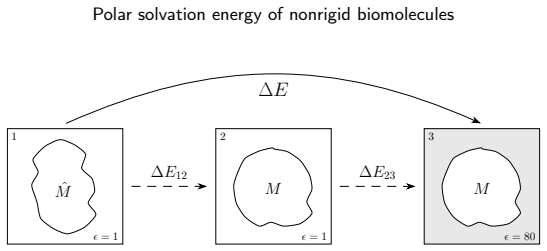
The central object is the regularized decomposition of the dimensionless potential, u = u_RF + G, where G is the Coulomb Green's function carrying the point-charge singularities and u_RF solves a smooth Poisson-Boltzmann equation. Cancellation of the diagonal self-energy terms in the two double sums converts a divergent expression into the finite formula (Equation 6). The companion device is a thermodynamic cycle that splits the nonrigid solvation energy into a vacuum Coulombic deformation energy plus a rigid-body PB solvation energy, so any ordinary solver needs only a post-processing correction.
What would settle it
Compute the solvation energy for a two-atom system with identical charges and radii but a large positional shift, using the corrected non-regularized scheme and a fully regularized scheme; they should agree. A more decisive test: repeat the calculation with different partial charges in the two conformations—if the formula still returns a finite number, the cancellation logic is being misapplied, because the z_i^2 self-energies would differ.
Extended reading notes
Core claim
For a protein with atom centers r_i in water and r-hat_i in vacuum (same partial charges z_i and radii), the paper decomposes the water potential into a reaction-field part and a Coulomb Green's function, and notes the vacuum potential is exactly the Coulomb Green's function of the vacuum structure. The solvation energy then contains two double Coulomb sums. The diagonal (i=j) terms are the singular self-energies; although the centers differ, each self-energy is z_i^2/(epsilon_m |r_i-r_i|) in water and z_i^2/(epsilon_m |r-hat_i-r-hat_i|) in vacuum, both the same divergent quantity, so they cancel identically. Removing them leaves finite pairwise Coulombic terms plus a bounded reaction-field
Load-bearing premise
The cancellation relies on each atom keeping the same partial charge and radius in vacuum and water; if charges or radii change between conformations, the infinite self-energies no longer cancel, and Equation (7) would ignore non-Coulombic deformation contributions.
Editorial extensions
If this is right
- Regularized PB models can now accept different vacuum and water structures without diverging, eliminating the rigidity assumption.
- Any existing non-regularized PB solver can yield nonrigid solvation energies by adding the analytic Coulombic correction as post-processing.
- Numerical tests on a perturbed two-atom system and 70 proteins show corrected energies stay finite and closely track the regularized scheme (correlations of 0.99 and 0.83).
- The correction applies uniformly across sharp-interface and diffuse-interface PB models and across different numerical solvers.
Reading between the lines
- The self-energy cancellation logic may extend to other point-charge implicit-solvent energy formulations, wherever the singular self-term is independent of the atom's location.
- The thermodynamic cycle treats the conformational change as purely electrostatic in vacuum; coupling this with mechanical or entropic deformation estimates could give a more complete transfer free energy.
- Because the correction is a post-processing step, it is straightforward to compute ensemble-averaged solvation energies over multiple conformations by averaging the Coulombic corrections.
Editorial analysis
A structured set of objections, weighed in public.
Referee Report
Summary. The paper proposes a generalization of the Poisson-Boltzmann (PB) theory to compute polar solvation energies of proteins whose structures differ between the vacuum and water states. For regularized PB models, the authors derive an expression (Eq. (6)) in which the divergent self-energy terms cancel analytically even though atom centers differ, yielding a finite sum of reaction-field, ionic, and Coulombic interaction terms. For non-regularized solvers (APBS, DelPhi), they introduce a thermodynamic cycle (Eq. (7) plus a rigid-body solvation step) and implement it as a post-processing correction. The methods are tested on a perturbed two-atom system and a set of 70 proteins, with comparisons among several PB solvers.
Significance. The central theoretical contribution—removing the rigidity assumption in PB solvation energy calculations—is significant and timely. The derivation is parameter-free and the proposed correction is directly applicable to widely used solvers such as APBS and DelPhi, giving the paper potential practical impact. The two-atom convergence test is a useful sanity check, and the availability of the correction code on GitHub is a strength. However, the numerical validation is entirely internal: all compared methods are PB-based, including the new REG scheme, so the 'accuracy' claims are not benchmarked against an external reference. One specific claim—that C-DelPhi is more accurate than C-APBS—is not supported by the reported statistics and may even be reversed in the 10-protein subset of Table 2.
major comments (4)
- [Section 5; Section 4, Figure 2 and Table 2] The claim that C-DelPhi is more accurate than C-APBS is not supported by the evidence. Pearson correlation coefficients measure linear association, not agreement; a high r can coexist with large systematic offsets. In the 10-protein subset of Table 2, C-APBS is closer to REG in absolute deviation in 7 of 10 cases (e.g., 1TG0: 116 vs 248 kcal/mol; 1W0N: 178 vs 344; 3LZT: 148 vs 349 kcal/mol). Please report mean absolute errors, slopes, intercepts, or Bland-Altman statistics, and revise the conclusion accordingly.
- [Section 4, Example 2; Abstract] The numerical validation demonstrates internal consistency (C-DIPB agrees with REG because they share the same diffuse-interface model; corrected sharp-interface results are bounded), but it does not establish 'accuracy' in an absolute sense because there is no external reference—all methods are PB-based and REG itself is new. The abstract's claim 'demonstrating its accuracy' is overstated. Please compare against an independent benchmark (e.g., explicit-solvent simulations or a model with an analytical solution) or temper the wording to 'internal consistency'.
- [Section 2, Eqs. (5)-(6)] The cancellation of self-energies is stated rather than justified. The terms (1/2)e_c^2 Σ_i z_i^2/(ε_m |r_i - r_i|) are formally infinite, and subtracting two divergent series is not an algebraic operation. The paper should present this as a renormalization/regularization step (e.g., introduce a cutoff δ, show the divergent parts are position-independent, and then take the limit) or cite the established treatment in regularized PB theory. As written, the derivation may appear mathematically incomplete.
- [Section 4, Example 2] The numerical evidence for the full protein set is weakened by the exclusion of four proteins (1MC2, 2FDN, 2H5C, 4TKB) due to non-convergence, with no discussion of how this affects representativeness, and by the absence of convergence tests or error estimates for the 70-protein calculations. All protein results are reported at a single grid resolution. Please provide a grid-convergence study for a few representative proteins or otherwise quantify discretization error.
minor comments (4)
- [Section 2] The assumption that partial charges z_j and radii R_j are unchanged between the two conformations is critical for Eq. (6). This should be explicitly identified as a limitation, since force fields may assign charges based on protonation states that can change with conformation.
- [Section 4, Example 1] The random perturbation in Eq. (9) uses uniform draws γ_{j,i}; for reproducibility, please provide a random seed or report the specific random configurations used.
- [Throughout] The term 'valence' for the partial charge z_j is nonstandard; consider using 'partial charge' or defining 'valence' explicitly.
- [Section 4, Table 1] The right half of Table 1 lists h values (0.8, 0.6, 0.4, 0.2, 0.1) in descending order, which is fine, but the row labels are not aligned with the columns; this makes the table harder to read. Consider splitting into two tables or adding explicit column headers.
Circularity Check
No significant circularity: the central formula is derived analytically; internal validation and self-citations do not reduce the argument to its inputs.
full rationale
The main derivation (Eq. 5 to Eq. 6) is an analytic manipulation of the PB energy functional taken from the authors' prior work [12]. The cancellation of the infinite self-energy terms is an explicit renormalization step, justified by the stated assumption that z_j and R_j are unchanged between the vacuum and water conformations. This is a standard regularization condition, not a circular use of the target formula. The thermodynamic cycle of Eq. (7) is explicitly motivated by Eq. (6), and C-DIPB is algebraically equivalent to REG within the same diffuse-interface model, so the agreement between C-DIPB and REG is a numerical consistency check rather than an independent validation. The comparisons of C-APBS and C-DelPhi to REG are cross-solver and cross-model checks; the use of Pearson correlation to rank accuracy is statistically questionable (correlation is not agreement), but that is a correctness/statistics concern, not circularity. Self-citations provide the PB energy functional and the regularization decomposition, but these are standard and are not the sole support for the new nonrigid treatment. No fitted parameter is renamed as a prediction, no uniqueness theorem is imported, and no ansatz is smuggled in via citation. The derivation is self-contained, though the validation is internal and would be strengthened by experimental or explicit-solvent benchmarks.
Assumptions & free parameters
assumptions (4)
- domain assumption The partial charges z_j and atomic radii R_j are unchanged between the vacuum and water conformations
- domain assumption The polar solvation energy functional is given by Eq. (3) from the DIPB model of [12]
- domain assumption The singular part of the potential is the Coulomb Green's function in a homogeneous medium with dielectric ε_m=1
- domain assumption The deformation free energy in vacuum (ΔE12) is the difference of Coulombic energies (Eq. 7)
Cite this review
Pith. "Pith review of On calculating polar solvation energy of nonrigid proteins in the Poisson-Boltzmann theory." pith.science (2026). https://pith.science/paper/KKTSZQM3
@misc{pith2026260802525,
  author       = {Pith},
  title        = {Pith review of: On calculating polar solvation energy of nonrigid proteins in the Poisson-Boltzmann theory},
  year         = {2026},
  howpublished = {\url{https://pith.science/paper/KKTSZQM3}},
  note         = {Machine review of arXiv:2608.02525}
}
read the original abstract
The Poisson-Boltzmann (PB) theory is a cornerstone of implicit solvent models for electrostatic analysis, and has found a great success in various biomolecular applications. However, in calculating polar solvation energy, one should consider that the structure of the protein changes upon transition from vacuum to water phases. To address this, here we report for the first time a generalized PB framework capable of accommodating nonrigid conformational changes without suffering from self-energy artifacts. For regularized PB models, in which the charge singularities are captured by the Green's functions, self-energies in the water and vacuum states will be analytically canceled. For non-regularized PB solvers, such as APBS and DelPhi, a simple thermodynamic cycle is proposed for nonrigid proteins by adding a Coulombic correction in vacuum. The generalized PB theory is validated using a perturbed two-atom system and a diverse set of proteins with different structures in vacuum and water, demonstrating its accuracy and robustness, regardless of the choice of sharp-interface and diffuse-interface PB models and different numerical solvers.
Figures

Reference graph
Works this paper leans on
-
[1]
Improving implicit solvent simulations: a poisson-centric view
Baker, N.A., 2005. Improving implicit solvent simulations: a poisson-centric view. Current Opinion in Structural Biology 15, 137–143. Theory and simulation/Macromolecular assemblages
2005
-
[2]
Reproducing the ensemble average polar solvation energy of a protein from a single structure: Gaussian-based smooth dielectric function for macromolecular modeling
Chakravorty, A., Jia, Z., Li, L., Zhao, S., Alexov, E., 2018. Reproducing the ensemble average polar solvation energy of a protein from a single structure: Gaussian-based smooth dielectric function for macromolecular modeling. Journal of Chemical Theory and Computation 14, 1020–1032. PMID: 29350933
2018
-
[3]
Accurate Evaluation of Electrostatics for Macromolecules in Solution
Chern, I.L., Liu, J.G., Wang, W.C., 2003. Accurate Evaluation of Electrostatics for Macromolecules in Solution. Methods and Applications of Analysis 10, 309 – 328
2003
-
[4]
A two-component matched interface and boundary (mib) regularization for charge singularity in implicit solvation
Geng, W., Zhao, S., 2017. A two-component matched interface and boundary (mib) regularization for charge singularity in implicit solvation. Journal of Computational Physics 351, 25–39
2017
-
[5]
On generalizing the induced surface charge method to heterogeneous poisson-boltzmann models for electrostatic free energy calculation
Ijaodoro, I., Shao, Y., Alexov, E., Zhao, S., 2026. On generalizing the induced surface charge method to heterogeneous poisson-boltzmann models for electrostatic free energy calculation. Journal of Computational Physics 545, 114452
2026
-
[6]
Improvements to the apbs biomolecular solvation software suite
Jurrus, E., et al., 2018. Improvements to the apbs biomolecular solvation software suite. Protein Science 27, 112–128
2018
-
[7]
Regularization methods for the poisson-boltzmann equation: Comparison and accuracy recovery
Lee, A., Geng, W., Zhao, S., 2021. Regularization methods for the poisson-boltzmann equation: Comparison and accuracy recovery. Journal of Computational Physics 426, 109958
2021
-
[8]
Delphi: a comprehensive suite for delphi software and associated resources
Li, L., Li, C., Sarkar, S., Zhang, J., Witham, S., Zhang, Z., Wang, L., Smith, N., Petukh, M., Alexov, E., 2012. Delphi: a comprehensive suite for delphi software and associated resources. BMC biophysics 5, 9. PMID: 22583952
2012
Show all 12 references
-
[9]
Rocchia, W., Sridharan, S., Nicholls, A., Alexov, E., Chiabrera, A., Honig, B., 2002. Rapid grid-based construction of the molecular surface and the use of induced surface charge to calculate reaction field energies: Applications to the molecular systems and geometric objects....
2002
-
[10]
Convergence of a diffuse interface Poisson-Boltzmann (PB) model to the sharp interface PB model: A unified regularization formulation
Shao, Y., McGowan, M., Wang, S., Alexov, E., Zhao, S., 2023. Convergence of a diffuse interface Poisson-Boltzmann (PB) model to the sharp interface PB model: A unified regularization formulation. Appl. Math. Comput. 436, Paper No. 127501
2023
-
[11]
On regularization of charge singularities in solving the poisson-boltzmann equation with a smooth solute-solvent boundary
Wang, S., Alexov, E., Zhao, S., 2021. On regularization of charge singularities in solving the poisson-boltzmann equation with a smooth solute-solvent boundary. Mathematical Biosciences and Engineering 18, 1370–1405
2021
-
[12]
Calculation of electrostatic free energy for the nonlinear poisson-boltzmann model based on the dimensionless potential
Zhao, S., Ijaodoro, I.E., McGowan, M., Alexov, E., 2024. Calculation of electrostatic free energy for the nonlinear poisson-boltzmann model based on the dimensionless potential. Journal of Computational Physics 497, 112634. M. Dogbatsey et al.:Preprint submitted to ElsevierPage 6 of 6
2024
Reviewed August 4, 2026 · model on record in the stance chip above.
Discussion (0). Continue with ORCID to comment.