REVIEW 4 major objections 6 minor 54 references
Revealing Intrinsic Anisotropy of Collective Magnetic Excitations in Twinned Crystals of a Kitaev-Heisenberg Quantum Magnet
T0 review · 4 major / 6 minor · reviewed 2026-08-04 · deepseek-v4-flash
Pith's one-line read A Kitaev-Heisenberg magnet's intrinsic spin waves are 24% anisotropic in-plane once twin-domain replica peaks are filtered out.
desk verdict A solid spectroscopic paper that delivers a clean single-domain magnon anisotropy measurement in a Kitaev candidate; the Hamiltonian modeling is under-determined, but the measured anisotropy is the headline and it holds up. read the letter →
The pith
A machine-rendered reading of the paper's core claim, the machinery that carries it, and where it could break.
The reading
What carries the argument
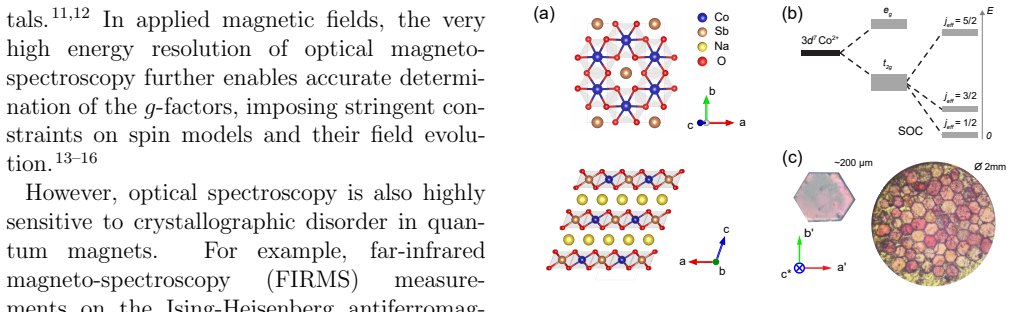
The central mechanism is the combination of two optical spectroscopies with different beam footprints: far-infrared magneto-spectroscopy (FIRMS) on a millimeter-scale mosaic averages over twin domains, producing a triple-peak 'one-magnon' structure, while angle-resolved polarized micro-Raman magneto-spectroscopy (ARPRS) spatially resolves single domains and, by rotating the field in 30° steps, reproduces the triple peak as the outer modes from three twin orientations plus an extrinsic middle mode. The analytic engine is a Curie-Weiss extension of the one-magnon energy (eq. 1), which expresses the energy as a function of field angle and direction via anisotropic Curie-Weiss temperatures, with
What would settle it
Measure a confirmed twin-free Na3Co2SbO6 crystal (as in previously reported low-field THz work) at 14 T with the field along the in-plane a and b axes: if the spin-polarized one-magnon energies are not 39.3 and 50.0 cm−1 with the same 24% splitting, the domain assignment fails. Alternatively, if a truly single-domain Raman spot ever resolves two closely spaced one-magnon lines, the middle FIRMS peak would be intrinsic rather than extrinsic.
Extended reading notes
Core claim
The paper's core claim is that the intrinsic magnetic excitation spectrum of a twinned Kitaev-Heisenberg crystal can be reconstructed by correlating two optical probes: far-infrared magneto-spectroscopy (FIRMS) averages over a mosaic and shows a triple-peak one-magnon structure, while micro-Raman magneto-spectroscopy with micrometer resolution resolves individual structural domains and reproduces that triple peak as the sum of single-domain modes from twin orientations differing by 60°. The isolated single-domain mode has twofold in-plane symmetry with E_a = 39.3 cm−1 and E_b = 50.0 cm−1 at 14 T, so (E_b−E_a)/√(E_aE_b) = 24.1%. Since the in-plane g-factor anisotropy obtained from the high-fi
Load-bearing premise
The single-domain anisotropy analysis rests on the assumption that the micro-Raman spot truly selects one crystallographic domain and that the middle FIRMS peak is extrinsic misalignment or domain-wall scattering; if the 'single domain' still contains unresolved twins, or if the middle peak is actually an intrinsic magnetic excitation, the extracted E_a = 39.3 cm−1, E_b = 50.0 cm−1, and the 24.1% anisotropy would be misidentified.
Editorial extensions
If this is right
- The prominent triple-peak structure in far-infrared magneto-spectra of Na3Co2SbO6 in the spin-polarized phase is primarily a twinning artifact: the outer peaks are single-domain magnons from differently oriented twins, and the middle peak is extrinsic (mosaic misalignment or domain-wall scattering), so spatially averaged spectra should not be interpreted as intrinsic modes.
- The single-domain magnon energies above roughly 2 T can serve as quantitative constraints on the anisotropic Kitaev-Heisenberg-Γ Hamiltonian, pinning down K_X = K_Y = −4.50 meV, K_Z = −4.00 meV, Γ_X = Γ_Y = 1.04 meV, Γ_Z = 1.50 meV, and Γ′ = 0.56 meV, subject to the paper's own caveat that q=0 data alone do not determine all exchange parameters independently.
- The high-field g-factors ga = 4.75(2) and gb = 5.32(2) are significantly smaller than previously reported low-field values, implying that field-dependent renormalization of the Zeeman response is substantial in this material.
- The two-magnon branch at roughly twice the one-magnon energy with twice the slope, plus a weak replica-like branch merging at high fields, are consistent with ΔS=±1 magnetic-dipole selection rules and with a higher-energy magnon branch made active by interlayer coupling, zone folding, or disorder.
- The combined FIRMS-plus-micro-Raman protocol is presented as a generally applicable route to extracting intrinsic spin dynamics in any multidomain quantum magnet where the domain size is small compared with the THz/IR beam.
Reading between the lines
- If the 24% in-plane magnon anisotropy is intrinsic, then models of Na3Co2SbO6 that treat in-plane exchange as nearly isotropic will fail to reproduce spin-polarized dynamics; a direct test would be to measure a confirmed twin-free crystal at 14 T along a and b and check for E_a ≈ 39.3 cm−1 and E_b ≈ 50.0 cm−1.
- The same twin-replica mechanism likely applies to other monoclinic honeycomb cobaltates and α-RuCl3-like systems; re-analyzing existing THz data with domain-resolved Raman could reveal that some reported multi-mode structures are twin superpositions rather than intrinsic excitations.
- The factor-of-four gap between magnon and g-factor anisotropy implies that the C3-breaking monoclinic distortion affects bond-dependent exchange more strongly than the local g-tensor; if this pattern holds in other cobaltates, the role of monoclinic distortion in stabilizing particular magnetic orders deserves reexamination.
- Because the CW-constrained LSWT fit uses only q=0 magnons, the exchange parameters are not unique; extending the measurement to finite momentum via inelastic neutron scattering on aligned single-domain mosaics could break the degeneracy and test whether the K/Γ parameter set survives.
Editorial analysis
A structured set of objections, weighed in public.
Referee Report
Summary. This manuscript reports a multimodal optical study of the Kitaev-Heisenberg candidate Na3Co2SbO6, combining far-infrared magneto-spectroscopy (FIRMS) on a mosaic of 68 twinned crystals with domain-resolved micro-Raman magneto-spectroscopy under in-plane fields up to 14 T. The authors assign the three closely spaced one-magnon peaks in the FIRMS spectra to three twin orientations, use micro-Raman to isolate the response of a single crystallographic domain, and obtain single-domain magnon energies E_a = 39.3 cm^-1 and E_b = 50.0 cm^-1 at 14 T, corresponding to an in-plane anisotropy (E_b-E_a)/sqrt(E_aE_b) = 24.1%, far larger than the 5.7% anisotropy of the measured g-factors. A Curie-Weiss expression (Eq. 1) is used to fit g_a, g_b and two Curie-Weiss temperature differences, and linear spin-wave theory with anisotropic Kitaev and symmetric off-diagonal exchange parameters reproduces the field evolution of the one-magnon modes for B > 2 T. The paper concludes that bond-dependent exchange interactions, particularly K and Gamma, dominate the in-plane magnon anisotropy.
Significance. If the single-domain assignment is reliable, the paper establishes a valuable and broadly applicable strategy for extracting intrinsic magnetic excitations from twinned quantum magnets. The direct single-domain Raman measurement is a genuine methodological advance over spatially averaged FIRMS/INS probes, and the claimed 24.1% magnon anisotropy versus 5.7% g-factor anisotropy is a striking, falsifiable result that would place tight constraints on the spin Hamiltonian of Na3Co2SbO6. The paper is also appropriately cautious in acknowledging that q = 0 magnon data are insufficient to determine all exchange parameters independently. However, the central quantitative claim rests on the assumption that the micro-Raman spot probes a single crystallographic domain; this assumption is currently supported by limited evidence, and the smooth twofold angular dependence alone does not rule out unresolved micro-twins. The experimental claim is plausible but not yet fully load-bearing, and the manuscript therefore requires additional verification before publication.
major comments (4)
- [Fig. 3 and §3] The central quantitative result—E_a = 39.3 cm^-1, E_b = 50.0 cm^-1, and the 24.1% anisotropy—is obtained from micro-Raman spectra on a spot described as a 'single domain.' The text states that single-domain crystals are relatively rare and that twinning is pronounced, but no evidence is provided that the region probed by the optical spot is a single domain at the scale of the probe volume. The ARPRS structural-domain map (Fig. S5) and the angular scan of Fig. 3e are necessary but not sufficient: an unresolved distribution of micro-twins inside the laser spot would also produce a smooth, apparently twofold response. Please provide spatially resolved maps at the true probe scale, line scans across the crystal, or a second independent single-domain probe, and show that two different spots on the same 'single domain' yield identical magnon energies. This verification is load-bearing for the
- [Fig. 2 and Fig. 3c,d] The assignment of the weaker middle peak in the triple-peak FIRMS structure is explicitly tentative ('likely arises from slight misalignment ... or from magnetic scattering at domain walls'). This tentative assignment is used to label the open-symbol single-domain branches in Fig. 2a,b and hence to construct the field-dependent data fitted in Fig. 4c. If the middle peak is actually an intrinsic magnetic mode, the branch-tracing in the mosaic FIRMS spectra may be contaminated, even if the Raman-derived energies at 14 T are unaffected. Please provide a more direct test—for example, by comparing spectra from a true twin-free crystal (e.g., Ref. 46) or by using polarization-selective FIRMS—or quantitatively estimate how an unresolved middle peak would shift the extracted E(B) branches and the fitted parameters.
- [Eq. (1), §4] The Curie-Weiss energy expression used to fit g_a, g_b, Theta_ba, and Theta_bc* is stated without derivation in the main text. This expression is the phenomenological basis for the exchange-anisotropy conclusion, and the manuscript notes that the fitted g-factors differ significantly from low-field THz values in Ref. 46. Please provide a full derivation in the Supporting Information, clarify the range of validity of the high-field approximation, and discuss why the g-factors extracted from Eq. (1) are smaller than those obtained from low-field magneto-THz data. Without this, a reader cannot assess whether the apparent anisotropy is partly imposed by the fitting form rather than being independently constrained by the data.
- [Fig. 4d, §4] The paper acknowledges that the field evolution of q = 0 magnons 'is not sufficient to determine all exchange parameters independently,' yet it reports a specific LSWT parameter set (K_X = K_Y = -4.50 meV, K_Z = -4.00 meV, Gamma_X = Gamma_Y = 1.04 meV, Gamma_Z = 1.50 meV, Gamma' = 0.56 meV) and states that the data are 'quantitatively captured.' Please provide confidence intervals, parameter correlations, and a discussion of which parameter combinations are actually constrained (e.g., K_Z - K_X, Gamma_Z - Gamma_X) versus those fixed by assumption. In particular, the assumption that C3 symmetry breaking enters only through Gamma while Gamma' is kept isotropic should be justified, since the text notes that C3 breaking in Gamma and Gamma' produces compensating effects. The qualitative conclusion of exchange-dominated anisotropy may be robust, but the specific Hamiltonian should not be prese
minor comments (6)
- [Abstract/Introduction] Typo: 'challenges posted by crystal twinning' should read 'challenges posed by crystal twinning.'
- [§3, Fig. 3] The notation 'B||a'+'-60°' is used to denote a field direction, but the relation between the laboratory frame (a', b') and the crystallographic axes (a, b) is not fully specified in the main text. A brief definition in the figure caption or text would improve clarity.
- [Fig. 3e / §3] The statement 'g' ∝ δE/δB' is schematic; the proportionality constant depends on the magnon g-factor and the detailed field dependence. Please use a more explicit definition (e.g., dE/dB = g μ_B for a linear branch) and clarify how the 5.7% anisotropy is computed.
- [§4, Fig. 4c] The fitted values g_a = 4.75(2), g_b = 5.32(2), Theta_ba = 2.73(5) K, and Theta_bc* = 21.48(18) K are reported without a description of the fitting procedure (e.g., weighting, background, correlated errors). Please include the residual plot or a statement of the reduced chi-square in SI.
- [§4, Fig. 4d] The LSWT intensity map is described as 'overlaid' with experimental data, but the plotted experimental guide lacks error bars. Adding representative error bars to the symbols in Fig. 4d would help the reader judge the quality of the agreement.
- [References] The citation to Ref. 46 (Li et al., Chinese Physics Letters 2025) is central to the twin-free comparison, and Ref. 21 (Li et al., Phys. Rev. X 2022) is central to the twinning. Please ensure both are quoted with complete author lists and that the discussion of Ref. 46 explicitly states what data are being compared.
Circularity Check
No significant circularity: the anisotropic-exchange conclusion rests on direct single-domain Raman measurement; the LSWT step is an acknowledged consistency fit, not an out-of-sample prediction.
full rationale
The central quantitative finding—E_a=39.3 cm−1, E_b=50.0 cm−1, and (Eb−Ea)/√EaEb=24.1%—is extracted directly from angle-resolved micro-Raman spectra on an individual single domain (Fig. 3e), not from the spin Hamiltonian. The g-factor anisotropy (5.7%) is similarly measured from the field slope of the same experimental magnon branch. The conclusion that anisotropic bond-dependent exchange dominates over the Zeeman contribution is therefore an empirical comparison, not a consequence of the fitted model. The CW expression (Eq. 1) is introduced as a phenomenological relation and fitted to the SP-phase data; the LSWT parameters are explicitly 'constrained by the CW fitting results' and reproduce the same data above 2 T. The paper also admits 'the field evolution of the q=0 magnons is not sufficient to determine all exchange parameters independently.' This is an acknowledged consistency fit and model underdetermination, not a claim of independent prediction, so it does not create a circular derivation. The main risk is experimental—single-domain purity and the attribution of the middle FIRMS peak to misalignment/domain walls—but this is a correctness concern, not circularity. No load-bearing self-citation or imported uniqueness theorem is present. Overall circularity is minimal, and the paper is largely self-contained on its primary experimental claim.
Assumptions & free parameters
free parameters (9)
- g_a =
4.75(2)
- g_b =
5.32(2)
- Θ_ba =
2.73(5) K
- Θ_bc* =
21.48(18) K
- K_X = K_Y =
-4.50 meV
- K_Z =
-4.00 meV
- Γ_X = Γ_Y =
1.04 meV
- Γ_Z =
1.50 meV
- Γ' =
0.56 meV
assumptions (5)
- domain assumption The spin-polarized phase magnon can be described by linear spin-wave theory on a generalized Kitaev-Heisenberg-Γ Hamiltonian.
- domain assumption The one-magnon mode in the SP phase has energy given by the Curie-Weiss relation Eq. 1, with Θ_a, Θ_b, Θ_c* independent of field and angle.
- domain assumption The twin-domain structure of Na3Co2SbO6 consists of domains rotated by ±60°, and the single-domain Raman measurement can be assigned to one crystal orientation.
- ad hoc to paper The middle peak in the triple-peak FIRMS structure is a replica/misalignment feature rather than an intrinsic magnon.
- domain assumption The LSWT intensity calculation assumes that disorder and interlayer coupling do not significantly affect the SP magnon energies above 2 T.
Cite this review
Pith. "Pith review of Revealing Intrinsic Anisotropy of Collective Magnetic Excitations in Twinned Crystals of a Kitaev-Heisenberg Quantum Magnet." pith.science (2026). https://pith.science/paper/FOQUKB3W
@misc{pith2026260802531,
  author       = {Pith},
  title        = {Pith review of: Revealing Intrinsic Anisotropy of Collective Magnetic Excitations in Twinned Crystals of a Kitaev-Heisenberg Quantum Magnet},
  year         = {2026},
  howpublished = {\url{https://pith.science/paper/FOQUKB3W}},
  note         = {Machine review of arXiv:2608.02531}
}
abstract
Quantum magnets with competing interactions often emerge from delicate balances among microscopic parameters, making it essential to disentangle intrinsic spin dynamics from extrinsic disorder effects. Here, we introduce a multimodal optical approach combining magneto-infrared spectroscopy with domain-resolved micro-Raman spectroscopy at high magnetic fields to reconstruct the intrinsic magnetic excitation spectrum of twinned crystals of the Kitaev-Heisenberg quantum magnet Na$_3$Co$_2$SbO$_6$. Far-infrared spectroscopy reveals multiple field-tunable magnetic excitations, but the intrinsic response is obscured by replica features arising from twin domains. By correlating magneto-infrared and domain-resolved Raman spectra, we isolate the single-domain magnon response and uncover a pronounced twofold in-plane magnon anisotropy. This anisotropy far exceeds that expected from the measured in-plane g-factor anisotropy and is instead dominated by anisotropic bond-dependent exchange interactions. By unifying high-field, high-resolution and spatially selective optical probes, our work establishes a broadly applicable framework for revealing intrinsic spin dynamics and constraining the spin Hamiltonian in multidomain quantum magnets.
Figures


Figures from the paper (1 more)

Reference graph
Works this paper leans on
-
[1]
2010 , keywords =
Balents, Leon , journal =. 2010 , keywords =
2010
-
[2]
Winter, Stephen M and Tsirlin, Alexander A and Daghofer, Maria and Brink, Jeroen van den and Singh, Yogesh and Gegenwart, Philipp and Valentí, Roser , journal =. 2017 , keywords =. doi:10.1088/1361-648x/aa8cf5 , eprint =
-
[3]
Broholm, C. and Cava, R. J. and Kivelson, S. A. and Nocera, D. G. and Norman, M. R. and Senthil, T. , journal =. 2020 , keywords =. doi:10.1126/science.aay0668 , url =
-
[4]
and Li, Ying and Jeschke, Harald O
Winter, Stephen M. and Li, Ying and Jeschke, Harald O. and Valentí, Roser , journal =. 2016 , keywords =. doi:10.1103/physrevb.93.214431 , eprint =
-
[5]
Takagi, Hidenori and Takayama, Tomohiro and Jackeli, George and Khaliullin, Giniyat and Nagler, Stephen E. , journal =. 2019 , month =. doi:10.1038/s42254-019-0038-2 , url =
-
[6]
Maksimov, P. A. and Chernyshev, A. L. , journal =. 2020 , keywords =. doi:10.1103/physrevresearch.2.033011 , eprint =
-
[7]
Jones, S. P. P. and Gaw, S. M. and Doig, K. I. and Prabhakaran, D. and H. Nature Communications , issn =. 2014 , month =. doi:10.1038/ncomms4787 , url =
-
[8]
Zhang, Xinshu and Mahmood, Fahad and Daum, Marcus and Dun, Zhiling and Paddison, Joseph A. M. and Laurita, Nicholas J. and Hong, Tao and Zhou, Haidong and Armitage, N. P. and Mourigal, Martin , journal =. 2018 , month =. doi:10.1103/PhysRevX.8.031001 , url =
Show all 54 references
-
[9]
and Takayama, Tomohiro and Takagi, Hidenori and Armitage, N
Halloran, Thomas and Wang, Yishu and Li, Mengqun and Rousochatzakis, Ioannis and Chauhan, Prashant and Stone, Matthew B. and Takayama, Tomohiro and Takagi, Hidenori and Armitage, N. Peter and Perkins, Natalia B. and Broholm, Collin , journal =. 2022 , month =. doi:10.1103/Phys...
2022 doi
-
[10]
2024 , month =
Na, Woongki and Park, Pyeongjae and Oh, Siwon and Kim, Junghyun and Scheie, Allen and Tennant, David Alan and Lee, Hyun Cheol and Park, Je-Geun and Cheong, Hyeonsik , journal =. 2024 , month =. doi:10.1021/acsnano.4c04824 , url =
2024 doi
-
[11]
Yankova, T. and H. Philosophical Magazine , issn =. 2012 , month =. doi:10.1080/14786435.2012.669072 , url =
2012
-
[12]
2024 , month =
Kumawat, Reshma and Farswan, Shubham and Kaur, Simranjeet and Bhatia, Smriti and Sen, Kaushik , journal =. 2024 , month =. doi:10.1088/1361-648X/ad75db , url =
2024 doi
-
[13]
and Kaib, D
Sahasrabudhe, A. and Kaib, D. A. S. and Reschke, S. and German, R. and Koethe, T. C. and Buhot, J. and Kamenskyi, D. and Hickey, C. and Becker, P. and Tsurkan, V. and Loidl, A. and Do, S. H. and Choi, K. Y. and Gr. Physical Review B , issn =. 2020 , month =. doi:10.1103/PhysRe...
2020 doi
-
[14]
2020 , keywords =
Wulferding, Dirk and Choi, Youngsu and Do, Seung-Hwan and Lee, Chan Hyeon and Lemmens, Peter and Faugeras, Clément and Gallais, Yann and Choi, Kwang-Yong , journal =. 2020 , keywords =. doi:10.1038/s41467-020-15370-1 , eprint =
2020 doi
-
[15]
Nature , issn =
Wang, Zhe and Halati, Catalin-Mihai and Bernier, Jean-S. Nature , issn =. 2024 , month =. doi:10.1038/s41586-024-07599-3 , url =
2024 doi
-
[16]
and Drichko, Natalia and Armitage, N
Zhang, Xinshu and Xu, Yuanyuan and Halloran, Thomas and Zhong, Ruidan and Broholm, Collin and Cava, Robert J. and Drichko, Natalia and Armitage, N. Peter , journal =. 2023 , month =. doi:10.1038/s41563-022-01403-1 , url =
2023 doi
-
[17]
and Rutherford, Aya and Chen, Long and Zhou, Haidong and Peng, Cheng and Xu, Mingyu and Xie, Weiwei and Vira, Advik D
Kim, Chaebin and Rathi, Sumedh and Zhang, Naipeng and Seth, Arnab and Simonov, Nikolai V. and Rutherford, Aya and Chen, Long and Zhou, Haidong and Peng, Cheng and Xu, Mingyu and Xie, Weiwei and Vira, Advik D. and Tian, Mengkun and Ozerov, Mykhaylo and Kimchi, Itamar and Mourig...
2025 doi
-
[18]
2023 , keywords =
Xiang, Li and Dhakal, Ramesh and Ozerov, Mykhaylo and Jiang, Yuxuan and Mou, Banasree S and Ozarowski, Andrew and Huang, Qing and Zhou, Haidong and Fang, Jiyuan and Winter, Stephen M and Jiang, Zhigang and Smirnov, Dmitry , journal =. 2023 , keywords =. doi:10.1103/physrevlett...
2023 doi
-
[19]
and Tsurkan, V
Reschke, S. and Tsurkan, V. and Do, S.-H. and Choi, K.-Y. and Lunkenheimer, P. and Wang, Zhe and Loidl, A. , journal =. 2019 , month =. doi:10.1103/PhysRevB.100.100403 , url =
2019 doi
-
[20]
Cao, H. B. and Banerjee, A. and Yan, J.-Q. and Bridges, C. A. and Lumsden, M. D. and Mandrus, D. G. and Tennant, D. A. and Chakoumakos, B. C. and Nagler, S. E. , journal =. 2016 , month =. doi:10.1103/PhysRevB.93.134423 , url =
2016 doi
-
[21]
Ovidiu and Iida, Kazuki and Kamazawa, Kazuya and Li, Yangmu and Deng, Guochu and Xiao, Qian and Zheng, Xiquan and Ye, Zirong and Peng, Yingying and Zaliznyak, I
Li, Xintong and Gu, Yuchen and Chen, Yue and Garlea, V. Ovidiu and Iida, Kazuki and Kamazawa, Kazuya and Li, Yangmu and Deng, Guochu and Xiao, Qian and Zheng, Xiquan and Ye, Zirong and Peng, Yingying and Zaliznyak, I. A. and Tranquada, J. M. and Li, Yuan , journal =. 2022 , mo...
2022 doi
-
[22]
and Kaiser, Julian and Jesche, Anton and Gegenwart, Philipp , journal =
Breitner, Franziska A. and Kaiser, Julian and Jesche, Anton and Gegenwart, Philipp , journal =. 2023 , month =. doi:10.1103/PhysRevB.108.235130 , url =
2023 doi
-
[23]
and Rees, Dylan and Thewalt, Eric and Lampen-Kelley, Paula and Banerjee, Arnab and Bridges, Craig A
Wu, Liang and Little, Arielle and Aldape, Erik E. and Rees, Dylan and Thewalt, Eric and Lampen-Kelley, Paula and Banerjee, Arnab and Bridges, Craig A. and Yan, Jiaqiang and Boone, Derrick and Patankar, Shreyas and Goldhaber-Gordon, David and Mandrus, David and Nagler, Stephen ...
2018 doi
-
[24]
and Tam, David W
Lu, Xingye and Scherer, Daniel D. and Tam, David W. and Zhang, Wenliang and Zhang, Rui and Luo, Huiqian and Harriger, Leland W. and Walker, H. C. and Adroja, D. T. and Andersen, Brian M. and Dai, Pengcheng , journal =. 2018 , title =. doi:10.1103/PhysRevLett.121.067002 , pages =
2018 doi
-
[25]
Fleury, P. A. and Loudon, R. , journal =. 1968 , title =. doi:10.1103/PhysRev.166.514 , pages =
1968 doi
-
[26]
and Chern, Gia-Wei and Kovrizhin, D
Knolle, J. and Chern, Gia-Wei and Kovrizhin, D. L. and Moessner, R. and Perkins, N. B. , journal =. 2014 , title =. doi:10.1103/physrevlett.113.187201 , eprint =
2014 doi
-
[27]
and Amado, M
Faugeras, C. and Amado, M. and Kossacki, P. and Orlita, M. and Kühne, M. and Nicolet, A. A. L. and Latyshev, Yu. I. and Potemski, M. , journal =. 2011 , month =. doi:10.1103/PhysRevLett.107.036807 , url =
2011 doi
-
[28]
2020 , keywords =
Liu, Huimei and Chaloupka, Jiří and Khaliullin, Giniyat , journal =. 2020 , keywords =. doi:10.1103/physrevlett.125.047201 , eprint =
2020 doi
-
[29]
and Robert, J
Songvilay, M. and Robert, J. and Petit, S. and Rodriguez-Rivera, J. A. and Ratcliff, W. D. and Damay, F. and Balédent, V. and Jiménez-Ruiz, M. and Lejay, P. and Pachoud, E. and Hadj-Azzem, A. and Simonet, V. and Stock, C. , journal =. 2020 , keywords =. doi:10.1103/physrevb.10...
2020 doi
-
[30]
2022 , keywords =
Kim, Chaebin and Jeong, Jaehong and Lin, Gaoting and Park, Pyeongjae and Masuda, Takatsugu and Asai, Shinichiro and Itoh, Shinichi and Kim, Heung-Sik and Zhou, Haidong and Ma, Jie and Park, Je-Geun , journal =. 2022 , keywords =. doi:10.1088/1361-648x/ac2644 , eprint =
2022 doi
-
[31]
and Mole, Richard A
Sanders, Alaric L. and Mole, Richard A. and Liu, Jiatu and Brown, Alex J. and Yu, Dehong and Ling, Chris D. and Rachel, Stephan , journal =. 2022 , keywords =. doi:10.1103/physrevb.106.014413 , eprint =
2022 doi
-
[32]
2023 , keywords =
Liu, Xiaoyu and Kee, Hae-Young , journal =. 2023 , keywords =. doi:10.1103/physrevb.107.054420 , abstract =
2023 doi
-
[33]
Ovidiu and Li, Yangmu and Deng, Guochu and Zaliznyak, I
Gu, Yuchen and Li, Xintong and Chen, Yue and Iida, Kazuki and Nakao, Akiko and Munakata, Koji and Garlea, V. Ovidiu and Li, Yangmu and Deng, Guochu and Zaliznyak, I. A. and Tranquada, J. M. and Li, Yuan , journal =. 2024 , month =. doi:10.1103/PhysRevB.109.L060410 , url =
2024 doi
-
[34]
and Huang, Q
Viciu, L. and Huang, Q. and Morosan, E. and Zandbergen, H.W. and Greenbaum, N.I. and McQueen, T. and Cava, R.J. , journal =. 2007 , keywords =. doi:10.1016/j.jssc.2007.01.002 , abstract =
2007 doi
-
[35]
Johnson, R. D. and Williams, S. C. and Haghighirad, A. A. and Singleton, J. and Zapf, V. and Manuel, P. and Mazin, I. I. and Li, Y. and Jeschke, H. O. and Valentí, R. and Coldea, R. , journal =. 2015 , title =. doi:10.1103/physrevb.92.235119 , eprint =
2015 doi
-
[36]
Nasir, Hamza and Balazs, Daniel and Nauman, Muhammad and Horsley, Ezekiel and Kim, Subin and Kim, Young-June and Modic, K. A. , archiveprefix =. 2026 , title =
2026
-
[37]
2019 , title =
Xiao, Guiling and Xia, Zhengcai and Zhang, Wanwan and Yue, Xiaoyu and Huang, Sha and Zhang, Xiaoxing and Yang, Feng and Song, Yujie and Wei, Meng and Deng, Han and Jiang, Dequan , journal =. 2019 , title =. doi:10.1021/acs.cgd.8b01770 , url =
2019 doi
-
[38]
, journal =
Zhong, Ruidan and Gao, Tong and Ong, Nai Phuan and Cava, Robert J. , journal =. 2020 , title =. doi:10.1126/sciadv.aay6953 , eprint =
2020 doi
-
[39]
2018 , month =
Liu, Huimei and Khaliullin, Giniyat , journal =. 2018 , month =. doi:10.1103/PhysRevB.97.014407 , url =
2018 doi
-
[40]
2018 , title =
Sano, Ryoya and Kato, Yasuyuki and Motome, Yukitoshi , journal =. 2018 , title =
2018
-
[41]
2021 , title =
Liu, Huimei , journal =. 2021 , title =
2021
-
[42]
2022 , title =
Winter, Stephen M , journal =. 2022 , title =
2022
-
[43]
and Okamoto, S
Yan, J.-Q. and Okamoto, S. and Wu, Y. and Zheng, Q. and Zhou, H. D. and Cao, H. B. and. Physical Review Materials , doi =. 2019 , keywords =. 1905.09365 , abstract =
2019 arXiv
-
[44]
2025 , keywords =
Mi, Xinrun and Li, Xintong and Zhang, Long and Gu, Yuchen and Wang, Aifeng and Li, Yuan and Chai, Yisheng and He, Mingquan , journal =. 2025 , keywords =. doi:10.1103/physrevb.111.014417 , eprint =
2025 doi
-
[45]
and Xiao, Di and Xu, Xiaodong , journal =
Cenker, John and Huang, Bevin and Suri, Nishchay and Thijssen, Pearl and Miller, Aaron and Song, Tiancheng and Taniguchi, Takashi and Watanabe, Kenji and McGuire, Michael A. and Xiao, Di and Xu, Xiaodong , journal =. 2021 , month =. doi:10.1038/s41567-020-0999-1 , url =
2021 doi
-
[46]
2025 , month =
Li, Rongsheng and Shi, Liyu and Gu, Yuchen and Chen, Yue and Li, Xintong and Wu, Qiong and Xu, Shuxiang and Wu, Dong and Li, Yuan and Wang, Fa and Dong, Tao and Wang, Nanlin , journal =. 2025 , month =. doi:10.1088/0256-307X/42/12/120711 , url =
2025 doi
-
[47]
and Lee, Eric Kin-Ho and Kee, Hae-Young , journal =
Rau, Jeffrey G. and Lee, Eric Kin-Ho and Kee, Hae-Young , journal =. 2014 , month =. doi:10.1103/PhysRevLett.112.077204 , url =
2014 doi
-
[48]
and Lee, Eric Kin-Ho and Kee, Hae-Young , journal =
Rau, Jeffrey G. and Lee, Eric Kin-Ho and Kee, Hae-Young , journal =. 2016 , keywords =. doi:https://doi.org/10.1146/annurev-conmatphys-031115-011319 , url =
2016 doi
-
[49]
Lee, Sangyun and Zhang, Shengzhi and Thomas, S. M. and Pressley, L. and Bridges, C. A. and Choi, Eun Sang and Zapf, Vivien S. and Winter, Stephen M. and Lee, Minseong , journal =. 2025 , month =. doi:10.1038/s41535-025-00728-9 , url =
2025 doi
-
[50]
1970 , title =
Verble, JL and Wieting, TJ , journal =. 1970 , title =
1970
-
[51]
2024 , title =
Ponosov, Yu S and Komleva, Evgeniya Viktorovna and Pankrushina, Elizaveta Alekseevna and Mikhailova, D and Streltsov, Sergey V , journal =. 2024 , title =
2024
-
[52]
2021 , title =
Xu, Bo and Mao, Nannan and Zhao, Yan and Tong, Lianming and Zhang, Jin , journal =. 2021 , title =. doi:10.1021/acs.jpclett.1c01889 , url =
2021 doi
-
[53]
2001 , title =
Blundell, Stephen , publisher =. 2001 , title =
2001
-
[54]
and Barros, Kipton , journal =
Dahlbom, David and Zhang, Hao and Miles, Cole and Quinn, Sam and Niraula, Alin and Thipe, Bhushan and Wilson, Matthew and Matin, Sakib and Mankad, Het and Hahn, Steven and Pajerowski, Daniel and Johnston, Steve and Wang, Zhentao and Lane, Harry and Li, Ying Wai and Bai, Xiaoji...
2025 doi
Reviewed August 4, 2026 · model on record in the stance chip above.
Discussion (0). Continue with ORCID to comment.