REVIEW 3 major objections 5 minor 30 references
Bridging Artificial Intelligence and Power Systems Education Using a Hands-On Executable Framework
T0 review · 3 major / 5 minor · reviewed 2026-08-04 · deepseek-v4-flash
Pith's one-line read A structured library of six executable notebooks aims to lower the barrier to learning AI for power systems by pairing every method with a concrete grid task.
desk verdict A useful, honestly-scoped education paper with real artifacts; the main gap is that the headline claim rests on demand proxies, not measured learning—but the authors say so themselves. read the letter →
The pith
A machine-rendered reading of the paper's core claim, the machinery that carries it, and where it could break.
The reading
What carries the argument
The load-bearing mechanism is the 'unified template': a notebook skeleton with a Settings block (Section 0) exposing data source, network architecture, and hyperparameters, followed by data generation, model construction, training, evaluation, and visualization. Because all six modules share this skeleton, a learner who has run one module can navigate any other by editing a single configuration block. The second load-bearing device is the explicit pairing of the AI knowledge map (regression, convolution, constrained decision making, sequential decision making, physics-constrained learning) with the power-system knowledge map (forecasting, power flow, dispatch, storage control, dynamics), so
What would settle it
A controlled study with random assignment—one group using this framework and another using a conventional generic tutorial—that finds no significant difference in time-to-first-successful-run, post-test score, or self-efficacy would refute the claim that the framework lowers the entry barrier. More directly, a representative survey of power engineers finding that setup barriers afflict well under half of respondents would undermine the motivating statistics.
Extended reading notes
Core claim
The paper's central claim is that the entry barrier to AI in power systems can be lowered by pairing two knowledge maps—one of AI methods by problem type, one of power-system tasks by function—into a progressive ladder of open, executable modules. Each module couples a single AI concept with a representative power-system problem: a DNN for function approximation and load-curve fitting, a CNN as a power-flow surrogate for a five-bus system, a ReLU network embedded as a constraint in a mixed-integer program, a deep Q-network for battery storage control, and a physics-informed neural network for the swing equation. Every module runs on the same editable template, so changing from a synthetic fu
Load-bearing premise
The survey's 52 responses must represent the wider power-and-energy community for the 92% barrier rate and 94% demand rate to justify the design, and the webinar and repository engagement must serve as a valid proxy for real learning gains.
Editorial extensions
If this is right
- A newcomer who completes the foundational tier can transfer the identical workflow to any one-dimensional regression problem, in power or beyond.
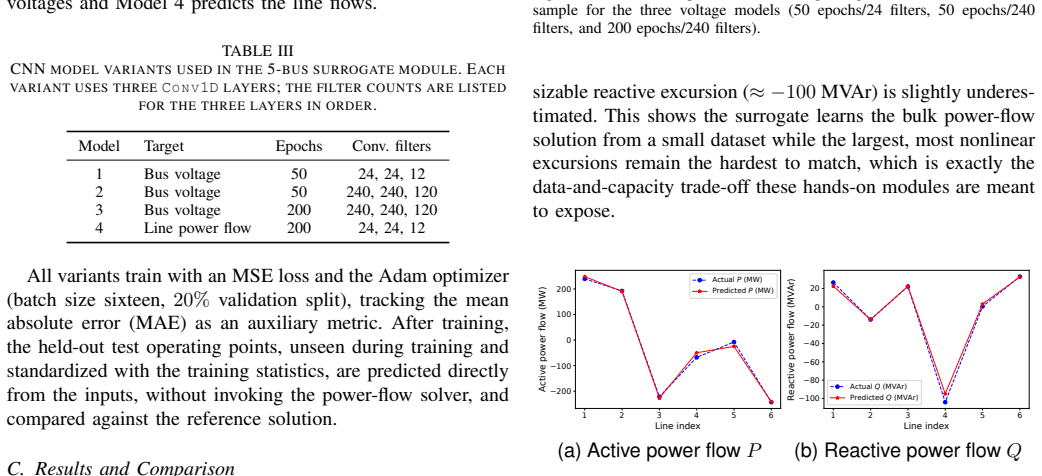
- The CNN power-flow surrogate, trained on just 100 Monte-Carlo power-flow samples, reproduces bus voltages to MAE below 1e-3 pu and line active flows to about 14 MW on unseen cases, showing that small surrogate models are viable teaching vehicles.
- The DRL battery module beats both no-storage and a heuristic cycle rule on its test day, confirming the state-action-reward loop is correctly implemented and can be studied hands-on.
- The PINN module, which adds purely physics-based collocation points to an otherwise identical network, matches the analytical swing-equation response better than an ordinary network, demonstrating the value of physics-informed training.
- The same Template-based design pattern transfers to any expensive-simulator discipline, meaning the framework's reach extends beyond power systems.
Reading between the lines
- If the framework works, the logical next test is a controlled comparison of learning outcomes (time-to-first-successful-run, post-test problem solving) against generic image-based tutorials; the paper explicitly leaves this to future work.
- The survey's N=52, with an undisclosed distribution channel, makes the 92% and 94% figures directional; a broader random sample of power professionals could either replicate or soften the demand signal.
- The 'engineering-grounded AI' principle the paper introduces implies a curriculum redesign principle—anchor every AI method in domain constraints—that could generalize to other engineering fields, though the paper only gestures at that.
- A testable extension is to add time-series (recurrent/sequence) and explainability modules on the same template; the paper lists these as future directions.
Signed reviews
Editorial analysis
A structured set of objections, weighed in public.
Referee Report
Summary. The paper presents an open, executable Jupyter-notebook module library for teaching AI in power systems, motivated by a 52-response community survey. Six modules are organized in three tiers: foundational DNN templates for function and load-curve fitting, a domain-coupled CNN power-flow surrogate for a 5-bus system, and frontier modules on DNN-assisted optimization, DRL battery control, and PINNs for the swing equation. The survey reports 92% of respondents facing at least one AI-learning barrier and 94% wanting a power-specific hands-on course. The authors report early deployment metrics (590+ webinar attendees, 344+ repository visits) and claim the framework lowers the entry barrier for AI in power systems. The technical modules are described with honest caveats about their lightweight demonstration settings.
Significance. If the central claim were fully established, this would be a valuable educational contribution: the open repository, Colab-ready notebooks, unified template, and progressive difficulty ladder are concrete, reusable resources that address a real gap between generic AI tutorials and power-systems practice. The paper's strengths include reproducible executable modules, honest discussion of technical limitations (e.g., the near-degenerate voltage target and the largest nonlinear flow residuals), and a survey-driven design rationale. However, the causal claim that the framework 'lowers the entry barrier' is not currently supported by direct evidence; the reported metrics are proxies for demand and reach, not for learning outcomes or barrier reduction. The EGAI terminology is a useful framing device but is not developed into a measured or testable construct.
major comments (3)
- [Abstract, Contribution C, Section VII-E] The paper's central claim is that the framework 'lowers the entry barrier' (Abstract and Contribution C). Section VII-E states that 'A formal classroom evaluation of learning outcomes... would further quantify the educational impact,' which concedes that no direct evaluation exists. The evidence actually presented—survey self-reports of barriers, webinar attendance, and repository visits—is evidence of demand and reach, not of barrier reduction or learning. Please reframe the claim to 'addresses self-reported barriers' or add direct evidence such as pre/post tests, notebook completion rates, or task-success measures. This is load-bearing because the title and abstract promise an outcome that is not measured.
- [Section II-A, Table I] The survey is the empirical foundation for the design. The distribution channel is undisclosed, N=52 is small, and the acknowledgment notes support from IEEE PES AIPSCC, an AI-focused committee, creating a risk of selection bias toward AI-friendly respondents. Without details on the sampling frame, recruitment method, response rate, and raw data availability, the aggregate 92%/94% figures cannot be interpreted as representative of the broader power-and-energy community. Please report how the survey was distributed, the response rate, and release anonymized survey data or a summary sufficient for independent assessment.
- [Section VII-C and Contribution D] The 'community validation' metrics (590+ webinar attendees, 344+ repository visits in two weeks) are engagement proxies. They do not demonstrate that learners successfully ran the notebooks, understood the concepts, or experienced a lower entry barrier. The phrase 'real-world validation' (Contribution D) overstates what these metrics can support. Please adjust the wording to 'early engagement' and, if possible, report more direct usability indicators from the repository, such as Colab execution counts, issue reports, or completion analytics.
minor comments (5)
- [Section II-A.1] Typo: 'tutotials' should be 'tutorials'.
- [Section VI-A] Typo: 'applilication' should be 'application'.
- [Section V-C] Notation: 'incase5' should be 'in case 5' for readability; also clarify what 'case5' refers to (the PJM 5-bus system with one PQ bus).
- [Table III] The header contains a formatting glitch: 'CO N V1D' should read 'Conv1D layers'.
- [References [11] and [25]] Reference [11] and Reference [25] are the same paper (She et al., 'Fusion of microgrid control with model-free reinforcement learning'); duplicate entries should be consolidated.
Circularity Check
No circularity: module results are checked against external references; the survey/webinar loop is a validity limitation, not a derivational circle.
full rationale
This paper makes no derivational claim that reduces to its own inputs. The DNN function-approximation module is compared to analytic ground truth; the CNN power-flow surrogate is evaluated against held-out pandapower reference solutions with an explicit leakage-free input/target split (Section V-A); the DNN-assisted optimization example separately evaluates satisfaction of the true nonlinear constraint; and the PINN is compared to the analytical swing-equation solution. None of these results are fitted to the comparison they are used to support. The survey and deployment metrics (590+ webinar attendees, 344 repo visits) are demand/engagement proxies, not predictions derived from the framework, and Section VII-E explicitly concedes that no formal classroom evaluation of learning outcomes was performed; that is a limitation in evidence, not circularity. Although several references are to the authors' own prior work (e.g., [14], [19], [20], [24]), none carries a load-bearing derivation: the PJM 5-bus system is an external benchmark, EGAI is introduced as a named design principle rather than an imported theorem, and no uniqueness claim or ansatz is borrowed to force the paper's conclusions. The central contribution is a set of executable educational modules whose pedagogical effectiveness is asserted on the basis of demand and engagement, not derived from those metrics, so no circular step is present.
Assumptions & free parameters
free parameters (6)
- LOAD_STD load perturbation noise =
0.10 (10%)
- N_SAMPLES Monte-Carlo power-flow runs =
100
- DNN/CNN training hyperparameters =
EPOCHS 50-500; HIDDEN_LAYERS [64,32] etc.; TRAIN_RATIO 0.70/0.20
- DRL synthetic 24-h profile and cost coefficients
- PINN composite loss weights and collocation points =
300 collocation points; weights unspecified in text
- DNN-assisted optimization training set size and width =
6000 samples; 64-unit hidden layer
assumptions (5)
- domain assumption pandapower's power-flow solver correctly solves the modified PJM 5-bus system, and its outputs are ground truth for the surrogate targets.
- domain assumption The linearized swing equation (M dω/dt + Dω + Ks δ = ΔP) with the given parameters captures the dynamics taught in the PINN module.
- domain assumption The 52-response survey sample represents the broader power-system AI-learner population.
- standard math The ReLU network with big-M / linear_bounds encoding is an exact MILP embedding of the trained network.
- standard math Standard supervised and RL training procedures (Adam+backprop, ε-greedy DQN with target networks) behave as the demos assume.
invented entities (1)
-
Engineering-Grounded AI (EGAI)
Cite this review
Pith. "Pith review of Bridging Artificial Intelligence and Power Systems Education Using a Hands-On Executable Framework." pith.science (2026). https://pith.science/paper/G7BL53KF
@misc{pith2026260802599,
  author       = {Pith},
  title        = {Pith review of: Bridging Artificial Intelligence and Power Systems Education Using a Hands-On Executable Framework},
  year         = {2026},
  howpublished = {\url{https://pith.science/paper/G7BL53KF}},
  note         = {Machine review of arXiv:2608.02599}
}
read the original abstract
Artificial intelligence (AI) is increasingly central to power and energy systems, supporting modeling, forecasting, optimization, and control. Yet most existing works emphasize specialized applications and offer little reusable material for newcomers or interdisciplinary learners, who increasingly rely on large language models rather than building their own. This gap points to a need for engineering-grounded AI (EGAI), in which AI workflows follow established engineering and power-system domain rules rather than acting as task-agnostic black boxes. Motivated by a community survey of researchers and practitioners, which shows 92% report at least one barrier before running an AI model and 94% want a power-specific hands-on course. This paper presents a framework consisting of open, executable module library that lowers the entry barrier for AI in power systems. The modules follow a progressive difficulty ladder that maps core AI concepts onto representative power-system tasks: (i) foundational deep neural network (DNN) templates for function approximation and load-curve fitting; (ii) a domain-coupled convolutional neural network (CNN) power-flow surrogate for a 5-bus system; and (iii) frontier modules on DNN-assisted optimization, deep reinforcement learning (DRL) for battery storage control, and physics-informed neural networks (PINNs) for the swing equation. All modules are released as Jupyter notebooks that run locally or on Google Colab and are delivered through an IEEE online course and IEEE Power & Energy Society (PES) webinar series. The webinar drew more than 590 live attendees, which is among the ten most-attended IEEE PES webinars, and over 344 repository visits within two weeks, reinforcing the survey-based motivation.
Figures


Figures from the paper (6 more)




Reference graph
Works this paper leans on
-
[11]
Fusion of microgrid control with model-free reinforcement learning: Review and vision,
B. She, F. Li, H. Cui, J. Zhang, and R. Bo, “Fusion of microgrid control with model-free reinforcement learning: Review and vision,” IEEE Transactions on Smart Grid, vol. 14, no. 4, pp. 3232–3245, 2022
2022
-
[25]
Fusion of microgrid control with model-free reinforcement learning: Review and vision,
B. She, F. Li, H. Cui, J. Zhang, and R. Bo, “Fusion of microgrid control with model-free reinforcement learning: Review and vision,” IEEE Transactions on Smart Grid, vol. 14, no. 4, pp. 3232–3245, Jul. 2023
2023
-
[20]
Do AI agents know when a task is simple? Toward complexity-aware reasoning and execution,
J. Yin and X. Feng, “Do AI agents know when a task is simple? Toward complexity-aware reasoning and execution,”arXiv preprint arXiv:2607.13034, 2026
arXiv 2026
-
[1]
X. Chen, G. Qu, Y . Tang, S. H. Low, and N. Li, “Reinforcement learning for selective key applications in power systems: Recent advances and future challenges,”IEEE Transactions on Smart Grid, vol. 13, no. 4, pp. 2935–2958, Jul. 2022. [Online]. Available: https://ieeexplore.ieee.org/document/9721402/
arXiv 2022
-
[2]
Recent developments in machine learning for energy systems reliability management,
L. Duchesne, E. Karangelos, and L. Wehenkel, “Recent developments in machine learning for energy systems reliability management,” Proceedings of the IEEE, vol. 108, no. 9, pp. 1656–1676, Sep. 2020. [Online]. Available: https://ieeexplore.ieee.org/document/9091534/
arXiv 2020
-
[3]
Grid resilience, extreme weather events, and clean energy development: Understanding their interactions in modern power systems,
X. Feng, J. Yin, C. Li, V . Wilson, B. She, Q. Zhang, J. Zhao, C.-f. Chen, K. Tomsovic, X. Fang, H. Cui, R. Bo, and F. F. Li, “Grid resilience, extreme weather events, and clean energy development: Understanding their interactions in modern power systems,”Nature Reviews Clean Technology, 2026, invited paper
2026
-
[4]
Creation and evaluation of a pretertiary artificial intelligence (AI) curriculum,
T. K. F. Chiu, H. Meng, C.-S. Chai, I. King, S. Wong, and Y . Yam, “Creation and evaluation of a pretertiary artificial intelligence (AI) curriculum,”IEEE Transactions on Education, vol. 65, no. 1, pp. 30–39, Feb. 2022. [Online]. Available: https://ieeexplore.ieee.org/ document/9455898
arXiv 2022
-
[5]
An LLM-driven chatbot in higher education for databases and information systems,
A. T. Neumann, Y . Yin, S. Sowe, S. Decker, and M. Jarke, “An LLM-driven chatbot in higher education for databases and information systems,”IEEE Transactions on Education, vol. 68, no. 1, pp. 103–116, Feb. 2025. [Online]. Available: https://ieeexplore.ieee.org/document/ 10706931/
2025
Show all 30 references
-
[6]
Integrating AI in engineering education: A comprehensive review and student- informed module design for U.K. students,
Y . Hao, Y . Liu, B. Liu, G. Amarantidis, and R. Ghannam, “Integrating AI in engineering education: A comprehensive review and student- informed module design for U.K. students,”IEEE Transactions on Education, vol. 68, no. 2, pp. 173–185, Apr. 2025. [Online]. Available: https:...
2025
-
[7]
Framework for adoption of generative artificial intelligence (GenAI) in education,
S. Shailendra, R. Kadel, and A. Sharma, “Framework for adoption of generative artificial intelligence (GenAI) in education,”IEEE Transactions on Education, vol. 67, no. 5, pp. 777–785, Oct. 2024. [Online]. Available: https://ieeexplore.ieee.org/document/10629211/
2024
-
[8]
Making AI accessible for STEM teachers: Using explainable AI for unpacking classroom discourse analysis,
D. Wang and G. Chen, “Making AI accessible for STEM teachers: Using explainable AI for unpacking classroom discourse analysis,”IEEE Transactions on Education, vol. 67, no. 6, pp. 907–918, Dec. 2024. [Online]. Available: https://ieeexplore.ieee.org/document/10605115/
2024
-
[9]
The impact of artificial intelligence on learning and teaching of engineering,
P. Guedes, E. Abranches Silva Lopes, P. F. Ribeiro, and A. C. Zambroni De Souza, “The impact of artificial intelligence on learning and teaching of engineering,”IEEE Transactions on Education, vol. 68, no. 5, pp. 417–425, Oct. 2025. [Online]. Available: https://ieeexplore.ieee...
2025
-
[10]
Applications of artificial intelligence in power system operation, control and planning: a review,
U. Pandey, A. Pathak, A. Kumar, and S. Mondal, “Applications of artificial intelligence in power system operation, control and planning: a review,”Clean Energy, vol. 7, no. 6, pp. 1199–1218, Dec
-
[12]
An overview of artificial intelligence applications for power electronics,
S. Zhao, F. Blaabjerg, and H. Wang, “An overview of artificial intelligence applications for power electronics,”IEEE Transactions on Power Electronics, vol. 36, no. 4, pp. 4633–4658, Apr. 2021. [Online]. Available: https://ieeexplore.ieee.org/document/9200511/
2021
-
[13]
Power for AI and AI for power: The infinite entanglement between artificial intelligence and power electronics systems,
M. Chen, H. Cui, F. Blaabjerg, L. Lorenz, R. Hellinger, T. Gray, O. Fink, and K. Hermanns, “Power for AI and AI for power: The infinite entanglement between artificial intelligence and power electronics systems,”IEEE Power Electronics Magazine, vol. 12, no. 1, pp. 37–43, Mar. ...
2025
-
[14]
Review and vision of AI in power system applications,
F. Li and J. Zhao, “Review and vision of AI in power system applications,” Denver, CO, Jul. 2022. [Online]. Available: https://cmte.ieee.org/pes-mlps/wp-content/uploads/sites/91/ 2025/01/IEEE-PES-GM22 AI-Supersession 1-Fran-Li.pdf
2022
-
[15]
Pathway toward an open source ecosystem in power systems: A blueprint for collaborative innovation and software sustainability,
A. Ali, J. Yin, F. F. Li, and H. Cui, “Pathway toward an open source ecosystem in power systems: A blueprint for collaborative innovation and software sustainability,”IEEE Electrification Magazine, vol. 13, no. 2, pp. 58–67, Jun. 2025. [Online]. Available: https: //ieeexplore....
2025
-
[16]
An open source power system simulator in python for efficient prototyping of W AMPAC applications,
H. Haugdal and K. Uhlen, “An open source power system simulator in python for efficient prototyping of W AMPAC applications,” Jan. 2021, arXiv:2101.02937 [eess]. [Online]. Available: http://arxiv.org/abs/2101. 02937
2021 arXiv
-
[17]
AI for optimal power flow
J. Montalvo, U. Agwan, P. Moutis, and E. Liang, “AI for optimal power flow.” [Online]. Available: https://colab.research.google.com/github/climatechange-ai-tutorials/ optimal-power-flow/blob/main/AI for Optimal Power Flow.ipynb
-
[18]
A data-driven adaptive control approach for enhancing the dynamic response of VSGs in varying grid conditions,
S. Fahad, B. She, J. Yin, F. Li, H. Cui, and R. Bo, “A data-driven adaptive control approach for enhancing the dynamic response of VSGs in varying grid conditions,”IEEE Transactions on Power Delivery, pp. 1–13, 2025. [Online]. Available: https: //ieeexplore.ieee.org/document/10950127
2025
-
[19]
Small test systems for power system economic studies,
F. Li and R. Bo, “Small test systems for power system economic studies,” inIEEE PES General Meeting, Jul. 2010, pp. 1–4, iSSN: 1944-9925. [Online]. Available: https://ieeexplore.ieee.org/document/ 5589973/authors
2010
-
[21]
AI for power and energy systems: Applications, challenges, and opportunities,
F. Li, “AI for power and energy systems: Applications, challenges, and opportunities,” 2026. [Online]. Available: https://xplorestaging.ieee.org/ courses/details/EDP818
2026
-
[22]
AI for power system applications: Hands-on examples, selected applications, and perspectives,
F. Li, “AI for power system applications: Hands-on examples, selected applications, and perspectives,” IEEE Power & Energy Society (PES) Webinar, Part I, Jun. 2026, video recording. [Online]. Available: https://resourcecenter.ieee-pes.org/education/webinars/pes ed web aip1 061026
2026
-
[23]
AI for power system applications: Hands-on examples, selected applications, and perspectives,
F. Li, “AI for power system applications: Hands-on examples, selected applications, and perspectives,” IEEE Power & Energy Society (PES) Webinar, Part I, Jun. 2026, slides. [Online]. Available: https://resourcecenter.ieee-pes.org/education/webinars/pes ed web aip1 061026 sld
2026
-
[24]
AI for power and energy systems: Hands- on examples,
J. Yin, B. She, and F. Li, “AI for power and energy systems: Hands- on examples,” GitHub repository, Sep. 2025. [Online]. Available: https://github.com/enliten/IEEE-course AI-for-Power-Energy-Systems
2025
-
[26]
Physics-informed neural networks: A deep learning framework for solving forward and inverse problems involving nonlinear partial differential equations,
M. Raissi, P. Perdikaris, and G. E. Karniadakis, “Physics-informed neural networks: A deep learning framework for solving forward and inverse problems involving nonlinear partial differential equations,” Journal of Computational Physics, vol. 378, pp. 686–707, 2019
2019
-
[27]
Physics-informed neural networks for power systems,
G. S. Misyris, A. Venzke, and S. Chatzivasileiadis, “Physics-informed neural networks for power systems,” in2020 IEEE Power & Energy Society General Meeting (PESGM), 2020, pp. 1–5. [Online]. Available: https://arxiv.org/abs/1911.03737
2020 arXiv
-
[28]
Encoding frequency dynamics into economic operation of IBR-penetrated power systems: Quantification, integration, and validation,
J. Yin, B. She, J. Wang, and F. Li, “Encoding frequency dynamics into economic operation of IBR-penetrated power systems: Quantification, integration, and validation,”IEEE Transactions on Smart Grid, 2026
2026
-
[29]
Virtual inertia scheduling (VIS) for real-time economic dispatch of IBR-penetrated power systems,
B. She, F. Li, H. Cui, J. Wang, Q. Zhang, and R. Bo, “Virtual inertia scheduling (VIS) for real-time economic dispatch of IBR-penetrated power systems,”IEEE Transactions on Sustainable Energy, vol. 15, no. 2, pp. 938–951, 2023
2023
-
[2023]
Available: https://academic.oup.com/ce/article/7/6/1199/ 7425141
[Online]. Available: https://academic.oup.com/ce/article/7/6/1199/ 7425141
Reviewed August 4, 2026 · model on record in the stance chip above.
Discussion (0). Continue with ORCID to comment.