REVIEW 4 major objections 5 minor 118 references
Hunyuan3D-Buffalo 1.0: A Unified Multimodal Model for Scalable 3D Generation, Understanding, and Editing
T0 review · 4 major / 5 minor · reviewed 2026-08-07 · deepseek-v4-flash
Pith's one-line read One unified 3D model outdoes prior systems in generation and editing
desk verdict A serious industrial unified 3D model with a genuinely novel data engine, but the editing data pipeline's admitted interior-mask inconsistency is the load-bearing risk. read the letter →
The pith
A machine-rendered reading of the paper's core claim, the machinery that carries it, and where it could break.
The reading
What carries the argument
The load-bearing mechanism is the two-model architecture plus a large synthetic data engine. Hunyuan3D-VLM encodes a colored point cloud through separate structure and appearance paths, compresses the tokens with a Q-Former, and augments the language vocabulary with 133 special tokens for quantized 3D bounding boxes, giving the model explicit part-level grounding. Hunyuan3D DiT, initialized from Hunyuan3D-2.1, performs flow-matching diffusion conditioned on VLM hidden states through an MLP connector, and for editing and part generation receives the source object's latent directly as additional input so unedited geometry can be preserved. On the data side, Nano3D-v2 generates editing pairs by selecting an anchor view with a VLM, editing that 2D view, predicting a 3D bounding box with a learned autoregressive transformer, applying voxel-level editing inside the box while freezing outside tokens, then refining geometry with LATTICE and texture with NaTex, and finally filtering and re-annotating pairs with a VLM. This pipeline is what makes 12M editing pairs available; without it, the unified training would not have editing supervision.
What would settle it
Run the Nano3D-v2 pipeline on a random sample of source assets, and for each pair measure the Chamfer distance restricted to the voxels inside the predicted bounding box that the source-target difference mask marks as unedited; if a substantial fraction of pairs exceed the model's own reported error range (e.g., average CD above about 0.009 on those interior regions), the end-to-end editing scores are inflated by training on inconsistent pairs.
Extended reading notes
Core claim
Hunyuan3D-Buffalo 1.0 claims that a single model can read a 3D object, answer questions about it, generate a new object from text, edit an existing object following an instruction, and extract or generate a named part, all without switching systems. The claim is carried by coupling a 3D vision-language model with a diffusion transformer: the VLM supplies semantic, structural, and spatial reasoning, an MLP connector projects its hidden states into the DiT's conditioning space, and for editing and part generation the source object's representation is concatenated into the denoiser so unedited regions are preserved. The authors further claim that unified training creates measurable synergy: stronger text-to-3D generation produces more complete edited geometry, and stronger 3D understanding improves localization and instruction following in editing. If correct, the result would make separate specialist models for each 3D task unnecessary for most purposes.
Load-bearing premise
The whole editing result stands on the assumption that the automatically generated editing pairs are geometrically consistent enough to learn from, specifically that regions inside the predicted 3D box that were not meant to change really are unchanged, an assumption the paper itself flags as difficult to guarantee.
Editorial extensions
If this is right
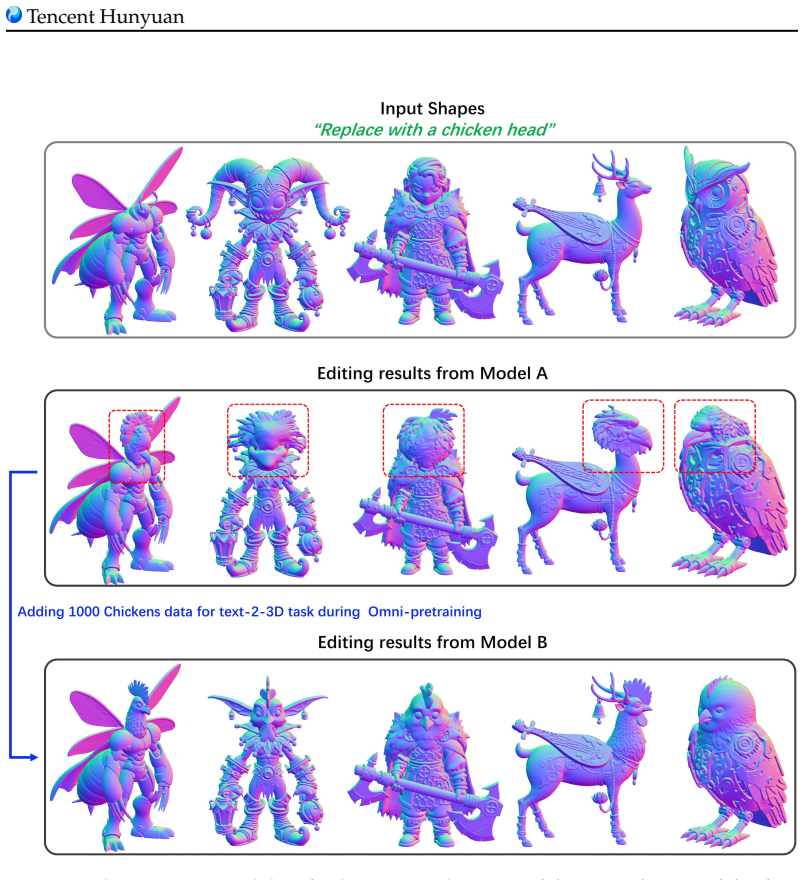
- If the synergy claim is right, adding cheaper text-to-3D data can substitute for expensive editing data: the paper shows that 1,000 additional chicken samples improved a chicken-head edit without any new editing pairs.
- A user could describe an object, request a change, and get back a 3D asset whose unedited regions match the source, because the source-object conditioning is built into the same architecture.
- 3D editing evaluation numbers would improve by roughly an order of magnitude on Chamfer distance compared with earlier feed-forward and optimization-based editors, an 86.7% relative reduction on average CD versus the strongest prior baseline.
- Part generation becomes a by-product of instruction following, so segmenting "the wheels" and generating a new wheel use the same prompt interface as editing.
- Scaling text-to-3D pretraining data is a direct lever on editing quality, since human preference rates rise monotonically from 8.4% to 57.5% as the corpus grows from 3M to 50M samples.
Reading between the lines
- A practical recipe implied by the paper is to keep scaling text-to-3D data rather than hand-labeling editing pairs, since the paper shows editing quality follows generation quality and text-to-3D data is far cheaper to construct.
- A testable next step would be to ablate the VLM conditioning while keeping the DiT fixed: if understanding genuinely helps editing, replacing the 3D-VLM with a weaker semantic encoder should degrade localization even when the generative backbone is unchanged.
- One could measure whether the reported editing gains persist on out-of-distribution edit types such as texture-only edits or edits far outside the training mask distribution, since the paper notes that texture editing remains largely unexplored.
- The paper's own caveat about interior mask inconsistency suggests that a more precise editing-region mask could yield further editing gains without changing the model architecture.
Editorial analysis
A structured set of objections, weighed in public.
Referee Report
Summary. The manuscript presents Hunyuan3D-Buffalo 1.0, a unified 3D multimodal model that combines a frozen Hunyuan3D-VLM semantic backbone with a 3D-DiT initialized from Hunyuan3D-2.1. The authors construct an 87M-sample corpus (25M understanding samples, 50M text-to-3D pairs, and 12M editing pairs produced by the proposed Nano3D-v2 pipeline) and train the model in four stages, branching into editing, text-to-3D, and part-generation paths. They report state-of-the-art or leading results on UniPart-Bench for 3D understanding, a 100-prompt human preference study for text-to-3D generation, and Edit3D-Bench for instruction-guided editing. They also claim two cross-task synergies: stronger text-to-3D generation improves editing, and stronger 3D understanding improves editing.
Significance. If the reported results hold, this is a meaningful step toward unified 3D multimodal models, with a large corpus, a reusable architecture, and an unusually candid discussion of limitations in Section 6. The paper deserves credit for evaluating on external benchmarks (UniPart-Bench, Edit3D-Bench) and for explicitly acknowledging the editing-data pipeline's weaknesses. However, the central editing claims rest on self-reported numbers and on training pairs whose interior-mask consistency is admitted to be unguaranteed; the headline human-preference results also lack basic statistical reporting. The significance of the contribution therefore hinges on whether the authors can validate the editing supervision and provide transparent evaluation details. With that validation, the contribution would be strong.
major comments (4)
- [§3.4 and §6, item 4] The editing-data pipeline's consistency guarantee applies only outside the predicted 3D bounding box; Section 6, item 4, states that the interior of the mask 'often contains non-edited regions whose consistency is difficult to guarantee' and that these inconsistencies 'propagate into the end-to-end model during training, degrading editing quality.' Since the 12M editing pairs are the sole supervision for the reported editing capability, this is a load-bearing limitation rather than a routine future-work item. The manuscript should quantify the fraction of affected pairs (e.g., through a human audit of a random sample before and after the Stage 5 filtering), ablate training with tighter interior consistency checks, or otherwise demonstrate that the Edit3D-Bench gains are not an artifact of learning to reproduce noisy interiors. As written, the claim in Section 3.4 that the corpus supplies 'geometrically consistent' editing pairs is in tension with the admitted limitation.
- [§5.3, Table 7] The Edit3D-Bench evaluation reports no error bars, no number of test samples, and no statistical significance tests; the 86.7% CD reduction over Omni123 is a single point estimate. Because the benchmark and the Nano3D-v2 pipeline may share similar geometric transformations, the manuscript should clarify how the Edit3D-Bench ground-truth edited meshes were constructed and whether any overlap exists with the training corpus or with the operations the model was trained to imitate. A small independent test set with human-verified edits would substantially strengthen the claim.
- [§5.2, Table 5] The human evaluation is described without participant count, recruitment or screening criteria, or statistical analysis. The statement that 'the ranking is consistent across every individual participant' is difficult to assess without per-participant data or at least a measure of agreement; with three baselines plus the proposed method, a preference rate of 55.2% should be accompanied by a confidence interval, inter-annotator statistic, or significance test. Please report these details.
- [§5.3, Fig. 10] The claimed synergy that stronger text-to-3D generation improves editing is supported by a single qualitative chicken-head example, which is not sufficient to establish a general capability-transfer effect. A systematic study varying the scale and diversity of text-to-3D data and measuring editing metrics on a fixed editing set would be needed to substantiate the 'clear direction' stated in the text.
minor comments (5)
- [§3.4 and §6, item 4] The earlier section calls the editing pairs 'geometrically consistent' while the conclusion acknowledges unguaranteed interior consistency; please align the wording to avoid an apparent contradiction.
- [References] References [90] and [91] are the same work (3DEditFormer / 'Towards scalable and consistent 3D editing') and should be merged; reference [24] is cited as 'Vision Banana' in Section 3.5 but as 'Vision-Banana' elsewhere.
- [§1 and §3.4] There are minor typos: 'an unified' in the Figure 1 caption and 'Editing Plaining' in the Stage 2 heading of Section 3.4.
- [Table 6] The units '300w/1500w/5000w' should be defined explicitly (e.g., w = 10^4) to avoid confusion with the earlier '50M' notation.
- [Table 2] The caption-tier descriptions would benefit from a one-sentence explanation of how the 'Paraphrase' tier is generated from the 'Simplified' tier.
Circularity Check
No significant circularity: headline results are measured on external benchmarks and human preference, and self-cited components are building blocks rather than forced inputs.
full rationale
The paper's derivation chain is not circular. Headline claims are evaluated on external benchmarks and human preference: UniPart-Bench (Tables 3-4), Edit3D-Bench (Table 7), and a 100-prompt four-way user study (Table 5) with prompts described as diverse and independent of the training-corpus construction pipeline. The training corpora (25M understanding samples, 50M text-to-3D pairs, 12M editing pairs) are produced by pipelines whose outputs are not defined in terms of the quantities being predicted. Nano3D-v2 is a data-generation engine, not a fitted evaluator; the editing loss is flow-matching on 3D latents, and the Edit3D-Bench metrics (Chamfer Distance and F1 against ground-truth meshes) are not constructed from the model's own fitted parameters. The paper does rely substantially on self-authored components (Hunyuan3D-2.1 initialization, Part-X-MLLM vocabulary and data, the Nano3D family, and Universe3D as a baseline), but these are building blocks or comparison baselines, not definitions of the reported results. No claimed number is equivalent by construction to a cited statement or to a training objective. The paper's own admitted limitation in Section 6, item 4 -- 'the interior of the mask often contains non-edited regions whose consistency is difficult to guarantee. Such inconsistencies propagate into the end-to-end model during training, degrading editing quality' -- is a genuine data-quality risk that could affect editing performance, but it does not make any benchmark result true by definition, nor does it turn a prediction into a fit. Similarly, the cross-task synergy claims are supported only by one qualitative chicken-head example (Fig. 10) and a conditioning-variant comparison; this is weak evidence, but it is not a circularity. No fitted parameter is relabeled as a prediction, and no uniqueness theorem or ansatz is imported from self-citations to force the architecture. Overall, the central results are externally falsifiable and self-contained against the benchmarks, so the appropriate circularity score is 0.
Assumptions & free parameters
free parameters (5)
- text-to-3D vs editing+part-generation sampling ratio =
1:1
- editing and part-generation data repeat factor =
4x
- geometry-quality threshold tau =
10
- Q-Former 3D token count =
512
- boundary alpha-blending band =
7 voxels
assumptions (4)
- domain assumption Nano3D-v2 editing pairs are geometrically consistent enough to serve as training supervision.
- domain assumption VLM filtering and annotation correctly identify valid editing pairs and instructions.
- domain assumption External benchmarks measure the claimed capabilities.
- domain assumption Pretrained components remain valid after joint fine-tuning.
Cite this review
Pith. "Pith review of Hunyuan3D-Buffalo 1.0: A Unified Multimodal Model for Scalable 3D Generation, Understanding, and Editing." pith.science (2026). https://pith.science/paper/V6TDQVA3
@misc{pith2026260802711,
  author       = {Pith},
  title        = {Pith review of: Hunyuan3D-Buffalo 1.0: A Unified Multimodal Model for Scalable 3D Generation, Understanding, and Editing},
  year         = {2026},
  howpublished = {\url{https://pith.science/paper/V6TDQVA3}},
  note         = {Machine review of arXiv:2608.02711}
}
read the original abstract
Recent advances in image generation have demonstrated the potential of unified multimodal models that integrate understanding, generation, and editing. However, unified 3D modeling remains constrained by scarce multimodal data, particularly the lack of large-scale and geometrically consistent editing data. To address this limitation, we propose Hunyuan3D-Buffalo 1.0, a unified framework supporting 3D understanding, text-to-3D generation, instruction-guided 3D editing, and text-grounded part generation within a single architecture. To enable scalable training, we construct an 87M-scale 3D multimodal corpus, comprising 25M understanding samples, 50M text-to-3D pairs, and 12M editing pairs generated using Nano3D-v2. Architecturally, the framework combines Hunyuan3D-VLM for semantic, structural, and spatial understanding with Hunyuan3D DiT for high-fidelity 3D synthesis. The VLM provides multimodal semantic conditions for generation, while editing and part generation additionally condition the diffusion process on the source object representation to preserve its overall structure and unedited regions. Extensive experiments show that Hunyuan3D-Buffalo 1.0 achieves state-of-the-art or leading performance on text-to-3D generation and 3D editing benchmarks, while exhibiting strong understanding and part-generation capabilities. Our analysis further shows that both generation and understanding improve editing, demonstrating the effectiveness of unified 3D multimodal training. Project Page: https://tencent-hunyuan.github.io/Hunyuan3D-Buffalo1.0/
Figures


Figures from the paper (10 more)




Reference graph
Works this paper leans on
-
[1]
S. Bai, K. Chen, X. Liu, J. Wang, W. Ge, S. Song, K. Dang, P . Wang, S. Wang, J. Tang, et al. Qwen2. 5-vl technical report.arXiv preprint arXiv:2502.13923, 2025
arXiv 2025
- [2]
- [3]
-
[4]
K. Bhat, N. Khanna, K. Channa, T. Zhou, Y. Zhu, X. Sun, C. Shang, A. Sudar- shan, M. Chu, D. Li, et al. Cube: A roblox view of 3d intelligence.arXiv preprint arXiv:2503.15475, 2025
arXiv 2025
-
[5]
W. Cai, S. Fang, W. Ye, X. Dong, Y. Yang, X. Zhang, W. Cheng, Y. Cao, G. Yu, and T. Chen. Native 3d editing with full attention.arXiv preprint arXiv:2511.17501, 2025
arXiv 2025
-
[6]
C. Cao, C. Yu, F. Wang, X. Xue, and Y. Fu. Mvinpainter: Learning multi-view consistent inpainting to bridge 2d and 3d editing, 2024. URL https://arxiv.org/abs/2408. 08000
2024
-
[7]
S. Cao, H. Chen, P . Chen, Y. Cheng, Y. Cui, X. Deng, Y. Dong, K. Gong, T. Gu, X. Gu, et al. Hunyuanimage 3.0 technical report.arXiv preprint arXiv:2509.23951, 2025
arXiv 2025
-
[8]
H. Chen, R. Shi, Y. Liu, B. Shen, J. Gu, G. Wetzstein, H. Su, and L. Guibas. Generic 3d diffusion adapter using controlled multi-view editing, 2024. URL https://arxiv. org/abs/2403.12032
arXiv 2024
Show all 118 references
-
[9]
J. Chen, Z. Xu, X. Pan, Y. Hu, C. Qin, T. Goldstein, L. Huang, T. Zhou, S. Xie, S. Savarese, et al. Blip3-o: A family of fully open unified multimodal models-architecture, training and dataset.arXiv preprint arXiv:2505.09568, 2025
2025 arXiv
-
[10]
J. Chen, L. Xue, Z. Xu, X. Pan, S. Yang, C. Qin, A. Yan, H. Zhou, Z. Chen, L. Huang, et al. Blip3o-next: Next frontier of native image generation.arXiv preprint arXiv:2510.15857, 2025
2025
-
[11]
L. Chen, P . Wang, G. Zhang, Z. Ma, and L. Zhang. Omni-3dedit: Generalized versatile 3d editing in one-pass. InProceedings of the IEEE/CVF Conference on Computer Vision and Pattern Recognition, pages 12640–12650, 2026
2026
-
[12]
M. Chen, J. Xie, I. Laina, and A. Vedaldi. Shap-editor: Instruction-guided latent 3d editing in seconds, 2023. URLhttps://arxiv.org/abs/2312.09246
2023 arXiv
-
[13]
R. Chen, Y. Chen, N. Jiao, and K. Jia. Fantasia3d: Disentangling geometry and ap- pearance for high-quality text-to-3d content creation. InProceedings of the IEEE/CVF International Conference on Computer Vision, pages 22246–22256, 2023
2023
-
[14]
X. Chen, Z. Wu, X. Liu, Z. Pan, W. Liu, Z. Xie, X. Yu, and C. Ruan. Janus-pro: Unified multimodal understanding and generation with data and model scaling.arXiv preprint arXiv:2501.17811, 2025
2025 arXiv
-
[15]
Y. Chen, T. He, D. Huang, W. Ye, S. Chen, J. Tang, X. Chen, Z. Cai, L. Yang, G. Yu, et al. Meshanything: Artist-created mesh generation with autoregressive transformers. arXiv preprint arXiv:2406.10163, 2024
2024 arXiv
-
[16]
Y. Chen, Z. Li, Y. Wang, H. Zhang, Q. Li, C. Zhang, and G. Lin. Ultra3d: Efficient and high-fidelity 3d generation with part attention.arXiv preprint arXiv:2507.17745, 2025
2025 arXiv
-
[17]
Y. Chen, Y. Wang, Y. Luo, Z. Wang, Z. Chen, J. Zhu, C. Zhang, and G. Lin. Me- shanything v2: Artist-created mesh generation with adjacent mesh tokenization. In Proceedings of the IEEE/CVF International Conference on Computer Vision, pages 13922– 13931, 2025
2025
-
[18]
Y. Chi, X. Li, Z. Huang, and J. M. Rehg. Vinedresser3d: Towards agentic text-guided 3d editing. InProceedings of the IEEE/CVF Conference on Computer Vision and Pattern Recognition, pages 12673–12683, 2026
2026
-
[19]
Y. Cui, H. Chen, H. Deng, X. Huang, X. Li, J. Liu, Y. Liu, Z. Luo, J. Wang, W. Wang, Y. Wang, C. Wang, F. Zhang, Y. Zhao, T. Pan, X. Li, Z. Hao, W. Ma, Z. Chen, Y. Ao, T. Huang, Z. Wang, and X. Wang. Emu3.5: Native multimodal models are world learners, 2025. URLhttps://arxiv.o...
2025 arXiv
-
[20]
C. Deng, D. Zhu, K. Li, C. Gou, F. Li, Z. Wang, S. Zhong, W. Yu, X. Nie, Z. Song, G. Shi, and H. Fan. Emerging properties in unified multimodal pretraining.arXiv preprint arXiv:2505.14683, 2025
2025 arXiv
-
[21]
N. A. Dinh, I. Lang, H. Kim, O. Stein, and R. Hanocka. Geometry in style: 3d stylization via surface normal deformation, 2025. URLhttps://arxiv.org/abs/2503.23241. 28 Tencent Hunyuan
2025 arXiv
-
[22]
S. Dong, L. Ding, Z. Huang, Z. Wang, T. Xue, and D. Xu. Interactive3d: Create what you want by interactive 3d generation, 2024. URLhttps://arxiv.org/abs/2404.16510
2024 arXiv
-
[23]
Erkoc ¸, C
Z. Erkoc ¸, C. G ¨umeli, C. Wang, M. Nießner, A. Dai, P . Wonka, H.-Y. Lee, and P . Zhuang. Preditor3d: Fast and precise 3d shape editing, 2024. URL https://arxiv.org/abs/ 2412.06592
2024 arXiv
-
[24]
Gabeur, S
V . Gabeur, S. Long, S. Peng, P . Voigtlaender, S. Sun, Y. Bao, K. Truong, Z. Wang, W. Zhou, J. T. Barron, K. Genova, N. Kannen, S. Ben, Y. Li, M. Guo, S. Yogin, Y. Gu, H. Chen, O. Wang, S. Xie, H. Zhou, K. He, T. Funkhouser, J.-B. Alayrac, and R. Soricut. Image generators are...
2026 arXiv
-
[25]
W. Gao, D. Wang, Y. Fan, A. Bozic, T. Stuyck, Z. Li, Z. Dong, R. Ranjan, and N. Sarafi- anos. 3d mesh editing using masked lrms, 2024. URL https://arxiv.org/abs/2412. 08641
2024
-
[26]
Y. Gao, L. Gong, Q. Guo, X. Hou, Z. Lai, F. Li, L. Li, X. Lian, C. Liao, L. Liu, et al. Seedream 3.0 technical report.arXiv preprint arXiv:2504.11346, 2025
2025 arXiv
-
[27]
I. Gat, D. Cohen-Bar, G. Levy, E. Richardson, and D. Cohen-Or. Shapeup: Scalable image-conditioned 3d editing.arXiv preprint arXiv:2602.05676, 2026
2026 arXiv
-
[28]
Z. Hao, D. W. Romero, T.-Y. Lin, and M.-Y. Liu. Meshtron: High-fidelity, artist-like 3d mesh generation at scale.arXiv preprint arXiv:2412.09548, 2024
2024 arXiv
-
[29]
Haque, M
A. Haque, M. Tancik, A. A. Efros, A. Holynski, and A. Kanazawa. Instruct-nerf2nerf: Editing 3d scenes with instructions. InProceedings of the IEEE/CVF International Conference on Computer Vision, pages 19740–19750, 2023
2023
-
[30]
He, Z.-X
X. He, Z.-X. Zou, C.-H. Chen, Y.-C. Guo, D. Liang, C. Yuan, W. Ouyang, Y.-P . Cao, and Y. Li. Sparseflex: High-resolution and arbitrary-topology 3d shape modeling. In Proceedings of the IEEE/CVF International Conference on Computer Vision, pages 14822– 14833, 2025
2025
-
[31]
Hsiao, B.-K
T.-F. Hsiao, B.-K. Ruan, Y.-L. Liu, and H.-H. Shuai. Vecset-edit: Unleashing pre-trained lrm for mesh editing from single image. InProceedings of the Special Interest Group on Computer Graphics and Interactive Techniques Conference Conference Papers, pages 1–12, 2026
2026
-
[32]
S. Hu, Y. Wei, F. Zha, Y. Guo, and J. Zhang. Easy3e: Feed-forward 3d asset editing via rectified voxel flow. InProceedings of the IEEE/CVF Conference on Computer Vision and Pattern Recognition, pages 12730–12740, 2026
2026
-
[33]
Huang, D
Z. Huang, D. Zheng, C. Zou, R. Liu, X. Wang, K. Ji, W. Chai, J. Sun, L. Wang, Y. Lv, T. Huang, J. Liu, Q. Guo, M. Yang, J. Chen, and J. Zhou. Ming-univision: Joint image understanding and generation with a unified continuous tokenizer.arXiv preprint arXiv:2510.06590, 2025
-
[34]
Hunyuan3D
T. Hunyuan3D. Hunyuan3d studio: End-to-end ai pipeline for game-ready 3d asset generation.arXiv preprint arXiv:2509.12815, 2025
2025
-
[35]
Hunyuan3D, B
T. Hunyuan3D, B. Zhang, C. Guo, H. Liu, H. Yan, H. Shi, J. Huang, J. Yu, K. Li, P . Wang, et al. Hunyuan3d-omni: A unified framework for controllable generation of 3d assets. arXiv preprint arXiv:2509.21245, 2025
2025
-
[36]
Hunyuan3D, :, B
T. Hunyuan3D, :, B. Zhang, C. Guo, D. Guo, H. Liu, H. Yan, H. Shi, J. Yu, J. Xu, J. Huang, K. Li, L. Wang, Linus, P . Wang, Q. Lin, R. Tang, X. Yang, Y. Li, Y. Guan, Y. Zhao, Y. Yang, Z. Lai, Z. Liang, and Z. Zhao. Hy3d-bench: Generation of 3d assets,
-
[37]
J. Kim, Y. Lan, A. Fortes, Y. Chen, and X. Pan. Fastmesh: Efficient artistic mesh generation via component decoupling.arXiv preprint arXiv:2508.19188, 2025
2025
-
[38]
B. F. Labs, S. Batifol, A. Blattmann, F. Boesel, S. Consul, C. Diagne, T. Dockhorn, J. English, Z. English, P . Esser, S. Kulal, K. Lacey, Y. Levi, C. Li, D. Lorenz, J. M¨uller, D. Podell, R. Rombach, H. Saini, A. Sauer, and L. Smith. Flux.1 kontext: Flow matching for in-conte...
2025 arXiv
-
[39]
Z. Lai, Y. Zhao, H. Liu, Z. Zhao, Q. Lin, H. Shi, X. Yang, M. Yang, S. Yang, Y. Feng, et al. Hunyuan3d 2.5: Towards high-fidelity 3d assets generation with ultimate details. arXiv preprint arXiv:2506.16504, 2025
2025 arXiv
-
[40]
Z. Lai, Y. Zhao, Z. Zhao, H. Liu, Q. Lin, J. Huang, C. Guo, and X. Yue. Lattice: Democratize high-fidelity 3d generation at scale.arXiv preprint arXiv:2512.03052, 2025
2025
-
[41]
Z. Lai, Y. Zhao, Z. Zhao, X. Yang, X. Huang, J. Huang, X. Yue, and C. Guo. Natex: Seamless texture generation as latent color diffusion.arXiv preprint arXiv:2511.16317, 2025. 29 Tencent Hunyuan
2025
-
[42]
L. Li, Z. Huang, H. Feng, G. Zhuang, R. Chen, C. Guo, and L. Sheng. Voxhammer: Training-free precise and coherent 3d editing in native 3d space.arXiv preprint arXiv:2508.19247, 2025
2025 arXiv
-
[43]
P . Li, S. Ma, J. Chen, Y. Liu, C. Zhang, W. Xue, W. Luo, A. Sheffer, W. Wang, and Y. Guo. Cmd: Controllable multiview diffusion for 3d editing and progressive generation,
-
[44]
W. Li, J. Liu, H. Yan, R. Chen, Y. Liang, X. Chen, P . Tan, and X. Long. Craftsman3d: High-fidelity mesh generation with 3d native generation and interactive geometry refiner.arXiv preprint arXiv:2405.14979, 2024
2024 arXiv
-
[45]
W. Li, A. Toisoul, T. Monnier, R. Shapovalov, R. Ranjan, P . Tan, and A. Vedaldi. Meshflow: Efficient artistic mesh generation via meshvae and flow-based diffusion transformer. InProceedings of the IEEE/CVF Conference on Computer Vision and Pattern Recognition, pages 5849–5858, 2026
2026
-
[46]
Li, Z.-X
Y. Li, Z.-X. Zou, Z. Liu, D. Wang, Y. Liang, Z. Yu, X. Liu, Y.-C. Guo, D. Liang, W. Ouyang, et al. Triposg: High-fidelity 3d shape synthesis using large-scale rec- tified flow models.arXiv preprint arXiv:2502.06608, 2025
2025 arXiv
-
[47]
Y. Li, V . Cheung, X. Liu, Y. Chen, Z. Luo, B. Lei, H. Weng, Z. Zhao, J. Huang, Z. Chen, and C. Guo. Auto-regressive surface cutting.arXiv preprint arXiv:2506.18017, 2026
2026 arXiv
-
[48]
Z. Li, W. Li, T. Wang, Z. Wang, J. Wu, H. Wang, Y. Yang, Z. Huang, Y. Li, P . Liu, and C. Guo. Moca: Mixture-of-components attention for scalable compositional 3d generation.arXiv preprint arXiv:2512.07628, 2025
2025
-
[49]
Z. Li, Y. Wang, H. Zheng, Y. Luo, and B. Wen. Sparc3d: Sparse representation and construction for high-resolution 3d shapes modeling.arXiv preprint arXiv:2505.14521, 2025
2025 arXiv
-
[50]
S. Lim, S. Yoon, G. Koo, H. Yun, and C. D. Yoo. Tango: Training-free 3d editing via tangent-space guidance and optimization.arXiv preprint arXiv:2607.14927, 2026
2026 arXiv
-
[51]
C.-H. Lin, J. Gao, L. Tang, T. Takikawa, X. Zeng, X. Huang, K. Kreis, S. Fidler, M.-Y. Liu, and T.-Y. Lin. Magic3d: High-resolution text-to-3d content creation. InProceedings of the IEEE/CVF conference on computer vision and pattern recognition, pages 300–309, 2023
2023
-
[52]
F. Liu, H. Wang, W. Chen, H. Sun, and Y. Duan. Make-your-3d: Fast and consistent subject-driven 3d content generation, 2024. URL https://arxiv.org/abs/2403.09625
2024 arXiv
-
[53]
F. Liu, J. Ye, Y. Wang, H. Wang, Z. Wang, J. Zhu, and Y. Duan. Dreamreward-x: Boosting high-quality 3d generation with human preference alignment.IEEE Transactions on Pattern Analysis and Machine Intelligence, 2025
2025
-
[54]
H. Liu, Y. Lin, J. Guo, R. Chu, J. Wang, R. Li, and Y. Yang. Velocity-space 3d asset editing.arXiv preprint arXiv:2605.07385, 2026
2026 arXiv
-
[55]
M. Liu, M. A. Uy, D. Xiang, H. Su, S. Fidler, N. Sharp, and J. Gao. Partfield: Learning 3d feature fields for part segmentation and beyond. InProceedings of the IEEE/CVF International Conference on Computer Vision (ICCV), pages 9704–9715, 2025
2025
-
[56]
Z. Luo, Y. Li, M. Zhang, S. Wang, H. Yan, X. Song, T. Shang, W. Mao, H. Li, X. Han, and P . Ji. Bag: Body-aligned 3d wearable asset generation.IEEE Transactions on Visualization and Computer Graphics, 2026
2026
-
[57]
C. Ma, Y. Li, X. Yan, J. Xu, Y. Yang, C. Wang, Z. Zhao, Y. Guo, Z. Chen, and C. Guo. P3-sam: Native 3d part segmentation.arXiv preprint arXiv:2509.06784, 2025
2025
-
[58]
Z. Ma, H. Chen, Y. Yue, and G. Gkioxari. Feedforward 3d editing via text-steerable image-to-3d, 2025. URLhttps://arxiv.org/abs/2512.13678
2025
-
[59]
K. Mo, S. Zhu, A. X. Chang, L. Yi, S. Tripathi, L. J. Guibas, and H. Su. Partnet: A large- scale benchmark for fine-grained and hierarchical part-level 3d object understanding. InProceedings of the IEEE/CVF conference on computer vision and pattern recognition, pages 909–918, 2019
2019
-
[60]
X. Pan, S. N. Shukla, A. Singh, Z. Zhao, S. K. Mishra, J. Wang, Z. Xu, J. Chen, K. Li, F. Juefei-Xu, et al. Transfer between modalities with metaqueries.arXiv preprint arXiv:2504.06256, 2025
2025 arXiv
-
[61]
Poole, A
B. Poole, A. Jain, J. T. Barron, and B. Mildenhall. Dreamfusion: Text-to-3d using 2d diffusion.arXiv preprint arXiv:2209.14988, 2022
2022 arXiv
-
[62]
Z. Qi, R. Dong, S. Zhang, H. Geng, C. Han, Z. Ge, L. Yi, and K. Ma. Shapellm: Universal 3d object understanding for embodied interaction. InEuropean Conference on Computer Vision, pages 214–238. Springer, 2024. 30 Tencent Hunyuan
2024
-
[63]
Z. Qi, Y. Fang, Z. Sun, X. Wu, T. Wu, J. Wang, D. Lin, and H. Zhao. Gpt4point: A unified framework for point-language understanding and generation. InProceedings of the ieee/cvf conference on computer vision and pattern recognition, pages 26417–26427, 2024
2024
-
[64]
Z. Qi, Y. Yang, M. Zhang, L. Xing, X. Wu, T. Wu, D. Lin, X. Liu, J. Wang, and H. Zhao. Tailor3d: Customized 3d assets editing and generation with dual-side images, 2024. URLhttps://arxiv.org/abs/2407.06191
2024 arXiv
-
[65]
L. Qiu, G. Chen, X. Gu, Q. Zuo, M. Xu, Y. Wu, W. Yuan, Z. Dong, L. Bo, and X. Han. Richdreamer: A generalizable normal-depth diffusion model for detail richness in text-to-3d. InProceedings of the IEEE/CVF conference on computer vision and pattern recognition, pages 9914–9925, 2024
2024
-
[66]
L. Qu, H. Zhang, Y. Liu, X. Wang, Y. Jiang, Y. Gao, H. Ye, D. K. Du, Z. Yuan, and X. Wu. Tokenflow: Unified image tokenizer for multimodal understanding and generation. In Proceedings of the Computer Vision and Pattern Recognition Conference, pages 2545–2555, 2025
2025
-
[67]
Seedream, Y
T. Seedream, Y. Chen, Y. Gao, L. Gong, M. Guo, Q. Guo, Z. Guo, X. Hou, W. Huang, Y. Huang, et al. Seedream 4.0: Toward next-generation multimodal image generation. arXiv preprint arXiv:2509.20427, 2025
2025 arXiv
-
[68]
Sella, G
E. Sella, G. Fiebelman, P . Hedman, and H. Averbuch-Elor. Vox-e: Text-guided voxel editing of 3d objects, 2023. URLhttps://arxiv.org/abs/2303.12048
2023 arXiv
-
[69]
Sella, H
E. Sella, H. Phung, N. Amiel, O. Litany, O. Patashnik, and H. Averbuch-Elor. Prox- e: Fine-grained 3d shape editing via primitive-based abstractions.arXiv preprint arXiv:2604.23774, 2026
2026 arXiv
-
[70]
Y. Shi, P . Wang, J. Ye, M. Long, K. Li, and X. Yang. Mvdream: Multi-view diffusion for 3d generation.arXiv preprint arXiv:2308.16512, 2023
2023 arXiv
-
[71]
J. Tang, J. Ren, H. Zhou, Z. Liu, and G. Zeng. Dreamgaussian: Generative gaussian splatting for efficient 3d content creation.arXiv preprint arXiv:2309.16653, 2023
2023 arXiv
-
[72]
J. Tang, Z. Li, Z. Hao, X. Liu, G. Zeng, M.-Y. Liu, and Q. Zhang. Edgerunner: Auto- regressive auto-encoder for artistic mesh generation.arXiv preprint arXiv:2409.18114, 2024
2024 arXiv
- [73]
-
[74]
S. Tong, D. Fan, J. Li, Y. Xiong, X. Chen, K. Sinha, M. Rabbat, Y. LeCun, S. Xie, and Z. Liu. Metamorph: Multimodal understanding and generation via instruction tuning. InProceedings of the IEEE/CVF International Conference on Computer Vision, pages 17001– 17012, 2025
2025
-
[75]
Touvron, T
H. Touvron, T. Lavril, G. Izacard, X. Martinet, M.-A. Lachaux, T. Lacroix, B. Rozi`ere, N. Goyal, E. Hambro, F. Azhar, et al. Llama: Open and efficient foundation language models.arXiv preprint arXiv:2302.13971, 2023
2023 arXiv
-
[76]
Van Den Oord, O
A. Van Den Oord, O. Vinyals, et al. Neural discrete representation learning.Advances in neural information processing systems, 30, 2017
2017
-
[77]
C. Wang, J. Ye, Y. Yang, Y. Li, Z. Lin, J. Zhu, Z. Chen, Y. Luo, and C. Guo. Part-x-mllm: Part-aware 3d multimodal large language model.arXiv preprint arXiv:2511.13647, 2025
2025
-
[78]
C. Wang, H. Weng, J. Ye, B. Lei, Y. Li, Z. Zhao, Z. Lai, K. Zhang, Y. Yang, Z. Chen, et al. Polyflow: Continuous topology embedding flow matching for artist-style mesh generation.arXiv preprint arXiv:2606.30673, 2026
2026 arXiv
-
[79]
Wang, Y.-C
H. Wang, Y.-C. Guo, Y.-T. Liu, Z.-X. Zou, B. Zhang, W. Quan, D. Liang, Y.-P . Cao, and D.-M. Yan. Face: A face-based autoregressive representation for high-fidelity and efficient mesh generation. InProceedings of the IEEE/CVF Conference on Computer Vision and Pattern Recogniti...
2026
-
[80]
P . Wang, Y. He, X. Lv, Y. Zhou, L. Xu, J. Yu, and J. Gu. PartNeXt: A next-generation dataset for fine-grained and hierarchical 3d part understanding. InAdvances in Neural Information Processing Systems, 2025. Datasets and Benchmarks Track
2025
-
[81]
X. Wang, X. Zhang, Z. Luo, Q. Sun, Y. Cui, J. Wang, F. Zhang, Y. Wang, Z. Li, Q. Yu, et al. Emu3: Next-token prediction is all you need.arXiv preprint arXiv:2409.18869, 2024. 31 Tencent Hunyuan
2024 arXiv
-
[82]
Z. Wang, C. Lu, Y. Wang, F. Bao, C. Li, H. Su, and J. Zhu. Prolificdreamer: High-fidelity and diverse text-to-3d generation with variational score distillation.Advances in Neural Information Processing Systems, 36:8406–8441, 2023
2023
-
[83]
H. Weng, Y. Wang, T. Zhang, C. Chen, and J. Zhu. Pivotmesh: Generic 3d mesh generation via pivot vertices guidance.arXiv preprint arXiv:2405.16890, 2024
2024 arXiv
-
[84]
H. Weng, Z. Zhao, B. Lei, X. Yang, J. Liu, Z. Lai, Z. Chen, Y. Liu, J. Jiang, C. Guo, et al. Scaling mesh generation via compressive tokenization. InProceedings of the Computer Vision and Pattern Recognition Conference, pages 11093–11103, 2025
2025
-
[85]
J. Weng, S. Zhang, Z. Diao, P . Li, H. Zhang, J. Chen, and H. Zhao. Feedforward 3d editing learns from semantic-part transformation.arXiv preprint arXiv:2605.27351, 2026
2026 arXiv
-
[86]
C. Wu, J. Li, J. Zhou, J. Lin, K. Gao, K. Yan, S.-m. Yin, S. Bai, X. Xu, Y. Chen, et al. Qwen-Image technical report.arXiv preprint arXiv:2508.02324, 2025
2025 arXiv
-
[87]
C. Wu, P . Zheng, R. Yan, S. Xiao, X. Luo, Y. Wang, W. Li, X. Jiang, Y. Liu, J. Zhou, et al. Omnigen2: Exploration to advanced multimodal generation.arXiv preprint arXiv:2506.18871, 2025
2025 arXiv
-
[88]
Y. Wu, Z. Zhang, J. Chen, H. Tang, D. Li, Y. Fang, L. Zhu, E. Xie, H. Yin, L. Yi, et al. Vila-u: a unified foundation model integrating visual understanding and generation. arXiv preprint arXiv:2409.04429, 2024
2024 arXiv
-
[89]
Z. Wu, P . Zhou, X. Yi, X. Yuan, and H. Zhang. Consistent3d: Towards consistent high-fidelity text-to-3d generation with deterministic sampling prior. InProceedings of the IEEE/CVF conference on computer vision and pattern recognition, pages 9892–9902, 2024
2024
-
[91]
R. Xia, Y. Tang, and P . Zhou. Towards scalable and consistent 3d editing.arXiv preprint arXiv:2510.02994, 2025
2025
-
[92]
Xiang, Z
J. Xiang, Z. Lv, S. Xu, Y. Deng, R. Wang, B. Zhang, D. Chen, X. Tong, and J. Yang. Structured 3d latents for scalable and versatile 3d generation. InProceedings of the Computer Vision and Pattern Recognition Conference, pages 21469–21480, 2025
2025
-
[93]
R. Xu, X. Wang, T. Wang, Y. Chen, J. Pang, and D. Lin. Pointllm: Empowering large language models to understand point clouds. InEuropean Conference on Computer Vision, pages 131–147. Springer, 2024
2024
-
[94]
Y. Xu, H. Zhu, C. Liu, T. Wang, K. Chen, S. Xu, J. Yang, Q. Zhang, et al. Beyond voxel 3d editing: Learning from 3d masks and self-constructed data. InProceedings of the IEEE/CVF Conference on Computer Vision and Pattern Recognition, pages 635–646, 2026
2026
-
[95]
H. Yan, Y. Li, Z. Wu, S. Chen, W. Sun, T. Shang, W. Liu, T. Chen, X. Dai, C. Ma, H. Li, and P . Ji. Frankenstein: Generating semantic-compositional 3d scenes in one tri-plane. InACM SIGGRAPH Asia Conference Proceedings, 2024
2024
-
[96]
H. Yan, M. Zhang, Y. Li, C. Ma, and P . Ji. Phycage: Physically plausible compositional 3d asset generation from a single image, 2024
2024
-
[97]
X. Yan, J. Xu, Y. Li, C. Ma, Y. Yang, C. Wang, Z. Zhao, Z. Lai, Y. Zhao, Z. Chen, and C. Guo. X-part: high fidelity and structure coherent shape decomposition.arXiv preprint arXiv:2509.08643, 2025
2025
-
[98]
Y. Yang, Y. Zhou, Y.-C. Guo, Z.-X. Zou, Y. Huang, Y.-T. Liu, H. Xu, D. Liang, Y.-P . Cao, and X. Liu. Omnipart: Part-aware 3d generation with semantic decoupling and structural cohesion.arXiv preprint arXiv:2507.06165, 2025
2025 arXiv
-
[99]
Y. Yang, C. Wang, J. Ye, Y. Li, Z. Chen, Z. Huang, Y. Mu, Z. Chen, C. Guo, and X. Liu. Physforge: Generating physics-grounded 3d assets for interactive virtual world.arXiv preprint arXiv:2605.05163, 2026
2026 arXiv
-
[100]
C. Ye, C. Cao, C. Pan, Y. Hao, Y. Zhi, Y. Hu, and X. Han. Omni123: Exploring 3d native foundation models with limited 3d data by unifying text to 2d and 3d generation. arXiv preprint arXiv:2604.02289, 2026
2026
-
[101]
J. Ye, F. Liu, Q. Li, Z. Wang, Y. Wang, X. Wang, Y. Duan, and J. Zhu. Dreamreward: Text-to-3d generation with human preference. InEuropean Conference on Computer Vision, pages 259–276. Springer, 2024
2024
-
[102]
J. Ye, Z. Wang, R. Zhao, S. Xie, and J. Zhu. Shapellm-omni: A native multimodal llm for 3d generation and understanding.arXiv preprint arXiv:2506.01853, 2025. 32 Tencent Hunyuan
2025 arXiv
-
[103]
J. Ye, S. Xie, R. Zhao, Z. Wang, H. Yan, W. Zu, L. Ma, and J. Zhu. Nano3d: A training- free approach for efficient 3d editing without masks.arXiv preprint arXiv:2510.15019, 2025
2025
-
[104]
J. Ye, Z. Huang, Y. Qu, C. Wang, Y. Yang, Y. Li, Y. Luo, Z. Chen, S. Lu, J. Zhu, et al. Universe3d: Emerging properties of unified multimodal models in 3d understanding and generation. InProceedings of the IEEE/CVF Conference on Computer Vision and Pattern Recognition, pages 6...
2026
-
[105]
T. Yi, J. Fang, J. Wang, G. Wu, L. Xie, X. Zhang, W. Liu, Q. Tian, and X. Wang. Gaussian- dreamer: Fast generation from text to 3d gaussians by bridging 2d and 3d diffusion models. InProceedings of the IEEE/CVF conference on computer vision and pattern recogni- tion, pages 679...
2024
-
[106]
Y. Yin, Y. Zhou, J. Wei, X. Yang, J. Zhang, J. Bai, J. Ye, W. Zhang, and G. Lin. Edit- verse3d: High-quality 3d object editing with region-aware learning.arXiv preprint arXiv:2607.07187, 2026
2026 arXiv
-
[107]
Zhang, J
B. Zhang, J. Tang, M. Niessner, and P . Wonka. 3dshape2vecset: A 3d shape representa- tion for neural fields and generative diffusion models.ACM Transactions On Graphics (TOG), 42(4):1–16, 2023
2023
-
[108]
Zhang, Z
L. Zhang, Z. Wang, Q. Zhang, Q. Qiu, A. Pang, H. Jiang, W. Yang, L. Xu, and J. Yu. Clay: A controllable large-scale generative model for creating high-quality 3d assets. ACM Transactions on Graphics (TOG), 43(4):1–20, 2024
2024
-
[109]
Zhang, Z
Y. Zhang, Z. Li, M. Zhou, S. Wu, and J. Wu. The scene language: Representing scenes with programs, words, and embeddings, 2025. URL https://arxiv.org/abs/2410. 16770
2025
-
[110]
R. Zhao, J. Ye, Z. Wang, G. Liu, Y. Chen, Y. Wang, and J. Zhu. Deepmesh: Auto- regressive artist-mesh creation with reinforcement learning. InProceedings of the IEEE/CVF International Conference on Computer Vision, pages 10612–10623, 2025
2025
-
[111]
R. Zhao, B. Li, Z. Liu, Y. Liang, J. Ye, F. Liu, D. Wu, Z. Wang, X. Yu, Y. Rao, et al. Gem: Generative supervision helps embodied intelligence.arXiv preprint arXiv:2605.28548, 2026
2026 arXiv
-
[112]
T. Zhao, Y. Zhang, H. Long, J. Zhang, W. Li, Y. Yang, G. Zhang, J. Hladk`y, M. Nießner, and W. Yang. Lato: 3d mesh flow matching with structured topology preserving latents.arXiv preprint arXiv:2603.06357, 2026
2026
-
[113]
Z. Zhao, W. Liu, X. Chen, X. Zeng, R. Wang, P . Cheng, B. Fu, T. Chen, G. Yu, and S. Gao. Michelangelo: Conditional 3d shape generation based on shape-image-text aligned latent representation.Advances in neural information processing systems, 36: 73969–73982, 2023
2023
-
[114]
Zheng, M
Y. Zheng, M. Huang, N. Chen, and Z. Mao. Pro3d-editor : A progressive-views perspective for consistent and precise 3d editing, 2025. URL https://arxiv.org/abs/ 2506.00512
2025 arXiv
-
[115]
Z. Zhou, F. Ma, C. Gui, X. Xia, H. Fan, Y. Yang, and T.-S. Chua. Anchorflow: Training- free 3d editing via latent anchor-aligned flows. InProceedings of the IEEE/CVF Confer- ence on Computer Vision and Pattern Recognition, pages 14387–14397, 2026
2026
-
[116]
Y. Zhu, K. Deng, J.-P . Fauconnier, I. Navarro, D. Li, A. Pun, Y. Zhang, P . Zhuang, X. Sun, M. Agrawala, K. Bhat, and T. Zhou. Cubepart: An open-vocabulary part-controllable 3d generator.arXiv preprint arXiv:2605.28763, 2026
2026 arXiv
-
[117]
Zhuang, D
J. Zhuang, D. Kang, Y.-P . Cao, G. Li, L. Lin, and Y. Shan. Tip-editor: An accurate 3d editor following both text-prompts and image-prompts, 2024. URL https://arxiv. org/abs/2401.14828. 33
2024 arXiv
-
[2025]
URLhttps://arxiv.org/abs/2505.07003
-
[2026]
URLhttps://arxiv.org/abs/2602.03907
Reviewed August 7, 2026 · model on record in the stance chip above.
Discussion (0). Sign in to comment.