REVIEW 5 major objections 4 minor 12 references
Virtues and Vices of Equivariant Transformers
T0 review · 5 major / 4 minor · reviewed 2026-08-07 · deepseek-v4-flash
Pith's one-line read Lorentz-equivariant transformers beat standard taggers whenever 4-vector geometry matters.
desk verdict A solid, cost-aware benchmark showing Lorentz-equivariant transformers win when 4-vectors matter, with a few documentation gaps that should be fixed before the quantitative rankings are trusted. read the letter →
The pith
A machine-rendered reading of the paper's core claim, the machinery that carries it, and where it could break.
The reading
What carries the argument
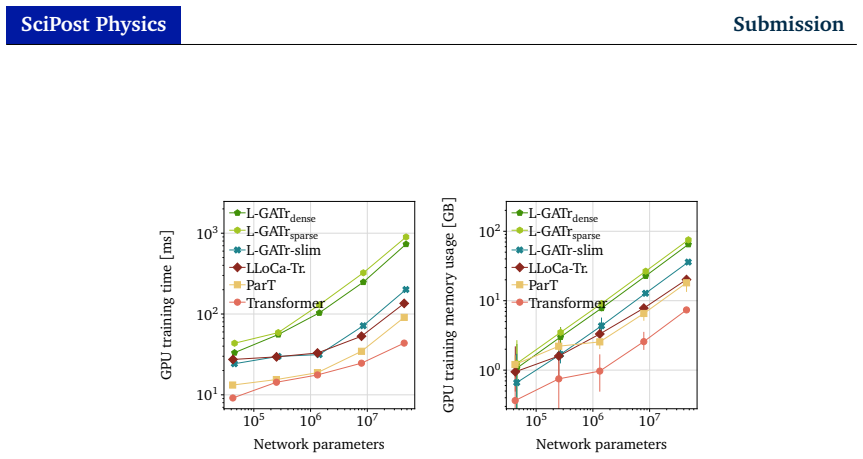
The comparison is built on four devices: a continuous scaling parameter $s$ that grows channels, blocks, heads, and equivariant feature multiplicities in lockstep across all architectures; a set of inference-cost metrics measured on CPUs and GPUs; a power-law fit $T(N)=T_\infty + B/N^\beta$ that separates asymptotic performance from convergence speed; and the geometric representations themselves. L-GATr operates on the 16-dimensional multivector representation of the Lorentz group, L-GATr-slim on a reduced vector-only subalgebra, and LLoCa on local Lorentz frames built by a small equivariant network plus Gram-Schmidt orthonormalization; each equivariant model also carries learned symmetry breaking, since the LHC beam and detector break the full Lorentz group. A new variance-preserving rescaling of the frame transformations, replacing $L$ by $L/\gamma$, keeps deep LLoCa transformers stable at large width. These mechanisms jointly turn the question of whether equivariance helps into a set of cost-performance curves.
What would settle it
Train every architecture with an individual hyperparameter search on the JetClass dataset and compare test loss at fixed measured GPU inference time; if the baseline transformer reaches parity with L-GATr-slim after per-architecture tuning, the paper's ranking is an artifact of the shared recipe. Alternatively, rerun the ATLAS top-tagging benchmark with all models implemented through the same custom CUDA kernels; if the baseline's curve moves onto the Pareto front, the equivariant advantage was mostly implementation headroom.
Extended reading notes
Core claim
The paper's stated conclusion is that Lorentz-equivariant architectures win whenever 4-vectors are relevant, and match the baseline performance when scalar information is important. In the ATLAS top-tagging study and the JetClass multi-class study, the equivariant L-GATr and its slim variant produce lower loss and higher background rejection than the baseline transformer and the approximately equivariant Particle Transformer, and the ordering survives once loss is plotted against inference FLOPs, energy, time, and memory rather than parameter count. In the JetSet flavor-tagging study, where track impact-parameter significances are the dominant scalar features, all architectures converge to nearly the same loss, and the baseline transformer sits on the Pareto frontier at low cost. Finally, a 48-million-parameter L-GATr-slim pretrained on 100 million JetClass jets and fine-tuned on top tagging matches the tagging performance of much larger billion-jet foundation models while using far less training energy.
Load-bearing premise
The load-bearing assumption is that the single scaling prescription and shared hyperparameters place every architecture on an equally good operating point; if the common learning rates, weight decay, and parameter-scaling rule happen to favor the equivariant models, the measured hierarchy would reflect tuning luck rather than the value of Lorentz equivariance.
Editorial extensions
If this is right
- On boosted-object tagging, a collaboration facing a FLOP, energy, or memory budget should expect the slim Lorentz-equivariant transformer to dominate the standard transformer at every budget above a very modest floor.
- A CPU latency budget below roughly one millisecond is the one regime where the baseline transformer is the safer choice for large-radius tagging.
- For flavor tagging, adding Lorentz equivariance is not a free performance win; the deciding input is the set of scalar track significances, not the four-momenta.
- Pre-training an equivariant transformer on a 100-million-jet sample can deliver the tagging performance of a foundation model trained on a billion jets, at a fraction of the training energy.
- On the ATLAS top-jet dataset, the equivariant models' better rejection comes with at most a few percent increase in modeling uncertainty and no clear increase in experimental uncertainty, so the gain is not an artifact of simulation overfitting.
Reading between the lines
- One implication the authors leave open is a hybrid design: feed four-momentum streams through a Lorentz-equivariant trunk and scalar track features through a conventional trunk, then merge late; the JetClass versus JetSet contrast predicts this should outperform either pure design when both feature types matter.
- A testable extension from the flavor-tagging null result is that equivariance will only pay off there if the task forces the network to combine kinematics, for example by adding an auxiliary vertex-mass or displaced-decay-length reconstruction objective.
- The scaling-exponent differences suggest that increasing the training dataset may widen the equivariant advantage on JetClass while the baseline saturates, but this extrapolates beyond the data the paper fits.
- Because the LLoCa stabilization term becomes important only at large depth, the paper predicts that shallow comparisons of equivariant and non-equivariant transformers will systematically understate the equivariant benefit at scale.
Editorial analysis
A structured set of objections, weighed in public.
Referee Report
Summary. This paper presents a systematic scaling comparison of five transformer-based jet taggers—a baseline transformer, ParT, L-GATr, L-GATr-slim, and LLoCa-Transformer—on three public LHC datasets: ATLASTop (boosted top tagging), JetClass (multi-class boosted-object tagging), and JetSet (flavor tagging). The authors introduce a single continuous scaling parameter s that controls width, depth, and attention heads, train networks with s = -2,...,2, and fit scaling curves of the form T∞ + B/N^β to loss, AUC, and background rejection. They additionally optimize all implementations for inference cost (FLOPs, CPU/GPU time, memory, energy) and compare architectures at fixed cost. The central finding is that Lorentz-equivariant architectures outperform the baseline transformer whenever 4-momentum information is discriminative, with L-GATr-slim generally on the Pareto frontier, while all architectures perform similarly on the scalar-dominated JetSet flavor-tagging task. A final section pre-trains a 48M-parameter L-GATr-slim on JetClass and fine-tunes it on the top-tagging benchmark, reaching performance comparable to much larger OmniLearned models at lower training energy.
Significance. If the reported hierarchy is robust, this is the first controlled scaling study of Lorentz-equivariant transformers for both large-R jet tagging and flavor tagging, and it provides concrete, actionable guidance for LHC collaborations: adopt L-GATr-slim above a modest inference-cost threshold for boosted-object tagging, and retain standard transformers for very low latency budgets and scalar-heavy flavor tagging. The paper's strengths include the use of public external datasets with held-out metrics, a public code release, consistent application of efficiency improvements (torch.compile, mixed precision where applicable, sparse jet representations) to all compared architectures, and an honest discussion of the conditional nature of the equivariance benefit. The main open questions concern the statistical and tuning rigor of the comparison rather than its conceptual design.
major comments (5)
- [Sec. 2.1 (Table 1) and Sec. 3] The central comparison assumes that the shared hyperparameter prescription — in particular the channel-dependent learning rate and the common weight decay of 1e-2 — places every architecture on an approximately optimal plateau. The text states this in one sentence ('We validate these settings and find that they lie on an approximately optimal plateau') but provides no tuning curves, no per-architecture learning-rate scan, and no seed-level repeats. Because the scaling parameter s couples depth, width, heads, and (for ParT) the number of class-attention blocks, a single suboptimal hyperparameter choice for one architecture can shift the entire fixed-cost ranking. Please add per-architecture sensitivity checks, at minimum a learning-rate scan at two sizes (e.g., s=0 and s=2) on one dataset, and show that the main ordering in Figures 3, 4, 7, and 8 is stable under these variations.
- [Sec. 3, Figures 3-9] All performance points in the scaling curves appear to be single training runs per architecture and size; the bootstrap bands in Table 3 and the figures quantify only the fit uncertainty from resampling the same five points, not run-to-run stochasticity. Differences that drive the conclusions — L-GATr-slim versus L-GATr on ATLASTop, ParT catching up at large s on JetClass, the CPU-time crossover around 1 ms in Figure 8 — could be within seed noise. Please provide seed-level repeats (at least three, ideally five) for the architectures on the Pareto frontier and for the crossover points, and report the resulting error bars on the loss/AUC/rejection values.
- [Sec. 3, Table 3] The asymptotic loss L∞ is an extrapolation of Eq. (3) from only five parameter points per architecture, and the reported uncertainties are obtained by bootstrapping those same five fitted points. The ranking of asymptotic losses (e.g., L-GATr-slim L∞ = 0.2196 vs ParT L∞ = 0.2222 on ATLASTop) is therefore sensitive to the assumed functional form, which is not tested. Please either restrict the hierarchy claims to the observed parameter range or add a sensitivity analysis (e.g., alternative fitting forms or dropping one point) to demonstrate robustness of the L∞ ordering.
- [Appendix B, Figures 15-17] The resilience study is summarized as showing that symmetry-aware networks improve performance without increasing systematic uncertainties, but the text itself reports a 'sharp drop in modeling uncertainties at s=2' for the LLoCa-Transformer and the standard transformer and states that this 'will require further study.' As written, this unexplained non-monotonicity undermines the claimed resilience advantage for the largest networks. The authors should either resolve the drop with additional analysis or qualify the resilience conclusion to the sizes where it is supported.
- [Appendix A, Eq. (10)] The variance-preserving rescaling replaces the frame transformation L by L/γ with a per-particle γ_i defined in Eq. (11). Since γ_i varies across tokens, this is not a global rescaling: it changes the relative attention logits in Eq. (10) compared to the original LLoCa attention, and therefore constitutes a new attention mechanism rather than a pure stabilization. Figure 12 shows training stability but not final performance or attention behavior. Please compare the original and rescaled LLoCa on at least one benchmark (e.g., JetClass at s=0 and s=2) to demonstrate that the modification does not alter the model's expressivity or its ranking in the comparison.
minor comments (4)
- [Throughout] There are several typos, e.g., 'datatsets' and 'netwroks' in Appendix B and 'LLoCa-Tranformer' in Section 4; please correct them.
- [Sec. 3.3] Section 3.3 excludes ParT from the JetSet comparison because its implementation does not handle the large number of scalar features. This is understandable, but since ParT is one of the two main non-equivariant baselines, the claim that 'standard transformers' match equivariant performance on flavor tagging rests on the baseline transformer alone; the text should state this caveat explicitly when drawing the JetSet conclusion.
- [Table 4] Table 4 reports 'Uncertainties in AUC are at most ±0.0001 and not reported'; for consistency and to allow readers to judge the new s=2 entry, please report the AUC uncertainties or mark all AUC values as having negligible uncertainty.
- [Sec. 2.2] In Section 2.2, the sentence 'For L-GATr the amount of FLOPs is reduced by 60M for L-GATr dense because of the sparse geometric product' is confusing; Table 2 suggests the 60M reduction applies to L-GATr_dense and the 1650M reduction to L-GATr_sparse. Please clarify which implementation each number refers to.
Circularity Check
No significant circularity: the central claims rest on held-out measurements on public external datasets, not on reductions to the models' own outputs.
full rationale
The paper's central claim—that Lorentz-equivariant transformers outperform standard transformers when 4-vector geometry is relevant—is established by measuring held-out loss, AUC, accuracy, and background rejection on three public external datasets (ATLASTop, JetClass, JetSet) and on the public top-tagger benchmark. These metrics are computed from trained models and are not derived from the architectures' own definitions. The scaling fit in Eq. (3) is a descriptive interpolation/extrapolation of measured performance versus parameter count or cost; it introduces no fitted parameter that is then relabeled as a prediction, and the fixed-cost comparisons in Section 4 use the same measured loss values as inputs. The common scaling prescription in Table 1 and the shared hyperparameters are stated and empirically validated ('We validate these settings and find that they lie on an approximately optimal plateau that is similar for all tasks investigated'); whether the plateau is equally flat for every architecture is a fairness or correctness question, not a circularity. Self-citations to L-GATr [19], L-GATr-slim [20], and LLoCa [21] provide the architectures and baseline implementations, but the benchmark numbers in this paper are new measurements on external data, so those citations are provenance rather than load-bearing reductions. No equation in the paper defines an equivariant architecture's superiority in terms of the same quantity it is used to predict, and no fitted parameter is renamed as a prediction. Therefore no circular step is identifiable.
Assumptions & free parameters
free parameters (2)
- Scaling fit parameters T∞, B, beta =
T∞ and beta reported per architecture and dataset in Table 3; B is not tabulated
- Shared hyperparameters (learning rate schedule, weight decay) =
Weight decay 1e-2; learning rates from Table 1 scaled by size
assumptions (6)
- domain assumption The LHC detector environment leaves no continuous residual symmetry, so Lorentz-equivariant networks need learned symmetry breaking.
- domain assumption The parameter-count scaling prescription in Table 1 gives comparable capacity across the different architectures.
- domain assumption The loss follows the power-law scaling form T∞ + B/N^beta in Equation (3).
- domain assumption The public simulated datasets ATLASTop, JetClass, and JetSet are faithful proxies for LHC tagging performance.
- domain assumption The efficiency improvements, including torch.compile, sparse representations, and AMP, are applied evenly enough for cost comparisons to be fair.
- ad hoc to paper The new variance-preserving rescaling L/gamma in LLoCa attention is a valid stabilization that does not distort model expressivity.
Cite this review
Pith. "Pith review of Virtues and Vices of Equivariant Transformers." pith.science (2026). https://pith.science/paper/Y7XWXFW5
@misc{pith2026260802735,
  author       = {Pith},
  title        = {Pith review of: Virtues and Vices of Equivariant Transformers},
  year         = {2026},
  howpublished = {\url{https://pith.science/paper/Y7XWXFW5}},
  note         = {Machine review of arXiv:2608.02735}
}
read the original abstract
We study for the first time the benefit of Lorentz-equivariant transformers for large-size jet tagging and flavor tagging. To control their computing demands, we optimize all implementations for inference cost metrics. In our scaling studies, we find that Lorentz-equivariant networks outperform standard transformers, provided geometric features are relevant. This holds true in an idealized world as well as for limited resources. The conditional gain from Lorentz equivariance provides interesting input to the development of foundation models for LHC data.
Figures


Figures from the paper (14 more)




Reference graph
Works this paper leans on
-
[1]
[1]A. Butteret al.,The Machine Learning landscape of top taggers, SciPost Phys.7(2019) 014, arXiv:1902.09914[hep-ph]. [2]B. Nachmanet al.,Jets and Jet Substructure at Future Colliders, Front. in Phys.10 (2022) 897719, arXiv:2203.07462[hep-ph]. [3]J. Cogan, M. Kagan, E. Strauss, and A. Schwarztman,Jet-Images: Computer Vision Inspired Techniques for Jet Tag...
arXiv 2019
-
[4]
https://cds.cern.ch/record/2965597. [33]CMS, A. Gevorgyanet al.,A unified approach for jet tagging in Run 3 at ps=13.6 TeV in CMS, CMS Detector Performance Note CMS-DP-2024-066, CMS,
- [7]
-
[9]
30 SciPost Physics Submission [44]M
arXiv:2311.04744[cs.LG]. 30 SciPost Physics Submission [44]M. Horowitz,1.1 computing’s energy problem (and what we can do about it), in2014 IEEE International Solid-State Circuits Conference Digest of Technical Papers (ISSCC)
-
[11]
https://arxiv.org/abs/2501.13986
arXiv:2501.13986[cs.LG]. https://arxiv.org/abs/2501.13986. [48]C. Krause, D. Wang, and R. Winterhalder,BitHEP — The limits of low-precision ML in HEP, SciPost Phys.20(2026) 2, 038, arXiv:2504.03387[hep-ph]. [49]S. Rai, Prisha, and J. Kumar,Investigating 1-bit quantization in transformer-based top tagging, Eur. Phys. J. C86(2026) 7, 758, arXiv:2508.07431[h...
arXiv 2026
-
[2014]
cuEquivariance: CUDA-accelerated equivariant operations
[45]H. Wang, S. Ma, L. Dong, S. Huang, H. Wang, L. Ma, F . Yang, R. Wang, Y. Wu, and F . Wei,Bitnet: 1-bit pre-training for large language models, Journal of Machine Learning Research26(2025) 125, 1, arXiv:2310.11453[cs.LG]. [46]NVIDIA Corporation, “cuEquivariance: CUDA-accelerated equivariant operations.” https://github.com/NVIDIA/cuEquivariance,
arXiv 2025
-
[2015]
arXiv:1502.01852[cs.CV]. [58]A. Butter, B. M. Dillon, T . Plehn, and L. Vogel,Performance versus resilience in modern quark-gluon tagging, SciPost Phys. Core6(2023) 085, arXiv:2212.10493[hep-ph]. 31 SciPost Physics Submission [59]J. Barr, D. Biswas, M. Draguet, P . Gadow, E. Haines, O. Karkout, D. Kobylianskii, W . S. Lai, M. Leigh, N. Luongo, I. Oleksiyu...
arXiv 2023
-
[2023]
arXiv:2305.11141[cs.LG]. [19]J. Brehmer, V . Bresó, P . de Haan, T . Plehn, H. Qu, J. Spinner, and J. Thaler,A Lorentz-equivariant transformer for all of the LHC, SciPost Phys.19(2025) 4, 108, arXiv:2411.00446[hep-ph]. [20]A. Petitjean, T . Plehn, J. Spinner, and U. Köthe,Economical Jet Taggers – Equivariant, Slim, and Quantized, arXiv:2512.17011[hep-ph]....
arXiv 2025
Show all 12 references
-
[2024]
[34]CMS, A
https://cds.cern.ch/record/2904702. [34]CMS, A. Gevorgyanet al.,Flavour tagging performance of the updated Unified Particle Transformer algorithm with the CMS experiment atps=13.6 TeV, CMS Detector Performance Note CMS-DP-2025-081, CMS,
2025
-
[2025]
[35]ATLAS, G
https://cds.cern.ch/record/2948917. [35]ATLAS, G. Aadet al.,Transforming jet flavour tagging at ATLAS, Nature Commun.17 (2026) 1, 541, arXiv:2505.19689[hep-ex]. [36]ATLAS, G. Aadet al.,GN3: Multi-task, Multi-modal Transformers for Jet Flavour Tagging in ATLAS, ATLAS Public Not...
2026
-
[2026]
[32]ATLAS, G
https://cds.cern.ch/record/2966239. [32]ATLAS, G. Aadet al.,GN3X: Improved Transformer-based Tagger for Boosted Higgs Bosons in ATLAS, ATLAS Public Note ATL-PHYS-PUB-2026-013, ATLAS,
2026
-
[7217]
Aadet al.,GN3: Multi-task, Multi-modal Transformers for Jet Flavour Tagging in ATLAS,
[38]ATLAS, G. Aadet al.,GN3: Multi-task, Multi-modal Transformers for Jet Flavour Tagging in ATLAS, . [39]ATLAS, G. Aadet al.,Accuracy versus precision in boosted top tagging with the ATLAS detector, JINST19(2024) 08, P08018, arXiv:2407.20127[hep-ex]. [40]A. Bogatskiy , T . Ho...
2024 arXiv
Reviewed August 7, 2026 · model on record in the stance chip above.
Discussion (0). Continue with ORCID to comment.