REVIEW 3 major objections 5 minor 70 references
Possible Bound States in the $D^\ast\bar D^\ast$/$B^\ast\bar B^\ast$ and $D^\ast D^\ast$/$\bar B^\ast\bar B^\ast$ Systems within the Bethe-Salpeter Formalism
T0 review · 3 major / 5 minor · reviewed 2026-08-15 · deepseek-v4-flash
Pith's one-line read Heavy vector-meson pairs can bind as S-wave hadronic molecules, a Bethe-Salpeter one-boson-exchange calculation concludes.
desk verdict A competent but incremental Bethe-Salpeter scan of four heavy-vector-meson systems; the hidden-heavy results are consistent with earlier OBE work, while the doubly-heavy section may be missing the u-channel exchange required for identical bosons. read the letter →
The pith
A machine-rendered reading of the paper's core claim, the machinery that carries it, and where it could break.
The reading
What carries the argument
The load-bearing machinery is the Bethe-Salpeter equation for two vector mesons, with a covariant $S$-wave wave function for each allowed $J^{PC}$ or $J^P$, and a kernel built from $t$-channel one-boson exchange of $\sigma$, $\pi$, $\eta$, $\rho$, and $\omega$ mesons. The equation is taken in the ladder and instantaneous approximations, reduced by contour and azimuthal integrations to a one-dimensional eigenvalue problem, and solved for the binding energy; a bound state is declared when the eigenvalue reaches unity. Short-distance physics enters through a monopole form factor $F(k^2)=(\Lambda^2-m^2)/(\Lambda^2-k^2)$ at each vertex, with $\Lambda=m+\alpha\Lambda_{\rm QCD}$ and $\Lambda_{\rm QCD}=220$ MeV, so the single free parameter $\alpha$ controls how much short-range attraction survives.
What would settle it
A lattice QCD calculation of $S$-wave $D^*\bar D^*$ scattering with $I=0$ and $J^{PC}=0^{++}$, $1^{+-}$, $2^{++}$ that finds no near-threshold pole would directly contradict the central prediction; likewise, a coupled-channel meson-exchange calculation that removes these bound states once $D\bar D$ and $D\bar D^*$ channels are included would show the one-boson-exchange-only result is an artifact of the truncated kernel.
Extended reading notes
Core claim
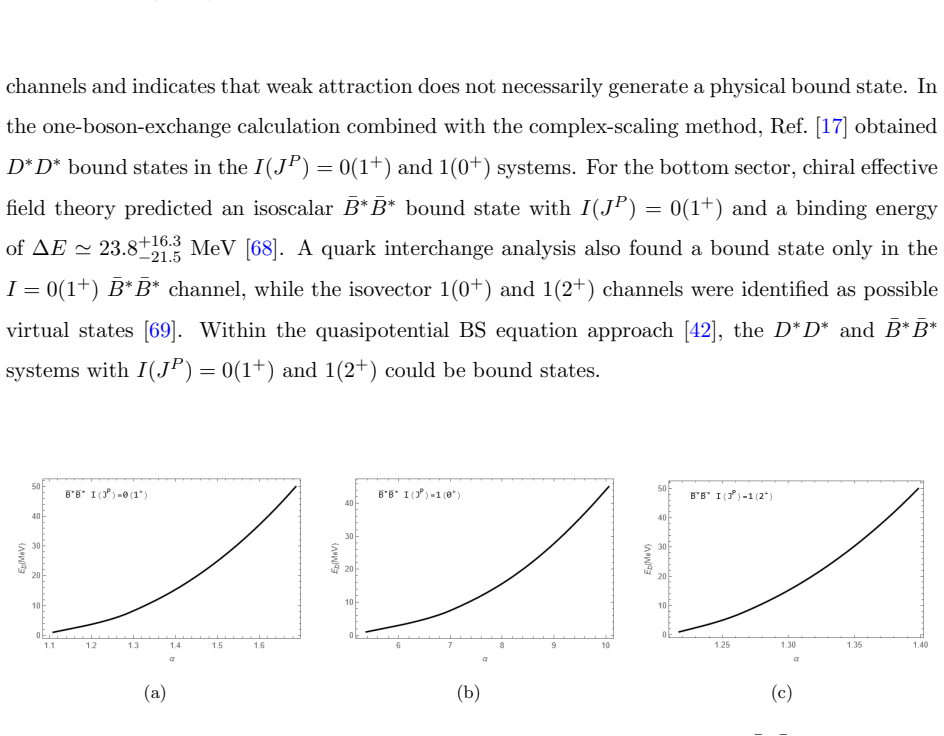
The paper's central claim is that one-boson-exchange dynamics, treated covariantly through the Bethe-Salpeter equation, is strong enough in certain channels to bind pairs of charmed or bottom vector mesons. Specifically, the isoscalar $D^*\bar D^*$ and $B^*\bar B^*$ systems admit $S$-wave bound solutions for $J^{PC}=0^{++}$, $1^{+-}$, and $2^{++}$ once the monopole cutoff is large enough, while the corresponding isovector systems never bind within $\alpha\in[0.5,10]$. For the identical-boson $D^*D^*$ and $\bar B^*\bar B^*$ systems, Bose symmetry leaves the allowed channels $I(J^P)=0(1^+)$, $1(0^+)$, and $1(2^+)$; the first two bind at moderate cutoffs, whereas $1(0^+)$ requires a substantially larger cutoff and is flagged as less reliable. Bottom analogues bind with smaller cutoffs for the same binding energy and are therefore more favorable candidates. Every reported bound state is a solution of a one-dimensional integral equation with eigenvalue unity for binding energies in the range 1 to 50 MeV.
Load-bearing premise
The results stand on the assumption that tuning the single cutoff parameter $\alpha$ over a wide range can stand in for the true short-distance strong interaction; if that interaction differs from the one-boson-exchange form, the predicted bound states could disappear.
Editorial extensions
If this is right
- Isoscalar hidden-heavy channels with $J^{PC}=0^{++}$, $1^{+-}$, and $2^{++}$ are predicted to host $S$-wave molecular states below the $D^*\bar D^*$ and $B^*\bar B^*$ thresholds.
- No isovector $D^*\bar D^*$ or $B^*\bar B^*$ bound states are expected within $\alpha\le 10$, so isovector candidates, if confirmed, would require dynamics beyond this one-boson-exchange kernel.
- In the doubly heavy sector, the $I(J^P)=0(1^+)$ channel is the most favorable molecular configuration, followed by $1(2^+)$, while the $1(0^+)$ state is the least trustworthy because it appears only at large cutoff.
- Bottom-sector analogues require smaller cutoffs than charmed counterparts for the same binding energy, making $B^*\bar B^*$ and $\bar B^*\bar B^*$ channels the most favorable experimental targets.
- Binding energies rise monotonically with $\alpha$, so the model's quantitative masses are regulator dependent; searches should target near-threshold states rather than a single predicted mass.
Reading between the lines
- Beyond the paper, the isoscalar $1^{+-}$ $D^*\bar D^*$ state would complete a heavy-quark spin-symmetry multiplet around $X(3872)$; discovering it would support the molecular picture, while not discovering it would mainly constrain the allowed cutoff range.
- A sharper test of the model would be to compute near-threshold scattering lengths and line shapes, which are more sensitive to the interaction than the existence of a pole.
- A natural extension not pursued here is the inclusion of coupled channels such as $D\bar D$ and $D\bar D^*$ alongside $D^*\bar D^*$; the fragile $1(0^+)$ doubly heavy state may disappear or be stabilized once those channels are added.
- Because bottom states bind at smaller $\alpha$, future searches in the bottom sector are the most cost-effective way to confirm or rule out the predicted molecular spectrum.
Signed reviews
Editorial analysis
A structured set of objections, weighed in public.
Referee Report
Summary. The manuscript studies S-wave molecular bound states in the hidden-heavy systems D*Dbar* and B*Bbar* and in the doubly heavy systems D*D* and Bbar*Bbar* within the Bethe-Salpeter formalism. The authors construct one-boson-exchange kernels (sigma, pi, eta, rho, omega) in the ladder and instantaneous approximations, introduce a monopole form factor with cutoff Lambda = m + alpha Lambda_QCD, reduce the four-dimensional BS equations to one-dimensional eigenvalue problems, and solve them numerically. They report bound-state solutions for the isoscalar hidden-heavy channels with J^PC = 0^{++}, 1^{+-}, and 2^{++}, no isovector solutions in the scanned parameter range, and doubly heavy solutions in I(J^P) = 0(1^+), 1(0^+), and 1(2^+), with the 1(0^+) channel requiring a comparatively large cutoff. The bottom analogues are found to bind at smaller cutoff values because of their larger reduced masses.
Significance. If the results survive the technical issues below, the paper would provide a systematic one-boson-exchange BS survey of the D*/B* vector-meson pair systems and a useful comparison with earlier meson-exchange, EFT, complex-scaling, and lattice studies. The authors deserve credit for being explicit that alpha is not determined from first principles and that large-alpha solutions should be interpreted cautiously; the comparison with the existing literature is broad and helpful, and the enumeration of Bose-allowed quantum numbers for the identical-particle systems is correct. The main barriers are the unsymmetrized kernel for identical bosons, the lack of quantitative cutoff thresholds, and the absence of the reduced equations needed to reproduce the numerical solutions.
major comments (3)
- [Sec. II B, Eqs. (14)-(16)] The doubly heavy sector is not Bose-symmetric as written. For two identical D* or B* mesons, the irreducible two-body kernel in Eq. (14) must be symmetric under particle exchange. Equation (16) contains only t-channel one-boson-exchange diagrams; the crossed u-channel diagrams, obtained by exchanging the final-state momenta and interchanging the vector indices, are neither included nor stated to be negligible. The flavor wave functions in Eq. (3) determine the symmetry of the state, but the kernel itself must also be symmetrized, so that the equation is invariant under p -> -p together with an exchange of the vector indices. As it stands, the solutions shown in Figs. 3 and 4 cannot be identified with physical two-boson bound states, and the conclusion is independent of the regulator alpha. The hidden-heavy sector is unaffected because D* and Dbar* are distinguishable, but the doubly heavy analysis in Secs. III B and IV must be redone with a Bose-symmetrized kernel or with an explicit argument that the u-channel contribution vanishes.
- [Sec. II B, Eq. (18), and Sec. III] The predictive content of the paper is weakened by the fact that alpha is a free scan parameter (0.5 <= alpha <= 10) and that threshold values are not reported. Each claimed bound state appears only above some alpha, and the distinction between 'moderate' and 'substantially large' cutoffs is never quantified. Please add a table, or explicit in-text values, of alpha_min and Lambda_min for every channel shown in Figs. 1-4, and state the criterion used to judge a cutoff as reasonable. Without these numbers, the reader cannot quantitatively compare the present results with the Lambda around 0.5 GeV used in Refs. [15,54,62], and the claim that the bottom systems bind more favorably is not quantitatively testable.
- [Sec. III, paragraph on numerical reduction] The reduction from the four-dimensional BS equation to the one-dimensional integral equations is not shown. The text states that the p_l integration is performed by contour integration and the azimuthal integration analytically, but the resulting projected kernels and the discrete matrix eigenvalue problem are not given. Without these expressions, or a clear pointer to a companion derivation, the numerical solutions in Figs. 1-4 cannot be checked. Please provide an appendix or supplemental material with the reduced equations, the quadrature rule, and a convergence test.
minor comments (5)
- [Sec. II A, around Eq. (8)] The text contains grammatical errors: 'is express in terms' and 'can be express as' should be 'is expressed in terms' and 'can be expressed as'.
- [Sec. III B] The allowed quantum numbers are listed as 'I(JP) = 0(1+), 1(0+) 1(2+)'; a comma is missing between 1(0+) and 1(2+).
- [Sec. IV] The phrase 'the 0(1+) and 1(2+) solutions' is ambiguous; please write 'the I(J^P) = 0(1^+) and I(J^P) = 1(2^+) channels'.
- [Eq. (17)] The text says the Lorentz tensor structures are 'exactly the same' as in Eq. (11); while the same tensor basis is used, the charge-conjugation properties differ between the hidden-heavy J = 1 channel and the doubly heavy J = 1 channel. Please clarify that the identity is at the level of the tensor basis only.
- [Abstract and Conclusion] The phrase 'the bottom systems are bounded more favorably' should be reworded, for example as 'the bottom systems bind more readily' or 'form bound states at smaller cutoff values'.
Circularity Check
No significant circularity: the cutoff α is an openly scanned regulator, not a fitted input; bound-state predictions are conditional and explicitly hedged, and self-citations are methodological only.
full rationale
The paper's central output is a set of BS bound-state solutions obtained by solving Eq. (8)/(14) with tree-level one-boson-exchange kernels (13)/(16) and a monopole form factor (18). The only free parameter α enters through Λ = m + α Λ_QCD and is not fitted to any subset of the predicted bound states; it is scanned over 0.5 ≤ α ≤ 10 "to examine the sensitivity of the bound-state solutions to the regulator." The paper states plainly that α "cannot be determined from first principles within the present framework and is therefore treated as a phenomenological parameter." Thus the existence of a bound state for a given α is a genuine solution of the integral equation, not an identity or a renaming. The honest caveats (e.g., "solutions that require unusually large values of α are strongly regulator dependent and should be interpreted with caution") also preclude the charge that fit-input is being relabeled prediction. Self-citations [59] and [60] are invoked only as methodological precedents for the BS approach, not as external theorems that force the conclusions. The possible omission of u-channel exchange for identical D*D* bosons is a physical/correctness concern, not a circularity: the kernel is not defined in terms of the bound-state output. No equation in the paper reduces by construction to its own input, and no claim rests on a self-citation chain. Accordingly the circularity score is 0.
Assumptions & free parameters
free parameters (1)
- alpha (cutoff parameter) =
varied 0.5 to 10; not fixed
assumptions (4)
- domain assumption Ladder approximation for the BS kernel (only t-channel OBE, no crossed or coupled-channel terms)
- domain assumption Instantaneous approximation: the longitudinal momentum integration is performed by contour integration, effectively neglecting energy transfer dependence
- domain assumption The covariant BS wave function for each J^PC contains only one scalar function (phi, psi, or eta) times a fixed tensor structure
- domain assumption Effective coupling constants are taken from the KSRF relation, vector meson dominance, and chiral symmetry (g_pi=3.73, g_V~5.8, beta~0.9, lambda=0.56 GeV^-1, f_pi=132 MeV)
Cite this review
Pith. "Pith review of Possible Bound States in the $D^\ast\bar D^\ast$/$B^\ast\bar B^\ast$ and $D^\ast D^\ast$/$\bar B^\ast\bar B^\ast$ Systems within the Bethe-Salpeter Formalism." pith.science (2026). https://pith.science/paper/W5XLYF63
@misc{pith2026260803104,
  author       = {Pith},
  title        = {Pith review of: Possible Bound States in the $D^\ast\bar D^\ast$/$B^\ast\bar B^\ast$ and $D^\ast D^\ast$/$\bar B^\ast\bar B^\ast$ Systems within the Bethe-Salpeter Formalism},
  year         = {2026},
  howpublished = {\url{https://pith.science/paper/W5XLYF63}},
  note         = {Machine review of arXiv:2608.03104}
}
abstract
We investigate possible $S$-wave bound states in the $D^\ast\bar D^\ast$, $B^\ast\bar B^\ast$, $D^\ast D^\ast$, and $\bar B^\ast\bar B^\ast$ systems within the Bethe-Salpeter formalism using one-boson-exchange interactions. Bound state solutions are obtained in the isoscalar hidden-heavy systems with $J^{PC}=0^{++}$, $1^{+-}$, and $2^{++}$, whereas no isovector solutions are found within the parameter range considered. For the doubly heavy systems, solutions are obtained in the allowed $I(J^P)=0(1^+)$, $1(0^+)$, and $1(2^+)$ systems, although the $1(0^+)$ solution requires a comparatively large cutoff parameter. The bottom systems are bounded more favorably than their charmed counterparts because of their larger reduced masses.
Figures


Figures from the paper (1 more)
Reference graph
Works this paper leans on
- [42]
- [46]
- [65]
-
[17]
X(3872) as a molecular $D\bar{D}^*$ state in the Bethe-Salpeter equation approach
Z.-Y. Wang, J.-J. Qi, X.-H. Guo, and C. Wang, X(3872) as a molecularD ¯D∗ state in the Bethe-Salpeter equation approach, Phys. Rev. D97, 016015 (2018), arXiv:1710.07424 [hep-ph]
work page Pith review arXiv 2018
-
[68]
N. Pitanga Lachini, C. E. Thomas, and D. J. Wilson (Hadron Spectrum), Coupled-channel scattering of DD, DD*, and D*D* in isospin-1 from lattice QCD, Phys. Rev. D112, 114511 (2025), arXiv:2505.01363 [hep-lat]
arXiv 2025
-
[1]
Gell-Mann, A Schematic Model of Baryons and Mesons, Phys
M. Gell-Mann, A Schematic Model of Baryons and Mesons, Phys. Lett.8, 214 (1964)
1964
-
[2]
Zweig, An SU(3) model for strong interaction symmetry and its breaking
G. Zweig, An SU(3) model for strong interaction symmetry and its breaking. Version 1, (1964)
work page 1964
-
[3]
and are listed in Table II. The only adjustable parameter in the present model isα, which determines the cutoff associated with each exchanged meson through Λ =m+αΛ QCD,Λ QCD = 220 MeV. Althoughαis expected to be of order unity on naturalness grounds, we vary it over the range 0.5≤α≤10 to examine the sensitivity of the bound-state solutions to the regulat...
work page 2010
Show all 70 references
-
[4]
Navaset al.(Particle Data Group), Review of particle physics, Phys
S. Navaset al.(Particle Data Group), Review of particle physics, Phys. Rev. D110, 030001 (2024)
2024
-
[5]
S. K. Choiet al.(Belle), Observation of a narrow charmonium-like state in exclusiveB ± → K ±π+π−J/ψdecays, Phys. Rev. Lett.91, 262001 (2003), arXiv:hep-ex/0309032
2003 arXiv
-
[6]
E. S. Swanson, Short range structure in the X(3872), Phys. Lett. B588, 189 (2004), arXiv:hep- ph/0311229
2004
-
[7]
Y. S. Kalashnikova, Coupled-channel model for charmonium levels and an option for X(3872), Phys. Rev. D72, 034010 (2005), arXiv:hep-ph/0506270
2005 arXiv
-
[8]
Zhang and M.-Q
J.-R. Zhang and M.-Q. Huang, Q anti-qanti-Q-(prime)q molecular states, Phys. Rev. D80, 056004 (2009), arXiv:0906.0090 [hep-ph]
2009 arXiv
-
[9]
X. Chen, B. Wang, X. Li, X. Zeng, S. Yu, and X. Lu, Mass of X (3872) in the relativistic quark model, Phys. Rev. D79, 114006 (2009)
2009
-
[10]
Ding, J.-F
G.-J. Ding, J.-F. Liu, and M.-L. Yan, Dynamics of Hadronic Molecule in One-Boson Exchange Approach and Possible Heavy Flavor Molecules, Phys. Rev. D79, 054005 (2009), arXiv:0901.0426 [hep-ph]
2009 arXiv
-
[11]
Liu and Z.-Y
Y.-R. Liu and Z.-Y. Zhang, X(3872) and the bound state problem ofD 0 ¯D* 0 (anti-D0 D*0) in a chiral quark model, Phys. Rev. C79, 035206 (2009), arXiv:0805.1616 [hep-ph]
2009 arXiv
-
[12]
I. W. Lee, A. Faessler, T. Gutsche, and V. E. Lyubovitskij, X(3872) as a molecular DD* state in a potential model, Phys. Rev. D80, 094005 (2009), arXiv:0910.1009 [hep-ph]
2009 arXiv
-
[13]
F.-K. Guo, C. Hanhart, Y. S. Kalashnikova, U.-G. Meißner, and A. V. Nefediev, What can radiative decays of the X(3872) teach us about its nature?, Phys. Lett. B742, 394 (2015), arXiv:1410.6712 [hep-ph]
2015 arXiv
-
[14]
He, Study of theB ¯B∗/D ¯D∗ bound states in a Bethe-Salpeter approach, Phys
J. He, Study of theB ¯B∗/D ¯D∗ bound states in a Bethe-Salpeter approach, Phys. Rev. D90, 076008 (2014), arXiv:1409.8506 [hep-ph]
2014 arXiv
-
[15]
L. Zhao, L. Ma, and S.-L. Zhu, Spin-orbit force, recoil corrections, and possibleB ¯B∗ andD ¯D∗ molecular states, Phys. Rev. D89, 094026 (2014), arXiv:1403.4043 [hep-ph]. 15
2014 arXiv
-
[16]
F.-K. Guo, C. Hidalgo-Duque, J. Nieves, and M. P. Valderrama, Consequences of Heavy Quark Sym- metries for Hadronic Molecules, Phys. Rev. D88, 054007 (2013), arXiv:1303.6608 [hep-ph]
2013 arXiv
-
[18]
J.-L. Lu, M. Song, P. Wang, J.-Y. Guo, G. Li, and X. Luo, The bound and resonant states ofD (∗)D(∗) andD (∗) ¯D(∗) with the complex scaling method, Eur. Phys. J. C85, 920 (2025), arXiv:2503.05131 [hep-ph]
2025 arXiv
-
[19]
H. Li, C. Shi, Y. Chen, M. Gong, J. Liang, Z. Liu, and W. Sun,X(3872) RelevantD ¯D∗ Scattering in Nf = 2 Lattice QCD, (2024), arXiv:2402.14541 [hep-lat]
2024 arXiv
-
[20]
Wong, Molecular states of heavy quark mesons, Phys
C.-Y. Wong, Molecular states of heavy quark mesons, Phys. Rev. C69, 055202 (2004), arXiv:hep- ph/0311088
2004
-
[21]
Maiani, F
L. Maiani, F. Piccinini, A. D. Polosa, and V. Riquer, Diquark-antidiquarks with hidden or open charm and the nature of X(3872), Phys. Rev. D71, 014028 (2005), arXiv:hep-ph/0412098
2005 arXiv
-
[22]
Ebert, R
D. Ebert, R. N. Faustov, and V. O. Galkin, Masses of heavy tetraquarks in the relativistic quark model, Phys. Lett. B634, 214 (2006), arXiv:hep-ph/0512230
2006 arXiv
-
[23]
M. V. Carlucci, F. Giannuzzi, G. Nardulli, M. Pellicoro, and S. Stramaglia, AdS-QCD quark-antiquark potential, meson spectrum and tetraquarks, Eur. Phys. J. C57, 569 (2008), arXiv:0711.2014 [hep-ph]
2008 arXiv
-
[24]
Vijande, E
J. Vijande, E. Weissman, N. Barnea, and A. Valcarce, Doc¯cn¯nbound states exist?, Phys. Rev. D76, 094022 (2007), arXiv:0708.3285 [hep-ph]
2007 arXiv
-
[25]
Maiani, A
L. Maiani, A. D. Polosa, and V. Riquer, Indications of a Four-Quark Structure for the X(3872) and X(3876) Particles from Recent Belle and BABAR Data, Phys. Rev. Lett.99, 182003 (2007), arXiv:0707.3354 [hep-ph]
2007 arXiv
-
[26]
Dubnicka, A
S. Dubnicka, A. Z. Dubnickova, M. A. Ivanov, and J. G. Korner, Quark model description of the tetraquark state X(3872) in a relativistic constituent quark model with infrared confinement, Phys. Rev. D81, 114007 (2010), arXiv:1004.1291 [hep-ph]
2010 arXiv
-
[27]
Wang and T
Z.-G. Wang and T. Huang, Analysis of theX(3872),Z c(3900) andZ c(3885) as axial-vector tetraquark states with QCD sum rules, Phys. Rev. D89, 054019 (2014), arXiv:1310.2422 [hep-ph]
2014 arXiv
-
[28]
Padmanath, C
M. Padmanath, C. B. Lang, and S. Prelovsek, X(3872) and Y(4140) using diquark-antidiquark operators with lattice QCD, Phys. Rev. D92, 034501 (2015), arXiv:1503.03257 [hep-lat]
2015 arXiv
-
[29]
M. N. Anwar, J. Ferretti, and E. Santopinto, Spectroscopy of the hidden-charm [qc][¯q¯c] and [sc][¯s¯c] tetraquarks in the relativized diquark model, Phys. Rev. D98, 094015 (2018), arXiv:1805.06276 [hep- ph]
2018 arXiv
-
[30]
P. C. Wallbott, G. Eichmann, and C. S. Fischer,X(3872) as a four-quark state in a Dyson- Schwinger/Bethe-Salpeter approach, Phys. Rev. D100, 014033 (2019), arXiv:1905.02615 [hep-ph]
2019 arXiv
-
[31]
Ablikimet al.(BESIII), Observation of a Charged Charmoniumlike Structure ine +e−→π +π−J/ψ at√s=4.26 GeV, Phys
M. Ablikimet al.(BESIII), Observation of a Charged Charmoniumlike Structure ine +e−→π +π−J/ψ at√s=4.26 GeV, Phys. Rev. Lett.110, 252001 (2013), arXiv:1303.5949 [hep-ex]. 16
2013 arXiv
-
[32]
Ablikimet al.(BESIII), Observation of a Charged Charmoniumlike StructureZ c(4020) and Search for theZ c(3900) ine +e−→π +π−hc, Phys
M. Ablikimet al.(BESIII), Observation of a Charged Charmoniumlike StructureZ c(4020) and Search for theZ c(3900) ine +e−→π +π−hc, Phys. Rev. Lett.111, 242001 (2013), arXiv:1309.1896 [hep-ex]
2013 arXiv
-
[33]
Abeet al.(Belle), Observation of a new charmonium state in double charmonium production in e+e− annihilation at√s≈10.6-GeV, Phys
K. Abeet al.(Belle), Observation of a new charmonium state in double charmonium production in e+e− annihilation at√s≈10.6-GeV, Phys. Rev. Lett.98, 082001 (2007), arXiv:hep-ex/0507019
2007 arXiv
-
[34]
Pakhlovet al.(Belle), Production of New Charmoniumlike States ine +e−→J/ψD (∗) ¯D(∗) at √ S≈ 10.6 GeV, Phys
P. Pakhlovet al.(Belle), Production of New Charmoniumlike States ine +e−→J/ψD (∗) ¯D(∗) at √ S≈ 10.6 GeV, Phys. Rev. Lett.100, 202001 (2008), arXiv:0708.3812 [hep-ex]
2008 arXiv
-
[35]
Aaijet al.(LHCb), Observation of an exotic narrow doubly charmed tetraquark, Nature Phys.18, 751 (2022), arXiv:2109.01038 [hep-ex]
R. Aaijet al.(LHCb), Observation of an exotic narrow doubly charmed tetraquark, Nature Phys.18, 751 (2022), arXiv:2109.01038 [hep-ex]
2022
-
[36]
Aaijet al.(LHCb), Study of the doubly charmed tetraquarkT + cc, Nature Commun.13, 3351 (2022), arXiv:2109.01056 [hep-ex]
R. Aaijet al.(LHCb), Study of the doubly charmed tetraquarkT + cc, Nature Commun.13, 3351 (2022), arXiv:2109.01056 [hep-ex]
2022
-
[37]
Bondaret al.(Belle), Observation of two charged bottomonium-like resonances in Y(5S) decays, Phys
A. Bondaret al.(Belle), Observation of two charged bottomonium-like resonances in Y(5S) decays, Phys. Rev. Lett.108, 122001 (2012), arXiv:1110.2251 [hep-ex]
2012 arXiv
-
[38]
Dong, F.-K
X.-K. Dong, F.-K. Guo, and B.-S. Zou, Explaining the Many Threshold Structures in the Heavy-Quark Hadron Spectrum, Phys. Rev. Lett.126, 152001 (2021), arXiv:2011.14517 [hep-ph]
2021 arXiv
-
[39]
H.-X. Chen, W. Chen, X. Liu, and S.-L. Zhu, The hidden-charm pentaquark and tetraquark states, Phys. Rept.639, 1 (2016), arXiv:1601.02092 [hep-ph]
2016 arXiv
-
[40]
F.-K. Guo, C. Hanhart, U.-G. Meißner, Q. Wang, Q. Zhao, and B.-S. Zou, Hadronic molecules, Rev. Mod. Phys.90, 015004 (2018), [Erratum: Rev.Mod.Phys. 94, 029901 (2022)], arXiv:1705.00141 [hep- ph]
2018 arXiv
-
[41]
Brambilla, S
N. Brambilla, S. Eidelman, C. Hanhart, A. Nefediev, C.-P. Shen, C. E. Thomas, A. Vairo, and C.-Z. Yuan, TheXYZstates: experimental and theoretical status and perspectives, Phys. Rept.873, 1 (2020), arXiv:1907.07583 [hep-ex]
2020 arXiv
-
[43]
Ding, H.-Y
Z.-M. Ding, H.-Y. Jiang, and J. He, Molecular states fromD (∗) ¯D(∗)/B(∗) ¯B(∗) andD (∗)D(∗)/ ¯B(∗) ¯B(∗) interactions, Eur. Phys. J. C80, 1179 (2020), arXiv:2011.04980 [hep-ph]
2020 arXiv
-
[44]
Dong, F.-K
X.-K. Dong, F.-K. Guo, and B.-S. Zou, A survey of heavy-antiheavy hadronic molecules, Progr. Phys. 41, 65 (2021), arXiv:2101.01021 [hep-ph]
2021 arXiv
-
[45]
Dong, F.-K
X.-K. Dong, F.-K. Guo, and B.-S. Zou, A survey of heavy–heavy hadronic molecules, Commun. Theor. Phys.73, 125201 (2021), arXiv:2108.02673 [hep-ph]
2021 arXiv
-
[47]
Yalikun, X.-K
N. Yalikun, X.-K. Dong, and U.-G. Meißner, Role of the short-range dynamics in the formation of D(*)D¯(*) and B(*)B¯(*) hadronic molecules, Phys. Rev. D111, 094036 (2025), arXiv:2503.01322 [hep-ph]. 17
2025 arXiv
-
[48]
L. M. Abreu, Production of the X(3872) state via the B0→K*0X(3872) decay, Phys. Rev. D112, 096002 (2025), arXiv:2508.21223 [hep-ph]
2025
-
[49]
Cai, Z.-S
H.-D. Cai, Z.-S. Jia, G. Li, and S.-D. Liu, Hidden charmed decays of X(3872) within the DD¯* molecular framework, Phys. Rev. D111, 114024 (2025), arXiv:2503.20183 [hep-ph]
2025 arXiv
-
[50]
J. M. Dias, T. Ji, X.-K. Dong, F.-K. Guo, C. Hanhart, U.-G. Meißner, Y. Zhang, and Z.-H. Zhang, Dispersive analysis of the isospin breaking in the X(3872)→J/ψπ+π- and X(3872)→J/ψπ+π0π- decays, Phys. Rev. D111, 014031 (2025), arXiv:2409.13245 [hep-ph]
2025 arXiv
-
[51]
Liu, X.-Z
M.-Z. Liu, X.-Z. Ling, and L.-S. Geng, Productions of X(3872)/Zc(3900) and X2(4013)/Zc(4020) in Y(4220) and Y(4360) decays, Phys. Rev. D110, 054035 (2024), arXiv:2404.07681 [hep-ph]
2024 arXiv
-
[52]
Deng and B
J.-C. Deng and B. Wang, Strong decays of the isovector-scalar D*D¯* hadronic molecule, Phys. Rev. D110, 054014 (2024), arXiv:2406.07000 [hep-ph]
2024 arXiv
-
[53]
Wu, M.-Z
Q. Wu, M.-Z. Liu, and L.-S. Geng, Productions of X(3872),Z c(3900),X 2(4013), andZ c(4020) inB (s) decays offer strong clues on their molecular nature, Eur. Phys. J. C84, 147 (2024), arXiv:2304.05269 [hep-ph]
2024 arXiv
-
[54]
X.-Y. Wang, G. Li, C.-S. An, and J.-J. Xie, Radiative decays of the neutral Zc(3900) and Zc(4020), Phys. Rev. D106, 074026 (2022), arXiv:2210.06783 [hep-ph]
2022 arXiv
-
[55]
Nieves and M
J. Nieves and M. P. Valderrama, The Heavy Quark Spin Symmetry Partners of the X(3872), Phys. Rev. D86, 056004 (2012), arXiv:1204.2790 [hep-ph]
2012 arXiv
-
[56]
Hidalgo-Duque, J
C. Hidalgo-Duque, J. Nieves, and M. P. Valderrama, Light flavor and heavy quark spin symmetry in heavy meson molecules, Phys. Rev. D87, 076006 (2013), arXiv:1210.5431 [hep-ph]
2013 arXiv
-
[57]
V. Baru, E. Epelbaum, A. A. Filin, C. Hanhart, U.-G. Meißner, and A. V. Nefediev, Heavy-quark spin symmetry partners of the X (3872) revisited, Phys. Lett. B763, 20 (2016), arXiv:1605.09649 [hep-ph]
2016 arXiv
-
[58]
Zhang, M.-Z
Y. Zhang, M.-Z. Liu, and L.-S. Geng, Productions of Tcc and its SU(3)-flavor symmetry and heavy quark spin symmetry partners in Bc decays, Phys. Rev. D113, 034029 (2026), arXiv:2510.11078 [hep- ph]
2026
-
[59]
Ren, G.-J
Y.-S. Ren, G.-J. Wang, Z. Yang, and J.-J. Wu, Systematic Study of Coupled-Channel Dynamics in Doubly Heavy Hadronic Molecules, (2026), arXiv:2606.01177 [hep-ph]
2026 arXiv
-
[60]
Zhao, Z.-Y
M.-J. Zhao, Z.-Y. Wang, C. Wang, and X.-H. Guo, Investigation of the possible DD¯*/BB¯* and DD*/B¯B¯* bound states, Phys. Rev. D105, 096016 (2022), arXiv:2112.12633 [hep-ph]
2022 arXiv
-
[61]
Qi, Z.-H
J.-J. Qi, Z.-H. Zhang, X.-H. Guo, and Z.-Y. Wang, Possible bound states of heavy baryonium and heavy dibaryon systems, Phys. Rev. D110, 094050 (2024), arXiv:2409.03315 [hep-ph]
2024 arXiv
-
[62]
Ding, Bound States of the Heavy Flavor Vector Mesons and Y(4008) and Z+(1)(4050), Phys
G.-J. Ding, Bound States of the Heavy Flavor Vector Mesons and Y(4008) and Z+(1)(4050), Phys. Rev. D80, 034005 (2009), arXiv:0905.1188 [hep-ph]
2009 arXiv
-
[63]
Liu, Z.-G
X. Liu, Z.-G. Luo, Y.-R. Liu, and S.-L. Zhu, X(3872) and Other Possible Heavy Molecular States, Eur. Phys. J. C61, 411 (2009), arXiv:0808.0073 [hep-ph]
2009 arXiv
-
[64]
Liu and Z.-Y
Y.-R. Liu and Z.-Y. Zhang, The Bound state problem of S-wave heavy quark meson-aitimeson systems, Phys. Rev. C80, 015208 (2009), arXiv:0810.1598 [hep-ph]. 18
2009 arXiv
-
[66]
Sun, Z.-G
Z.-F. Sun, Z.-G. Luo, J. He, X. Liu, and S.-L. Zhu, A note on the B* anti-B, B* anti-B*, D* anti-D, D* anti-D*, molecular states, Chin. Phys. C36, 194 (2012)
2012
-
[67]
L. Qiu, C. Gong, and Q. Zhao, Coupled-channel description of charmed heavy hadronic molecules within the meson-exchange model and its implication, Phys. Rev. D109, 076016 (2024), arXiv:2311.10067 [hep-ph]
2024 arXiv
-
[69]
Wang, Z.-W
B. Wang, Z.-W. Liu, and X. Liu, ¯B(∗) ¯B(∗) interactions in chiral effective field theory, Phys. Rev. D99, 036007 (2019), arXiv:1812.04457 [hep-ph]
2019 arXiv
-
[70]
Yu, Z.-Y
M.-T. Yu, Z.-Y. Zhou, D.-Y. Chen, and Z. Xiao, Possible molecular states inB (∗)B(∗) scatterings, Phys. Rev. D101, 074027 (2020), arXiv:1912.07348 [hep-ph]
2020 arXiv
Reviewed August 15, 2026 · model on record in the stance chip above.
Discussion (0). Continue with ORCID to comment.