REVIEW 3 major objections 4 minor
CROSS: Cascaded Distillation and Dual-Constraint Grounding for Remote Sensing Referring Segmentation
T0 review · 3 major / 4 minor · reviewed 2026-08-06 · deepseek-v4-flash
Pith's one-line read CROSS claims the best published scores on two referring-remote-sensing benchmarks by injecting SAM's geometry into a vision-language encoder and adding contrastive spatial-logic training.
desk verdict Solid empirical gains on RRSIS, but the paper's text-guided mask is likely a constant under standard softmax attention—core mechanism needs a fix. read the letter →
The pith
A machine-rendered reading of the paper's core claim, the machinery that carries it, and where it could break.
The reading
What carries the argument
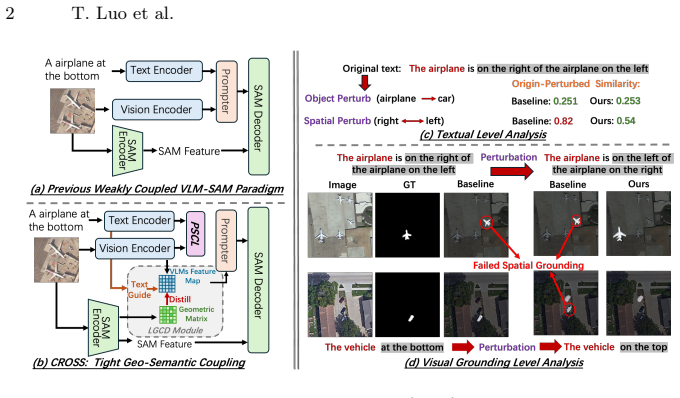
LGCD: a cascade of three residual cross-attention blocks inserted into SigLIP 2, where at each stage the SAM 2 encoder's Gram-matrix affinities $G(S)$ are distilled into the VLM features $G(H_i)$, with each patch pair weighted by a text-guided soft mask $M_{\text{text}}(p)=\frac{1}{L}\sum_j A_i(p,j)$ derived from cross-attention. PSCL: an asymmetric InfoNCE loss whose negatives are top-$K$ background distractors mined under the target mask and counterfactual texts with spatial relations swapped or subject-object order reversed. The combination of relative-affinity (Gram) distillation instead of pixel alignment, and the two hard-negative families, carries the argument.
What would settle it
On RefSegRS, retrain CROSS with the text-guided mask $M_{\text{text}}$ in Eq. (4) replaced by a constant uniform weight across all patches, keeping everything else fixed. If cIoU does not drop materially below the reported 83.25%, or the drop is within noise, then text-guided routing is not doing the causal work the paper claims.
Extended reading notes
Core claim
The central claim is that a tightly coupled VLM-SAM design beats weakly coupled pipelines on referring remote sensing segmentation. At the center of the argument is the transfer of SAM's class-agnostic spatial topology, expressed as Gram matrices of patch affinities, into the VLM's shallow, deep, and final layers. The transfer is weighted by a soft mask built from the VLM's own cross-attention to the referring text, so only linguistically relevant locations are constrained. PSCL then constructs two hard-negative families: background patches that match the text but lie outside the target mask, and rewritten texts with spatial relations reversed, penalized in an InfoNCE objective. On RefSegRS,
Load-bearing premise
LGCD assumes the soft mask built from SigLIP's cross-attention reliably marks the linguistically relevant pixels; if that attention is diffuse or misaligned, the distilled Gram-matrix regularizer will amplify irrelevant patch structure and could erase the precision gains.
Editorial extensions
If this is right
- If the reported results hold, CROSS sets the highest cIoU on RefSegRS (83.25%) and the highest cIoU on RRSIS-D (79.89%) among compared methods, making the two identified bottlenecks actionable design constraints.
- The largest margins appear at Pr@0.8 and Pr@0.9, including a 6.92-point gain at Pr@0.9 on RefSegRS, so the mechanisms mainly improve exact boundary adherence rather than coarse overlap.
- CROSS maintains precise localization under spatial perturbation, a direct corollary of training on spatial counterfactual negatives in PSCL.
- Only about 7.2% of parameters are trainable (106.09 M of 1.455 B), so the reported gains come from auxiliary losses and light adapters rather than large-scale fine-tuning.
- Layer-ablation results suggest the method is insensitive to the exact choice of intermediate layers as long as they span diverse depths, lowering the engineering burden for reproduction.
Reading between the lines
- The text-guided soft mask is the hinge: if SigLIP's cross-attention is not spatially reliable in a given domain, LGCD would amplify structural noise; a natural extension is to test LGCD with attention from a separately trained grounding module.
- Because LGCD transfers relative affinities rather than absolute features, the same distillation could be reused to inject geometric priors from SAM into other CLIP-style encoders or into video referring segmentation.
- The counterfactual text generation via a lightweight LLM is template-based in this paper; on naturally varied spatial language the gain may shrink unless the perturbation distribution is expanded, which is a testable extension.
- The small parameter overhead over RSRefSeg 2 suggests the improvements could transfer to stronger future backbones without redesign.
Editorial analysis
A structured set of objections, weighed in public.
Referee Report
Summary. The paper proposes CROSS for Referring Remote Sensing Image Segmentation (RRSIS), combining a SigLIP2 encoder, a cross-modal prompter, and a SAM2 decoder. Two auxiliary mechanisms are introduced: LGCD, which distills SAM2's patch-affinity Gram matrices into three cascaded SigLIP2 layers under a supposedly text-guided soft mask, and PSCL, which builds an asymmetric InfoNCE loss using GT-mask-mined visual distractors and LLM-generated spatial counterfactual texts. Experiments on RefSegRS and RRSIS-D report cIoU of 83.25% and 79.89%, respectively, with ablations attributing gains to both modules. The paper also provides hyperparameter sensitivity analyses, parameter overhead comparisons, and qualitative robustness examples.
Significance. If the stated mechanism were correct, the cIoU improvements over the strongest baseline RSRefSeg-2 (by +2.01 cIoU on RefSegRS and +0.44 cIoU on RRSIS-D) would be a solid empirical contribution to RRSIS. The paper is well structured, gives component-wise ablations, reports sensitivity over four hyperparameters, and includes a code link. However, the text-guided routing in LGCD degenerates as written (Eq. 4), so the central mechanistic claim is not currently supported. The SOTA claim is also overstated for RRSIS-D, where the method loses on several metrics. The empirical numbers may still be valuable, but the paper needs substantive correction before the claims can be accepted.
major comments (3)
- [Sec. 4.1, Eqs. (4)-(6)] Eq. (4) defines M_text(p) = (1/L) Σ_j A_i(p,j). If A_i is the standard cross-attention weight matrix (softmax over the L text keys), then Σ_j A_i(p,j)=1 for every spatial query p, making M_text(p)=1/L constant over p. Consequently the weight w_{p,q} in Eq. (6) becomes the constant α+(1−α)/L, and the distillation is uniform Gram-matrix matching with no text-guided spatial selectivity. This contradicts the text in Sec. 5.5 describing a 'layer-specific soft mask' that 'conditionally routes only the linguistically relevant topology.' The +0.60 cIoU gain attributed to TGD in Table 3(a) is then not evidence for linguistic guidance. Please clarify whether A_i is post-softmax; if so, replace Eq. (4) with a non-degenerate formulation (e.g., using attention logits or a query-normalized attention) and re-run the TGD ablation, or revise the mechanistic claims accordingly.
- [Abstract / Conclusion / Sec. 5.3, Table 2] The paper claims 'state-of-the-art performance across all evaluation metrics' in the conclusion and says on RRSIS-D that CROSS 'maintains substantial gains' across thresholds. Table 2 shows CROSS loses to RSRefSeg-2 on Pr@0.6 (74.56 vs 75.78), Pr@0.7 (64.80 vs 65.41), and gIoU (68.92 vs 69.17). Sec. 5.3 itself partially acknowledges the gIoU deficit, but the abstract and conclusion do not qualify the SOTA claim. The correct statement is that CROSS achieves the best cIoU on both benchmarks and best Pr@0.5, Pr@0.8, Pr@0.9 on RRSIS-D, not all metrics. Please revise the wording and add a corresponding qualification.
- [Abstract / Sec. 5.5, Fig. 4] The abstract and introduction claim that CROSS 'maintains precise localization even under severe spatial description perturbations.' The only evidence for this is a small set of qualitative examples in Fig. 4; there is no quantitative perturbation protocol, no perturbed test set, and no metric comparing CROSS against baselines under controlled spatial-text changes. Since this robustness property is a headline contribution, please provide a quantitative evaluation (e.g., systematically perturb spatial relations on a held-out set and report cIoU/gIoU) or soften the claim to qualitative observation.
minor comments (4)
- [Sec. 5.3, RRSIS-D paragraph] The phrase 'Filter-Refine-Verify paradigm' appears here but is never defined or introduced. Either define it or remove it.
- [Table 2] The baseline 'RSRefSeg-2' is cited as [3] in the table, but the paper's reference [3] is RSRefSeg and [2] is RSRefSeg 2. Please correct the citation.
- [Sec. 4.2, Eq. (8)] The positive prototype v+ is described as 'aggregated from the target mask prediction,' which is ambiguous. Does this mean the current predicted mask, the ground-truth mask, or a masked visual feature using the ground truth during training? Please specify, since this affects the interpretation of the contrastive objective.
- [Sec. 4.1, Eq. (6)] The set Ω is defined as all N×N location pairs, which for a 512×512 input with patch size 16 gives N=1024 and about 10^6 pairs per stage. Please state explicitly whether all pairs are used or whether subsampling is applied, for reproducibility.
Circularity Check
Text-guided mask in Eq. 4 is constant by construction, nullifying LGCD's claimed linguistic routing
-
self definitional
[Sec. 4.1, Eq. (4) and Eq. (6); ablation in Tab. 3]
"we repurpose the cross-attention matrix A^i as a semantic mask to conditionally route only the linguistically relevant topology. For each spatial location p, the mask M^i_text ∈ R^N is aggregated across all L tokens: M^i_text(p) = 1/L ∑_{j=1}^L A^i(p,j) ... the text-guided soft weight is defined as w^i_{p,q} = α + (1−α)·(M^i_text(p)+M^i_text(q))/2."
Under the standard cross-attention formulation implied by Eq. (3), A^i is row-stochastic: for every visual location p, ∑_j A^i(p,j)=1. Therefore Eq. (4) gives M^i_text(p)=1/L for all p, a spatial constant, and Eq. (6)'s weight w^i_{p,q} reduces to the constant α+(1−α)/L. The 'text-guided' mask thus has no spatial selectivity by construction, so the distillation loss is uniform Gram-matrix matching, not 'conditionally routing only the linguistically relevant topology.' The paper's central LGCD mechanism and its ablation attribution (Tab. 3, +0.60 cIoU from TGD) rest on a text-guided property that is definitionally absent. This is a self-definitional collapse of the claimed mechanism, not merely a tuning concern.
full rationale
The paper's benchmark numbers are not circular in the usual statistical sense: CROSS is trained and evaluated on separate splits, and the SOTA claims are empirical results rather than algebraic consequences of the loss definitions. Self-citations in Related Work and the method description are not load-bearing for the central result. However, the key novelty of LGCD is self-defeating as written. Eq. (4) defines the text-guided mask as an average over the text-key dimension of the cross-attention matrix. With the standard softmax normalization of cross-attention attention weights, each row sums to 1, so the mask is identically 1/L at every spatial position. Consequently, the 'text-guided soft weight' in Eq. (6) is constant, and the distillation term cannot selectively route linguistically relevant topology. The ablation gain attributed to TGD therefore cannot be attributed to the stated text-guided mechanism; at best it reflects unweighted structure transfer. This is a definitional reduction of a central claim, giving partial circularity, while the empirical ranking itself remains independent.
Assumptions & free parameters
free parameters (6)
- lambda1 (distillation loss weight) =
0.5
- lambda2 (PSCL loss weight) =
0.2
- K (top-K visual negatives) =
8
- alpha (soft mask margin) =
0.1
- eta (spatial penalty scaling) =
2
- Cascade layer indices {shallow, deep, final} =
{9,18,27}
assumptions (4)
- domain assumption SAM 2's frozen encoder features encode class-agnostic geometry transferable across domains
- domain assumption SigLIP 2 cross-attention A_i yields a valid text-to-patch relevance mask
- domain assumption LLM-generated spatial counterfactual texts preserve all meaning except the flipped relation
- domain assumption Cosine-similarity Gram alignment transfers topological structure between heterogeneous latent spaces
Cite this review
Pith. "Pith review of CROSS: Cascaded Distillation and Dual-Constraint Grounding for Remote Sensing Referring Segmentation." pith.science (2026). https://pith.science/paper/WPU336TI
@misc{pith2026260803147,
  author       = {Pith},
  title        = {Pith review of: CROSS: Cascaded Distillation and Dual-Constraint Grounding for Remote Sensing Referring Segmentation},
  year         = {2026},
  howpublished = {\url{https://pith.science/paper/WPU336TI}},
  note         = {Machine review of arXiv:2608.03147}
}
read the original abstract
Referring Remote Sensing Image Segmentation (RRSIS) has achieved significant progress through the integration of VLMs and the Segment Anything Model (SAM). However, this progress largely relies on strong pre-trained capabilities, while leaving two fundamental limitations insufficiently addressed: (1) Architectural Weak-Coupling, where the unidirectional flow forces reliance on coarse VLM prompts and wastes SAM's pixel-level structural guidance, causing localization drift; and (2) Object-Centric Semantic Bias, where models overemphasize dominant object semantics while remaining insensitive to spatial reasoning crucial for RRSIS. Motivated by these observations, we propose CROSS, a tightly integrated paradigm for RRSIS. First, we introduce Linguistic-Guided Cascaded Distillation (LGCD) to bridge the architectural gap, which distills SAM's geometric affinities as soft regularizers into VLM intermediate layers, injecting dense structural priors to refine localization. Second, Perspective-Spatial Contrastive Learning (PSCL) imposes cross-anchored constraints by mining mask-filtered deceptive distractors and spatial-linguistic counterfactuals as hard negatives, explicitly shattering semantic shortcuts to enforce genuine logical consistency. Extensive experiments on RRSIS benchmarks demonstrate that CROSS achieves state-of-the-art performance and maintains precise localization even under severe spatial description perturbations, standing as a robust new paradigm for RRSIS.
Figures


Figures from the paper (2 more)


Reviewed August 6, 2026 · model on record in the stance chip above.
Discussion (0). Sign in to comment.